Editorial
The meaning of research as inquiry for discovery and educational improvement
Dolana Mogadime p. 1
Articles
Maladaptive Personality and Neuropsychological Features of Highly Relationally Aggressive Adolescent Girls
Michael Savage, Anne-Marie DiBiase p. 4
The Lived Experiences of Instructors Co-teaching in Higher Education
Jennifer Lock, Tracey Clancy, Rita Lisella, Pat Rosenau, Carla Ferreira and Jacqueline Rainsbury p. 22 Collaboration through knowledge sharing between cooperating teachers and university supervisors Liliane Portelance, Josianne Caron, and Stéphane Martineau p. 36 Doctoral Research Education in Canada: Full-time and Part-time Students’ Access to Research Assistantships
Ewalina Kinga Niemczyk p. 52
Addressing the Teaching of English Language Learners in the United States: A case Study of Teacher
Educators’ Response
Heidi L. Hallman, Hannah R. Meineke p. 68
Entrepreneurship Education in the Caribbean: Learning and Teaching Tools
Paul Pounder p. 83
Book Review
Digital Diversity: Youth, Equity, and Information Technology
The meaning of research as inquiry for discovery and educational
improvement
Dolana Mogadime, Ph.D.
Editor-in-Chief Brock University
The articles in this issue of Brock Education: A Journal of Educational Research and Practice feature innovative educational inquiries that are designed to explore answers to sets of problems that if better understood stand to improve the quality of educational experiences for both students and educators. For example, a theme consistent across the articles is commitment to sustained research inquiry. Albeit within a broad range of educational contexts. Nonetheless these research articles make known the fact that the educational issue they each tackle requires sustained inquiry to arrive at meaningful discovery that makes a difference.
In their coauthored article, Savage and DiBiase highlight the negative psychosocial outcomes highly relationally aggressive female middle school students, so-called ‘mean girls’, face. Using a multistage statistical clustering procedure, the researchers identified a group of highly, yet almost exclusively, relationally aggressive female students. They then compared this group of students to a matched group of non-aggressive female students on a variety of behavioural, social, psychological and personality variables. The authors report that high levels of relational aggression in these female students, even in the absence of physical and verbal aggression, are correlated with numerous maladaptive behaviours, personality patterns and social functioning deficits. Savage and DiBiase discuss the possible interventions for this group of young women but caution a condition that should be met includes recognition on the part of the individual that the intervention is in their best interest. The implications of their research include a call for longitudinal studies to begin in early childhood and continue to adulthood to give an accurate picture regarding the stability of high levels of relational aggression.
According to Lock et al, in the second article of this Brock Education Journal issue, co-teaching holds many positive benefits for instructors in higher education. Supported by
institutional funding for research design based on the Scholarship of Teaching Learning (SoTL) the team of instructors documented their investigation of coteaching a ‘Nurse as Educator’ course, over a period of two years. The notion was the instructors were to model their co-teaching practices so nursing students could apply that understanding to their own co-co-teaching assignment. The train the trainer approach held possibilities for nursing instructors to grow professionally through critical dialogue with their colleagues regarding their own teaching practice. As the coauthors argue, “the strength of co-teaching informs educators’ understanding of their own teaching practice and fosters a rediscovery of their passion for teaching.” The inquiry produced four recommendations for practice and two implications for educational development and administration.
In their coauthored contribution, featured as the third article, Portelance, Caron and Martineau examine collaboration between student teacher trainers, the cooperating teacher, and the
importance of that collaboration that impacts on the quality of training provided. They believe that, “it is vital for both trainers to position themselves as co-trainers of the future teacher and as professionals who work together and support one another. Their comments, suggestions, and questions greatly influence the student’s professional development." Their research is
particularly useful in gaining insight into collaborations that demonstrate commitment toward assisting the student teacher in the development of their professional abilities. They further recommend that action research be instated in the collaborations in order to dialogue between student teacher co-trainers.
Hallman and Meineke’s research article, featured fourth in this issue, is informed by a US based nationwide survey of English language arts teacher educators. The coauthors conducted focus group interviews with a sub-section of the participants in a follow-up to the survey. The purpose of their focused study was to gauge how English language arts teachers view teaching ELLs as part of related disciplinary fields. The inquiry is important because while national census has projected that by 2030 over 40% of the K-12 population in U.S. schools will be children whose first language is not English; teacher education programs have differing views on how best to include ELLs. Some programs include the teaching of ELLs in separate coursework, others believe knowledge about how to teach ELLs should be infused in content areas (e.g. English language arts). Using the work of Nagle (2013) the authors embed a teaching learning framework for effective teaching of ELLs within the questions that form their inquiry as well as the analysis of the data from the focus group interviews. The coauthors align their inquiry with Nagle’s work because it acknowledges the importance of professional development that will enhance teacher educators understanding of teaching ELLs. The findings from their research provides a set of overarching themes regarding teacher educators’ views on teaching ELLs in teacher education programs.
Niemczyk research article is fifth in this issue. It closely examines the three national funding research agencies in Canada; the Social Sciences and Humanities Research Council of Canada (SSHRC), the Natural Sciences and Engineering Research Council of Canada (NSERC), and the Canadian Institutes of Health Research (CIHR) to ascertain how each conceptualizes the role of educational institutions in providing research assistantship opportunities to graduate students as a vehicle for cultivating succeeding generations of new researchers. Niemczyk’s study included semi-structured interviews with three groups of participants—13 doctoral students, five research supervisors, and two administrators and makes known the challenges and constraints embedded within institutional structures that limit part-time students’ access to research assistantships positions relative it full-time graduate students. Niemczyk’s study, “offers quality
recommendations to improve full- and part-time students’ access to RAships within and beyond the program under investigation.” According to Niemczyk, “the findings may help students understand access to RAships, assist academics in hiring research assistants, and inform administrators and academic program committees about possible organizational changes to be made.”
thinking among researchers.
Maladaptive Personality and Neuropsychological Features of Highly
Relationally Aggressive Adolescent Girls
Michael Savage
Brock UniversityAnne-Marie DiBiase
Brock UniversityAbstract
The maladaptive personality and neuropsychological features of highly relationally aggressive females were examined in a group of 30 grade 6, 7, and 8 girls and group-matched controls. Employing a multistage cluster sampling procedure, a group of highly, yet almost exclusively, relationally aggressive females were identified and matched on a number of variables to a group of nonaggressive females. Parents of the students in both groups completed the Coolidge Personality and Neuropsychological Inventory, a 200-item DSM-IV-TR aligned, parent-as-respondent, standardized measure of children’s psychological functioning. It was found that high levels of relational aggression, in the absence of physical and verbal aggression, were associated with symptoms of DSM-IV-TR Axis I oppositional defiant disorder and conduct disorder. The highly relationally aggressive group also exhibited a wide variety of personality traits associated with DSM-IV-TR Axis II paranoid, borderline, narcissistic, histrionic, schizotypal, and passive aggressive personality disorders that were not exhibited by the matched controls. Implications of these findings are discussed.
Keywords: Maladaptive personality, relational aggression, adolescent girls, personality disorder, psychopathology
Michael Savage is an Assistant Professor in the Department of Graduate and Undergraduate Studies in Education at Brock University. Michael is also a clinical and school psychologist whose research interests include mental health and wellness, psychopathology, and assessment. He is interested in supporting the mental health and wellness of children, adolescents and adults in educational settings.
Email: [email protected]
Ann-Marie DiBiase is an Associate Professor in the Department of Graduate and Undergraduate Studies in Education at Brock University. Her research interests include the genetic, environmental and neurobiological underpinnings of behavior, particularly disruptive behavior in children and adolescents. Ann-Marie was instrumental in creating the EQUIP for Educators intervention for children and adolescents who are at-risk for disruptive behavior disorders.
Over the past several years there has been increasing concern over how young females are developing socially and behaviorally (Cote, Zoccolillo, Tremblay, Nagin, & Vitaro, 2001). This concern is reflected in the empirical research being conducted on the negative trajectories of females (e.g., Cote et al., 2001; Moffitt, Caspi, Rutter, & Silva, 2001) as well as in the media attention they have been receiving. The latter has largely been fueled by dramatic and tragic events that have involved adolescent girls, such as the brutal death of Reena Virk (Tafler, 1998). Teachers, juvenile justice workers, and mental health professionals who work with these troubled girls argue that the risk factors, characteristics, and outcomes for disruptive behaviors may differ in males and females (Chamberlain & Reid, 1994). Therefore a better understanding of the sex differences in antisocial behavior should be a priority, especially as they relate to their interpersonal relationships.
Some researchers, such as Crick and Grotpeter (1995), propose that the sex differences in the rates of antisocial behaviors may be explained by males’ propensity to use greater amounts of physical aggression and females' tendency to use relational aggression to express anger or inflict harm. Crick et al. (1999) defined relational aggression as "behaviors that harm others through damage (or the threat of damage) to relationships or feelings of acceptance, friendship or group inclusion" (p. 77). Relational aggression involves interpersonally manipulating others rather than causing bodily harm through physical attacks (Crick & Grotpeter, 1995). Crick, Casas, and Nelson (2002) outlined that these manipulative behaviors include social exclusion, social alienation, rejection, and direct control. Several studies have found that these relationally aggressive behaviors are more commonly found in females than males (Bjorkqvist, Lagerspetz, & Kaukiainen, 1992; Crick & Grotpeter, 1995) and are perceived as more harmful by females than males (Crick, 1995).
A recent study conducted by Salmivalli and Kaukiainen (2004) investigated whether females were more relationally aggressive than males. Their sample included 272 girls and 274 boys from 22 school classes in Finland. The participants were from three grade levels and were aged 10, 12, and 14 years. Salmivalli and Kaukiainen found that girls were generally nonaggressive compared to boys, but that girls who were highly aggressive rarely used all the forms of aggression to any great extent. In fact, Salmivalli and Kaukiainen found a group of highly aggressive females who used relational aggression almost exclusively. This was in direct contrast to highly aggressive males who were found to favor physical and verbal aggression or to employ high levels of all forms of aggression. Salmivalli and Kaukianen did not find any highly aggressive males who almost exclusively used relational aggression. From these findings it appears that there are a group of females in the population who are highly aggressive but who employ relationally aggressive behaviors almost exclusively in order to inflict harm.
Frick, Cornell, Barry, Bodin, and Dane (2003), Marsee, Silverthorn, and Frick (2005), and Essau, Sasagawa, and Frick (2006) found a strong correlation between high levels of relational aggression and callous-unemotional personality traits and antisocial behaviors in females. Interestingly, this relationship was found only in females, not in males. The limitation of these studies is that the researchers used an alternate conception of personality pathology and antisocial behavior than the one used by the diagnostic standard, the DSM-IV-TR (American Psychiatric Association [APA], 2000). As a result, these findings have no diagnostic utility for clinicians, as the callous-unemotional personality traits and antisocial behaviors defined by Frick et al. and Marsee et al. are found scattered throughout numerous DSM-IV-TR Axis I and Axis II diagnostic categories. Specifically, these two studies demonstrate that the study of personality traits, particularly those characteristic of personality pathology, are important for understanding the development of antisocial and aggressive behaviors in females. Thus, it would be particularly salient to examine the association between highly, almost exclusively, relationally aggressive girls with DSM-IV-TR clinical syndromes (Axis I), personality disorders (Axis II), neuropsychological dysfunction, and other psychopathological behaviors so that the association would have some diagnostic utility.
The purpose of this study was to examine the association between females who are highly, yet almost exclusively, relationally aggressive with DSM-IV-TR (APA, 2000) clinical syndromes (Axis I), personality disorders (Axis II), neuropsychological dysfunction, and other clinically relevant psychopathological behaviors. The purpose was initiated in order to ascertain whether females who were highly, almost exclusively, relationally aggressive were manifesting a symptom of underlying psychopathology.
The four research questions this study sought to answer were: (a) Do females who are highly relationally aggressive also exhibit behaviors that are associated with Axis I disorders found in the DSM-IV-TR (APA, 2000); (b) Do these relationally aggressive females have personality traits typically associated with any of the DSM-IV-TR (APA, 2000) personality disorders?; (c) Do highly relationally aggressive females have high levels of neuropsychological behavioral impairment?; (d) Do highly relationally aggressive females exhibit other clinically relevant psychopathological behaviors?
Method Instrumentation
Three instruments were used in this study. The first was the Direct and Indirect Aggression Scales (Bjorkqvist, Lagerspetz, & Osterman, 1992). This is a self- and peer-report instrument that measures physical, verbal, and relational aggression. It consists of 24 items assessed using a 5-point Likert scale, ranging from (0) never to (4) very often. Five items measure physical aggression, 7 items measure verbal aggression, and 12 items measure relational regression. Factor analysis has confirmed the construct validity of the three subscales (Lagerspetz, Bjorkqvist, & Peltonen, 1988; Toldos, 2005). High levels of internal consistency have been found, ranging from 0.80 to 0.96, in subsamples that have used this instrument in a variety of cultural settings (Bjorkqvist et al., 1992; Owens, Daly & Slee, 2005; Salmivalli & Kaukiainen, 2004; Toldos, 2005).
syndromes from DSM-IV-TR (APA, 2000; conduct disorder, oppositional defiant disorder, attention-deficit hyperactivity disorder, depression, general anxiety disorder, separation anxiety disorder, gender identity disorder, anorexia nervosa, and bulimia nervosa), (b) nine personality disorders and their features (avoidant, borderline, dependent, histrionic, narcissistic, obsessive-compulsive, paranoid, schizoid, schizotypal) according to the criteria on Axis II of the DSM-IV-TR, and two personality disorders in its appendix (passive-aggressive and depressive; note that antisocial personality disorder is not assessed by the CPNI because it requires an age of 18 years to be diagnosed), (c) four neuropsychological-behavioral syndromes including mild neurocognitive disorder (in the appendix of DSM-IV-TR), postconcussion disorder, general neuropsychological dysfunction, and executive function deficits (and its three subscales: decision-making, metacognitions, and social judgment), and (d) 13 clinical scales: dangerousness, aggression, emotional lability, apathy, paranoia, psychotic thinking, emotional coldness, social anxiety, social withdrawal, self-esteem problems, sleep disturbances, antisocial triumvirate symptoms, and disinhibition.
The CPNI uses a 4-point Likert scale ranging from (1) strongly false to (4) strongly true. The CPNI normative sample consists of 780 children, aged 5-17 years old. The 11 personality disorder scales have a median internal scale of reliability of 0.67 and a median test-retest reliability of 0.81 (4- to 6-week interval). The nine Axis I scales have a median internal scale reliability of 0.81 and a median test-retest reliability of 0.87. The four neuropsychological scales have a median internal scale reliability of 0.91 and a median test-retest reliability of 0.83. The 13 clinical scales have a median internal scale reliability of 0.64 and a test-retest reliability of 0.70. The general construct validity of the CPNI scales has been demonstrated in a variety of clinical and nonclinical empirical studies (Coolidge, DenBoer, & Segal, 2004; Coolidge, Segal, Stewart, & Ellet, 2000; Coolidge, Thede, & Jang, 2001; Coolidge, Thede, & Jang, 2004). Coolidge, Thede, Stewart, and Segal (2002) provide a summary of the CPNI reliability and construct validity studies.
The final measure used was the Demographic Information Form. It asked for the participants’ birth month and year, grade, and ethnicity. The measure included questions that sought to elicit general socioeconomic status indicators from the parents, including mother’s and father’s highest education level achieved and approximate total annual family income. This measure was used to describe the sample and to provide variables on which to match the targeted and control groups.
Participants and Procedure
This study employed a multistage cluster sampling procedure. In the first phase female students in grade 6, 7, and 8 in 12 elementary schools located in a medium-sized city in southern Ontario, Canada, and their parents were selected to participate in this study. Clearance by Brock University’s Research Ethics Board was obtained prior to recruitment. Once permission was obtained from the school board and each individual principal, the researcher travelled to each site, convened the potential participants, delineated the study to the potential participants, and disseminated letters of information and consent.
staff (the library, an empty classroom, the cafeteria, etc.). At this time they were asked to independently fill out the self-report version of the Direct and Indirect Aggression Scales (Bjorkqvist et al., 1992). The female students used this to evaluate their own behavior when dealing with a conflict with a classmate. The participants were not permitted to talk to each other during the administration of the DIAS, but the researcher read each item aloud to the assembled group and answered any questions they had regarding the items. It took them approximately 10 minutes to fill out the questionnaire. All of their responses were anonymous; they did not indicate their names on the questionnaires.
When the participants had completed the questionnaire they returned the questionnaire to the researcher. The researcher then gave the participant an envelope with a unique number on it. These tracking numbers were used so the researcher could preserve the anonymity of the participants while still being able to match the measures for data analysis.
Included in the envelope the students took home was a copy of the Coolidge Personality and Neuropsychological Inventory (Coolidge, 1998), and the Demographic Information Form. The parents/guardians then filled out both forms, which took them approximately 25 minutes to complete. The responses on both forms were anonymous; the parents did not indicate their names on either form. Once the CPNI and the demographic data forms were filled out they were put into the provided envelope, sealed, and returned to the school. The researcher returned approximately 1 week later to retrieve the envelopes. The researcher then scored the measures and the scores were inputted into SPSS 15.0.
To obtain the final sample, the raw scores from the self-report DIAS measure were converted to standard z-scores. SPSS K-means cluster analysis was performed with the standardized self-reported scores on the three aggression scales as criterion variables for forming the clusters. Five clusters with different aggression profiles were identified. The standardized mean scores on the aggression variables of the participants in each of the five clusters and the number of participants in each cluster are presented in Table 1.
A one-way analysis of variance was conducted in order to ensure the members of each of these clusters differed significantly from each other on self-reported physical [F(4, 360) = 111.511, p = .000], verbal [F(4, 360)= 149.907, p = .000], and relational aggression [F(4, 360)= 200.429, p = .000].
The 30 female students who made up Cluster 1, the highly, almost exclusively, relationally aggressive cluster became the target sample. The target sample consisted of 11 grade 6 students (36.7%), 10 grade 7 students (33.0%) and 9 grade 8 students (30.0%). They ranged in age from 11.4 years to 14.3 years (M = 12.7 years, SD = 0.91 years).
The target sample was then matched for age, grade, school, ethnicity, mother’s highest achieved education level, father’s highest achieved education level, and approximate total annual family income with participants in Cluster 5, the nonaggressive cluster. This became the matched control group. Identical to the target sample, the control group consisted of 11 grade 6 students (36.7%), 10 grade 7 students (33.3%) and 9 grade 8 students (30.0%). They ranged in age from 11.4 years to 14.3 years (M = 12.8 years, SD = 0.89 years).
2-tailed Asymp. Sig. = .952), father’s/male guardian’s education level (Z = .994; 2-tailed Asymp. Sig. = .994), and approximate total annual family income (Z = -.108; 2-tailed Asymp. Sig. = .914).
Results
To examine the symptoms of underlying psychopathology, highly, yet almost exclusively, relationally aggressive females exhibited descriptive and inferential statistics were used. The raw scores on each of the CPNI’s (Coolidge, 1998) 50 scales were converted to standard T scores using the means and standard deviations of the normative sample, as outlined in the CPNI Manual (Coolidge, 1998).
Descriptive statistics in the form of means and standard deviations were calculated for both the relationally aggressive group and the control group on each of the CPNI’s (Coolidge, 1998) scales in order to examine the direction of differences between the two groups.
Clinical (Axis I) Scales
A MANOVA was performed on the six Axis I–Internalizing disorders scales for the main effect of group (relationally aggressive and controls). The MANOVA was not statistically significant, approximate F(6,53) = 1.32, p = 0.265.
A MANOVA was also conducted on the three Axis I–Externalizing disorders scales. The MANOVA was significant, approximate F(3,56) = 16.53, p = 0.001. To examine this further post hoc t tests with a modified Bonferroni correction (Holm, 1979) were conducted. The post hoc tests revealed that scores on the conduct disorder and oppositional defiant disorder scales were significantly elevated in the relationally aggressive group. The effect sizes for these differences were large. The attention deficit/hyperactivity scale was not significant (see Table 2). Inspection of the relationally aggressive group indicated that 20% of the students were clinically elevated, which Coolidge defines as T ≥ 60 (Coolidge, 1998), for the conduct disorder scale, and 60% were clinically elevated for the oppositional defiant disorder scale.
Personality Disorder (Axis II) Scales
A MANOVA was performed on the CPNI’s (Coolidge, 1998) 11 personality disorder scales. The MANOVA was significant, approximate F(11,48) = 6.80, p = 0.001. Post hoc t tests, with the modified Bonferroni correction, revealed that the paranoid personality disorder, borderline personality disorder, schizotypal personality disorder, narcissistic personality disorder, histrionic personality disorder, and passive-aggressive personality disorder scales were significantly different between the two groups (See Table 2).
Neuropsychological Scales
aggressive group and the nonaggressive group (see Table 2).
Other Clinical Scales
A MANOVA was performed on the CPNI’s (Coolidge, 1998) 13 clinical scales. The MANOVA was significant, approximate F(13, 46) = 5.46, p = 0.001. Post hoc t tests with the modified Bonferroni correction revealed that the highly relationally aggressive group was significantly elevated on the emotional coldness, emotionally labile, aggression, apathy, and dangerousness scales (see Table 2).
Discussion
The first research question was concerned with associations between high levels of relational aggression and DSM-IV-TR (APA, 2000) Axis I clinical syndromes. Contrary to findings reported by Werner and Crick (1999), who found relational aggression to be related to increases in self-harm behaviour, affective features of depression, and bulimic symptoms in their female participants, we found no significant differences between the relationally aggressive female students and their nonaggressive peers on measures of internalizing disorders. A possible reason for the discrepancy in findings is that Werner and Crick’s participants were much older than the participants in this sample, as they were all young adults enrolled in a postsecondary institution. It is possible that as they grow older the relationally aggressive females who participated in this study may also develop internalizing problems.
Yet, the highly relationally aggressive group was significantly elevated on symptoms associated with conduct disorder and oppositional defiant disorder compared to the nonaggressive controls in the current study. Furthermore, 20% of the relationally aggressive group were clinically elevated on the conduct disorder scale, and 60% of the relationally aggressive female students were clinically elevated on the oppositional defiant disorder scale. These findings are consistent with previous studies that found highly relationally aggressive females to be more likely to experience externalizing symptoms associated with conduct disorder and oppositional defiant disorder than females who were not as relationally aggressive (Keenan, Coyne, & Lahey, 2008; Prinstein et al., 200l). A key difference between this study and those conducted previously, however, is that this study did not statistically control for physical and verbal aggression but rather only examined female students who were highly, yet almost exclusively, relationally aggressive. This indicates that females whose aggression is almost exclusively relational seem to be at a substantial risk for developing externalizing behaviour problems. High levels of physical and verbal aggression as well as relational aggression are not required for the risk to be present.
examined. What emerged were 20 personality traits that distinguished the highly relationally aggressive group from their nonaggressive peers. Consistent with Werner and Crick (1999), we found that the highly relationally aggressive females exhibited affective instability, anger problems, and a degree of impulsivity, all of which are features of borderline personality disorder.
Similar to previous research (Frick et al., 2003; Marsee & Frick, 2007) we found that the highly relationally aggressive group exhibited traits that have been identified as being characteristic of the psychopathy construct. Such traits include narcissistic traits such as taking advantage of other children, exaggerating abilities and accomplishments, rapidly shifting, shallow emotions, and acting like they are better than others. Moreover, they also include callous-unemotional traits such as hiding emotions or being unemotional and lacking empathy. Furthermore, they include impulsive traits evidenced by not thinking ahead. Consistent with previous findings (Marsee & Frick, 2007; Marsee et al., 2005) this study found that the highly relationally aggressive females exhibited all of the psychopathic traits listed above, while the nonaggressive controls did not.
Frick et al. (2003) and Kruh, Frick, & Clements (2005) have found that psychopathic traits, particularly the callous-unemotional traits, seem to be uniquely associated with a severe pattern of aggression characterized by proactive aggressive acts. In females only, callous-unemotional traits have been found to be associated with high levels of relational aggression and serious delinquent acts (Chamberlain & Moore, 2002; Frick & Marsee, 2006; Frick et al., 2003; Marsee et al., 2005).
The link we found between high levels of relational aggression and psychopathic traits is especially important due to the finding that the presence of psychopathic traits, particularly callous-unemotional traits, seems to designate a distinct developmental pathway in females to serious conduct problems that is associated with a temperamental style characterized by reduced emotional reactivity to the distress of others (Frick, 2007). The fact that high levels of relational aggression, in the absence of high levels of verbal and physical aggression, were found to be associated with a lack of empathy and a general lack of affect (callous-unemotional traits) further supports the importance of relational aggression in studying the development of antisocial tendencies in females.
The third and fourth research questions were concerned with the association between high levels of relational aggression in females and neuropsychological behavioural impairment and other psychopathological behaviours. In the current study the relationally aggressive group was significantly elevated on the postconcussion disorder scale compared to the nonaggressive controls. This finding requires some clarification, however, as further analysis of the individual items that make up the postconcussion disorder scale revealed that the relationally aggressive females were significantly higher than their nonaggressive peers only on items that had to do with regulating emotion such as quickly changing moods, irritability, touchiness, quick temper, and rapidly shifting, shallow emotions.
Taken together these findings appear to indicate that the relationally aggressive group exhibits an emotion regulation deficit, which would imply that their high levels of relational aggression are in reaction to anger due to a perceived provocation or threat. This is consistent with Marsee and Frick (2007), who found in their detained female sample that reactive relational aggression was associated with poorly regulated emotion. Adding further support to this interpretation, in the current study the relationally aggressive students were significantly elevated on the emotionally labile and aggression scales, both of which measure elements of emotional dysregulation, compared to nonaggressive controls. This supports Conway’s (2005) assertion that highly relationally aggressive individuals may feel high levels of distress in relational conflict situations and that they reactively relationally aggress in order to attempt to regulate their emotions.
The difficulty is that this hypothesis is in direct opposition to this study’s finding that the highly relationally aggressive group was significantly higher on the clinical emotional coldness and apathy scales, indicating a pronounced lack of empathy, a lack of care, and inhibited affect. Previous studies (Chamberlain & Moore, 2002; Frick & Marsee, 2006; Frick et al., 2003; Marsee et al., 2005) have found strong associations between a lack of empathy and inhibited affect (callous-unemotional traits) and relational aggression in females.
One possible explanation for these apparently contradictory findings is that there are two subgroups of highly relationally aggressive females. One subgroup would use relationally aggressive behaviours as a strategy to regulate their emotions. This group would primarily use reactive relational aggression in order to maintain control over their social status and relationships when they felt their position in the social hierarchy was being threatened or when they were angered. They would be the females who exhibited high levels of emotional dysfunction. The other subgroup would use high levels of relational aggression more proactively in order to achieve social and material gains. These females would be the ones who exhibited a lack of empathy and inhibited affect, the callous-unemotional traits. Marsee and Frick (2007) provide some empirical support for this hypothesis, as they found reactive relational aggression was associated with emotional dysregulation, while proactive relational aggression was associated with callous-unemotional traits and positive outcome expectations for aggression.
Implications for Research, Policy, and Practice
Future research could focus on these potential differences as it is possible that proactive and reactive relational aggression represent unique pathways to antisocial behaviour, each with its own characteristics and outcomes. These two pathways may require drastically different treatment approaches (Marsee & Frick, 2007). For example, treatments for females who engage in more reactive relational aggression perhaps should focus on better emotion regulation and anger management skills. Interventions for the group that proactively use relational aggression could be more effective if they included a component to address these females’ emphatic lack of concern for others. Moreover, the proactively relationally aggressive females would benefit from a cognitive-behavioural component that addressed perceptions of the usefulness of aggression for obtaining their social and material goals. It appears to be very important that before any intervention is undertaken in this group that the proactively relationally aggressive students are convinced it is in their best interest to apply the strategies they are taught; otherwise the intervention will not be effective (Frick, 2007).
exclusively, relationally aggressive females and found them to exhibit a range of symptoms characteristic of DSM-IV-TR (APA, 2000) Axis I and Axis II disorders. Longitudinal studies need to be conducted in order to determine how stable high levels of relational aggression and the maladaptive personality traits and antisocial behaviours associated with them are. These studies should, ideally, begin in early childhood and continue into adulthood in order to give an accurate picture of the stability of these traits and behaviours.
References
American Psychiatric Association. (2000). Diagnostic and statistical manual of mental disorders (4th ed., text rev.). Washington, DC: Author.
Bjorkqvist, K., Lagerspetz, M. J., & Kaukiainen, A. (1992). Do girls manipulate and boys fight? Developmental trends in regard to direct and indirect aggression. Aggressive Behavior, 18, 117-127.
Bjorkqvist, K., Lagerspetz, M. J., & Osterman, K. (1992). The direct and indirect aggression scales. Vasa, Finland: Abo Akademi University, Department of Social Sciences. Chamberlain, P., & Moore, K. J. (2002). Chaos and trauma in the lives of adolescent females
with antisocial behavior and delinquency. In R. Greenwald (Ed.), Trauma and juvenile delinquency: Theory, research, and interventions (pp. 79-108). Binghampton, NY: Haworth.
Chamberlain, P., & Reid, J. B. (1994). Differences in risk factors and adjustment for male and female delinquents in treatment foster care. Journal of Child and Family Studies, 3(1), 23-39.
Conway, A. M. (2005). Girls, aggression, and emotion regulation. American Journal of Orthopsychiatry, 75(2), 334-339.
Coolidge, F. L. (1998). Coolidge personality and neuropsychological inventory for children (CPNI): Manual. Colorado Springs, CO: Author.
Coolidge, F. L., DenBoer, J. W., & Segal, D. L. (2004). Personality and neuropsychological correlates of bullying behavior. Personality and Individual Differences, 36, 1559-1569. Coolidge, F. L., Segal, D. L., Stewart, S. E., & Ellet, J. A. C. (2000). Neuropsychological
dysfunction in children with borderline personality disorder features: A preliminary investigation. Journal of Research in Personality, 34, 554-561.
Coolidge, F. L., Thede, L. L., & Jang, K. L. (2001). Heritability of personality disorders in childhood. Journal of Personality Disorders, 15, 33-40.
Coolidge, F. L., Thede, L. L., & Jang, K. L. (2004). Are personality disorders psychological manifestations of executive function deficits? Bivariate heritability evidence from a twin study. Behavior Genetics, 34, 152-164.
Coolidge, F. L., Thede, L. L., Stewart, S. E., & Segal, D. L. (2002). The Coolidge personality and neuropsychological inventory for children (CPNI): Preliminary psychometric characteristics. Behavior Modification, 26, 550-566.
Cote, S., Zoccollilo, M., Tremblay, R., Nagin, D., & Vitaro, F. (2001). Predicting girls' conduct disorder in adolescence from childhood trajectories of disruptive behaviors. Journal of the American Academy of Child and Adolescent Psychiatry, 40, 678-684.
Crick, N. R. (1995). Relational aggression: The role of intent attributions, feelings of distress, and provocation type. Development and Psychopathology, 7(2), 313-322.
Crick, N. R. (1996). The role of overt aggression, relational aggression, and pro-social behavior in the prediction of children's future social adjustment. Child Development, 67, 2317- 2327.
Crick, N. R., Casas, J. F., & Nelson, D. A. (2002). Toward a more comprehensive understanding of peer maltreatment: Studies of relational victimization. Current Directions in
Psychological Science, 11(3), 98-101.
Crick, N. R., & Grotpeter, J. (1995). Relational aggression, gender, and social-psychological adjustment. Child Development, 66, 710-722.
Markon, K. (1999). Childhood aggression and gender: A new look at an old problem. In D. Bernstein (Ed.), Nebraska symposium on motivation: Gender and motivation (pp. 75-140). Lincoln: University of Nebraska Press.
Essau, C. A., Sasagawa, S., & Frick, P. J. (2006). Callous-unemotional traits in a community sample of adolescents. Assessment, 13(4), 454-469.
Frick, P. J. (2007). Using the construct of psychopathy to understand antisocial and violent youth. In H. Herve & J. C. Yuille (Eds.), The Psychopath: Theory, research and practice (pp. 343-367). Mahwah, NJ: Lawrence Erlbaum Associates.
Frick, P. J., Cornell, A. H., Barry, C. T., Bodin, S. D., & Dane, H. A. (2003). Callous-
unemotional traits and conduct problems in the prediction of conduct problem severity, aggression, and self report of delinquency. Journal of Abnormal Child Psychology, 31, 457-470.
Frick, P. J., & Marsee, M. A. (2006). Psychopathy and developmental pathways to antisocial behavior in youth. In C. J. Patrick (Ed.), Handbook of psychopathy (pp. 353-374). New York: Guilford Press.
Holm, S. (1979). A simple sequentially rejective multiple test procedure. Scandinavian Journal of Statistics, 6, 65–70.
Keenan, K., Coyne, C., & Lahey, B. B. (2008). Should relational aggression be included in the DSM-V? Journal of the American Academy of Child and Adolescent Psychiatry, 47(1), 86-93.
Kruh, I. P., Frick, P. J., & Clements, C. B. (2005). Historical and personality correlates to the violence patterns of juveniles tried as adults. Criminal Justice and Behavior, 32, 69–96. Lagerspetz, K., Bjorkqvist, K., & Peltonen, T. (1988). Is indirect aggression typical of females?
Gender differences in aggressiveness in 11- to 12-year-old children. Aggressive Behavior, 14, 403-414.
Marsee, M. A., & Frick, P. J. (2007). Exploring the cognitive and emotional correlates to proactive and reactive aggression in a sample of detained girls. Journal of Abnormal Child Psychology, 35(6), 969-981.
Marsee, M. A., Silverthorn, P., & Frick, P. J. (2005). The association of psychopathic traits with aggression and delinquency in non-referred boys and girls. Behavioral Sciences and the Law, 23, 803-817.
Moffitt, T. E., Caspi, A., Rutter, M., & Silva, P. A. (2001). Sex differences in antisocial behavior: Findings from the Dunedin longitudinal study. Cambridge: Cambridge University Press.
Owens, L., Daly, A., & Slee, P. (2005). Sex and age differences in victimisation and conflict resolution among adolescents in a south Australian school. Aggressive Behavior, 31(1), 1-12.
Prinstein, M. J., Boergers, J., & Vernberg, E. M. (2001). Overt and relational aggression in adolescents: Social-psychological adjustment of aggressors and victims. Journal of Clinical Child Psychology, 30, 479-491.
Salmivalli, C., & Kaukiainen, A. (2004). 'Female aggression' revisited: Variable- and person- centered approaches to studying gender differences in different types of aggression. Aggressive Behavior, 30(2), 158-163.
Tafler, S. (1998). Who was Reena Virk? Saturday Night Magazine, 4, 17-21.
Appendix A: Table 1
The Aggression Clusters With Their Average Standardized Scores on the Three Aggression Scales
Cluster N Physical Verbal Relational
1.High relational aggression group 30 -.46 -.22 1.54
2. Average aggression group 100 .46 1.22 .94
3. High direct aggression group 7 2.87 1.11 -.30
4. Extreme aggression group 5 3.91 2.22 1.68
Appendix B: Table 2
Means, T Scores, t Values, and Correlation of Effect Size for Relationally Aggressive Group and Nonaggressive Group on the CPNI ** Significant according to modified Bonferroni correction **
r = correlation of effect size; small = 0.100, medium = 0.243, large = 0.371.
T scores T p r**
Relationally aggressive group (SD)
Nonaggressive group (SD)
Axis I – Externalizing
Conduct Disorder 52.7 (9.9) 42.7 (3.5) 5.3 0.001* 0.56
Oppos. Defiant Dis. 60.9 (4.7) 39.8 (7.7) 7.0 0.001* 0.67
ADHD 43.8 (8.4) 40.7 (7.7) 1.5 0.141 0.19
Axis II
Paranoid PD 50.4 (11.5) 42.6 (10.9) 2.7 0.009* 0.33
Borderline PD 47.1 (9.8) 39.0 (10.6) 3.0 0.003* 0.36
Obsessive-compulsive PD 41.4 (11.8) 40.6 (10.1) 0.3 0.776 0.04
Dependent PD 36.4 (10.9) 37.0 (6.9) -0.3 0.779 0.03
Schizotypal PD 48.3 (7.8) 42.9 (6.3) 3.0 0.004* 0.36
Schizoid PD 44.5 (10.3) 42.7 (11.3) 0.6 0.522 0.08
Narcissistic PD 55.1 (12.8) 40.8 (8.0) 5.2 0.001* 0.56
Avoidant PD 40.2 (8.3) 44.4 (9.9) -1.8 0.082 0.08
Passive-aggressive PD 54.1 (10.5) 41.9 (8.0) 5.1 0.001* 0.55
Depressive PD 45.0 (9.7) 43.7 (9.8) 0.5 0.625 0.07
Neuropsychological scales
Mild neurocognitive disorder 42.7 (8.0) 42.2 (8.0) 0.2 0.818 0.03
Postconcussion disorder 53.5 (8.5) 42.8 (9.9) 4.5 0.001* 0.50
Executive function deficits 43.5 (9.4) 40.0 (8.1) 1.6 0.124 0.20
Decision-making problems 39.2 (8.5) 40.9 (8.0) -0.8 0.430 0.10
Metacognitive problems 44.6 (8.5) 41.5 (7.8) 1.4 0.155 0.19
Social Inappropriateness 50.0 (11.2) 39.8 (7.4) 4.1 0.001* 0.47
Neuropsych. Dysfunction 43.0 (8.1) 41.6 (8.0) 0.6 0.525 0.09
Emotional dysfunction 56.5 (9.0) 43.2 (10.4) 5.3 0.001* 0.56
Neurosomatic complaints 46.1 (10.2) 44.5 (8.6) 0.6 0.538 0.08
Language problems 45.7 (7.2) 44.4 (5.0) 0.8 0.400 0.10
Memory difficulties 43.1 (7.9) 41.6 (6.3) 0.8 0.403 0.10
Learning problems 45.7 (6.9) 44.4 (7.8) 0.7 0.516 0.09
Perceptual-motor problems 42.4 (6.4) 42.7 (5.8) -0.2 0.870 0.02
Subcortical problems 44.7 (4.4) 45.3 (4.2) -0.5 0.619 0.07
Delayed maturation 44.2 (3.4) 46.3 (10.5) -1.0 0.430 0.13
Other clinical scales
Emotional coldness 60.7 (16.5) 43.3 (5.5) 5.5 0.001* 0.58
Sleep disturbances 46.9 (9.8) 45.2 (6.7) 0.8 0.429 0.08
Emotionally labile 59.4 (12.5) 43.0 (8.6) 6.0 0.001* 0.61
Disinhibited 46.0 (9.1) 42.5 (6.8) 1.7 0.097 0.21
Aggressive 49.4 (11.0) 35.4 (6.7) 5.9 0.001* 0.36
Apathetic 58.2 (15.2) 43.2 (6.1) 5.0 0.001* 0.54
Paranoid 50.8 (11.3) 45.8 (8.4) 1.9 0.057 0.24
Dangerousness 55.7 (11.8) 38.8 (6.8) 6.8 0.001* 0.66
Antisocial Triumvirate 46.0 (3.1) 45.3 (1.8) 1.0 0.310 0.14
Psychotic thinking 45.5 (6.5) 43.8 (5.6) 1.0 0.309 0.13
Social anxiety 42.1 (8.2) 43.9 (9.3) -0.8 0.429 0.10
Social withdrawal 44.9 (9.7) 43.8 (10.2) 0.4 0.689 0.05
Appendix C: Table 3
Means, T scores, t Values and Correlation of Effect Size for Relationally Aggressive Group and Nonaggressive Group on Significant Individual Items from the CPNI’s Axis II Personality Disorder Scales
T scores t p r*
Relationally aggressive group (SD)
Nonaggressive group (SD)
1. My child takes advantage of other children.
56.0 (10.7) 44.0 (3.8) 5.8 0.001 0.60
2. I think my child
exaggerates her emotions.
54.9 (8.5) 45.1 (9.1) 4.3 0.001 0.49
3. My child pouts and argues. 54.6 (8.0) 45.4 (9.7) 4.0 0.001 0.46
4. My child’s moods change quickly.
53.5 (9.2) 46.5 (9.7) 2.9 0.006 0.35
5. My child seems to exaggerate her abilities and accomplishments.
53.0 (10.5) 47.0 (8.6) 2.4 0.018 0.30
6. My child’s emotions shift rapidly and seem to be shallow.
56.3 (9.7) 43.7 (5.3) 6.2 0.001 0.63
7. My child criticizes or puts down authority figures.
55.1 (10.5) 44.9 (6.2) 4.6 0.001 0.51
8. My child has an anger problem.
54.2 (10.4) 45.8 (7.7) 3.5 0.001 0.42
9. My child uses physical attractiveness to draw attention to herself.
55.5 (9.7) 44.5 (6.7) 5.1 0.001 0.55
10. My child resents, resists, or refuses to do things when asked.
54.6 (9.5) 45.4 (8.3) 4.0 0.001 0.46
11. My child bears grudges for a long time.
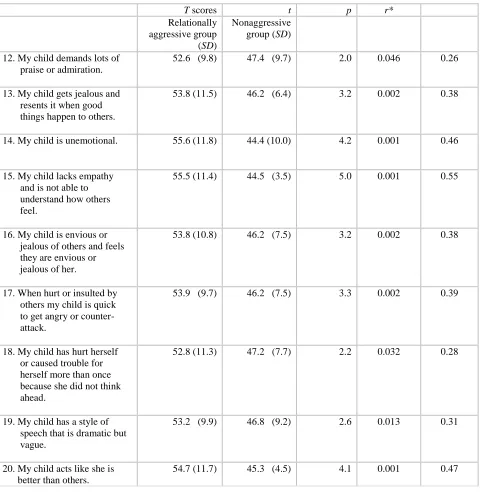
Table 3 Continued
* r = correlation of effect size; small = 0.100, medium = 0.243, large = 0.371.
T scores t p r*
Relationally aggressive group (SD)
Nonaggressive group (SD)
12. My child demands lots of praise or admiration.
52.6 (9.8) 47.4 (9.7) 2.0 0.046 0.26
13. My child gets jealous and resents it when good things happen to others.
53.8 (11.5) 46.2 (6.4) 3.2 0.002 0.38
14. My child is unemotional. 55.6 (11.8) 44.4 (10.0) 4.2 0.001 0.46
15. My child lacks empathy and is not able to understand how others feel.
55.5 (11.4) 44.5 (3.5) 5.0 0.001 0.55
16. My child is envious or jealous of others and feels they are envious or jealous of her.
53.8 (10.8) 46.2 (7.5) 3.2 0.002 0.38
17. When hurt or insulted by others my child is quick to get angry or counter- attack.
53.9 (9.7) 46.2 (7.5) 3.3 0.002 0.39
18. My child has hurt herself or caused trouble for herself more than once because she did not think ahead.
52.8 (11.3) 47.2 (7.7) 2.2 0.032 0.28
19. My child has a style of speech that is dramatic but vague.
53.2 (9.9) 46.8 (9.2) 2.6 0.013 0.31
20. My child acts like she is better than others.
The Lived Experiences of Instructors Co-teaching in Higher
Education
Jennifer Lock Tracey Clancy Rita Lisella Patricia Rosenau Carla Ferreira
Jacqueline Rainsbury
University of Calgary, Alberta (Canada)
Abstract
The strength of co-teaching informs educators’ understanding of their own teaching practice and fosters a rediscovery of their passion for teaching. Instructors bring their skills and competencies to the co-teaching relationship in ways that create an instructional dynamic greater than can be achieved individually. From a qualitative research design, instructors’ focus group interview data were examined with regard to identifying elements that influence successful co-teaching experiences, factors that impact the development and sustainability of the co-teaching relationship, and challenges that need to be addressed to avoid a breakdown in the co-teaching relationship. Drawing on the literature and the data, four recommendations for co-teaching practice are shared. Further, implications for educational development and administrative support are discussed in relation to co-teaching practice in higher education.
Keywords: Co-teaching, higher education, teaching, learning
Jennifer Lock is a Professor and the Associate Dean of Teaching and Learning in the Werklund School of Education at the University of Calgary. Her research is in online learning, ICT integration, change and innovation, and educational development in higher education. Email: [email protected]
Tracey Clancy is an instructor in the Faculty of Nursing at the University of Calgary. Hermaster’s research focused on the phenomenon of uncertainty as an embodied space of transformation for defining clinical teaching practice. Email: [email protected]
Rita Lisella is a retired Instructor in the Faculty of Nursing at the University of Calgary
Patricia Rosenauis a retired Senior Instructor and past Associate Dean of Teaching and Learning in the Faculty of Nursing at the University of Calgary. Pat’s research is focused on reflective practice and peer mentorship in nursing education. Email: [email protected]
Carla Ferreira is an Instructor in the Faculty of Nursing at the University of Calgary. Carla teaches using simulation within the Clinical Simulation Learning Centre within the undergraduate nursing program. [email protected]
In higher education, faculty members are often collaborators in research, but not necessarily collaborators in teaching. Co-teaching that involves simultaneous instruction in one classroom over a semester is not common, as compared to this practice in K-12 educational settings. From the literature (Kerridge, Kyle, & Marks-Maran, 2009; Minardi & Riley, 1991; Shepherd & Ashley, 1979), it is evident that there are advantages to co-teaching that contribute to the richness of the student learning experience. However, studies examining the practice of co-teaching in higher education are in the early stages and often report on reflective accounts by faculty members (Seymour & Seymour, 2013).
The purpose of this article is to identify and examine factors that influence the dynamic nature of the co-teaching relationship from the experience of three instructors within a professional program in higher education. The article begins with a critical review of the literature to examine the nature of co-teaching in higher education and its advantages, challenges, and strategies. A description of the research design and findings are shared with regard to three instructors’ experiences and insights into co-teaching with each other through three iterations of an undergraduate nursing course. In conclusion, by drawing on the findings and the literature, four recommendations for practice are offered to foster the pedagogical relationship among instructors who are assigned to co-teach. The article concludes with a discussion of two implications for educational development and administration.
Defining Co-teaching
There are various ways to define co-teaching. Sometimes it is referred to as team teaching or teaming. Co-teaching according to Wenzlaff et al. (2002) is described as “two or more individuals who come together in a collaborative relationship for the purpose of shared work…for the outcome of achieving what none could have done alone” (p. 14). Within teacher education, Heck, Bacharach, and Dahlberg (2008) defined co-teaching as the cooperating teacher and student teacher in which the two “collaboratively plan and deliver instruction” (p. 1). In this relationship, at the beginning the cooperating teacher makes explicit the instructional decisions, and over time this instructional pair “seamlessly alternate between assisting and/or leading the planning, teaching and evaluation” (p. 1). This co-teaching relationship involves a transition of power and a change in roles that occurs over time rather than being mutual between the two people.
The following are six types or approaches of co-teaching practice that is both responsive to student learning needs and fosters purposeful instruction:
1. One teach, one observe - Instructors determine what information is to be gathered through observation, one observes and the other teaches, and together they analyze this information.
2. Station teaching - Each teacher has specific content to be taught to one group and then repeats teaching the content to the second group. The third station is where students work on their own.
4. Alternative teaching - One instructor is responsible for teaching a large group and the other works with a small group of students for such purpose as enrichment or additional support. 5. Teaming - Both instructors are involved in delivering the same content to a group of students through lecturing and providing opposing perspectives in debate or two processes for problem solving.
6. One teach, one assist - One instructor has the responsibility to teach the large group while the other provides individual assistance in the classroom. (Friend, Cook, Hurley-Chamberlain, & Thrasher Shamberger, 2010)
For the purpose of this article, co-teaching is defined as two instructors who team teach by providing simultaneous instruction to a large group of students in a course over a period of time (e.g., a semester). Both instructors mutually engage in a collaborative relationship involved in simultaneous planning, instruction, and assessment throughout the instructional time. A key component is the intentionality and purposefulness in the creation of the co-teaching relationship. Co-teaching relationships are not simple and “[i]t cannot be assumed that co-teaching or team teaching relationships occur naturally or evolve in a healthy manner” (Clancy, Rosenau, Ferreira, Lock, & Rainsbury, 2015, p. 73). According to Yanamandram and Noble (2005), successful co-teaching collaboration requires an investment of time and effort. Co-co-teaching, according to Rytivaara and Kershner (2012) is “a genuinely peer-learning relationship in which communication shifts between different contexts within and beyond the classroom” (p. 1001). Adding to this, Laughlin, Nelson, and Donaldson (2011) argued that co-teaching is more than pairing two instructors together. Rather, they believed successful co-teaching requires “careful preparation” (p. 12). At the heart of this definition, co-teaching is about developing a relationship in which two instructors react and respond to each other and to the class. In effective co-taught lessons, there is
an invisible flow of instruction with no prescribed division of authority. Both teachers are actively involved in the lesson. From the students’ perspective, there is no clearly defined leader – both share the instruction, are free to interject information, and available to assist students and answer questions. (Bacharach, Heck, & Dahlberg, 2008, p. 11)
Rationale for Co-teaching in Higher Education
successes and challenges based on their shared experiences. Another advantage within an interdisciplinary instructional context, co-teachers are able to “learn about lesser-known fields and thereby grow intellectually” (p. 15). This provides an opportunity to learn discipline knowledge while sharing the teaching experience.
Co-teaching also provides an opportunity for instructors to model best practices of this approach to teaching to each other and to their students. Harris and Harvey (2000) recommended that co-teaching in higher education create opportunities for modeling different approaches to teaching, as well as how to respond to tensions and conflict that may arise in the classroom. From their research of pre-service teachers, Stang and Lyons (2008) found that all students in their study acknowledged the value to learning through observing co-teaching. Further, Plank (2011) argued that students observing “their teachers learn from each other and even disagree with each other models for students how scholars and informed citizens within a community of learning can navigate a complex and uncertain world” (p. 5). This modeling helps students to develop an appreciation for collaboration and the nature of negotiation in collaborative relationships that form part of their professional workplace context.
Co-teaching provides a professional learning opportunity for the instructors. From their study, Bacharach et al. (2008) reported co-teaching experience supported the utilization of different teaching strategies, enhanced their teaching practice, allowed co-instructors to be more reflective with regard to their teaching given the required negotiation of decisions with each other, and the “co-teaching experience provided an energizing opportunity for faculty to renew their passion for their profession” (p. 15). It also provides a forum for their own educational development. According to Ferguson and Wilson (2011) co-teaching provides instructors with opportunities for professional growth and development, and at the same time offers students various instructional strategies, along with different alignments of teaching philosophies in practice “
If higher education embraces more co-teaching, then careful consideration needs to be given to preparing instructors for this experience. It cannot be assumed that co-teaching is the same as teaching on one’s own. Co-teaching, as noted by Plank (2011), involves “messiness” that “moves beyond the familiar and predictable and creates an environment of uncertainty, dialogue, and discovery” (p. 3). In part, this messiness arises from instructors’ underlying cultural differences as well as their different approaches to work ethic, organizational skills and problem-solving perspectives (Ploessl, Rock, Schoenfeld, & Blanks, 2010). Expectations and assumptions need to be checked and managed by the instructors. There is a mindfulness both in going into the relationship and developing a healthy rapport, as well as in the maintenance of a co-teaching relationship that positively impacts student learning.
Context and Design of the Study
Funded through a university scholarship of teaching and learning (SoTL) grant, a two-year mixed methods study (Creswell, 2012) was conducted to investigate co-teaching in a Nurse as Educator course within a Bachelor of Nursing program. A major component of the research was to investigate the benefits and challenges of co-teaching in higher education. Both students and instructors in the course were invited to participate in the study. The study involved the following data collection: pre- and post-student surveys, end-of-semester and four month later individual interviews with students, artifacts of student learning (philosophy statement and reflection on peer teaching) and focus group interviews with instructors. Given the focus of this article is on instructors’ experiences and insights into co-teaching, only the qualitative findings from the study’s focus group interviews with the three instructors are shared and discussed. Other data from the larger mixed methods study are reported elsewhere.
The Nurse as Educator was a senior-level course designed to engage nursing students in exploring principles of teaching and learning in relation to the development of their nursing practice. The course was taught in the final year of the four-year program. A critical element of the course was for nursing students to observe the co-teaching role modeling provided by their instructors. It was hoped that such demonstration of practice would provide an example for students to follow in their co-teaching assignment and in their future professional practice. The co-teaching assignment involved students working in pairs to plan a three-hour nursing lab and then to co-teach the lesson to their junior peers.
From 2014 to 2015, this course was co-taught three times and involved three instructors (n=3) with various experience teaching this course. One instructor taught all three sections and had taught it previously with a fourth instructor. The second instructor taught with the first instructor twice and had co-taught the course once before. The third instructor taught the course once with the first instructor and during the study this was the second time she had co-taught the course. The rationale for using a focus group interview was to provide an opportunity for the instructors to engage in a guided conversation regarding their co-teaching practice. As each responded to questions, there was additional reciprocal elaboration. Often one instructor’s response would initiate further discussion on the topic. The two focus group interviews, which were 25 to 30 minutes in length, were conducted by a lead faculty member of the research team, who was not an instructor nor a member of the Faculty in which the course was taught.
Two instructors participated in each focus group interview. The focus groups occurred at the end of the first two times the course was taught. This provided an opportunity for the second and third instructors to be interviewed once and the first instructor participated in both focus group interviews. During the interviews, the instructors were asked to define co-teaching and its attributes, to describe the process of how the co-teaching unfolded in the course identify strengths in modelling a co-teaching approach, and also to share the challenges of co-teaching.
In the second cycle, it provided “a way of grouping those summaries into a smaller number categories, themes, or constructs” (p. 86). Through this analysis process, the pattern codes included 1) “[c]ategories or themes”; 2) “[c]auses/explanations”; and 3) “[r]elationships among people” (p. 87). Following the second cycle, member checking occurred when the instructors reviewed the coded data.The analysis were reviewed by all members of the research team, which also included three instructors and an independent research associate.
Discussion of the Findings
Five themes emerge from the focus group interview data from the instructors. First, the instructors identify key elements of co-teaching. Second, we explore how previous professional relationships impact on the development of the co-teaching relationship. Third, we examine attributes of what is required to nurture a collaborative pedagogical relationship. Fourth, the instructors share insights into what they learned with and from each other through the co-teaching experience. Fifth, challenges to co-teaching are identified and discussed in terms of how to address these issues.
Elements of co-teaching. From the two focus-group interviews, the instructors (n=3) were asked to provide three words or phrases that capture what is at the heart of their co-teaching. They shared such elements as trust, respect, self-respect, mutuality, and collaboration. In terms of trust, they reported how they trusted the knowledge they brought to the lesson, as well as how they brought it to life in relationship with the students and their learning. It was not a matter of rehearsing or second guessing each other’s responses or movements. Rather, the dynamic is fluid (Barcharah et al., 2008; Rytivaara & Kershner, 2012). This notion of fluidity is supported by having both instructors in the room simultaneously. In cultivating the sense of relationship in the classroom, there is no substitute for time. When students are new to the instructors, they need to learn to trust the co-teaching approach, to trust the experience, and then become active members of the learning community.
One instructor spoke of the need to trust oneself but also to trust the other person. As technical as an instructor is in the planning, the experience of how it is lived out cannot be anticipated. The co-instructors have to appreciate and embrace the uniqueness of each co-teaching moment. There is no re-creation, given the nature of co-teaching. There are elements that make it unique. It is the matter of being in the moment and responding well to the given experience. As noted by another instructor, “you have to authentically know who you are. You have to value that … you have to be willing to enter into that relationship and share all of those pieces of yourself with somebody else and allow them to be authentic and trust you.”
Another element they acknowledged was “openness to vulnerability.” In co-teaching, their planning, instruction and assessment are in a public space where they are negotiating decisions, observations and interactions with each other and providing feedback. They needed to trust in each other. Here is how one instructor described her insight into vulnerability: