VOLUME 36, ARTICLE 62, PAGES 1889
,
1916
PUBLISHED 28 JUNE 2017
http://www.demographic-research.org/Volumes/Vol36/62/ DOI: 10.4054/DemRes.2017.36.62
Research Article
The timing of parenthood and its effect on social
contact and support
Jesper J. Rözer
Anne-Rigt Poortman
Gerald Mollenhorst
© 2017 Jesper J. Rözer, Anne-Rigt Poortman & Gerald Mollenhorst.
This open-access work is published under the terms of the Creative Commons Attribution NonCommercial License 2.0 Germany, which permits use, reproduction & distribution in any medium for non-commercial purposes, provided the original author(s) and source are given credit.
1 Introduction 1890
2 Theory and hypotheses 1891
2.1 The transition to parenthood and changes in personal networks 1892 2.2 Changes in people’s personal network as their first child grows up 1894 2.3 Differences between men and women 1896
3 Data and measurements 1896
3.1 The Swiss Household Panel study 1896
3.2 Measurements 1897
3.3 Analytic strategy 1900
4 Results 1902
5 Conclusion 1906
References 1909
The timing of parenthood and its effect on social contact and support
Jesper J. Rözer1
Anne-Rigt Poortman2
Gerald Mollenhorst3
Abstract
OBJECTIVE
The objective of this study is to investigate how the timing of parenthood affects social contacts and support.
METHODS
Fixed effects models on 12 waves of the Swiss Household Panel (1999−2010) are used to analyse how social relationships with relatives, friends, and neighbours change after people have children and how these changes depend on the timing of parenthood.
RESULTS
The models show that parenthood increases contact with neighbours and decreases contact with friends. However, there are differences based on whether parenthood is early, on time, or late, and based on gender. The earlier men and women have children, the harder it is to keep in contact with friends and to establish contact with neighbours. Later in life the differences between early, ‘on-time’, and late parents tend to decline, except for contact with friends, for fathers.
CONCLUSIONS
We conclude that the timing of parenthood has a substantial impact on how people’s social networks change, especially shortly after they become parents.
CONTRIBUTION
With this study, we show that the timing of parenthood moderates people’s network changes after they become parents.
1 Department of Sociology/ICS, Amsterdam University, the Netherlands. E-Mail:[email protected]. 2 Department of Sociology/ICS, Utrecht University, the Netherlands.
1. Introduction
The average age of first childbirth is rising worldwide, and as a result the timing of parenthood has gained increasing attention from demographers and family researchers (Cherlin 2010; Taylor et al. 2010; Burkimsher 2015). The demographic, sociopsychological, and economic implications of the timing of parenthood are well known. For instance, postponed childbirth is associated with more involuntary childlessness, smaller families, more complications at birth for both mothers and children, and socioeconomic advantages such as better job prospects (Abele and Spurk 2011; Mills et al. 2011; Balbo, Billari, and Mills 2011; Schmidt et al. 2012; Weinschenker 2015). Although the emotional and physical support social contacts can offer – such as shared advice or babysitting − is critical for the well-being of parents and their children (e.g., Bost et al. 2002; Armstrong, Birnie-Lefcovitch, and Ungar 2005; Nelson, Kushlev, and Lyubomirsky 2014), we know little about the impact of the timing of parenthood on people’s social contacts and the support they receive from them – in short, their personal network.
Previous studies have shown that personal networks affect people’s fertility and birth timing (e.g., Balbo and Barban 2014; Bernardi and Klärner 2014; Lois 2016) and that parenthood changes people’s personal networks (e.g., Moore 1990; Munch, McPherson, and Smith-Lovin 1997; Kalmijn 2012; Song 2012; Rözer, Mollenhorst, and Poortman 2016). However, we do not know how the timing of birth moderates network changes after people become parents. Because the experiences of parenthood depend on the timing of births, network changes after becoming a parent may also vary between those who become parents earlier or later than their peers. Particularly for parents that have their first child relatively early, parenthood is depicted as difficult and time- and energy-consuming (Booth and Rustenbach 2008; Umberson, Pudrovska, and Reczek 2010). As a result, early parents might have less time for friendships and seek additional support from people who are able and willing to help them, such as family members or neighbours. Although late parenthood might be less stressful – for instance, because late parents often have more financial resources and life experience – being older than most of their peers and neighbours with children may make it more difficult to establish contact with them.
same direction after parenthood. However, the differential effects of network size, frequency of contact, and amount of support are discussed where applicable. We consider men and women to be ‘on-time’ with parenthood when they have a child in the age range in which the majority of people have a child. Men and women who have a child earlier or later are ‘off-time’ and are considered as being either early or late with parenthood. We examine both the immediate impact of the timing of parenthood and how this impact changes as children grow older. Empirically, we build on a recent study by Kalmijn (2012), who examines the consequences of marital status and parenthood for social networks. Employing the same dataset, the Swiss Household Panel (SHP), we extend the research of Kalmijn (2012) by focusing on the timing of parenthood.
2. Theory and hypotheses
Because the birth of a child drastically changes people’s roles, daily activities, and lifestyle, childbearing is considered a critical life stage in the development and maintenance of personal networks (Stueve and Gerson 1977; Bost et al. 2002; Wrzus et al. 2013). To explain how personal networks change with parenthood, both dispositional (or demand side) and structural (or supply side) factors have to be taken into account (Kalmijn 2012). Dispositional factors emphasize people’s own abilities, resources, and choices. They can be captured by the concept of ‘needs’. In certain life phases people have more need for social contact and support, which can alter the amount of social contact they have and the support they receive. Structural factors can be characterized as opportunities and the role of others, or ‘alters’. Above all, the opportunity to meet is needed in order to remain in contact with personal contacts and to make new friends. Moreover, other people must be willing and able to remain or become friends and to provide support (for similar notions, see Kalmijn 2012; Rözer, Mollenhorst, and Poortman 2016).
2.1 The transition to parenthood and changes in personal networks
In general, parents need additional support because of the challenges a newborn creates. Family members, particularly grandparents, are often willing and able to offer this support because of the family bonds that are at play and their experience raising children (Moore 1990; Munch, McPherson, and Smith-Lovin 1997; Deave, Johnson, and Ingram 2008). Neighbours are also often willing and able to help because of their proximity (Moore 1990; Song 2012; Kalmijn 2012). However, the substantial demands of having a child reduce the parents’ time and energy and bind them to their home and family, thereby decreasing their opportunities to see their contacts. Friendships are particularly vulnerable to a loss in contact and might therefore be lost (Munch, McPherson, and Smith-Lovin 1997; Keizer, Dykstra, and Poortman 2010; Rözer, Mollenhorst, and Poortman 2016).
However, early, on-time, and late parents do not experience parenthood in the same way. Although becoming a parent is a period in which all parents can use additional support, early parents may be in particular need of support. An important reason for this is that early parents often have fewer (financial) resources, such as stable living conditions for their children to grow up in. Moreover, when they become parents they often have not yet reached the same level of stability in their identity and in their personal network as older people have. Furthermore, they often have to make several important changes simultaneously, such as finishing their education while learning how to raise a child. In addition, they are often becoming parents in a different period than their peers, which makes it harder to share experiences with them (Settersen and Mayer 1997; Liefbroer and Billari 2010; Van Bavel and Nitsche 2013). By being ‘off-time’ with parenthood they violate important age norms; e.g., that before becoming a parent they should first finish their education, forge a career, or buy a house. This adds to the stress and challenges of becoming a parent. Although these norms in modern, individualized societies are less frequently sanctioned by third parties than in the past, they are often deeply internalized and provide a broad framework that makes life predictable and psychologically manageable (Hagestad and Neugarten 1985; Liefbroer and Billari 2010). Although late parents are often not having children at the same time as their peers, many of their peers already have children and thus have child-rearing experience. In addition, when they become parents they often have had time for personal development, are more mature, have more life experience, more socioeconomic resources, and their jobs and romantic relationships tend to be more stable. These factors might counterbalance the additional stresses of off-time parenthood and violating age norms (Cooney et al. 1993; Mills et al. 2011; Schmidt et al. 2012; Barban 2013; Guedes and Canavarro 2016; Barclay and Myrskylä 2016).
members, friends, and neighbours are able and willing to offer it. There may be enough opportunities for early parents to ask for additional support from their family members because they often (still) live relatively close to their parental home (Vandell et al. 2003; Hank and Buber 2009). In addition, family members are often willing to provide support in times of crisis (e.g., Kahn and Antonucci 1980; Bost et al. 2002). The willingness to provide support is especially strong among relatives because the well-being of not only the parents but also the new-born child is at stake (Rossi and Rossi 1990). (Grand)parents in particular might be eager to play a role in the lives of their children and grandchildren. However, the extent to which family members are able to attend to the needs of early parents is doubtful, as the child’s grandparents tend to still be occupied with their careers and to have little spare time. In this respect, late parents may also be more disadvantaged than on-time parents, because their parents might be relatively old and physical demands could form a barrier to offering support (Hughes et al. 2007; Hank and Buber 2009; Schmidt et al. 2012). Also, late parents often live further away from their family members, which reduces the family members’ availability (Silverstein and Marenco 2001). In addition, when new parents are older the chance that their parents are still alive decreases steeply. Considering these arguments, we formulate the following hypothesis:
Contact with family members increases after becoming a parent, but the probability of this increase is highest for on-time parents, probably smaller for early parents, and smallest in the case of late childbirth (Hypothesis 1).
and on-time parents. In addition, late and on-time parents are likely to meet and to have more peers who already have or will soon have children. As a result they are less likely to differ from their peers and are more likely to have friends with child-rearing experience, which makes it easier to retain and establish friendships. Thus, we can expect the following:
Contact with friends declines after parenthood particularly for early parents, but less for on-time and late parents (Hypothesis 2).
Neighbours are a third potential source of personal contact and, as described above, relationships with neighbours typically become stronger after people become parents (Munch, McPherson, and Smith-Lovin 1997; Kalmijn 2012; Rözer, Mollenhorst, and Poortman 2016). However, it might be difficult for early parents to increase contact with neighbours to the same extent as on-time and late parents. They often live in less desirable and less cohesive neighbourhoods, which complicates their asking neighbours for support (Moffit 2002). Furthermore, their age difference with neighbours that have children may make it difficult to associate with them. Neighbours in particular (compared to friends and family) may not fully approve of early or late parenthood. It might be somewhat easier for late parents to sustain contact with neighbours because parenthood can be less stressful for them than for early parents, allowing them the time and energy to make friends with neighbours. Moreover, it may be easier for late parents to associate with neighbours if becoming a parent coincides with the birth of a neighbour’s second or third child. Thus, we can expect the following:
Contact with neighbours increases after becoming a parent particularly for on-time and late parents but less for early parents (Hypothesis 3).
2.2 Changes in people’s personal network as their first child grows up
create new places where they can sustain those close relationships (Feld 1981). Moreover, economic (dis)advantage early in life may accumulate, which may translate into life-long smaller/larger networks. For example, early parenthood may put early parents at risk of becoming educationally disadvantaged and having poorer economic circumstances later in life because, especially for early parents, taking care of a child can conflict with successfully finishing an education or starting a promising career (e.g., Budig and England 2001; Miller 2011). A combination of these factors may cause the personal networks of early, on-time, and late parents to differ later in life. Based on these arguments we can expect that
Differences in network patterns between early, on-time, and late parents persist or increase over time (Hypothesis 4a).
Differences in network patterns between early, on-time, and late parents decline as children grow older (Hypothesis 4b).
2.3 Differences between men and women
The consequences of parenthood still differ widely for men and women (e.g., Coltrane 2000; Cherlin 2010; Cotter, Hermsen, and Vanneman 2011). In line with traditional gender norms, after having their first child, women are more likely to reduce their working hours to care for it, while men are more likely to increase the hours they work. Because women are often the primary caretakers of children, the effects of becoming a parent can be expected to be stronger for women than for men.
However, recent research shows that network changes after life events are broadly similar for men and women (Kalmijn 2012; Rözer, Mollenhorst, and Volker 2015). This may reflect that gender roles have become more equal over time. Furthermore, parenthood may have a similar effect on the personal networks of men and women because couples share their personal contacts. For instance, when women increase contact with relatives and neighbours after parenthood they may also sustain contact with them on their husband’s behalf. Similar mechanisms may be at play for early, on-time, and late fathers and mothers. Because of these recent findings, we may expect that For men and women the network changes after becoming a parent are (broadly) similar, as is the effect of birth timing(Hypothesis 5). More specifically, we expect that the direction of the effects is similar for men and women; i.e., if there is an increase/decrease in contact with relatives/friends/neighbours for men, this will also be the case for women.
3. Data and measurements
3.1 The Swiss Household Panel study
was included. Information on the household was collected by interviewing a reference person, while individual information was collected by interviewing each household member. Children were interviewed starting at age 14 years. Interviews were conducted using the computer-assisted telephone interviewing (CATI) technique.
There was a relatively high level of attrition in the panel. In 2012, 58% of households from the first sample and 59% from the second sample were still participating (Voorpostel and Lipps 2011). Fortunately, the results of using and not using weights to adjust for attrition rates were similar for many characteristics, including changes in personal networks (Kalmijn 2012). This indicates that the influence of attrition was mild for our study.
We selected respondents who participated in the survey at least twice. For respondents who experienced a follow-up gap of more than three years we included only the first available years, overcoming the problem that changes in personal network through the waves were based on large time gaps. Furthermore, we restricted our sample to cohorts born after 1950 to overcome the impact of the Second World War, in which many women delayed birth, and to ensure that women had access to the pill, which came on the market in 1961 in Switzerland and spread rapidly. After these selections and the list-wise deletion of missing values, we used information on 5,301 respondents, constituting 30,805 person-years.
3.2 Measurements
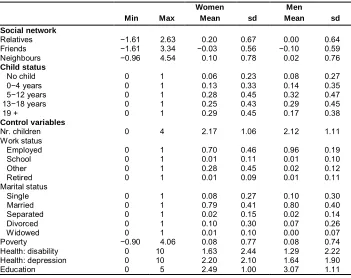
One scale was created to measure people’s personal networks, based on how much contact they had with family, friends, and neighbours.4 To this end, we took the average of three common indicators of personal networks, which we standardized. These indicators involved respondents’ number of personal contacts, frequency of contact with these contacts, and amount of support they could seek from them. We combined these indicators because their results generally pointed in the same direction: if the network size declined/increased, the frequency of contact and support also declined/increased. Furthermore, using one scale greatly simplified the results. Nevertheless, we also analysed differences between network size and frequency of contact, and support and discuss these where applicable. Appendices A and B present these results graphically (the parametric models are available upon request).
First, respondents were asked about the size of their networks, gauged based on questions about the number of family members, friends, and neighbours with whom they were on good terms. We truncated the answers to a maximum of 30 to avoid the influence of outliers. Second, they were asked about the frequency of contact with these family members/friends/neighbours per month. Telephone contacts were explicitly included, but no information was offered as to whether (e)mails counted. No specific answer categories were provided. We truncated the answers to a maximum of 30 to avoid the influence of outliers. Third, the amount of support respondents could request from network members was gauged via two questions, i.e., regarding the extent to which their personal contacts could provide 1) practical support and 2) emotional support (e.g., showing understanding and having conversations). Answering categories ranged from 0 “not at all” to 10 “a great deal”. Answers to these two questions were combined by taking the average before creating the final scale (r=.736 for family members, .807 for friends, and .909 for neighbours). Descriptive statistics of this and other variables are presented in Table 1.
Parental status was measured as being childless, having a child aged 0 to 4 years (and thus being a new parent), having a child aged 5 to 12 years (going to primary school), having a child over the age of 13 years (going to high school), or having a child who had left the parental home.5 These categories enabled us to explore the consequences of becoming a parent and the long-term effects of parenthood, and were created by combining information at the household and the individual level. At the household level, a reference person was asked about the number and age of children within the household, while at the individual level each respondent was asked about the number and age of children they had outside the household.6 In total, 293 women and 265 men became a parent, 457 women and 391 men had a child that had turned 5 years of age, 657 women and 530 men had a child that had turned 13 years of age, and 628 women and 410 men had a child that had turned 19 years of age. In contrast to previous research (e.g., Munch, McPherson, and Smith-Lovin 1997; Kalmijn 2012), we focused on the first child. This allowed us to track the effect of this child on network changes
5 The age of the child changes by approximately 1 point every year. As a result, treating the age of a child as a continuous variable, its interpretation would be similar to including any other variable that changes by 1 point every year, such as a variable that indicates the wave of the survey. It would not allow to distinguish between a parent whose child turns 1 or 12, because in both instances the changes through the waves is 1.
over time (while with each subsequent birth a different child becomes the youngest). We also tracked the influence of the youngest child, which led to very similar results.
Table 1: Descriptive statistics
Women Men
Min Max Mean sd Mean sd
Social network
Relatives −1.61 2.63 0.20 0.67 0.00 0.64
Friends −1.61 3.34 −0.03 0.56 −0.10 0.59
Neighbours −0.96 4.54 0.10 0.78 0.02 0.76
Child status
No child 0 1 0.06 0.23 0.08 0.27
0−4 years 0 1 0.13 0.33 0.14 0.35
5−12 years 0 1 0.28 0.45 0.32 0.47
13−18 years 0 1 0.25 0.43 0.29 0.45
19 + 0 1 0.29 0.45 0.17 0.38
Control variables
Nr. children 0 4 2.17 1.06 2.12 1.11
Work status
Employed 0 1 0.70 0.46 0.96 0.19
School 0 1 0.01 0.11 0.01 0.10
Other 0 1 0.28 0.45 0.02 0.12
Retired 0 1 0.01 0.09 0.01 0.11
Marital status
Single 0 1 0.08 0.27 0.10 0.30
Married 0 1 0.79 0.41 0.80 0.40
Separated 0 1 0.02 0.15 0.02 0.14
Divorced 0 1 0.10 0.30 0.07 0.26
Widowed 0 1 0.01 0.10 0.00 0.07
Poverty −0.90 4.06 0.08 0.77 0.08 0.74
Health: disability 0 10 1.63 2.44 1.29 2.22
Health: depression 0 10 2.20 2.10 1.64 1.90
Education 0 5 2.49 1.00 3.07 1.11
0 500 1000 1500 2000
15 25 35 45 55
F re q u e n c y
Age at first birth
0 500 1000 1500 2000
15 25 35 45 55
F re q u e n c y
Age at first birth
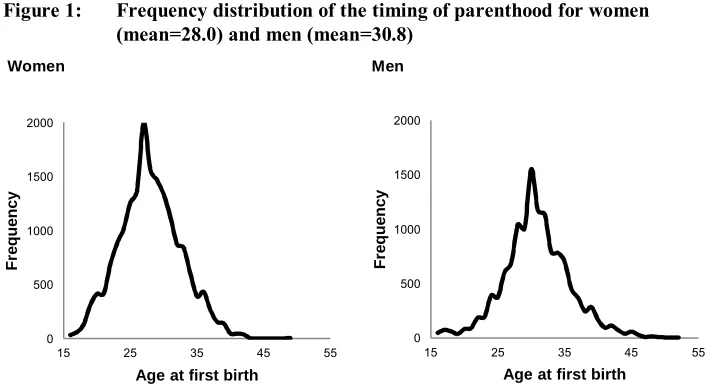
Figure 1: Frequency distribution of the timing of parenthood for women
(mean=28.0) and men (mean=30.8)
Women Men
3.3 Analytic strategy
Linear fixed effects models are used to analyse the data.7 To this end, a person-period file is created in which each respondent can be observed multiple times. Fixed effects models control for the variation between persons, and as a result we examine only within-person variation. Therefore, we focus on the association between the changes in the dependent and independent variables. We control for the average change between the waves by including wave dummies.
To estimate the effect of the timing of parenthood, interactions between time-variant variables and time-intime-variant variables are included in the analyses. We treat the age of the oldest child (e.g., having no child, 0 through 4, 5 through 12) as a time-variant variable whose effect we let vary by the timing of birth, which we treat as a time-invariant variable. Because the timing of birth is treated as a time-invariant variable its main effect does not have to be added to the model when the interaction is included, in contrast to ‘simple’ (e.g., OLS) regression (Allison 2009). We include the timing of birth as a quadratic effect to anticipate possible curvilinear effects. Whether the timing of birth − including its quadratic effects − affects the personal networks, and thus improves the model fit, is tested with a post-estimation test, based on an F-statistic. The timing of birth is mean-centred for men and women, such that the main effects of the age of the child are those for men and women who were ‘on-time’ (i.e., had an average timing of birth).
To simplify interpretations and to give an intuition of the effects for early, on-time, and late parents, graphical representations of the interactions are presented. Although the timing of birth is a continuous variable, in these graphical representations men and women who have a child at the average age are considered ‘on time’, whereas men and women who have their first child 5 years above or below the overall average are considered early and late with parenthood, respectively (which boils down to approximately 1 standard deviation above or below the average).
The respondent’s highest level of education and year of birth are considered as time-invariant variables. To control for these, education and year of birth enter the model in interaction with the wave dummies.
To test our expectations about gender differences, and to ensure that few members of the same household are in the same model, separate models are estimated for men and women. In this way, dependencies between household members in our data are largely ruled out. We present separate models for men and women instead of gender-interaction models because these models imply three-way gender-interactions, which are difficult to interpret. Significant gender interactions are bolded and based on the gender-interaction models.
Before we examine the changes within parents’ personal networks we compare the median number of and median frequency of contact with family, friends and neighbours and the average amount of support that can be asked from family, friends and neighbours, one year before childbirth for early, on-time, and late parents (results not shown but available upon request). In general, early, on-time, and late parents differ little, which implies that changes in the personal network after childbirth are probably caused by the timing of parenthood rather than having a different personal network before childbirth.
4. Results
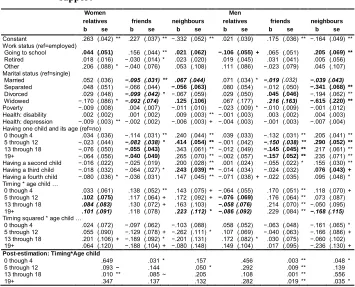
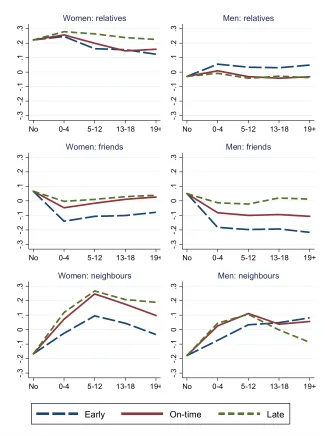
Table 2 presents the outcomes of our fixed effects models. For ease of interpretation, the effects of the timing of birth are graphically displayed in Figure 2. The timing of parenthood is centred, and as a result the main effects for the age of the child represent the effects for people who became parents ‘on time’ (i.e., at the average age). For on-time men and women, the birth of a child has little effect on contact with relatives. Further analyses show that the number of relatives the parent is close to and the support received from relatives declines, but that the frequency of contact increases, particularly for women (see Appendix A and B). Contact with friends declines after the birth of a child, slightly more so for on-time men than on-time women. Whereas women regain contact with their friends when the child gets older, contact with friends remains lower for on-time men than before childbirth, even after the child turns 19. Further analyses show that especially the number of friends declines, and that particularly the frequency of contact with friends – for on-time women from the moment the child turns 5 – increases when the child gets older (see Appendix A and B). Contact with neighbours increases after childbirth both for on-time men and on-time women. Men and women have the most contact with neighbours when their child is approximately between 5 and 12 years old and probably plays in the neighbourhood. Women in particular have contact with neighbours at this time in their life course. Even when the child turns 19 (and leaves the parental home), contact with neighbours remains higher than before childbirth.
parenthood leads to more contact with relatives than early parenthood. Men differ significantly in this respect: the earlier men become fathers, the more contact they have with relatives. However, this effect does not significantly differ from zero, suggesting that whether men have their child on time, late, or early, there is no difference in the effect of parenthood on contact with relatives. Regarding contact with friends, we see that the earlier men and women have children, the greater the losses in contact with friends. These differences between early, late, and on-time parents remain more or less similar as the child grows older, but in the case of men only remain significant when the child turns 19 because the variation within early, on-time, and late parents increases.8 Contact with neighbours also depends on the timing of parenthood. The later one becomes a parent, the greater the increase in contact with neighbours after becoming a parent (or, in the case of women, when the child turns 5, see the post-estimation test). These effects decline as the child grows older, and for men eventually reverse (P-value post-estimation test for men is .035 when the child turns 19).
To sum up, we have to reject Hypothesis 1: the increase in contact with relatives is not smallest for late parents. Instead, there is no significant difference in the increase in contact with relatives after childbirth between early, on-time, and late fathers and mothers. Hypotheses 2 and 3 are corroborated: the earlier men and women have children, the larger the decline in contact with friends and the smaller the increase in contact with neighbours. In line with hypothesis 4b, when the child grows older, the decrease in contact with friends remains greater (and significant according to the post-estimation test) for early than for on-time and late fathers, suggesting that these network patterns persist. Other network patterns, however, decline or become insignificant as the child grows older: contact with neighbours becomes similar between early, on-time, and late fathers when their child is 13 years old, while early mothers’ contacts with neighbours and friends no longer differ significantly from those of on-time and late mothers when the child is 13 and 19-years-old, respectively. This suggests that, in line with Hypothesis 4a, these earlier network patterns decline. However, only the variation between early, on-time, and late mothers increases (as shown by the standard errors), while effect sizes remain strong and comparable to just after becoming a parent, offering some support that these patterns may persist as well. In line with Hypothesis 5, no significant differences between men and women are found in the direction of the effects of becoming a parent, and little in the effect of birth timing. That said, we do see gender differences in the strength of the effects of parenthood. For instance, the decline in friendship after becoming a parent is larger for men than for women.
Table 2: Fixed effects regression for network size, frequency of contact, and support
Women Men
relatives friends neighbours relatives friends neighbours b se b se b se b se b se b se
Constant .263 (.042) ** .227 (.037) ** −.332 (.052) ** .021 (.039) .175 (.036) ** −.164 (.049) **
Work status (ref=employed)
Going to school .044 (.051) .156 (.044) ** .021 (.062) −.106 (.055) + .065 (.051) .205 (.069) **
Retired .018 (.016) −.030 (.014) * .023 (.020) .019 (.045) .031 (.041) .005 (.056)
Other .206 (.088) * −.040 (.076) .053 (.108) .111 (.086) −.023 (.079) .045 (.107)
Marital status (ref=single)
Married .052 (.036) −.095 (.031) ** .067 (.044) .071 (.034) * −.019 (.032) −.039 (.043)
Separated .048 (.051) −.066 (.044) −.056 (.063) .080 (.054) −.012 (.050) −.341 (.068) **
Divorced .029 (.048) −.099 (.042) * −.067 (.059) .029 (.050) .045 (.046) −.194 (.062) **
Widowed −.170 (.086) * −.092 (.074) .125 (.106) .067 (.177) .216 (.163) −.615 (.220) **
Poverty −.009 (.008) .004 (.007) −.011 (.010) −.023 (.009) * −.010 (.009) −.001 (.012)
Health: disability .002 (.002) .001 (.002) .009 (.003) ** −.001 (.003) .003 (.002) .004 (.003)
Health: depression −.009 (.003) ** −.002 (.002) −.006 (.003) + −.004 (.003) −.001 (.003) −.007 (.004)
Having one child and its age (ref=no)
0 though 4 .034 (.036) −.114 (.031) ** .240 (.044) ** .039 (.033) −.132 (.031) ** .205 (.041) **
5 through 12 −.023 (.044) −.082 (.038) * .414 (.054) ** −.001 (.042) −.150 (.038) ** .290 (.052) **
13 through 18 −.076 (.050) −.055 (.043) .343 (.061) ** −.012 (.049) −.145 (.045) ** .217 (.061) **
19+ −.064 (.056) −.040 (.049) .265 (.070) ** −.002 (.057) −.157 (.052) ** .235 (.071) **
Having a second child −.016 (.022) −.025 (.019) .200 (.028) ** .001 (.024) −.055 (.022) * .155 (.030) **
Having a third child −.018 (.032) −.064 (.027) * .243 (.039) ** −.014 (.034) −.024 (.032) .076 (.043) +
Having a fourth child −.080 (.036) * −.036 (.031) .147 (.045) ** −.071 (.038) + −.022 (.035) .095 (.048) *
Timing * age child …
0 though 4 .033 (.061) .138 (.052) ** .143 (.075) + −.064 (.055) .170 (.051) ** .118 (.070) +
5 through 12 .102 (.075) .117 (.064) + .172 (.092) + −.076 (.069) .176 (.064) ** .073 (.087)
13 through 18 .084 (.083) .130 (.072) + .163 (.103) −.058 (.076) .214 (.070) ** −.050 (.095)
19+ .101 (.091) .118 (.078) .223 (.112) * −.086 (.092) .229 (.084) ** −.168 (.115) Timing squared * age child …
0 though 4 .024 (.072) −.097 (.062) −.103 (.088) .058 (.052) −.063 (.048) −.161 (.065) *
5 through 12 .055 (.090) −.129 (.078) + −.262 (.111) * .107 (.069) −.040 (.063) −.166 (.086) +
13 through 18 .201 (.106) + −.189 (.092) * −.201 (.131) .172 (.082) * .030 (.075) −.060 (.102)
19+ .064 (.120) −.188 (.104) + −.080 (.148) .149 (.104) .017 (.095) −.236 (.130) +
Post-estimation: Timing*Age child
0 though 4 .649 .031 * .157 .456 .003 ** .048 *
5 through 12 .093 ~ .144 .050 * .292 .009 ** .139
13 through 18 .010 ** .085 ~ .205 .108 .001 ** .556
19+ .347 .137 .132 .282 .019 ** .035 *
Note: Timing of birth is centred and divided by 10; cohorts born after 1950 selected; Time, Time*edu and Time*cohort fixed effects
are included but not presented; standard errors between brackets; bold: differences between men and women are significant at P<.05, bold and italics: differences between men and women are significant at P<.10. Significance levels: + P<.10, *P<.05, ** P<.01(two-tailed); p-values are presented for the post-estimation tests;
Figure 2: Margins plot of the effect of parenthood on personal network by age of the child, for people who are early, on-time, and late with
parenthood -. 3 -. 2 -. 1 0 .1 .2 .3
No 0-4 5-12 13-18 19+ Women: relatives -. 3 -. 2 -. 1 0 .1 .2 .3
No 0-4 5-12 13-18 19+ Men: relatives -. 3 -. 2 -. 1 0 .1 .2 .3
No 0-4 5-12 13-18 19+ Women: friends -. 3 -. 2 -. 1 0 .1 .2 .3
No 0-4 5-12 13-18 19+ Men: friends -. 3 -. 2 -. 1 0 .1 .2 .3
No 0-4 5-12 13-18 19+ Women: neighbours -. 3 -. 2 -. 1 0 .1 .2 .3
No 0-4 5-12 13-18 19+ Men: neighbours
Finally, we discuss the results of the control variables. Compared to being employed, for women being a homemaker (i.e., the other category) increases contact with relatives and going to school and becoming retired increases contact with friends, while for men going to school increases contact with neighbours. Furthermore, compared to women who remain single, becoming a widow decreases contact with relatives, while marriage and divorce decreases contact with friends. Compared to men who remain single, becoming married increases contact with relatives, and becoming separated, divorced, or widowed decreases contact with neighbours. Becoming poor decreases contact with relatives for men. For women, a disability increases contact with neighbours, while becoming (more) depressed decreases contact with relatives. Having a second, third, and fourth child increases contact with neighbours for both men and women. Furthermore, for women, having a third child leads to a decrease in contact with friends, while having a fourth child decreases contact with relatives. The time fixed effects show that men in later waves were more likely to increase contact with friends than those in earlier waves. Other changes in the network seem to be relatively independent of the period of the survey. The birth cohort*time fixed effects show that men from older cohorts were less likely through the waves to make friends than men from younger cohorts. Finally, the education*time fixed effects show that in most waves, higher-educated women were more likely to increase contact with relatives than lower-educated women, while higher-educated men were less likely to increase contact with relatives and friends but more likely to establish contact with neighbours than lower-educated men.
5. Conclusion
The timing of parenthood has well-known consequences for demographic, sociopsychological, and economic outcomes (e.g., Abele and Spurk 2011; Mills et al. 2011; Schmidt et al. 2012). In this study we explore the impact of the timing of parenthood on personal networks using longitudinal data collected on 5,301 respondents in Switzerland. By focusing on the consequences of the timing of parenthood we refine previous research that has examined the association between personal networks and parenthood per se (e.g., Moore 1990; Munch, McPherson, and Smith-Lovin 1997; Kalmijn 2012; Rözer, Mollenhorst, and Poortman 2016).
who uses the same longitudinal dataset, but it is in contrast to results from cross-sectional research (e.g., Munch, McPherson, and Smith-Lovin 1997; Rözer, Mollenhorst, and Poortman 2016). However, these changes differ between people who are early, ‘on-time’, and late with parenthood, as well as between men and women.
The earlier men and women have children, the harder it is to stay in contact with friends and to establish contact with neighbours. A combination of factors explains this finding. First, parenthood tends to be relatively difficult and time- and energy-consuming for early parents (e.g., Moffit 2002; Taylor 2009; Umberson, Pudrovska, and Reczek 2010; Barban 2013), which reduces the amount of time they can spend with their friends, neighbours, and relatives. Second, early parents are often at the start of their career, have had little time to build up financial resources, and consequently might still rent (or have only recently bought) a house, which complicates establishing (close) contact with neighbours (Moffit 2002). Third, early parents often have friends who are at a stage of life when having children is not yet being considered, making it difficult to sustain friendships, while an age gap between friends and neighbours who have children might hinder becoming friends with them.
When the child grows older, the decrease in contact with friends remains greater for early than for on-time and late fathers, suggesting that these network patterns persist. At the same time, the differences in contact with friends and neighbours between early, on-time, and late mothers decline (or at least become not significant), while they decline for men with respect to contact with neighbours − and eventually even reverse after the child turns 19. This suggests that these earlier (changes in) network patterns decline as children grow older. However, only the variation within early, on-time, and late mothers increases, while effect sizes remain strong, and comparable to just after becoming a parent. Possibly with a larger sample size, and more transitions of parents whose children become adults, these effects become significant, supporting that network patterns persist.
receive could be greater and the stress lower, and the effects could be smaller than we estimated.
References
Abele, A.B. and Spurk, D. (2011). The dual impact of gender and the influence of timing of parenthood on men’s and women’s career development. Journal of Behavioral Development 35(3): 225–232.
Allison, P.D. (2009).Fixed effects regression models. Beverly Hills: Sage.doi:10.4135/ 9781412993869.
Armstrong, M.I., Birnie-Lefcovitch, S., and Ungar, M.T. (2005). Pathways between social support, family well-being, quality of parenting, and child resilience: What we know. Journal of Child and Family Studies 14(2): 269–281. doi:10.1007/s10826-005-5054-4.
Balbo, N. and Barban, N. (2014). Does fertility behavior spread among friends? American Sociological Review 79(3): 412–431. doi:10.1177/0003122414531 596.
Balbo, N., Billari, F.C., and Mills, M. (2011). Fertility in advanced societies: A review of research. European Journal of Population 29(1): 1–38. doi:10.1007/s10680-012-9277-y.
Barban, N. (2013). Family trajectories and health: A life course perspective.European Journal of Population 29(4): 357–385.doi:10.1007/s10680-013-9296-3.
Barclay, K. and Myrskylä, M. (2016). Advanced maternal age and offspring outcomes: Reproductive aging and counterbalancing period trends. Population and Development Review 42(1): 69–94.doi:10.1111/j.1728-4457.2016.00105.x. Bernardi, L. (2003). Channels of social influence on reproduction.Population Research
and Policy Review 22(5): 527–555.doi:10.1023/b:popu.0000020892.15221.44. Bernardi, L. and Klärner, A. (2014). Social networks and fertility. Demographic
Research 30(22): 641–670.doi:10.4054/DemRes.2014.30.22.
Booth, A. and Rustenbach, E. (2008). Early family transitions and depressive symptom changes from adolescence to early adulthood. Journal of Marriage and Family 30(1): 3–14.doi:10.1111/j.1741-3737.2007.00457.x.
Brashears, M.E. (2008). Gender and homophily: Differences in male and female association in Blau space.Social Science Research 37(2): 400–415.doi:10.1016/ j.ssresearch.2007.08.004.
Budig, M.J. and England, P. (2001). The wage penalty for motherhood. American Sociological Review 66(2): 204–225.doi:10.2307/2657415.
Bühler, C. and Philipov, D. (2005). Social capital related to fertility: Theoretical foundations and empirical evidence from Bulgaria. Vienna Yearbook of Population Research 3: 53−81.
Burkimsher, M. (2015). Europe-wide fertility trends since the 1990s: Turning the corner from declining first birth rates. Demographic Research 32(21): 621–656. doi:10.4054/DemRes.2015.32.21.
Cherlin, A.J. (2010). Demographic trends in the United States: A review of research in the 2000s.Journal of Marriage and Family 72(3): 403–419. doi:10.1111/j.1741-3737.2010.00710.x.
Coley, R.L. and Chase-Lansdale, P.L. (1998). Adolescent pregnancy and parenthood. Recent evidence and future directions. American Psychologist 53(2): 152–166. doi:10.1037/0003-066X.53.2.152.
Coltrane, S. (2000). Research on household labor: Modeling and measuring the social embeddedness of routine family work.Journal of Marriage and Family 62(4): 1208–1233.doi:10.1111/j.1741-3737.2000.01208.x.
Cooney, T.M., Pedersen, F.A., Indelicato, S., and Palkovitz, R. (1993). Timing of fatherhood: Is “on-time” optimal?Journal of Marriage and Family 55(1): 205– 215.doi:10.2307/352969.
Cotter, D., Hermsen, J.M., and Vanneman, R. (2011). The end of the gender revolution? Gender role attitudes from 1977 to 2008.American Journal of Sociology 117(1): 259–289.doi:10.1086/658853.
Deave, T., Johnson, D., and Ingram, J. (2008). Transition to parenthood: The needs of parents in pregnancy and early parenthood. BMC Pregnancy and Childbirth 8(30): 1–11.doi:10.1186/1471-2393-8-30.
Feld, S.L. (1981). The focused organization of social ties. American Journal of Sociology 86(5): 1015–1035.doi:10.1086/227352.
Guedes, M. and Canavarro, M.C. (2016). Perceptions of influencing factors and satisfaction with the timing of first childbirth among women of advanced age and their partners. Journal of Family Issues 37(13): 1797–1816. doi:10.1177/ 0192513X14566621.
Hagestad, G.O. and Neugarten, B.L. (1985). Age and the life course.In: Binstock, R.H. and Shanas, E. (eds.).Handbook of aging and the social sciences (2nd ed.). New York: Van Nostrand Reinhold: 46–61.
Hank, K. and Buber, I. (2009). Grandparents caring for their grandchildren: Findings from the 2004 Survey of Health, Ageing, and Retirement in Europe. Journal of Family Issues 30(1): 53–73.doi:10.1177/0192513X08322627.
Hoffman, S.D. (1998). Teenage childbearing is not so bad after all...or is it? A review of the new literature. Family Planning Perspectives 30(5): 236–239. doi:10.2307/ 2991610.
Hughes, M.E., Waite, L.J., LaPierre, P.A., and Luo, Y. (2007). All in the family: The impact of caring for grandchildren on grandparents’ health. Journal of Gerontology: Social Sciences 62B(2): S108–S119. doi:10.1093/geronb/62.2. S108.
Kahn, R.L. and Antonucci, T.C. (1980). Convoys over the life course: Attachment, roles, and social support. In: Baltes, P.B. and Brim, O.G. (eds.). Life-span development and behavior. San Diego: Academic Press: 253–286.
Kalmijn, M. (2012). Longitudinal analyses of the effects of age, marriage, and parenthood on social contacts and support. Advances in Life Course Research 17(4): 177–190.doi:10.1016/j.alcr.2012.08.002.
Keizer, R., Dykstra, P.A., and Poortman, A. (2010). Life outcomes of childless men and fathers.European Sociological Review 26(1): 1–15.doi:10.1093/esr/jcn080. Liefbroer, A.C. and Billari, F.C. (2010). Bringing norms back in: A theoretical and
empirical discussion of their importance for understanding demographic behaviour.Population, Space and Place16(4): 287–305.doi:10.1002/psp.552. Lois, D. (2016). Types of social networks and the transition to parenthood.
Demographic Research 34(23): 657–688.doi:10.4054/DemRes.2016.34.23. McPherson, M., Smith-Lovin, L., and Brashears, M.E. (2006). Social isolation in
McPherson, M., Smith-Lovin, L., and Cook, J.M. (2001). Birds of a feather: Homophily in social networks.Annual Review of Sociology 27: 415–444.doi:10.1146/annu rev.soc.27.1.415.
Miller, A.R. (2011). The effects of motherhood timing on career path. Journal of Population Economics 24(3): 1071–1100.doi:10.1007/s00148-009-0296-x. Mills, M., Rindfuss, R.R., McDonald, P., and Te Velde, E. (2011). Why do people
postpone parenthood? Reasons and social policy incentives. Human Reproduction Update 17(6): 848–860.doi:10.1093/humupd/dmr026.
Moffit, T.E. (2002). Teen-aged mothers in contemporary Britain. Journal of Child Psychology and Psychiatry 43(6): 727–742.doi:10.1111/1469-7610.00082. Mollenhorst, G., Völker, B., and Flap, H. (2008). Social contexts and personal
relationships: The effect of meeting opportunities on similarity for relationships of different strength. Social Networks 30(1): 60–68. doi:10.1016/j.socnet.2007. 07.003.
Moore, G. (1990). Structural determinants of men’s and women’s personal networks. American Sociological Review 55(5): 726–735.doi:10.2307/2095868.
Munch, A., McPherson, J.M., and Smith-Lovin, L. (1997). Gender, children, and social contact: The effects of childrearing for men and women.American Sociological Review 62(4): 509–520.doi:10.2307/2657423.
Nelson, S.K., Kushlev, K., and Lyubomirsky, S. (2014). The pains and pleasures of parenting: When, why, and how is parenthood associated with more or less well-being?Psychological Bulletin 140(3): 846–895.doi:10.1037/a0035444.
Rossi, A.S. and Rossi, P.H. (1990).Of human bonding. New York: Aldine.
Rözer, J.J., Mollenhorst, G., and Poortman, A. (2016). Family and friends: Which types of personal relationships go together in a network? Social Indicators Research 127(2): 809–826.doi:10.1007/s11205-015-0987-5.
Rözer, J.J., Mollenhorst, G., and Volker, B. (2015). Romantic relationship formation, maintenance and changes in personal networks. Advances in Life Course Research 23: 86–97.doi:10.1016/j.alcr.2014.12.001.
Settersen, R.A. and Mayer, K.U. (1997). The measurement of age, age structuring, and the life course. Annual Review of Sociology 23: 233–261. doi:10.1146/annurev. soc.23.1.233.
Silverstein, M.J. and Marenco, A. (2001). How Americans enact the grandparent role across the family life. Journal of Family Issues 22(4): 493–522. doi:10.1177/ 019251301022004006.
Smith, J.A., McPherson, M., and Smith-Lovin, L. (2014). Social distance in the United States: Sex, race, religion, age, and education homophily among confidants, 1985 to 2004. American Sociological Review 79(3): 432–456. doi:10.1177/ 0003122414531776.
Song, L. (2012). Raising network resources while raising children? Access to social capital by parenthood status, gender, and marital status.Social Networks 34(2): 241–252.doi:10.1016/j.socnet.2011.12.005.
Stueve, C.A. and Gerson, K. (1977). Personal relations across the life-cycle. In: Fischer, C.S., Jackson, R.M., Stueve, C.A., Gerson, K., Jones, J.M., and Baldrassare, M. (eds.). Networks and places: Social relations in the urban setting. New York: The Free Press: 79–98.
Taylor, J.L. (2009). Midlife impacts of adolescent parenthood.Journal of Family Issues 30(4): 484–510.doi:10.1177/0192513X08329601.
Taylor, P., Cohn, D., Livingston, G., Wang, W., and Dockterman, D. (2010).The new demography of American motherhood (A social and demographic trends report). Washington: Pew Research Center.
Umberson, D., Pudrovska, T., and Reczek, C. (2010). Parenthood, childlessness, and well-being: A life course perspective. Journal of Marriage and Family 72(3): 612–629.doi:10.1111/j.1741-3737.2010.00721.x.
Van Bavel, J. and Nitsche, N. (2013). ‘The proper age for parenthood’ and second birth rates in Europe. European Sociological Review 29(6): 1149–1161.doi:10.1093/ esr/jct003.
Vandell, D.L., McCartney, K., Owen, M.T., Booth, C., and Clarke-Stewart, A. (2003). Variations in child care by grandparents during the first three years. Journal of Marriage and Family 65(2): 375–381.doi:10.1111/j.1741-3737.2003.00375.x. Voorpostel, M. and Lipps, O. (2011). Attrition in the Swiss Household Panel: Is change
Weinschenker, M. (2015). The effect of fatherhood on employment hours: Variation by birth timing, marriage, and coresidence. Journal of Family Issues 36(1): 3–30. doi:10.1177/0192513X13493280.
Appendix A – Margins plot of parenthood and the age of the child
(x-axis) on network size, frequency of contact, and social support
(y-axis), for people who are early, on-time, and late with parenthood
(women)
5
6
7
8
No 0-4 5-12 13-18 19+ Relatives: number
7
8
9
No 0-4 5-12 13-18 19+ Relatives: frequency
6
7
8
No 0-4 5-12 13-18 19+ Relatives: support
4
5
6
No 0-4 5-12 13-18 19+ Friends: number 6 7 8 9 1 0 11
No 0-4 5-12 13-18 19+ Friends: frequency
7
8
No 0-4 5-12 13-18 19+ Friends: support
2
3
4
No 0-4 5-12 13-18 19+ Neighb.: number
4
6
8
10
No 0-4 5-12 13-18 19+ Neighb.: frequency
3
4
5
6
No 0-4 5-12 13-18 19+ Neighb.: support
Appendix B – Margins plot of parenthood and the age of the child
(x-axis) on network size, frequency of contact, and social support
(y-axis), for people who are early, on-time, and late with parenthood
(men)
5
6
7
8
No 0-4 5-12 13-18 19+ Relatives: number
5
6
7
No 0-4 5-12 13-18 19+ Relatives: frequency
6
7
8
No 0-4 5-12 13-18 19+ Relatives: support
5
6
7
No 0-4 5-12 13-18 19+ Friends: number 6 7 8 9 10 11
No 0-4 5-12 13-18 19+ Friends: frequency
7
8
No 0-4 5-12 13-18 19+ Friends: support
2
3
4
No 0-4 5-12 13-18 19+ Neighb.: number
4
6
8
10
No 0-4 5-12 13-18 19+ Neighb.: frequency
3
4
5
6
No 0-4 5-12 13-18 19+ Neighb.: support