University of New Orleans University of New Orleans
ScholarWorks@UNO
ScholarWorks@UNO
University of New Orleans Theses and
Dissertations Dissertations and Theses
Spring 5-16-2014
Non-Linear Electromechanical System Dynamics
Non-Linear Electromechanical System Dynamics
Shathiyakkumar Ganapathy Annadurai
Follow this and additional works at: https://scholarworks.uno.edu/td
Part of the Controls and Control Theory Commons, Electrical and Electronics Commons, and the
Electromagnetics and Photonics Commons
Recommended Citation Recommended Citation
Ganapathy Annadurai, Shathiyakkumar, "Non-Linear Electromechanical System Dynamics" (2014). University of New Orleans Theses and Dissertations. 1799.
https://scholarworks.uno.edu/td/1799
This Thesis is protected by copyright and/or related rights. It has been brought to you by ScholarWorks@UNO with permission from the rights-holder(s). You are free to use this Thesis in any way that is permitted by the copyright and related rights legislation that applies to your use. For other uses you need to obtain permission from the rights-holder(s) directly, unless additional rights are indicated by a Creative Commons license in the record and/or on the work itself.
Non-Linear Electromechanical System Dynamics
A Thesis
Submitted to the Graduate faculty of the University of New Orleans
In partial fulfillment of the Requirements for the degree of
Master of Science In
Engineering
Naval Architecture & Marine Engineering
By
Shathiyakkumar Ganapathy Annadurai B.E. Marine Engineering, Anna University, 2007
ii
Dedicated to
iii
Acknowledgement
I wish to express my heartfelt thanks to all the people who supported me during the
composition of this work. I have learned many new and exciting things, and for whichI
would like to especially thank Dr Nikolaos Xiros for guiding me throughout the thesis
and making me complete by instilling so much confidence. I would like to thank God and
iv
Table of Contents
List of figures ... vii
Nomenclature...ix
Abstract ...xi
1 Introduction ... 1
1.1 Objective ... 1
1.2 Applications Overview ... 1
1.2.1 Energy Harvesting ... 1
1.2.2 Vibration Analysis & Vibration Control ... 1
1.3 Text Outline ... 3
1.4 Context of Thesis ... 3
1.5 Description of Systems ... 4
1.6 Model Description ... 4
1.6.1 Single magnet model ... 4
1.6.2 Two – Magnet Model ... 5
1.7 Uncoupled System Dynamics ... 7
1.7.1 Mechanical Subsystem ... 7
1.7.2 Electrical system ... 7
1.8 Coupled system dynamics ... 8
1.8.1 Low-pass equivalent system ... 11
v
1.8.3 Limiters for single magnet system ... 16
2 Two Magnet systems ... 26
2.1.1 Two- Magnet model Governing Equations ... 26
2.1.2 Two Magnet Description ... 26
2.1.3 Limiters for two magnet system ... 27
3 Two Magnet, Band-Pass System ... 29
3.1 Model Description ... 29
3.2 System Equations ... 29
3.3 Results of Band- pass system under different conditions ... 30
3.3.1 Systems displacement of mass ... 30
3.3.2 Systems current ... 32
4 Two Magnet, Low-Pass system ... 34
4.1 Systems Equations ... 34
4.2 Model testing under same condition as Band-pass ... 36
4.2.1 Displacement of the system ... 36
4.2.2 Current Envelope ... 37
5 Two Magnet, Low-Pass Perturbation System ... 39
5.1 Model description ... 39
5.2 Governing Equations of Right Magnet ... 39
5.2.1 Mechanical Subsystem ... 39
5.2.2 Electrical Subsystem ... 40
vi
5.3.1 Displacement of the mechanical subsystem:... 45
5.3.2 Current Envelope ... 46
6 Validation of Low-Pass Equivalent & Low-pass Perturb Models ... 48
6.1 Description ... 48
6.2 Condition 1 ... 48
6.2.1 Right Magnet Real Parts ... 49
6.3 Condition 2 ... 50
6.4 Condition 3 ... 52
7 Conclusion ... 55
References ... 57
Appendix A ... 59
Mechanical subsystem... 59
Electrical subsystem-LP ... 60
Electrical Subsystem-BP ... 61
vii
List of figures
Figure 1- One Magnet Model ... 5
Figure 2- two magnet model ... 6
Figure 3- Band-pass & Low-pass Flat Line validations ... 19
Figure 4- Monochromatic Disturbance- of amplitude 1.0cos5t N ... 20
Figure 5- Polychromatic disturbance ... 22
Figure 6- displacement comparison for low-pass (green) and band-pass(blue) ... 23
Figure 7- Displacement and imaginary current envelope comparison... 24
Figure 8- limiter check ... 25
Figure 9- Two Magnet Model... 28
Figure 10- displacement ... 31
Figure 11-Right Magnet Current ... 32
Figure 12-Left Magnet Current ... 32
Figure 13 – Displacement LP ... 36
Figure 14- Real Part of right Magnet current envelope ... 37
Figure 15- Imaginary Part of right Magnet current envelope ... 37
Figure 16- Real Part of left Magnet current envelope ... 38
Figure 17- Imaginary Part of left Magnet current envelope ... 38
Figure 18- Displacement –LP Perturb ... 45
Figure 19- Real Part of right Magnet Current Envelope ... 46
Figure 20- Imaginary part of Right Current Envelope ... 46
Figure 21- Real part of Left Current Envelope ... 47
Figure 22- Imaginary part of Left Current Envelope ... 47
Figure 23-Zero disturbance & Zero excitation voltage ... 49
Figure 24-Zero disturbance & Zero excitation voltage ... 50
viii
Figure 26- Real right current envelope at 0.005N Monochromatic disturbance and 10V
on right magnet & 20V on left magnet. ... 53
Figure 27- Imaginary right current envelope at 0.005N Monochromatic disturbance and
10V on right magnet & 20V on left magnet. ... 54
ix
Nomenclature
Description Notations Used Units, (If applicable) Values, (if applicable)Capacitance of Left EM F 5.00E-06
Capacitance of Right EM F 2.00E-05 Charge Envelope of Left EM C
Charge Envelope of Right EM C Current Envelope of left EM A Current Envelope of Right EM A
Damping b kg/s 0.25
Displacement y cm
Displacement influencing the inductance, Left
EM cm
Displacement influencing the inductance,
right EM cm
Distance between EM’s cm 10
Disturbance d N
Frequency of Left EM rad/s 2000
Frequency of Mechanical system rad/s 10
Frequency of Right EM rad/s 1000
Inductance of Left EM , H, H/m 0.05,0.5 Inductance of Right EM , H, H/m 0.05,0.5
Mass m kg 0.25
Rate of change of charge Envelope of Left EM C/s (A) Rate of change of Charge Envelope of Right
EM C/s (A)
Rate of change of current Envelope of Left EM A/s Rate of change of Current Envelope of Right
EM A/s
x Description
Notations
Used
Units,
(If applicable)
Values,
(if applicable)
Resistance of Right EM , Ω(ohms) 1 State space Matrices (), () 1/s, A/Vs (1/ Ωs)
State space vector of current and charge
envelopes , C, A
State space vector of displacement and
velocity , m, m/s
Stiffness of spring K Kg/s2 0.1
xi
Abstract
Electromechanical systems dynamics analysis is approached through non-linear
differential equations and further creating a state space model for the system. There are
three modules analyzed and validated; the first module consists two magnet coupled
with a mass spring damper system as a band-pass system; a Low-pass equivalent system
and a Low-pass equivalent system through perturbation analysis. Initially Band Pass
frameworks for the systems are formulated considering the relation between the
mechanical forcing and current. Using Mathematical tools such as the Hilbert
Transforms, a Low-Pass equivalent of the systems is derived. The state equations of the
systems are then used to design a working model in MATLAB and simulations
investigated completely.
Keywords
1
1
Introduction
1.1
Objective
The Electromechanical system is non-linearly coupled; if analyzed extensively and with
the prospective development in their controls will make to be a great tool in the field of
mechatronics for a number of applications including vibration analysis, vibration control
and energy harvesting.
1.2
Applications Overview
The vast and continuing reduction in the size and power led to focus on development of
effective tools for monitoring & control in various fields.
1.2.1 Energy Harvesting
The micro-electromechanical systems (MEMS) have been proven to be an attractive
technology for harvesting small magnitudes of energy from ambient vibrations. This
technology eliminates the need for replacing chemical batteries or complex wiring in
micro-sensors/micro-systems, moving us closer toward battery-less autonomous
sensors systems and networks. The recent year development shows that they can
provide real time information on consumption of energy. The mechanical component
vibrates due to the force induced by the ambient vibration, this movement of the
component changes the flux linked in the electric circuit in turn changing the current
envelope which could in-turn be used for the components operation.
1.2.2 Vibration Analysis & Vibration Control
Vibrations are inherent part of any system and structure which needs to be attended
continuously through-out the span of operation. This can be effectively addressed by
2
electromagnetic force created by the electrical system. The displacement of the
mechanical system can be monitored and controlled effectively. With recent
development in the self-powered MEMS, the analysis and control has improved
efficiently with remote and autonomous control and monitoring. The Vibration analysis
field is of numerous types, some types of vibration where this work on
electromechanical systems is of great use are,
1.2.2.1 Structural Vibrations
A smaller sensor reduces the strain caused by the added sensors on the structure,
preserving dynamics of structures. Smaller sensors can also be used to monitor the local
strain on structures without averaging the strain at the neighborhood. MEMS/NEMS
could be solution for the structural vibration control and monitoring.
1.2.2.2 Vortex Induced Vibrations
In fluid dynamics, vortex-induced vibrations [1] are motions induced on bodies
interacting with an external fluid flow, produced by or the motion producing periodical
irregularities on this flow. MEMS actuators have recently made their way to the
forefront of flow control research. Flow control is most effective when applied near the
transition or separation points, i.e., near the critical flow regimes where flow
instabilities amplify quickly. This is especially important for micro actuators because
these actuators cannot deliver large forces or high power. The matching in length scale
between the micro transducers and the structures makes the manipulation of these
structures possible. This phenomenon being most common in offshore structures and
underwater cables, such extension of the work proposed in this thesis will also address
3
1.3
Text Outline
The chapters following from now on will be in the outline as follows, the module one
consisting of initial chapters detailing Band-pass systems governing equation derivation
and the low-pass equivalent governing equations derived using the Hilbert transform
tool and following chapters details the validation of work done by Dr. Xiros, Associate
Professor, University of New Orleans and Mr. Psarrou. The later chapters present the
two magnet model with the developed concept of single magnet model and validation
of this system for various disturbance forms and also for different voltage profiles.
1.4
Context of Thesis
In this thesis, analysis of spectrally decoupled but non-linearly coupled subsystems is
carried out using appropriate mathematical tools. The electrical system (RLC circuit) is
evidently band-pass operating near resonant frequency while the mechanical system
which is a mass, spring & damper system operating at much lower frequency is a
low-pass subsystem. When these two systems are coupled and its dynamics analyzed by
designing a simulated model, the system has to be run at twice the frequency of the
higher frequency. This is overcome by deriving low-pass equivalent of the subsystem
describing its essential dynamics. Thus the mechanical subsystem is influenced by the
voltage source of the electric (RLC circuit), but the mechanical subsystems position also
influences the inductance of the circuit therefore presenting a mutual interaction. If
there is external disturbance the subsystems can be suitably designed to cope, thus the
objective of the system as a whole is maintained.
Both the systems are validated for different disturbance conditions and different voltage
profile. The validation of single magnet model and two magnet models carried out and
results compared and effectiveness of both discussed for further extension in the field
4
This two magnet system is used for payload positioning. The results are discussed for
future work in different applications as afore said. The band-pass system current
through resistor will be in phase with the voltage source.
The appendix at end of the report contains the Simulink coding of the systems built for
analysis.
1.5
Description of Systems
As put-forth earlier electromechanical systems comprises of two subsystems. Before
describing the systems there are few basic definitions required to better understand the
dynamics of coupled subsystems.
There are different types of Signals and Systems [2], in this thesis we will be focusing on
the linear or Non-linear time invariant systems. A linear system is any system that obeys
the properties of scaling (homogeneity) and superposition, while a non-linear system is
any system that does not obey at least one of these. The coupled subsystems exhibit
similar properties of the Non-linear time invariant systems; this will be evident as the
dynamics of the coupled subsystems will be desired.
1.6
Model Description
1.6.1 Single magnet model
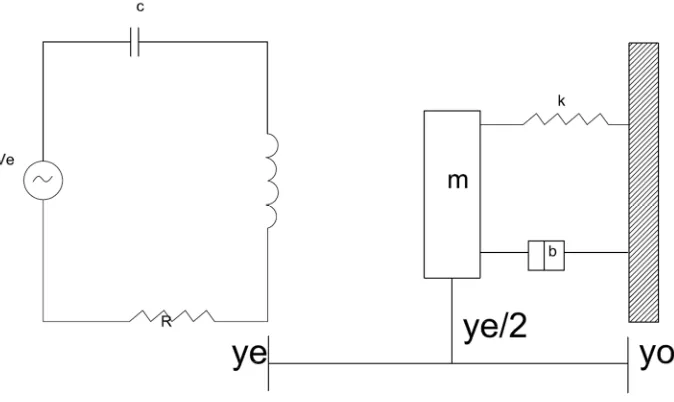
The single magnet model [3] comprises of One RLC circuit (Band-Pass subsystem) and a
mass-spring- damper arrangement. The mass’s spring when at its natural length places
the mass at midpoint from the fixed end towards the electromagnet. The fixed end is at
y0=0 and the electromagnet is at distance of ye. Thus the mass can move from 0 to
maximum ye. The dynamics of the non-linearly coupled subsystems will be analyzed by
5
Figure 1- One Magnet Model
1.6.2 Two – Magnet Model
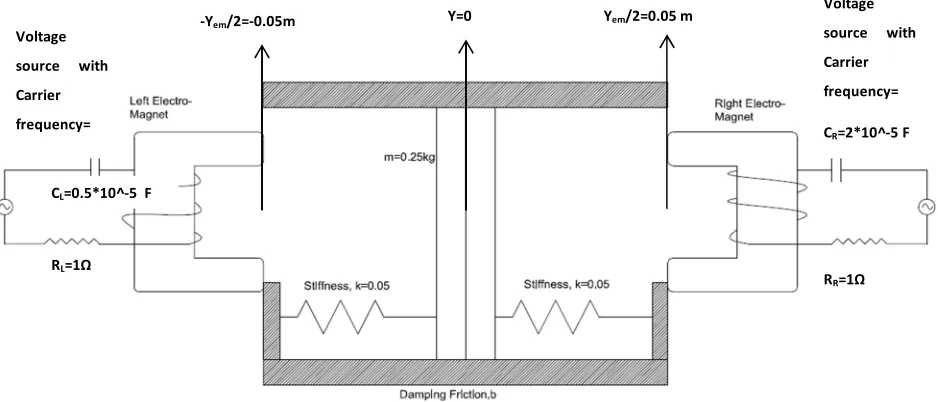
The validations and verification is made using the two magnet model, in the mass’s
spring when at its natural length is at y0=0 and the both the electromagnets are at
effective distance of ye/2. Based on these limits and already derived governing
equations of single magnet model as shown in (1-10) & (1-12), governing equations
6
Inductance of the circuit
L1234 5 L6 Lξ1234; ξ1234 5 9y 6 y2/2
L<=>?4 5 L6 Lξ<=>?4; ξ<=>?4 5 y 6 y2/2
Figure 2- two magnet model RL=1Ω
CL=0.5*10^-5 F
-Yem/2=-0.05m Y=0 Yem/2=0.05 m
Friction coeff., b=0.25 kg/sec
Voltage
source with
Carrier
frequency=
RR=1Ω CR=2*10^-5 F Voltage
source with
Carrier
7
1.7
Uncoupled System Dynamics
1.7.1 Mechanical Subsystem
Considering the mechanical subsystem as represented above Figure 1- One Magnet
Model, the second order force equation of the system can be represented as following
my 6 by 6 ky 5 fem(t) 6 d (1—1)
Where,
m--- Mass of the payload
b--- Damping coefficient
k--- Spring constant
fem (t) --- Electromagnetic force experienced by the mass
d--- Disturbance force
y--- Displacement of mass, and its corresponding velocity and acceleration.
The natural resonant frequency of the mass spring damper system is given by,
ωm5Ek/m (1—2)
1.7.2 Electrical system
The second order force equation of the electrical system can be represented as,
8 Where,
L--- Inductance,
R--- Resistance,
C--- Capacitance,
e(t) - Voltage source,
q--- Charge at the capacitor, corresponding current and rate of change of current
The resonant frequency of the RLC circuit is,
5E1/(LC) (1—4)
Thus equations represent the linear dynamics of both subsystems.
1.8
Coupled system dynamics
In this chapter, an analytical model defining the governing equations of the coupled
system will be shown [4]. The subsystem when analyzed for its dynamics separately they
are shown above, but these two systems are coupled and both are interacting with each
other.
Let’s see the electrical subsystem now, the inductance of the electromagnet a function
of the displacement of mass because the flux linkage is proportional to inductance of
the circuit. It is a clear fact that as the mass is closer to the coil the flux cut by the mass
will be more so the inductance will be higher. But as the mass is farther out of the
influence of the flux linkage there will be still a self -inductance of the coil existing.
Based on this basic electromagnetic theory, the inductance as a function of
displacement can be given as,
9 Where,
L0 – Self-Inductance of the coil,
L1 – Sensitivity of the coil as influenced by the displacement of the mass
Outside the limits though the flux linkage still exists it is negligible and the systems will
be decoupled, so the limits are placed.
Let’s consider the mechanical subsystem, the force influenced by the mass is from two
sources one will be the electromagnetic force and exogenous disturbance as explained
earlier. The electromotive force [5] caused by the electromagnet is given by,
fem 5 N edl (1—6)
Where
e—Voltage source
I— Current flowing through the coil,
e 5 φ, rate of change of flux (1—7)
φ 5 L(y). I, flux linkage (1—8)
Combining equation above, it can be easily found that
fem 5 (IL
/2) (1—9)
my 6 by 6 ky 5 LY Z
10
[(\(])^)
[4 6 Rq 6
^
_5 e(t) (1—11)
(L 6 Ly)q 6 (L 6 R)q 6 q/C 5 e(t) (1—12)
Thus the above four equations clearly show the non-linearly coupled electromechanical
system. The inductance of the coil is the factor that couples the subsystems, if the L1
tends to becomes “0” the subsystems decouple. This is the governing equation which
depicts the dynamics of the systems clearly.
Electrical subsystem is Band-pass system as the natural frequency of subsystem will be
much higher than the natural frequency of the mass spring damper system. If seen little
clearly, the voltage source will be a combination of low-pass signal that is the signal
corresponding to that of the mass and band-pass signal containing the electrical system
higher frequency. This is similar to modulated signal used in signal transmission [6]. That
is the electrical signal is the carrier signal which is required for the low-pass signal to
carry out the positioning of the mass in the field of the magnetic flux.
The variables considered for representing system are displacement and velocity of the
mechanical system, while for the electrical system the charge and the current are the
variables. Thus those are the states space variables. Hence the governing equations with
these variables can be given as following,
q 5 (e(t) 9 (Ly 6 R)q 9 q/C)/(L6 Ly) (1—13)
q 5 I (1—14)
y 5 (LY Z
9 d 9 by 9 ky)/m (1—15)
11
The above equations are used to build the band-pass model representing the entire
system.
1.8.1 Low-pass equivalent system
In this chapter, a detailed description will be of given how a low-pass equivalent set of
governing equations will be derived using the Hilbert Transform. The objective is finding
an equivalent in low pass is because as “Nyquist” [7] proposed that in order to properly
reconstruct a signal, any signal, baseband or band-pass, needs to be sampled by at least
two times its highest spectral frequency. The point here is that the mathematical
concept will help us get around the signal processing requirements by Nyquist for
sampling of band-pass systems.
As earlier notified that band-pass systems signal is a combination of carrier signal and a
low-pass signal. Such a signal can be expressed by an analytic signal. Before explaining
this part a short description on the mathematical tool ‘Hilbert transform’ will be helpful
in further understanding.
1.8.1.1 Hilbert Transform
The Hilbert Transform [8] provides signal analysis with some additional information
about amplitude, instantaneous phase, and frequency. The Hilbert Transform is
equivalent to linear filter, where all the amplitudes of the spectral components are left
unchanged, but their phases are shifted by π/2.
The Hilbert Transform representation of the original function is the convolution integral,
written as
u`(t) 5 u(t)(πt)b (1—17)
Hilbert transform has few important properties which is useful in this thesis is the
12
case, then Hilbert transform applies only to the band-pass signal. Consider a signal with
low-pass and band-pass components,
u(t) 5 u(t)u(t) (1—18)
Then the Hilbert transform of the signal is given by,
u`(t) 5 u(t)u`(t) (1—19)
In frequency domain,
Ud(f) 5 9jsign(f)U(f) (1—20)
In Digital Signal Processing we often need to look at relationships between real and
imaginary parts of a complex signal. These relationships are generally described by
Hilbert transforms. Hilbert transform not only helps us relate the real component that is
the ‘In-phase’ component and imaginary component that is the ‘Quadrature’
components but it is also used to create a special class of causal signals called analytic
which are especially important in simulation.
1.8.1.2 Analytic Signal
The analytic signals help us to represent band-pass signals as complex signals which
have especially attractive properties for signal processing [8]. The complex envelope is
nothing but the low pass signal. Thus for low pass equivalent derivation a signals split
into low pass and carrier signal is all we want. This is accomplished by the analytic signal
of a signal.
ug(t) 5 u(t) 6 ju`(t) (1—21)
ug(t) 5 u(t)ehij4 (1—22)
Where,
13
1.8.1.3 Low-Pass Equivalent governing Equations
The above brief description on the mathematical tool will be used to derive the low-pass
equivalent of the electromechanical system. It is clearly understood that the band-pass
signal is that of the electrical subsystem and the mechanical subsystems governing
equations dynamics are already low pass. So the equations have to be represented in
their equivalent forms.
The complex envelope of the current flowing in the circuit is found as following,
ig(t) 5[^[46 j[^k(4)[4 (1—23)
ig(t) 5[^[4l (1—24)
qg(t) 5 q(t) 6 jq`(t) (1—25)
Multiplying both sides by mnopqwe get the analytic signal represented as complex
envelope and solving that we get
q 5 jωrq 6 q (1—26)
Where,
q 5 qgebhis4 (1—27)
q 5 [[^[4]gebhis4 (1—28)
This gives the complex envelope of the charge current.
14
[ṽ [45
xbyzjb({g\|] )ṽ g 2}
[\~g\|]] 9 jω2ı̃ (1—29)
The low pass systems equations are,
y 5 x\| |ṽ|Z6 d 9 by 9 ky} /m (1—30)
The modulus of complex envelope will be equal to the square root of the sum of squares
of the imaginary and real part of the complex current envelope when derived it will be
found that it will be twice the analytic signals value hence it has to be halved. Other way
to put this point is that to make it low pass the value needs to be replaced by its RMS
value.
y 5 dy/dt (1—31)
These equations represent the low pass equivalent of the coupled system. Since now
the low pass signals could be in complex form, for simulation purpose the system has to
be split into real and imaginary parts.
Realdqdt 5 ω2Img(q) 6 Real(q)
Imgdqdt 5 9ω2Real(q) 6 Img(q)
Realq 5 real(e) 9 real(q)c[L 9 R 6 (Ly)realq
15
Imgq 5img(e) 9 img(q)c[L 9 R 6 (Ly)imgq
6 Ly] 9 ω2real(q)
(1—32)
The above set of equations gives the complete low pass equivalent set of governing
equations.
1.8.2 Single Magnet Description
By setting the initial conditions for the governing conditions as “0” for velocity,
acceleration, current and rate of change of current variables at y=ye/2, considering ye/2
as the equilibrium point. This is the point where all forces equalize each other and the
mass will remain at equilibrium.
Since the forces will be equal to each other i.e., the magnetic force and the spring force
considering no exogenous disturbance, then
I 5 k\]| (1—33)
For the parameters used, the values of current required to maintain the mass at
equilibrium is 2.236A.
Using this value of current and tending the equation to ‘0’ from initial conditions, we get
|ê|579.099 V (1—34)
16
e (t) 5 (79.0996Acosωm t) cosωe t (1—35)
Where,
A - Amplitude of the signal,
ωm –Resonant frequency of the mass,
ωe - Carrier frequency, equal to electrical resonance frequency
The governing equations are incorporated in the MATLAB functions and coupled with
integrators. The velocity integrator is of limiter type while the acceleration integrators
will be of rising hold type which will be explained briefly in the limiters chapter.
The low pass equivalent input complex envelope is the low pass part of the band-pass
input signal,
e (t) 5 (79.0996Acosωm t) (1—36)
The corresponding governing equations for the real and imaginary part of the low-pass
equivalent system is incorporated in the MATLAB functions and coupled with
integrators to get the displacement and current envelope of the system. The simulation
results will be validated in later chapters along with different input conditions.
1.8.3 Limiters for single magnet system
The payload/mass which gets displaced when it gets experienced by the exogenous
disturbance and the electromagnetic force, it is necessary to limit the movement of the
mass so that after it touches the electromagnet or the fixed end it should be brought
back or stopped from moving further. This is done by making the velocity of the payload
17
At, y50; y 5 0, y 5 0 & (1—37)
At, y5ye, y 5 0, y 5 0 (1—38)
And since at y=0, the displacement interaction with the inductance of the magnet will
also be 0, so only self-inductance exists. Similarly at y=ye, the electromagnetic force is
made 0, thereby, there exists only spring force which will pull back the payload avoiding
the mass to extend further of electromagnet.
These limiters are incorporated in the embedded MATLAB functions. These limiters are
in addition to that of the limits incorporated directly on the integrators.
Validation of single magnet Systems:
The systems simulation is run for three cases, typically depicting
• When the system experiences no exogenous disturbance and influenced only by
the DC signal optimum to maintain the mass in equilibrium.
• When the system is experiencing single tone and polychromatic low-pass
exogenous disturbances.
• Limiter checked for higher amplitude disturbances.
• For different voltage profile.
This validation is carried out for all the types of model with similar set up.
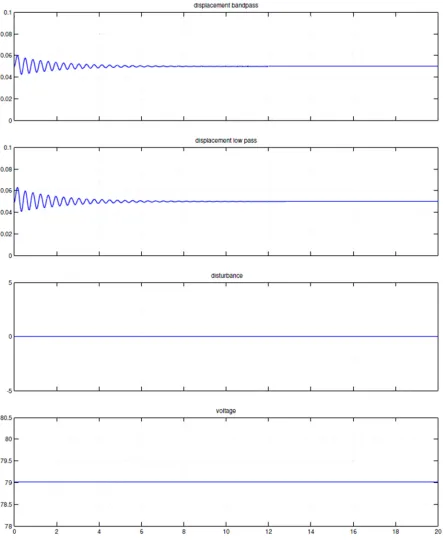
1.8.3.1 Band-Pass & Low-pass System
As explained earlier the band-pass model will be validated for 4 conditions,
When the system is inputted with DC signal optimum to maintain at midpoint, is the
equilibrium point. This voltage has been calculated in the above section. There will be
18
this case the distance between the minimum and maximum the mass can be moved is
10cm. Thus equilibrium point is 5cm. This will be seen in Figure 3.
The other condition maintained for this validation is that there is no exogenous
disturbance on the mass. This is also clearly shown in the scope represented in the
Figure 3.
It is clearly visible that the low-pass equivalent and the band-pass settles at the same set
equilibrium point proving the point the system can be sampled at just twice the
resonant frequency of the mechanical system instead that of the electrical signal which
19
20
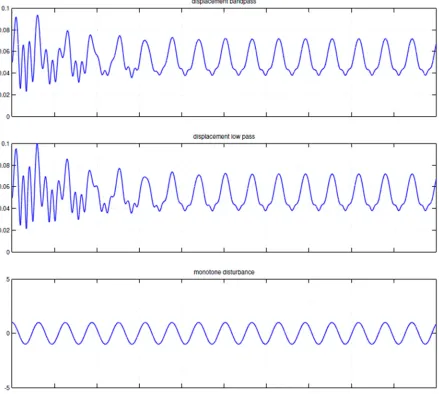
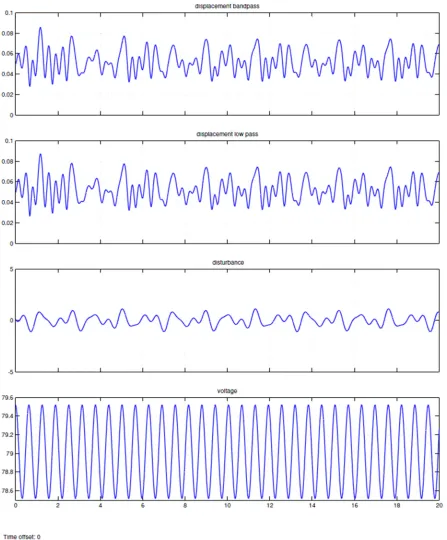
For the monochromatic disturbance as in Figure 4 is obtained when the system is
influenced by single sinusoidal disturbance. And also there is the informational signal on
to the mass i.e., the voltage signal with resonant frequency of the mass.
21
The Figure 5 is obtained for polychromatic disturbance with three disturbances of
amplitude and phase as follows, 0.5cos5t + 0.3sin11t+0.4cos8t N, at ωm. It can be
noticed that the movement of the mass is exactly the same as that of the band-pass
22
Figure 5- Polychromatic disturbance
Though the displacement of the mass of band-pass system matches almost to that of
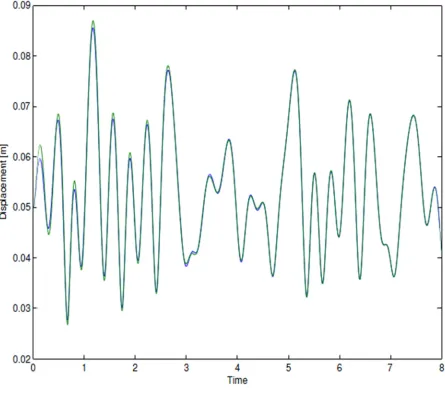
23
small difference between the displacements of the low-pass equivalent and that of the
band-pass model. This is because of the existence non-linearity in the low-pass
equivalent governing equations. This can be overcome in the two magnet model. This
will be validated and verified in the later text. But this difference is not the permanent
one, the difference voids off as the system stabilizes as the time frame increases.
24
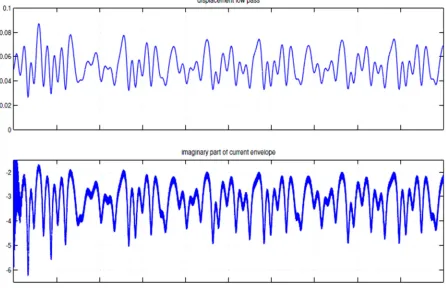
Figure 7- Displacement and imaginary current envelope comparison
Figure 7, the scope shows clearly the low-pass equivalent is that the imaginary part of
the complex current envelope is in phase of that displacement of the payload/mass.
Though there is a non-linearity difference. But for analysis of the type of vibration or
amplitude of vibration or control of vibration this result can be employed. The relation
between both the displacement and imaginary part of the current envelope could be
found out by calculating the ratio between the mean values of the both the scopes. This
will be the factor relating the two.
Figure 8 validates the setup of the limiters. The mass is not allowed to cross the
ye=10cm, as soon as it hits the values ye, the limiters comes into force setting up the
25
26
2
Two Magnet systems
2.1.1 Two- Magnet model Governing Equations
The basic governing equations are used for both types of model being discussed
henceforth. In the two magnets model there is same set of equations but for both
magnets individually. Since the mass is placed at y=0, and the electromagnets at ye/2
and -ye/2, there is equivalent displacement introduced such that influence of
displacement on the inductance of both the electromagnets could be calculated
effectively.
For left magnet, ξl5-y6ye/2, (2—1)
For right magnet, ξr5y6ye/2, (2—2)
The respective inductances of the magnets and the low pass governing equations will
have their corresponding coefficients. The electromagnetic force will be the effective
force of both the magnets on the mass. This will be shown on the hence forth results of
the simulation run of the model made using these governing equations.
The important aspect of using the two magnet model is being the advantage of using
not the predefined voltage source set to bring the mass to equilibrium. By maintaining
same current values in both the electromagnets the mass can be maintained in
equilibrium and this plays major role in control part in positioning the mass.
Now that the governing equations have been derived for both the cases, henceforth
variables will be defined and the set of values used for testing the model designed using
these governing equations.
2.1.2 Two Magnet Description
The two magnet model’s governing equations are derived similar to that of the single
27
the both the magnets on the mass. The current flow and rate of change of current are
found for both the magnets with the parameters.
Input DC signals of the electromagnets to maintain the mass at equilibrium at y=0 can
be any value with current maintained same in both the magnets. If there is change in
current and corresponding difference in voltage signal based on the potential of the
electromagnets the mass will be inclined towards that electromagnet.
Using equation for an arbitrary value of voltage current is found for one model and the
same current is used for second model to find the corresponding signal voltage.
2.1.3 Limiters for two magnet system
Limiters conditions are of similar to that of the single magnet limiters, difference being
the positioning of the electromagnets.
At y5-ye/2; y 5 0, y 5 0 & (2—3)
At y56ye/2, y 5 0, y 5 0 (2—4)
The integrators are incorporated in this too for velocity and acceleration as additional
28
29
3
Two Magnet, Band-Pass System
3.1
Model Description
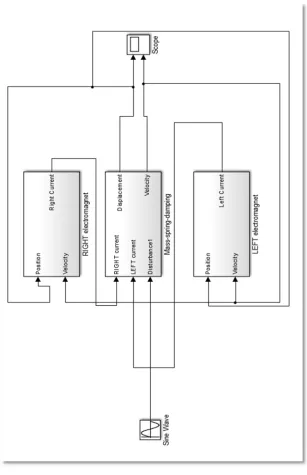
The Band-Pass system is developed by using the coupled non-linear equations afore
said. The two magnet model or the base model for all the systems is made in the
Simulink as following, the mechanical system state space decomposition constitutes a
single block which will get the influence of the current vectors from both the magnets.
In the similar way the velocity and the displacement of the mechanical system as a
result of the mutual effect of the electrical system over the mechanical influences the
electrical system.
3.2
System Equations
The system equation for one magnet is derived by splitting system in to state space
model, by splitting them into state vectors [10],
5 x} (3—1)
5 xqq<<} (3—2)
5 09k/m 9b/m 1 (3—3)
() 5
0
^zZ\|
(3—4)
() 5
0 1
9
_x\~gx]gsZ}\|} 9
[{g\|]]
30
() 5 1/[L<6 xy 60 ]s
} L<] (3—6)
u 5 e (3—7)
y 5 q (3—8)
By this state- state space decomposition, the following second order final vectors are
obtained from the basic equations,
yy 5 9k/m 9b/m x0 1 yy} 6 |^|0Z\| 6 0[ (3—9)
qq<
< 5
0 1
9
_x\~gx]gsZ}\|} 9
[{g\|]] x\~gx]gsZ}\|}x
q<
q<} 6
0
\~gx]gsZ}\|¡ m
(3—10)
The above set of matrices is used in the Simulink model for the mechanical and the
electrical system correspondingly. The set of equations derived are for one side of the
magnet for the “Right Magnet”. The left magnet has similar set of matrices but the
distance of the mass from the magnet changes opposite to that of the right magnet.
3.3
Results of Band- pass system under different conditions
3.3.1 Systems displacement of mass
3.3.1.1Different voltages to both magnets and a Monochromatic disturbance
The displacement of the mechanical system which includes the influence of the current
of both the magnets and effective inductance of the system since the inductance of the
magnets is kept same value for testing purpose the influence of magnets different
currents is considered important. The effective current of the magnets on the mass and
the monochromatic disturbance 0.005 N, play role in positioning the mass since in this
particular condition the monochromatic disturbance and voltage value of the magnets
31
The maximum displacement the mass can attain is 0.05m on either side of origin. This is
explained earlier as in two cases of limits. The displacement (position) of the mass can
be effectively controlled using the voltage envelope applied compensating the
disturbance there by influencing the current. This part will explain why Low-pass model
of the electromechanical system is built and analyzed.
32
3.3.2 Systems current
Figure 11-Right Magnet Current
33
The above results are under the condition of not only a monochromatic disturbance but
34
4
Two Magnet, Low-Pass system
4.1
Systems Equations
The system equations of the mechanical system [9] is similar to that of the band-pass
system since it is already in linear form so the effective magnitude of the current in the
complex envelope form and the analytic form remains the same. Thus the mechanical
system follows similar way as that of that of the band-pass system.
The electrical system employs the low-pass equivalent system of equations that is the
complex envelope of the charge and envelope which reduces the carrier and the
information of the system and at much lower frequency there by the systems response
is effective but still maintaining the information that is linked with the mechanical
system. This also reduces the effect of non-linearity on to the mechanical systems’
displacement because the complex envelope reduces the effect of non-linearity by
eliminating the higher order variables and the effect of high frequency on them. This is
well explained in the above chapters describing the math tools used in deriving the
governing equations of the complex envelope there by deriving the low-pass system
equations.
The following equations follow the same principle as that of the band-pass system
wherein the variables are split into state space vectors and their corresponding state
space decomposition is carried out. But since the vectors of current and charge are of
complex variables the time series run results in generating complex dimension.
5 xyy} (4—1)
5 qq<
35
5 09k/m 9b/m1 (4—3)
() 5
0
^zZ\|
(4—4)
() 5 91/[C<xL< 6 xy 60 ]s 1
} L<}] 9[R<6 L<y]/ xL< 6 xy 6 ]s
}L<} (4—5)
() 5 ¢
0
\~g[]gsZ]\|¡£ (4—6)
5 6 () 6 d (4—7)
yy 5 9k/m 9b/m x0 1 yy} 6 0
^zZ\|
6 0[
(4—8)
5 ()6 ()e (4—9)
q< q< 5 ¤
9jω2 1
9
_x\~gx]gsZ}\|} 9
[{g\|]]
x\~gx]gsZ}\|}9 jω2¥
q<
q< 6
0
\~gx]gsZ}\|¡ m̃
(4—10)
Similar to that in the Band-Pass system the left magnet equations are similar to that of
the right magnet varying with the distance of the mass from the position that of the
right magnet. The complex envelope of the charge and current are derived by using the
‘Hilbert Transform’, where in the pre envelope is the sum of the input signal vector and
Hilbert transform of the input signal vector in the frequency domain as shown in (1-17)
to (1-20). When converted to time domain we get real part of the analytic signal gives
the input signal vector. This is used in converting the input signal vector to complex
36
4.2
Model testing under same condition as Band-pass
4.2.1 Displacement of the system
Figure 13 – Displacement LP
The above plot displays the displacement of the mass of the Low pass equivalent system
of the electromechanical system because of a monochromatic disturbance of 0.005N
and voltage supply of 10V to right magnet and 20V to the left magnet. The below plots
are the current envelopes of the magnets with imaginary and real parts. In the future
chapters conditions used for this LP equivalent testing will be used for validation with
the perturbation model. The current envelope is since proportional to the charge
envelope, in effect the plots of the current envelope are shown and charge envelope
37
4.2.2 Current Envelope
Figure 14- Real Part of right Magnet current envelope
38
Figure 16- Real Part of left Magnet current envelope
39
5
Two Magnet, Low-Pass Perturbation System
5.1
Model description
Low-pass equivalent system is validated by linearizing with respect to electrical
subsystem variables with parameters as displacement and velocity of the non-linearly
coupled mechanical and electrical subsystems. The electrical sub-systems complex
envelope of the LP equivalent is considered and using Taylor expansion using the
Jacobian of the variables involved the subsystem is expanded and used as the electrical
subsystem.
5.2
Governing Equations of Right Magnet
5.2.1 Mechanical Subsystem
The state space variables of the subsystems is,
5 xyy} (5—1)
5 qq<
< (5—2)
5 09k/m 9b/m 1 (5—3)
() 5
0
^zZ\|
(5—4)
5 6 () 6 d (5—5)
yy 5 9k/m 9b/m x0 1 yy} 6 0
^¦Z\|
6 0[
(5—6)
40
5.2.2 Electrical Subsystem
The electrical subsystem state space vectors,
() 5 91/[C<xL< 6 xy 60 ]s 1
} L<}] 9[R<6 L<y]/ xL<6 xy 6 ]s
}L<}
(5—7)
() 5 ¢
0
\~g[]gsZ]\|¡£ (5—8)
§5 F(x)x6 G(x)e< (5—9)
The above equation is the governing equation for the electrical subsystem, which is
expanded using the Taylor’s expansion and neglecting the higher order functions and
considering the steady state is also included. But since it is of negligible value when the
model is tested in Simulink the steady state component is not considered. The function
to the order of only first order is only considered [11, 12].
©#«6 ©¬« 5 [(#)]©¬«6 (#)®z©¬«¯ 6
[(¬) 9 °±²³]©#«¯ 6
[(¬)®z©#«] 6 6 6 6
[(¬) 9 °±²³]©¬«¯ 6
[(¬)®z©¬«]
(5—10)
The state space matrix is differentiated and variables influencing the electrical vectors
are the velocity and displacement which is termed up to “0”.
(¬) 5 91/(C<[L<06]s 1 L<]) 9R</[L<6
]s
41 ´µµ
¶¬´ 5 ¤
0 0
9 \|]
_ \~gsZ\|¡Z 9
\|x]x\~gsZ\|}b{]} x\~gsZ\|}Z
¥ (5—12)
(¬) 5 ·1/[L<60 ]s
L<]¸ (5—13)
´µµ
¶¬´ 5 ¢
0
b\|]
\~gsZ\|¡Z£ (5—14)
©¬«5 ¹qq<©«
<©«º (5—15)
©#«5 ¹qq<©#«
<©#«º (5—16)
®z©¬« 5 ²§ (5—17)
©#«5 yy©#«©#«¡ (5—18)
(#) 5 ¤
0 0
9 \|]
_ \~gsZ\|¡Z 9
\|[][\~gsZ\|]b{]] x\~gsZ\|}Z
¥ (5—19)
(#)©¬« 5 ¤
0 0
9 \|]
_ \~gsZ\|¡Z 9
\|x][\~gsZ\|]b{]} x\~gsZ\|}Z
¥ qq<©«
<©« (5—20)
(#)©¬« 5 ¤
0 0
9 \|]
_ \~gsZ\|¡Z 9
\|x]x\~gsZ\|}b{]} x\~gsZ\|}Z
¥ qq<r©«6 jq<»©«
<r©«6 jq<»©« (5—21)
(#) 5 ¢
0
b\|]
42 (¬) 9 [jω2³]¯©#«5 ¤
0 1
9_
[\~gsZ\|] 9 {
x\~gsZ\|} 9 [jω2I]¥
q<r©#«6 jq<»©#«
q<r©#«6 jq<»©#«
(5—23)
(#)©« 5
¼ ½ ½
¾ 0
9 q<r©«L<y C< L<6 y2 L2 <¡
9
L<xy xL<6 y2 L2 <} 9 R<y} q<r©«
xL<6 y2 L2 <} ¿ À À Á 6 j ¼ ½ ½ ¾ 0
9 q<»©«L<y C< L< 6 y2 L2 <¡
9
L<xy[L< 6 y2 L2 <] 9 R<y} q<»©«
xL< 6 y2 L2 <} ¿ À À Á (5—24)
(¬) 9 [jω2³]¯©#«
5 Â
ω2q<»©#«6 q<r©#«
9 q<r©#« C<xL<6 y2 L2 <}
9 q<r©#«R< xL< 6 y2 L2 <}
6 q<»©#«ω2Ã
6 j Â
9ω2q<r©#«6 q<»©#«
9 q<»©#« C<xL< 6 y2 L2 <}
9 q<»©#«R< xL<6 y2 L2 <}
9 q<»©#«ω2Ã
5—25
[(¬)]®z©#« 5
0
43 (¬) 9 [jω2³]¯©«
5 Â
ω2q<»©«6 q<r©«
9 q<r©« C<xL<6 y2 L2 <}
9 q<r©«R< xL<6 y2 L2 <}
6 q<»©«ω2Ã
6 j Â
9ω2q<r©«6 q<»©«
9 q<»©« C<xL< 6 y2 L2 <}
9 q<»©«R< xL<6 y2 L2 <}
9 q<»©«ω2Ã
(5—27)
[(¬)]®z©¬« 5
0
x\~gsZ\|}[u<r©«6 ju<»©«] (5—28)
(#)®z§©¬« 5
0
b\|]
\~gsZ\|¡Z [u<r©«6 ju<»©«] (5—29)
The set of equations are derived for the right magnet are derived, the left magnet is
self- evident with only the displacement varying. The final vectors since in the complex
dimension the imaginary and real parts of the charge and current envelope are shown in
the following equations.
44 q<<5 9 q<r©«L<y
C< L<6 y2 L2 <¡ 9
L<xy xL<6 y2 L2 <} 9 R<y} q<r©«
xL< 6 y2 L2 <}
9 q<r©#«
C<xL<6 y2 L2 <}
9 q<r©#«R< xL<6 y2 L2 <}
6 q<»©#«ω26 9 q<r©«
C<xL<6 y2 L2 <}
9 q<r©«R< xL< 6 y2 L2 <}
6 q<»©«ω26 1
xL<6 y2 L2 <}
u<r©«6 1
xL<6 y2 L2 <}
u<r©#«
6 9L<y L<6 y2 L2 <¡
u<r©«
(5—31)
q<= 5 9ω2q<r©#«6 q<»©#«9 ω2q<r©«6 q<»©« (5—32)
q<= 5 9 q<»©«L<y
C< L<6 y2 L2 <¡ 9
L<xy xL<6 y2 L2 <} 9 R<y} q<»©«
xL<6 y2 L2 <}
9 q<»©#«
C<xL<6 y2 L2 <}
9 q<»©#«R< xL<6 y2 L2 <}
9 q<»©#«ω29 q<»©«
C<xL<6 y2 L2 <}
9 q<»©«R< xL<6 y2 L2 <}
9 q<»©«ω26 1
xL<6 y2 L2 <}
u<»©#«6 1
xL< 6 y2 L2 <}
u<»©«
6 9L<y L<6 y2 L2 <¡
u<»©«
45
5.3
Model Testing
5.3.1 Displacement of the mechanical subsystem:
Figure 18- Displacement –LP Perturb
This particular test for the perturbation analysis is carried out with the same conditions
as of the other two earlier models. Value of the disturbance is of 0.005sin 2Å/6 N. The
excitation voltage supply of the right magnet is of 10V and the left magnet is supplied
with 20V. But the model will be run for other different conditions and will be compared
46
5.3.2 Current Envelope
Figure 19- Real Part of right Magnet Current Envelope
47
Figure 21- Real part of Left Current Envelope
48
6
Validation of Low-Pass Equivalent & Low-pass Perturb
Models
6.1
Description
The LP- equivalent model and LP-perturbation model are compared in the following
sections to show the LP-Equivalent is not by neglecting the related variables and
conditions. The above methodology for the derivation of LP- equivalent of the
electromechanical systems dynamics proves the point that voltage excitation of the
electric circuit needs to be BP if it is around resonance frequency of the circuit then only
its complex envelope is needed in order to perform calculations for the output system. If
the disturbance is LP then it has some dynamic effect on the system but it will be greatly
attenuated due to the LP characteristic of the electromechanical subsystems.
Both models are combined on a single time series with same disturbance and excitation
voltages for magnets of both models are maintained the same. Three conditions in the
following pages are considered to show the comparison between the systems. The
current envelope is only shown in the plots comparison because the displacement and
velocity is coupled with the electrical system and comparison becomes self-evident for
the other variables.
6.2
Condition 1
The conditions employed for the comparison,
• External disturbance maintained zero for both systems.
• Excitation voltages of both the systems are maintained zero.
49
6.2.1 Right Magnet Real Parts
Figure 23-Zero disturbance & Zero excitation voltage
The above plot of the current envelopes of both the systems with the conditions
explained shows clearly after initial fluctuation for the system to get stablised and it
settles at the initial condition. And it is clearly evident that the LP equivalent when
compared with LP perturbation model stabilises at the same value indicating the LP
equivalents dynamics follows as such of linearized system. The above and below plots
are for the real and imaginary parts of the current envelope of the right magnet of both
50
Figure 24-Zero disturbance & Zero excitation voltage
6.3
Condition 2
The conditions employed for the comparison are:
• External disturbance maintained zero for both systems.
• Excitation voltages of both the systems are maintained 10V for both magnets.
51
Figure 25- Zero disturbance & 10V for both the magnets
The above plot shows the similarity in the behavior of both systems. With LP equivalent
varying slightly less than that of the LP linearized perturbation model. This exists
because of the non-linearity of the electromechanical systems. But the phase of the
52
6.4
Condition 3
The conditions employed for the comparison,
• External disturbance maintained 0.005N and monochromatic sine-wave for both
systems.
• Excitation voltages of both systems are maintained 10V for right magnet and 20V
for the left magnet.
• The initial conditions for steady state.
The above condition is to show complete dynamics comparison of the system reflecting
the scope. The LP disturbance is greatly attenuated due to the mechanical subsystems
LP characteristic. The difference in voltages corresponding to the difference in the
frequencies of the magnets stabilizes the systems too. This is very much followed by the
LP equivalent system. The linearized LP equivalent by perturbation analysis results
match perfectly to that of the LP equivalent system with very or negligible difference.
The dynamics of the subsystems established by the LP equivalent system using the
mathematical tools showing that the electromechanical systems information can be
established using only the complex envelope of the input signal which carries the
information and influenced by low frequency of the mechanical subsystem and
53
Figure 26- Real right current envelope at 0.005N Monochromatic disturbance and 10V
on right magnet & 20V on left magnet.
The above plots and below plots shows the comparison between the real and imaginary
parts of the right magnet’s current envelope. It is clearly visible that the phase,
magnitude of both the models is in agreement with each other. The negligible variations
54
Figure 27- Imaginary right current envelope at 0.005N Monochromatic disturbance and
55
7
Conclusion
The analysis of the dynamics of an electromechanical system considering the
non-linearity arising when the systems are coupled gives great information which could be
used for control and analysis of vibrations. The non-linearity arises because of the
mutual interaction of the magnetic force on to the mechanical system and the
interaction of the mechanical system on to the inductance of the coil.
As seen, the resonant frequency of the electrical signal is much higher than that of the
resonant frequency of the mechanical system, so the information voltage signal with
very high frequency which controls the displacement of mass other than the exogenous
disturbance is modulated. In effect the information signal is close to the resonant
frequency of the mechanical system but also has the electrical signal’s frequency as the
carrier frequency. To sample this signal the sampling rate has to be twice the highest
frequency. This increases considerably the simulation time.
Considering this the low-pass equivalent system takes the low-pass part of the
band-pass signal, that is the complex envelope, and this information signal is close to the
frequency of the mechanical system. Thus sampling rate will be just little higher than
(double) the natural frequency of the mechanical system but representing the dynamics
of the system perfectly, and reducing the simulation time considerably.
As validation and comparison between the single magnet model and the two magnet
model is made the agreement is shown clearly, however the sensitivity is higher for the
two magnet model; even slightest disturbance affects the displacement of the mass. But
with proper analysis of the current envelope on both the magnets, and the
displacement of the magnet can be stabilized faster. The measurement of the complex
56
involved, the latter could be found by the finding peak values of both and finding the
ratio.
It is also a known fact that “A charged particle cannot be held [statically] in a stable
equilibrium by electrostatic forces alone.” This calls for a feedback control for the
system.
An effective control will be of great use in the various fields where vibration has to be
analyzed or controlled. In the future works, the scope of development of MEMS is
unlimited for the time being because it’s just in the initial phase.
The validation of the LP equivalent system using the linearized LP-Perturbation model
projects the scope of developing a control system effectively to position the mass at
desired location by varying the excitation voltage compensating any external
disturbance.
The recent application which is under development of an Active Hydromagnetic Journal
Bearing [13], this employs the same principle as applying a direct electromagnetic force
on arising the shaft and levitating the shaft there by removing the surface contact as in
the case of traditional bearings. This analysis will help in the effective control design of
57
References
1. Fitzpatrick.R, Oscillations and Waves: An Introduction, CRC Press, 2013.
2. Baraniuk.R, Signals And Systems , Orange Grove Books, 2009.
3. Psarrou.D, Simulations and feedback control of non-linear coupled
electromechanical oscillators for energy conversion applications, Florida Atlantic
University, College of Engineering & Computer Science, Master Thesis- August
2011.
4. Krause.P.C., Wasiynczuk.O, Scott D.S, Analysis of electric machinery and drive
systems, Purdue University, Second Edition, IEEE Power Engineering Society,
2002.
5. Feldman.M, Hilbert Transform Applications In Mechanical Vibration - John Wiley
& Sons, Ltd, 2011 .
6. Referred Online source (http://en.wikipedia.org/wiki/Modulation)
7. Referred Online source (http://en.wikipedia.org/wiki/Nyquist%E2%80%93
Shannon _sampling_ theorem)
8. Feucht, D.L , Magnetic-Electric Analogs, Innovatia Laboratories. (n.d)
9. Everett. E, Micheal Wu, ELEC,433, Course on Architectur for wireless
communications, Rice University, - (n.d) (cmclab.rice.edu/433/notes/fitz_
bandpassnotes.pdf )
10.Xiros. N.I, Dynamical Systems, Marine engineering process Modelling, Control &
Automation, NAME6098, University Of New Orleans, 2012 Fall (Class Notes)
11.Xiros, N.I., Georgiou, I.T. Analysis of coupled electromechanical oscillators by a
band-pass, reduced complexity Volterra method., ASME-IMECE 2005, November
58
12.Xiros.N.I, Georgiou, I.T., A combined method for the investigation of coupled
bandpass-lowpass non-linear oscillators based on hilbert transform and
perturbation analysis, 2006 ASME International Mechanical Engineering Congress
& Exposition, Chicago, Illinois, USA
13.Farmakopoulos M.G, Loghis.E.K, Nikolakopoulos.P.G, Xiros.N.I, Papadopoulos.C.A,
Modelling & Control Of Electrical Actuation System Of an Active Hydromagenetic
Journal Bearing, IMEDE 2014-38346, November 14-20, 2014 Montreal
59
Appendix A
Mechanical subsystem
m = .25;
b = .25;
k = 0.1;
yem = .1;
L1 = .5;
y = u(1);
y_dot = u(2);
i_Right = u(3);
i_Left = u(4);
d = u(5);
Trig = -1;
Dy = y_dot;
if y <= (-yem/2);
Dy_dot = ( d - (k * y) - (b * y_dot) ) /m;
%dx22= (e-(x21/C)- (R*x22))/ L0 ;
if Dy_dot < 0
Dy_dot = 0;
end;
if Dy < 0
Trig = 1;
60
elseif y >= (yem/2)
Dy_dot = ( d - (k * y) - (b * y_dot) ) /m;
if Dy_dot > 0
Dy_dot = 0;
end;
%dx22= (e-(x21/C)- (R*x22))/ (L0+(L1*yem)) ;
if Dy > 0
Trig = 1;
end;
else
Dy_dot = ( (L1/4) * ( (i_Right)^2 - (i_Left)^2 ) + d - (k * y) - (b * y_dot) ) /m;
%dx22= (e-(x21/C)- (R+ ( L1*x12))* x22)/ (L0+(L1*x11))
Electrical subsystem-LP
L0 = .05; L1 = .5;
yem = .1;
R = 1;
omega_em_L = 2000;
C_L=.5e-5;
x = u(1:2);
y = u(3); y_dot = u(4);
e = u(5);
if (y <= -yem/2)
Xi_L = yem;
61
Xi_L = 0;
else
Xi_L = -y+yem/2;
end;
A = [0, 1; -1/(L0+L1*Xi_L)/C_L,
-(R-L1*y_dot)/(L0+L1*Xi_L)];
B = [0; 1/(L0+L1*Xi_L)];
Dx = (A-j*omega_em_L*eye(2))*x+B*e;
Electrical Subsystem-BP
L0 = .05; L1 = .5;
yem = .1;
R = 1;
omega_em_L = 2000;
C_L=.5e-5;
x = u(1:2);
y = u(3); y_dot = u(4);
e = u(5);
if (y <= -yem/2)
Xi_L = yem;
elseif (y >= (yem/2))
Xi_L = 0;
else
Xi_L = -y+yem/2;
62
A = [0, 1; -1/(L0+L1*Xi_L)/C_L,
-(R-L1*y_dot)/(L0+L1*Xi_L)];
B = [0; 1/(L0+L1*Xi_L)];
63
Vita
Shathiyakkumar Ganapathy Annadurai, is a Masters student of Naval Architecture &
Marine Engineering, at University of New Orleans. His career started as Marine
Engineer. And he worked with different ships which includes Oil Tankers, Pure
Car-Carriers and Bulk Car-Carriers. He holds a Bachelor’s degree in Marine Engineering and
Certificate of Competency for Marine Engineering Officers. His research interests are