SEARCHING FOR PATTERNS OF DISCOURSE IN A SEA OF PROFESSIONAL DEVELOPMENT:
PROFESSIONAL LEARNING AND TEACHER DISCOURSE
by
Brian T. Whitney
A dissertation
submitted in partial fulfillment of the requirements for the degree of
Doctor of Education in Curriculum and Instruction Boise State University
DEFENSE COMMITTEE APPROVAL
of the dissertation submitted by
Brian T. Whitney
We have read and discussed the dissertation submitted by Brian T. Whitney, and we have deemed it satisfactory for a doctoral degree by the proportion of votes designated by the program.
______________________ __________________________________________
Date Jonathan Brendefur, Ph.D.
Co-Chair, Supervisory Committee
______________________ __________________________________________
Date Keith Thiede, Ph.D.
Co-Chair, Supervisory Committee
______________________ __________________________________________
Date Ann Farris, Ed.D.
Member, Supervisory Committee
______________________ __________________________________________
Date Jennifer Snow-Gerono, Ph.D.
BOISE STATE UNIVERSITY GRADUATE COLLEGE COLLEGE OF EDUCATION AND GRADUATE COLLEGE
FINAL READING APPROVAL
To the Graduate Council of Boise State University:
I have read this dissertation of Brian T. Whitney in its final form and have found it to be of satisfactory quality for a doctoral degree.
Approved for the College of Education:
Date Diane Boothe, D.P.A.
Dean, College of Education
Approved for the Graduate Council:
Date John R. Pelton, Ph.D.
v
DEDICATION
To you, the reader of this dissertation, may you not only digest the text but also use your words as tools, and do the work that must be done - whatever it is - through inquiry, respect and passion.
vi
ACKNOWLEDGEMENTS
Thank you, family. Cara, for your endless support, confidence, and patience; even when you couldn’t buy that totally snazzy bag, yet a box of books would show up on the front porch the next day. Ava, for providing me with inspiration and a powerful reminder to keep life balanced. Mom and Dad, for your ability to help me believe that anything is possible and to inspire me to do the same for my own children and the learners with whom I work. To the Perdews and other family members and friends for their interest and patience, as it seems that conversations at every family event since my nieces were born began with questions about course work and studies I was engaged in.
Thank you, committee, colleagues, and peers. Jonathan, for enjoyable meetings at Big City, consistent modeling that this work is lifelong and that one day I may also download lectures on my mp3 player. Jennifer, for inspiring within me a belief that I had something valuable to share through my writing and for your persistent modeling of what it means to embody and enact an inquiry-stance. Ann, for supporting a logical connection between doctoral studies and professional responsibilities and for sharing a personal perspective which greatly helped to relieve my stress. Go Broncos! Keith, for your
vii
viii
AUTOBIOGRAPHICAL SKETCH
Brian Whitney is committed to the pursuit of balance within a life framed by teaching and learning. He taught fourth and sixth grade in public schools receiving Title I and III funding, various curriculum and instruction courses at Boise State University, and professional development courses with the Boise School District (BSD) and Optimize: Professional Development.
Whitney is currently working as a consulting teacher and coach for the BSD, collaborating with teachers working to integrate the Sheltered Instruction Observation Protocol into their practice. He has helped launch a peer coaching training program based on the apprenticeship model and works within the BSD to establish communities of collaborative practice.
In 2004, after completing a Masters degree in education with an emphasis on the arts in learning, Whitney founded Optimize: Professional Development, LLC and has since expanded Optimize’s consulting and workshop services, releasing their first product, a web-based collaboration management program in the spring of 2009.
Whitney has made both local and national conference presentations on the use of the SIOP in delivering effective classroom instruction and increasing student
ix
x ABSTRACT
Professional development, like a sea of changing tides, ebbs and flows through a myriad of professional trends. Some of these trends have disenfranchised teachers from the core of professional learning while others have empowered teachers to confront change with passion and courage. As collaboration continues to gain popularity as an empowering and effective route to professional learning, scrutinizing the effects of professional development on teacher discourse will ensure desired outcomes are achieved.
While collaboration holds the power to break down some of the isolation that exists in the teaching profession, talk alone, void of inquiry and reflection, will not necessarily lead to school improvement, pedagogical evolution, or improved learning experiences for students. Working on the belief that these are necessary targets in professional development, this qualitative study investigated what ways, if any, teacher collaborative discourse differed considering various levels of professional development teachers had received.
Four independent focus groups, each consisting of teachers who
had participated in varying types of professional learning, collaboratively discussed instruction they viewed of an unknown model teacher and instruction of a peer.
xi
xii
TABLE OF CONTENTS
DEDICATION ... v
ACKNOWLEDGMENTS ... vi
AUTOBIOGRAPHICAL SKETCH ... viii
ABSTRACT ... x
LIST OF FIGURES ... xvi
INTRODUCTION ... 1
A Framework for Teacher Learning ... 4
Professional Learning: Keep it Real ... 5
Continuous Improvement: Keep it Simple ... 7
LITERATURE REVIEW ... 10
Working on the Periphery ... 12
Why Bother? ... 13
Comparative History: Looking at Others and Looking at Ourselves ... 15
The Grammar of Professional Development ... 16
Let’s Get Busy ... 18
Building a Community of Practice ... 19
Professional Learning Communities ... 23
The Co-mingling of Situated Learning and Coaching ... 26
Building a Model of Co-participatory Professional Development ... 28
xiii
Choosing The Words That Change How We Think ... 39
What Might It Look Like? ... 40
Collaboration ... 42
Inquiry Community ... 44
Knowledge-of-Practice ... 47
If It Should Be So, Why Not? Constraints On Discourse ... 49
Basic Obstacles To Sustaining Deep Levels Of Discourse In Schools ... 49
Summary ... 54
DESIGN AND METHODOLOGY ... 57
Sampling ... 57
Participants ... 59
Situation ... 62
Smith’s Point School District’s SIOP Professional Development Model ... 63
Treatment: Smith’s Point School District SIOP Professional Development Effects on Discourse ... 64
Instrument ... 66
Tier 1 Data: Statement Types ... 66
Tier 2 Data: Discourse Types ... 69
Data Collection ... 71
xiv
FINDINGS ... 81
Tier 1 Data: Statement Types ... 83
Interrogative Codes ... 83
Declarative Codes ... 90
Strategy Codes ... 95
Strategy: Reflection ... 99
Judgment Statements ... 102
Summary of Tier 1 Findings ... 104
Tier 2 Data: Discourse Types ... 106
Discourse Codes: Comparative ... 107
Discourse Codes: Discourse Map ... 114
Focus Group 3 ... 119
Focus Group 4 ... 121
Summary of Tier 2 Findings ... 123
Summary of Findings ... 124
IMPLICATIONS/DISCUSSION ... 125
What Might it Mean for Teachers ... 125
Never Too Much of a Good Thing ... 127
Inquiry-based Discourse ... 129
Tiers of Readiness ... 133
Dare to Challenge, or Not? ... 138
xv
Constraints to Change ... 143
Potential Support Entry-points ... 145
What Might it Mean for Policy? ... 147
Summary ... 149
Next Steps ... 150
REFERENCES ... 155
APPENDIX A ... 169
Descriptions of Smith’s Point Sheltered Instruction Observation Protocol Training APPENDIX B ... 171
Initial Participant Email Survey Letter APPENDIX C ... 173
Follow-up Email Letter to Interested Potential Participants APPENDIX D ... 175
Sheltered Instruction Observation Protocol APPENDIX E ... 179
Survey: General Questions for Participants in Focus Groups APPENDIX F... 181
xvi
LIST OF FIGURES
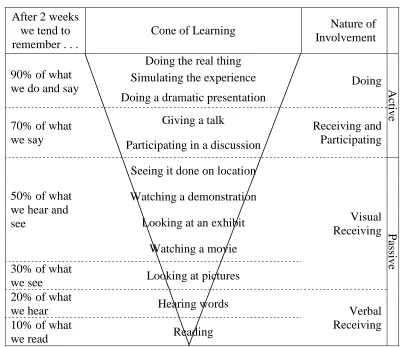
Figure 2.1. Edgar Dale’s Cone of Learning ... 28
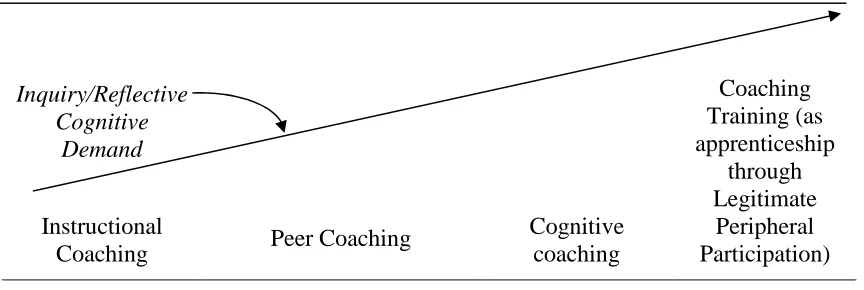
Figure 2.2. Coaching model continuum ... 31
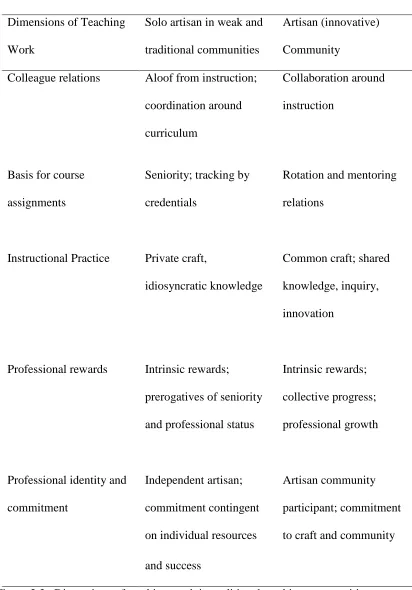
Figure 2.3. Dimensions of teaching work in traditional teach communities Versus Artisan Communities ... 52
Figure 3.1. Descriptions of focus groups ... 61
Figure 3.2. Codes and Code Descriptions for Tier 1 Data: Statement Types ... 68
Figure 3.3. Codes and Code Descriptions for Tier 2 Data: Discourse Types ... 70
Figure 3.4. Focus group activity descriptions ... 74
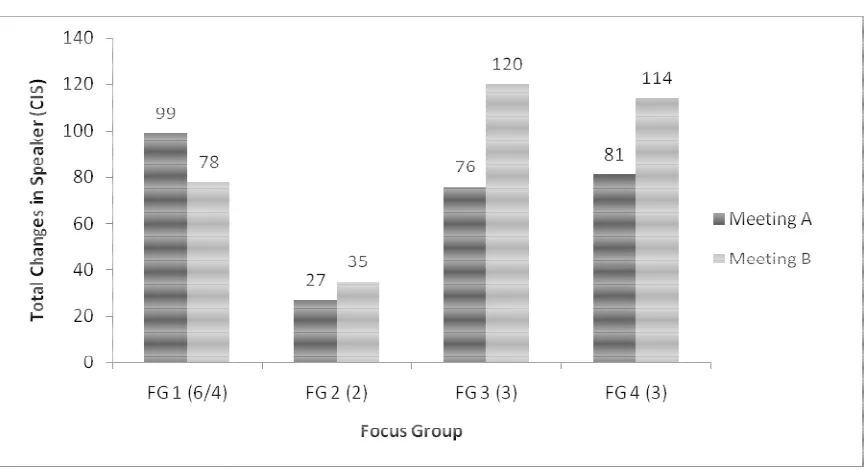
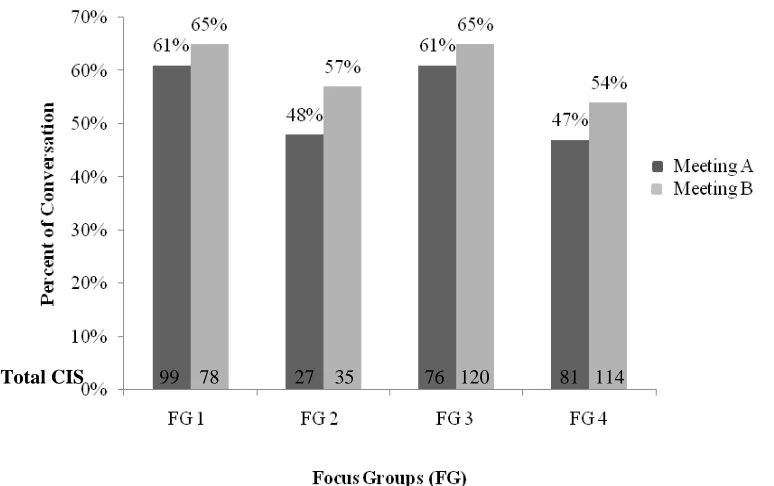
Figure 4.1. Changes to speaker (CIS) for all focus groups, Meeting A and Meeting B... 83
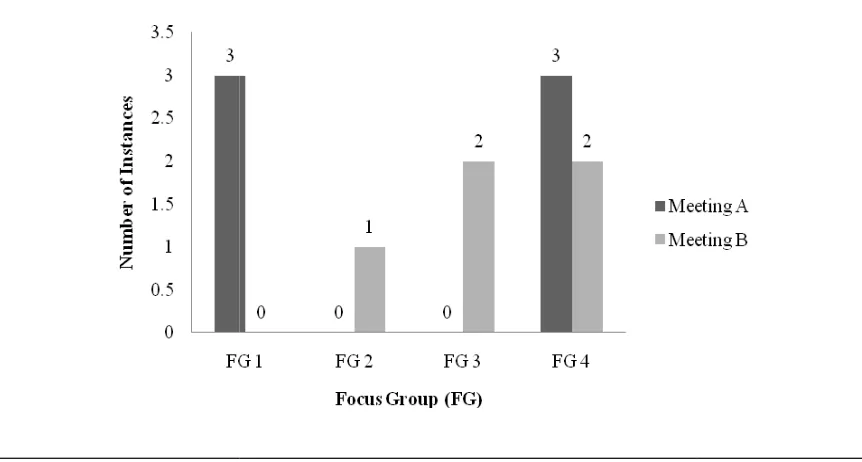
Figure 4.2. Instances of Interrogative: Reference (IR) Statement Types for all Focus Groups Comparing Meeting A and Meeting B ... 84
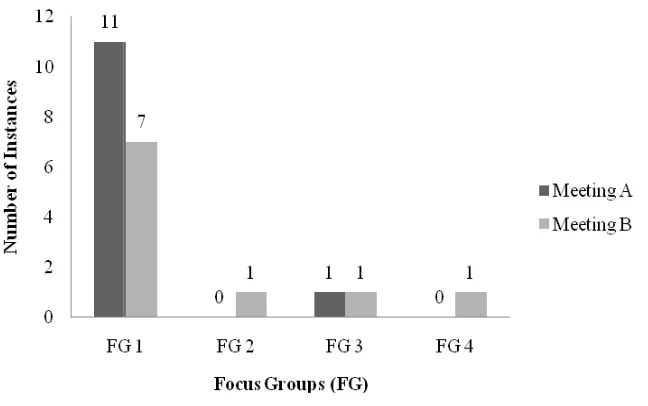
Figure 4.3. Instances of Interrogative: Knowledge (IK) Statement Types for all Focus Groups Comparing Meeting A and Meeting B... 86
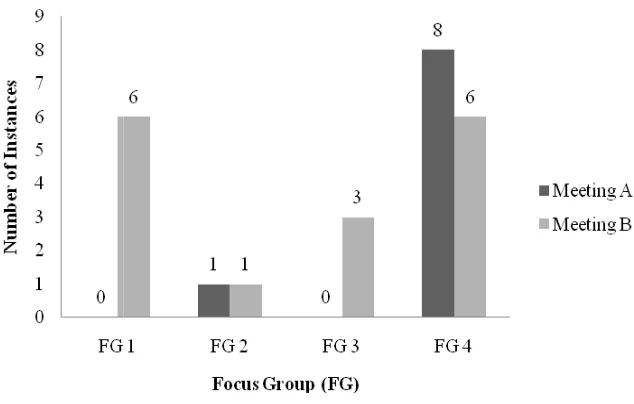
Figure 4.4. Instances of Interrogative: Inquiry-based, other IIO) Statement Types for all Focus Groups Comparing Meeting A and Meeting B... 88
xvii
(Combined) ... 91 Figure 4.7. Instances of Declarative: Reflective (DR) Statement Types for
all Focus Groups Comparing Meeting A and Meeting B ... 93 Figure 4.8. Instances of Declarative: Instructional Model (DIM) Statement
Types for all Focus Groups Comparing Meeting a and Meeting B ... 95 Figure 4.9. Instances of Strategy: Critical (SC) Statement Types for all
Focus Groups Comparing Meeting A and Meeting B ... 97 Figure 4.10. Instances of Strategy: Share (SS) Statement Types for all
Focus Groups Comparing Meeting A and Meeting B ... 99 Figure 4.11. Instances of Strategy: Reflection (SR) Statement Types for all
Focus Groups Comparing Meeting A and Meeting B ... 101 Figure 4.12. Instances of Strategy: Planning (SP) Statement Types for all
Focus Groups Comparing Meeting A and Meeting B ... 102 Figure 4.13. Instances of Judgment Statement Types for all Focus Groups
Comparing Meeting A and Meeting B... 104 Figure 4.14. Statement Types: Total Number of Instances for all Focus
Groups, Meeting A and B ... 106 Figure 4.15. Statement Types: Total Number of Instances for all Focus
Groups, Meeting A and B ... 108 Figure 4.16. Unidirectional Discourse Instances for Focus Group 1-4,
xviii
Meeting A and B ... 112 Figure 4.18. Instructive Discourse Instances for Focus Group 1-4, Comparing
Meeting A and B ... 113 Figure 4.19. Discourse Type Sequence and Duration (Focus Group 1
Meeting A and Meeting B) ... 116 Figure 4.20. Discourse Type Sequence and Duration (Focus Group 2
Meeting A and Meeting B) ... 118 Figure 4.21. Discourse Type Sequence and Duration (Focus Group 3
Meeting A and Meeting B) ... 120 Figure 4.22. Discourse Type Sequence and Duration (Focus Group 4
Meeting And Meeting B) ... 122 Figure 4.23. Discourse Types: Total Number of Instances for All Focus
Groups ... 123 Figure 5.1. Three Tiers of Collaborative Discourse Readiness ... 134 Figure 5.2 Potential Sequence of Change Engagement ... 153
INTRODUCTION
Teachers and students will benefit from improvements in professional development (Darling-Hammond, Wei, Andree, Richardson, & Orphanos, 2009; Ball & Cohen, 1999; Lieberman & Miller, 2001; Fullan, 2001). Hunt (2009) shares his opinion:
I know of no better way to transform the outmoded factory model of school organization and the egg-crate isolation of teachers than to give teachers the tools and support they need and greater responsibility over what happens in their buildings to ensure that all students achieve. This is an effort that will require – and is worthy of – another decade of school reform. (p. 2)
Having worked in schools as a part-time professional development facilitator while also working as a classroom teacher and more recently as a full-time professional
developer focused on establishing a district-wide coaching model, I have seen the consequences of teachers working in isolation, and have, even more significantly, seen the glowing embers of possibility that flare up as we touch on the intersection of useful research, ready teachers, and collaborative synergy. These moments illuminate the exciting possibilities that exist in professional learning as we continuously improve approaches to professional development.
Professional development should be rooted in context and should require reflective, collaborative effort (Darling-Hammond, Wei, Andree, Richardson, & Orphanos, 2009; Zeichner & Liston, 1996; Schon, 1983; Little, 1999). Hirsh (2009) illuminates this reality:
allocations for schoolwide professional development. Title II funding has resulted in the allocation of more than three billion dollars to professional development. More than 40 states have adopted standards calling for effective professional development for all educators accountable for results in student learning. And several national studies on what distinguishes high-performing, high-poverty schools from their lower-performing counterparts consistently identify effective schoolwide
collaborative professional learning as critical to the school’s success. And yet as a nation we have failed to leverage this support and these examples to ensure that every educator and every student benefits from highly effective professional learning. (p. 3)
Not only does the research support these necessities in building capacity and generating lasting change in teacher behavior, but simple observations in schools and conversations with teachers paint the picture quite clearly for anyone willing to look and listen.
How best are these practices encouraged and sustained? Considering social and situated learning theories (Lave & Wenger, 1991; Kirshner & Whitson, 1997; Vygotsky, 1986), a direct and feasible avenue to supporting teacher learning is through communities of practice (Wenger, 1998) or professional learning communities (Hord, 1997, 2004; DuFour, DuFour, & Eaker, 2008) in which teachers work together to construct and deepen knowledge regarding teaching and learning. Might this knowledge be represented in collaborative discourse within teacher groups? The answer to this question might be found delicately balanced on the premise of hope, as it is not overtly common to wander through the halls of schools and hear teachers engaged in inquiry, reflection, and
knowledge construction, with the exception of the highly motivated collaborative team or the colleagues working together in a coaching relationship.
Coaching (Allen & LeBlanc, 2005; Gottesman, 2000; Joyce & Showers, 1982; Knight, 2007; Costa & Garmston, 2002), while gaining popularity in schools and demonstrating success in helping teachers implement effective teaching strategies
(Southern California Comprehensive Assistance Center, n.d.; Joyce & Showers, 1982), is supported by little evidence of programs which are utilizing coaching as a means to intentionally support and develop levels of collaborative discourse among practitioners.
United States” (Hirsh, in Darling-Hammond, Wei, Andree, Richardson, and Orphanos 2009, p. 4).
Current research on the effects that collaboration and coaching have on helping teachers evolve is exciting and vital to school improvement. Considering how
professional development, specifically coaching and training in how to coach peers, influences the conversations teachers have would help professional developers focus on transferring strategies of being and interacting within a community of practice to members of learning organizations, leading to broader influence and potentially greater change through the power of collaborative inertia.
A Framework for Teacher Learning
Lave and Wenger (1991) ask, “what kinds of social engagements provide the proper context for learning to take place” (p. 14). Within this quote, there is the
underlying epistemological view that learners “acquire the skills to perform by actually engaging in the process, under the attenuated conditions of legitimate peripheral
participation” (p. 14). Therefore, teachers should be given authentic opportunities to engage in new and different work with colleagues if pedagogical evolution is to take place. “The common element here is the premise that meaning, understanding, and learning are all defined relative to actional contexts, not to self-contained structures” (Lave & Wenger, 1991, p. 15).
move from no training in an instructional model to a fully supported relationship between training in the model, coaching, and even coaching training, the later which elevates the level of discourse through Legitimate Peripheral Participation as a “coach”, recognized by their ability to work at a higher level of inquiry and critical discourse.
Might certain approaches to professional development produce observable,
measurable results which exhibit discernable characteristics of discourse (Kreckel, 1981; Gee, 2005; Phillips & Hardy, 2002), inquiry (Cochran-Smith & Lytle, 2001; Dewey, 1910, 1938; Ball & Cohen, 1999) and “knowledge-of-practice” (Cochran-Smith & Lytle, 2001; Schon, 1987, 1991)? Answering this question effectively will require the
unpacking of many layers. The first layer, which this study is attempting to illuminate, will provide evidence of the fundamental impact that coaching has on teacher
collaborative discourse compared to more traditional professional development models. An adventure awaits teachers in their everyday work if they are given the
opportunity to engage in a community of practice (Wenger, 1998; Hord, 2004; DuFour, DuFour, & Eaker, 2008), using an apprenticeship model of coaching (Lave & Wenger, 1991) to negotiate participation that values and develops collaboration skills, an inquiry stance, and “knowledge-of-practice” (Cochran-Smith & Lytle, 2001; Dewey, 1910, 1938; Ball & Cohen, 1999; Schon, 1987, 1991).
Professional Learning: Keep It Real
non-engagement. We can interpret similar sentiment through Schwandt and Marquardt’s (2000) description of organizational learning:
Existing knowledge tends to misdirect inquiry rather than facilitate problem resolution. People and organizations need to learn new ways of coping with problems. Only by improving the learning capacity of
organizations can we deal with change dynamics. Thus learning inside the organization must be equal to or greater than change outside the
organization or the organization will not survive (p. 3).
This brings me back to life’s other adventures - those activities which we choose to engage in for the sake of rejuvenation, enlightenment, or even just excitement. I have never seen why every day, both exceptional and ordinary, should not have some element of excitement – the unexpected through which we must navigate new solutions, the engagement of our attention or emotions in a lively and compelling manner - mixed into that window that we can describe as consciousness. In order for this to happen, we must adjust ourselves, posit our perspective of interpretation in a context within which we can create agreement between the familiar and unknown and adjust our attitude from one of problem-creation to problem-solution. I have learned a lot about this philosophy through personal experiences and trial and error.
Get to the Heart of the Matter: A Personal Example
When I was ten years old I went on my first backpacking trip with my Dad, a two-night exploration of the Sierra Nevada. I was determined that in order to truly be a
dusty trail. About forty-five minutes later things weren’t looking too bright. I was sick. Sick of carrying all that weight, which lead to my being sick of walking, which lead to me being sick of my Dad’s excitement. A clear memory I have is of one point in the hike when my proud father wanted to take my picture and I pouted, refusing to smile for the shot. I handed all of my extra gear over to my dad, leaving him to carry my
over-ambitious vision as only a parent can, and me with only the essentials. A day passed, we ate, fished, hiked, napped, and I finished the trip with a much lighter pack and a lesson learned that has stuck with me since – its not the look, not attempting to recreate an image that one believes defines an endeavor, that really matters, it’s the depth with which you take each breath. This is what experience lived authentically and genuinely should be about. Now, whenever I pack for a trip, I follow the famous KIS rule – keep it simple. Settle in, savor the pace, sweat when needed, and smile at all that surrounds you. We must critically evaluate the image that professional development has created of itself and identify the core purposes of professional learning and the most direct avenues to
actualizing these purposes. By doing so, teachers might quite possibly settle in to their roles as learners, savor the pace, and smile at all that surrounds them.
Continuous Improvement: Keep It Simple
non-negotiable here. All movement should, even if through recursive, hermeneutic patterns of reflection and action, be forward movement, a constant pursuit of continuous
improvement. Marquardt (1996) shares a similar sentiment in regards to organizational learning, “The prospect that organizational learning offers is one of managing change by allowing for quantum leaps. Continuous improvement means that every quantum leap becomes an opportunity to learn and therefore prepare for the next quantum leap” (p. 3).
What I have outlined so far are the two critical components that must be acknowledged before engaging more fully with the detailed literature regarding my argument for using an apprenticeship model of coaching within a community of practice to help teachers engage in deeper levels of critical discourse. First, enjoy the adventure of continuous improvement and second, we must keep organizational learning focused on continuous improvement by keeping it simple and stripped of ineffective routines, rituals, and traditions.
I believe in integrated theory, pouring what matters to us most into every task we initiate and doing so through a network of discourse. By pulling this theory into the context of school improvement, I add emphasis to this point – professional development needs to be personal, meaningful, simple, and in the hands of those who are working head-on with the change.
LITERATURE REVIEW
What might be a legitimate goal for professional development? It might be to justify placing professional development in the hands of teachers through a community of practice (Wenger, 1998) that values and develops collaboration skills (Rosenholtz, 1989; DuFour, Eaker, DuFour, 2005; Fishbaugh, 1997), an inquiry stance (Cochran-Smith & Lytle, 2001; Dewey, 1910, 1938; Ball & Cohen, 1999), and knowledge-of-practice (Cochran-Smith & Lytle, 2001; Schon, 1987). I believe, based on current research and experience, that these are the essential networks through which to tap educational change (Fullan, 2001; Lieberman & Miller, 2001; Knight, 2007; Borko, 2004; Ball & Cohen, 1999; Wilson & Berne, 1999). Borko and Putman (1996) suggest the following four professional development truisms to ensure that professional development is meaningful and makes an impact on teacher and student learning: “1) Teachers should be treated as active learners, 2) teachers must be empowered as professionals, 3) teacher education must be situated in classroom practice, and 4) teacher educators should treat teachers as they expect teachers to treat students” (p. 176).
(Darling-Hammond, Wei, Andree, Richardson, & Orphanos, 2009; Ball & Cohen, 1999; Corcoran, 1995; Houghton & Goren, 1995; National Commission on Teaching and America’s Future, 1996). Scribner (1999) shares that, “these studies emphasize the need to (a) integrate professional development into schools through sustained support at the state, district, and local levels; (b) link individual and organizational improvement; and (c) develop organizational contexts that support continuous professional learning” (p. 238). These efforts could save money, time, and, most significantly, could make immediate differences in the learning of students. This represents the concept of Keep it Simple in a few ways.
Keeping it simple tends to bring out the best in most people and scenarios; why not put it to work in professional development? I believe that by keeping professional development simple, i.e. – job embedded, context- and time- based, authentic, and peer dependent, we will see more immediate positive impacts in classrooms than results from traditional professional development in the common form of workshops, trainings, and university coursework (Darling-Hammond, Wei, Andree, Richardson, & Orphanos, 2009; Guskey, 2003). Lieberman and Miller (2008a) explain the origins of such traditional professional learning:
Just as the NDEA had placed the schools in a national defense role, the ESEA positioned them as agents of social change. As before, external experts were charged with the development and dissemination of
curriculum materials and strategies that teachers were expected to adopt with high degrees of fidelity. In both NDEA and ESEA we saw the establishment of a training model of staff development.
recently – in training teachers to implement ‘scientifically based
practices.’ . . . the norm was the transmission of knowledge by experts. (p. 7)
Working on the Periphery
We see it time and again in schools, teachers who attend all of the newest
workshops, have been teaching for years, love their students as only a committed teacher can, but still fail to deliver educational experiences that help their students learn (Ball & Cohen, 1999). I consider this ‘working on the periphery’. As a classroom teacher, I was guilty of working on the periphery on occasion. Working on the periphery refers to those instances when everything looks and feels right, but you have not actually committed your mind, time, and actions to the very simple act of engaging a learner in a learning moment. Professional development has worked on the periphery for years. Ball and Cohen (1999) explain how:
Reformers routinely invoke the need for professional development; and there is no shortage of in-service workshops for teachers. Although a good deal of money is spent on staff development in the United States, most is spent on sessions and workshops that are often intellectually superficial, disconnected from deep issues of curriculum and learning, fragmented, and noncumulative (p. 3).
Mere collegiality will not cut it. Discussions about curricular issues or popular strategies can feel good but go nowhere. The right image to embrace is of a group of teachers who meet regularly to share, refine, and assess the impact of lessons and strategies continuously to help increasing numbers of students learn at higher levels. (p. xiv)
We must continue to invest committed, passionate work into finding ways to take what we know is best in professional development and put it in the hands of teachers. Let’s strip away the glam and flash. Will teachers and administrators miss the exciting trip to Orlando or Las Vegas to receive our free bag and binder full of how-tos? Of course they will. But the rewards of evolving professionally within authentic contexts, working consistently through efficient patterns of reflection, discourse, and action with peers is proving in many schools to far outweigh the loss and will infuse our schools with the inertia necessary to actualize the efforts of many reform movements (Fullan & Miles, 1992; Spillane, 1999; Smith, Wilson, & Corbett, 2009).
Why Bother?
Schools are great places. Teachers lead learners through inspiring journeys every day in the United States. Students are opening the doors to a tomorrow that older
generations never even imagined. Hord (2004) shares that:
the other hand are schools that have changed only minimally, applying knowledge and practices that, at best, merely maintain the status quo. (p. 5)
Schwandt and Marquardt (2000), although speaking through a perspective focused on the business sector, provide strikingly aligned insight into the necessities of organizations in general. Through a business metaphor, we can interpret and anticipate the future of schools that change only minimally, and their prediction is bleak:
“companies that do not become learning organizations will soon go the way of the dinosaur: die, because they were unable to adjust quickly enough to the changing environment around them” (p. 2).
Glennnan, Bodilly, Gallagher, and Kerr (2004) describe multiple cases of success in schools that have been boosting student achievement for at least the past two decades. There are schools decorating our nation with stories similar to the Central Park East that Meier (1995) so proudly speaks of, a school where “children could and should be
inventors of their own theories, critics of other people’s ideas, analyzers of evidence, and makers of their own personal marks in this most complex world” (p. 4). Look closely and critically at your local school system and you should be able to identify practices worthy of praise.
focus of professional development away from these canyons of failure and instead, zooming in on the potential of the pockets of success. After all, we have come a long way.
Comparative History: Looking at Others and Looking at Ourselves
The Third International Mathematics and Science Study ([TIMSS], 2003) throws in our face the fact that “U.S. students performed quite poorly compared with their peers in most Asian and many European countries” (Stigler & Hiebert, 1999, p. 5) and A Nation at Risk (1983), “the most influential school reform report of the 1980s” (Tyack & Cuban, 1995, p. 13), inspired fear and doubt in Americans’ faith of their public school system. Stigler and Hiebert explain that, “The results from TIMSS have garnered a great deal of media interest and have caught the attention of politicians, policymakers, and the general public. The results are dramatic, and they do not paint a flattering picture of American education” (p. 6). However, Meier (1995) adds to this picture:
Until World War II the average American did not graduate from high school. Most teenagers were expected to leave school for unskilled or semiskilled work; even many highly skilled jobs could be aspired to without a high school diploma. On the eve of World War II, the average American had attended school for only nine years, and 12 percent had attended for fewer than five. (p. 70)
While considering where the American education system is today and what students are achieving, we cannot let these facts overshadow the more energizing truths. Meier continues to illustrate that:
of research that ‘on nearly every measure we found steady or slightly improving trends’ over the past three decades. (p. 70)
This is good news . . . but we often do not hear about the good news. “Not only were these findings not heralded, but the report was, in fact, suppressed” (Meier, p. 70). We could analyze reasons for this suppression and others like it; however, this would disrupt our celebration.
The fact is, regardless of the reports we hear and findings that certain studies bring to light, schools are growing and shifting, and education professionals are learning new ways of doing their work (Darling-Hammond, Wei, Andree, Richardson, &
Orphanos, 2009; Darling-Hammond, 2006). This might not be happening as quickly as we would hope and there are certainly some substantial shortcomings in the education children receive across our country, but focusing down this path of failure obscures the awe and excitement that overflows many classrooms every day. Why not look more intensely down the road we would like to travel? To begin this journey, I believe we must make some adjustments to the ‘grammar of professional development.’
The Grammar of Professional Development
impedes change, innovation, and experimentation. Unfortunately, “the standard grammar of schooling has proven remarkably durable” (Tyack & Cuban, p. 87).
So how then might one define the ‘grammar of professional development’? When digging to the root of this question, I must clarify that I believe it too lies in a historical context. In other words, the grammar of professional development does not represent many of the exciting trends that have recently garnered more attention in classrooms, schools, text, and conferences. A few examples of these would be action research (Sagor, 2005), reflective practice (Schon, 1983, 1987, 1991; Zeichner, & Liston,1996),
professional learning communities and collaboration (Hord, 2004; DuFour & Eaker, 1998; Fishbaugh, 1997), and instructional coaching (Knight, 2007).
In contrast to these teacher-centered avenues to continuous improvement, the
grammar of professional development represents the notion of how teachers come into
contact with outside expert knowledge. This grammar includes such traditions as separation of researcher and practitioner, workshop models of knowledge/theory transmission, a general perception that schools need to be fixed and teachers need to be taught how to do their job better (Tyack & Cuban, 1995). It is my own theory that
because of this perception of schools as needing to be fixed, professional developers have become fixated on identifying the problems within schools, only diverting energy from the exciting work waiting to happen, eroding public support for education in general, and this undermines relationships between professional developers and teachers.
those people who are actually in classrooms everyday, looking children in the eyes and speaking the words that make or break the future of America’s learners, thinkers, doers, and makers. What would this shift that I hope for actually sound like? It is subtle. We must speak of teachers as the experts and seek them out as such to engage collaboratively with researchers, theorists, and other practitioners (Schon, 1983). We must speak of the processes of professional development in ways that put students in the center of our intent, then teachers, then theory, research, and academia. We must not speak only of the pitfalls of schools and the shortcomings of teachers as the need for professional
development; instead, we must emphasize the creative, innovative steps that are being taken every day in classrooms by empowered teachers engaging in their own professional learning.
I feel these shifts are important if those of us involved in professional development are to ever truly succeed. By leading our work with a more optimistic grammar and shifting our focus to teachers as experts, professional development might just be the counter pressure needed to slow down the mighty pendulum perception of professional expectations in schools (Lieberman, 2005) and inspire teachers to engage in the amazing work that is continuous improvement through professional learning.
Let’s Get Busy
2005; Garmston, 1997; Little, 1990), an inquiry stance (Lipman, 2003; Cochran-Smith & Lytle, 2001), and knowledge-of-practice (Cochran-Smith & Lytle, 2001; Schon, 1983) schools might realize more immediate, sustained improvement in teaching and learning.
Building a Community of Practice
Research on learning theory through the 1980s and 1990s by Lave and Wenger supports a model of situated learning that proposed, “learning involved a process of engagement in a community of practice” (Smith, 2003, p. 1). A community of practice can be defined by:
What it is about – its joint enterprise as understood and continually renegotiated by its members. How it functions – mutual engagement that bind members together into a social entity. What capability it has
produced – the shared repertoire of communal resources (routines,
artifacts, vocabulary, styles, etc) that members have developed over time. (Smith, 2003, p. 2)
It would likely be argued by most situated cognitivists that you cannot build a community of practice; instead, they naturally exist in the formal and informal contexts of society. Related to this, but illustrating a slightly different angle, Wenger (1998) explains how she believes that:
Considering this, let me explain what I imply by stating that we must build a community of practice. First, we must build an awareness of the concepts of
communities of practice within professional development networks and schools. Wenger (1998) characterizes social participation as a process of learning and knowing and
summarizes critical components of social participation into the following four points: 1) Meaning: a way of talking about our changing ability – individually
and collectively – to experience our life and the world as meaningful. 2) Practice: a way of talking about the shared historical and social
resources, frameworks, and perspectives that can sustain mutual engagement in action.
3) Community: a way to talk about the social configurations in which our
enterprises are defined as worth pursuing and our participation is recognizable as competence.
4) Identity: a way of talking about how learning changes who we are and
creates personal histories of becoming in the context of our communities. (p. 5)
By intentionally bringing about an awareness of these components within school contexts, professional developers will be tapping a knowledge pool (Patterson, Grenny, McMillan, & Switzler, 2002) which holds great potential to transform teaching and learning within a school. My hypothesis fueling this belief is that as teachers develop more integrated metacognitive skills and rely on these skills when navigating their own professional growth they will develop a stronger awareness and a more acute relationship between their ego, superego, and id, specifically in relation to their personal professional growth. This provides some of the power of a site-embedded approach that is built upon the principles of a community of practice and social learning. Wenger supports this point as she describes what matters most about learning:
2) Knowledge is a matter of competence with respect to valued enterprises . . .
3) Knowing is a matter of participating in the pursuit of such enterprises, that is, of active engagement in the world.
4) Meaning – our ability to experience the world and our engagement with it as meaningful – is ultimately what learning is to produce. (p. 4) Secondly, we must build systems and opportunities that support intentional professional social engagement within the work schedule so that educators may express and expand their ongoing pedagogical evolution. Wenger (1998) suggests that “the structure of practice is emergent, both highly perturbable and highly resilient, always reconstituting itself in the face of new events” (p. 233). By scrutinizing and reflecting on this emergent nature of practice, educators may be better prepared to provide for the changing, dynamic needs of their learners. Smith (2003) suggests that, “Learning is social and comes largely from our experience of participating in daily life” (p. 1).
Cochran-Smith and Lytle (2001) expand on these ideas and state that,
“professional development needs to focus on culture building, not skills training . . . must be deeply embedded in the daily life of schools . . . and must feature opportunities for teachers to inquire systematically about how teaching practice constructs rich learning opportunities for some students” (p. 46). Little (1999) explains that:
A school organized for teacher learning would promote the systemic study of teaching and learning in at least two ways. First, the school would support teachers in investigating questions, problems, and curiosities that arise in teaching . . . . Second, a school would promote the study of teaching and learning by developing the organizational habit of shared student assessment. (pp. 236-237)
skills, looking for an inquiry stance and boundary spanners – those conversations that propel teachers beyond their current realities (McLaughlin & Zarrow, 2001). A
community of practice should provide the support and environment that teachers need to collaboratively tackle teacher learning through inquiry of their own practice, but only if the community is cognitively operating with a balance of participation.
Wenger (1998) explains that:
We know who we are by what is familiar and by what we can negotiate and make use of, and that we know who we are not by what is unfamiliar, unwieldy, and out of our purview. This is an important point. We not only produce our identities through the practices we engage in, but we also define ourselves through practices we do not engage in. Our identities are constituted not only by what we are but also by what we are not. (p. 164) Participation and non-participation roles in a community of practice can be classified into three trajectories – peripheral, inside, and marginal (Wenger, 1998). Wenger explains how the role through which we define our identity shapes fundamental aspects of our lives in the following ways:
1) how we locate ourselves in a social landscape 2) what we care about and what we neglect
3) what we attempt to know and understand and what we choose to ignore
4) with whom we seek connections and whom we avoid 5) how we engage and direct our energies and
6) how we attempt to steer our trajectories. (pp. 167-168)
exist within every school building. They exist as the very essence of social beings working within a contextually bound environment, in this case, a school. Wenger (1998) explains that:
Organizations are social designs directed at practice. Indeed, it is through the practices they bring together that organizations can do what they do, know what they know, and learn what they learn. Communities of practice are thus key to an organization’s competence and to the evolution of that competence. (p. 241)
Professional Learning Communities
The closest professional development movement to have capitalized on this essence is the idea of a professional learning community (PLC). Although fundamentally quite different, communities of practice and professional learning communities do share common ideals. For the purposes of this paper, I am only going to illuminate those ways in which I view communities of practice and PLCs working synergistically or ways in which a PLC might create leverage through which professional developers and educators alike might be able to tap into the power of collaborative knowledge building.
Hord (2004) explains how, after A Nation at Risk (1983) was published: researchers began to focus on the influence of the work setting and culture on workers – in both the private corporate world and the public education sector. By the late 1980s teacher workplace factors were introduced into the discussion of teaching quality. Researcher Susan Rosenholtz (1989) found that teachers who felt supported in their own ongoing learning and classroom practice were more committed and effective than those who did not. (p. 6)
Rosenholtz (1989) describes that:
of the many resources required by schools, the most vital are the
it is also the ultimate means through which schools acquire many other necessary resources. (p. 421)
This research began fueling a belief that schools could be improved if more attention was given to supporting “teacher networks, cooperation among colleagues, and expanded professional roles” (Hord, 2004, p. 6). Hord continues, “teachers with a strong sense of efficacy were more likely to adopt new classroom behaviors and that a strong sense of efficacy encouraged teachers to stay in the profession” (p. 6). Senge (1990) mirrored these sentiments in The Fifth Dimension, in which he suggested that
“performing for someone else’s approval – rather than learning to become more
adaptable and to generate creative solutions to problems – creates the very conditions that ensure mediocre performance” (Hord, p. 6). Senge defines a learning organization as a place where “people continually expand their capacity to create the results they truly desire, where new and expansive patterns of thinking are nurtured, where collective aspiration is set free, and where people are continually learning to see the whole
together” (p. 3). This idea works in close concert with much of Schmoker’s work (1999, 2006) emphasizing teamwork, goals, data, results, and research and development.
Key Features of Professional Learning Communities
First, a critical aspect in the sustainability of a community of practice and a PLC is collaboration. DuFour and Eaker (2006) explain that, “Collaboration represents a systematic process in which teachers work together interdependently in order to impact their classroom practice in ways that will lead to better results for their students, for their team, and for their school” (DuFour & Eaker, 2006).
Another shift in teacher thinking within a PLC is from focusing on teaching to looking more closely at student learning. DuFour and Eaker (2006) share that, “The very essence of a learning community is a focus on and a commitment to the learning of each student . . . educators within the organization embrace high levels of learning for all students as both the reason the organization exists and the fundamental responsibility of those who work within it” (DuFour & Eaker, 2006).
Lastly, how does an organization not only embrace high levels of learning, but also actualize high levels of learning and student achievement? This is accomplished through a commitment to continuous improvement. This requires each member of the organization engage in an ongoing cycle of:
• gathering evidence of current levels of student learning,
• developing strategies and ideas to build on strengths and address weaknesses in that learning,
• implementing those strategies and ideas,
• analyzing the impact of the changes to discover what was effective and what was not, and
• applying new knowledge in the next cycle of continuous improvement (DuFour & Eaker, 2006).
suggested through the PLC literature. However, when considering the translation of PLC concepts to a belief in communities of practice, one must be cautioned. Wenger (1998) argues that communities of practice differ from institutional entities along three
dimensions:
1) they negotiate their own enterprise, though they may at times construct a conforming response to institutional prescriptions,
2) they arise, evolve, and dissolve according to their own learning, though they may do so in response to institutional events,
3) they shape their own boundaries, though their boundaries may at times happen to be congruent with institutional boundaries. (p. 241)
Now, lets bring it all back to the core – keeping it simple . . . what is the goal of all this? The literature on communities of practice and learning communities suggests that professional learning should and does take place within context, should be and is
transmitted between participants in the community, and evolves over time. After all, “the greatest resource in a school is still the brainpower and problem-solving ability of the human beings who comprise the school community” (Gottesman, 2000, p. 1). With this said, should, and if so, how, can professional developers help facilitate the evolution of these communities?
The Co-mingling of Situated Learning and Coaching
compared to an 80% application rate for peer coaching (Southern California
Comprehensive Assistance Center, n.d.). Joyce and Showers (1987) also provide the following statistics:
• 5% of learners will transfer a new skill into their practice as a result of theory
• 10% will transfer a new skill into their practice with theory and
demonstration
• 20% will transfer a new skill into their practice with theory and
demonstration, and practice within the training
• 25% will transfer a new skill into their practice with theory and
demonstration, and practice within the training, and feedback
• 90% will transfer a new skill into their practice with theory and
demonstration, and practice within the training, feedback, and coaching (p. 23)
Hawley & Valli (1999) state that, “Teachers need assistance from peer coaches or outside experts to support new instructional strategies” (p. 131). Joyce and Showers (1995) agree that, “Without companionship, help reflecting on practice, and instruction on fresh teaching strategies, most people can make very few changes in their behavior, however well-intentioned they are” (p. 6).
After 2 weeks we tend to remember . . .
Cone of Learning Nature of
Involvement
90% of what we do and say
Doing the real thing
Doing A
ct
ive
Simulating the experience Doing a dramatic presentation 70% of what
we say
Giving a talk Receiving and
Participating Participating in a discussion
50% of what we hear and see
Seeing it done on location
Visual Receiving P
as
si
ve
Watching a demonstration Looking at an exhibit
Watching a movie 30% of what
we see Looking at pictures
20% of what
we hear Hearing words Verbal
Receiving 10% of what
we read Reading
Figure 2.1. Edgar Dale’s Cone of Learning
Building a Model of Co-participatory Professional Development Dale’s (1969) cone of learning illustrates the importance of
community strengthens the image of what constitutes effective professional learning.
With these recommendations in mind, what might a coaching/mentoring approach look like? Sherris, Bauder, and Hillyard (2007) describe one approach involving a
relationship in which, “a coach assists a team of teachers, who may or may not be experienced . . . to implement [a] model in their school” (p. xi) and in the
Mentoring/Induction Coach approach “the . . . mentor provides one-on-one support to an inexperienced teacher, such as one new to the profession” (p. xi). The goal should be to help teachers “develop both a deep understanding of a model and flexible practices for implementing it to a high degree in their lessons” (Sherris, Bauder, & Hillyard, 2007, p. xi). While Sherris et al. (2007) advised coaches that “most teachers need approximately one year of substantial support to fully implement the model in their daily practice” (p xi), and they encouraged coaches to “set long-term goals, provide intensive assistance, and not expect immediate implementation by their teachers” (Sherris et al., p xii), I am not convinced that, even after a year of such support, that coaching alone can lead to the type of internal change required for sustainable continuous improvement within a school (Darling-Hammond, 2006; Borko, 2004).
and processes involved in the innovation and believe that they can make a difference for students” (p. 130). Therefore, when considering the need for coaching models in schools, remember this, “teacher efficacy is enhanced when teachers have opportunities to observe new strategies modeled, practice them, engage in peer coaching, acclimate students to new ways of learning and use new teaching and learning strategies regularly and appropriately” (Hawley & Valli, p. 130).
Here’s the twist – while instructional coaching (Knight, 2007; Sherris, Bauder, & Hillyard, 2007) is proving to be a viable and powerful approach to professional
development (Knight, 2004), I would like to suggest a parallel role for coaches - coaching as apprenticeship through legitimate peripheral participation (LPP) targeting the
approach that I am suggesting as a means to develop cognitive processes focuses more on how to actually establish norms of a community of practice in which teachers engage in critically constructive discourse. I will briefly explain how each of these differs, with a greater focus on defining coaching as apprenticeship through LPP.
Inquiry/Reflective Cognitive
Demand
Cognitive coaching
Coaching Training (as apprenticeship
through Legitimate
Peripheral Participation) Instructional
Coaching Peer Coaching
All coaching approaches can be mutually inclusive Figure 2.2. Coaching model continuum
Instructional Coaching
First, a snapshot of the details behind the role of an instructional coach. Knight (2007) explains that:
The focus of an instructional coach is to help teachers improve their instruction. Instructional coaches are often content or model experts. Their job is to help teachers teach a specific subject more effectively. According to Knight, an instructional coach can obtain a focus by considering one of the “Big Four issues – behavior, content knowledge, direct instruction, and formative assessment” (p. 21). Where traditional instructional coaching falls short is in building upon the advantages of situated cognition. Lave and Wenger (1991) explain that:
Legitimate peripheral participation is not itself an educational form, much less a pedagogical strategy or a teaching technique. It is an analytical viewpoint on learning, a way of understanding learning . . . legitimate peripheral participation takes place no matter which educational form provides a context for learning, or whether there is any intentional educational form at all. (40)
Although this creates counter pressure to my argument for LPP as a valid and necessary formal approach to professional development, Wenger (1998) also suggests that:
Rethinking schooling from the perspective afforded by legitimate peripheral participation will turn out to be a fruitful exercise. Such an analysis would raise questions about the place of schooling in the community at large in terms of possibilities for developing identities of mastery. (p. 41)
While instructional coaching places an expert at the center of the transmission of knowledge, leaving the teacher to passively receive transmitted knowledge, situated cognition engages all parties in a co-constructed relationship of knowledge transmission and creation. Julien (1997) explains that:
Situated cognition is characterized by a concern for competence and an insistence that competence cannot be ignored (e.g., Lave, 1985).
Competence, understood as the ability to act on the basis of understanding, has been a fundamental goal of education. But it is a painful fact of
transfer to the ability to act competently in more “worldly” settings. (p. 261).
I would argue that traditional instructional coaching does not address internal competence that can be easily translated to differential contexts. The social interaction that occurs through instructional coaching is mono-directional; therefore, according to a situated cognitivist, less effective at developing networks of applicable, evolving
knowledge. “From the viewpoint of situated cognition, competent action is not grounded in individual accumulations of knowledge but is, instead, generated in the web of social relations and human artifacts that define the context of our action” (Julien, 1997, p. 261).
Peer Coaching
Next on our continuum, and arguably slightly more representative of, and dependent on, social cognitive theories, is peer coaching. Gottesman (2000) explains peer coaching as:
A simple, non-threatening structure designed for peers to help each other improve instruction or learning situations. The most common use is
teacher-to-teacher peers working together on an almost daily basis to solve their own classroom problems . . . teachers can use their years of training from college and on the job to help each other solve classroom problems. (p. 5)
Peer coaching, following a variety of models (Allen & LeBlanc, 2005; Gottesman, 2000; Costa & Garmston, 2002; Joyce & Showers, 1982) works as a dynamic
and social engagement with ideas around teaching and learning practices” (Southern California Comprehensive Assistance Center, n.d.).
Although more socially dependent than instructional coaching, peer coaching is still typically anchored to a focus on improving instructional practice. To reach farther toward the end of the continuum, I am challenging professional developers to consider how using Legitimate Peripheral Participation (Lave & Wenger, 1991), as a vehicle to establish a greater awareness of localized communities of practice and to help teachers participate fully and constructively in a community which utilizes discourse and reflection to facilitate pedagogical evolution – the ongoing evolution of knowledge, theory,
philosophy, and practice as a teacher negotiates new experiences, reflects on previous knowledge and practice, and shifts her pedagogy in relation to the disequilibrium among these factors (Levin, 2003).
Legitimate Peripheral Participation
Legitimate Peripheral Participation (LPP), as defined by Lave and Wenger (1991) suggests that:
Learning viewed as situated activity has as its central defining
characteristics a process that we call legitimate peripheral participation. By this we mean to draw attention to the point that learners inevitably participate in communities of practitioners and that the mastery of
Drawing on theories of situated cognition (Driscoll, 2005; Kirshner & Whitson, 1997) and the major principals of social learning theory (Bandura, 1986; Vygotsky, 1986; Lave & Wenger, 1991), LPP suggests that learning takes place as one travels through a trajectory of learning which is authentic (legitimate), respectfully co-constructed beginning at a place of little or no direct action and moving toward contexts into which one would become an insider, or full participant (peripheral), and that they are active participants in the practice at hand, even if in non-direct ways (participation). It is important to know, however, that, “the concept of LPP obtains its meaning, not in a concise definition of its boundaries, but in its multiple, theoretically generative
to learning as participation in the social world, and from the concept of cognitive processes to the more-encompassing view of social practice” (p. 43).
The Reality of It All
From my personal experiences working with teachers as an instructional coach, I often find myself trying to describe our relationship, the relationship of coach and person being coached. I try to emphasize the fact that I am engaged in a co-constructive
relationship through which we will both be learning more about teaching and learning. I encourage openness, reflection, critique, and mutual knowledge building. However, it is often hard to cooperatively engage in these processes without the teachers being coached perceiving the relationship, on some level, as a hierarchical transmission of knowledge or judgment. I attribute this to the belief that most teachers have a strongly established schema regarding coaching and this schema runs contrary to my intentions.
both the coach and individual being coached evolve each other’s knowledge and skill to a level previously unobtainable. Hanks (1991) adds to this statement:
This means, among other things, that it [learning] is mediated by the differences of perspective among the co-participants. It is the community, or at least those participating in the learning context, who ‘learn’ under this definition. Learning is, as it were, distributed among co-participants, not a one-person act. While the apprentice might be the one transformed most dramatically by increased participation in a productive process, it is the wider process that is the crucial locus and precondition for this transformation. (p. 15)
An aspect of strength when examining LPP and situated cognition as a method of professional development resides in the fact that it must be contextual. Clancey (1997) explains that, “the theory of situated cognition . . . claims that every human thought is adapted to the environment, that is, situated, because what people perceive, how they,
conceive of their activity, and what they physically do develop together” (pp. 1-2). Lave
and Wenger (1991) explain that:
There is no activity that is not situated. It implied emphasis on comprehensive understanding involving the whole person rather than “receiving” a body of factual knowledge about the world; on activity in and with the world; and on the view that agent, activity, and the world mutually constitute each other. (p. 33)
An Evolving Road Map
to make this transparent to all parties involved. I see LPP as helping with this. This is because, “knowledge remains inert and unused if taught in contexts that separate
knowing from doing” (Driscoll, 2005, p. 156) and “one must consider the broader context in how culture shapes the mind and provides the toolkit by which individuals construct worlds and their conceptions of themselves and their powers” (Driscoll, p. 226).
While one of the defining features that has given coaching in general a good
reputation (Corcoran, 1995) is that it places professional development within the teaching context, provides real time feedback, and actual modeling of practices, it does not
commonly address the deeper level of how one negotiates their own improvement through critical constructive reflection and discourse. These issues might be notable within the different coaching processes, but they are not overtly addressed and developed on any level between the coach and teacher. I believe that by building a coaching
program with greater attention to issues of LPP and communities of practice that these principles could be more easily and successfully addressed.
Secondly, we can better appreciate the significance of social negotiation of learning through Wertsch’s (1985) description of Vygotsky’s theoretical framework, which included:
(1) a reliance on a genetic or developmental method; (2) the claim that higher mental processes in the individual have their origin in social processes; and (3) the claim that mental processes can be understood only if we understand the tools and signs that mediate them. (pp. 14-15)
with peers at levels that strip assumptions away and force critical dialogue. Both the coach and teacher will need to symbiotically create and navigate the cultural artifacts that define their involvement in and creation of their community of practice related to
pedagogical evolution through collaborative discourse and deconstructive practice – the skill of breaking apart one’s practice into reflective segments with the purpose of analyzing for improvement. This co-participation is critical because of reasons clarified above within the literature on LPP and communities of practice which can be
summarized best by Lave and Wenger (1991) in the following statement: “The purpose is not to learn from talk as a substitute for legitimate peripheral participation; it is to learn to talk as a key to legitimate peripheral participation” (p. 109).
With LPP as the avenue through which to build a community of practice, we must next illuminate what practices might be ideal in defining the roles within the type of community of practice I am envisioning, working parallel to and in concert with other current communities built around the practices of cognitive coaches and peer coaches.
Choosing The Words That Change How We Think
It is argued within this paper that it is this dialogue, critical inquiry-based discourse that we must scaffold and develop in professional development if we are to influence lasting change at a cultural, social level. However, as mentioned previously, the majority of coaching initiatives operate on the premise of improving instructional delivery
(Knight, 2007).
We are seeing wonderful results from these efforts (Joyce & Showers, 1987, 1982; Southern California Comprehensive Assistance Center, n.d.) and many schools are moving to professional development models that utilize coaching as the core vehicle for improving teaching. There is growing belief that “the general orientation of the new approach to professional development is more constructivist than transmission-oriented” (Cochran-Smith & Lytle, 2001, p. 45). This is exciting news, and the progress made in professional development in relation to increased effective use of instructional coaching has provided us with the fulcrum from which to pry open an entry point to a deeper level of professional learning, professional learning which embraces the development of inquiry based discourse. This will require a different approach to coaching.
What Might It Look Like?
I will continue to describe this deeper level through the lens of a coach, operating within an overtly transparent community of practice, using an apprentice approach (Lave & Wenger, 1991) to help both coaches and teachers negotiate the discourse and
reflection and analysis of instructional practice. After all, “new images of professional development are informed by research about how teachers think about their work”
(Cochran-Smith & Lytle, 2001, p. 45; see also Clark & Peterson, 1986). While such goals have been argued for some time now, I have found little evidence of any clearly
established means of building this level of cognition through professional development and within schools. I believe that coaching might be the ticket.
A self-exposing apprenticeship model which utilizes the verbal expression of metacognition and metatalk to empower teachers in developing stronger collaboration skills (Fishbaugh, 1997), inquiry communities (Cochran-Smith & Lytle, 2001),
Collaboration
While I will not be providing an in-depth analysis of collaboration, for I feel many authors and researchers have already illuminated the details and necessity of this topic quite thoroughly, I must make it clear that at the heart of my argument for coaching at a deeper level with a conscious awareness of a community of practice, there must reign an integrated, dependent reliance on collaboration. It is collaboration that “brings small sparks together to generate breakthrough innovation” (Sawyer, 2007, p. 102). DuFour and Eaker (2006) explain that, “Collaboration represents a systematic process in which teachers work together interdependently in order to impact their classroom practice in ways that will lead to better results for their students, for their team, and for their school” (retrieved from www.allaboutplc.com on March 8, 2008).
Fishbaugh (1997) shares that “educational collaboration has been termed a catalyst for change . . . they [Idol & West, 1991] define collaboration as an interactive relationship, an adult-to-adult interactive process” (p. 8). Schmoker (2005) emphasizes that “the right image to embrace is of a group of teachers who meet regularly to share, refine, and assess the impact of lessons and strategies continuously to help increasing numbers of students learn at higher levels” (p. xiv). DuFour (2005) explains:
The powerful collaboration that characterizes professional learning communities is a systematic process in which teachers work together to analyze and improve their classroom practice. Teachers work in teams, engaging in an ongoing cycle of questions that promote deep team learning. This process, in turn, leads to higher levels of student achievement. (p. 36)
practices, teachers in many schools continue to work in isolation” (DuFour, 2005, p. 36).
The good news is that collaboration skills can be taught and learned. There are many models and processes that support the development of collaboration in various settings (Fishbaugh, 1997) and as argued in this paper, helping teachers learn these models and processes should be one of a coach’s roles if the goal is to establish norms within a community of practice which yield high results in increased attention to continuous improvement.
Even more specifically, beyond simply collaborating, what might be the consequences in schools if coaches, using Legitimate Peripheral Participation, helped teams of teachers experience group flow (Sawyer, 2007, p. 43), a collaborative experience of seamless interaction and/or performance among a group. Sawyer (2007) explains that:
Basing my research on Csikszentmihalyi’s seminal work, I discovered that, sure enough, improvising groups attain a collective state of mind that I call group flow. Group flow is a peak experience, a group performing at its top level of ability. In a study of over three hundred professionals at three companies – a strategy consulting firm, a government agency, and a petrochemical company – Rob Cross and Andrew Parker discovered that the people who participated in group flow were the highest performers. In situations of rapid change, it’s more important than ever for a group to be able to merge action and awareness, to adjust immediately by improvising. In group flow, activity becomes spontaneous, and the group acts without thinking about it first. (pp. 43-44)