43
An Action Learning Approach to Changing
Teaching Practice Using Group Reflection
on Student and Graduate Feedback
Lorna Jarret, Damien Field, Tony Koppi
Corresponding author: Damien field
Faculty of Agriculture, Food and Natural Resources, The University of Sydney, NSW 2015, Australia
Keywords: cultural change, student feedback, scholarship of teaching, collaborative reflection, action learning
International Journal of Innovation in Science and Mathematics Education, 19(1), 43-54, 2011.
Abstract
We present a model for a collaborative activity intended to promote scholarship of teaching and contribute to curricular change through small-group discussion and reflection on feedback from current and former students. Reflection on teaching is often a lone activity and the literature suggests that lone reflection on teaching can fail to confront entrenched attitudes. This paper describes the process by which we collected data on students’ and former student’s learning experiences; prepared the qualitative data for discussion by cross-institutional groups; structured the discussion activities to maintain focus on cultural change; and evaluated the activities’ impact. The activity was carried out as part of our ALTC-supported project’s first academic forum and repeated during the second forum, with refinements to the procedure based on evaluation of the first activity. Data collected for evaluation of the first and second iterations of the activity suggests that it is an effective strategy for the promotion of scholarship of teaching and the associated development and implementation of changes to teaching practice.
Background
This paper describes the development of structured group reflection activities intended to promote scholarship of teaching and learning among soil science academics from five institutions. The activities involved discussion of qualitative data on current and former students’ learning experiences; and lead to the generation of recommendations for teaching practice. The activity was first carried out during the project’s first academic forum, which brought academics together for the first time specifically to discuss education. The forums were attended by teaching staff from all participating institutions and comprised several sessions intended to promote engagement and reflection. Evaluation of the activity demonstrated its effectiveness in promoting critical reflection, so a similar activity was developed for the second forum using new data from graduates and with the additional participation of employers.
44
education and graduates have valuable knowledge of how their effective their educational experiences were in preparing them for work. Surveying graduates in the workplace who have recently experienced a university curriculum can be an effective force for informing curriculum revision on a number of issues (Koppi et al, 2009, 2010a, 2010b). Therefore consultation with these groups is vital in helping to ensure that the intended, delivered and received curricula are aligned, alternative viewpoints are heard, unexpected and unintended issues are less likely to be neglected, and misleading results are less likely (Bath et al., 2004; Bruinsma & Jansen, 2007; Plaza, 2007; Wachtler & Troein, 2003). Consultation with stakeholders can take the form of surveys, interviews or focus groups. Our consultation with students and former students took the form of online surveys developed by the project team. The authors are pleased to make the surveys available: please contact them directly if you would like to use any of the surveys.
Introduction and rationale for the activity
The curriculum that our ALTC-supported project aims to develop will be student-centred, encouraging students to take an active role and assume responsibility for their learning: this will involve cultural change for both staff and students. According to Schön (1987) and Brookfield (1995), peer discussion and reflection on teaching practices can contribute to the process of cultural change. Fullan (1999) states that reflection by individuals, between groups and within organisations, is essential to effecting change in teaching practice. However, Fendler (2003) points out that reflection based only upon the teachers’ own thoughts can fail to confront existing ways of thinking. Loughran (2002) asserts that in order for reflection to be meaningful, a method must be found to enable teachers to see their practice as others do. Therefore we devised a method which allowed teaching staff to reflect on their practice; which incorporated the input and perspectives of others; and which focused on effecting change. While there is a vast literature on the scholarship of teaching and learning (e.g. (Healey, 2000) we were unable to identify any studies describing group reflection on student feedback.
45
Andresen (2000) asserts that the activities of intellectual development, inquiry and action must be personal but rigorous. A component of scholarly teaching is the provision of a process for staff to assess the quality of their teaching. This process should be activity-oriented, student-centred and should lead to a resonance between what teachers aim for and what students experience (Trigwell & Shale 2004). Trigwell and Shale’s scholarship model assumes a partnership rather than an instructional relationship between teacher and student and thus advocates the inclusion of the student voice as a means to participate in the disciplinary community. Our activities addressed this by making students’, and former students’ voices the focus of staff reflection and group discussion. For this reflection to contribute to scholarship there also needs to be the opportunity for teaching staff to identify how this can be used to effect change. In order to fulfill this we asked our participants to generate recommendations for practice based on their interpretation of the feedback: in the first activity participants generated learning and teaching principles and during the second activity they suggested changes to teaching practice.
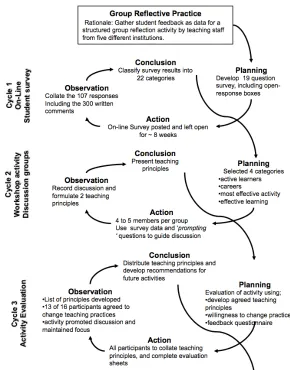
Preparation of the group-discussion activities involved a number of stages: development of the surveys; collation and preparation of the data; implementation of the forum session; and its evaluation. These are described in detail in the following sections. The preparation and execution of this activity is illustrated in Figure 1 as a series of cycles forming an action learning process (Kemmis & McTaggart, 2001).
46
Methods and Results
Both activities followed the same basic format. Online surveys were developed by the project team and made available for about one month. Qualitative data from these were categorised according to emerging themes. Subsets of the data were assembled for groups to discuss during the forum sessions. To stimulate and guide discussion, a set of suggested questions and description of required output was provided. Each activity began with a brief summary of quantitative data from the survey and an explanation of the activity. Each group was given their comments and instructions. They discussed the data, formulated their response, recorded their responses on paper and gave a brief audio-recorded presentation of their ideas.
The development of a set of teaching principles for soil science (Field, Koppi, Jarrett, Abbott, Cattle, Grant, McBratney, Menzies, & Weatherley 2011) was a major focus of our first forum, so a natural choice of task of the first activity was to ask participants to generate teaching principles for the theme that their comments addressed. We did not want to adapt existing teaching principles from another discipline as this might be seen as ‘preaching’ to the participants and would therefore be unlikely to lead to ownership of the project or to result in lasting change. As the project progressed we felt it was appropriate to ask for more specific recommendations for change, so the task for the second activity was to suggest possible changes to teaching practice that could address the issues raised by graduates. Table 1 summarises the numbers of participants and survey comments for the two activities. Written responses in the form of recommendations for teaching practice, audio-recordings of presentations and evaluation forms completed at the end of each forum served as sources of data for evaluation of the effectiveness of the activities.
Table 1: numbers of participants and comments for activities 1 (refection on feedback from current students) and 2 (reflection on feedback from graduates)
The first activity: refection on feedback from current students, forum 1
Development of the survey
We obtained Ethics approval for all project activities including surveys and participation of teaching staff and employers. The authors and project leader developed the student survey which was trialed by members of the project team at the partner institutions. The survey design was informed by Fowler (2002) with open-response boxes in most questions to allow respondents to express their ideas fully and avoid constraint by the survey design (Figure 1, cycle 1). The survey was made available online for four weeks. 107 students from all participating institutions responded to the survey and made over 300 comments in total. This represents a response rate of approximately 24 percent.
Activity 1 Activity2
Number of participants 16 19
Group size for activity 3-5 4-5
Number of survey respondents 107 205
Number of survey comments supplied to each group
18-25 33-41
47
Preparation for the activity
Prior to the forum the qualitative data were assigned by the lead author to one or more themes (Figure 1, cycle 1). Some of these themes were determined by the survey questions but most emerged from the data. This qualitative data analysis method was informed by the work of Bogdan and Bicklen (2002) and Boyatzis (1998).
The next stage involved choosing which themes would be the focus of for discussion amongst the groups. Our selection criteria were: interest to participants; potential for contribution to the development of teaching principles; and alignment between the outcomes of the activity and the desired outcomes of the wider project. The themes we chose were: ‘active learners’, ‘careers’, ‘most effective activity’ and ‘effective learning’ (Figure 1, cycle 2). Comments which had been placed into these themes were extracted to form a list for each theme containing between 18 and 25 comments. Any potentially identifying information was removed and spelling corrected but no other changes were made.The four sets of comments were printed and the pages cut into strips containing single comments. This was to prevent the participants perceiving them as an ordered list with the associated primacy / recency (Jersild, 1929) effects; to help participants to focus on each comment individually; and also to allow participants to physically organise the comments into groups to aid their analysis.
The activity
Forum participants were assigned to four groups, with at least one member of each institution in each group wherever possible (Figure 1, cycle 2). Each group was issued with a set of student comments belonging to one of the themes, a set of instructions comprising two tasks and a list of possible questions to stimulate discussion. The instructions for the four groups were broadly similar, but the focus questions and tasks were tailored to the category under consideration. As an example, the instructions for the category ‘active learners’ are shown below:
Tasks – ‘active learners’
1. Write down words and phrases to summarise what the data suggests about fostering active learners.
2. Can you formulate two teaching principles to support and encourage students to take responsibility for their learning?
Possible questions to focus discussion
1. How would you define an active learner?
2. Are our students active and self-motivated learners?
3. What factors are preventing them from taking a more active role in their learning? 4. What things are we doing to help them take responsibility for their learning? 5. Are there any contradictions in what the students say? Can you explain these? 6. What skills do students need to engage in active or self-directed learning?
7. What topics, activities and year groups is active or self-directed learning suitable / unsuitable for?
48
Evaluation and recommended changes to the activity format
The activity was evaluated in terms of:
• Principles derived from the student comments by each group
• The intention, expressed by most participants, to make changes to their teaching as a result of the forum
• Feedback from the participants, ALTC project team members and the project evaluator who was in attendance.
The most tangible outcomes of the activity were the teaching principles generated by each group (Figure 1, cycle 3). Less tangible outcomes include focused reflection and discussion between teaching staff, engagement with and critical evaluation of students’ feedback and a feeling of ownership of the project. Evidence of these was gathered through observation of participants during the activity, participants’ forum evaluations and comments made by the ALTC project team and evaluator. Of the sixteen participants who completed forum evaluations, thirteen agreed or strongly agreed that they would change something about their teaching as a result of the forum. Given that this forum was intended simply to begin the process of cultural change in teaching, this is a powerful result. Participants made the following comments on their evaluation forms:
“Interpretation of student comments – good because we were interpreting / analysing actual feedback”
“Student feedback information and good teaching principles were very useful” “It was excellent to share ideas about teaching with other soil scientists”
“Props were good, some thought had gone into “helping” us contribute at sessions” “Students’ feedback – too much to do in the given time”
These comments demonstrate the value of both the activity’s structure and use of recent student feedback but underline the importance of providing enough time for participants to fully engage.
The ALTC project team discussed the activity the next day as part of their forum appraisal. This discussion was audio-recorded and the following remarks were made about the activity:
“The group activities worked surprisingly well. What we did was effective and generated a depth of discussion that perhaps we wouldn’t have achieved otherwise”.
“I thought it went extremely well and I’ve been to many of these sessions. People were obviously genuinely engaged – it wasn’t just a talk-fest”.
“The preparation really made the day work. The structure made it so that people wanted to come. The structure was good – that was an important part of why it worked”.
49
potentially enable us to study the process by which the groups analysed the feedback and decided on their response. Finally, Trigwell and Shale (2004) caution that scholarship does not end with discussion but depends critically on putting ideas into action. Therefore it seems appropriate to develop a strategy for follow-up: for example inviting participants to record changes that they wanted to make as a result of the forum and soliciting feedback on whether they had made the intended changes. This would feed into a further cycle in the action learning process (Figure 1).
The second activity: refection on feedback from current students, forum 2
Development of the survey
As with the student survey, the survey of graduates concerning their curriculum was designed by the project team and made available online for five weeks. During this time we received 205 responses but because the survey was forwarded to Alumni offices for dissemination we do not know how many people were invited and so cannot calculate the participation rate. This survey focused on attributes, qualities and discipline knowledge required in the workplace. Rather than an analysis of the entire qualitative data set, our forum activity was based on responses to one question which asked:
‘Do you have any suggestions for improvement of your university soil courses?’
There were a number of reasons for this choice of data set. First, we received twice as many responses as to the student survey, so it was not feasible to analyse the entire qualitative data set in the time available. We felt that focusing on all responses to one question had more authenticity than selecting comments from across a number of questions. Second, we wanted participants to focus on possible improvements to teaching practice, so responses to this question were well-matched to our purpose. Third, this question followed a series of questions relating to attributes, qualities and discipline knowledge and we expected that reflecting on their responses to these previous questions would help prompt graduates to give particularly insightful answers.
Preparation for the activity
Qualitative data analysis was carried out using the same method as for the first activity. We created four lists of between 33 and 41 comments. To compensate for the larger number of comments we increased the discussion time; also the participation of employers in this activity increased group sizes. Again, comments were printed on separate slips of paper and instructions provided.
The activity
As before, participants were assigned to four groups with each group containing an employer and where possible, a member of staff from each participating institution. Twelve teaching staff, seven employers and the chair of the reference group attended. Groups were given the following instructions:
Tasks:
1. Indentify the most significant issues raised in these comments
2. Formulate THREE possible changes to teaching practice that could be implemented to address these issues.
Questions to guide discussion:
50
2. Identify the key concepts (which could be words or phrases) in each comment. Do you see any patterns emerging?
3. What are the most common issues raised, and what is being said about these? 4. Do comments on common issues tend to agree or disagree with each other? If they disagree, can you suggest reason for this?
5. Are there any comments that you will discount, and why?
Presenting your findings:
Please jot down notes during your discussion, and to summarise your final results, which should include:
• The most significant issues raised
• THREE possible teaching practices to address these issues
For this activity the groups had 45 minutes of discussion time: an increase of 50% on activity 1. However although all groups were able to formulate a set of three possible changes to teaching practice (some groups suggested more), two groups felt that there was insufficient time for discussion. This suggests that less data should be provided, more time allowed for discussion or more active strategies for time management employed during the activity. As a result of our evaluation of the first activity, we audio-recoded all group discussions. Recordings were analysed and provided insight into the groups’ data-analysis and decision-making process.
Survey: feedback from participants of implementation of suggested changes to teaching practice
Evaluation of the first activity identified the importance of including follow-up on translation of ideas into action, so we decided to contact participating teaching staff to find out whether they had implemented any of the suggested changes. Four weeks after the activity we distributed the forum report which included the suggested changes to teaching practice and at the start of the following session we surveyed all participating teaching staff. Each group had been asked to formulate three possible changes to teaching practice. We pooled all the suggested changes into one list of 17 items. We surveyed all participating teaching staff using this list to preserve anonymity and to allow respondents to consider changes that had been suggested by other groups.
For each item on the list, respondents were asked whether they: • Would definitely not make the change in the next 18 months • Would probably not make the change in the next 18 months • Would probably make the change in the next 18 months • Would definitely make the change in the next 18 months • Had already made the change before the forum
• Had made the change since the forum Or
• The change was not applicable to their teaching area.
51
Evaluation
The second activity was evaluated in terms of:
• Possible changes to teaching practice derived from the student comments by each group
• The intention, expressed by most participants, to make changes to their teaching as a result of the forum
• Feedback from the participants and ALTC project team members • Analysis of audio recordings of the discussion process
• Survey feedback on implementation of suggested changes
Three of the four groups were able to suggest three or more possible changes to teaching practice in response to graduates’ feedback: the fourth group ran short of time but were able to generate two possible changes. Fourteen participants completed evaluation forms for the day’s activities. Twelve of these, ie: all of the teaching staff, agreed or strongly agreed that they would change something about their teaching as a result of the forum and fifteen agreed or strongly agreed that feedback from graduates in the workplace was useful. No respondents disagreed with either statement. Participants made the following comments on their evaluation forms:
“They made me think about learning and teaching and what students need to become”. “Sharing of ideas and critiquing them in a non-threatening environment was a plus”. “it would be better if some graduates were in attendance to give feedback”.
Audio-recordings of group discussions provided further data for evaluation of this activity, enabling us to study the process by which groups arrived at their recommendations. One surprising finding was that most groups did not refer to the list of guiding questions during their discussion. All groups also asked the lead author for clarification of the task. This, along with comments by group members suggests that the task was perceived as more complex than the lead author realised and imposed a high cognitive load (Kirschner, 2002; Paas, Renkl, & Sweller, 2003; Sweller, 1994; Sweller & Chandler, 1991).
“There’s a fair bit of work, a lot to absorb. It’s very complex – great Scott!” “We’ve got too many [comments]”
52
in itself as it enabled us to follow up these ideas. This further demonstrates the value of audio-recording discussions if participants consent.
We surveyed participants 16 weeks after distributing the forum report to find out about their uptake of suggested changes. This time gap was longer than was originally intended and was due to lack of availability of teaching staff during December and January. Ten of the twelve teaching staff responded to the survey: everyone “probably” or “definitely” intended to make at least 2 changes. The average number of “probable” changes per respondent was 2.6 and for “definite” changes the average was 2.2. Given that the activity involved groups generating three possible changes to practice, we consider this a very encouraging result. A notable finding was that although there was at least one positive response to every suggested change (ie: “probably in the next 18 months” or “definitely in the next 18 months”), no respondent claimed to have made any of the suggested changes since the forum: in other words, although none of the participants had implemented changes in the period between the forum and the survey, participants did intend to implement some changes. This suggests that follow-up strategies such as this survey may play a useful role in reminding participants of their ideas and prompting them to put them into action. Out of the seventeen suggested changes to practice, fourteen were already established practice for at least one respondent. This suggests that some participants may have suggested teaching practices that were already a part of their repertoire. However, the fact every suggested change was intended to be taken up by at least one participant means that either some participants were generating new ideas for change to their own practice or that cross-fertilisation of ideas was taking place, with established practices of some staff being considered for implementation by others. New units of study were cited as providing opportunities to implement change.
Conclusions and recommendations
Reflection by individual teachers on feedback from their students is a common practice (Hoban, 2000; Hoban & Hastings, 2006; Wickramasinghe & Timpson, 2006) but we believe that the cross-institutional group activities described here have the additional advantages of greater anonymity for survey respondents, feedback from a wider group of learners and staff collaboration. The on-line student survey was clearly identified as cross-institutional. This may have encouraged students to be more forthright in their comments as opposed to completing an evaluation in their ‘classroom’. Rather then reflecting on data from a group of students they had recently taught, the participants reflected on feedback from all participating institutions, representing (within sampling limitations) the perceptions of the whole student body. This may have had the effect of de-personalising the experience and making it less threatening. The collaboration of teachers from different institutions, each with their own experiences, culture and concerns, may have increased the opportunities for questioning assumptions and breaking out of entrenched ways of thinking (Garry Hoban & Hastings, 2006). The results of our follow-up survey confirm that these activities succeeded in prompting staff to think seriously about implementing changes to practice, with all survey respondents intending to implement change and, importantly, all but one respondent
“definitely” intending to implement at least one change.
53
demonstration is carried out (Chandler & Sweller, 1991) Evaluating our action learning cycle, we are satisfied that each cycle produced information of sufficient quality to inform the subsequent cycles. Audio recordings were useful in shedding light on the data-analysis and decision-making processes. Discussions were not inhibited by audio-recording and sound quality was sufficient despite four groups sharing one room.
The follow-up survey appeared to have value in reminding participants of their ideas and possibly prompting them to plan changes. In order to ascertain whether changes are implemented, it would be necessary to contact participants again. Given that no participant reported making any of the suggested changes in the period between the forum and the survey, it might be preferable to leave less time between the forum and distribution of the survey: it could be linked to distribution of the forum report.
Future research
Possible further research directions include the application of design principles based on Cognitive Load Theory to reduce the cognitive load imposed by the task and the further development of follow-up activities to encourage and support staff in implementing changes to practice.
Acknowledgements
We acknowledge the Australian Learning and Teaching Council for funding the project of which this activity is a part, and everyone who completed the graduate and student surveys. We also want to acknowledge the invaluable contribution of all forum 1 and 2 participants (Alex McBratney, Annie McNeill, Balwant Singh, Cameron Grant, David Chittleborough, Deli Chen, Lori Watson, Lyn Abbott, Martin Fey, Mike McLaughlin, Neal Menzies, Peter Kopittke, Ron Smernik, Stephen Cattle, Talitha Santini, Tony Weatherley, Carter, Phil Mulvey, Simon Leake, Dave McKenzie, Richard McEwan, Dave Anthony, Pat Hulme and Stuart Macnish).
References
Andresen, L. W. (2000). A useable, trans-disciplinary conception of scholarship. Higher Education Research & Development, 19(2), 137–153.
Bath, Smith, Stein, & Swann. (2004). Beyond mapping and embedding graduate attributes: bringing together quality assurance and action learning to create a validated and living curriculum. Higher Education Research & Development, 23(3), 313-328.
Bogdan, R. C., & Biklen, S. K. (2002). Qualitative Research for Education: An Introduction to Theories and Methods (4th ed.). Boston, Mass, Allyn & Bacon.
Boyatzis, R. E. (1998). Transforming qualitative information: Thematic analysis and code development. Thousand Oaks, CA, Sage Publications.
Brookfield, S. D. (1995). Becoming a Critically Reflective Teacher. Jossey-Bass Higher and Adult Education
Series, San Francisco, CA., Jossey-Bass, Inc.
Bruinsma, M., & Jansen, E. (2007). Curriculum mapping: integrating multiple perspectives on the curriculum.
curriculum and teaching, 22(1), 25-45.
Chandler, P., & Sweller, J. (1991). Cognitive load theory and the format of instruction. Cognition and Instruction, 8(4), 293-332.
Cohen, Manion, & Morrison. (2007). Research methods in education. London ; New York, Routledge.
Daniels, & McLean. (2004). Integrating Technology into Teacher Education Through Curriculum Mapping: An Update on Year Two. Proceedings of Society for Information Technology and Teacher Education
International Conference 2004, (pp. 2089-2094). Presented at the Society for Information Technology and Teacher Education International Conference (SITE) 2004, Atlanta, GA, USA.
Fendler, L. (2003). Teacher Reflection in a Hall of Mirrors: Historical Influences and Political Reverberations.
54
Field, D. J., Koppi, A. J., Jarrett, L., Abbott, L., Cattle, S., Grant, C., McBratney, A., Menzies, N. and Weatherley, T. (2011). Soil science teaching principles. Geoderma (accepted)
Fowler, F. J. (2002). Survey research methods. Thousand Oaks, CA: Sage Publications. Fullan, M. (1999). Change forces: the sequel. Philadelphia, PA: Falmer Press.
Harden, R. (2000). Curriculum mapping: a tool for transparent and authentic teaching and learning. Medical researcher, 23(2), 123-137.
Healey, M. (2000). Developing the scholarship of teaching in higher education: a discipline-based approach.
Higher Education Research and Development, 19(2), 169–189.
Hoban, G. (2000). Making practice problematic: Listening to student interviews as a catalyst for teacher reflection. Asia-Pacific Journal of Teacher Education, 28(2), 133–147.
Hoban, Garry, & Hastings, G. (2006). Developing different forms of student feedback to promote teacher reflection: A 10-year collaboration. Teaching and Teacher Education, 22(8), 1006-1019.
doi:10.1016/j.tate.2006.04.006
Jersild, A. (1929). Primacy, recency, frequency, and vividness. Journal of Experimental Psychology, 12(1), 58-70. doi:10.1037/h0072414
Kemmis, S., & McTaggart, R. (2001). Participatory action research. In N. Denzin & Y. Lincoln (Eds.), Handbook of Qualitative Research (Second ed., pp. 567-605). Thousand Oaks: Sage.
Kirschner, P. A. (2002). Cognitive load theory: implications of cognitive load theory on the design of learning.
Learning and Instruction, 12(1), 1-10. doi:10.1016/S0959-4752(01)00014-7
Koppi, T., Sheard, J., Naghdy, F., Chicharo, J., Edwards, S. L., Brookes, W. and Wilson, D. (2009). What our ICT graduates really need from us: a perspective from the workplace. In M. Hamilton & T. Clear (Eds),
Conferences in Research and Practice in Information Technology, 95, (pp 101–110), Eleventh Australasian Computing Education Conference (ACE2009).
Koppi, T., Edwards, S. L., Sheard, J., Naghdy, F. and Brookes, W. (2010a). The case for ICT work-integrated learning from graduates in the workplace. In T. Clear & J. Hamer (Eds.), Conferences in Research and Practice in Information Technology, 103 (pp 107–116), Twelfth Australasian Computing Education Conference (ACE2010), Brisbane, Australia, January 2010.
Koppi, T., Sheard, J., Naghdy, F., Edwards, S. L. and Brookes, W. (2010b). Towards a gender inclusive information and communications technology curriculum: a perspective from graduates in the workforce.
Computer Science Education,20(4), 1–18.
Loughran, J. J. (2002). Effective reflective practice: In search of meaning in learning about teaching. Journal of Teacher Education, 53(1), 33.
Paas, F., Renkl, A., & Sweller, J. (2003). Cognitive Load Theory and Instructional Design: Recent Developments. Educational Psychologist, 38(1), 1. doi:10.1207/S15326985EP3801_1
Plaza. (2007). Curriculum Mapping in Program Assessment and Evaluation. American Journal of Pharmaceutical Education, 71(2). Retrieved October 31, 2011, from
Schön, D. A. (1987). Educating the reflective practitioner. San Francisco: CA, Jossey-Bass.
Sweller. (1994). Cognitive load theory, learning difficulty, and instructional design. Learning and Instruction,
4(4), 295-312. doi:10.1016/0959-4752(94)90003-5.
Sweller, & Chandler. (1991). Evidence for Cognitive Load Theory. Cognition and Instruction, 8(4), 351-362. Trigwell, K., & Shale, S. (2004). Student learning and the scholarship of university teaching. Studies in Higher
Education, 29(4), 523. doi:10.1080/0307507042000236407.
Wachtler, C., & Troein, M. (2003). A hidden curriculum: mapping cultural competency in a medical programme. Medical Education, 37(10), 861-868. doi:10.1046/j.1365-2923.2003.01624.x
Wickramasinghe, S. R., & Timpson, W. M. (2006). Mid-Semester student feedback enhances student learning.