NBER WORKING PAPER SERIES
NONLINEAR ADVENTURES AT THE ZERO LOWER BOUND Jesús Fernández-Villaverde
Grey Gordon
Pablo A. Guerrón-Quintana Juan Rubio-Ramírez Working Paper 18058
http://www.nber.org/papers/w18058
NATIONAL BUREAU OF ECONOMIC RESEARCH 1050 Massachusetts Avenue
Cambridge, MA 02138 May 2012
ˆWe thank Michael Woodford for useful comments. We also thank Larry Christiano for explaining to us several aspects about his work on the topic. Keith Kuester provided valuable comments on earlier drafts. Beyond the usual disclaimer, we must note that any views expressed herein are those of the authors and not necessarily those of the Federal Reserve Bank of Atlanta, the Federal Reserve Bank of Philadelphia, the Federal Reserve System, or the National Bureau of Economic Research. Finally, we also thank the NSF for financial support.
NBER working papers are circulated for discussion and comment purposes. They have not been peer-reviewed or been subject to the review by the NBER Board of Directors that accompanies official NBER publications.
Nonlinear Adventures at the Zero Lower Bound
Jesús Fernández-Villaverde, Grey Gordon, Pablo A. Guerrón-Quintana, and Juan Rubio-Ramírez NBER Working Paper No. 18058
May 2012
JEL No. E30,E50,E60
ABSTRACT
Motivated by the recent experience of the U.S. and the Eurozone, we describe the quantitative properties of a New Keynesian model with a zero lower bound (ZLB) on nominal interest rates, explicitly accounting for the nonlinearities that the bound brings. Besides showing how such a model can be efficiently computed, we find that the behavior of the economy is substantially affected by the presence of the ZLB. In particular, we document 1) the unconditional and conditional probabilities of hitting the ZLB; 2) the unconditional and conditional probabilty distributions of the duration of a spell at the ZLB; 3) the responses of output to government expenditure shocks at the ZLB, 4) the distribution of shocks that send the economy to the ZLB; and 5) the distribution of shocks that keep the economy at the ZLB.
Jesús Fernández-Villaverde University of Pennsylvania 160 McNeil Building 3718 Locust Walk Philadelphia, PA 19104 and NBER
[email protected] Grey Gordon
University of Pennsylvania 160 McNeil Building 3718 Locust Walk Philadelphia, PA 19104 [email protected]
Pablo A. Guerrón-Quintana
Federal Reserve Bank of Philadelphia [email protected]
Juan Rubio-Ramírez Duke University P.O. Box 90097 Durham, NC 27708
1. Introduction
How does the economy behave when it faces the zero lower bound (ZLB) on the nominal interest rate? To answer this basic question in macroeconomics, we build a New Keynesian model with the ZLB and solve it nonlinearly using a projection method and rational expec-tations. Besides showing how the model can be e¢ ciently computed, this paper documents 1) the unconditional and conditional probabilities of hitting the ZLB; 2) the unconditional and conditional probability distributions of the duration of a spell at the ZLB; 3) the dis-tributions of shocks that send the economy to the ZLB and the ones that keep it there; 4) the responses of output to government expenditure shocks at the ZLB; and 5) the impulse response functions of the economy at and away from the ZLB.
Our investigation is motivated by the recent U.S. and Eurozone experience of (nearly) zero short-term nominal interest rates after 2008. This experience has rekindled the interest in understanding the theoretical and quantitative e¤ects of the ZLB in dynamic stochastic general equilibrium (DSGE) models. These e¤ects are consequential for the conduct of policy as illustrated, for instance, by Eggertsson and Woodford (2003)— for monetary policy— and Christiano, Eichenbaum, and Rebelo (2011)— for …scal policy.
However, the quantitative analysis of the ZLB is complicated by the essential nonlinearity that it generates. Along the equilibrium path of the model, the nominal interest rate is a function of the states of the economy and government policy. Since, in the typical model, the nominal interest rate will be zero for some states of the economy and government policies but not for others, the function that determines interest rates must be nonlinear. This nonlinearity is an obstacle both for traditional linearizations techniques and for the increasingly popular higher-order perturbations. These methods, by construction, cannot handle the ZLB in a model with rational expectations.
The literature has tried to get around this problem using di¤erent approaches. We high-light three of the most in‡uential. Eggertsson and Woodford (2003) log-linearize the equi-librium relations except for the ZLB constraint, which is retained in its exact form. They then solve the corresponding system of linear expectational di¤erence equations with the lin-ear inequality constraint. To obtain numerical results, Eggertsson and Woodford assume a 2-state Markov chain with an absorbing state for an exogenous disturbance that drives the dynamics of the model.1 Christiano, Eichenbaum, and Rebelo (2011) linearize the two models
they use: a simple model without capital and a model with capital. In the …rst model, they assume that there is a 2-state Markov chain with an absorbing state for the discount factor.
The economy starts with a high discount factor that sends the nominal interest rate to zero and, in every period, there is a probability that the discount factor will move to its long run value and never change again. In the model with capital, the path for the discount factor (and hence, for the economy, conditional on some …scal policy) is deterministic. Braun and Körber (2010) employ a variant of extended shooting, which solves the model forward for an exogenously …xed number of periods (after which the economy reverts to the steady state) given some initial conditions and assuming that in these periods, shocks are set to zero.
Although a big step toward understanding the ZLB, the existing solutions have made sim-plifying assumptions that may have unexpected implications. First, linearizing equilibrium conditions such as the Euler equations may hide some nonlinear interactions between the ZLB and the policy functions of the agents. Second, linear approximations provide a poor description of the economy during deep recessions such as the 2007-2009 one. Hence, our approach is a step forward to analyze the role of policy during contractions a- icted by the ZLB. Third, dynamics driven by exogenous variables that follow 2-state Markov chains with absorbing states or have deterministic paths imply the durations of spells at the ZLB have very simple expectations and variances. When we solve the model nonlinearly, however, these expectations and variances change substantially over time. This is key because the shape of the distribution of future events and the uncertainty it implies have material consequences for quantities important to policy analysis such as the size of the …scal multiplier.
function. Next, we simulate the model to calculate its moments, asking questions such as what is the e¤ect of …scal policy when the economy is at the ZLB. Our research …nds inspira-tion in Wolman (1998), who solved a simpler sticky prices model using …nite elements. The main di¤erence is that our model considers a larger set of shocks and it is closer to the ones that have been taken successfully to the data and employed in applied policy analysis. Thus, we can o¤er quantitative assessments of issues such as the size of …scal multipliers, which are at the heart of the current policy discussion.2
Our main …ndings are:
1. The dynamics of the economy near or at the ZLB are poorly approximated by a linear solution.
2. The economy spends 5.53 percent of the time at the ZLB (one of each 18 quarters), and the average duration of a spell at the ZLB is 2.06 quarters with a variance of 3.33. In our simulation, the duration of spells at the ZLB may last up to one decade.
3. The expected duration and the variance of the number of additional periods at the ZLB is time-varying. Furthermore, the number of expected periods and its variance grows with the number of periods already spent at the ZLB. This has been a point overlooked in the past, but it is important for the assessment of …scal policy.
4. Positive shocks to the discount factor or to productivity raise the probability of the economy hitting the ZLB. Shocks on monetary or …scal policy have little e¤ect on this probability. While most previous literature has focused on shocks to the discount factor, we highlight the importance of positive shocks to productivity as a force pushing the economy to the ZLB.
5. The ZLB is associated with output, consumption, and in‡ation below their steady-state values; although, given the rich stochastic structure of the model, it is not always the case. In our simulation, we observe quarters with positive in‡ation, while the ZLB binds.
6. When the economy is hit by a discount factor shock that sends it to the ZLB for an average of 4 quarters, the multiplier of government expenditure at impact is around 3 times larger than when the economy is outside the bound.
7. Since the model is nonlinear, we need to distinguish between the marginal multiplier (the response of the economy to an in…nitesimal innovation in government expenditure) and the average multiplier (the response of the economy to an innovation in government expenditure of size x; see, for the same distinction, Erceg and Lindé (2010)). The marginal multiplier is substantially larger than the average one.
8. When the economy is hit by a shock that sends it to the ZLB for an average of 2 quarters, the multiplier is only around twice as large as when the economy is outside the bound. Further, the multiplier is close to 1.
9. Increases on the variance of the additional number of periods at the ZLB lower the …scal multiplier.
The rest of this paper is organized as follows. In section 2, we present a baseline New Keynesian model and we calibrate it to the U.S. economy. In section 3, we show how we compute the model nonlinearly. In section 4, we compare the solution that we obtain with the resulting one from a linearization. Section 5 presents our quantitative …ndings and section 6 concludes. A technical appendix o¤ers some further details on the solution of the model.
2. The Model
Our investigation is built around a baseline New Keynesian model, which has often been used to frame the discussion of the e¤ects of the ZLB. The structure of the economy is as follows. A representative household consumes, saves, and supplies labor. The …nal output is assembled by a …nal good producer who uses as inputs a continuum of intermediate goods manufactured by monopolistic competitors. The intermediate good producers rent labor from the household. Also, these intermediate good producers can only change prices following Calvo’s rule. Finally, there is a government that …xes the one-period nominal interest rate, sets taxes, and consumes. We have four shocks: one to the time discount factor, one to technology, one to monetary policy, and one to …scal policy.
2.1. Household
There is a representative household that maximizes a lifetime utility function separable in consumption ct and hours worked lt;
E0 1
X
t=0
t Y
i=0
i !
logct
l1+t #
where # is the inverse of the Frisch labor supply elasticity and t is the discount factor. The
discount factor follows a law of motion
t+1 =
1 b b
t exp ( b"b;t+1) where "b;t+1 N(0;1):
Thus, the discount factor ‡uctuates around its mean with a persistence b and innovations "b;t+1. We normalize 0 = .
The household trades Arrow securities (which we do not discuss further to save on nota-tion) and a nominal government bond bt that pays a nominal gross interest rate of Rt: Then,
given a price level pt, the household’s budget constraint is
ct+ bt+1
pt
=wtlt+Rt 1
bt pt
+Tt+zt
where wt is the real wage, Tt is a lump-sum transfer, and zt are the pro…ts of the …rms in
the economy. Finally, the household, as all agents in the economy, has rational expectations about the evolution of the variables in the model.
The …rst-order conditions of this problem are
1
ct
=Et t+1
1
ct+1
Rt
t+1
and
l#tct=wt:
2.2. The …nal good producer
There is one …nal good yt produced using intermediate goodsyit and the technology
yt=
Z 1
0
y " 1
" it di
" " 1
(1)
where " is the elasticity of substitution. Final good producers are perfectly competitive and maximize pro…ts subject to the production function (1), taking as given all intermediate goods prices ptiand the …nal good pricept. The input demand functions associated with this
problem are
yit= pit
pt "
yt 8i;
and the price level is
pt=
Z 1
p1it "di
1 1 "
2.3. Intermediate good producers
Each intermediate …rm produces di¤erentiated goods usingyit =Atlit, wherelitis the amount
of the labor input rented by the …rm. Productivity At follows
At=A1 aAta1exp ( a"a;t) where "a;t N(0;1)
whereAis the average productivity level. Therefore, the real marginal cost of the intermediate good producer, common across all …rms, is mct= Awtt:
The monopolistic …rms engage in infrequent price setting á la Calvo. In each period, a fraction 1 of intermediate good producers reoptimize their pricespit. All other …rms keep
their old prices. Thus, prices are set to solve
max pit E
t 1 X =0 Y i=0
t+i !
t+
t
pit pt+
mct+ yit+
s.t. yit = pit
pt "
yt
where t+s is the Lagrangian multiplier for the household in period t+s.
The solution for the …rm’s pricing problem has a recursive structure in two auxiliary variables x1;t and x2;t that satisfy "x1;t = (" 1)x2;t and have laws of motion
x1;t= 1
ct
mctyt+ Et t+1 "t+1x1;t+1
and
x2;t = 1
ct t
yt+ Et t+1
" 1
t+1
t
t+1
x2;t+1 = t 1
ct
yt+ Et t+1
" 1
t+1
t+1
x2;t+1
in which t = pt
pt is the ratio between the optimal new price (common across all …rms that
reset their prices) and the price of the …nal good. Also, by the properties of Calvo pricing, in‡ation dispersion is given by 1 = "t 1+ (1 ) ( t)1 ".
2.4. The government
The government sets the nominal interest rates according to Rt= max [Zt;1] where
Zt =R1 rRtr1
"
t yt
y
The variable represents the steady-state target level of in‡ation and R is the steady-state nominal gross return of bonds (equal to divided by ). The term mt is a random shock to
monetary policy that follows mt= exp ( m"m;t) with "m;t distributed according toN(0;1).
This policy rule is the maximum of two terms. The …rst term, Zt, follows a conventional
Taylor rule that depends on the lagged interest rate, the deviation of in‡ation with respect to its target, and the output gap (R1 r appears on the right-hand side because we move R from the left-hand side of the equation). The second term is the ZLB: the gross nominal interest rate cannot be lower than 1.
Beyond the open market operations, the lump-sum transfers also …nance a stream of government expenditures gt with
gt=sg;tyt and sg;t=s
1 g
g sg;tg 1exp ( g"g;t) where "g;t N(0;1): (2)
Because of Ricardian irrelevance, the timing of these transfers is irrelevant, so we set bt = 0
period by period. The evolution of gt is expressed in terms of its share of output,sg;t.3
2.5. Aggregation
Aggregate demand is given by yt =ct+gt. By well-known arguments, aggregate supply is
yt = At
vt lt
where:
vt =
Z 1
0
pit pt
" di
is the aggregate loss of e¢ ciency induced by price dispersion of the intermediate goods. By the properties of Calvo pricing,
vt= "tvt 1+ (1 ) ( t) "
:
2.6. Equilibrium
The de…nition of equilibrium in this model is standard. This equilibrium is given by the sequence fyt; ct; lt; mct; x1;t; x2;t; wt; t; t; vt; Rt; Zt; t; At; mt; gt; bt; sg;tg1t=0 determined by:
3While it could happen that s
g;t >1, our calibration of sg and g is such that this will happen with a
the …rst-order conditions of the household
1
ct
=Et t+1
ct+1
Rt
t+1
l#tct =wt
pro…t maximization
mct= wt At
"x1;t= (" 1)x2;t
x1;t = 1
ct
mctyt+ Et t+1
"
t+1x1;t+1
x2;t = t 1
ct
yt+ Et t+1
" 1
t+1
t+1
x2;t+1
government policy
Rt = max [Zt;1]
Zt=R1 rRtr1
"
t yt
y
y#1 r mt
gt=sg;tyt
bt= 0
in‡ation evolution and price dispersion
1 = "t 1+ (1 ) ( t)1 "
vt = "tvt 1+ (1 ) ( t) "
market clearing
yt=ct+gt
yt = At
and the stochastic processes
t+1 =
1 b b
t exp ( b"b;t+1)
At=A1 aAta1exp ( a"a;t)
mt = exp( m"m;t)
sg;t=s
1 g
g sg;tg 1exp ( g"g;t):
The steady state of the model is given byfy; c; l; mc; x1; x2; w; ; ; v; R; Z; ; A; m; g; b; sgg,
where we have eliminated subindexes to denote a steady-state value of the variable. See the appendix for details.
2.7. Calibration
We calibrate the model to standard choices in the literature. We start with the preferences parameters. We set = 0:994 to match a real interest rate at the steady state of roughly 2.5 percent on an annual basis, # = 1 to deliver a Frisch elasticity of 1 (in the range of the numbers reported when we consider both the intensive and the extensive margin of labor supply), and = 1; a normalization of the hours worked that is nearly irrelevant for our results. As it is common in the New Keynesian literature, we set the Calvo parameter
= 0:75, which implies an average duration of the price of 4 quarters, and the elasticity of substitution among good varieties to " = 6, which implies a steady-state markup of 20
percent (Christiano, Eichenbaum, and Evans, 2005, and Eichenbaum and Fisher, 2007). The parameters in the Taylor rule are conventional: = 1:5, y = 0:25, = 1:005,
and, to save on the dimensionality of the problem, r = 0 (this is also the case in Christiano,
Eichenbaum, and Rebelo, 2011). Then:
Rt = max
R
y y t y y
t mt;1 :
For …scal policy, sg = 0:2 so that government expenditures in steady state account for 20
percent of output, which is close to the average of government consumption in the U.S. We set, for the discount factor, b = 0:8and b = 0:0025. Thus, the preference shock has a
half-life of roughly 3quarters and an unconditional standard deviation of0:42percent. With these values, our economy hits the ZLB with a frequency consistent with values previously reported (see section 5 below for details). For the technology process, we set A= 1, a = 0:9;
and a = 0:0025. These numbers are lower than those used in Cooley and Prescott (1995)
monetary shock is set to m = 0:0025, which is in the range of values reported in
Guerrón-Quintana (2010). Finally, for the government expenditure shock, we have somewhat smaller values than Christiano, Eichenbaum, and Rebelo (2011) by setting g = 0:8and g = 0:0025.
This last value is half of that estimated in Justiniano and Primiceri (2008). We pick those numbers to avoid numerical problems associated with very persistent …scal shocks when we hit the economy with a large …scal expansion. Since we will document that …scal shocks are less important than preference shocks in sending the economy to the ZLB, this lower persistence is not terribly important.
3. Solution of the Model
Given the previous calibration, our model has …ve state variables: price dispersion, vt 1;
the time-varying discount factor, t; productivity, At; the monetary shock, mt; and the
government expenditure share, sg;t. Then, we de…ne the vector of state variables:
St= (S1;t;S2;t;S3;t;S4;t;S5;t) = (vt 1; t; At; mt; sg;t):
Note that we have one endogenous state variable and four exogenous ones. For convenience, we also de…ne the vector evaluated at the steady state as Sss= (v; ;1;1; sg):
Solving nonlinear models with …ve state variables that are not Pareto e¢ cient is challeng-ing. For instance, it is computationally expensive to apply value function iteration techniques or any projection method using the tensor product of one-dimensional polynomials. Instead, we use a projection method— Smolyak’s algorithm— in which the number of grid points and the associated number of terms of the approximating polynomial do not grow exponentially in the dimensionality of the problem. This projection method judiciously chooses grid points and polynomials so that their number coincide and so that the function to be approximated is interpolated at the grid points. Although the algorithm is described in detail in the appendix, its basic structure is as follows.
Let the equilibrium functions forct, t, and x1;t be written as functions of the states by
ct = f1(St)
t = f2(St)
x1;t = f3(^St)
where fi : R5
f is unknown, we approximate ct, t, and x1;t as
ct = fb1(St)
t = fb2(St)
x1;t = fb3(St)
where fb= fb1;fb2;fb3 are polynomials.
To compute fb, we …rst de…ne a hypercube for the state variables (we extrapolate when we need to move outside the hypercube in the simulations) and rely on Smolyak’s algorithm to obtain collocation points (grid points) within the hypercube. We guess the values of fbat those collocation points, which implicitly de…ne fbover the entire state space. Then, treating
b
f as the true time t+ 1 functions, we exploit the equilibrium conditions to back out the current ct, t, and x1;t values at the collocation points and check that those values coincide
with the ones implied by fb. If not, we update our guess until convergence. In our application of Smolyak’s algorithm, we use polynomials of up to degree 4.
Once we have foundfb, from the equilibrium conditions we get an expression for the second auxiliary variable,
x2;t= " " 1x1;t;
output,
yt=ct+gt=ct+sgsg;tyt= 1 1 sgsg;t
ct;
and for reset prices,
t =
1 "t 1 1
1 1 "
:
Then, we get the evolution of price dispersion,
vt= "tvt 1+ (1 ) ( t) "
;
labor,
lt= vt At
yt;
wages,
wt= lt#ct;
and marginal costs,
Now we are ready to determine the interest rate:
Rt = max
R
y y t y y
t mt;1 :
Thus, with this procedure, we get a set of functions ht =h(St) for the additional variables
in our model ht2 fyt; lt; mct; x2;t; wt; t; vt; Rtg.
An important advantage of our procedure is that we solve nonlinearly for ct, t, andx1;t
and only later for the other variables exploiting the remaining equilibrium conditions. Hence, conditional on ct, t, and x1;t; our method deals with the kink of Rt at 1 in the Taylor rule
without any approximation: Rt comes from a direct application of the Taylor rule. Also,
the functions for ct, t, andx1;t are derived from equations that involve expectations, which
smooth out any possible kinks created by the ZLB.
4. Comparison between Log-linear and the Nonlinear Solution
Equipped with our nonlinear solution, we can address many important questions. In this section, we start by comparing the decision rules that we just obtained with the ones resulting from a log-linear approximation when we ignore the ZLB, only imposing it ex-post in the simulation (that is, when the Taylor rule would like to setRt<1, we instead set Rt= 1 and
continue). We illustrate, in this way, the important di¤erences that the presence of the ZLB generates in the dynamics of the model and motivate the need for a full nonlinear approach. Our …rst step is to compute the log-linearized decision rules for our model given our calibration. For example, the log-linear decision rule for consumption is given by:
logct logc= 1(logvt 1 logv)+ 2(log t log )+ 3logAt+ 4logmt+ 5(logsg;t logsg):
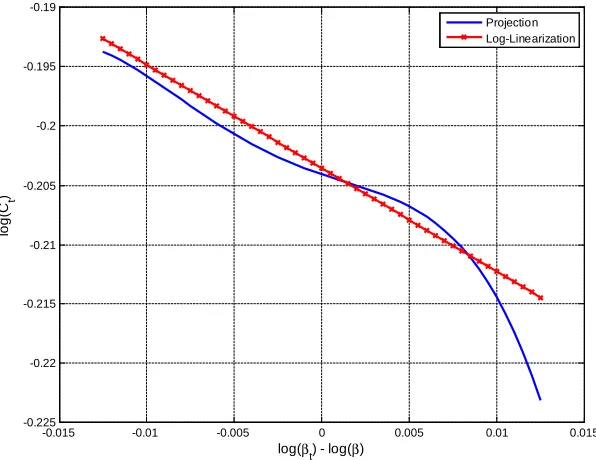
To compare this decision rule with our nonlinear solution, we plot in …gure 4.1 both decision rules along thelog t-axis, while we keep the other state variables at their steady-state values. The decision rule has an overall negative slope because a value of the discount factor above its steady state induces the household to save more, which lowers the real interest rate. Hence, if su¢ ciently large and positive innovations bu¤et the discount factor, the economy may be pushed to the ZLB. We observe this urgency to save more and consume less in the nonlinear policy. Consumption plunges for shocks that push the discount factor 0:7 percent or higher than its steady-state value. This is not a surprise. We calibrated to be0:994. Then, when the discount factor increases 0.6 percent (0.006 in our graph), t becomes bigger than 1 and
perfectly capable to respond to that feature of the model and capture the change of optimal consumption.4 In contrast, the log-linear approximation, since it is built around the value of t in the steady state, predicts a stable decline in consumption. This di¤erence becomes
stronger as tmoves into higher values. If we expanded the horizontal scale, we would observe
a bigger di¤erence between the two decision rules. At the same time, the two policies almost coincide for values of the discount factor close to or below its steady state value, where the log-linear approximation is valid.5
-0.015 -0.01 -0.005 0 0.005 0.01 0.015
-0.225 -0.22 -0.215 -0.21 -0.205 -0.2 -0.195 -0.19
log(βt) - log(β)
log(
Ct
)
Projection Log-Linearization
Figure 4.1: Log-linear versus nonlinear decision rules for consumption
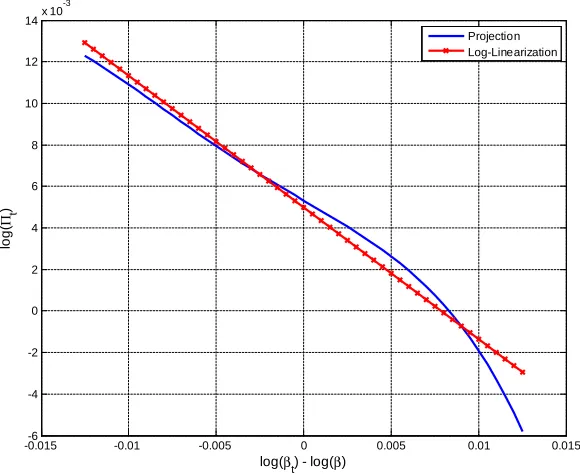
The policy function for in‡ation (…gure 4.2) con…rms the same pattern as in the previous plot. As the discount factor becomes bigger, there is less aggregate demand today, and this pushes in‡ation down as those …rms that reset their prices do not raise them as much as they would otherwise do. In the nonlinear solution, this phenomenon of contraction-de‡ation becomes acuter as increases and the economy moves toward the ZLB.
In conclusion, nonlinearities matter when we talk about the ZLB. This point will be even clearer with the …ndings of the next section.
4A technical point: the projection method does not deliver a decision rule that is globally concave. Since we have price rigidities, there is no theoretical result that implies that this should be the case.
-0.015-6 -0.01 -0.005 0 0.005 0.01 0.015 -4
-2 0 2 4 6 8 10 12 14x 10
-3
log(βt) - log(β)
log(
Πt
)
Projection Log-Linearization
Figure 4.2: Log-linear versus nonlinear equilibrium functions for in‡ation
5. Results
We now present the quantitative results from the model. First, we report the probabilities of being at the ZLB. Second, we analyze the distribution of the duration of a spell at the ZLB. Third, we show the distribution of shocks that send and keep the economy at the ZLB. Fourth, we analyze the behavior of the endogenous variables at the ZLB. Fifth, we analyze in detail one spell at the ZLB. Sixth, we analyze the size of the …scal multipliers. We close by talking about the impulse-response functions (IRFs) of the model.
5.1. Probability of being at the ZLB
Our …rst exercise is to derive the probability that the economy is at the ZLB in any particular period. This step is important because, in our model, the entry and exit from the ZLB is endogenous. The spells are caused by the interaction of the exogenous state variables (which have a continuous distribution over many values) and the endogenous state. Thus, we compute the integral
Pr (fRt= 1g) = Z
for all t 1, where IB[f(x)] : Rn ! f0;1g, is the indicator function of a set B Rk and f :Rn!Rk, de…ned as
IB[f(x)] = (
1 if f(x)2B
0 if f(x)2= B
for any n, and where (St) is the unconditional distribution of the states of the economy.
We further de…ne IB[x] asIB[ (x)], where is the identity map.
Given our solution from section 3, we simulate the model forT = 300;000periods starting at Sss. We de…ne the sequence of simulated states as fSi;ssgTi=1, where Si;ss is the value of
the state vector in period i of the simulation when the initial condition is Sss.6 Using this
sequence, we follow Santos and Peralta-Alva (2005) to approximate equation (3) by
Pr (fRt = 1g)'cPr (fRt= 1g) =
PT
i=1If1g[R(Si;ss)]
T : (4)
From equation (4) we learn that our economy is at the ZLB during 5.53 percent of quarters, or approximately 1 out of each 18 quarters, a noticeable share. However, since this percentage was a criterion for the calibration, we do not emphasize it.7
The probability of being at the ZLB is not independent of the history of states. To show this, we calculate the probability of being at least one extra period at the ZLB conditional on having been at the ZLB for exactly s periods as
Pr (fRt= 1g j fRt 1 = 1; : : : ; Rt s = 1; Rt s 1 >1g) =
Z
If1g[R(St)] (Stj fRt 1 = 1; : : : ; Rt s = 1; Rt s 1 >1g)dSt
for all t 3and t 2 s 1.
If we let Rt 1;s = fRt 1 = 1; : : : ; Rt s = 1; Rt s 1 >1g for all t 3 and t 2 s 1, then the above expression can be rewritten as
Pr (fRt= 1g jRt 1;s) = Z
If1g[R(St)] (StjRt 1;s)dSt (5)
6We have only one endogenous state variable: price dispersion,v
t 1. The mean of its ergodic distribution
and its steady-state value are nearly identical. The means of the ergodic distribution and the steady-state values of the four exogenous state variables are, by construction, the same. Hence, we do not need a burn-in period at the start of our simulation.
for all t 3 and t 2 s 1 and where (StjRt 1;s) is the distribution of the states
conditional on Rt 1;s implied by our model.
For s 1, let Siks;ss Ms
ks=1 be the Ms elements of the sequence fSi;ssg T
i=1 such that
R Siks 1;ss = 1, . . . , R Siks s;ss = 1, andR Siks s 1;ss >1 for allks 2 f1; : : : ; Msg. We
then approximate (5) by
Pr (fRt = 1g jRt 1;s)'cPr (fRt = 1g jRt 1;s) = Ms
X
ks=1
If1g[R(Siks;ss)] Ms
: (6)
for Ms >0. When Ms is 0, we saycPr (fRt= 1g jRt 1;s) = 0.
Table: 5.1 Probability of being at least one extra period at the ZLB
1 2 3 4 5 6 7 8 9 10
c
Pr (fRt= 1g jRt 1;s) 44% 54% 60% 62% 65% 60% 65% 67% 65% 60%
Table 5.1 reports the values of equation (6) fors from 1 to 10. The probability of being at least one extra period at the ZLB increases from 44 percent conditional on having been at the ZLB for 1 period to 67 percent for 8 periods and decreases thereafter.8 That is, during the …rst two years of a spell at the ZLB, the longer we have been at the ZLB, the more likely it is we stay there next period. The intuition is simple: if we have been at the ZLB for, say, 4 quarters, it is because the economy has su¤ered a string of bad shocks. Thus, the economy will linger longer on average around the state values that led to the ZLB in the …rst place. The fact that the probabilities in table 5.1 are not constant over time already points out a feature of our model that will play a key role in the next subsections: the expectation and variance of the time remaining at the ZLB are time-varying.
5.2. How long are the spells at the ZLB?
Another important question is to determine the length of the spells of the economy at the ZLB. To answer that question, …rst, we compute the expected number of consecutive periods that the economy will be at the ZLB right after entering it. In mathematical terms:
E(TtjRt 1;1) = 1
X
j=1
(jPr (fTt=jg jRt 1;1))
=
1
X
j=1
j Z
Ifjg[Tt] (St;St+1; : : :jRt 1;1)dStdSt+1: : : (7)
for all t 3, where Rt 1;1 describes the event “just entering the ZLB”, (St;St+1; : : :jRt 1;1) is the distribution of the sequence of future states conditional onRt 1;s implied by our model,
and Tt =T(St;St+1; : : :) = minf! :!2 f1;2; : : :g and Rt+! 1 =R(St+! 1)>1g for allt
3 is the …rst period outside the ZLB as a function of the future path of state variables. If
Tt = 1, then Rt >1 for that path. In the same way, if Tt= 2, thenRt= 1 and Rt+1 >1 for that path of state variables.
To approximate the expectation in (7), takenSik1;ss
oM1
k1=1
and calculate
E(TtjRt 1;1)'Eb(TtjRt 1;1) =
T 2 X j=1 0 @j 0 @ M1 X
k1=1
Ifjg
h b
T Sik1+1;ss; : : : ;ST;ss
i M1 1 A 1 A (8)
where we approximate the probability
Pr (fTt=jg jRt 1;1) =
Z
Ifjg[Tt] (St;St+1; : : :jRt 1;1)dStdSt+1: : :
for all t 3and T 2 j 1, by
Pr (fTt=jg jRt 1;1)'Prc
n b Tt=j
o
jRt 1;1 =
M1 X
k1=1
Ifjg
h b
T Sik1;ss; : : : ;ST;ss
i
M1
whereTbt=Tb(St; : : : ;ST) = minf! :! 2 f1;2; : : : ; T t+ 1g and Rt+! 1 =R(St+! 1)>1g for all t 3. The expression (8) equals 2.06 quarters in our simulation. That is, on average, we are at the ZLB for slightly more than half a year after entering it.
We highlight two points. First, given our simulation ofT periods, we can be at the ZLB at most T 2(we need a period before entry and one period of exit of the ZLB). Second, we approximate T Sik1;ss;Sik1+1;ss; : : : byT Sb ik1;ss; : : : ;ST;ss . But this approximation has no
e¤ect as long as R(ST;ss)>1, similar to what happens in our simulation.
We can also compute the variance of the number of consecutive periods at the ZLB right after entering it. Again, in mathematical terms:
Var(TtjRt 1;1) = 1
X
j=1
(j E(TtjRt 1;1)2Pr (fTt =jg jRt 1;1)
=
1
X
j=1
(j E(TtjRt 1;1)2
Z
for all t 3, that we approximate by:
Var(TtjRt 1;1)'Vard(TtjRt 1;1) =
T 2
X
j=1
0
@ j Eb(TtjRt 1;1) 2XM1
k1=1
Ifjg
h b
T Sik1;ss; : : : ;ST;ss i
M1
1
A:
By applying the previous steps, we …nd that the variance is 3.33 quarters. Since the number of consecutive periods at the ZLB is bounded below by 1 quarter (one period in our model), a variance of 3.33 (standard deviation of 1.8 quarters) denotes a quite asymmetric distribution of consecutive periods at the ZLB just after entering it, with a long right tail. We revisit this issue below.
Now, we would like to see how the conditional expectations and variance depend on the number of periods already at the ZLB. First, we calculate the expected number of additional periods at the ZLB conditional on having already been at the ZLB for s periods:
E(Tt 1jRt 1;s) =
1
X
j=1
((j 1) Pr (fTt=jg jRt 1;s)) =
1
X
j=1
(j 1)
Z
Ifjg[Tt] (St;St+1; : : :jRt 1;s)dStdSt+1: : :
for allt 3andt 2 s 1, where we are subtracting1fromTtbecause we are calculating
the number of additional periods at the ZLB. This expression can approximated by:
b
E(Tt 1jRt 1;s) = TXs 1
j=1
0
@(j 1)
Ms
X
ks=1
Ifjg
h b
T Siks;ss; : : : ;ST;ss i
Ms
1
A:
We build the analogous object for the conditional variance:
Var(Tt 1jRt 1;s) =
1
X
j=1
(j E(Tt sjRt 1;s))
2
Pr (fTt=jg jRt 1;s) =
1
X
j=1
(j E(TtjRt 1;s))
2 Z
Ifjg[Tt] (St;St+1; : : :jRt 1;s)dStdSt+1: : : :
approximated by
d
Var(TtjRt 1;s) = TXs 1
j=1
0
@ j Eb(TtjRt 1;s)
2XMs
ks=1
Ifjg
h b
T Siks;ss; : : : ;ST;ss i
Ms
1
Recall that, given our simulation of T periods, we can be at the ZLB at most T s 1
additional periods (we need s periods before entry and one period of exit of the ZLB). These two statistics are reported in table 5.2. The expected number of additional periods increases with the number of periods already at the ZLB (at least until 8 quarters). This is not surprising after having seen table 5.1. The variance grows monotonically, from 2.70 to 5.57. Hence, the agents have more uncertainty forecasting the periods remaining at the ZLB as the time at the ZLB accumulates (at least for the …rst 10 quarters).
Table 5.2: Number of additional periods at the ZLB
s 1 2 3 4 5 6 7 8 9 10
b
E(Tt 1jRt 1;s) 1.06 1.41 1.62 1.72 1.79 1.75 1.91 1.92 1.86 1.86 d
Var(Tt 1jRt 1;s) 2.70 3.39 3.78 4.00 4.22 4.35 4.64 4.87 5.16 5.57
The results in table 5.2 re‡ect how the distribution of additional periods at the ZLB is time-varying. This is an important di¤erence of our paper with respect to the literature. Previous papers have considered two cases. In the …rst one, there is an exogenous variable that switches in every period with some constant probability; the typical change is the discount factor going from low to high. Once the variable has switched, there is a perfect foresight path that exists from the ZLB (see, for instance, Eggertsson and Woodford, 2003). Although this path may depend on how long the economy has been at the ZLB, there is no uncertainty left once the variable has switched. In the second case, researchers have looked at models with perfect foresight (see, for example, sections IV and V of Christiano, Eichenbaum, and Rebelo, 2011). Even if …scal policy in‡uences how long we are at the ZLB, there is no uncertainty with respect to events, and the variance is degenerate.
5.3. What shocks do take us to the ZLB?
We would like to know whether a shock of a given size increases or decreases the probability of hitting the ZLB in the next I periods. More concretely, we would like to compute:
Pr [Ii=1fRt+i = 1g j fSj;t =Ajg = Z
max If1g[R(St+1)]; : : : ;If1g[R(St+I)] (St+1; : : : ;St+Ij fSj;t =Ajg)dSt+1: : : dSt+I (9)
for Aj 2 R and where Sj;t is the jth element of St. We perform this analysis only for the
exogenous states variables, that is j 2 f2; : : : ;5g.
To approximate (9) given our solution, we simulate the model N = 10;000 times for I
periods starting at Sss for all states, but for thejth element of St, which we start at Aj. For
each simulation n 2 f1; : : : ; Ng; we call the I periods long sequence of states nSAj n;i;ss
oI
i=1
:
Then, we set I = 10 and approximate the probability by:
c
Pr [Ii=1fRt+i = 1g j fSj;t =Ajg = N X
n=1
max If1g
h
R SAj n;1;ss
i
; : : : ;If1g
h
R SAj n;I;ss
i
N :
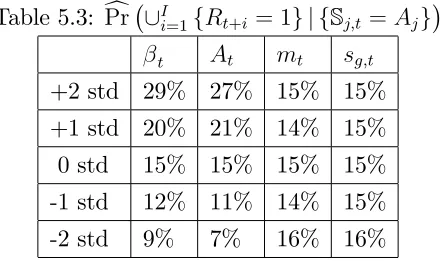
Table 5.3 reports these probabilities when the initial exogenous states are set, one at a time (corresponding to each column), to 0, 1, and 2 standard deviation innovations away from the steady state. In other words, Aj =Sj;ss f0;1;2g j for the discount factor,
technology, monetary, and government expenditure. The third row (labeled 0 std) shows a baseline scenario in which all the exogenous states are set at their steady-state values. In this baseline, the probability of getting to the ZLB in the next two and a half years is 15 percent (all the entries in the row are equal, since we are describing the same event). When we have a one-standard-deviation positive innovation to the discount factor, that probability goes up to 20 percent, and when we have a two-standard-deviation innovation to 29 percent. When
t is higher than in the steady state, the household is more patient and the interest rate that
clears the good market is low. Hence, it is easy for the economy to be pushed into the ZLB. The reverse results occur when the innovation is negative: the probability of entering into a ZLB falls to 12 percent (one-standard-deviation) or 9 percent (two-standard deviation).
the economy closer to the ZLB. Second, when productivity is high, the real interest rate is low. In the absence of capital, the extra output must be consumed for markets to clear. The real interest rate goes down to overcome the desire of the representative household to smooth consumption. This lower real interest rate translates, through the working of the Taylor rule, into a lower nominal interest rate. Often, the ZLB prevents the necessary reduction in the nominal interest rate caused by these two mechanisms.9
Table 5.3: cPr [I
i=1fRt+i = 1g j fSj;t =Ajg
t At mt sg;t
+2 std 29% 27% 15% 15%
+1 std 20% 21% 14% 15%
0 std 15% 15% 15% 15%
-1 std 12% 11% 14% 15%
-2 std 9% 7% 16% 16%
Understanding the economics behind this point is important. During the 2007-2009 reces-sion in the U.S., many observers argued that the good behavior of productivity was compelling proof that the problems of the economy came from an insu¢ cient aggregate demand. Our previous …nding reinterprets the situation. Far from being just a problem of demand, high productivity may have aggravated the problem of the ZLB (see, for a related point, Eggerts-son, 2010). Finally, monetary and …scal policy shocks have a volatility that is too small to make much of a di¤erence with respect to the probability of hitting the ZLB (and the Taylor rule undoes much of their impact).10
Understanding which shocks lead us to the ZLB is particularly relevant for policymakers who need to assess the conditions of the economy in order to respond to them. Consequently, we can also learn about the distribution of states conditional on being at the ZLB, that is:
(Stj fRt = 1g): (10)
9The …rst mechanism still exists with endogenous capital. The second mechanism will switch signs because, with capital, a higher productivity increases the desire to invest. With endogenous capital, the strength of each mechanism depends on parameter values. In Smets and Wouters (2007), to use a well-known example, the nominal interest rate goes down after a positive technological shock (see their …gure 7, p. 602). Therefore, it is still the case that in their model good productivity shocks increase the risk of hitting the ZLB.
LetfSik;ssg M
k=1be theM elements subsequence of the sequencefSi;ssg
T
i=1such thatR(Sik;ss) =
1 for all k 2 f1; : : : ; Mg. Then, we approximate (10) by:
(fSt2Ag j fRt= 1g)'
PM
k=1IA(Sik;ss)
M (11)
for any set A R5. Since St2R5, it is hard to represent equation (11) graphically. Instead,
in …gure 5.3 we represent the four individual marginal distributions
(fSj;t 2Ajg j fRt= 1g)'
PM
k=1IAi(Sj;ik;ss) M
for any set Aj R, where Sj;t is the jth element of St and Sj;ik;ss is the j
th element of Sik;ss
(again, we drop the distribution for vt 1, since it has a less straightforward interpretation).
To facilitate comparison, the states are expressed as deviations from their steady state values and we plot, with the red continuous line, the unconditional distribution of the state.
-0.020 -0.01 0 0.01 0.02 1000
2000 3000 4000
βt -β
Discount Factor
-0.020 -0.01 0 0.01 0.02 1000
2000 3000
At - A Technology
-0.020 -0.01 0 0.01 0.02 1000
2000 3000
mt - m Monetary Shock
-0.020 -0.01 0 0.01 0.02 1000
2000 3000
sg,t - sg Government Shock
Figure 5.3: Distribution of exogenous states, unconditional and conditional on being at the ZLB
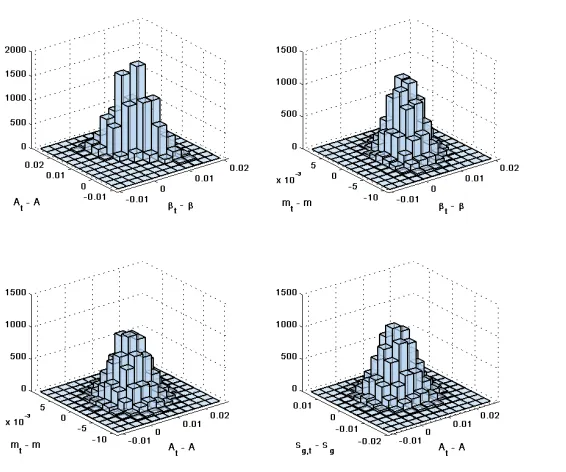
…scal and monetary shocks are nearly uncorrelated. The same information appears in table 5.4, where we report the mean and the standard deviation of the four exogenous variables, unconditionally (this is just our calibration of these processes) and conditional at being at the ZLB. The ZLB is associated with high discount factors and high productivities, but it is not correlated with either monetary or …scal policy.
Table 5.4: Unconditional and conditional moments of (log of) exogenous states
Mean (%) Std (%)
log of A m sg A m sg
Unconditional 0.00 0.00 0.00 0.00 0.41 0.58 0.25 0.42 At ZLB 0.60 0.78 -0.10 -0.07 0.32 0.47 0.25 0.42
We just analyzed the conditional marginal distribution of every individual exogenous state. We can also study the bivariate conditional distributions of the exogenous states:
((Si;t;Sj;t)j fRt = 1g) (12)
where Sj;t is the jth element ofSt and i; j 2 f2; : : : ;5g. We approximate (12) by:
(f(Si;t;Sj;t)2Ai Ajg j fRt= 1g)'
PM
k=1IAi Aj((Si;ik;ss;Sj;ik;ss))
M : (13)
Figure 5.4: Conditional bivariate distribution of exogenous states conditional on being at the ZLB
5.4. Endogenous variables at the ZLB
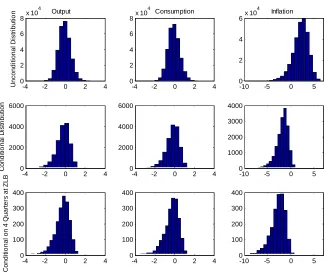
We now document how the endogenous variables behave while the economy is at the ZLB. In order to analyze this issue, …gure 5.5 compares the distributions of consumption, output, and in‡ation. The …rst row represents the unconditional distribution of the three variables. In particular, (variablet) for variablet2 fc; y; gto be approximated by:
(fvariablet 2Ag)'
PT
i=1IA(variable(Si;ss))
T
for any set A R. Here we do not condition on being at the ZLB because we use the unconditional distributions as a reference. The second row shows the same distribution conditional of being at the ZLB, that is (variabletj fRt= 1g), approximating it by:
(fvariablet 2Ag j fRt= 1g)'
PM
k=1IA(variable(Sik;ss))
The third row conditions on being at the ZLB for four periods (variabletjRt 1;4); approxi-mating it by:
(fvariablet 2Ag jRt 1;4)'
PM4
k4=1IA variable Sik4;ss M4
:
-4 -2 0 2 4 0
2 4 6 8x 10
4 Output U ncondi ti onal D ist ri but io n
-4 -2 0 2 4 0
2 4 6 8x 10
4 Consumption
-10 -5 0 5 0
2 4 6x 10
4 Inflation
-4 -2 0 2 4 0 2000 4000 6000 C ondi ti o nal D ist ri but ion
-4 -2 0 2 4 0
2000 4000 6000
-10 -5 0 5 0
1000 2000 3000 4000
-4 -2 0 2 4 0 100 200 300 400 C ondi ti o nal on 4 Q uar ter s at ZLB
-4 -2 0 2 4 0
100 200 300 400
-10 -5 0 5 0
100 200 300 400
Figure 5.5: Distributions of endogenous variables
always associated with de‡ation. Out of the 300,000 simulations, our economy is at the ZLB in 16,588 periods, and in 562 of those, in‡ation is positive (around 3 percent of the time11), with an annualized average value of 0.29 percent.
5.5. Autopsy of a spell at the ZLB
The longest spell in our simulation lasts 25 quarters. This spell is triggered by a sharp spike in the discount rate combined with a positive productivity shock and a negative monetary policy shock. Since we can think about our discount factor shock as a proxy for demand shocks (as those caused by debt overhangs), this situation resembles the U.S. data from 2008-2009 when poor behavior of output was combined with good performance of productivity. Therefore, it is worthwhile to analyze this spell at the ZLB in great detail.
20 40 60 80 100 0
2 4 6 8
Interest Rate
20 40 60 80 100 -3
-2 -1 0 1 2
Consumption
20 40 60 80 100 -4
-3 -2 -1 0
Labor
20 40 60 80 100 -10
-5 0
Inflation
Non-Linear Approx Linear Approx
Figure 5.6: Spell at the ZLB
and the bottom right panel in‡ation (the last three variables in deviations with respect to the steady state). In each panel there are two lines, one for the nonlinear approximation and one (to appreciate the di¤erences implied by solution methods) for the log-linear approximation. The spell starts at period 25 and lasts until period 50. We plot some periods before and after to provide a frame for the reader for comparison. Several points are worth highlighting. First, the ZLB is associated with low consumption, less hours, and with de‡ation. Second, even if the economy is out of the ZLB by period 50, it is still quite close to it for many quarters (up to period 68), which shows that a model such as ours can generate (although admittedly with low probability) a “lost decade”of recession and de‡ation.12 Third, the linear dynamics
departs from the nonlinear one in a signi…cant way when we are at (or close to) the ZLB. In particular, the recession is deeper and the de‡ation acuter. Also, consumption goes down, while in the linearized world it goes up. Thus, a policy maker looking at the linearized world would misread the situation. This divergence in the paths for consumption is not a surprise because the nonlinear policy functions that we computed in the previous section curved down with respect to the linear approximations when at (or close to) the ZLB.
0 10 20 30 40 50 60 70 80 90 100
-25 -20 -15 -10 -5 0 5 10
Constrained Interest Rate Unconstrained Interest Rate
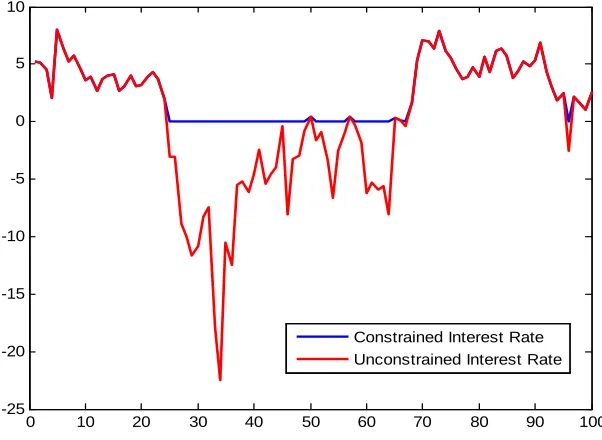
Figure 5.7: Constrained versus unconstrained interest rate
Figure 5.7 helps to understand the role of the ZLB. We plot the same path of the interest rate (from the nonlinear approximation) as in …gure 5.6, but we addZt 1, the unconstrained
net interest rate that the model would have computed in the absence of the bound.13 During
the spell, the economy would require a negative interest rate (as large as -22.5 percent) to induce the households to consume enough in response to the (temporarily) high discount factor and productivity shock. Since a negative interest rate is precluded, the economy must contract to reduce the desired level of savings.
5.6. The size of the …scal multiplier
Our next set of results corresponds to the size of the …scal multiplier. The ZLB is a situation in which conventional monetary policy has lost its power as further reductions of the nominal interest rate are not possible. Even if other types of monetary policy (such as announcing a price level target) are still feasible, the di¢ culties in applying them without full commitment has led many macroeconomists to refocus their attention on …scal policy, particularly because, at the ZLB, the …scal multiplier may be large; as forcefully argued by Woodford (2011) and Christiano, Eichenbaum, and Rebelo (2011).
We analyze …scal policy with the help of our model. In …gure 5.8, we plot (in blue lines) the size of the government multiplier when the economy is outside the ZLB. Since the model is nonlinear, the multiplier depends on the point where we make our computation. A natural candidate is the unconditional mean of the states. Thus, the multiplier is computed as follows:
1. We …nd the unconditional means of output,y1, and government spending, G1.
2. Starting at those, we increase government consumption at impact by 1 percent, 10 percent, 20 percent, and 30 percent (that is, if government consumption is 1, we raise it to either 1.01, 1.1, 1.2, or 1.3). As time goes by, government consumption follows its law of motion (2) back to its average level.
3. For each increase in government spending, we simulate the economy. Let yg;t and Gg;t
denote the new simulated paths where the subindex g indicates the economy has been bu¤eted by a government spending shock.
4. We compute the multiplier:
yg;t y1
Gg;1 G1
:
13To facilitate the interpretation, in …gure 5.2 we compute Z
t 1 period by period; that is, without
We calculate the response of the economy to di¤erent increases of government consump-tion because, when we solve the model nonlinearly, the marginal multiplier (the multiplier when government consumption goes up by an in…nitesimal amount) is di¤erent from the
aver-age multiplier (the multiplier when government consumption goes up by a discrete number).
We approximate the marginal multiplier with the multiplier that increases government con-sumption by 1 percent. The other three higher increases give us an idea of how the average multiplier changes with the size of the increment in government consumption. When the nominal interest rate is positive, though, …gure 5.8 tells us that the di¤erence between the marginal and the average multiplier is small. This is just another manifestation of the near linearity of the model in that situation.
0 2 4 6 8
0 0.5 1 1.5 2
1 percent increase in G
0 2 4 6 8
0 0.5 1 1.5 2
10 percent increase in G
0 2 4 6 8
0 0.5 1 1.5 2
20 percent increase in G
quarters
0 2 4 6 8
0 0.5 1 1.5 2
30 percent increase in G
quarters
Multiplier w ithout ZLB Multiplier w ith ZLB
Figure 5.8: Government spending multiplier when the ZLB lasts 4 quarters on average
Outside the ZLB, the value of the multiplier at impact is around 0.5 (going from 0.54 when the increment is 1 percent to 0.47 when the increment is 30 percent), a relatively small number, but not unusual in New Keynesian models with a low labor elasticity, without liquidity-constrained households, and with a Taylor rule that responds to the output gap.14 This value
is also consistent with the analytic insights in Woodford (2011), who derives multipliers less than 1 when the economy is outside the ZLB and has parameter values commonly found
in empirically estimated medium-sized DSGE models. The observation that the multiplier decreases with the size of the increase in government consumption suggests that we must be careful when we read the empirical evidence of …scal multipliers, as their estimated value may depend on the size of the observed changes in government consumption.
Figure 5.8 also displays the multiplier when the economy is at the ZLB (red crossed lines). The multiplier is computed as follows:
1. We start at the unconditional mean of states except that, to force the economy into the ZLB, we set the discount factor 2 percent above its unconditional mean (at 1.014 instead of the calibrated mean 0.994). This shock sends the economy to the ZLB, on average, for 4 consecutive quarters in the absence of any additional shock during those periods. We call these unconditional means, yzlb
1 , and government spending, Gzlb1 . 2. With these states, we simulate the economy and store the time paths for output, yzlb
t ,
and government spending, Gzlb t .
3. With the same states, except that we consider an increase in government consumption at impact of 1 percent, 10 percent, 20 percent, and 30 percent relative to its unconditional mean, we simulate the economy. As time goes by, government consumption follows its law of motion. Let yzlb
g;t and Gzlbg;t denote the new simulated paths.
4. We compute the multiplier:
yzlb g;t ytzlb Gzlb
g;1 Gzlb1
:
Now the multiplier of government consumption at impact is much larger: 1.76 for increases of government consumption of 1 percent, 1.68 for increases of 10 percent, 1.59 for increases of 20 percent, and 1.50 for increases of 30 percent. That is, the new multiplier is around 3 times larger than when outside the ZLB.
We now discuss some details of our exercise. We raise t to 1.014. Given our calibration,
Several patterns are apparent from the red lines in …gure 5.8. First, the multiplier at the ZLB is signi…cantly above one, albeit smaller than the values reported in the literature (Christiano, Eichenbaum, and Rebelo, 2011). Second, as in the previous case, the multiplier declines as the size of the government shock increases. This is because, as the government shock increases, the expected number of periods at the ZLB decreases for a given discount factor shock. In our experiment, a 30 percent government shock pushes the economy, on average, out of the ZLB upon impact.
The natural question is to ask why the multiplier is smaller than the one reported in the literature, for instance by Christiano, Eichenbaum, and Rebelo (2011) in a related environ-ment. Our exercise is somewhat di¤erent from previous ones. First, in our model there is a rich stochastic structure: in any period the economy is hit by several shocks. Agents do not have perfect foresight of future events and the distribution of the number of periods at the ZLB is not degenerate. Second, the government expenditure follows its law of motion (2) regardless of whether or not the economy is at the ZLB. So, for instance, if a large government consumption shock pushes the economy out of the ZLB right away, government consumption would still be high for many quarters, lowering the multiplier.15 Our experiment is a nice
complement to other exercises in the literature and provides answers that policy-makers are interested in: neither governments nor agents know in real life for how many periods the economy will be at the ZLB, and government expenditure is di¢ cult to change once stimulus plans have been approved.
Table 5.5: Unconditional and conditional moments of exogenous states
b Expected periods at ZLB Standard dev. of periods at ZLB Multiplier
0.0027 4 2.04 1.97
0.0025 4 2.08 1.76
0.00175 4 2.17 1.57
Let us now analyze in detail how the nondegenerate distribution of the number of periods at the ZLB that the agents face a¤ects our results. To do this, we solve three versions of the model with three levels of volatility for the discount factor shock (column 1 of table 5.5). In each of the three cases, we increase— at time zero— the discount factor so that, on average, the economy stays at the ZLB for 4 periods.16 We report the standard deviation of the periods at the ZLB (third column) and the impact …scal multiplier (fourth column). To compute these numbers (and for each version of our model), we simulate the economy 5;000 times. As we
15Christiano, Eichenbaum, and Rebelo (2011) also show a similar result. 16The size of the innovation is di¤erent in each case because of
b, which a¤ects both the impact of the
reduce b, the multiplier falls, while the standard deviation of the number of periods at the
ZLB grows. Because of the left censuring of the spell duration, even if the expected durations of the ZLB spell are constant across the three experiments, a higher standard deviation of the number of periods at the ZLB means a higher probability of ZLB spell durations shorter than four periods. For instance, this probability increases four percentage points from b = 0:0027
to b = 0:00175. Since, in these events, government expenditure pushes interest rates up, the
total e¤ect of additional government expenditure on aggregate demand today is much lower.
0 2 4 6 8
0 0.5 1 1.5
1 percent increase in G
0 2 4 6 8
0 0.5 1 1.5
10 percent increase in G
0 2 4 6 8
0 0.5 1 1.5
20 percent increase in G
quarters
0 2 4 6 8
0 0.5 1 1.5
30 percent increase in G
quarters
Multiplier without ZLB Multiplier with ZLB
Figure 5.9: Government spending multiplier when the ZLB lasts 2 quarters on average
intuition comes directly from the Euler equation forwarded several periods. The longer we are expected to stay at the ZLB, the lower is the current demand for consumption (a lower consumption in the future imposes, by optimality, a lower consumption today).
5.7. Endogenous durations of spells at the ZLB
We complete our analysis by reporting the IRFs of the model (computed as we did for the …scal multipliers). The IRFs highlight how the duration of the spell at the ZLB is endogenous. Figure 5.10 shows the IRFs for an increase of government expenditure of 1 percent. The IRFs are computed as percentage deviations from the unconditional mean when we are outside the ZLB (blue line) and as percentage deviations from the trajectories without government spending when the ZLB binds (red crossed line). At the ZLB, Figure 5.10 is again computed under a demand shock that sends the economy to the ZLB, on average, for 4 consecutive quarters.
5 10 15 20 -0.1
0 0.1
C
5 10 15 20 0.1
0.2 0.3
Y
5 10 15 20 0
0.01 0.02 0.03
R
5 10 15 20 0.02 0.04 0.06 0.08 0.1 Infl
5 10 15 20 0.05
0.1 0.15 0.2
Pistar
5 10 15 20 0
0.2 0.4
W
5 10 15 20 0.1
0.2 0.3
L
quarters
5 10 15 20 0
0.2 0.4
Mc
quarters
5 10 15 20 0.2 0.4 0.6 0.8 1 G quarters Outside ZLB Inside ZLB
Figure 5.10: IRFs to a 1% government spending increase when the ZLB lasts 4 quarters in expectation
interest rates and defer consumption for the future. Ultimately, output (and labor) rise above its unconditional mean, but by less than the increase in government spending. In contrast, when the economy is at the ZLB (red crossed line), consumption and output simultaneously go up in response to higher government spending. With the nominal interest rate locked at zero and rising in‡ation, the real rate is below the value prevailing in the absence of the government stimulus. Hence, households prefer to reduce savings and consume more. Note that, when the government spending shock is small it does not a¤ect the expected duration of the ZLB spell (4 periods).
Figure 5.11 shows that a government shock of10 percent pushes the economy out of the ZLB, on average, after three quarters. This is one period less than the expected duration without the government shocks. This shorter expected duration implies a smaller response of consumption today and, therefore, a smaller e¤ect of government spending at impact. Yet the multiplier is still above one because the shock does not preclude the economy from immediately escaping the ZLB.
5 10 15 20 -1
0 1
C
5 10 15 20 1
2 3
Y
5 10 15 20 0
0.1 0.2 0.3
R
5 10 15 20 0.2 0.4 0.6 0.8 1 Infl
5 10 15 20 0.5
1 1.5 2
Pistar
5 10 15 20 0 1 2 3 4 W
5 10 15 20 1
2 3
L
quarters
5 10 15 20 0 1 2 3 4 Mc quarters
5 10 15 20 2 4 6 8 10 G quarters Outside ZLB Inside ZLB
Figure 5.11: IRFs to a 10% government spending increase when the ZLB lasts 4 quarters in expectation
5 10 15 20 -4 -2 0 2 4 C
5 10 15 20 2
4 6 8
Y
5 10 15 20 0.2 0.4 0.6 0.8 1 1.2 1.4 R
5 10 15 20 0
1 2
Infl
5 10 15 20 0
2 4 6
Pistar
5 10 15 20 0
5 10
W
5 10 15 20 2 4 6 8 L quarters
5 10 15 20 0
5 10
Mc
quarters
5 10 15 20 10 20 30 G quarters Outside ZLB Inside ZLB
Figure 5.12: IRFs to a 30% government spending increase when the ZLB lasts 4 quarters in expectation
6. Conclusion
Our paper is a step toward a more complete understanding of economies in which the ZLB is a relevant constraint in the implementation of policy. We have demonstrated that a full nonlinear solution delivers important insights, for instance with respect to the role of …scal policy at the ZLB and the conditional expectations of agents.
References
[1] Braun, R.A. and L.M. Körber (2010). “New Keynesian Dynamics in a Low Interest Rate Environment.”Mimeo, Federal Reserve Bank of Atlanta.
[2] Christiano, L., M. Eichenbaum, and C.L. Evans (2005). “Nominal Rigidities and the Dynamic E¤ects of a Shock to Monetary Policy.”Journal of Political Economy 113, 1-45.
[3] Christiano, L., M. Eichenbaum, and S. Rebelo (2011). “When is the Government Mul-tiplier Large?”Journal of Political Economy 119, 78-121.
[4] Chung, H., J-P. Laforte, D. Reifschneider, and J. C. Williams (2010). “Have We Underes-timated the Probability of Hitting the Zero Lower Bound?”Mimeo, Board of Governors. [5] Coleman, W. J. (1991) “Equilibrium in a Production Economy with an Income Tax.”
Econometrica 59, 1091-1104.
[6] Cooley, T. and E.C. Prescott (1995). Economic Growth and Business Cycles. Frontiers
of Business Cycle Research, edited by Thomas Cooley. Princeton University Press.
[7] Eggertsson, G.B. (2010). What Fiscal Policy is E¤ective at Zero Interest Rates? NBER
Macroeconomic Annual.
[8] Eggertsson, G.B. and M. Woodford (2003). “The Zero Bound on Interest Rates and Optimal Monetary Policy.”Brookings Papers on Economic Activity 34, 139-235.
[9] Eichenbaum, M. and J. Fisher (2007). “Estimating the Frequency of Price Re-optimization in Calvo-style Models.”Journal of Monetary Economics 54, 2032-2047. [10] Erceg, C. and J. Lindé (2010). “Is There a Fiscal Free Lunch in a Liquidity Trap?”
CEPR Discussion Paper 7624.
[11] Fernández-Villaverde, J. and J. Rubio-Ramírez (2007). “Estimating Macroeconomic Models: A Likelihood Approach.”Review of Economic Studies 74, 1059-1087.
[12] Fernández-Villaverde, J., P. Guerrón-Quintana, and J. Rubio-Ramírez (2011). “Supply-Side Policies and the Zero Lower Bound.”Working Papers 11-47, Federal Reserve Bank of Philadelphia.
[14] Judd, K.L., L. Maliar, and S. Maliar (2011). “A Cluster-Grid Algorithm: Solving Prob-lems with High Dimensionality.”Mimeo, Hoover Institution.
[15] Justiniano A. and G.E. Primiceri (2008). “The Time-Varying Volatility of Macroeco-nomic Fluctuations.”American Economic Review 98, 604-641.
[16] Krueger, D., F. Kubler, and B. Malin (2011). “Solving the Multi-Country Real Business Cycle Model Using a Smolyak-Collocation Method.”Journal of Economic Dynamics and
Control 35, 229-239.
[17] Reifschneider, D. and J. C. Williams (1999). “Three Lessons for Monetary Policy in a Low In‡ation Era.”Mimeo, Board of Governors.
[18] Santos, M.S. and A. Peralta-Alva (2005). “Accuracy of Simulations for Stochastic Dy-namic Models.”Econometrica 73, 1939-1976.
[19] Smets, F. and R. Wouters (2007). “Shocks and Frictions in U.S. Business Cycles: A Bayesian DSGE Approach.”American Economic Review 97, 586-606.
[20] Tanaka, T. (2012). “Optimal Fiscal and Monetary Policy with Occasionally Binding Zero Bound Constraints.”Mimeo, New York University.
[21] Wolman, A.L. (1998). “Staggered Price Setting and the Zero Bound on Nominal Interest Rates.”Economic Quarterly, Federal Reserve Bank of Richmond Fall, 1-24.
[22] Woodford, M. (2011). “Simple Analytics of the Government Expenditure Multiplier.”
7. Appendix: Solving the Model
We explain now in further detail how we compute the model using a projection method. First, however, we need to …nd the steady state as this centers the projection and serves as the point around which we log-linearize the model in the comparison exercise of section 4.
7.1. Steady state
The steady state is de…ned by the following equations (where now is not a variable but a parameter, the in‡ation target):
R =
l#c=w
mc=w
"x1 = (" 1)x2
x1 =
1
cmcy +
"x
1
x2 =
c y+
" 1x 2
g =sgy
b = 0
1 = " 1+ (1 ) ( )1 "
v = "v+ (1 ) ( ) "
y =c+g
y= 1
To solve these equations, we …rst get the variables:
= 1
" 1
1
1 1 "
v = 1
1 "( )
"
g y =sg c
y = (1 sg)
x2 =
1
1 sg1 " 1
x1 =
" 1
" x2
mc= (1 sg) (1 ")x1
and
w=mc:
Setting = 1, which just selects a normalization for l, one has
l y =v l c =
l y
y c
l = wl
c
1 1+#
:
Lastly, c; g, and y are determined using l=y; c=y; g=y;and l.
7.2. The projection method
Recall that the state variables of the model are price dispersion, v; the discount factor, t;
productivity, At; the monetary shock,mt; and the government expenditure share, sg;t. Recall
that we have de…ned a vector,
where the …rst state, price dispersion, is endogenous, while the other four are exogenous. De…ne a new vector,
^
St= (vt 1;log t;logAt;logmt;logsg;t);
so that the exogenous states are in logs. Then, we can write the equilibrium functions that characterize the dynamics of the model as:
logct = f1(^St)
log t = f2(^St)
logx1;t = f3(^St)
wheref = (f1; f2; f3). Sincef is unknown, to solve the model, we approximatelogc
t,log t,
and logx1;t as
logct = fb1(^St)
log t = fb2(^St)
logx1;t = fb3(^St)
using the Smolyak collocation method laid out in Krueger, Kubler, and Malin (2011). De…ne
b
f = fb1;fb2;fb3 .
To construct fb, three steps are required.17 First, one must specify both a level of
ap-proximation and bounds on a hypercube. Given these two, the method speci…es a …nite number n of collocation pointsfS^igni=1 within the hypercube. Second, one must provide the values of f at each of these n points. Given these values, the method constructs polynomial coe¢ cients that implicitly de…ne f^. Third, given the coe¢ cients, the method provides a way to evaluate f^at any point (inside or outside of the hypercube).
The approximation f^satis…es several important properties: 1. f^agrees withf at each ^Si.
2. Iff is composed of polynomials that have degree or belong to a certain subset of the complete set of polynomials of degree2 , thenf^agrees withf everywhere. For our level of approximation, = 2, whenf is composed of linear combinations of the polynomials
x4j,x3j, x2j, xj, 1, x2jx2k, x
2
jxk, xjxk for j; k = 1; : : : ; d, where d is the dimension of S, it
will be reproduced exactly. See Barthelmann, Novak, and Ritter (2000) for details. 3. If f is continuous, the approximation f^is nearly optimal in a certain sense.