The Thirty-Third AAAI Conference on Artificial Intelligence (AAAI-19)
Diversity-Driven Extensible Hierarchical Reinforcement Learning
Yuhang Song,
1Jianyi Wang,
2,†Thomas Lukasiewicz,
1Zhenghua Xu,
1,3,*Mai Xu
2 1Department of Computer Science, University of Oxford, UK2School of Electronic and Information Engineering, Beihang University, China
3State Key Laboratory of Reliability and Intelligence of Electrical Equipment, Hebei University of Technology, China
*Corresponding author, email: [email protected]
†Co-first author
Abstract
Hierarchical reinforcement learning (HRL) has recently shown promising advances on speeding up learning, improv-ing the exploration, and discoverimprov-ing intertask transferable skills. Most recent works focus on HRL with two levels, i.e., a master policy manipulates subpolicies, which in turn manip-ulate primitive actions. However, HRL with multiple levels is usually needed in many real-world scenarios, whose ulti-mate goals are highly abstract, while their actions are very primitive. Therefore, in this paper, we propose a diversity-driven extensible HRL (DEHRL), where an extensible and scalable framework is built and learned levelwise to realize HRL with multiple levels. DEHRL follows a popular assump-tion: diverse subpolicies are useful, i.e., subpolicies are be-lieved to be more useful if they are more diverse. However, existing implementations of this diversity assumption usually have their own drawbacks, which makes them inapplicable to HRL with multiple levels. Consequently, we further propose a novel diversity-driven solution to achieve this assumption in DEHRL. Experimental studies evaluate DEHRL with nine baselines from four perspectives in two domains; the results show that DEHRL outperforms the state-of-the-art baselines in all four aspects.
Introduction
Hierarchical reinforcement learning (HRL) recombines se-quences of basic actions to form subpolicies (Sutton, Precup, and Singh 1999; Parr and Russell 1998; Dietterich 2000). It can be used to speed up the learning (Bacon, Harb, and Precup 2017), improve the exploration to solve tasks with sparseextrinsic rewards(i.e., rewards generated by the en-vironment) (S¸ims¸ek and Barto 2004), or learn meta-skills that can be transferred to new problems (Frans et al. 2018). Although most previous approaches to HRL require hand-crafted subgoals to pretrain subpolicies (Heess et al. 2016) or require extrinsic rewards as supervisory signals (Vezh-nevets et al. 2016), the recent ones seek to discover sub-policies without manual subgoals or pretraining. Most of them (Xu et al. 2018a; Bacon, Harb, and Precup 2017) are working in a top-down fashion, where a given agent first ex-plores until it accomplishes a trajectory that reaches a pos-itive extrinsic reward, and then tries to recombine the basic actions in the trajectory to build subpolicies.
Copyright c2019, Association for the Advancement of Artificial Intelligence (www.aaai.org). All rights reserved.
However, such top-down solutions are not practical in sit-uations with sparse extrinsic rewards and large action space, where extrinsic rewards are almost unreachable by explo-ration using primitive actions. Therefore, more recent works focus on discovering “useful” subpolicies in a bottom-up fashion (Lakshminarayanan et al. 2016; Kompella et al. 2017), which are capable of discovering subpolicies be-fore reaching any extrinsic rewards. In addition, the bottom-up strategy can discover subpolicies that better facilitate learning for an unseen problem (Frans et al. 2018). This is also calledmeta-reinforcement-learning(Al-Shedivat et al. 2018), where subpolicies are shared across different tasks and thus calledmeta subpolicies.
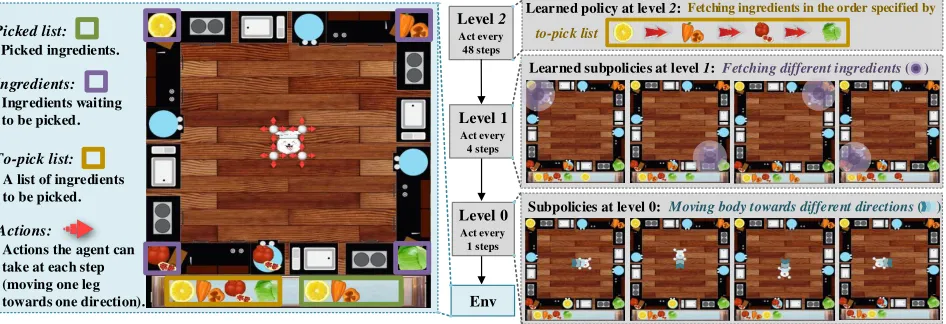
However, none of the above methods shows the capabil-ity to build extensible HRL with multiple levels, i.e., build-ing subpolicies upon subpolicies, which is usually needed in many real-world scenarios, whoseultimate goalsare highly abstract, while their basicactionsare very primitive. We take the gameOverCookedin Figure 1 as an example. The ulti-mate goal of OverCooked is to let anagentfetch multiple
ingredients(purple boxes) in a particular sequence accord-ing to ato-pick list(orange box), which is shuffled in every episode. However, the basic action of the agent is so primi-tive (thus calledprimitive actionin the following) that it can just move one of its four legs towards one of the four direc-tions at each step (marked by red arrows), and the agent’s body can be moved only when all four legs are moved to the same direction. Consequently, although we can simplify the task by introducing subpolicies to learn to move the body towards different directions with four steps of primitive ac-tions, it is still difficult to reach the ultimate goal, because the to-pick list changes in every episode.
Act every 48 steps
Level 2 Learned policy at level 2: Fetching ingredients in the order specified by
Env
Subpolicies at level 0: Actions:
Actions the agent can take at each step (moving one leg towards one direction). A list of ingredients to be picked. To-pick list: Ingredients:
Ingredients waiting to be picked. Picked list:
Picked ingredients.
Learned subpolicies at level 1:
Moving body towards different directions ( )
Fetching different ingredients ( ) to-pick list
Act every 4 steps
Level 1
Act every 1 steps
Level 0
Figure 1: Playing OverCooked with HRL of three levels.
diversity assumption(Gregor, Rezende, and Wierstra 2016; Florensa, Duan, and Abbeel 2017): subpolicies are believed to be more useful if they are more diverse. Therefore, the objective of DEHRL at each level is to learn correspond-ing subpolicies that are as diverse as possible, thus called diversity-driven. The intuition of this diversity assumption is as follows: in real-world situations, when there is no specific stimulation, people tend to learn skills as diverse as possible to prepare for potential future needs; similarly, when there is no extrinsic reward, by learning subpolicies as diverse as possible, an agent will be able to explore its own capability as much as possible.
However, existing implementations of the diversity as-sumption usually have their own drawbacks, which make them inapplicable to HRL with multiple levels: (i) The im-plementation in (Daniel et al. 2016) works in a top-down fashion, making it impractical in situations with sparse ex-trinsic rewards. (ii) Although SAC-LSP in (Haarnoja et al. 2018) can also learn policy of multiple layers, whether it can operate different layers at different temporal scales is an open problem, making it also unable to solve tasks with sparse extrinsic rewards. (iii) The implementation in (Gregor, Rezende, and Wierstra 2016; Florensa, Duan, and Abbeel 2017) is not extensible to higher levels.
Consequently, we further propose a novel diversity-driven solution to achieve this diversity assumption in DEHRL. We first introduces apredictorat each level to dynamically pre-dict the resulting state of each subpolicy. Then, the diversity assumption is achieved by giving higher intrinsic rewards
(rewards generated by the agent) to subpolicies that result in more diverse states. Consequently, subpolicies converge to taking actions that result in most diverse states.
The contributions of this paper are summarized as fol-lows. (i) We propose a diversity-driven extensible hierar-chical reinforcement learning (DEHRL) approach, which, to our knowledge, is the first learning algorithm that is built and learned levelwise with verified scalability, so that HRL with multiple levels can be realized end-to-end without human-designed extrinsic rewards. (ii) We further propose a new diversity-driven solution to achieve the widely adopted
di-versity assumption in HRL with multiple levels. (iii) Exper-imental studies are conducted to compare DEHRL with nine baselines from four perspectives in two domains. The re-sults show that: (a) DEHRL can discover useful subpolicies more effectively; (b) DEHRL can solve the sparse extrinsic reward problem more efficiently; (c) DEHRL can learn bet-ter inbet-tertask-transferable meta subpolicies; and (d) DEHRL has a good portability.
Diversity-Driven Extensible HRL
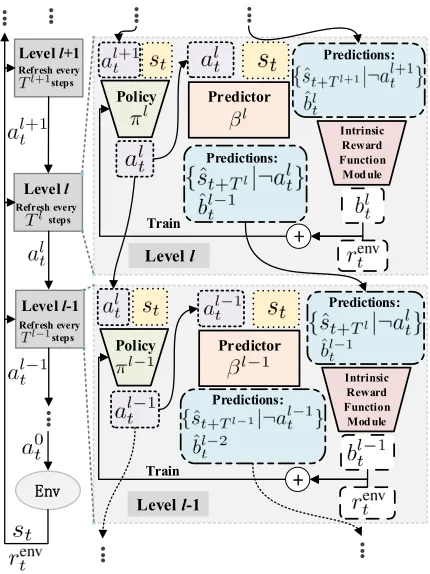
The structure of DEHRL is shown in Figure 2, where each levell contains apolicy(denotedπl), apredictor(denoted
βl), and anIntrinsic Reward Function Module(abbreviated as IRFM). Thepolicyandpredictorare two deep neural net-works (i.e., parameterized functions) withπlandβl denot-ing their trainable parameters, while IRFM contains a set of unparameterized functions. For any two neighboring levels (e.g., levelland levell−1), there are three connections as shown in Figure 2: (i) the policy at the upper levelπl pro-duces an actional
t, which is treated as an input for the policy at the lower levelπl−1; (ii) the predictor at the upper levelβl makes several predictions, which are passed to IRFM at the lower levell−1; (iii) using the predictions from the upper levell, IRFM at the lower levell−1generates an intrinsic re-wardblt−1to train the policy at the lower levelπl−1. The rest of this section introduces some important information of the proposed DEHRL framework and the diversity-driven solu-tion; more details and theoretical interpretations of DEHRL can be found in (Song et al. 2018a).
Policy
As shown in Figure 2, the policies for different levels act at different frequencies, i.e., the policy πl samples an action everyTl steps. Note thatTlis always an integer multiple of Tl−1, and T0always equals to1, so the time complex-ity of the proposed framework does not grow linearly as the level goes higher. Tl for l > 0 are hyper-parameters. At levell, the policyπl takes as input the current states
is conditional toalt+1. Note thata l+1
t ∈Al+1, whereAl+1 is the output action space ofπl+1. Thus,
A0 should be set to the action space of theenvironmentfor the policyπ0 di-rectly taking actions on the environment, whileAlofl >0 are hyper-parameters. The policy takes as input bothstand
alt+1to integrate multiple subpolicies into one model; a sim-ilar idea is presented in (Florensa, Duan, and Abbeel 2017). The detailed network structure of the policyπlis presented in (Song et al. 2018a). Then, the policyπlproduces the ac-tional
t ∈Alby sampling from a parameterized categorical distribution:
alt=πl(st, alt+1). (1)
The reward to trainπlcombines the extrinsic reward from the environmentrenv
t and the intrinsic rewardblt generated from IRFM at levell. When facing games with very sparse extrinsic rewards, whererenv
t is absent most of the time,blt will guide the policy at this level πl to learn diverse sub-policies, so that the upper level policyπl+1 may reach the sparse positive extrinsic reward more easily. The policyπl is trained with the PPO algorithm (Schulman et al. 2017), but our framework does not restrict the policy training algo-rithm to use. The following denotes the loss of training the policyπl:
Llpolicy=PPO alt,(renvt +λb l t)|π
l
, (2)
whereπlmeans that the gradients of this loss are only passed to the parameters inπl, andλis a hyper-parameter set to1
all the time (the section on IRFM below will introduce a normalization of the intrinsic rewardbl
t, makingλfree from careful tuning).
Predictor
As shown in Figure 2, the predictor at levell(i.e.,βl) takes as input the current statestand the action taken by the policy at level l (i.e., al
t) as a one-hot vector. The integration of
st andalt is accomplished by approximated multiplicative interaction (Oh et al. 2015), so that any predictions made by the predictorβlis conditioned on the action input ofalt. The predictor makes two predictions, denotedsˆt+Tl andˆblt−1, respectively. Thus, the forward function ofβlis:
ˆ
st+Tl,ˆblt−1=βl(st, alt). (3)
The detailed network structure of the predictorβlis given in (Song et al. 2018a). The first predictionsˆt+Tl in (3) is trained to predict the state afterTlsteps with following loss function:
Lltransition=MSE(st+Tl,ˆst+Tl|βl), (4)
where MSE is the mean square error, andβlindicates that the gradients of this loss are only passed to the parameters inβl. The second predictionˆblt−1in (3) is trained to approx-imate the intrinsic reward at the lower levelblt−1, with the loss function
Llintrinsic reward=MSE(blt−1,ˆblt−1|βl), (5)
whereβlmeans that the gradients of this loss are only passed to the parameters inβl. The next section about IRFM will
Level l-1 Level l
Env
Train
Intrinsic Reward Function Mod ule
+
Policy
Predictions: Predictor
Predictions:
Level l
Train
+
Policy
Predictions: Predictor
Predictions:
Level l-1
...
...
...
...
...
...
Refresh every steps
Refresh every steps
Refresh every steps Level l+1
...
Intrinsic Reward Function Module
Figure 2: The framework of DEHRL.
show that the intrinsic rewardblt−1is also related to the ac-tionalt−1sampled according to the policy at the lower level
πl−1. Sinceal−1
t is not fed into the predictorβl, the intrin-sic rewardˆblt−1 is actually an estimation of the expectation ofblt−1under the currentπl−1:
ˆbl−1
t =Eπl−1{blt−1}. (6) The above two predictions will be used in IRFM, described in the following section.
The predictor is active at the same frequency as that of the policy. Each time the predictorβlis active, it produces several predictions feeding to IRFM at levell−1, including
ˆ
blt−1and{sˆt+Tl|¬atl}, where{sˆt+Tl|¬alt}denotes a set of predictions when feeding the predictorβlwith actions other thanal
t. In practice, the predictor is affected by the distri-bution of the sampled data from the online policy; DEHRL thus adds an entropy regularization loss in the training to encourage the policy to be uniform over its action space.
Intrinsic Reward Function Module (IRFM)
As shown in Figure 2, taking as inputˆblt−1and{sˆt+Tl|¬alt}, IRFM produces the intrinsic reward blt−1, which is used to train the policy πl−1, as described in the policy sec-tion. The design of IRFM is motivated as follows: (i) If the currently selected subpolicyπl−1(s
t, alt)for the upper-level action al
t differs from the subpolicies for other ac-tions (i.e.,{πl−1(s
Table 1: The settings of DEHRL.
A0 A1 A2 T0 T1 T2
16 5 5 1 1*4 1*4*12
via the distance between the states resulting from the sub-policy πl−1(s
t, alt)and subpolicies {πl−1(st,¬alt)}. Note that sincealtis selected everyTlsteps, these resulting states are the ones att+Tl.
In the above motivation, the resulting state of the subpol-icyπl−1(s
t, alt)is the real state environment returned after
Tlsteps (i.e.,s
t+Tl), while the resulting states of the sub-policies{πl−1(s
t,¬alt)}have been predicted by the predic-tor at the upper levell (i.e.,{sˆt+Tl|¬alt}), as described in the last section. Thus, the intrinsic rewardblt−1is computed as follows:
blt−1= X
s∈{ˆst+T l|¬al t}
D(st+Tl, s), (7)
whereDis the distance chosen to measure the distance be-tween states. In practice, we combine the L1 distance and the distance between the center of mass of the states, to ob-tain information on color changes as well as objects mov-ing. A more advanced way to measure the above distance is to match features in states and to measure the movements of the matched features, or to integrate the inverse model in (Pathak et al. 2017) to capture the action-related feature changes. However, the above advanced ways are not investi-gated here, due to the scope of the paper. Equation (7) gives a high intrinsic reward, ifst+Tlis far from{sˆt+Tl|¬alt} over-all. In practice, we find that punishingst+Tlfrom being too close to the one state in{ˆst+Tl|¬alt}that is closest tost+Tl is a much better choice. Thus, we replace the sum in (7) with the minimum, and find that it consistently gives the best in-trinsic reward estimation.
Estimating the intrinsic reward with distances of high di-mensional states comes with the problem that the changes in distance that we want the intrinsic reward to capture is ex-tremely small, compared to the mean of the distances. Thus, we use the estimation of the expectation of the intrinsic re-ward blt−1 (i.e.,ˆb
l−1
t described in last section) to normal-izeblt−1:
blt−1←btl−1−ˆblt−1. (8)
In practice, this normalization gives a stable algorithm with-out need to tuneλaccording to the distance that we choose or the convergence status of the predictor at the upper level.
Experiments
We conduct experiments to evaluate DEHRL with nine base-lines from four perspectives based on two domains, Over-Cooked (shown in Figure 1) and Minecraft. The important hyper-parameters of DEHRL are summarized in Table 1, while other details (e.g., neural network architectures and hyper-parameters in the policy training algorithm) are pro-vided in (Song et al. 2018a). Easy-to-run codes have been
...
(625 possibilities states after =4 steps)...
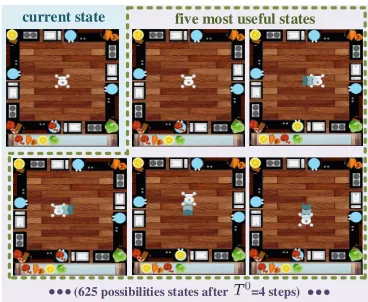
current state five most useful statesFigure 3: State examples of Overcooked.
released to further clarify the details and facilitate future re-search1, where evaluations and visualizations on more do-mains, such as Montezuma’s Revenge and PyBullet (an open source alternative of MuJoCo), can also be found.
Subpolicy Discovery
We first evaluate the performance of DEHRL in discovering diverse subpolicies in OverCooked. As shown in Figure 1, an agent in OverCooked can move one of its four legs to-wards one of four directions at each step, so its action space is16. Only after all four legs are moved towards the same direction, the body of this agent can be moved towards this direction. There are four different ingredients at the corners of the kitchen (purple boxes). An ingredient is automatically picked up when the agent reaches it. There is a list of ingre-dients that the chief needs to pick in sequence to complete a dish (orange box), called to-pick list.
Without Extrinsic Rewards. We first aim to discover useful subpolicies without extrinsic rewards. Since there are four legs, and every leg of an agent has five possible states (staying or moving towards four directions), there are totally
54= 625possible states for everyT0 = 4steps. As shown in Figure 3, five of them are the most useful states (i.e., the ones that are most diverse to each other), whose four legs have the same state, making the body of the chief move to-wards four directions or stay still.
Consequently, a good implementation of the diversity as-sumption should be able to learn subpolicies at level0that can result in the five most useful states (called five use-ful subpolicies) efficiently and comprehensively. Therefore, givenA1 = 5 (i.e., discovering only five subpolicies), and the number of steps being10millions, the five subpolicies learned by DEHRL at level 0 are exactly the five useful subpolicies. Furthermore,SNN(Florensa, Duan, and Abbeel 2017) is a state-of-the-art implementation of the diversity as-sumption, which is thus tested as a baseline under the same setting. However, only one of the five useful subpolicies is discovered by SNN. We then repeat experiments ten times with different training seeds, and the results are the same.
1
Table 2: The different settings of extrinsic rewards in OverCooked.
reward-level goal-type: any(easy) goal-type: fix(medium) goal-type: random(hard)
1(easy) Get any ingredient. Get a particular ingredient. Get the first ingredient shown
in the shuffling* to-pick list.
2(hard) Get 4 ingredients in any order. Get 4 ingredients in a particular order. Get 4 ingredients in order accordingto the shuffling* to-pick list.
*
The to-pick list is shuffled every episode.
Subpolicy 1
Current state Subpolicy 2
Subpolicy 3 Subpolicy 4 Subpolicy 5
useful subpolicies
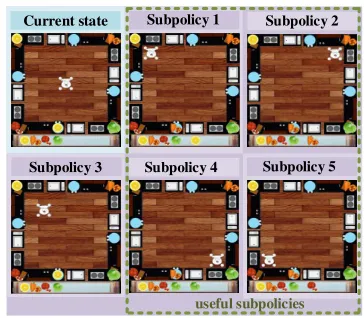
Figure 4: Subpolicies learned at level 1 in DEHRL.
Furthermore, we loose the restriction by settingA1 = 20 (i.e., discovering 20 subpolicies) and the number of steps is 20 millions. With no surprise, the five useful subpoli-cies are always included in the20subpolicies discovered by DEHRL; however, the 20 subpolicies discovered by SNN still contain only one useful subpolicy.
The superior performance of DEHRL comes from the proposed new diversity-driven solution, which gives higher intrinsic rewards to subpolicies that result in more diverse states; consequently, subpolicies in DEHRL converge to tak-ing actions that result in most diverse states. And the failure of SNN may be because the objective of SNN is to maxi-mize mutual information, so it only guarantees to discover subpolicies resulting in different states, but these different states are not guaranteed to be most diverse to each other. Similar failures are found in other state-of-the-art solutions, e.g., (Gregor, Rezende, and Wierstra 2016); we thus omit the analysis of these methods due to space limit.
As for finding useful subpolicies at higher levels, due to the failures at level 0, none of the state-of-the art solu-tions can generate useful subpolicies at higher levels. How-ever, useful subpolices can still be learned by DEHRL at higher levels. Figure 4 visualizes five subpolicies learned by DEHRL at level 1, where four of them (marked by a green dash-line box) result in getting ingredients at four different corners, which are the useful subpolicies at level1.
With Extrinsic Rewards. We further compare DEHRL with three state-of-the-art methods, option-critic (Bacon, Harb, and Precup 2017),FeUdal(Vezhnevets et al. 2017),
Table 3: Final performance score of DEHRL and baselines on OverCooked with six different extrinsic reward settings.
reward-level goal-type
1 any
1 fix
1 random
2 any
2 fix
2 random
DEHRL 1.00 1.00 1.00 0.95 0.93 0.81
Option-critic 1.00 1.00 0.00 0.00 0.00 0.00
DIAYN 1.00 1.00 0.83 0.42 0.10 0.00
FeUdal 1.00 1.00 0.93 0.00 0.00 0.00
PPO 0.98 0.97 0.56 0.00 0.00 0.00
State Novelty 1.00 0.96 0.95 0.00 0.00 0.00
Transition Novelty 1.00 1.00 1.00 0.00 0.00 0.00
andDIAYN(Eysenbach et al. 2018), when extrinsic rewards are given. As shown in Table 2, six different extrinsic reward settings with different difficulties are given to OverCooked.
To measure the performance quantitatively, two metrics,
final performance score and learning speed score, based on reward per episode, are imported from (Schulman et al. 2017). Generally, the higher the reward per episode, the bet-ter the solution. Specifically, the final performance score av-erages the reward per episode over the last 100 episodes of training to measure the performance at final stages; while the learning speed score averages the extrinsic reward per episode over the entire training period to quantify the learn-ing efficiency.
Table 3 show results of the final performance scores. As shown in Table 3, DEHRL can solve the problems in all six settings. However, option-critic only solves the two easier ones; the failure of option-critic is because the extrinsic re-ward gets more sparse in the last four harder cases. In ad-dition, FeUdal fails when it is extended to 3 levels, because its key idea “transition policy gradient” does not work well for multi-level structures, making it hard to converge for
reward-levels = 2. Similarly, DIAYN also fails when the
reward-levels = 2, showing that only achieving diversity over primitive actions is not enough. Consequently, we state that DEHRL can also achieve better performances than the state-of-the-art baselines when extrinsic rewards are given.
Solving the Sparse Extrinsic Reward Problem
Then, we further compare DEHRL with two state-of-the-art methods,state novelty(S¸ims¸ek and Barto 2004) and transi-tion novelty(Pathak et al. 2017), towards improving explo-ration. In addition, as our framework is based on thePPO
Ta-0 0.2 0.4 0.6 0.8 1
1/any 1/fix 1/random 2/any 2/fix 2/random
Le
ar
ni
ng
Spe
ed
Sc
or
e
Game Settings (reward-level/goal-type) DEHRL Option-critic PPO State Novelty Transition Novelty
DIAYN FeUdal
Figure 5: Learning speed score of DEHRL and the baselines on OverCooked with six different extrinsic reward settings.
0 0.2 0.4 0.6 0.8 1
DEHRL MLSH DEHRL (Filtered) MLSH (Filtered)
Goal Changed
Goal:
Goal Changed Goal Changed
E
p
is
od
e R
ew
ar
d
0 0.2 0.4 0.6 0.8 1
Trained Frames
5M 10M 15M
0M 20M
Goal:
E
p
is
od
e R
ew
ar
d
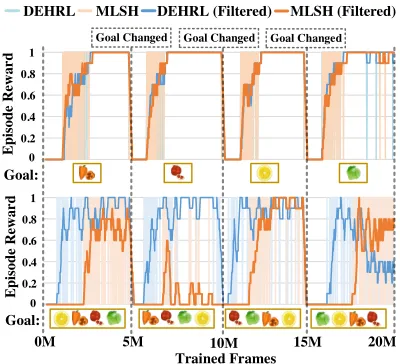
Figure 6: Meta HRL performances of DEHRL and MLSH in OverCooked.
ble 3 show that, these three baselines are all able to solve the task in the first three settings but all fail in the last three set-tings. This thus demonstrates that DEHRL can resolve the sparse extrinsic reward problem more effectively.
Finally, Figure 5 shows the learning efficiency in the learning speed score. We note that although DEHRL is much more complicated than the baselines, it still maintains very good learning efficiency in easy tasks: its learning speed scores are very close to the best of the baselines in the first two easier tasks. Furthermore, the learning efficiency of DEHRL greatly outperforms all baselines in the harder tasks. This asserts that, besides effectiveness, DEHRL also achieves superior learning efficiency. Also, efficiency mea-sured by wall-clock time can be found in (Song et al. 2018a).
Meta HRL
HRL has recently shown a promising ability to learn meta-subpolicies to better facilitate adaptive behaviors for new problems (Solway et al. 2014; Frans et al. 2018). We thus further compare DEHRL with the state-of-the-art frame-work, MLSH (Frans et al. 2018), to investigate its perfor-mance in meta learning.
We first set reward-level=1 and goal-type=random in OverCooked. The episode extrinsic rewards of both DEHRL
2
le
ve
ls
4
le
ve
ls
6
le
ve
ls
R
an
d
om
D
E
H
R
L
(11 / 5 / 16)
(Valid Build / Valid Break / Valid Operation = Valid Build + Valid Break) (21 / 10 / 36) (4 / 12 / 16) (7 / 1 / 8)
(11 / 5 / 16) (21 / 10 / 36) (4 / 12 / 16) (7 / 1 / 8)
(8 / 102 / 110) (10 / 98 / 108) (2 / 101 / 103) (7 / 90 / 97)
(23 / 137 / 160) (13 / 123 / 136) (4 / 102 / 106) (9 / 132 / 141)
Figure 7: Worlds built by playing Minecraft without extrin-stic reward.
and MLSH are plotted in Figure 6 (upper part), which al-ways drop when the goal is changed, because the top-level hierarchies of both methods are re-initialized. Obviously, the increase speeds of the episode extrinsic rewards after each reset can measure the performances of methods in facilitat-ing adaptive behaviors for a new goal (i.e., learnfacilitat-ing meta-subpolicies). Consequently, we find that DEHRL and MLSH have a similar meta-learning performance under this setting. Then, we repeat the above experiment with reward-level=2, and the results are shown in Figure 6 (lower part). We find that DEHRL achieves a better meta-learning than MLSH in this setting. This is because DEHRL can learn the subpolicies at level1to fetch four different ingredients, while MLSH can only learn subpolicies to move towards four different directions. Obviously, subpolicies learned at level1are better intertask-transferable, which make DEHRL resolve the new goal more easily and quickly than MLSH.
Application of DEHRL in Minecraft
To show the portability of DEHRL, we further apply DEHRL in a popular video game called Minecraft, where the agent has much freedom to act and build, and it has a 1st-person view via raw pixel input. At the beginning of each episode, the world is empty except one layer ofGRASS
blocks that can be broken. We allow the agent to play 1000 steps in each episode; then the world is reset. At each step, ten actions are available: moving towards four directions, ro-tating the view towards four directions, break/build a block and jump. More detailed settings and visualizations are in (Song et al. 2018a).
re-1 2 3
1.95E+04 3.14E+06 6.28E+06 9.16E+06
P
re
d
ic
te
d
I
n
tr
in
si
c R
ew
ar
d
Number Trained Frames
Figure 8: Predicted intrinsic reward.
quires human-designed extrinsic reward signals to train sub-policies is not appropriate to be used as the baseline. Conse-quently, we first construct three DEHRL models with three different numbers of levels, and then compare their perfor-mances in Minecraft to a framework with a random policy. Figure 7 shows the building results, where we measure the performance by world complexity. As shown in Figure 7, ac-cording to our intuitive feeling, DEHRL models obviously build more complex worlds than the random policy. Further-more, with the increase of the number of levels, DEHRL tends to build more complex worlds.
Then, we further use a metric,Valid Operations, to quan-tify the complexity of the worlds, which is defined as:
V alid Operations=V alid Breaks+V alid Builds,
whereValid Buildsis the number of blocks that have been built and not broken at the end of an episode;Valid Breaks
is the number of blocks that are originally in the world that have been broken. Consequently, blocks that are built but broken later will not be counted intoValid Build or Valid Break. As in Figure 7, the quantitative results are consis-tent with our previous intuitive feelings. Here, although the diversity objective is defined under a 1st-person view, the diversity score is measured under a 3rd-person view; it is to follow an intuition that although human players have a 1st-person view in Minecraft, their underlying intrinsic rewards motivate them to build complex 3rd-person view structures.
Finally, as the predicted intrinsic reward (ˆbl
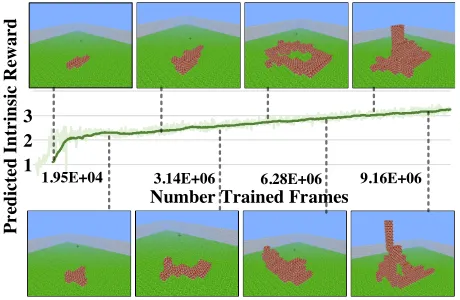
t) is an in-dication of the diversity of current subpolicies, we plot in Figure 8 the averagedˆblt over all levels and visualize the world built by DEHRL at different points to illustrate rela-tionship betweenˆbl
tand the built world. Minecraft with spe-cific goals has also been investigated and included in (Song et al. 2018a).
Related Work
Discovering diverse subpolicies in HRL.The diversity as-sumption is prevailing in the recent works of option discov-ery. HiREPS (Daniel et al. 2016) is a popular approach, but it works in a top-down fashion. SNN (Florensa, Duan, and Abbeel 2017) is designed to handle sparse extrinsic reward
tasks, which achieves this diversity assumption explicitly by information-maximizing statistics. Besides, it is promising to apply SNN in HRL of multiple levels. However, SNN suf-fers from various failures when the possible future states are enormous, making it impractical on domains with a large ac-tion space and unable to further learn higher-level subpoli-cies. Similar failure cases are observed in (Gregor, Rezende, and Wierstra 2016).
Extensible HRL.Recently, there has been some attempts in increasing the levels of HRL. Such works include MAXQ (Dietterich 2000), which requires completely searching the subtree of each subtask, leading to high computational costs. In contrast, AMDP (Gopalan et al. 2017) explores only the relevant branches. However, AMDP concentrates on the planning problem. Deeper levels are also supported in (Sil-ver and Ciosek 2012), but its scalability is not clear. DDO (Fox et al. 2017) and DDCO (Krishnan et al. 2017) dis-cover higher-level subpolicies from demonstration trajecto-ries. However, our work focuses on learning those purely end-to-end without human-designed extrinsic reward. Other works (Rasmussen, Voelker, and Eliasmith 2017; Song et al. 2018b) also involve a modular structure that supports deeper-level HRL. However, there is no guarantee or veri-fication on whether the structure can learn useful or diverse subpolicies at different temporal scales.
Meta HRL.Neuroscience research (Solway et al. 2014) pro-poses that the optimal hierarchy is the one that best facili-tates an adaptive behavior in the face of new problems. Its idea is accomplished with a verified scalability in MLSH (Frans et al. 2018), where meta HRL is proposed. However, MLSH keeps reinitializing the policy at the top level, once the environment resets the goal. This brings several draw-backs, such as requiring auxiliary information from the en-vironment about when the goal has been changed. In con-trast, our method does not introduce such a restriction. Re-gardless of the difference, we compare with MLSH in our experiments under the settings of MLSH, where auxiliary information on goal resetting is provided. As such, the meta HRL ability of our approach is investigated.
Improved exploration with predictive models.Since we introduce the transition model to generate intrinsic rewards, our method is also related to RL improvements with predic-tive models, typically introducing sample models (Fu, Co-Reyes, and Levine 2017), generative models (Song et al. 2017), or deterministic models (Pathak et al. 2017) as transi-tion models to predict future states. However, the transitransi-tion model in our DEHRL is introduced to encourage developing diverse subpolicies, while those in the above works are intro-duced to improve the exploration. Our method is compared with the above state novelty (S¸ims¸ek and Barto 2004) and transition novelty (Pathak et al. 2017) in our experiments.
Summary and Outlook
distance between states is another future research direction, where better representations of states may lead to improve-ments. Finally, DEHRL may be applied to visual tasks (Xu et al. 2018b) to achieve promising solution with diverse rep-resentations and mixed reward functions.
Acknowledgments. This work was supported by China Scholarship Council under the State Scholarship Fund, by the Alan Turing Institute under the UK EPSRC grant EP/N510129/1, and by Hebei University of Technology un-der the Yuanguang Scholar Plan.
References
Al-Shedivat, M.; Bansal, T.; Burda, Y.; Sutskever, I.; Mor-datch, I.; and Abbeel, P. 2018. Continuous adaptation via meta-learning in nonstationary and competitive environ-ments. InICLR.
Bacon, P.-L.; Harb, J.; and Precup, D. 2017. The option-critic architecture. InAAAI.
Daniel, C.; Neumann, G.; Kroemer, O.; and Peters, J. 2016. Hierarchical relative entropy policy search.JMLR.
Dietterich, T. G. 2000. Hierarchical reinforcement learning with the maxq value function decomposition. JAIR. Eysenbach, B.; Gupta, A.; Ibarz, J.; and Levine, S. 2018. Diversity is all you need: Learning skills without a reward function.arXiv preprint arXiv:1802.06070.
Florensa, C.; Duan, Y.; and Abbeel, P. 2017. Stochastic neural networks for hierarchical reinforcement learning. In
ICLR.
Fox, R.; Krishnan, S.; Stoica, I.; and Goldberg, K. 2017. Multi-level discovery of deep options. arXiv preprint arXiv:1703.08294.
Frans, K.; Ho, J.; Chen, X.; Abbeel, P.; and Schulman, J. 2018. Meta learning shared hierarchies. InICLR.
Fu, J.; Co-Reyes, J.; and Levine, S. 2017. EX2: Exploration with exemplar models for deep reinforcement learning. In
NIPS.
Gopalan, N.; desJardins, M.; Littman, M. L.; MacGlashan, J.; Squire, S.; Tellex, S.; Winder, J.; and Wong, L. L. 2017. Planning with abstract markov decision processes. InICAPS.
Gregor, K.; Rezende, D. J.; and Wierstra, D. 2016. Varia-tional intrinsic control. InICLR Workshop.
Haarnoja, T.; Hartikainen, K.; Abbeel, P.; and Levine, S. 2018. Latent space policies for hierarchical reinforcement learning. InICML.
Heess, N.; Wayne, G.; Tassa, Y.; Lillicrap, T.; Riedmiller, M.; and Silver, D. 2016. Learning and transfer of modulated locomotor controllers.arXiv preprint arXiv:1610.05182. Kompella, V. R.; Stollenga, M.; Luciw, M.; and Schmidhu-ber, J. 2017. Continual curiosity-driven skill acquisition from high-dimensional video inputs for humanoid robots.
AIJ.
Krishnan, S.; Fox, R.; Stoica, I.; and Goldberg, K. 2017. Ddco: Discovery of deep continuous options for robot learn-ing from demonstrations. InCoRL.
Lakshminarayanan, A. S.; Krishnamurthy, R.; Kumar, P.; and Ravindran, B. 2016. Option discovery in hierarchi-cal reinforcement learning using spatio-temporal clustering.
arXiv preprint arXiv:1605.05359.
Oh, J.; Guo, X.; Lee, H.; Lewis, R. L.; and Singh, S. 2015. Action-conditional video prediction using deep networks in atari games. InNIPS.
Parr, R., and Russell, S. J. 1998. Reinforcement learning with hierarchies of machines. InNIPS.
Pathak, D.; Agrawal, P.; Efros, A. A.; and Darrell, T. 2017. Curiosity-driven exploration by self-supervised prediction. InICML.
Rasmussen, D.; Voelker, A.; and Eliasmith, C. 2017. A neural model of hierarchical reinforcement learning. PLOS ONE.
Schulman, J.; Wolski, F.; Dhariwal, P.; Radford, A.; and Klimov, O. 2017. Proximal policy optimization algorithms.
arXiv preprint arXiv:1707.06347.
Silver, D., and Ciosek, K. 2012. Compositional planning us-ing optimal option models.arXiv preprint arXiv:1206.6473. S¸ims¸ek, ¨O., and Barto, A. G. 2004. Using relative novelty to identify useful temporal abstractions in reinforcement learn-ing. InICML.
Solway, A.; Diuk, C.; C´ordova, N.; Yee, D.; Barto, A. G.; Niv, Y.; and Botvinick, M. M. 2014. Optimal behavioral hierarchy. PLOS Comput. Biol.
Song, Y.; Grimm, C.; Wang, X.; and Littman, M. L. 2017. Learning approximate stochastic transition models. arXiv preprint arXiv:1710.09718.
Song, Y.; Wang, J.; Lukasiewicz, T.; Xu, Z.; and Xu, M. 2018a. Diversity-driven extensible hierarchical reinforce-ment learning. arXiv preprint arXiv:1811.04324.
Song, Y.; Xu, M.; Zhang, S.; and Huo, L. 2018b. General-ization tower network: A novel deep neural network archi-tecture for multi-task learning. InNIPS Workshop.
Sutton, R. S.; Precup, D.; and Singh, S. 1999. Between MDPs and semi-MDPs: A framework for temporal abstrac-tion in reinforcement learning.AIJ.
Tessler, C.; Givony, S.; Zahavy, T.; Mankowitz, D. J.; and Mannor, S. 2017. A deep hierarchical approach to lifelong learning in Minecraft. InAAAI.
Vezhnevets, A.; Mnih, V.; Osindero, S.; Graves, A.; Vinyals, O.; Agapiou, J.; et al. 2016. Strategic attentive writer for learning macro-actions. InNIPS.
Vezhnevets, A. S.; Osindero, S.; Schaul, T.; Heess, N.; Jader-berg, M.; Silver, D.; and Kavukcuoglu, K. 2017. Feu-dal networks for hierarchical reinforcement learning. arXiv preprint arXiv:1703.01161.
Xu, D.; Nair, S.; Zhu, Y.; Gao, J.; Garg, A.; Fei-Fei, L.; and Savarese, S. 2018a. Neural task programming: Learning to generalize across hierarchical tasks. InICRA.