The Thirty-Third AAAI Conference on Artificial Intelligence (AAAI-19)
Hierarchical Attention Network for Image Captioning
Weixuan Wang, Zhihong Chen, Haifeng Hu
∗School of Electronics and Information Technology, Sun Yat-sen University, Guangzhou 510275, China {wangwx25, chenzhh45}@mail2.sysu.edu.cn, [email protected]
Abstract
Recently, attention mechanism has been successfully applied in image captioning, but the existing attention methods are only established on low-level spatial features or high-level text features, which limits richness of captions. In this pa-per, we propose a Hierarchical Attention Network (HAN) that enables attention to be calculated on pyramidal hierarchy of features synchronously. The pyramidal hierarchy consists of features on diverse semantic levels, which allows predicting different words according to different features. On the other hand, due to the different modalities of features, a Multivari-ate Residual Module (MRM) is proposed to learn the joint representations from features. The MRM is able to model projections and extract relevant relations among different fea-tures. Furthermore, we introduce a context gate to balance the contribution of different features. Compared with the exist-ing methods, our approach applies hierarchical features and exploits several multimodal integration strategies, which can significantly improve the performance. The HAN is verified on benchmark MSCOCO dataset, and the experimental re-sults indicate that our model outperforms the state-of-the-art methods, achieving a BLEU1 score of 80.9 and a CIDEr score of 121.7 in the Karpathy’s test split.
Introduction
Image captioning, which aims to describe the content of an image, has emerged as a prominent attractive research problem in both academia and industry. It is a multidisci-plinary task involving computer vision and natural language processing. Image captioning is difficult for machine since it not only requires a comprehensive understanding of ob-jects, scene and their mutual relations, but also needs to de-scribe the content of an image with semantically and syn-tactically correct sentence. In real life, image captioning has a wide range of applications, ranging from helping visually impaired people to personal assistants.
Recently, attention mechanism, which plays an impor-tant role in image captioning, has been developed into di-verse forms. For example, (Xu et al. 2015; Lu et al. 2017;
∗
Corresponding author
Copyright c2019, Association for the Advancement of Artificial Intelligence (www.aaai.org). All rights reserved.
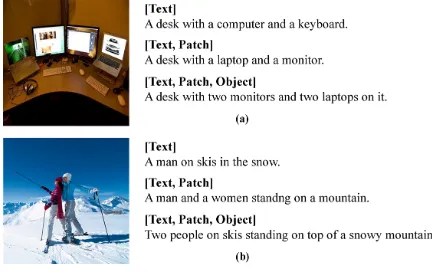
Figure 1: The illustration of captions generated by features of different levels. Text, Patch and Object indicate the se-mantically strong text features, sese-mantically weak patch fea-tures and semantically moderate feafea-tures respectively.
fea-tures of different levels, and it is of great significance to incorporate features of different levels to predict sentences. In this paper, we propose a novel features hierarchy, which consists of features on diverse semantic levels. On top of this hierarchical structure, we construct several independent parallel attention modules to refine the features of different levels, which allow us to leverage different features as the dominant role to predict words at different time steps.
Since features from different attention networks are in dif-ferent modalities, it is necessary to explore a multimodal embedding strategy to combine them. However, most ex-isting image captioning models (You et al. 2016; Rennie et al. 2017), directly integrate features of different modalities via addition or concatenation, which is unable to fully cap-ture the complex correlations between feacap-tures of different modalities. Motivated by the researches (Kim et al. 2016; 2017; Ben-younes et al. 2017) in Visual Question Answer (VQA), in this paper, we propose a novel Multivariate Resid-ual Module (MRM) to model the richer multimodal repre-sentation. MRM is able to project features of each modality into the target space and exploit the relevant relations among source spaces. Compared with the traditional methods, the MRM preserves valuable information of each modality and extracts more discriminative multimodal features. On the other hand, inspired by the neuroscience researches (Unger-leider and Haxby 1994; Lu et al. 2018b), we further design a parallel MRM (pMRM) for integrating features of different levels gradually.
Since the importance of the features generated by MRM varies from word to word at the different time step, we intro-duce a context gate structure to adaptively balance the con-tribution of features of different levels.
Overall, the contributions of this paper are four fold:
• In order to generate accurate and informative sentences, we construct a feature pyramid leveraging patch features, object features and text features, and build an attention network to refine features.
• We propose a parallel Multivariate Residual Network to integrate features of different levels, which aims at pro-jecting features into a unified target space and exploring the intrinsic relationship between different source spaces.
• A context gate mechanism is introduced into our model to adaptively balance the contribution of features on differ-ent levels.
• We conduct a number of experiments on the MSCOCO dataset and the results show that our model outperforms the state-of-the-art approaches, achieving a BLEU1 score of 80.9 and a CIDEr score of 121.7 in the Karpathy’s test split.
Related Work
Attention mechanism Recently, plenty of researchers are devoted to studying diverse attention mechanisms in order to refine visual information for image captioning. (Xu et al. 2015) presents a spatial attention mechanism to focus on the fixed-size patches which are most relevant to the generated
words. (You et al. 2016) applies an attribute predictor to pro-pose semantic concepts which are selectively attended and combined with the semantic information of recurrent neural network to predict words. (Anderson et al. 2018) proposes a bottom-up and top-down attention mechanism that com-putes the relevance between the generated words and salient objects. Although these attention mechanisms are effective, they have the deficiency of predicting words by using only one kind of features. In a sentence, different words could be determined by the features of different levels. For example, the color words could be predicted by low-level features and the quantifier could be generated by mid-level features. Pre-dicting on one-level features may generate words that are inconsistent with the content of images.
Multimodal embeddingIn the previous works (You et al. 2016; Rennie et al. 2017) in image captioning, features of different modalities are usually integrated by the concatena-tion or addiconcatena-tion operators. However, in the Visual Quesconcatena-tion Answering (VQA), Kim (Kim et al. 2016) proposes Mul-timodal Residual Network (MRN) for mulMul-timodal residual learning, which adopts Hadamard multiplication for the joint residual mappings. Kim (Kim et al. 2017) further presents a Multimodal Low-rank Bilinear Attention Networks (MLB) so as to approximate bilinear pooling to learn the multimodal features. It is beneficial to introduce these achievements into the image captioning task.
Methodology
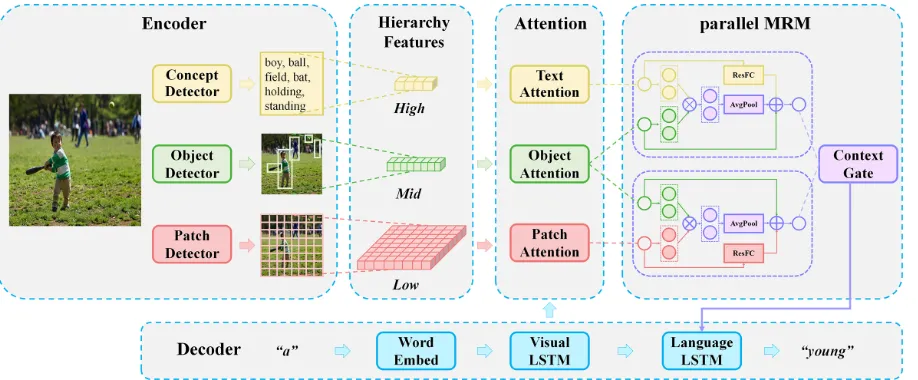
Overall
Given an imageI, the image captioning model needs to gen-erate a caption sequencew={w1, w2, . . . , wT},wt ∈D,
whereDis the vocabulary dictionary andTis the sequence length. We adopt the variant CNN-RNN architecture for im-age captioning. In particular, CNN, which plays the role of an visual encoder, extracts four different features including global featuresVg, patch featuresVp, object featuresVoand
text featuresVt to establish hierarchical features. As a
se-mantic decoder, RNN is leveraged to guide the generation of attention and caption sequences. In order to alleviate the vanishing gradient problem, we adopt LSTM (Hochreiter and Schmidhuber 1997) as a decoder in this paper.
To decouple attention guidance and sequence generation, we construct a cascaded LSTM structure that includes a vi-sual LSTM and a language LSTM. The former is applied to perceive global information of images and guide dif-ferent attention mechanisms to generate attention features
Ap, Ao, At, while the latter guides caption generation. In
or-der to better integrate attention features of different levels, we construct MRM to extract the internal relationship be-tween features.
Figure 2: The illustration of the overall structure of HAN, which is composed of Encoder module, Attention module, parallel MRM and Decoder module. The model takes the images and the words generated at last time step as input and outputs the next words.
The process can be defined by the following formulas:
Vg, Vp, Vo, Vt=Detectors(I) (1)
hVt =LST MV([hLt−1, Vg, E(wt)]) (2)
Ap, Ao, At=Attentions(hVt , Vp, Vo, Vt) (3)
M =pM RM(Ap, Ao, At) (4)
hLt =LST ML(M) (5)
wt∼Sof tmax(hLt) (6)
whereDetectors()represents feature extractors andE()is the embedding function which maps the one-hot represen-tation into the embedding space. LST MV,Attentions(),
pM RM()andLST ML represent visual LSTM, attention
module, pMRM and language LSTM, respectively.
Given an image I and the corresponding caption w =
{w1, w2, . . . , wT}, the model aims to maximize the
follow-ing loss function:
θ∗=argmaxX
(I,y)
logp(y|I;θ) (7)
where θ is the parameters of our model. Applying chain rule, we can model the joint probability on w =
{w1, w2, . . . , wT}and the cross entropy loss function (XE)
is adopted to minimize a negative log-likelihood:
L=−
T X
t=1
logp(wt|w1, ..., wt−1, I) (8)
Hierarchy feature pyramid
In the previous work, most attention mechanisms are based on only one-level features. For example, (Xu et al. 2015) is based on semantically weak patch features. (Anderson et al. 2018) is established on semantically moderate object fea-tures and (You et al. 2016) leverages semantically strong text
features. However, as shown in Figure 1, different words are associated with features of different levels. To leverage dif-ferent features to generate words synchronously, we propose a hierarchy feature pyramid structure. The bottom, middle and top layers of the hierarchy are the patch features, object features and text features respectively.
Patch featuresPatch features refer to the abstract feature expression of each patch in an image. We utilize a Resnet-101 pre-trained on ImageNet to extract features of the last convolution layer as patch featuresVp ∈ Rr×r×d. In
par-ticular, Vp = [Vp(1), Vp(2), . . . , Vp(r×r)],Vp(i) ∈ Rd is a
d-dimensional visual patch vector and the number of patch features isN p=r×r= 196.
Object featuresObject features refer to the feature rep-resentation of salient objects. In order to accurately capture objects, we introduce the Faster RCNN into our model. In our work, we take No object features Vo with the
high-est confidence, where No = 15. In particular, Vo =
[Vo(1), Vo(2), . . . , Vo(No)],Vo(i)∈R
dis ad-dimensional
vi-sual object vector.
Text features Text features refer to semantic concepts related to images, including adjectives, verbs, and nouns. In order to obtain the text features, we construct a K = 2000 classification text predictor, where the K represents the number of the most frequent words in the dataset. We takeNt= 10text conceptsT = [T1, T2, . . . , TNt]with the
highest score. In particular, when constructing feature hier-archy, the semantic concepts are converted to text features
Vt∈RNt×dvia the Embedding function, whereVt(i)∈Rd
is ad-dimensional text vector.
Figure 3: The illustration of text predictor based on Resnet101 with three fully connected layers.
L=−1
N
N X
i=1
[p∗i log(pi) + (1−p∗i) log(1−pi)] (9)
whereNrepresents the number of texts and thep∗i is 1 if the corresponding word exists in the groundtruth.
Attention module
In order to focus on the features that are most relevant to words at the current time step, the soft attention mechanism (Xu et al. 2015) is introduced into our framework. We con-struct three independent attention networks on three levels for refining features. Given the featuresV of one level and the outputhV
t of the visual LSTM, we apply a neural
net-work to normalize attention weights:
z(t) =WαTtanh(WVV +WhhVt) (10)
α(t) =sof tmax(z(t)) (11) whereWV, Wh ∈ Rd×dandWα ∈Rd×1are the trainable
matrices andα(t)∈RN are the attention weights. Based on
the weight matrix, attention featuresA(t)can be calculated by weighted sum at the current time stept:
A(t) =
N X
i=1
αi(t)Vi (12)
Specially, non-visual words in captions are not relevant to object and text features. Thus, we concatenate object tures with global features, text features with semantic fea-tures of the Language LSTM at the last time step in order to provide the extra global information to attend.
Multivariate Residual Module
The existing image captioning methods do not employ the strategy of combining various features, but directly fuse fea-tures with concatenation or addition operators. Motivated by the researches (Kim et al. 2016)(Kim et al. 2017), we pro-pose a novel Multivariate Residual Module (MRM) to inte-grate information of different modalities. The MRM consists of a projection part and a relation part.
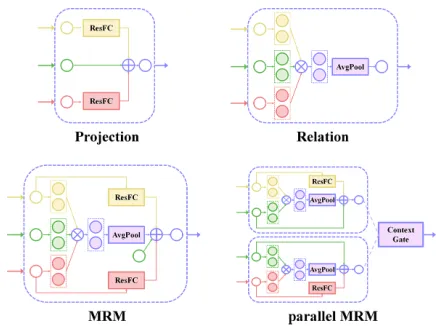
ProjectionInspired by ResNet (He et al. 2016), the pro-jection part (show in Figure 4(a)) is proposed to learn the relationship between the input data and nonlinear residual function, rather than directly learn the desired mapping. Thus, we construct two independent residual networks to
Figure 4: The illustration of Multivariate Residual Module and parallel Multivariate Residual Module.
project the patch attention feature and the text attention fea-ture into the object space:
Hp=Ap+ReLU(WmpAp) (13)
Ht=At+ReLU(WmtAt) (14)
whereApandAtare the patch attention feature and text
at-tention feature respectively.ReLUis a nonlinear activation function and the overall projected featureH defined as
H=Ao+Hp+Ht (15)
whereAois the object attention feature.
RelationMotivated by (Kim et al. 2016)(Kim et al. 2017), the relation part is proposed to apply the multimodal bilin-ear strategy to exploit the inherent relationship among di-verse spaces. The relation network is shown in Figure 4(b). Given the patch attention featureAp ∈Rmand object
fea-ture Ao ∈ Rn, multimodal bilinear strategy is defined as
follows:
Zi=ATpWiAo (16)
whereWi ∈ Rm×n is the weight matrix. In order to
ob-tain the outputZ ∈ Ro, we need to learnomatricesW = [W1, ..., Wo] ∈ Rm×n×o. According to (Kim et al. 2017),
we can rewrite the above formula to decrease the dimensions of parameter matrices:
Zi=ATpWiAo=ATpUiViTAo=UiTAp◦ViTAo (17)
Z =UTAp◦VTAo (18)
whereU = [U1, ..., Uo]∈Rm×o,V = [V1, ..., Vo]∈Rn×o,
and◦represents the Hadamard product. Further, we can ex-tend this strategy to merge the features of three modalities and rewrite it as follows:
Z=UTAp◦VTAo◦WTAt (19)
where At represents text attention feature. U, V, W are
weight matrices. Finally, we apply an average pooling layer to condense relation features:
MRM The MRM is shown in Figure 4(c). The output of the multivariate residual module is determined by projection featuresH(refers to the equation (15)) and relation features
R(refers to the equation (20)), which is defined as:
M =H+R (21)
pMRM (parallel MRM)The neuroscience (Ungerleider and Haxby 1994) proves that there is a content pathway in the brain for responding selectively to relevant object iden-tification, and a position pathway for responding selectively to spatial aspects of stimuli. Furthermore, the latest research (Lu et al. 2018b) indicates that there is a cluster of neurons in the brain that provides fine-grained object information to the pathways when identifying objects. In our work, similar to these research, we propose a parallel MRM to integrate features of different levels. The pMRM first provide the ob-ject information to the text features and the patch features respectively. Then a context gate is introduced to selectively focus on high-level content features and low-level position features. The pMRM is shown in Figure 4(d).
Context Gating
Inspired by the gating mechanism in LSTM (Hochreiter and Schmidhuber 1997) and the work (Wang et al. 2018) in dense video captioning, we introduce a context gating mech-anism into our model to balance the contribution of low-level context and high-low-level context. When obtaining the low-level attended featuresMLand the high-level attended
featuresMH, we learn a context gate to balance them. We
project the two different features into the same space:
˜
ML=tanh(WLML) (22)
˜
MH=tanh(WHMH) (23)
whereWL,WHare the projection matrices. The context gate
is then calculated by a nonlinear sigmoid function:
gctx=σ(Wg[ ˜ML,M˜H, hVt]) (24)
wherehVt is the previous visual LSTM state andgctx is a
512-d weight vector. We could fuse the low-level features and the high-level features as follows:
M = [(1−gctx)◦ML, gctx◦MH] (25)
Objective
Firstly, we adopt the usual cross entropy loss (XE) to opti-mize our model. Considering the XE may result in the dis-crepancy of evaluation between training and inference, we further adopt the CIDEr (Rennie et al. 2017) as the objective function to finetune our model. Specially, we minimize the negative expectation score of CIDEr as follows:
L(θ) =−Ews∼p
θ[CIDEr(w
s)] (26)
According to (Rennie et al. 2017), the expected gradient for single samplews∼p
θis:
5θL(θ)≈ −(CIDEr(ws)−CIDEr(w))5θlogpθ(ws)
(27) wherews= (w1s, ..., wTs),wst is the word sampled at timet
andCIDEr(w)is the baseline score obtained by greedily decoding the current model.
Experiment
Datasets and Evaluation metrics
The MSCOCO dataset (Lin et al. 2014) is the bench-mark dataset for image captioning, which contains 82,783, 40,504, and 40775 images for training, validation and test re-spectively. For offline evalution, we employ the Karpathy’s splits (Karpathy and Li 2015) which contain 113,287 images for training, 5,000 images for validation and 5,000 images for test. For fair comparison, we also report the results of the online MSCOCO testing server. To evaluate the quality of captioning, we adopt the evaluation criteria widely applied in previous works: BLEU (Papineni et al. 2002), METEOR (Denkowski and Lavie 2011), ROUGEL (Lin 2004), CIDEr (Vedantam, Zitnick, and Parikh 2015) and SPICE (Anderson et al. 2016).
Implement details
We use the ResNet101 pretrained on ImageNet to extract global feature and patch features, and use the Faster RCNN pretrained on MSCOCO object detection dataset to obtain object features, and train another ResNet101 to predict vi-sual concepts. The dimension of these features are reduced to 512. Due to the limitation of the hardware, we only adopt 196 patch features, 15 object features and 10 text features for each image. The dimensions of embedding layers and both LSTMs are set to 512. Firstly, we train our model under cross entropy (XE) loss using ADAM optimizer with a learn-ing rate 5e-4 and do not finetune the CNN. Afterwards, we perform the CIDEr standard optimization on the XE-trained model, and also use the Adam optimizer. In the decoding process, we use beam search and set beam size to 3.
Comparison with the state-of-the-art methods
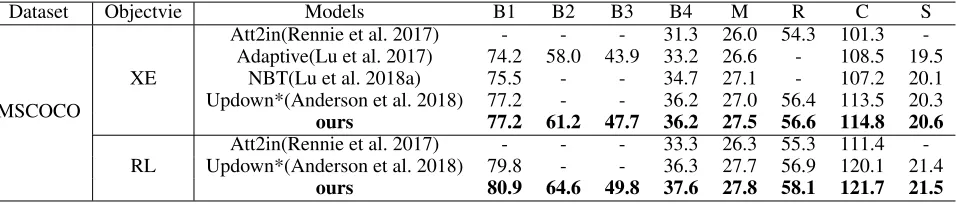
For offline evaluation on MSCOCO dataset, we compare our model with the current state-of-the-art methods: Adaptive (Lu et al. 2017), Att2in (Rennie et al. 2017), Updown (An-derson et al. 2018) and NeuralBabyTalk (Lu et al. 2018a) on MSCOCO. The Adaptive method proposes an adaptive at-tention to decide where and when to attend. Att2in modifies the architecture of the traditional spatial attention mecha-nism and optimizes the model with reinforcement learning. Updown proposes a bottom-up mechanism to detect image regions, and a top-down mechanism to determine feature weightings. NBT combines the patch attention with object attention, and generates sentences template with slots, which are then filled in by visual concepts. Table 1 shows the re-sults on the Karpathy’s test split. From the table we can find that our model achieves the best performances in all metrics. With XE objective, our model has an superiority over NBT model with an improvement of 7.1% in terms of the CIDEr metric. With CIDEr objective, our model improves 9.2% rel-ative to att2in model. Considering the fact that Updown ap-plies the object detector trained on Visual Genome dataset (Krishna et al. 2017) and thus obtains better object features, we do not compare its performance with other models.Table 1: The performance of HAN on the MSCOCO Karpathy’s test split. The XE is the cross entropy objective and the RL is the reinforcement learning objective. * uses better object features, and are thus not directly comparable.
Dataset Objectvie Models B1 B2 B3 B4 M R C S
MSCOCO
Att2in(Rennie et al. 2017) - - - 31.3 26.0 54.3 101.3 -Adaptive(Lu et al. 2017) 74.2 58.0 43.9 33.2 26.6 - 108.5 19.5
XE NBT(Lu et al. 2018a) 75.5 - - 34.7 27.1 - 107.2 20.1
Updown*(Anderson et al. 2018) 77.2 - - 36.2 27.0 56.4 113.5 20.3
ours 77.2 61.2 47.7 36.2 27.5 56.6 114.8 20.6
Att2in(Rennie et al. 2017) - - - 33.3 26.3 55.3 111.4 -RL Updown*(Anderson et al. 2018) 79.8 - - 36.3 27.7 56.9 120.1 21.4
ours 80.9 64.6 49.8 37.6 27.8 58.1 121.7 21.5
Table 2: Comparison with the state-of-the-art methods on the online MSCOCO test server.†indicates the results of ensemble models.
Models B1 B2 B4 M R C
c5 40 c5 40 c5 40 c5 40 c5 40 c5 40
SCA(Chen et al. 2017) 72.5 89.2 55.6 80.3 30.6 58.2 24.6 32.9 52.8 67.2 91.1 92.4 NIC(Vinyals et al. 2015) 71.3 89.5 54.2 80.2 30.9 58.7 25.4 34.6 53.0 68.2 94.3 94.6 ATT(You et al. 2016) 73.1 90.0 56.5 81.5 31.6 59.9 25.0 33.5 53.5 68.2 94.3 95.8 Adaptive(Lu et al. 2017) 74.8 92.0 58.4 84.5 33.6 63.7 26.4 35.9 55.0 70.5 104.2 105.9 MIXER(Ranzato et al. 2016) 74.7 90.9 57.9 82.7 31.7 60.0 25.8 34.0 54.5 68.6 99.1 101.2 SPIDEr(Liu et al. 2017) 75.4 91.8 59.1 84.1 33.2 62.4 25.7 34.0 55.0 69.5 101.3 103.2 AC(Zhang et al. 2017) 77.8 92.9 61.2 85.5 33.7 62.5 26.4 34.4 55.4 69.1 110.2 112.1 SCST†(Rennie et al. 2017) 78.1 93.1 61.9 86.0 35.2 64.5 27.0 35.5 56.3 70.7 114.7 116.7
HAN 80.4 94.5 63.8 87.7 36.5 66.8 27.4 36.1 57.3 71.9 115.2 118.2
Figure 5: The classes predicted by Faster RCNN and the texts predicted by our proposed text predictor.
with CIDEr. We can find that HAN outperforms other mod-els, and achieves an impressive result.
Ablation study
To better understand the effect of our hierarchical features strategy, we conduct experiments on a unified framework to compare the model leveraging hierarchical features by con-catenation (Hierarchy) with three models leveraging patch features (Patch), object features (Object) and text features (Text) respectively. In particular, the framework mainly con-sists of Visual LSTM, Attention module and Language LSTM. The MRM is removed in order to provide the same experimental conditions. The results are shown in Table 3. The Hierarchy model achieves an improvement of 5.2%, 3.8% and 18.6% in terms of the CIDEr metric compared with the Patch model, Object model and Text model. Bet-ter performance can be attributed to the fact that
Hierar-Figure 6: The visualization of text attention. The numbers represent the attention weights between our generated cap-tion(bottom) and our generated concepts(left).
chy model can provide more extensive features for Attention module.
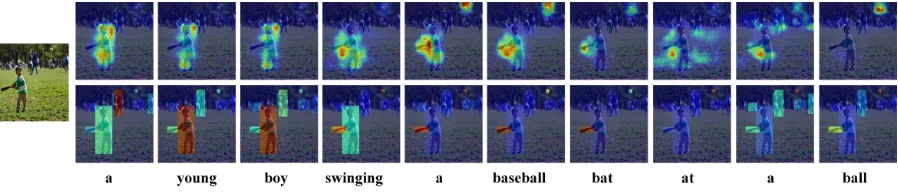
Figure 7: The visualization of patch attention(top) and object attention(bottom). The red and blue color represent the highest and lowest score respectively.
Figure 8: The visualization of the context gate. The red and blue colors represent the highest and lowest score respec-tively.
Qualitative Analysis
In order to qualitatively analyze our model, we first ex-hibit the categories proposed by Faster RCNN trained on MSCOCO and the texts generated by our text predictor in Figure 5. The results reveal that the texts proposed by our predictor are more related to image content. Secondly, we visualize the attention masks of features of different levels for each word in the generated caption. The visualization of text attention is shown in Figure 6, and the visualization of patch and object attention are shown in Figure 7. In Fig-ure 6, when inputting the word “baseball”, the text attention assigns the highest confidence to the concrete concepts for guiding the next word “bat”. In Figure 7, when predicting the word “bat”, our patch attention focuses on the area around the baseball bat, and the object attention can accurately at-tend to the region of “bat”. Figure 8 exhibits the visualiza-tions of the context gate when predicting the words “boy” and “bat”. Each row represents a weight vector, and the red and blue colors denote the highest and lowest score respec-tively. When predicting different words, the context gate can adaptively focus on the different channels of the high-level feature and the low-level feature.
Conclusions
In this paper, we propose a Hierarchical Attention Network (HAN) for image captioning. The key of our work is adopt-ing semantically weak patch features, semantically moder-ate object features and semantically strong text features to construct a pyramidal hierarchy of features, which allows predicting different words according to different features.
Table 3: The performance of the ablation experiment on sin-gle feature and hierarchical features.
Model B1 B2 B4 M R C
Patch 75.2 59.1 34.4 26.2 55.3 106.8 Object 75.5 59.3 34.9 26.4 55.6 108.3 Text 71.2 54.3 30.8 24.7 52.8 94.8 Hierarchy 76.3 60.4 35.5 27.1 56.4 112.4
Table 4: The performance of the ablation experiment on hi-erarchical features with different combination.
Model B1 B2 B4 M R C
Add 76.4 60.2 35.3 27.2 56.3 111.2 Concat 76.3 60.4 35.5 27.1 56.4 112.4 Projection 76.5 60.6 35.7 27.2 56.3 112.3 Relation 76.7 60.8 35.8 27.3 56.5 113.2 MRM 76.8 60.7 36.1 27.5 56.6 114.2 pMRM 77.2 61.2 36.2 27.5 56.6 114.8
We also propose an MRM to model projections and extract relevant relations among different features. Inspired by the latest research in neuroscience, we further construct the par-allel MRM to combine features gradually. Moreover, a con-text gate is introduced to balance the contribution of differ-ent features. We verify our model on the benchmark datasets MSCOCO, and achieve the state-of-the-art results.
Acknowledgement
This work was supported in part by the NSFC (61673402), the NSF of Guangdong Province (2017A030311029), the Science and Technology Program of Guangzhou (201704020180), and the Fundamental Research Funds for the Central Universities of China.
References
Anderson, P.; Fernando, B.; Johnson, M.; and Gould, S. 2016. Spice: Semantic propositional image caption evalu-ation. InECCV, 382–398.
Ben-younes, H.; Cadene, R.; Cord, M.; and Thome, N. 2017. Mutan: Multimodal tucker fusion for visual question an-swering. InICCV, 2631–2639.
Chen, L.; Zhang, H.; Xiao, J.; Nie, L.; Shao, J.; Liu, W.; and Chua, T.-S. 2017. Sca-cnn: Spatial and channel-wise attention in convolutional networks for image captioning. In CVPR, 6298–6306.
Denkowski, M., and Lavie, A. 2011. Meteor 1.3: Automatic metric for reliable optimization and evaluation of machine translation systems. InProceedings of the Sixth Workshop on Statistical Machine Translation, 85–91. Association for Computational Linguistics.
Gan, Z.; Gan, C.; He, X.; Pu, Y.; Tran, K.; Gao, J.; Carin, L.; and Deng, L. 2017. Semantic compositional networks for visual captioning. InCVPR, 1141–1150.
He, K.; Zhang, X.; Ren, S.; and Sun, J. 2016. Deep residual learning for image recognition. InCVPR, 770–778.
Hochreiter, S., and Schmidhuber, J. 1997. Long short-term memory.Neural Computation9(8):1735–1780.
Karpathy, A., and Li, F. F. 2015. Deep visual-semantic align-ments for generating image descriptions. InCVPR, 3128– 3137.
Kim, J.-H.; Lee, S.-W.; Kwak, D.; Heo, M.-O.; Kim, J.; Ha, J.-W.; and Zhang, B.-T. 2016. Multimodal residual learning for visual qa. InNIPS, 361–369.
Kim, J.; On, K. W.; Lim, W.; Kim, J.; Ha, J.; and Zhang, B. 2017. Hadamard product for low-rank bilinear pooling. In ICLR.
Krishna, R.; Zhu, Y.; Groth, O.; Johnson, J.; Hata, K.; Kravitz, J.; Chen, S.; Kalantidis, Y.; Li, L.-J.; Shamma, D. A.; et al. 2017. Visual genome: Connecting language and vision using crowdsourced dense image annotations. Inter-national Journal of Computer Vision123(1):32–73.
Lin, T.-Y.; Maire, M.; Belongie, S.; Hays, J.; Perona, P.; Ra-manan, D.; Doll´ar, P.; and Zitnick, C. L. 2014. Microsoft coco: Common objects in context. InECCV, 740–755.
Lin, C. 2004. Rouge: A package for automatic evaluation of summaries. InWorkshop on Text Summarization Branches Out.
Liu, S.; Zhu, Z.; Ye, N.; Guadarrama, S.; and Murphy, K. 2017. Improved image captioning via policy gradient opti-mization of spider. InICCV, 873–881.
Lu, J.; Xiong, C.; Parikh, D.; and Socher, R. 2017. Knowing when to look: Adaptive attention via a visual sentinel for image captioning. InCVPR, 3242–3250.
Lu, J.; Yang, J.; Batra, D.; and Parikh, D. 2018a. Neural baby talk. InCVPR, 7219–7228.
Lu, Y.; Yin, J.; Chen, Z.; Gong, H.; Liu, Y.; Qian, L.; Li, X.; Liu, R.; Andolina, I. M.; and Wang, W. 2018b. Revealing detail along the visual hierarchy: neural clustering preserves acuity from v1 to v4.Neuron98(2):417–428.
Papineni, K.; Roukos, S.; Ward, T.; and Zhu, W.-J. 2002. Bleu: a method for automatic evaluation of machine transla-tion. InProceedings of the 40th annual meeting on
associa-tion for computaassocia-tional linguistics, 311–318. Association for Computational Linguistics.
Ranzato, M.; Chopra, S.; Auli, M.; and Zaremba, W. 2016. Sequence level training with recurrent neural networks. In ICLR.
Rennie, S. J.; Marcheret, E.; Mroueh, Y.; Ross, J.; and Goel, V. 2017. Self-critical sequence training for image caption-ing. InCVPR, 1179–1195.
Ungerleider, L. G., and Haxby, J. V. 1994. ‘what’ and ‘where’ in the human brain. Current Opinion in Neurobi-ology4(2):157–165.
Vedantam, R.; Zitnick, C. L.; and Parikh, D. 2015. Cider: Consensus-based image description evaluation. In CVPR, 4566–4575.
Vinyals, O.; Toshev, A.; Bengio, S.; and Erhan, D. 2015. Show and tell: A neural image caption generator. InCVPR, 3156–3164.
Wang, Y.; Lin, Z.; Shen, X.; Cohen, S.; and Cottrell, G. W. 2017. Skeleton key: Image captioning by skeleton-attribute decomposition. InCVPR, 7378–7387.
Wang, J.; Jiang, W.; Ma, L.; Liu, W.; and Xu, Y. 2018. Bidi-rectional attentive fusion with context gating for dense video captioning. InCVPR, 7190–7198.
Wu, Q.; Shen, C.; Liu, L.; Dick, A.; and Hengel, A. V. D. 2016. What value do explicit high level concepts have in vision to language problems? InCVPR, 203–212.
Xu, K.; Ba, J.; Kiros, R.; Cho, K.; Courville, A.; Salakhudi-nov, R.; Zemel, R.; and Bengio, Y. 2015. Show, attend and tell: Neural image caption generation with visual attention. InICML, 2048–2057.
You, Q.; Jin, H.; Wang, Z.; Fang, C.; and Luo, J. 2016. Image captioning with semantic attention. InCVPR, 4651– 4659.