237
Copyright © 2018. IJEMR. All Rights Reserved.
Volume-8, Issue-2, April 2018
International Journal of Engineering and Management Research
Page Number: 237-244
DOI: doi.org/10.31033/ijemr.v8i02.12029
An Analysis of Startup Ecosystem in Metropolitan City in India
Neeraj K Pandey
Academic Associate, Department of Management, Ahmedabad University, INDIA
Corresponding Author: [email protected]
ABSTRACT
Entrepreneurial ecosystems are now a days receiving keen attention from the research scholars and corporate practitioners. In this paper studies have focused on the factor affecting an entrepreneurial ecosystem in the metropolitan cities in India; however, prior research has not offered a theory of entrepreneurial ecosystems that predict the initial funding of a startup based on the education, gender and experience of the founder. We contribute to entrepreneurship research by developing a regression model for the funding of a startup, which ultimately help to improve the efficiency of an entrepreneurial ecosystem. Beyond developing the theory, we also describe how scholars can examine entrepreneurial ecosystems as complex systems using quantitative analysis, multiple regressions modeling, and interpretivist methods. This model also provides implications for entrepreneurs and policymakers.
Keyword-- Startup, Entrepreneurial Ecosystem, Funding, Regression Model
I.
INTRODUCTION
A startup ecosystem is defined as a society of founders with ideas and skills, young companies at early stages with talent, incubators with mentors and capital, early adopters and the media. These elements or entities link, interact and assist each other, strengthening the ecosystem while increasing their own value (Kuratko DF & Rao TV, 2012). The goal for any startup ecosystem is to develop a self-sustaining network of talent and resources that seek to solve issues affecting the wider community. Early period startups are set to explore for market/product fit under circumstances of tremendous ambiguity. Alternatively, late stage startups are deigned to look for cyclical and scalable business model(s) and then move into bigger companies designed to execute under conditions of high certainty (Shane, 2012). Entrepreneurship stakeholders may integrate with schools, universities,
238
Copyright © 2018. IJEMR. All Rights Reserved.
This is because start-up ecosystems around the world havewitnessed an increased burst of entrepreneurship that has seen new ones founded and existing ones experiencing maturity (Aleisa, 2013), and tech start-ups are often viewed as important sources of innovation, productivity growth and employment (World Economic Forum, 2014). They can also contribute to a country’s competitiveness if they introduce new products or services (Muller and Rammer, 2012). However, what is decisive is an appropriate entrepreneurial ecosystem for their emergence, survival and sustenance, and growth over a period of time (Arruda et al., 2013).
II.
STARTUP ECOSYSTEM:
LITERATURE REVIEW
An Start-up ecosystem is defined as ―a set of entrepreneurial factors (both internal and external), entrepreneurial organizations (firms, venture capitalists, business angels, banks) institutions (universities, public sector agencies, incubations centers, financial institutions) and entrepreneurial processes (e.g. business birth rate, number of high growth firms, levels of blockbuster entrepreneurship, number of serial entrepreneurs, degree of sell-out mentality within firms and levels of
entrepreneurial ambition), which formally and informally coalesce to connect, mediate and govern the performance within the local entrepreneurial environment‖ (Mason and Brown, 2014). A start-up ecosystem is formed by people, start-ups in their various stages and various types of organizations in a location, interacting as a system to create new start-up ventures. The ecosystem for start-ups is dynamic. From time to time, ecosystems change in terms of people, organizations and environments (Isenberg, 2011). Start-up ecosystems in similar environments but located in different parts of the world can end up doing things differently simply because they have a different entrepreneurial culture and resources pool. Internal factors not only control ecosystem processes but are also controlled by them and are often subject to feedback loops. While some of the resource inputs are generally controlled by external processes like financial climate and market disruptions, the availability resources within the ecosystem is controlled by internal factors like people and organizations ability to contribute towards the ecosystem. Other internal factors include startups success and failures succession along types of people and available skills. Although people exist and operate within ecosystems, their cumulative effects are large enough to influence external factors like financial climate.
Figure: 1 An Ideal model of Start-up ecosystem
Elements of Startup ecosystem
Ideas, inventions and researches Start-ups at various stages Entrepreneurs
Start-up team members
Angel investors Startup mentors Start-up advisors
239
Copyright © 2018. IJEMR. All Rights Reserved.
Third people from other organizations with start-up activities
Organizations and activities with start-up activities Universities
Advisory & mentoring organizations Startup incubators
Startup accelerators Co-working spaces
Service providers (consulting, accounting, legal, etc.)
Event organizers Start-up competitions Investor networks
Venture capital companies Crowd funding portals
Other funding providers (loans, grants etc.) Start-up blogs & other business media Other facilitator
The benefits of entrepreneurship to the society and the economy as a whole are enormous. Entrepreneurship helps in avoidance of monopolies and cartels. Entrepreneurship is one of the easier ways of checking large corporations and MNCs from exploiting the consumers (Rehman and Elahi, 2012). Startup ecosystems have the ability to innovate, build exceptional companies, create jobs and open businesses. Entrepreneurial success is dependent on three contributing factors. They include economy, geography and sociology (Aleisa, 2013). These elements are crucial and introduce the dimension of aggregate startup entrepreneurial. 'Aggregating startup entrepreneurial' refers to an intrinsic set of qualities that entrepreneurs lean toward. These qualities include commitment, inclusivity and must be proactive. These traits could clarify why startups create clusters, that is, entrepreneurs are productive, create industries and draw others to their ecosystems. Two concepts can explain aggregating startup ecosystems; entrepreneurial density and entrepreneurial proximity. Entrepreneurial density refers to the quantity of entrepreneurs, quantity of people working for startups or high growth companies over the overall adult population (Feld, 2012). However, the three main members in the ecosystem that are indispensable for it is success are entrepreneurs, private investors & advisors. An entrepreneur is an innovator or developer who recognizes and seizes the opportunities; convert those opportunities into workable/marketable ideas; add value through time, effort money or skills; assume the risk of the competitive marketplace to implement these ideas; and realize the rewards from these efforts (Kuratko DF & Rao TV, 2012).
―Nearly every mistake I’ve made has been in picking the wrong people, not the wrong ideas.‖
(Arthur Rock, venture capitalist and founder of Intel: Sahlman, 1999).
The founder’s traits, attitude, his professional
experience as well as his practical skillset all play a part in the company’s growth potentials. Being proactive, motivated (Barba-Sánchez and Atienza-Sahuquillo, 2017), open to innovation and taking risks (Akbar, Bortoluzzi & Tracogna, 2014) are considered to be key assets of an entrepreneur’s personality.
Among 4000 successful entrepreneurs, the study of Butler (2017) suggested that the ability to thrive in uncertainty, a passionate desire to author and own project, and unique skills at persuasion as the most distinct character traits. Although these particular characteristics might fit to a 20- year old, the ideal age of startup founder (for otherwise lacking experience) is between 30 and 50 (Kon, Cukier, Melo, Hazzan & Yuklea, 2014). Challenging working condition and the pressure of critical decision- making are both part of the rather stressful job of an entrepreneur (Semerci, 2016), which may one day affect his mental or physical health. Therefore, founder with a high tolerance for stress have a valuable assets.
In contrast to common belief, after closely watching over 100 startup companies in the past two decades, (Furr and Ahlstrom, 2011)) discovered that attributes such as passion, vision and determination more often lead to failure than to success. When entrepreneurs invest countless work hours, money and reputation into their project, passion and determination can easily become dogmatism, falling in love with one’s product and ignoring honest customer feedback is the reason why most startup fail (Furr & Ahlstrom, 2011). Essentially, there should be a beneficial balance between being confident about what you know while at the same time distrusting your knowledge enough to stay eager to learn more (Kelley, Singer & Herrington, 2012).
Monitor, G. E., (2005) state that it would be beneficial, especially for complex technology-driven startups, to have a team of founders rather than one single founder. It allows the company to move faster, be more agile to enter a market and more responsive to a change in market conditions. A team also enables opportunities for accelerated and specialized decision making (Eisenhardt & Schoonhoven, 1996) as well as faster pace for innovations (Eisenhardt and Tabrizi, 1995). The ideal team of founder and co-founder consist of member with experience in the industry and in leadership. Although these attributes do not need to apply to everyone. In term of education, a heterogeneous team with different background would be preferred over a team of members with the same education (Frank et al 2009). Education itself is regarded as prerequisite for being a successful entrepreneur (Ferrante, 2005) industry experience has a positive impact as well (Walter et al., 2013).
240
Copyright © 2018. IJEMR. All Rights Reserved.
(Bala Subrahmanya, 2015). However, entrepreneursthemselves can play multiple important roles in the build-up of an entrepreneurial ecosystem such as mentorship, inspiration, investment, new founders and new employees. The second important stakeholder is large companies who have the potential to provide important leverage for early-stage companies in their growth and development. The third important stakeholder is the government, which can influence the ecosystem through its regulatory policies. These are viewed by entrepreneurs as both potential growth accelerators and potential growth inhibitors. If major differences exist in the entrepreneurial ecosystem from one region to another, it is primarily because of government policy differences because governments often adopt a strong country/regional focus in their entrepreneurial ecosystem promotion policies (Foster and Shimizu, 2013).The goal for any start-up ecosystem is to develop a self-sustaining network of talent and resources
that seek to solve issues affecting the wider entrepreneurial community. To do that, ecosystems must have some critical components such as (i) entrepreneurs with technical skills because it is a basic requirement in technology development, (ii) availability of a variety of sources of funding because it is an important element in a good startup ecosystem for innovative ideas and (iii) a favorable government regulation because it is an important determinant of the success of up-coming and existing start-ups (Bala Subrahmanya MH, 2017). Government regulations are in terms of taxation, support, funding, incentives, education and training. Thus, the presence of entrepreneurs, funding, investors and all the major stakeholders make an ecosystem for start-ups. If an ecosystem is to become effective, it is crucial for the government to address these needs adequately to promote such an ecosystem (Aleisa, 2013).
The Process of Start-ups creations
Source: Salamzadeh, A., & Kirby, D. A. (2017)
Lifecycle of the Start-up
A start-up goes through six stages of development throughout their lifecycle. The first stage is discovery where the purpose is to validate whether a startup is solving a fundamental difficulty and if anyone can theoretically be involved in the solution. This stage involves team formation, conducting customer interviews, creation of viable products, joining an incubator, financing from family and friends and bringing mentors and advisors on board. This process takes between 5-7 months. The second stage is validation where startups seek to get early validation that people are interested in their products through attention or actual purchase. This stage involves alteration of main features of their products, growth of users, metrics and analytics implementation, seed funding and ensuring product fit. The third stage is efficiency where the rationale of a startup is to improve their business structure and improve competence of their customer acquisition process. Startups should be able to obtain efficiently clients in order to evade scaling with a hole-filled bucket.
The stage goes through 5-6 months. The fourth stage is scale where startups Endeavour to steer growth insistently. Activities include massive customer acquirement, establishment of departments, employ executives and enhance scalability (Blank, Eesley, 2012). The fifth stage is the profit maximization stage. At this stage, the customer has a commendable customer base and products are moving, constituting a favorable profit margin. Startups at this stage are sustainable and are easy to move the next stage, which is renewal. The startup is mature enough to sustain itself and an entrepreneur is a position to start a new project without much supervision on the existing one (Startup Genome, 2011).
III.
RESEAERCH METHODOLOGY
241
Copyright © 2018. IJEMR. All Rights Reserved.
word, this section is devoted to description of the researchmethodology used in the study for a detailed analysis of the various factors (founders’ education, institute, age, experience, gender and investment type) that affect the initial funding of a startup in the metropolitans city in the country.
Objective of the study
As this topic is gaining significant importance in recent years and little work have been done on this particular topic, the paper attempt to make a contribution to this subject. The objective of this paper is to identify the factor that influence the initial funding of a startup and with the help of the identified factor to build a regression model which predict the funding of a startup based on the identified factor.
By considering the objective and purpose, this study can be categories in exploratory research, where the research is executed to explore the likelihoods of undertaking a larger research study.
Data Collection
To understand and analyze the factor affecting startup funding based on the literature review; data (Name
of the startups) which is secondary in nature have been collected from various website during the period of January to June 2017, for the four metropolitan’s cities Mumbai, New Delhi, Bangalore and Chennai.
To check the internal consistency of the factors affecting funding of a startup, Cronbach’s alpha was calculated. After compiling the data multiple regression analysis has been conducted. Secondary data sources such as, published report, research journals, reference books and online databases have been referred for the study.
Size and design of the sample
The data has been collected from the different source for four metropolitans’ cities which are New Delhi (25%), Mumbai (25%), Chennai (25%) and Bangalore (25%) with a sample size of 50 from each city with a total number of 200 from all the cities.
Descriptive Statistics
The demographic and socioeconomic profiles of the founders of the startups for each city have been studies in the Table 1. The table represents the city-wise distribution of founder’s gender.
Table 1 Gender and City Cross tabulation
City Total
Bangalore Mumbai Chennai New Delhi
Gender Male Count 47 45 47 44 183
% within City 94.0% 90.0% 94.0% 88.0% 91.5% % of Total 23.5% 22.5% 23.5% 22.0% 91.5%
Female Count 3 5 3 6 17
% within City 6.0% 10.0% 6.0% 12.0% 8.5%
% of Total 1.5% 2.5% 1.5% 3.0% 8.5%
Source: Author’s own calculation
It was found that 91.5% of the sample size is male and the rest are female. Majority of them belongs to less than 30 year of age. This is surprising as a majority of the founder are male in each city.
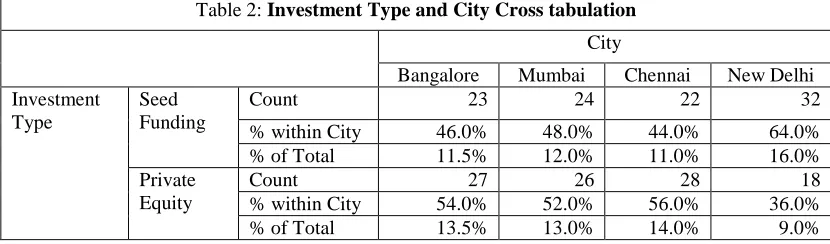
However, when a cross tabulation is conducted between the investment type and cities, interesting result are observed (Table 2).
Table 2: Investment Type and City Cross tabulation
City
Bangalore Mumbai Chennai New Delhi Investment
Type
Seed Funding
Count 23 24 22 32
% within City 46.0% 48.0% 44.0% 64.0% % of Total 11.5% 12.0% 11.0% 16.0% Private
Equity
Count 27 26 28 18
% within City 54.0% 52.0% 56.0% 36.0% % of Total 13.5% 13.0% 14.0% 9.0% Source: Author’s own calculation
From the given table, it could be observed that in the initial stage of a startup, they are getting more funding through private equity as compared to seed funding. But in
242
Copyright © 2018. IJEMR. All Rights Reserved.
connection in order to sustain and maintain a steadygrowth. The overall ratio of getting fund through seed funding and private equity is 49.5: 50.5 respectively.
The present study is basically based on cross- sectional data and has considered seven variable for this research, including Funding of the Startup, gender, Kind of education (Science, management and Art), Institute (Tier-I, Tier-II and others), Age, experience of the founder and the kind of funding (Seed funding or Private equity) for the selected metropolitans’ cities of the country.
IV.
RESULT AND DISCUSSION
To prove the above formulated hypothesis. A multiple regression analysis has been done. The multiple regression is conducted here to examine whether actually the funding of the startup is based on the education, institute, gender, experience and the type of funding. The dependent variable considered is funding of the startup and the five independent variable are education, experience, gender, institute and type of funding. Further, to estimate the impact of the above mentioned variable, Ordinary least square (OLS) has been performed.
The Regression Model
Y =
Funding of the Startup (Y) = α + β1(Gender) + β2 (Education) + β3 (Type of Institute) + β4 (Experience) + β5 (Type of
Investment) + unexplained variable
Where α is the intercept and; β is the slope parameter; U is the unobserved variable and β1, β2, β3, β4,
and β5 are gender, education, institute, experience of the founder and type of the funding respectively.
Model Summaryb
Model R R Square Adjusted R Square
Std. Error of the Estimate
Durbin-Watson
1 .527a .395 .135 7979618.807 1.852
a. Predictors: (Constant), Investment Type, Founder`s Education, Gender, Institute, Experience
b. Dependent Variable: Amount (in $ ) Source: Author’s own calculation
ANOVAa
Model Sum of Squares df Mean Square F Sig.
1 Regression 2277770411547298.00 5 455554082309459.60 7.154 .000b
Residual 12289143046369782.0 193 63674316302434.100
Total 14566913457917080.0 198
a. Dependent Variable: Amount (in $ )
b. Predictors: (Constant), Investment Type, Founder`s Education, Gender, Institute, Experience Source: Author’s own calculation
Coefficientsa
Model Unstandardized Coefficients Standardized Coefficients
t Sig. 95.0% Confidence Interval for B
Collinearity Statistics B Std. Error Beta Lower Bound Upper Bound Tolerance VIF
1
(Constant) -6065687.1 3665983.89 -1.655 .100 -13296223.28 1164849.04
Gender -1393064.02 2039578.69 -.046 -.683 .495 -5415789.68 2629661.63 .985 1.016 Founder`s
243
Copyright © 2018. IJEMR. All Rights Reserved.
Institute 428759.22 717506.93 .042 .598 .551 -986402.43 1843920.88 .902 1.108
Experience 117113.64 86951.11 .098 1.347 .180 -54382.79 288610.09 .834 1.200
Investment
Type 6078183.87 1175210.86 .355 5.172 .000 3760278.25 8396089.49 .927 1.079
a. Dependent Variable: Amount (in $ ) Source: Author’s own Calculation
Multiple Linear Regression analysis has been used to develop a model for predicting the funding of the startups based on the education, institute, gender, experience and type of funding. Basic descriptive statistics and regression coefficients are shown in Table 1. The predictor variables Investment type had a significant (p < .01) zero-order correlation with the funding of the startups. The other four predictor model was able to account for 40% of the variance in funding of the startups, F = 11.13 > 2.96, p < .005, R2 = .395, at the confidence level of 95%. In the table above, I have used asterisks to indicate which zero-order correlations and beta weights are significant and to indicate that the multiple R is significant. It is assumed that the informed reader will know that if a beta is significant then the semi-partial r and the unstandardardized slope are also significant. Providing the semi-partials, unstandardized slopes, and intercept is optional, but recommended in some cases – for example, when the predictors include dummy variables or variables for which the unit of measure is intrinsically meaningful (such as pounds or inches), then unstandardized slopes should be reported.
If there were more than five predictors, a table of this format would get too crowded. Then it would probably first drop the column of semi-partials, then either the column of standardized or unstandardized regression coefficients. If necessary it is recommended to drop the zero-order correlation coefficients between predictors, but not the zero-order correlation between each predictor and the criterion variable.
V.
CONCLUSION
The purpose of this paper was to study the impact of Education, institute, experience, gender and the type of funding on Initial funding of a Startup. For this research data has been collected from various website during the during the period of January to June 2017. The result revealed that although funding of a startup is primarily depending on the type of funding i.e.; seed funding and private equity, but also the other factor, which has been assimilated in this research as independent variable has a significant impact on the funding. In this study it also has been found that Bangalore is the best startup ecosystem among the Mumbai, New Delhi and Chennai, on the basis of dataset, Chennai has the least impact of founder’s education background on the funding of the startup.
Through Statistically analysis the study proves that there is least impact of gender, institute and education of the founder respectively on the initial funding of a startup.
REFERENCES
[1] Aleisa, E., & Recker, J., Liddle, R., & Brown, T. (2013). Startup ecosystems. Study of the ecosystems
around the world. Available at:
http://www.janrecker.com/wp- content/uploads/2013/02/20130213_FinalReport_Startup-Ecosystems.pdf.
[2] Akbar, Y. H., Bortoluzzi, G., & Tracogna, A. (2014). Beyond entry mode–SME escalation in emerging markets: a conceptual framework. Journal for International
Business and Entrepreneurship Development, 7(4),
326-340.
[3] Bennett, J. (2017). Navigation: A very short
introduction. Oxford: Oxford University Press.
[4] Barba-Sánchez, V. & Atienza-Sahuquillo, C. (2017). Entrepreneurial motivation and self-employment: Evidence from expectancy theory. International
Entrepreneurship and Management Journal, 13(4),
1097-1115.
[5] Barba-Sánchez, V. & Atienza-Sahuquillo, C. (2017). Entrepreneurial intention among engineering students: The role of entrepreneurship education. European Research on
Management and Business Economics, 24(1), 53-61.
[6] Boocock, G., Frank, R., & Warren, L. (2009). Technology-based entrepreneurship education: meeting educational and business objectives. The International
Journal of Entrepreneurship and Innovation, 10(1), 43-53.
[7] Bala Subrahmanya, M. H. (2017). How did bangalore emerge as a global hub of tech start-ups in india? Entrepreneurial ecosystem—Evolution, structure and role. Journal of Developmental Entrepreneurship, 22(01), 1750006.
[8] Eisenhardt, K. M., & Schoonhoven, C. B. (1990). Organizational growth: Linking founding team, strategy, environment, and growth among US semiconductor ventures, 1978-1988. Administrative science quarterly,
35(3), 504-529.
[9] Eisenhardt, K. M., & Tabrizi, B. N. (1995). Accelerating adaptive processes: Product innovation in the global computer industry. Administrative science
244
Copyright © 2018. IJEMR. All Rights Reserved.
[10] Eisenhardt, K. M., & Schoonhoven, C. B. (1996). Resource-based view of strategic alliance formation: Strategic and social effects in entrepreneurial firms. Organization Science, 7(2), 136-150.
[11] Feld, B. (2012). Startup communities: Building an
entrepreneurial ecosystem in your city. Hoboken, New
Jersey: John Wiley & Sons.
[12] Ferrante, F. (2005). Revealing entrepreneurial talent. Small Business Economics, 25(2), 159-174.
[13] Peabody, D. & De Raad, B. (2002). The substantive nature of psycholexical personality factors: A comparison across languages. Journal of Personality and Social Psychology, 83(4), 983-997.
[14] Au, K., & Kwan, H. K. (2009). Start-up capital and Chinese entrepreneurs: The role of family.
Entrepreneurship Theory and Practice, 33(4), 889-908. [15] Krishna, H. S., & Subrahmanya, M. B. (2015). Transnational Entrepreneurship and Indian High-tech Start-up Survival: An Empirical Investigation. South Asian
Journal of Management, 22(2), 81-98.
[16] Keeble, D & Wilkinson, F. (1999). Collective learning and knowledge development in the evolution of regional clusters of high technology smes in europe.
Regional Studies, 33(4), 295‐303.
[17] Amini, S, Keasey, K., & Hudson, R. (2010). The equity funding of smaller growing companies and regional stock exchanges. International Small Business Journal, 30(8), 832-849.
[18] Lee, H., & Kelley, D. (2008). Building dynamic capabilities for innovation: an exploratory study of key management practices. R & D Management, 38(2), 155-168.
[19] Birch, D. (1987). Job Creation in America: How Our Smallest Companies Put the Most People to Work. New York: The Free Press.
[20] Walshok, M L., Furtek, E L, Carolyn W.B., & Windham, P. H. (2002). Building regional innovation capacity: The San Diego experience. Industry and Higher Education, 16(1), 27-42.
[21] Mason, C., & Brown, R. (2014). Entrepreneurial ecosystems and growth oriented entrepreneurship. Final
Report to OECD, Paris, 30(1), 77-102.
[22] Rehman, A., & Elahi, Y. A. (2012). Entrepreneurship Education in India–Scope, challenges and Role of
B-schools in Promoting Entrepreneurship
Education. International Journal of Engineering and
Management Research, 2(5), 5-14.
[23] Salamzadeh, A., & Kirby, D. A. (2017). New venture creation: How start-ups grow?. AD-minister, (30), 9-29. [24] Sahlman, W. A., Stancill, J., & Rock, A. (1999). Harvard business review on entrepreneurship. Cambridge: Harvard Business Press.
[25] Semerci, A. B. (2016). The effect of social support on job stress of entrepreneurs. Academy of Entrepreneurship
Journal, 22(1), 41.
[26] Shane, S. (2012). Reflections on the 2010 AMR decade award: Delivering on the promise of entrepreneurship as a field of research. Academy of
Management Review, 37(1), 10-20.
[27] Walter, S. G., Parboteeah, K. P., & Walter, A. (2013). University departments and self‐employment intentions of business students: a cross‐level analysis. Entrepreneurship