478
Copyright © 2016. Vandana Publications. All Rights Reserved.
Volume-6, Issue-1, January-February-2016
International Journal of Engineering and Management Research
Page Number: 478-486
Impact of Online Marketing in Molding Consumer Behaviour
Aditi Srivastava1, Dr. Komal Chopra2
1,2
Symbiosis Institute of Management Studies, INDIA
ABSTRACT
E-commerce has seen a significant development and growth in India, post ‘Liberalisation’ that occurred in the year 1991. Since over the years Indians have taken to online modes of shopping, they have been looking for the convenience of buying with the comfort of being at their homes, along with products being delivered to them at lower costs. The various advantages available to the online consumers has led to a transformation of the brick and mortar businesses to turn towards online business models, hence very evidently, the relevance of online marketing has been significant, post year 2005.
Though it is true that the relevance of online marketing has increased due to consumers ‘online buying’ behaviour and frequency of purchase being made, it is also evident that digital marketing has been responsible in moulding consumer behaviour. The online initiatives through owned, earned and paid media are collectively responsible for moulding a consumer’s perspective in terms of recall value, consumer involvement levels as well as purchase decisions about products and services; displayed and sold, online. There are various tools used by online marketers that help in creating a brand recall for a consumer. Such tools include the use of earned, owned and paid media. Owned media is the brand website – which is used for showcasing the various products online. Earned media is the tool that uses social media; where the initiatives are taken for engagement of consumers, online and direct interaction with them for creating a buzz about the products, offers as well as the promotion of any landmark achieved by any brand. The Paid media is the tool where there is creation of online advertisements, in the form of banners, videos as well as promoted posts on social media that are used in the circulation and are then influencing the minds of the consumers. These are thereby collectively making it a reason for the consumers to make up their minds for a particular brand or deciding on the purchase of products belonging to these brands. There are several ways how the marketers have tried to reach the audience on the digital platform. They have created many modes of reaching out to them via internet. The main gadgets used by consumers are desktops/laptops, mobile phones (smart phone/feature phone), tablets.
This study is aimed towards having a wholesome view of the change in consumer behaviour, as a consequence of initiatives taken online-in order to increase online consumer engagement, consumer traffic as well as conversions being made through such initiatives, as well.
There are various kinds of initiatives taken online that create awareness about the products. The initiatives most definitely begin through owned media – where websites are attractively decorated and details are carefully placed, in order to make them appealing for the consumers and also to let them have ease in purchasing products. This step is then followed by earned media – which is about social media creating a buzz on Facebook/Twitter or LinkedIn and other networks where a consumer spends maximum time in a day. The last is the paid media where the advertisements are created for the purpose of online marketing and creating awareness of events. The researchers have worked towards knowing the various ways in which consumers get influenced and are motivated to go ahead and participate in the online engagement and ultimately go on to make a purchase.
Keywords---- Online Consumers, Consumer Behaviour, Online Marketing, Online Initiatives
I.
INTRODUCTION
479
Copyright © 2016. Vandana Publications. All Rights Reserved.
influencing the minds of the consumers. These are thereby collectively making it a reason for the consumers to make up their minds for a particular brand or deciding on the purchase of products belonging to these brands. There are several ways how the marketers have tried to reach the audience on the digital platform. They have created many modes of reaching out to them via internet.
The main gadgets used by consumers are
desktops/laptops, mobile phones (smart phone/feature phone), tablets. Hence in the Tier I and Tier II cities one of the biggest drivers of traffic towards websites is smart phones. And in order to leverage on this, most companies are moving towards „Mobile first‟ approach. Talking about Tier III cities, most of the entertainment is happening through feature phones and hence there is a strong connect being made with these rural consumers via campaigns, that glue them to these entertaining
gadgets; and subsequently shower them with
information, on various crucial aspects in life. Just as how the „KankhajuraTesan‟ campaign by HUL has impacted loads of rural consumers to get involved in the entertainment business and thereby have become dependent on them, reflects how these marketing campaigns have moulded the trends in behaviour of consumers towards the content they show on various media. These initiatives are thus collectively responsible for making a difference in their perception about brands as well as altering their opinion based on the experience they have by these tools online. Each step taken by an online marketer, somewhat counts in such a case. This study was thus aimed at knowing how much one person gets influenced by these innumerable tools, used by marketers online and to establish that these tools mould consumer behaviour.
Objectives of the Study
1. To investigate the brands‟ initiatives/factors online that led to the engagement of consumers, thereby moulding their attitudes by increasing brand recall and buying behaviour.
2. To learn the impact of brands‟ online content i.e. articles/ blogs and advertisements etc. on consumers, that led to moulding their behaviour towards their lifestyle and purchase decisions. Limitations
1. The demographics considered are mainly
youth/working professionals and not many non-working audiences or from the middle aged generation could be targeted.
2. Rural population from tier three cities could not be included in the survey due to limitations in reaching out to them.
II.
REVIEW OF LITERATURE
Sen on 20 January 2015,wrote an article on “FabAlley – Shock and Awe” in Afaqs.com. Comedian Radhika Vaz‟s campaign created by Jack in the Box worldwide, where she presents a monologue questioning fashion trends and also a rant against abiding by fashion norms. The call to action is to „Unfollow‟. The strategic
objectives were to give a voice and personality to the brand FabAlley considering that all e-com start-ups mostly focus on the discounting of transactional methods. The conversation the campaign has generated is testimony to the fact that people were intrigued and it had an emotional connect. The official website of FabAlley saw phenomenal traffic since the campaign launch. The involvement of the consumer with the viral video and also the emotional connect created by the brand while setting a niche trend of „being a rebel‟ versus „conforming to the trends‟- explains the involvement of the consumer, but does not really translate the attention to purchase. While a film circulated like this has definitely helped in creating a distinctive brand identity, customer acquisition and loyalty will mostly depend on the parameters like price comparisons, packages, coupons etc. followed by good after sales service. So, the impact of the desirable buzz that was created online, shows only that it was good for entertainment, but most of the perception and moulded behaviour of consumers is related to what they offered in terms of good deals and tangibles.
Hughes in January2015, wrote a research on “How the digital revolution is changing consumer behaviour” in PA Consulting. In his article he has explained how societal trends driven by the digital revolution are changing consumer behaviour and demands, and shall remain so. If brands can manage to understand these changes, it can outstrip the rivals and even the upcoming competition that may disrupt the long term strategies set by the brands. Hughes has mentioned seven key changes that are visible in consumer behaviour. These include the fact that customers are not only dependent on comparing brands with competitors, they look at other intangible factors like and experience and word of mouth. Consumers are not as tolerant as they used to be. They are led by social opinions by an influencer or friends and followers. They have turned less loyal as it is easy to entice them to go for a new brand. There is mistrust for the mainstream information channels and strong advocacy against direct marketing. The rise of digital has brought people to become more aware and informed, on their own. All consumers have become multichannel users. The study hence reinforces that the digital way of life has created a huge impact on how the traditional behaviour of consumers has become more inclined towards rationality.
480
Copyright © 2016. Vandana Publications. All Rights Reserved.
attention and interaction brands create for them. Following of communities and brand pages, followed by the organic thumbs up or „likes‟ is quite important to a brands social clout, much of the social endorsement is incentivised by way of contests and gratification. The researchers have also reiterated the importance of social media with the way it has been creating brand loyalty with the use of online word of mouth, taking help of the online influencers – it is indeed important to have paid strategies but it is all the more essential to not over-saturate the target audience with the incentivised efforts, only.
Gangalon 30 June 2014, wrote an article on “An insight into HUL's stunning mobile marketing initiative that has taken rural Bihar and Jharkhand by storm” in Afaqs.com. The researcher has mentioned how mobile marketing has created a revolution of a sort in rural India, which was supposed to be a media dark region, deprived of basic technology and infrastructure. KanKhajuraTesan is a mobile radio station that provides entertainment to those who give missed calls to their toll free number. Most of the people in rural India depend on their mobile phones for entertainment, as due to frequent power cuts television and radio have been moved to the grey background. HUL found an opportunity in the problem and created a masterpiece by attracting these rural consumers and getting them glued to their mobile phones. The entertainment provided by the radio station, in turn became the reason why they started using mobile phones more frequently. Those who were not yet technology savvy, were lured to use these gadgets to be able to get entertainment free of cost, even without electricity in these regions. Slowly and steadily, HUL started introducing promotional content on these calls right before they were provided entertainment content. This became a revolution in the rural cities as there was now a means of communication and slowly these media dark regions were being enlightened by digital content. The campaign thus enabled the rural consumer to get aware, get involved in many social issues as they were being educated by the content promoted via these calls they made with their mobile phones.
Motwani, Shrimali and Agarwal, in January 2014, wrote a review on “Customers Attitude towards Social Media Marketing” in Journal of Business Management & Social Sciences Research vol3, pp4.It is evident from the study by researchers that the consumers rely on a lot of review and word of mouth, spread by communities and groups online leading to their participation and decision making in a purchase. Social media such as Facebook, Twitter and YouTube are dynamic tools that facilitate online relationships. Customers have a positive perception towards social media marketing practices. They consider social media advertising more interesting, innovative, informative and interactive as compared to traditional advertising. Social media is not only actively into creating awareness but also has turned out to be the preferred media by consumers for making their final purchase. Social media hence has proved to be a powerful online tool that helps
the consumers in being upfront and honest with their opinions and since the content shared on these networks, gets viral within hours to the point of trending – it is an essential part of every consumer‟s life, as it depends on word-of-mouth via blogs, articles, reviews etc. The point that the researcher has wanted to make is of how social media‟s relevance has increased with the changing times. From being just a networking site to how it evolved into communities and groups where members participated in discussions as well as social conversations such that they became dependent on them. Dependent on the transparency of information and just the fact that these networks are interactive, created a big opportunity for the online marketers to use this platform for reaching out to its consumers and to know them better, to be able to gather the requirements as well as made it a virtual portal for leaving any remarks or testimonials for them, making it an easy way to reach out to the brands and vice-versa. Hence Social media can be counted as one of the major reasons for brands doing well and moulding their consumers‟ behaviour- due to various pieces of information that are shared by them online, with interactions happening around such information and also how the information is used, thereafter.
Singer on 03 October 2014, wrote an article on “5 Ways mobile changed consumer behaviour forever” in The Future of Commerce. This review as explained by researchers is about the significance of Mobile phones in the current generation, how the perpetual use of smart phones/feature phones, one has brought a vivid change in shopping styles and faster purchase making decisions. More than half of the consumers‟ digital time is spent on mobile devices tablets, iPads and smart-phones, etc. To the users it is indeed very important to have great experiences and they demand them on their devices. As per Google there are more than half the consumers more likely to purchase from a mobile site, if the experience is good while some would leave their mobile site if they didn‟t promptly get what they are looking for. This is extremely critical and crucial as the search-ability and hierarchy of content on their website. Digital marketers need to and must have optimised search experience that includes SEO, SEM and Local search. When one invests in their mobile presence, one must maintain it with an array of tools because they save time and cost. It is thus imperative to say that the consumers depend much on time and await excitement on the mobile platform. They depend on the new innovations that keep coming through various technology driven campaigns. They like to explore more through mobile if there are good ideas being used for campaigns online and targeted at mobile users. It is hence needless to mention that mobiles are an effective tool in moulding one‟s behaviour hence need to be carefully selected and they must also invest in the array of tools that come with it.
481
Copyright © 2016. Vandana Publications. All Rights Reserved.
came to perceiving themselves as beautiful or ugly- and how there was a factor of brand connect involved, such that it led to a huge recall value for Dove as well as people‟s increased affinity towards this brand. The campaign and post the release of it after a month, has garnered more than 114 million views making it the most viral video ever. Despite critics at play, there was a boosting message clearly resonating with a massive audience. It was uploaded in various languages to multiple channels on YouTube and has been viewed in more than 110 countries. In terms of the emotional connect; it elicited a heavy emotional response from the audience. Published data by Dove asserted that more than half the women globally have consented that when it comes to their own appearances, they are their worst critics. The fact that the campaign did well is the „content‟ that reflected the response of warmth, happiness, and knowledge from its target demographic. Social motivations leading to video sharing on social media became more profoundly important thereby bringing a good brand recall. These videos shared online were of utmost importance, looking at how the social connect had been formed by these campaigns of making consumers realise how beautiful they were. These brands took this to a whole new level, by connecting with the audience with sharing this video and making it viral. Such a revolutionary campaign that made women think- beyond what seemed the truth. With this campaign and the video sharing, women began to empathise with each other and even moulded their behaviour when they realised how they had been treating themselves. Or even other humans of a similar make. The emotional chord was touched by this advertisement but how soon it was shared and how easily it was circulated, created a vast difference. It created a buzz online on social media, various media channels. The world spoke about the depth of the social stigma that women face when it comes to their appearances. How women have given utmost importance to their appearance, especially if they are not gifted with what seems the best. Another reason why just a mere video made viral, brought about a social change and even a change in consumer behaviour; with how they started liking the brand and even appreciating it. Affinity grew and it increased brand recall.
Taylor in September 2012,wrote a review on “Social Media for Social Change” in Institute of Strategic Dialogue. The article explains the relevance of Social media in moulding behaviour of consumers and mentions that it is not a tool in itself but a reinforcement through digital social conversations of what already exists in the media campaigns. It is about creating conversations around events and campaigns. Social media does not change the rules of campaigning nor does the existence negate the need for offline work. It is crucial to establish a professional presence through which all the social media platforms can interact. Civil society organisations need to invest in social media training and this is one aspect where government can offer support. Organisations need to be apt with some social media analysis to help the impact they are having.
Social media is a tool not an end in itself which means that businesses need to be confident of what they need to achieve. A chain of events affect repurchases of consumers, which further affect future earnings and long term organisational sustainability. Hence the aim of having social media is not as a separate tool for a separate objective, but only for reinforcing the existing campaigns through digital conversations.
Ford and Freeman in March2009, wrote a review on “The Influence of Digital Communication on Consumers‟ Attitudes to Brands” in Harris Interactive.
The researchers have mentioned this with four billion pages, that the brands will have lesser scope of dominating the medium. In a brand campaign the reach in digital media will remain small but the potential influence could be huge. Online therefore offers much more in terms of audience of interest as compared to the traditional media. Digital communication is used more with the focus of sharpening the message, originally carried out by the traditional media. Traditional media builds consideration and the online media creates the clicks. Online word of mouth is an essential epitome of digital marketing and a challenge for a brand to reach a meaningful reach but in case of a success is definitely more powerful. The power needs to be harnessed and monitored. The research hence explains that an offline initiative needs to be reinforced through digital media with an equivalent message on the digital platform. There are more consumers who can be reached out to, in the digital space which may not be possible on traditional media.
Elia in January 2009, wrote a research paper on “Internet marketing, website design and Consumer Behaviour” in University of Manchester. In the research the author has aimed to provide an empirical analysis of the website elements, which affect customers in the online markets. The impetus has been upon customers‟ satisfaction, trust and loyalty to the vendors‟ website which are attached to the prospect of visiting the website in the future or even recommending it to their peers. The concept model has shown that the main two factors affecting a consumer‟s satisfaction are website design and information content. The findings of the research showed that customer satisfaction is positively influenced by website design and information content, respectively. In the end, it this research and by its outcome, it can be debated that a brand that operates on the internet is capable of achieving a competitive advantage by taking all aspects of the website into consideration. It requires careful analysis of the elements and features, which conduct a website and a thorough examination of the perspective users of the online market. Digit
III.
RESEARCH METHODOLOGY
Selection of Topic
482
Copyright © 2016. Vandana Publications. All Rights Reserved.
developed as compared to when it was in its nascent stage. From corporate brands to politicians showcasing their identity in a country, digital media has phenomenally spread across all platforms and is well imbibed by our country leaders in managing their leagues, amongst millions of people in the population. This research was aimed at finding out whether the initiatives for moulding consumer behaviour, taken online via websites, social media, EDMs, advertisements on you-tube channels etc. for the purpose of creating a buzz online, have had an impact on the individuals‟ purchase decisions.
Selection of Sample
Sample consisted of 200 respondents from varied walks of life and geographical location.
Pilot Study
To test the feasibility of the tools of the research the pilot study was carried out. For this study a questionnaire was directed to 50 respondents. On the
basis of the results, the questionnaire was redesigned and a final one was created.
Collection of Data
The final questionnaire was forwarded to 200 respondents. A sample questionnaire has been enclosed at the end as „Appendix‟ under Chapter 8 on page 35. Previous research studies on similar topics were
evaluated and analysed, collected from books,
magazines, articles and journals on the internet. Analysis of Data
The responses and data gathered have been presented in the form of tables and graphs under chapter 4 results. No statistical tools have been utilised or applied in the project.
IV.
RESULTS/FINDINGS OF STUDY
The results of the study are presented in the form of tables and figures.
Table 1: Demographic profile of Respondents
S.No Questionnaire n = number of Percentage of
Respondents Respondents (%)
1 Name 200 100
2 Location 200 100
a. Metropolitan 138 69
b. State Capital 33 17
c. Town 25 13
d. Village 3 2
3 Working Status 200 100
a. Working 151 76
b. Not Working 49 25
4 Age Group 200 100
a. 18-30yrs 151 76
b. 31-45yrs 39 20
c. 46yrs - above 10 5
5 Education 200 100
a. Under Graduate 8 4
b. Graduate 85 43
483
Copyright © 2016. Vandana Publications. All Rights Reserved.
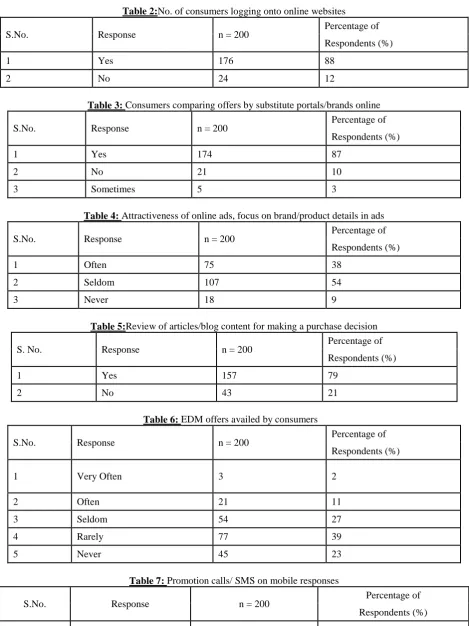
Table 2:No. of consumers logging onto online websitesS.No. Response n = 200 Percentage of
Respondents (%)
1 Yes 176 88
2 No 24 12
Table 3: Consumers comparing offers by substitute portals/brands online
S.No. Response n = 200 Percentage of
Respondents (%)
1 Yes 174 87
2 No 21 10
3 Sometimes 5 3
Table 4: Attractiveness of online ads, focus on brand/product details in ads
S.No. Response n = 200 Percentage of
Respondents (%)
1 Often 75 38
2 Seldom 107 54
3 Never 18 9
Table 5:Review of articles/blog content for making a purchase decision
S. No. Response n = 200 Percentage of
Respondents (%)
1 Yes 157 79
2 No 43 21
Table 6: EDM offers availed by consumers
S.No. Response n = 200 Percentage of
Respondents (%)
1 Very Often 3 2
2 Often 21 11
3 Seldom 54 27
4 Rarely 77 39
5 Never 45 23
Table 7: Promotion calls/ SMS on mobile responses
S.No. Response n = 200 Percentage of
Respondents (%)
1 Yes 82 41
484
Copyright © 2016. Vandana Publications. All Rights Reserved.
Table 8: Brand recall on the basis of popular jingles/hash-tagsS.No. Response n = 200 Percentage of
Respondents (%)
1 Yes 140 70
2 No 59 30
Table 9:No. of communities and groups followed on social media
S.No. Response n = 200 Percentage of
Respondents (%)
1 200-250 6 3
2 150-200 7 4
3 100-150 18 9
4 50-100 103 52
5 0 66 33
Table 10: No. of consumers who follow communities for primarily knowing popular trends
S.No. Response n = 200 Percentage of
Respondents (%)
1 Yes 109 55
2 No 91 45
Table 11: Effectiveness of „trending‟ updates on social media
S.No. Response n = 200 Percentage of
Respondents (%)
1 Always 28 14
2 Sometimes 130 65
3 Never 42 21
Table 12: Effect of online ads in influencing consumers in making impulse purchase decisions
S.No. Response n = 200 Percentage of
Respondents (%)
1 Yes 97 49
2 No 103 51
Table 13: Influence of overall digital initiatives on Consumer‟s purchase decisions
S.No. Response n = 200 Percentage of
Respondents (%)
1 Yes 153 77
2 No 47 24
Table 14: Influence of advertisements in moulding consumer lifestyle
S.No. Response n = 200 Percentage of
Respondents (%)
1 Yes 82 41
485
Copyright © 2016. Vandana Publications. All Rights Reserved.
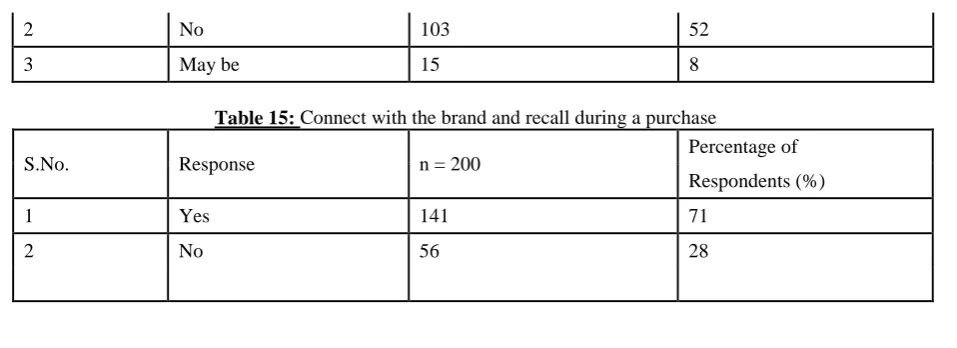
2 No 103 52
3 May be 15 8
Table 15: Connect with the brand and recall during a purchase
S.No. Response n = 200
Percentage of
Respondents (%)
1 Yes 141 71
2 No 56 28
V.
SUMMARY OF RESULTS
The results and findings of the study can be summarized as follows:
88% of the respondents do log onto online websites.
Majority of the respondents do compare the offers on substitute websites. The percentage is 87%. Those who do not go for a comparison are 10%. Those who consider it sometimes are only 3%.
54% respondents seldom find ads attractive and
focus on brand details in it and then there are respondents who often find the ads attractive i.e. 38%. There are only 9% respondents who do not find them attractive.
Majority of respondents i.e. 79% do review articles and blogs for their content for making their purchase decision. The rest of the respondents who do not go for a review are 21%.
Respondents rarely availing EDMs, are in the majority i.e. 39%, then there are those who respond only seldom i.e. 27%, followed by those who respond never i.e. 23%. Those respondents availing an EDM very often are only found to be 2%.
The percentage of respondents in majority i.e. 59% are those who do respond to the promotional calls or smses received which is 117 in number.
The majority of the respondents are those who do recall the brand on the basis of the jingles/hashtags used in their campaign i.e. 70%, whereas there are only 30% respondents who do not recall any brand on the basis of that.
Majority of respondents follow between 50-100
communities and groups and are around 52%, whereas those not following them at all are 33%. There are many others who do follow moderate number of communities i.e. between 150-200 are 4% and between 100-150 are 3%.
The maximum respondents do follow
communities for knowing popular trends i.e. 55%, while the other 45% do not follow communities for the prime reason of knowing
popular trends.
The respondents only sometimes follow the
trending updates on Social media i.e. 65%, whereas those who never follow trending updates are 21%, then only 14% are those who follow them always.
Majority of the respondents i.e. 51% were not influenced by the online ads and it did not lead to their impulse buying decisions, whereas around 49% did get influenced by the ads leading to an impulse buying decision.
Majority of respondents do feel they get
influenced by the overall digital initiatives for making their purchase decisions. i.e. 61%, those who sometimes get influenced are only 16% and those who never get influenced are 24%.
Majority of the respondents do not get
influenced so much as to change their lifestyle through it. i.e. 52%. There are 41% who do get influenced however, and 8% respondents who sometimes get influenced
Majority of respondents i.e. 71% recall an ad while making a purchase, whereas the remaining ones are 28% who do not recall an ad while making a purchase.
VI.
RECOMMENDATIONS
In the light of the study the following recommendations can be made:
Success in creating awareness on brands can be
achieved by people with the help of awareness campaigns that give a direction to the audience through the knowledge these campaigns impart. Hence brands should continue releasing these campaigns at regular intervals
Reiteration of the message through online
awareness campaigns is to be made frequent to people, to be able to reach the goals in time
Brands should have more
486
Copyright © 2016. Vandana Publications. All Rights Reserved.
Brand recall needs to be created in the form of
hash-tags, customer engagement online on social media as consumers tend to build a connect
Purchase decision is triggered by how well the brand paints its products picture. It is indeed important for brands to present its platter, well. The product in itself may do well by word of mouth, but the presentation of it and conversations around it together make it the product that it is.
Area of Scope
There should be a more effective way of
making use of the online marketing tools like electronic e-mailers where the results have shown very little effect on consumer behaviour.
There should also be a well thought out way to
incorporate an impulse buying behaviour in consumers which ensures that online is the best mode of purchase – as per the research this is an area of scope.
There should be more incentives provided to consumers in order for them to follow more communities/brand pages on social media – as per the research, there is still a lot more scope in having consumers engage with brands as they mostly do not join more than 50-100 communities/brand pages on an average.
REFERENCES
[1] Sen,S. (2015, Jan 20). FabAlley Shock and Awe.
Digital. Retrieved 20th May, 2015 from
http://www.afaqs.com/news/story/43052_FabAlley-shock-and-awe
[2] Motwani, D. Shrimali, D. &Agarwal, K.
(2014).Customers Attitude towards Social Media Marketing. Journal of Business Management & Social Sciences Research, Article Vol. 3 no.4. Retrieved 2nd
Jun, 2015 from
http://www.borjournals.com/a/index.php/jbmssr/article/v iew/1660
[3] Singer, J.(2014, Oct 3). 5 Ways mobile changed
consumer behavior forever. The future of
commerce.Retrieved6th Jun, 2015 from http://www.the- future-of-commerce.com/2014/10/03/5-ways-mobile-changed-consumer-behavior-forever-part-2/
[4] Strampler, L. (2013, May 22).How Dove's 'Real Beauty Sketches' became the most viral video ad of all time. Business Insider. Retrieved 7th Jun, 2015 from http://www.businessinsider.com/how-doves-real-beauty- sketches-became-the-most-viral-ad-video-of-all-time-2013-5?IR=T
[5] Taylor, H. (2012). Social media for Social change -
Using the internet to tackle intolerance. Institute of Strategic Dialogue. Retrieved 7th Jun, 2015 from http://www.strategicdialogue.org/Social_Media_Social_ Change.pdf
[6] Ford, K, &Freeman, A.(2009). The Influence of Digital Communication on Consumers Attitudes to Brands - Harris Interactive. Retrieved 7th Jun, 2015 from http://www.harrisinteractive.com/vault/HI_UK_Paper_C onsumersAttitudesBrands.pdf
[7] Hughes, A. (2015). How the digital revolution is
changing consumer behaviour-PA Consulting. Retrieved
7th Jun, 2015 from http://www.paconsulting.com/our-
thinking/how-the-digital-revolution-is-changing-consumer-behaviour/?format=pdf
[8] Gangal, A. (2014, Jun 30).An insight into HUL's stunning mobile marketing initiative that has taken rural Bihar and Jharkhand by storm -KanKhajuraTesan: The Full story. Digital. Retrieved 7th Jun, 2015 from http://www.afaqs.com/news/story/41226_Kan-Khajura-Tesan-The-Full-Story
[9] Ireton, J.S. (2014, Jul 30).Social media marketing influences Consumer Behaviour.Blast Media. Retrieved 21st Jun, 2015 from http://blastmedia.com/2014/07/30/3- ways-social-media-marketing-influences-consumer-behavior/
[10] Elia, M. (2015). Internet Marketing, Website Design and Consumer Behaviour – University of Manchester.
Retrieved 20th Jul, 2015 from