illfiSTER C0113`0'
Controlling
Grass
Tetany
LEAFLET NO. 561
Controlling
Grass
Tetany
By D. L. Grunes, U.S. Plant, Soil and Nutrition Laboratory, Ithaca, N.Y., and H. F. May/and, Snake River Conservation Research Center, Kimberly, Idaho, Agricultural Research Service.
Grass tetany is a magnesium deficiency that occurs in beef and dairy cattle and sometimes sheep. It has been responsible for a large number of deaths of cows in the (Jnited States as well as in other countries. It is some-times called hypomagnesemic tetany, lactation tetany, grass staggers, wheat pasture poisoning, or winter tetany. Cows are particularly susceptible when nursing a calf or producing milk. Sometimes pregnant animals die from the condition. Older cows are more susceptible than those with their first or second calves. Also, cows that are herded or worked may be more susceptible to tetany.
RECOGNITION OF GRASS TETANY
Cattle are most likely to get grass tetany soon after they are turned out on spring pasture. In mild cases, milk yield is decreased and the animals are nervous. These signs may indicate the need for preventive measures. In more severe cases, affected cows may avoid the rest of the herd, walk with a stiff gait, and lose their appetite. They are nervous, have staring eyes, and keep their head and ears in an erect position. Also, they may stagger, have a twitching skin, especially on the face, ears, and flanks, and lie down and get up frequently.
After a time, extreme excitement and violent convulsions may develop. Animals lie flat on their side, the forelegs pedal periodically, saliva flows freely, breathing is labored, and the heart pounds. If treatment is not given at this stage, animals usually die during or after a convulsion.
Grass tetany should not be confused with nitrate toxicity. In cases of nitrate toxicity the blood is brown.
Also, there is a grayish to brownish discoloration of white areas on the skin and on the nonpigmented mucous membranes of the mouth, nose, eyes, and vulva. On some pastures, the hazard from nitrate toxicity and from grass tetany may occur at the same time.
If animals are deficient in calcium, they may be sluggish instead of being nervous as they are when they have magnesium deficiency. Also, they may have calcium and magnesium deficiency at the same time, thus masking the signs of magnesium deficiency.
If a laboratory diagnosis shows the blood serum contains less than 10 parts per million (ppm) of magnesium or if the urine contains less than 20 ppm of magnesium, the animal is in acute danger of having a convulsive attack of grass tetany.
OCCURRENCE OF GRASS TETANY
Grass tetany is common during cool, cloudy, and rainy weather and often occurs when cool weather is followed by a warm period. Animals get grass tetany most often when they are grazing cool-season grasses or small grain pastures in spring or fall. Rapidly growing lush grasses are the most dangerous. Grass tetany has occured on orchardgrass, perennial ryegrass, timothy, tall fescue, crested wheatgrass, bromegrass, and winter annuals such as soft chess. The small grain pastures include wheat, rye, and oats. Grass tetany also occurs when animals are being wintered on low magnesium grass hay, corn stover, and occasionally on low magnesium alfalfa hay. It is not common on legume pastures or in animals wintered on legume hay.
Grass tetany is most likely to occur on pastures grown on soils that are low in available magnesium and high in available potassium. Many State soil testing laboratories can provide information on the danger of tetany on pastures and can recommend corrective fertilization or dolomitic liming practices.
OW ROM&
Y:1;,
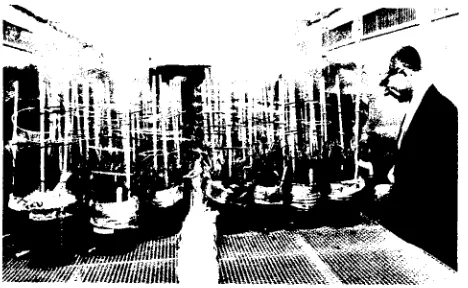
Figure
1.—Experimentto study effect of temperature on level
of magnesium in plants. PN-4041Figure 2.—An atomic absorption spectrophotometer can be used for measuring the level of magnesium in plants, soils, blood, and urine. PN-4042
Figure 3.—Studying the effect of diet on magnesium status of sheep. PN-4043
Forage grasses should be analyzed when a grass-tetany hazard is suspected. Forage containing less than 0.2 percent magnesium and more than 3 percent potassium and 4 percent nitrogen (25 percent protein) are especially likely to cause tetany. Forage that is high in potassium and nitrogen should have a magnesium concentration of at least 0.25 percent.
PREVENTION OF GRASS TETANY
Be sure of the diagnosis. Stockmen who have not previously seen grass tetany should consult a veterinarian, extension livestock specialist, county agent, or other person who has had experience with the problem. Where a diagnosis of grass tetany is made, one or more of the following practices may be useful.
(1) Application of magnesium fertilizer and dolomitic limestone to the soil may increase the magnesium concentration in plants, although it may take several years before there is much effect from the dolomitic limestone. The effect of magnesium fertilizer or dolomitic limestone is generally greatest on coarse-textured acid soil that is low in potassium. On some soils, very high rates are required to appreciably increase the magnesium concentration in plants.
Local recommendations should be obtained before magnesium fertilizer or dolomitic limestone is used. The amount of magnesium used may vary considerably, depending on the soil pH, texture, and potassium content. Local recommendations should also be followed to avoid using too much nitrogen and potassium fertilizer.
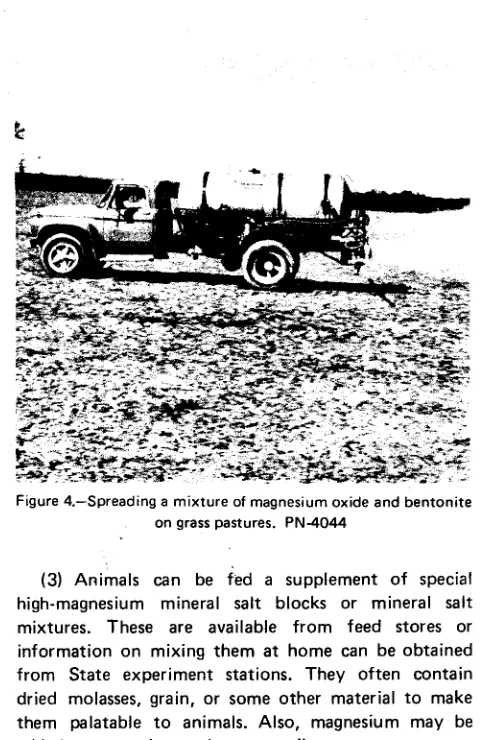
(2) Dusting pastures with magnesium oxide (Mg0) as finely powdered calcined magnesite is useful to increase the intake of magnesium by cattle. Rates of 15 to 30 pounds of MgO per acre can be used, with the lower rates suited to cases where cattle are moved to new pastures every 2 or 3 days.
To help keep rain from washing the Mg0 off the foliage, a water slurry of 10 percent Mg0 and 1.5 percent bentonite can be applied to the grass with a suspension fertilizer applicator.
Figure 4.—Spreading a mixture of magnesium oxide and bentonite on grass pastures. PN-4044
(3) Animals can be fed a supplement of special high-magnesium mineral salt blocks or mineral salt mixtures. These are available from feed stores or information on mixing them at home can be obtained from State experiment stations. They often contain dried molasses, grain, or some other material to make them palatable to animals. Also, magnesium may be added to a protein supplement or silage.
Licking wheels or licking belts are sometimes used that slowly dispense magnesium oxide or magnesium sulfate in molasses. Cows that are milking, or nursing calves, should get magnesium supplements daily. If forage is high in nitrogen, supplement it with hay, molasses, or grain.
For beef cattle, a minimum of 8 grams of magnesium per cow per day should be given. A daily rate of 15 to 30 grams is better but harder to achieve.
For dairy cows, 30 grams of magnesium (50 grams or about 2 ounces of commercial grade MgO) per day is recommended. For calves, 4 to 8 grams per day (7 to 15 grams of MgO) is needed, depending on their age.
Lactating ewes, just after giving birth during the tetany-susceptible period, should receive about 3 grams
of magnesium (5 grams of MgO) per day.
Magnesium supplements should be started several weeks before the tetany period to get the animals accustomed to them.
(4) Adding magnesium sulfate to drinking water is helpful but some diarrhea may occur. Magnesium acetate may be used instead of magnesium sulfate. To be effective, the drinking trough must be the only source of water.
(5) Use grass-tetany-hazard pastures for steers and dry stock and use legume hay or high-legume pastures for milking cows, or cows nursing calves.
TREATMENT
Treatment of tetany cases can be successful if g iven early and without excessive handling of the affected cows. For ranchers under range conditions, 200 cubic centimeters (cc) of a saturated solution of magnesium sulfate (50 percent) injected under the skin gives a high level of magnesium in the blood in 15 minutes.
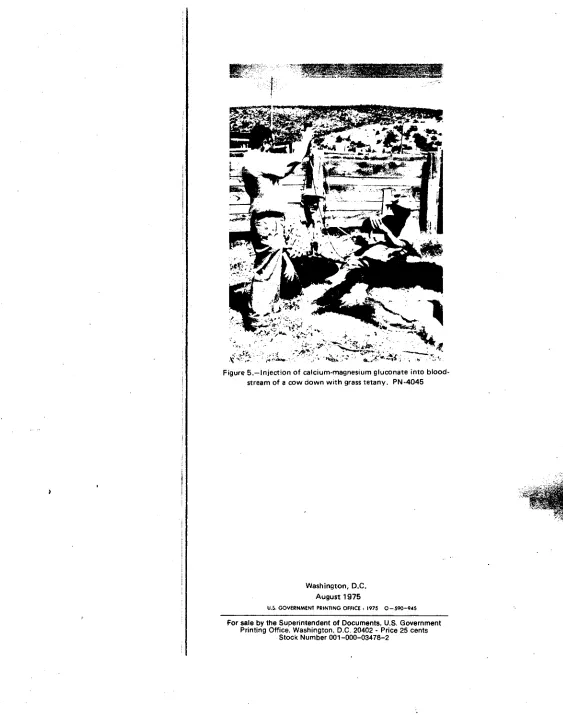
Some veterinarians use intravenous injections of chloral hydrate or magnesium sulfate to calm excited animals and then follow with a calcium-magnesium gluconate solution. If the animal again goes into convulsions, a second dose of calcium-magnesium gluconate solution may be required. Intravenous injections should be administered slowly by a trained person because there is danger of heart failure if they are given too rapidly.
For followup treatment, the animal should be removed from the tetany-producing pasture and fed hay and concentrates. Also, 30 grams of magnesium (2 ounces calcined magnesite containing 85 percent MgO) should be given daily. Force feeding of magnesium may be
necessary
but after a week, the amount can be greatly reduced.•n•
Figure 5.-Injection of calcium-magnesium gluconate into blood-stream of a cow down with grass tetany. PN-4045
Washington, D.C. August 1975
U.5. GOVERNMENT PRINTING OFFICE 1975 0-590-945
For sale by the Superintendent of Documents, U.S. Government Printing Office, Washington, D.C. 20402 - Price 25 cents