Shampa et al. World Journal of Pharmaceutical and Life Sciences
INITIAL CHARACTERIZATION OF MUNICIPAL SOLID WASTE OF DIBRUGARH
MUNICIPAL WASTE DUMPING SITE IN ASSAM, INDIA
Dr. Shampa Deb*, Jonali Saikia and Ajay S. Kalamdhad
Department of Civil Engineering, Indian Institute of Technology Guwahati- 781039, Assam, India.
Article Received on 12/09/2018 Article Revised on 03/10/2018 Article Accepted on 24/10/2018
1. INTRODUCTION
Solid waste is referred as any garbage, refuse, sludge from a wastewater treatment plant, water supply treatment plant or air pollution control facility and other discarded materials including solid, liquid, semi-solid or contained gaseous material resulting from industrial, commercial, mining, agricultural and from community activities. Any discarded or abandoned materials which can be solid, liquid, semi-solid or containerized gaseous material is considered as solid waste. Increasing population, rapid urbanization, rise in community living standard and booming economy have greatly influenced Municipal solid waste (MSW) generation rate in developing countries like India (Minghua et al., 2009). India is an agriculturally based country with a present population of approximately 1.34 million (indiaonlinepages.com). Due to rapid industrial growth, the urban population is increasing rapidly. In the world, the MSW disposal has three primary ways such as landfilling, incineration, and composting.
The composition of municipal solid waste varies greatly from municipality to municipality (Kumar et al., 2016). Solid waste management is a multi-dimensional issue. Municipal solid waste provides services to the general public and private firms in regards to waste collection and disposal. The MSW amount is expected to increase significantly in the near future as the country strives to
attain an industrialized nation status by the year 2020 (Sharma and Shah, 2005; CPCB, 2004). The composition and the quantity of MSW generated form the basis on which the management system needs to be planned, designed and operated. In India, MSW differs greatly with regard to the composition and hazardous nature when compared to MSW in the western countries (Gupta et al., 1998; Shannigrahi et al., 1997; Jalan and Srivastava, 1995). Solid waste management (SWM) is one of the most challenging issues owing to lack of authentic data on different elements of SWM, namely, storage, collection, transportation, separation, processing and disposal.
The daily waste generated in Dibrugarh is about 50 metric tons per day. The main generators of the solid waste are the five markets in the city. It accounts for almost 50% of the total solid waste generated. There is no leachate collection or protection system installed in the existing disposal site (Government of Assam for the Asian Development Bank, 2011).
Heavy metals are metallic elements that have relatively high density and toxic even at low concentration (Duribe, et al., 2007).They have a great ecological significance due to their toxicity accumulative behavior. Heavy metals in the MSW are a potential source of contamination of surrounding soil and ground water
World Journal of Pharmaceutical and Life Sciences
WJPLS
www.wjpls.org SJIF Impact Factor: 5.088
*Corresponding Author: Dr. Shampa Deb
Department of Civil Engineering, Indian Institute of Technology Guwahati- 781039, Assam, India.
ABSTRACT
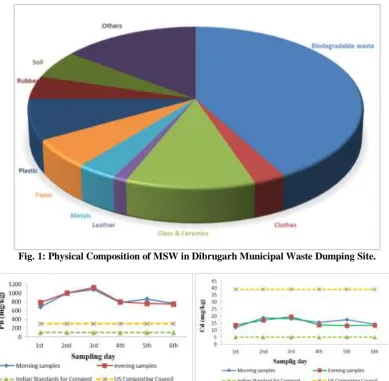
Municipal Waste Management is one of the most challenging issues now a days due to lack of authentic data on different elements of Solid waste, namely, storage, collection, transportation, separation, processing and disposal. This study present an assessment of existing status of waste generation rate in conjunction with physical and chemical characterization. The collected MSW included biodegradables (organic fraction), paper, plastic, glass, ceramics, metals, inert materials, ash and debris. The data analysis indicated that the biodegradable components dominate the characterization at 39.56-41.95% followed by glass and ceramics (10.09%-11.40%). pH value of the waste was neutral 6.02-7.31 which coupled with high value of electrical conductivity. Organic waste, ash, plastic and paper are also the main heavy metal sources of MSW which accounted for 1128.60 mg/kg and 552.78 mg/kg contribution of the Fe and Cu. Much more attention should be paid on the MSW management to avoid heavy metal pollution.
because of their leaching ability and mobility. The mobility of hazardous substance and contaminates should be reduced by stabilization of heavy metal. The accumulations of heavy metals in soil reach con-centration since become a threat to vegetation and animals. Ultimately affect the quality of human life through food chain. Heavy metals are found in electrical wastes, municipal solid waste and from degradation of organic wastes (Esarru et al., 2003). Some metals are very essential to life but they are toxic at thigh level of dose (Ukpebor and Unigbe, 2003).
The major sources contributing to Municipal Solid Wastes generation in Dibrugarh city include the household, institutions, industries, markets, street sweeping, construction and demolition activities etc. Unscientific disposal of waste causes an adverse impact on all components of the environment including human health (Rathi, 2006; Sharholy et al., 2005; Ray et al., 2005; Jha et al., 2003; Kansal, 2002). The main objective of the present study is to assess the waste quantity and initial characterization of waste.
2. MATERIAL AND METHOD
2.1. Study Area
In the present study, Dibrugarh Municipal Waste dumping cities was selected. Dibrugarh is located along the Southern Bank of the Brahmaputra River lying between 27.26º N Latitude and 94.35º E Longitude. The town is situated at 104 m above the mean sea level. The physical characteristic of the district is constituted by a variety of elements such as flood plain, wetland and swamps, occasional highlands and foothills of the Barail Range. Dibrugarh experiences subtropical monsoon climate with mild winter, warm and humid summer.
The present dumping site is located at Maizan, Barsuikiya Gaon which is 6 km away from the city covering an area of 0.5 ha. The major activities included performing field investigations to assess the quantity of MSW generation per day and determining waste composition and characteristics. The activities included performing one-week field investigations and actual data measurement at MSW disposal sites, locations of which were selected in consultation with the local authorities. Initial planning and scheduling of the field investigations along with sampling were undertaken through field
study, MSW comprised biodegradable/compostable matters, leather, papers, plastics, glass and ceramics, metals, inerts, ash and debris. Density of the waste was done by mass per volume.
2.3. Physico-chemical Analysis
The samples were analysed in the department of Civil Engineering, Indian Institute of Technology Guwahati, India. Physico-chemical analysis were performed based on standard procedures prescribed by APHA, 2005 to determine pH, electrical conductivity, fixed carbon, volatile substance, ash content, moisture content. Heavy metals of the waste were measure by atomic absorption Spectrophotometric method (Varian, Spectra AA Duo). Sodium, potassium, calcium were estimated by flame photo meter (Systronics: 167).
RESULT AND DISCUSSION
that the moisture content are found to be important factors which influence the anaerobic condition of the dumpsite. Raymond and Zeiss (2004) also supported the fact that moisture content has an important effect on biodegradation rates in landfills. Heavy metals have greater density than water. The poisoning effects of heavy metals are due to their interference with the normal body bio chemistry in the normal metabolic processes. They are converted to their stable oxidation states combine with the body to form strong and stable chemical bonds (Asgele and Gebremedhin, 2015). Iron concentration was monitored to be 8453.76 mg/kg and 3949.44 mg/kg. Lead is the most significant toxic element of heavy metals and the organic forms of lead are absorb though ingression by food and water and by halation. Lead concentration was found 1128.60 mg/kg and 686.40 mg/kg. Copper was recorded more in the morning samples 552.78 mg/kg and less in the evening time (133.12 mg/kg). Highest concentration of Zinc was recorded in morning hours 676.66 mg/kg followed by 553.01 mg/kg. Long et al., (2010) reported that Cu and Zn contents in MSW are in greatly influenced by spatial variation. Chromium is released by combustion
processes and from metal industries. In the present study Chromium was not detected in any one of the samples which is due to limited industries in the vicinity. Nickel was in the range of 115.83 mg/kg and 68.64 mg/kg. Cadmium was in the range of 19.60 mg/kg and 11.86 mg/kg. This finding was also supported by Kumar et al., 2016. High concentration of Sodium, Potassium and Calcium were monitored as 732.50 mg/kg, 9,639.70 mg/kg and 4470.20 mg/kg. The sources of these observed metals, Cd, Pb and Cr in the site are expected to be plastics, shoes, rubber, electronic waste and non-ferrous metal that were composed in the dumpsite. Based on the average concentrations, the heavy metal recorded in the present study followed the following trend- Pb>Zn>Cu>Mn>Ni>Cd. Garg and Prasad, 2003; CPCB, 2000; Bhide and Shekdar, (1998) mention that the physical and chemical characteristic of MSW change with population density. Jha et al., reported that in the metro cities of India, there is no much difference in the types of waste generated in the physical characterization data of MSW although there is an increase in the magnitude of generation over the years.
Table 1: Heavy metal contents in MSW fine fractions (all values are in mg/kg).
Particulars Pb Zn Mn Cu Ni Cd Cr
Average values 868 ±147 395 ± 159 251±56 285 ± 146 91 ± 15 16 ± 2 ND Indian Compost Standardsa 100 1000 -- 300 50 5 50 US EPA Compost Standardsb 300 2800 -- 1500 420 39 1200
a
Municipal solid Waste (Management and Handling Rules 2000)
b
US Composting Council (1997)
Table 2: Physicochemical Characteristic of MSW.
Sl.
No. Parameters
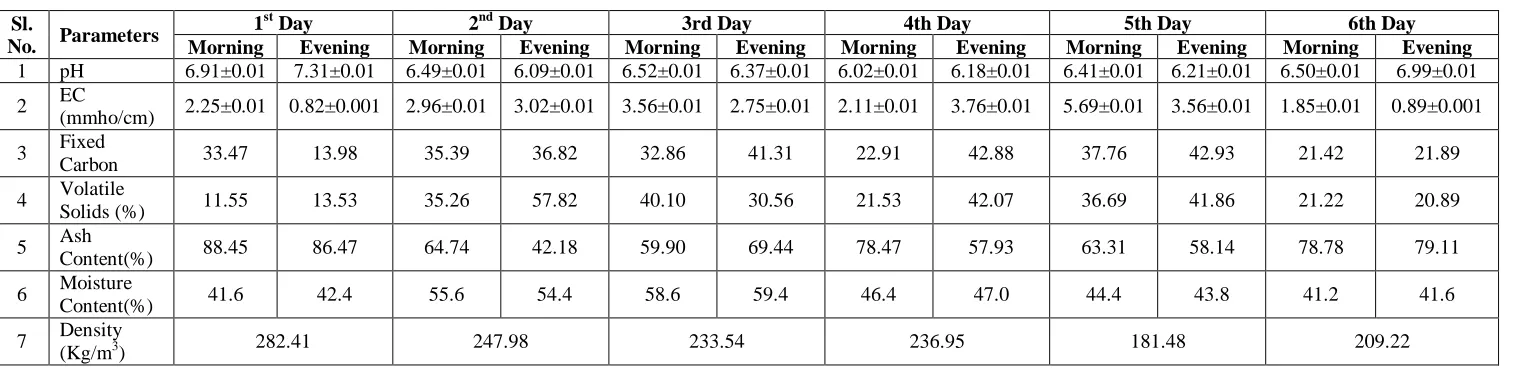
1st Day 2nd Day 3rd Day 4th Day 5th Day 6th Day
Morning Evening Morning Evening Morning Evening Morning Evening Morning Evening Morning Evening
1 pH 6.91±0.01 7.31±0.01 6.49±0.01 6.09±0.01 6.52±0.01 6.37±0.01 6.02±0.01 6.18±0.01 6.41±0.01 6.21±0.01 6.50±0.01 6.99±0.01
2 EC
(mmho/cm) 2.25±0.01 0.82±0.001 2.96±0.01 3.02±0.01 3.56±0.01 2.75±0.01 2.11±0.01 3.76±0.01 5.69±0.01 3.56±0.01 1.85±0.01 0.89±0.001
3 Fixed
Carbon 33.47 13.98 35.39 36.82 32.86 41.31 22.91 42.88 37.76 42.93 21.42 21.89
4 Volatile
Solids (%) 11.55 13.53 35.26 57.82 40.10 30.56 21.53 42.07 36.69 41.86 21.22 20.89
5 Ash
Content(%) 88.45 86.47 64.74 42.18 59.90 69.44 78.47 57.93 63.31 58.14 78.78 79.11
6 Moisture
Content(%) 41.6 42.4 55.6 54.4 58.6 59.4 46.4 47.0 44.4 43.8 41.2 41.6
7 Density
CONCLUSION
The study will be helpful to the decision-makers in identifying appropriate processing and disposal options. The determination of the physical and chemical characteristics of MSW should be considered because their importance in the biochemical transformation and final treatments such as incineration or energy recovery.
REFERENCES
1. APHA, Standard method for examination of water and wastewater.21st ed.pub. APHA, AWAA, WPCF, Washington DC, USA, 2005.
2. Asgele, T. and Gebremedhin, K. Heavy Metals Analysis In Solid Municipal Wastes. International Journal of Technology Enhancements and Emerging Engineering Research, 2015; 3(7): 2347-4289. 3. Central Pollution Control Board (CPCB), 2004.
Management of Municipal Solid Waste. Ministry of Environment and Forests, New Delhi, India.
4. Dios, P.M. Estudio Estudio y desarrollo de tecnicas respirometricas parael control dela estabilidad del compost. Servicio de Publicaciones de la Universidad de Cordoba. Cordoba, Espana, 2008; 377.
5. Duribe, J.O., Wuegbuand, M.O.C. and J.N.Gwurugwu, J.N., Heavy metal pollution and human biotoxic Effects, physics, 2007; 2: 111-119. 6. Esarru, S., Polonivelu and Kuria, J., Assessment of
Heavy metals in municipal solid waste Dumpsite, Work. Suts, land fills.manag, 2003; 139-145. 7. Jha, M.K., Sondhi, O.A.K., Pansare, M., Solid waste
management –a case study. Indian Journal of Environmental Protection, 2003; 23(10): 1153–1160.
8. Jha, A.K., Sharma, C., Singh, N., Ramesh, R., Purvaja, R., and Gupta, P.K., Greenhouse gas emissions from municipal solid waste management in Indian mega-cities: a case study of Chennai landfill sites. Chemosphere, 2008; 71(4): 750–758. 9. IND: Assam Urban Infrastructure Investment
Program – Dibrugarh Solid Waste Management Subproject, Government of Assam for the Asian Development Bank, 2011.
10. Kumar, S., Dhar, H., Vijay, V., Nair, V.V., Bhattacharyya, J. K., Vaidya, A.N., and Akolkar, A.B., Characterization of municipal solid waste in high altitude sub-tropical regions. Environmental
International Journal of Business, Humanities and Technology, 2013; 3: 8.
14. Minghua, Z., Xiumin, F., Rovetta, A., Qichang, H., Vicentini, F., Bingkai, L., Giusti, A.,Yi, L., Municipal solid waste management in Pudong New Area, China.Journal of Waste Management, 2009; 29: 1227–1233.
15. Ostman, M.,Wahlberg, O., Agren, S. and Matensson, A.M., Metal and organic matter contents in a combined household and industrial landfill, Waste Manage, 2006; 26: 29–40.
16. Prechthai, T., Parkpian, P. and Visvanathan, C., Assessment of heavy metal contamination and its mobilization from municipal solid waste open dumping site. Journal of Hazardous Materials, 2008; 156: 86–94.
17. Prudent, P., Domeizel, M. and Massiani, C., Chemical sequential extraction as decision-making tool: application to municipal solid waste and its individual constituents, Sci. Total Environ, 1996; 178: 55–61.
18. Rathi, S., Alternative approaches for better municipal solid waste management in Mumbai, India. Journal of Waste Management, 2006; 26(10): 1192–1200.
19. Ray, M.R., Roychoudhury, S., Mukherjee, G., Roy, S., Lahiri, T., Respiratory and general health impairments of workers employed in a municipal solid waste disposal at open landfill site in Delhi. International Journal of Hygiene and Environmental Health, 2005; 108(4): 255–262.
20. Raymond S. Li and Zeiss, C., In situ Moisture Content Measurement in MSW Landfills with TDR. Environmental Engineering Science, July 2004; 18(1): 53-66.
21. Sharholy, M., Ahmad, K., Mahmood, G., Trivedi, R.C., Analysis of municipal solid waste management systems in Delhi – a review. In: Book of Proceedings for the second International Congress of Chemistry and Environment, Indore, India, 2005; 773–777.
22. Sharma, S., Shah, K.W., Generation and disposal of solid waste in Hoshangabad. In: Book of Proceedings of the Second International Congress of Chemistry and Environment, Indore, India, 2005; 749–751.