Research Article
a
June
2019
Computer Science and Software Engineering
ISSN: 2277-128X (Volume-9, Issue-6)
Image Features for Content Based Image Retrieval System
in Image Mining
Hlaing Htake Khaung Tin
Faculty of Information Science, University of Computer Studies, Yangon, Myanmar
Divyendu Kumar Mishra
Department of CSE, VBS Purvanchal University, Jaunpur, India
Abstract— The digital images are used in multiple applications, such as Geographical image, medical image, architecture design, advertising and military. Image retrieval that is user-defined image from a large image database is a critical image processing technique. The main objective of this research paper is supporting the image features for content based image retrieval system in image mining. The capability of present CBIR systems has been limited by their use of only primitive features, so they cannot satisfy most semantic-level query demands. The CBIR system extracts the stored images from the database by comparing the features of the query image with the images in the collection. The implemented system only used RGB and HSV color model for color feature extraction. Other color models such as HIS, CMYK, CMY, etc.; can also be incorporated to extract color feature for image retrieval to improve the accuracy of the system.
Keywords—CBIR, image mining, feature extraction, matching, HSV, HIS, CMYK, CMY.
I. INTRODUCTION
Image retrieval that is user-defined image from a large image database is a critical image processing technique. The method for large collections of multimedia and digital libraries has created a great need for the development of search engines to index and retrieve data. There are now a lot of good search engines that can extract texts in a format that the device can read. However, there is no quick tool to extract intensity and color images. The traditional way to search and index image is slow and expensive. Therefore, there is an urgent require to progress an algorithm to retrieve embedded content images. The digital image features (shape, texture, color, object structure, etc.) can be used as an index button to find and extract images from a large image database. Image retrieval based on the content of the image is called the content-based image retrieval [12, l3].
The images in the database are indexed according to extract sections visual content (or features) such as color, texture, pattern, structure of the image, the shape of the object, the layout and position in the image, etc. The image can be acted as a multidimensional vector of features retrieved from the image.
The feature vector perform by image signature. This feature vector can be assumed to be associated to a point in the multidimensional space. For example, the images can be displayed with the N-Dimensional feature vector, where the first element n1 can perform the color of the component. The following n2 can represent the shape of the component. The following n3 can represent the topology of some images and finally the element n4 can represent the surface of the images to contain the components N =n1+n2+n3+n4.
Image queries can be analyzed to distinguish visible and comparable functions to find matches in image indexes stored in databases. The extracted image function is saved as metadata and images indexed depended on this metadata. This metadata contains several dimensions of the extracted image function. The feature vector is to measure several different image functions. The feature vector with the same image is summarized in N-dimension space. The retrieval of an image similar to query image then decreases to find the index of the image in the search space.
II. BACKGROUND THEORY
ISSN(E): 2277-128X, ISSN(P): 2277-6451, pp. 59-64 A. Types of Image Features
In image processing and pattern recognition, the extraction of features is an important step that constitutes a special form of dimensionality reduction. When the input data is too large to process and is suspected to be duplicated, the data will be changed to a reduced set of features. The process of modifying input data into a set of properties is called feature extraction. Features typically include information related to the characteristics of digital images.
B. Low-level Image Features
Most of the recommended CBIR methods are based on pre-processing procedures for feature extraction, in order to extract the appropriate image features (descriptors, properties) that contain enough information to extract relevant images from database containing thousands of images [14]. Low-level features depend on color, texture, and shape, which are related easy to calculate and can be relevant to the low-level human perception.
C. Higher-level Image Features
High level functions are designed to show concepts that have meaning in the image (such as activities appearing in images or objects seen in image) that are of greater interest to humans [14]. The higher level features in images are not extracted easily from pixels.
III. TYPES OF IMAGES IN CBIR
Four types of images are: Intensity images, Binary images, Indexed images, and RGB (Red, Green and Blue) images [3].
A. Intensity Images
This image is a data matrix whose values are ranged to express intensities. If the elements of an intensity image belong to class uint8 or to class uint16, they have integer values in the length of (0.255) and (0, 65535), for each. If the image has a double class, the values are floating-point numbers. The miniature value, twice the intensity of the class, is in range (0, 1) depending on the pattern.
B. Binary Images
A binary image is a logical matrix 0s and 1s. An array of 0s and 1s whose data class value is uint8 is not considered a binary image in MATLAB. A digital matrix is converted to binary using logical functions.
C. Indexed Images
These images consist of two parts: the matrix data of the X integers and the map color matrix map. The matrix map is the m * 3 matrix of double class with a decimal value in between (0, 1). The length of the map corresponds to the specified number of colors. Each map line identifies the red, green and blue part of a single color.
Indexed images use "direct mapping" of pixel intensity value and color mapping values. The color of each pixel is determined using the corresponding amount of the matrix. Integer X is a pointer on the map. If X is a class, all components less than or equal to one point in the first row of the map are doubled. It costs 2 points in the second line and so on. If X is a uint8 or uint16 class, all elements with value 0 point to the first set of map. This goes to the second row and so on.
D. RGB Images
The RGB color image is the matrix of the M * N * 3 matrix, where each pixel color is a triplet that matches the red, green, and blue portion of the RGB image at a particular location spatial. The RGB image is seen as a "stack" of three gray images inserted in red, green and blue items on the screen. Creating a color image is called red, green, and blue. The part image data class specifies the set of values. If the RGB image has a double class, the set of values is (0, 1). Also, the set of values (0, 255) or (0, 65535) for the RGB image is uint8 or uint16, respectively. The number of bits used to display the pixel image value of the part refers to the bit depth of the RGB image.
IV. IMAGE FEATURES FOR RETRIEVAL MINING
Image features affect all aspects of the CBIR system. It is therefore important to choose the appropriate image properties for each CBIR system.
A. Color Features
ISSN(E): 2277-128X, ISSN(P): 2277-6451, pp. 59-64
different colors in the field. The colors used to properly extract images that have a very strong relationship with the underlying object in the image. In addition, the properties of color resistant complications, perspective, attenuation (scaling), alignment (orientation) and image size.
Although the system can use any color space to calculate color histograms in HSV (hue, saturation, value), HLS (hue, brightness, saturation) and CIE color space (such as CIELAB, CIELUV), giving better results than RGB places . Since the color space becomes visual (or viewed) from RGB, they are more effective in measuring the color equation between the images.
B. RGB Color Model
In the RGB model, each color appears in the main components of the spectrum red, green and blue. The RGB format depends on the Cartesian coordinate system. The color sub-space where the RGB core value is at three corners; the secondary colors cyan, magenta and yellow are three corners; black is the origin and the white color is in the farthest corner of the source.
In the RGB model, the gray scale (points with equal RGB values) will extend from black to white along the lines connected to these two points. The color difference in the RGB model is that the top or the inside of the cube is determined by an extended vector from the origin. For convenience, assume that all color values are normalized so that the cube is a unit cube. In other words, all values of red, green and blue are considered in the range [0, 1]. RGB images in which each red, green and blue image is an 8-bit format. The term full-color image is 24-bit format.
C. CMYK (Cyan, Magenta, Yellow, Black)
One more attraction color model uses CMYK (cyan, magenta, yellow and black). This model is useful for color printers. Most output devices, including printers or color copiers, use CMY color templates and additives. The main colors are red, green and blue, while the primary colors of the pigments are magenta, cyan and yellow and the secondary colors are red, green and blue. The conversion from RGB to CMY can be done in case of R, G, and B which shows the normal color value in the range from 0 to1.
You can see from above that cyan coated surfaces do not have red or dark skin turning from magenta to green. It can be seen that the same number of pigments as primary colors (such as cyan, magenta and yellow) produce black. Therefore, the four-color system is cyan (C), magenta (M), yellow (Y), and black (B) in the four-color model.
D. HIS (Hue, Saturation, Intensity)
HSI is a color space that describes colors seen by humans. HSI (or HSV) means Tone (H), Saturation (S) and Intensity (I) (or V Value). Hue have been mentioned as chromatic light characteristics. It can be regarded as a surface property that is reflected or transmitted by light. For example, the blue car reflects the blue hue. It is also a feature of human perception. Hue, which is an important part of our perception, can be seen as a weal or hue or strong hue. The color intensity is explained by the saturation component. For example, the color of a single monochromatic light source that produces only one color of the wavelength is very saturated, while the colors consisting of different wavelengths have color intensity less chroma and less saturation.
The gray color has no hues and therefore zero saturation or no saturation. Therefore, the saturation is the size of the color or whiteness in color perception. The brightness (L) or intensity (I) or value (V) basically indicates the measurement of color brightness. This allows you to measure the amount of light shown by the object or the amount of light emitted from the region. It is proportional to the electromagnetic energy the object emits. Brightness (or intensity) helps the human eye recognize the color. The colorful objects in the dark do not appear in color at all.
The hue component describe their own colors as angles between (0, 360) degrees. 0 means red, 120 degrees means green, 240 means blue, 60 degrees is yellow, and 300 degrees is magenta. The saturation component indicates the amount of color contaminated by the white. The range of elements S is (0, 1). The intensity range is between (0, 1) and 0 means black, 1 means white.
E. HSV (Hue, Saturation, Values)
ISSN(E): 2277-128X, ISSN(P): 2277-6451, pp. 59-64
Hue, the type of color (such as red, blue or yellow) can be measured between 0 and 360 by central tendency of the wavelength, the saturation of the color and the intensity of the color (or how much greyness is present) 0-100% of the value for the amplitude of the wavelength, the brightness of the color, measured in the value 0-100% by the diffusion of the wavelengths.
The value of hue is 0, which means red, green, the color is the value corresponding to 120 and the blue color is the value corresponding to 240.The horizontal plane through the hexagonal cone, the primary and the secondary (red, yellow, green, blue, cyan and magenta) occurs at the top of a hexagon. The two saturation components describe the intensity of the color. The saturation value of the color 0 (in the center of the hexagon) means that the color is "colorless" (gray), the highest saturation value (on the outer edge of the hexagon) means that the color is in the "colorfulness" for that angle, and brightness.
The value component (in the HSV space) and the lightness component (in the HLS space) describe the brightness or luminance. HLS (hue, lightness, saturation) similar to HSI: this word uses lightness instead of intensity. In the HSV and HLS color spaces, the value 0 means black. In the HSV space, the maximum value means that the color is the brightest .In the HLS space, the maximum brightness value means that the color is white, regardless of the current value of the hue and the saturation components.
The brightest and most intense color in the HLS space appears at half of the highest value. The difference between HIS and HSV is to calculate the brightness component (I or V), which determines the distribution and dynamics of brightness (I or V) and saturation (S). The HIS color space is best for the traditional images processing function such as convolution, equalization, histograms and others that work by manipulating the brightness, because I depend on R, G and B. The HSV color space is preferred for the manipulation of hue and saturation (to change the color or adjust the number of colors) because it offers a wider dynamic saturation range.
V. ARCHITECTURE OF A CONTENT-BASED IMAGE RETRIEVAL
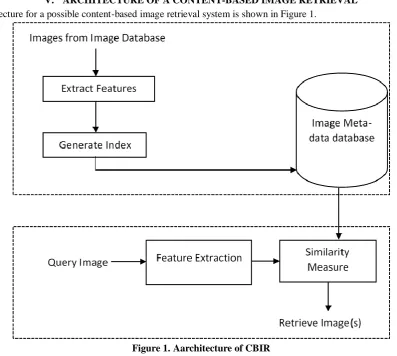
The architecture for a possible content-based image retrieval system is shown in Figure 1.
Figure 1. Aarchitecture of CBIR
ISSN(E): 2277-128X, ISSN(P): 2277-6451, pp. 59-64
The second part describes the image retrieval process. Image query is analyzed to retrieve visible features. These features take same images from the image database. Instead of directly compare both images, the visual properties of the query images are measured by the characteristics of image stored in the Meta database. Often, the similarity of both images is determined by calculating the distance between the vector vectors of two images.
The system takes the image by returning the first image k, which has the distance from the same request image or less than the specified threshold. Many image features can index images based on content. The most popular image retrieval system between them is color, texture and shape, image topology, color arrangement, interest region and so on.
VI. CONCLUSIONS
The concepts of image classification and Content Based Image Retrieval have been combined in the proposed system is to classify the images to identify and retrieve the formation of query image. Classifier is generally used to classify the category of each image. CBIR is the process of searching for relevant images in image database when the user sets a new image or query image. The goal of system is to support image retrieval based on content properties (color, texture), usually encoded into feature vectors. It is used by combining the content properties of the image. The more combination of the contents, the better result of the system will come out. The system must use proper contents extraction techniques and classification techniques to improve the accuracy of system results.
ACKNOWLEDGMENT
I would like to thank all of my teachers and colleagues at University of Computer Studies, UCSY for their support and encouragement during my research work. Big thanks to my colleagues at Faculty of Information Science from UCSY for their help and support.
REFERENCES
[1] Amit Singla1, Meenakshi Garg, "CBIR Approach Based On Combined HSV, Autocorrelogram, Color Moments and Gabor Wavelet,” International Journal of Engineering and Computer Science ISSN: 2319-7242 Volume 3,
Issue 10 October, 2014 pp. 9007-9012.
[2] C. S. Gode, A. N. Ganar,”Image Retrieval by Using Colour, Texture and Shape Features”, International Journal
of Advanced Research in Electrical, Electronics and Instrumentation Engineering , Vol. 3, Issue 4, April 2014. [3] Emile Karamutsa, Cheruiyot W.K, Anthony luvanda, “Similarity Image Retrieval using Enhanced Color
Histogram Based on Support Vector Machine,” International Journal of Innovative Science, Engineering &
Technology, Vol. 2 Issue 10, October 2015.
[4] H. Mohamadi, A. Shahbahrami and J. Akbari, “Image retrieval using the combination of text-based and content-based algorithms,” Journal of AI and Data Mining, Published online: 20 February 2013.
[5] K.Valli Madhavi, R.Tamilkodi, R.Bala Dinakar, K.JayaSudha,”An Innovative Technique for Content Based Image Retrieval Using Color and Texture Features,” International Journal of Innovative Research in Computer
and Communication Engineering,Vol. 1, Issue 5, July 2013.
[6] M.C. Hingane, Satish B. Matkar, “Classification of MRI Brain Image using SVM Classifier,” International
Journal of Science Technology & Engineering | Volume 1, Issue 9, March 2015.
[7] Mohammed Alkhawlani, Mohammed Elmogy, Hazem Elbakry, “Content-Based Image Retrieval using Local Features Descriptors and Bag-of-Visual Words,” International Journal of Advanced Computer Science and
Applications, Vol. 6, No. 9, 2015.
[8] R.Senthil Kumar, M.Senthilmurugan, "Content-Based Image Retrieval System in Medical Applications," International Journal of Engineering Research & Technology (IJERT) Vol. 2 Issue 3, March – 2013.
[9] Ramesh K Lingadalli, N.Ramesh, “Content Based Image Retrieval using Color, Shape and Texture,”
International Advanced Research Journal in Science, Engineering and Technology Vol. 2, Issue 6, June 2015. [10] S.Mangijao Singh , K. Hemachandran,”Contents Based Image Retrieval using Color Moment and Gabor
Texture Feature,” International Journal of Computer Science Issues, Vol. 9, Issue 5, No 1, September 2012.
[11] S.Mangijao Singh, K.Hemachandran, “Image Retrieval based on the Combination of Color Histogram and Color Moment,” International Journal of Computer Applications Volume 58– No.3, November 2012.
ISSN(E): 2277-128X, ISSN(P): 2277-6451, pp. 59-64
[13] Sanmukh, N.M. Tejaswini, M.L.“Color histogram features for image retrieval systems,” International Journal of
Innovative Research in Science, Engineering and Technology, Vol.3, Issue 4, March 2014.
[14] Suchismita Das, Shruti Garg, G. Sahoo, "Comparison of Content Based Image Retrieval Systems Using Wavelet and Curvelet Transform", International Journal of Multimedia & Its Applications, Vol.4, No.4, August 2012. [15] X.-Y. Wang, B.-B. Zhang, H. Y. Yang, “Content based image retrieval by integrating color and texture
features,” Springer journal of Multimedia Tools and Applications, Volume 68, Issue 3, February 2014, pp.545–