R E V I E W A R T I C L E
Open Access
Cognitive dysfunction and migraine
Doga Vuralli
1,2, Cenk Ayata
3,4and Hayrunnisa Bolay
1,2*Abstract
Cognitive dysfunction has recently gained attention as a significant problem among migraine sufferers. All of the clinical studies show poor cognitive performance during migraine attacks, though, the interictal data are conflicting. Migraineurs show impaired cognitive function interictally in most of the clinic-based studies. Population-based studies did not reveal a difference in cognitive functions between migraineurs and controls. The specific cognitive domains involved are information processing speed, basic attention, executive functions, verbal and non-verbal memory and verbal skills. Neurophysiological, imaging and pharmacological studies support clinical symptoms of cognitive impairment in migraine. Longitudinal studies do not suggest progressive cognitive decline over time in migraine patients. Preventive medications and comorbid disorders such as depression and anxiety can impact cognitive function, but cannot fully explain the cognitive impairment in migraine. In contrast to migraine, tension type or cluster headache are not associated with cognitive impairment, at least during headache-free periods.
Keywords:Migraine, Cognitive dysfunction, Clinical studies, Neuropsychological tests, Neurophysiology, Neuroimaging
Background
Migraine is a common headache disorder with an average
prevalence of 20,2% in women and 9,4% in men [1–3].
Mi-graine headache is the third most prevalent disorder and the sixth highest specific cause of disability worldwide [4].
Subjective cognitive decline is not uncommon in migraine patients. Although cognitive symptoms are not considered among the core symptomatology of migraine, many migraineurs often complain of intellectual impair-ment, particularly deficits in attention and memory. Cog-nitive symptoms are frequent in the premonitory phase and headache phase of a migraine attack and may also persist in the postdrome. Some migraineurs also complain of cognitive symptoms outside migraine attacks. Acute attack treatments are not always successful at relieving cognitive symptoms. Cognitive dysfunction, particularly impairment in executive function, also contributes to migraine attack-related disability. Indeed, cognitive symp-toms ranked second after pain in intensity and attack-related disability [5], making this a relevant target in migraine attack management. High levels of attack re-lated disability are also rere-lated to decreased cognitive performance [6]. Worse pain severity, higher levels of
depression and anxiety, and poor sleep quality and de-creased sleep duration, are all associated with more severe subjective cognitive decline [7].
Methods
Studies for our qualitative review were selected from PubMed and PsychInfo databases using the key words
“Migraine”,“Headache”,“Cognition”,“Cognitive Functions”
and“Cognitive Impairment”and reference sections of these
studies provided further studies that evaluated cognitive functions on migraine patients. This search was performed to establish the results of neuropsychological assessment for monitoring cognitive functions in migraine patients.
Studies were included 1) If they used validated
neuro-psychological and cognitive assessments. Studies were ex-cluded 1) If they inex-cluded patients with other neurologic disorders aside from migraine, 2) If migraine was not differ-entiated from other primary headaches, 3) If they did not have a control group and 3) If they were not published in English. In addition, neuroimaging, neurophysiological and pharmacological studies were also reviewed.
No randomized controlled trial was found in the lit-erature regarding cognitive functions in migraine. Case control studies, population based prospective cohort studies and case series were found in the literature and case control studies and population based prospective cohort studies were included in the review.
* Correspondence:[email protected]
1Department of Neurology and Algology, Gazi University Faculty of Medicine,
Besevler, 06510 Ankara, Turkey
2Neuropsychiatry Center, Gazi University, Besevler, 06510 Ankara, Turkey
Full list of author information is available at the end of the article
© The Author(s). 2018Open AccessThis article is distributed under the terms of the Creative Commons Attribution 4.0
Overview of clinical studies on cognitive dysfunction in migraine
Concordant with the subjective complaints, all objective studies of cognitive performance in migraineurs consist-ently show various degrees of impairment during an attack [8–12]. Even though interictal studies show conflicting
re-sults [13–19], most of the clinic-based studies reported
worse cognitive performance interictally in migraineurs compared to healthy controls. Clinic-based studies, evalu-ated cognitive functions in migraine had small sample sizes and enrolled patients with higher frequency of attacks and higher headache intensity than migraine patients in the general population. Moreover patients from clinics usually have more severe accompanying conditions such as anxiety and depression. Disease severity measures such as disease duration, frequency and duration of headache attacks and pain intensity may be a factor in cognitive impairment in migraine patients. Indeed, Huang et al. [13] showed that the increased frequency and the longer durations of mi-graine attacks are correlated with worse cognitive function. There are limited clinic based studies which found no dif-ference between migraine patients during interictal period and healthy controls regarding cognitive functions. In a clinic based functional magnetic resonance imaging (fMRI) study [20], 14 migraine without aura and 14 migraine with aura patients and 14 healthy controls underwent a resting state with high field fMRI examination and cognitive evalu-ation with a battery of standardized neuropsychological tests. Even though no abnormalities were found in neuro-psychological evaluation of migraine patients, an alteration in functional connectivity were shown in migraine with aura patients compared to migraine without aura patients and healthy controls. In another clinic based study, re-sponse time in word priming, orientation search and tem-poral discrimination tasks were comparable among 12 migraine with aura, 12 migraine without aura and 12 con-trols [19]. In the latter study, some patients were under mi-graine prophylaxis and headache frequency of the mimi-graine patients were lower compared to other clinical based studies.
Population-based studies have the advantages of large size and generalizability. Most population-based studies reported no difference between migraine patients and subjects without headache. In one cross-sectional, popu-lation based study performed in 99 migraineurs and 1768 people without migraine, migraine patients did not show significantly lower cognitive performance [21]. How-ever, in this study migraine diagnosis was based on self-reporting. In another cross-sectional, population based study performed in 1393 twins, 536 with migraine diagnosed in neurology departments (347 migraine with-out aura and 157 migraine with aura), the mean cognitive scores on fluency, digit span, delayed word recall, and symbol digit substitution test were comparable between
patients with migraine or one of the migraine subtypes and non-migraineurs [22]. In fact, one population-based study of middle aged and elderly migraineurs showed even better cognition than non-migraineurs according to Mini Mental State Examination and global cognition assessed by a general cognitive factor [23]. In this study, the cogni-tive abilities of migraine with aura patients and those with a past history of migraine were markedly better than mi-graine patients without aura and those with ongoing attacks. Even though the study had strengths such as being population-based, large number of participants and detailed cognitive evaluation, it also had limitations such as older age group and the retrospective nature of mi-graine diagnosis. The relatively better cognitive status could be related not to migraine itself but to other con-founders such as lifestyle changes (e.g. less alcohol intake, avoiding triggers such as dehydration, fasting, lack of sleep and smoking) and medications used. In fact, age, alcohol intake, smoking, presence of type 2 diabetes and diastolic blood pressure were lower, and anti-hypertensive usage and female/male ratio were higher in the definite and probable migraine groups in this study [23]. In contrast to above studies, there are two population based studies which found impairment in cognitive functions in mi-graine patients. In the first one with 61 mimi-graine patients, 50 non-migraine headache patients and 367 headache-free controls [24], migraine sufferers performed worse in a task of sustained attention and processing speed, which are related to the activation and integrity of prefrontal cortex, but not in the verbal fluency tasks, working memory (digit span backwards), inhibitory control (Stroop test), or mea-sures of verbal and visual learning and recall. The other one revealed significantly poorer performance in Trail Making Test version B in migraine patients, suggesting an impairment in executive functions, processing speed and attention [25].
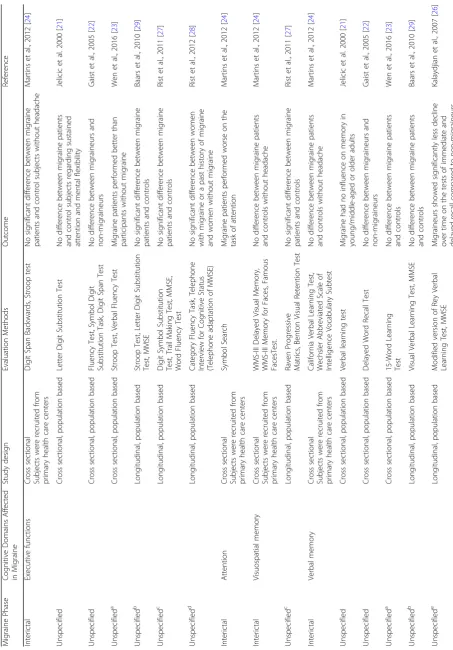
Longitudinal study design has the advantage of show-ing the association between migraine and cognitive de-cline over time. Longitudinal studies assessing cognitive function in migraine have used population-based sam-ples. Longitudinal studies did not provide any evidence for cognitive decline over time in migraine patients. In most studies, migraine was diagnosed using a question-naire based on International Classification of Headache
Disorders-I (ICHD-I) or ICHD-II [26, 27], or based on
patients’self-reports [28,29]. Participants were assessed
at least one more time after the baseline evaluation and
average follow-up ranged between 3.4 to 23 years [26–29].
recall in the Baltimore Epidemiologic Catchment Area study, migraineurs experienced slower decline over time
than those without migraine [26, 27]. However, in these
four longitudinal population based studies, the main aim was not to compare cognitive functions between migrai-neurs and controls without headache and comparisons were done as a part of larger studies. In Maastricht Aging Study, the aim was to define the determinants of cognitive aging in which migraine was one of the reported medical conditions by the patients. The EVA study was a longi-tudinal study of vascular and cognitive ageing in a population-based cohort, migraine was assessed in the third wave of the study and cognitive assessments from the third wave were used as the baseline measurements. Baltimore Epidemiologic Catchment Area study was ac-tually a longitudinal population-based study that mainly aimed to evaluate the prevalence and incidence of Diag-nostic and Statistical Manual of Mental Disorders (DSM) mental disorders in five regions of the United States. The data from the third and fourth waves of the Baltimore Epidemiologic Catchment Area study was reported [26] separately, as an interview for migraine diagnosis took
place in the third wave. The Women’s Health Study was a
randomised, placebo controlled clinical trial that investi-gated the role of low dose aspirin and vitamin E in the prevention of cardiovascular disease and cancer. Rist and colleagues published the cognitive sub cohort data from
Women’s Health Study and included subjects who
pro-vided information about their migraine status and partici-pated in cognitive testing during follow-up [28].
In another longitudinal study, health and behavior of in-dividuals born in Dunedin, New Zealand between 1 April 1972 and 31 March 1973 were investigated and cognitive, neuropsychological and medical assessments were done at ages 3, 5, 7,9, 11, 13, 15, 18, 21 and 26 [30]. At age 26, in-dividuals were assessed for migraine and retrospectively 114 migraine patients, 109 tension type headache (TTH) patients and 739 controls without headache were com-pared for performance in cognitive and neuropsycho-logical tests. Migraine patients had impaired verbal ability (especially language reception) at ages 3, 7, 9, 11, and 13, before the development of headache attacks, compared to controls without headache or subjects with tension type headache, but no decline with age was observed, suggest-ing that migraine did not cause verbal impairment itself but they had a shared risk factor [30]. Although longitu-dinal studies do not provide convincing evidence that cog-nitive function worsens over time in migraine patients, participants in most longitudinal studies were older than
those in cross sectional and clinic-based studies [8–
10, 13–15, 31–37], and both active (< 1 year since last attack) and non-active migraine patients were included (> 1 year since last attack), as potential confounders. The studies evaluating cognitive functions in migraine
patients categorized according to age groups are
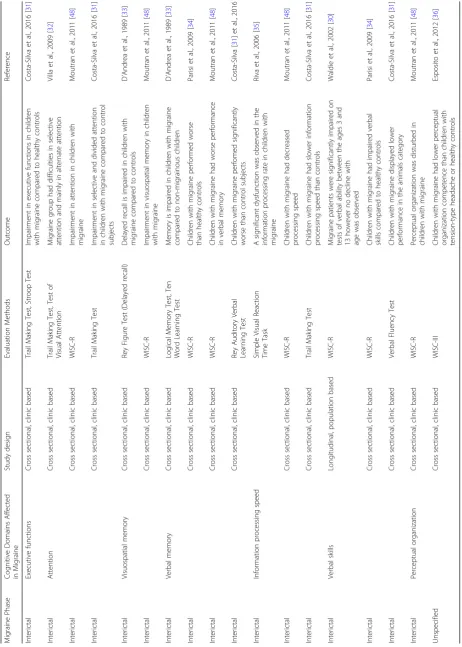
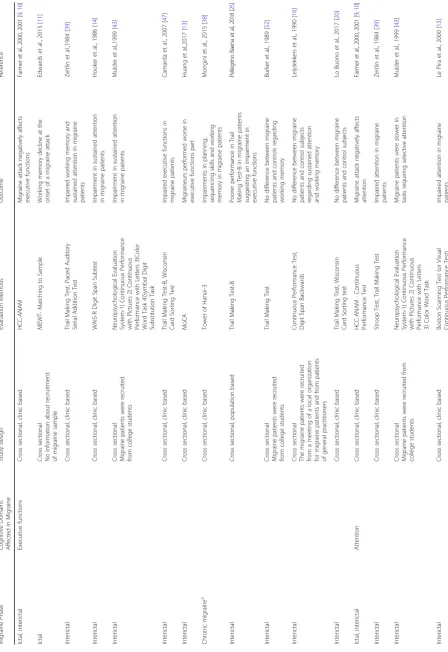
sum-marized in Tables1,2,3.
Migraine prophylactic medications (e.g. topiramate) or prevalent comorbidities (e.g. depression and anxiety) can also contribute to but cannot solely account for the cogni-tive impairment in migraineurs. For example, drug-naïve migraine without aura patients were shown to have sig-nificantly lower scores on the total Montreal Cognitive Assessment scale in 4 out of 6 cognitive subdomains (ex-ecutive function, attention, visuospatial memory, and ver-bal memory) compared to healthy controls with similar psychological profiles [6]. Unfortunately, few studies dir-ectly examined the impact of psychiatric comorbidities [22,26,27,38] and medications [14,15,29,39] on cogni-tive function in migraineurs. Gaist et al. adjusted the difference in cognitive scores between migraine patients and controls for the effect of depression and less marked difference was found [22]. The data from the third and fourth waves of the Baltimore Epidemiologic Catchment Area study revealed that depression had no impact on cognitive function in migraine patients [26], and in the EVA study adjusting the cognitive test results for de-pression had no impact on the results [27]. In another study, no difference in executive function was found between migraineurs with psychiatric disorders (depres-sion and obsessive compulsive disorder) and controls [38]. Lastly, studies on the effects of preventive medications and acute attack treatment on cognitive function in migraineurs did not find a significant impact on cognitive
function [14,15,29,39].
Because migraine aura is caused by cortical spreading depression, an intense neuronal and glial depolarization wave that is known to disrupt cortical function and cause
lasting cerebrovascular dysfunction [40, 41], and because
aura is a risk factor for white matter lesions and cerebro-vascular events [42], it is worth mentioning that a small number of studies with heterogeneous methodologies have investigated cognitive function in migraineurs with or without aura. The results of these studies were mixed and non-conclusive. Although migraineurs with aura ap-peared to have more prominent cognitive impairment par-ticularly with tasks evaluating sustained attention and
processing speed [14,43], and showed anomia and
proso-pagnosia [44, 45], other studies found no difference in
cognitive performance between migraineurs with or with-out aura [28], and as mentioned above, some even showed better cognition in migraineurs with aura [23].
Table
2
Studies
evaluating
cognitive
function
in
migraine
pa
tients
<
50
years
(Continued)
Migraine
Phase
Cogni
tive
Domains
Affect
ed
in
Migrai
ne
Study
design
Evalua
tion
Methods
Outcom
e
Refe
rence
Interictal
Longitudinal,
population
based
WISC
-R
Migraine
patients
were
signifi
cantly
impaired
on
test
s
of
verba
l
abili
ty
between
the
ages
3
and
13
however
no
decline
with
age
was
observed
Waldie
et
al.,
2002
[
30
]
Interictal
Cross
section
al
Migraine
patients
were
recruit
ed
from
college
studen
ts
Aphas
ia
screeni
ng
test
,
Speech
Soun
ds
Percepti
on
Test
No
differenc
e
betw
een
migraine
patients
and
contr
ols
Bu
rker
et
al.,
1989
[
52
]
Interictal
Cross
section
al
The
migraine
patients
were
recruited
from
a
meeting
of
a
local
organiza
tion
for
mi
graine
patients
and
from
patients
of
general
prac
titioners
Vocabular
y
Test
No
significant
differenc
e
betw
een
migraine
patients
and
control
subjects
Leij
dekkers
et
al.,
1990
[
16
]
Interictal
Cross
section
al,
clinic
based
Verba
l
Flue
ncy
Test
No
differenc
e
betw
een
migraine
patients
and
heal
thy
controls
Lo
Buono
et
al.,
2017
[
20
]
Ictal
Calculat
ion
Cross
section
al,
clinic
based
HCC-ANAM
-Mathematical
process
ing
Impairment
in
mathemat
ical
processi
ng
durin
g
a
migraine
attack
Fa
rm
er
et
al
.,
20
00
,2
00
1
[
9
,
10
]
Interictal
Cross
section
al,
clinic
based
Paced
au
ditory
ser
ial
addition
test
Disturbance
in
calcul
ation
ability
in
migraine
pat
ients
Zeitli
n
et
al.,
1984
[
39
]
Interictal
Cross
section
al,
clinic
based
MoCA
Calculation
was
im
paired
in
migraine
patients
Huang
et
al.,2017
[
13
]
Ictal
Somato
sensory
infor
mation
processi
ng
Cross
section
al,
clinic
based
STD
Prolonged
STD
threshold
values
Bora
n
et
al.,
2016
[
61
]
Vu
ralli
et
al.,
2017
[
62
]
Chronic
mi
graine
(during
headache
and
headache
free
periods)
Cross
section
al,
clinic
based
STD
Prolonged
STD
threshold
values
during
both
durin
g
headache
and
hea
dache
free
periods
Vu
ralli
et
al.,
2016
[
63
]
aIt
was
not
stated
whether
the
patients
were
evaluated
on
a
headache
day
or
a
headache
free
day
HCC-ANAM
Headac
he
Care
Center-Autom
ated
Neuropsychological
Ass
essment
Metrics,
MEWT
Mental
Efficiency
Workload
Test,
WAIS-R
Wechsler
Adult
Intellig
ence
Scale
-Revised,
WMS
Wechsler
Memory
Scale,
STD
Somatosens
ory
temporal
dis
Table
3
Studies
evaluating
cognitive
function
in
migraine
pa
tients
>
50
years
(Continued)
Migrai
ne
Phas
e
Cogni
tive
Domai
ns
Af
fected
in
Mi
graine
Study
de
sign
Evaluation
Met
hods
Out
come
Refere
nce
Unsp
ecified
c
Longitudinal,
populat
ion
bas
ed
Rey
15-word
Mem
ory
Test,
Raven
Progres
sive
Matrics
No
significan
t
differ
ence
be
tween
mi
graine
pat
ients
and
controls
Rist
et
al.,
20
11
[
27
]
Unsp
ecified
d
Longitudinal,
populat
ion
bas
ed
East
Boston
Me
mory
Test,
10
Word
List
Reca
ll,
Telephon
e
Intervi
ew
for
Cogni
tive
Stat
us
(Teleph
one
adaptation
of
MM
SE)
The
ris
k
of
substan
tial
cog
nitive
de
cline
in
wom
en
with
migrai
ne
or
a
past
hist
ory
of
mi
graine
was
not
increased
com
pared
to
wom
en
without
mi
graine
Rist
et
al.,
20
12
[
28
]
Unsp
ecified
c
Recogn
ition
memor
y
Longitudinal,
populat
ion
bas
ed
Benton
Faci
al
Recog
nition
Test
No
significan
t
differ
ence
be
tween
mi
graine
pat
ients
and
controls
Rist
et
al.,
20
11
[
27
]
Unsp
ecified
Information
proc
essing
speed
Cross
sectional
,
popu
lation
bas
ed
Verbal
learn
ing
test
Migrai
ne
ha
d
no
inf
luenc
e
on
proc
essing
spee
d
in
youn
g/middle-aged
or
olde
r
adu
lts
Jelicic
et
al.
20
00
[
21
]
Unsp
ecified
Cross
sectional
,
popu
lation
bas
ed
Symbol
Digit
Su
bstitution
Task
No
differ
ence
be
tween
mi
graineu
rs
and
non-migrai
neurs
Gaist
et
al.,
2005
[
22
]
Unsp
ecified
a
Cross
sectional
,
popu
lation
bas
ed
Letter
–
dig
it
substitut
ion
te
st
No
differ
ence
be
tween
mi
graine
patients
and
contro
ls
Wen
et
al.,
20
16
[
23
]
Unsp
ecified
b
Longitudinal,
populat
ion
bas
ed
Stroop
Test,
Lett
er
Digit
Substitution
Test
No
differ
ence
be
tween
mi
graine
patients
and
contro
ls
Baars
et
al.,
2010
[
29
]
Post-i
ctal,
interictal
Percep
tual
or
ganization
Cross
sectional
,
cl
inic
bas
ed
Comput
erized
glob
al-local
test
No
differ
ence
be
tween
mi
graine
pat
ients
and
contro
ls
regarding
pe
rceptual
organ
ization
capabiliti
es
Koppen
et
al.,
2011
[
17
]
aMigraine
patients
were
categorized
as
active
(<
1
year
since
the
last
attack)
or
non-active
(>
1
year
since
last
attack)
migraine
bActive
migraine
patients
were
included
in
the
study
cPatients
with
a
lifetime
history
of
severe
headache
had
a
phone
interview
with
a
neurologist
for
migraine
diagnosis
dBoth
women
with
migraine
and
women
with
a
past
history
of
migraine
were
included
in
the
study
eTime
since
the
last
attack
in
migraine
patients
were
reported
as
<
6
months
since
last
attack,
6
months-1
year
since
last
attack
and
>
1
year
since
last
att
ack
MoCA
Montreal
Cognitive
Assessment,
MMSE
Mini-Mental
State
Examination,
WMS
Wechsler
Memory
migraine preventive treatments, and 6) comorbidities (e.g. vascular risk factors, affective disorders).
Dysfunctional cognitive domains in migraine
Cognitive impairment in cross sectional, clinic-based stud-ies showed that migraine affected certain cognitive domains in particular, such as processing speed, attention, memory, verbal skills and executive function (e.g. working memory, divided attention/inhibition, set-shifting, and planning). Mi-graine had a moderate to marked effect on processing
speed and visuomotor scanning speed [14, 39, 46–48],
whereas basic attention [14–16,46,48,49] and delayed
ver-bal memory [14–16,46,49–51] were mildly affected, and
more complex psychomotor processing speed tasks were
not significantly affected [16, 50]. Some studies observed
mild to moderate impairments in non-verbal memory (e.g.
immediate figure recall tests) [14, 15, 46] whereas others
found no effect or better performance in migraineurs [49,52]. Verbal skills (auditory comprehension, reading, aphasia screening, verbal reasoning, vocabulary, phoneme
detection) were mildly impaired [14, 16, 47, 50, 51]. In
terms of executive function, migraine had a moderate to marked effect on sustained attention and working memory [16,39,43]. There was slight dysfunction in the inhibition
domain in migraine patients [16,39,43]. In the domains of
mental flexibility and set shifting, several studies reported that migraine patients exhibited a moderate or marked
im-pairment [14, 38, 47]. One study that included problem
solving and decision making also found a marked impair-ment in these domains in migraine patients [38].
Neuroimaging, neurophysiological and pharmacological studies
The predominant involvement of processing speed, sus-tained attention and memory suggested prefrontal and temporal cortical dysfunction during the attacks [8], also
supported by functional imaging studies [53,54]. A
posi-tron emission tomographic study showed activation of prefrontal cortex and temporal lobe during migraine at-tacks [53], and an fMRI study revealed significantly greater activation in the medial temporal lobe [54]. In the latter study, temporal lobe showed increased func-tional connectivity with several brain regions in migrai-neurs relative to controls in response to painful heat, and fMRI activation in temporal lobe was exacerbated during migraine headache attacks.
The functional organization of brain networks associated with pain and cognitive processes may be altered in mi-graine. De Tommaso et al. showed that episodic or chronic migraine patients have deficits in cognitive task-related sup-pression of laser evoked potential amplitudes during acute pain [55]. fMRI studies reveal blunted cognitive-related neural activity in migraine patients [56]. While healthy subjects have strong task-related deactivation in the left
dorsolateral prefrontal cortex, dorsal anterior midcingulate cortex, and cerebellum that is decreased with acute pain, migraineurs show blunted task-related deactivation with no change in response to acute pain. These changes were not associated with pain catastrophizing or pain intensity.
In a fMRI study, migraine without aura patients showed aberrant intrinsic connectivity within the bilateral central executive network (CEN) and salience network (SN), and greater connectivity between the default mode network (DMN) and right CEN (rCEN) and the insula. Moreover, greater connectivity between the DMN and rCEN and the insula correlated with duration of migraine. Both the DMN and CEN are related to cognition. CEN is associated with higher-order cognitive processes, working memory and attention. DMN is involved in specific cognitive do-mains such as social cognition, semantic and episodic memory and future planning. A possible neurobiological mechanism underlying cognitive deficits in migraine could be pain-related reorganization of intrinsic connectivity networks [57]. In another fMRI study, the association be-tween cognitive functions and cerebral functional con-nectivity (FC) in migraine without aura, migraine with aura patients and healthy controls during interictal period was investigated [20]. A battery of neuropsychological tests was used to assess cognitive functions and no signifi-cant difference was found between three groups. However, migraine with aura patients showed altered functional connectivity compared to migraine without aura patients and healthy controls. An increased connectivity in left an-gular gyrus, left supramarginal gyrus, right precentral gyrus, right postcentral gyrus, right insular cortex was ob-served in migraine with aura patients compared to mi-graine without aura patients.
Event related potentials recorded by electroencephalog-raphy or magnetoencephalogelectroencephalog-raphy have been used to evaluate cognitive processing. Electroencephalographic P3 (third positive wave around 300 milliseconds), and its magnetoencephalographic counterpart (P3m), have been shown to correlate with attention, information processing and executive function. P3 latency reflects the length of the stimulus processing time and P3 amplitude changes reflect neural activity related to cognition. P3 amplitude depends on the amount of attention given to the stimulus, working memory and the complexity of the task. Migraine patients have prolonged P3 latencies indicating prolonged
cognitive processing time [13, 58]. Some of the previous
studies revealed decreased P3 amplitudes in migraine
pa-tients without a significant change in P3 latencies [59,60]
whereas others showed significant elongation of P3 laten-cies with reduced P3 amplitudes [58].
entry of each external stimuli which is crucial for the survival and to generate proper reactions. Prolonged STD threshold (STDT) values have been reported in
neurodegenerative disorders such as Parkinson’s disease,
multiple system atrophy, and cerebellar atrophy. In episodic migraine patients STDT values are transiently but markedly increased during migraine attacks (3-fold higher than inter-ictal) indicating an impairment in higher cognitive
process-ing of somatosensory stimuli [61, 62]. In contrast to
episodic migraine patients in whom interictal STDTs were normal, STD prolongation was detected on both headache days and headache free intervals of chronic migraine pa-tients [63]. Therefore persistent elevation of STDT values above 100 ms in chronic migraine could indicate unremit-ting cognitive problems associated with CM. The latter was also supported by clinical neuropsychological studies which revealed cognitive impairment in CM patients [38]. In sum-mary, processing of two discrete somatosensory stimuli remained disrupted in chronic migraine brain throughout the headache and headache-free days, showing persistent impairment in cognitive sensory processing.
Short latency afferent inhibition (SAI) is the modula-tion of motor response by a sensory stimulus and is known to be associated with sensorimotor integration, cognitive functions and cholinergic system. In SAI para-digm, a preceding electrical stimulation of a peripheral nerve (conditioning afferent stimulus) transiently sup-presses transcranial magnetic stimulation (TMS)-in-duced motor output. Inhibition of the motor response occurs if the interstimulus interval between the electrical
stimulation and TMS is 19–50 milliseconds [64]. In
cog-nitive disorders such as Alzheimer dementia, mild
cogni-tive impairment and Parkinson’s disease with dementia,
SAI is shown to be reduced and rivastigmin, a choliner-gic drug, augments SAI [65]. Recently it is reported that SAI is reduced during a migraine attack and is normal interictally and it is probably associated with cognitive disturbances during a migraine attack [66].
Donepezil, an acetylcholinesterase inhibitor was able to induce antinociception in mice in a dose dependent manner. Donepezil induced antinociception was shown to be dependent on cholinergic activation since it was inhibited by a non-selective muscarinic antagonist sco-polamine. In an open label clinical pharmacological study, donepezil was found to be effective in migraine prophy-laxis both in episodic and chronic migraine patients [67]. There seems to be a cholinergic dysfunction in migraine and since cholinergic activity of the cortex is linked to cognitive functions, cholinergic dysfunction may be re-lated to cognitive symptoms during a migraine attack.
In two small open label studies [9, 10], cognitive
func-tions were evaluated during interictal period, untreated migraine and following an anti-migraine drug, sumatrip-tan administration. Cognitive impairment was observed
during the migraine attack compared to interictal period and cognitive functions were shown to be restored after sumatriptan administration (6 mg subcutaneous injection or 20 mg nasal spray).
Other primary headache disorders
Cluster headache primarily affects men and has only one-tenth the incidence of migraine, but causes disability comparable to migraine [2]. There are few studies on cognitive performance in cluster headache. Although pa-tients display a reversible cognitive decline during the cluster attacks, their cognitive performance was detected
as normal between the attacks [68,69].
In TTH, acute headache was associated with reversibly impaired cognitive function [70]. In a longitudinal birth cohort study, childhood headache was related to worse performance on cognitive measures such as verbal and
performance IQ, receptive language, and reading,
whereas cognitive performance of adults with TTH was similar to headache-free controls or headache-free tin-nitus sufferers [71]. TTH, known as the most common headache disorder, is often misdiagnosed in patients with probable migraine, and chronic migraine, resulting in
a highly varying prevalence of TTH between 5.1–78%
[1, 2]. It is likely that majority of TTH studies are
not conducted on pure TTH patients and that may be at least partially responsible for cognitive problems detected in TTH studies. Indeed, STD test was intact during headache attacks in pure TTH patients [62], while STDTs were significantly elevated in migraine attacks. STD differentiates the central pathology of migraine from TTH and, normal STDTs in TTH could suggest a better cognitive status in pure TTH attacks.
Conclusion
Standardized neuropsychological tests show that mi-graine attacks are associated with poor cognitive
per-formance compared with headache-free periods,
order to establish the extent of cognitive impairment in patients with migraine and other primary headache dis-orders and whether migraine prophylactic medications have an impact on reversal of cognitive dysfunction.
Abbreviations
EVA:Epidemiology of Vascular Aging Study; fMRI: Functional Magnetic Resonance Imaging; ICHD: International Classification of Headache Disorders; STD: Somatosensory Temporal Discrimination; STDT: Somatosensory Temporal Discrimination Threshold; TTH: Tension Type Headache
Acknowledgements
None
Funding
No funding to declare.
Availability of data and materials
Not applicable.
Authors’contributions
All authors conceived and designed the review, DV drafted the manuscript and all authors revised it for intellectual content. All authors read and approved the final manuscript.
Ethics approval and consent to participate
Not applicable.
Consent for publication
Not applicable.
Competing interests
The authors declare that they have no competing interests.
Publisher’s Note
Springer Nature remains neutral with regard to jurisdictional claims in published maps and institutional affiliations.
Author details
1Department of Neurology and Algology, Gazi University Faculty of Medicine,
Besevler, 06510 Ankara, Turkey.2Neuropsychiatry Center, Gazi University,
Besevler, 06510 Ankara, Turkey.3Neurovascular Research Lab, Department of
Radiology, Massachusetts General Hospital, Harvard Medical School,
Charlestown, MA, USA.4Stroke Service, Department of Neurology,
Massachusetts General Hospital, Harvard Medical School, Charlestown, MA, USA.
Received: 27 August 2018 Accepted: 16 October 2018
References
1. Ertas M, Baykan B, Kocasoy Orhan E, Zarifoglu M, Karli N, Saip S, Onal AE, Siva A (2012) One-year prevalance and the impact of migraine and tension-type headache in Turkey: a nationwide home-based study in adults. J Headache Pain. 13:147–157
2. Rasmussen BK, Jensen R, Schroll M, Olesen J (1991) Epidemiology of headache in a general population—a prevalence study. J Clin Epidemiology 44:1147–1157
3. Burch RC, Loder S, Loder E, Smitherman TA (2015) The prevalence and burden of migraine and severe headache in the United States: updated statistics from government health surveillance studies. Headache 55(1):21–34
4. Herricks JR, Hotez PJ, Wanga V, Coffeng LE, Haagsma JA, Basáñez MG et al (2017) The global burden of disease study 2013: what does it mean for the NTDs? PLoS Negl Trop Dis 11(8):e0005424
5. Gil-Gouveia R, Oliveira AG, Martins IP (2016) The impact of cognitive symptoms on migraine attack-related disability. Cephalalgia 36(5):422–430 6. Santangelo G, Russo A, Trojano L, Falco F, Marcuccio L, Siciliano M et al
(2016) Cognitive dysfunctions and psychological symptoms in migraine without aura: a cross-sectional study. J Headache Pain. 17(1):76
7. Lee SH, Kang Y, Cho SJ (2017) Subjective cognitive decline in patients with migraine and its relationship with depression, anxiety, and sleep quality. J Headache Pain 18(1):77
8. Gil-Gouveia R, Oliveira AG, Martins IP (2015) Cognitive dysfunction during migraine attacks: a study on migraine without aura. Cephalalgia 35(8):662–674 9. Farmer K, Cady R, Bleiberg J, Reeves D (2000) A pilot study to measure
cognitive efficiency during migraine. Headache 40:657–661
10. Farmer K, Cady R, Bleiberg J, Reeves D, Putnam G, O’Quinn S et al (2001) Sumatriptan nasal spray and cognitive function during migraine: results of an open-label study. Headache 41:377–384
11. Edwards KR, Rosenthal BL, Farmer KU, Cady RK, Browning R (2013) Evaluation of sumatriptan-naproxen in the treatment of acute migraine: a placebo-controlled, double-blind, cross-over study assessing cognitive function. Headache 53:656–664
12. Mazzucchi A, Sinforiani E, Zinelli P, Agostinis C, Granella F, Miari A et al (1988) Interhemispheric attentional functioning in classic migraine subjects during paroxysmal and interparoxysmal phases. Headache 28(7):488–493 13. Huang L, Juan Dong H, Wang X, Wang Y, Xiao Z (2017) Duration and
frequency of migraines affect cognitive function: evidence from neuropsychological tests and event-related potentials. J Headache Pain. 18(1):54
14. Hooker WD, Raskin NH (1986) Neuropsychologic alterations in classic and common migraine. Arch Neurol 43:709–712
15. Le Pira F, Zappala G, Giuffrida S, Lo Bartolo ML, Reggio E, Morana R et al (2000) Memory disturbances in migraine with and without aura: a strategy problem? Cephalalgia 20:475–478
16. Leijdekkers ML, Passchier J, Goudswaard P, Menges LJ, Orlebeke JF (1990) Migraine patients cognitively impaired? Headache 30:352–358 17. Koppen H, Palm-Meinders I, Kruit M, Lim V, Nugroho A, Westhof I et al
(2011) The impact of a migraine attack and its after-effects on perceptual organization, attention, and working memory. Cephalalgia 31(14):1419–1427 18. Conlon E, Humphreys L (2001) Visual search in migraine and visual
discomfort groups. Vis Res 41:3063–3068
19. Palmer JE, Chronicle EP (1998) Cognitive processing in migraine: a failure to find facilitation in patients with aura. Cephalalgia 18:125–132
20. Lo Buono V, Bonanno L, Corallo F, Pisani LR, Lo Presti R, Grugno R et al (2017) Functional connectivity and cognitive impairment in migraine with and without aura. J Headache Pain 18(1):72. https://doi.org/10.1186/s10194-017-0782-6.
21. Jelicic M, van Boxtel MP, Houx PJ, Jolles J (2000) Does migraine headache affect cognitive function in the elderly? Report from the Maastricht aging study (MAAS). Headache 40:715–719
22. Gaist D, Pedersen L, Madsen C, Tsiropoulos I, Bak S, Sindrup S et al (2005) Long-term effects of migraine on cognitive function: a population-based study of Danish twins. Neurology 64:600–607
23. Wen K, Nguyen NT, Hofman A, Ikram MA, Franco OH (2016) Migraine is associated with better cognition in the middle-aged and elderly: the Rotterdam study. Eur J Neurol 23(10):1510–1516
24. Martins IP, Gil-Gouveia R, Silva C, Maruta C, Oliveira AG (2012) Migraine, headaches, and cognition. Headache 52(10):1471–1482
25. Pellegrino Baena C, Goulart AC, Santos IS, Suemoto CK, Lotufo PA, Bensenor IJ (2018) Migraine and cognitive function: baseline findings from the Brazilian longitudinal study of adult health: ELSA-Brasil. Cephalalgia 38(9):1525–1534 26. Kalaydjian A, Zandi PP, Swartz KL, Eaton WW, Lyketsos C (2007) How
migraines impact cognitive function: findings from the Baltimore ECA. Neurology 68:1417–1424
27. Rist PM, Dufouil C, Glymour MM, Tzourio C, Kurth T (2011) Migraine and cognitive decline in the population-based EVA study. Cephalalgia 31:1291–1300 28. Rist PM, Kang JH, Buring JE, Glymour MM, Grodstein F, Kurth T (2012)
Migraine and cognitive decline among women: prospective cohort study. BMJ 345:e5027
29. Baars MA, van Boxtel MP, Jolles J (2010) Migraine does not affect cognitive decline: results from the Maastricht aging study. Headache 50:176–184 30. Waldie KE, Hausmann M, Milne BJ, Poulton R (2002) Migraine and cognitive
function: a life-course study. Neurology 59:904–908
31. Costa-Silva MA, de Almeida Prado AC, de Souza LC, Gomez RS, Teixeira AL (2016) Cognitive functioning in adolescents with migraine. Dementia & Neuropsychol 10(1):47–51
33. D'Andrea G, Nertempi P, Milone FF, Joseph R, Cananzi AR (1989) Personality and Memory in Childhood Migraine. Cephalalgia 9(1):25–28
34. Parisi P, Verrotti A, Paolino MC, Urbano A, Bernabucci M, Castaldo R, Villa MP (2010) Headache and cognitive profile in children: a cross-sectional controlled study. J Headache Pain 11(1):45–51
35. Riva D, Aggio F, Vago C, Nichelli F, Andreucci E, Paruta N, D'Arrigo S, Pantaleoni C, Bulgheroni S (2016) Cognitive and Behavioural Effects of Migraine in Childhood and Adolescence. Cephalalgia 26(5):596–603 36. Esposito M, Pascotto A, Gallai B, Parisi L, Roccella M, Marotta R, et al (2012).
Can headache impair intellectual abilities in children? An observational study. Neuropsychiatr Dis Treat. 8:509–13.
37. Santangelo G, Russo A, Tessitore A, Garramone F, Silvestro M, Della Mura MR, Marcuccio L, Fornaro I, Trojano L, Tedeschi G (2018) Prospective memory is dysfunctional in migraine without aura. Cephalalgia 38(12): 1825–1832
38. Mongini F, Keller R, Deregibus A, Barbalonga E, Mongini T (2005) Frontal lobe dysfunction in patients with chronic migraine: a clinical-neuropsychological study. Psychiatry Res 133:101–106
39. Zeitlin C, Oddy M (1984) Cognitive impairment in patients with severe migraine. Br J Clin Psychol 23(Pt 1):27–35
40. Ayata C, Lauritzen M (2015) Spreading depression, spreading depolarizations, and the cerebral vasculature. Physiol Rev 95(3):953–993 41. Bolay H, Reuter U, Dunn A, Huang Z, Boas D, Moskowitz A (2002) Intrinsic
brain activity triggers trigeminal meningeal afferents in a migraine model. Nature Med 8(2):136–142
42. Mawet J, Kurth T, Ayata C (2015) Migraine and stroke: in search of shared mechanisms. Cephalalgia 35:165–181
43. Mulder EJ, Linssen WH, Passchier J, Orlebeke JF, de Geus EJ (1999) Interictal and postictal cognitive changes in migraine. Cephalalgia 19:557–565 44. Martins IP, Cunha-Sá M (1999) Loss of topographic memory and
prosopagnosia during migraine aura. Cephalalgia 19:841–843
45. Hadjikhani N, Sanchez Del Rio M, Wu O, Schwartz D, Bakker D, Fischl B et al (2001) Mechanisms of migraine aura revealed by functional MRI in human visual cortex. Proc Natl Acad Sci U S A 98:4687–4692
46. Calandre EP, Bembibre J, Arnedo ML, Becerra D (2002) Cognitive disturbances and regional cerebral blood flow abnormalities in migraine patients: their relationship with the clinical manifestations of the illness. Cephalalgia 22:291–302
47. Camarda C, Monastero R, Pipia C, Recca D, Camarda R (2007) Interictal executive dysfunction in migraineurs without aura: relationship with duration and intensity of attacks. Cephalalgia 27(10):1094–1100 48. Moutran AR, Villa TR, Diaz LA, Noffs MH, Pinto MM, Gabbai AA, Carvalho
Dde S (2011) Migraine and cognition in children: a controlled study. Arq Neuropsiquiatr 69:192–195
49. Sinforiani E, Farina S, Mancuso A, Manzoni GC, Bono G, Mazzucchi A (1987) Analysis of higher nervous functions in migraine and cluster headache. Funct Neurol 2(1):69–77
50. Pearson AJ, Chronicle EP, Maylor EA, Bruce LA (2006) Cognitive function is not impaired in people with a long history of migraine: a blinded study. Cephalalgia 26:74–80
51. McKendrick AM, Badcock DR, Badcock JC, Gurgone M (2006) Motion perception in migraineurs: abnormalities are not related to attention. Cephalalgia 26:1131–1136
52. Burker E, Hannay HJ, Halsey JH (1989) Neuropsychological functioning and personality characteristics of migrainous and nonmigrainous female college students. Neuropsychology 3:61–73
53. Afridi SK, Giffin NJ, Kaube H, Friston KJ, Ward NS, Frackowiak RS et al (2005) A positron emission tomographic study in spontaneous migraine. Arch Neurol 62:1270–1275
54. Moulton EA, Becerra L, Maleki N, Pendse G, Tully S, Hargreaves R et al (2011) Painful heat reveals hyperexcitability of the temporal pole in interictal and ictal migraine states. Cereb Cortex 21(2):435–448
55. de Tommaso M, Valeriani M, Guido M, Libro G, Specchio LM, Tonali P, Puca F (2003) Abnormal brain processing of cutaneous pain in patients with chronic migraine. Pain 101(1–2):25–32
56. Mathur VA, Khan SA, Keaser ML, Hubbard CS, Goyal M, Seminowicz DA (2015) Altered cognition-related brain activity and interactions with acute pain in migraine. Neuroimage Clin 7:347–358
57. Xue T, Yuan K, Zhao L, Yu D, Zhao L, Dong T et al (2012) Intrinsic brain network abnormalities in migraines without Aura revealed in resting-state fMRI. PLoS One 7(12):e52927
58. Titlic M, Mise NI, Pintaric I, Rogosic V, Vanjaka-Rogosic L, Mihalj M et al (2015) The event-related potential p300 in patients with migraine. Acta Inform Med 23:339–342
59. Chen W, Shen X, Liu X, Luo B, Liu Y, Yu R et al (2007) Passive paradigm single-tone elicited ERPs in tension-type headaches and migraine. Cephalalgia 27:139–144
60. Wang R, Dong Z, Chen X, Zhang M, Yang F, Zhang X et al (2014) Gender differences of cognitive function in migraine patients: evidence from event-related potentials using the oddball paradigm. J Headache Pain. 15:6 61. Boran HE, Cengiz B, Bolay H (2016) Somatosensory temporal discrimination
is prolonged during migraine attacks. Headache 56:104–112 62. Vuralli D, Boran HE, Cengiz B, Coskun O, Bolay H (2017) Somatosensory
temporal discrimination remains intact in tension-type headache whereas it is disrupted in migraine attacks. Cephalalgia 37:1241–1247
63. Vuralli D, Boran HE, Cengiz B, Coskun O, Bolay H (2016) Chronic Migraine Is Associated With Sustained Elevation of Somatosensory Temporal Discrimination Thresholds. Headache 56:1439–1447
64. Tokimura H, Di Lazzaro V, Tokimura Y, Oliviero A, Profice P, Insola A et al (2000) Short latency inhibition of human hand motor cortex by somatosensory input from the hand. J Physiol 523(Pt 2):503–513 65. Di Lazzaro V, Oliviero A, Pilato F, Saturno E, Dileone M, Marra C et al (2005)
Neurophysiological predictors of long term response to AChE inhibitors in AD patients. J Neurol Neurosurg Psychiatry 76(8):1064–1069
66. Kiyak Keceli Y, Alaydın HC, Can E, Bolay H, Cengiz B (2018) Migraine Attack Also Disrupts Cortical Sensorimotor Integrity. p. 101.https://www.tkneed. org/_media/DEYTARESELLER_tkneed/deytacatalog/content/files/ KOngre%20EMG%202018%20Özet%20kitap%281%29.pdf
67. Nicolodi M, Galeotti N, Ghelardini C, Bartolini A, Sicuteri F (2002) Central cholinergic challenging of migraine by testing second-generation anticholinesterase drugs. Headache 42:596–602
68. Meyer JS, Thornby J, Crawford K, Rauch GM (2000) Reversible cognitive decline accompanies migraine and cluster headaches. Headache 40(8):638– 646
69. Evers S (2005) Cognitive processing in cluster headache. Curr Pain Headache Rep 9(2):109–112
70. Smith AP (2016) Acute tension-type headaches are associated with impaired cognitive function and more negative mood. Front Neurol 7:42 71. Waldie KE, Welch D (2007) Cognitive function in tension-type headache.