16 | P a g e
International Journal of Phytopharmacology
www.onlineijp.com
e- ISSN 0975 – 9328 Print ISSN 2229 – 7472
EVALUATION OF ANTIMICROBIAL AND ANTIOXIDANT
ACTIVITY OF POLYHERBAL FORMULATION
Sonia Sethi*, Sukanyabhowad, Kajalgurav
Lords Universal College, Topiwala Marg, Off Station Road, Goregaon West, Mumbai, Maharashtra 400062, India.
ABSTRACT
The present study was carried out to determine the phytochemical constituents, antioxidant activity and antimicrobial activity in the Different Churna samples. Out of four churna samples tested, extract of Gtee showed highest total antioxidant capacity. Also reducing power activity and hydrogen peroxide activity was found to be highest in Pipple tea extract. The antimicrobial potential of eight tea extracts was screened against eight bacteria E. coli, S. aureus, P. vulgaris, Pseudomonas, Coryne bacterium, Streptococci, Bacillus and Klebsiella sp using well diffusion assay. The tea extracts of Lipton showed significant activity against Pseudomonas sp (20mm). Extract of Tetly exhibit highest activity against P. vulgaris (17mm) and Organic tulsi showed highest activity against
Klebsiella (25mm). It can be inferred that the parts of tea having high content of phytochemicals may serve as a good source of nutraceuticals which have potential for use in health care formulations.
Key words: Phytochemicals, Nutraceuticals, Antioxidant, Phenolics, Healthcare.
Corresponding Author Sonia Sethi Email: [email protected]
INTRODUCTION
An molecule capable of slowing or preventing the oxidation of other molecules is called an Antioxidant. Oxidation is a chemical reaction that transfers electrons from a substance to an oxidizing agent. Oxidation reactions can produce free radicals, which start chain reactions that damage cells. Antioxidants terminate these chain reactions by removing free radical intermediates, and inhibit other oxidation reactions by being oxidized themselves. As a result, antioxidants are often reducing agents such as thiols, although oxidation reactions are crucial for life, they can also be damaging; hence, plants and animals maintain complex systems of multiple types of antioxidants, such as glutathione, vitamin C, and
Access this article online Home page:
http://onlineijp.com/
DOI:
http://dx.doi.org/10.21276/ijp.2017.8.1.4
Quick Response code
Received:09.01.17 Revised:12.01.17 Accepted:20.01.17
vitamin E as well as enzymes such as catalase, superoxide dismutase and various peroxidases. Low levels of antioxidants, or inhibition of the antioxidant enzymes, cause oxidative stress and may damage or kill cells. As per the Ayurvedic concept of Preparations, Churna is a fine powder of a drug or drugs which is prepared by mixing clean, finely powdered and sieved drugs. The preparation of Churna is based on traditional methods in accordance with the procedures given in classical texts (Anonymous, 2003).
Kayam Churna is an ayurvedic proprietary medicine used for constipation. It has moderate laxative properties. Its occasional use might be safe, but if you start using it on regular basis, it can result in developing a laxative habit by weakening the intestines and conflicting with natural peristaltic movements. Kayam Churna contains 50% senna leaves, so it is a stimulant laxative, which provides a quick relief from constipation. Kayam Churna irritates bowel lining and helps treating constipation. It is also beneficial for people suffering from gas,
17 | P a g e
abdominal distention, heaviness in abdomen, headache and mouth ulcer. Kayam Churna is more effective if the underlying cause of all these conditions is constipation (https://www.ayurtimes.com).
Divya Churna contains seven ingredients viz. Sanaikipaati, Haritaki, Fennel, Dried ginger, Dries rose petals, Kala daana and Rock salt. Sanaipaati or Cassia angustifolia is a very well-known medicinal herb with purgative effect. It has strong laxative effect that causes excretion of feces adhered in the intestines. It helps in total evacuation of bowel. If taken at bed time, bowel happens next morning.Dry ginger powder or Sunthi is appetizer, stomachic, thermogenic, carminative, laxative, digestive and is useful in many digestive problems such as colic, diarrhoea, flatulence, flatulence, hyperacidity, abdominal pain, vomiting etc (http://www.bimbima.com).
Triphala [„three‟ (tri) „fruits‟ (phala)] is a traditional Ayurvedic herbal formulation consisting of the dried fruits of three medicinal plants,
Terminalia chebula, Terminalia bellirica and
Phyllanthus emblica, also known as the „three myrobalans‟. This formulation, rich in antioxidants, is a frequently used ayurvedic medicine to treat many diseases such as anemia, jaundice, constipation, asthma, fever and chronic ulcers. It is an important medicine of the „rasayana‟ group and is believed to promote health, immunity and longevity. It corrects constipation, cleanses and tonifies the gastrointestinal tract and also detoxifies the whole body, and improves digestion and assimilation. It exhibits anti-viral, anti-bacterial, antifungal and anti-allergic properties (Singh PK, 2003). Triphala and its constituents act as cardio-tonic, control blood pressure, improve blood circulation and reduce cholesterol levels. Triphala” shows immunomodulatory properties and helps in improving the body‟s defence system (Srikumar R et al., 2005).
Hingwashtak churna is a polyherbal Ayurvedic medicine used as a digestive, carminative, astringent and as an antacid. It is claimed to cure peptic ulcers by way of improving digestion. Hingwashtak churna consisits of eight ingredients i.e. Piper nigrum, Piper longum, Zingiber officinale, Nigella sativa, Cuminum cyminum, Trachyspermum ammi, Ferula foetida and Rock salt (Satyanarayana S
et al., 1989).
The use of antioxidants in treatment of oxidative stress-related pathologies is a possible therapeutical strategy for the future. Natural product with antioxidant properties could trigger this goal. The aim of this in vitro study was to assess the antioxidant activity and antimicrobial activity of the
extracts of different polyherbal formulations.
MATERIALS AND METHODS Samples
Different commercial polyherbal formulations. Churna) were purchased at supermarkets in Mumbai. For each commercial sample, these bags were opened and the contents homogenized. Then, 1 g of the powder was placed back in original bag and resealed.
Extraction
1 g powder was soaked in methanol for 7 days with intermittent shaking and the solvent was filtered with Whatman filter paper and obtained extracts were recovered and used for determination of total phenolic compounds, total flavanoids and tannin content, as well as antioxidant activity.
Phytochemical Screening
The methanolic extracts of different formulations were used as samples for qualitative phytochemical screening for tannins, alkaloids, saponin, total phenol and flavonoids following the standard procedures of (Trease GE and Evans WC, 1989).
Antioxidant activity Reducing power
The reducing power was based on Fe (III) to Fe (II) transformation in the presence of the solvent fractions (Fejes S et al., 2000). The Fe (II) can be monitored by measuring the formation of Perl‟s Prussian blue at 700 nm. Various concentrations of the sample (2 ml) were mixed with 2 ml of phosphate buffer (0.2 M, pH 6.6) and 2 ml of potassium ferricyanide (10 mg/ml). The mixture was incubated at 50°C for 20 min followed by addition of 2 ml of trichloroacetic acid (100 mg/l). The mixture was centrifuged at 3000 rpm for 10 min to collect the upper layer of the solution. A volume of 2 ml from each of the mixture earlier mentioned was mixed with 2 ml of distilled water and 0.4 ml of 0.1% (w/v) fresh ferric chloride. After 10 min reaction, the absorbance was measured at 700 nm. Higher absorbance of the reaction mixture indicates a higher reducing power.
Total Antioxidant Activity
18 | P a g e
2.0 mL of the reagent solution with the appropriate volume of the same solvent used to dissolve the sample. The tubes were capped and incubated in water bath at 95 °C for a period of 90 minutes. The sample and blank were left on the shelf for half an hour to cool down to room temperature. The absorbance of the sample was measured against blank solution at 695 nm. A tocopherol graph was plotted by using α-tocopherol as standard and the total antioxidant activity of the plant extract was expressed as μg -tocopherol equivalent. The equation of the plotted graph is given as: Y = 5.358x + 0.2427 where, Y = Absorbance and X = Concentration
Hydrogen peroxide scavenging activity
Hydrogen peroxide solution (2 mM) was prepared in 50 mM phosphate buffer (pH 7.4). Aliquots (0.1 ml) of different fractions was transferred into the test tubes and their volumes were made up to 0.4 ml with 50 mM phosphate buffer (pH 7.4) After addition of 0.6 ml hydrogen peroxide solution, tubes were vortexed and absorbance of the hydrogen peroxide at 230 nm was determined after 10 min, against a blank (Ruch RJ et al., 1989).
Agar well diffusion assay
The antimicrobial activity was measured by Agar well diffusion assay. The polyherbal formulations extract were allowed to diffuse out into the medium and interact in a plate freshly seeded with the test organisms. Petri plates containing 20 ml Mueller Hinton medium were seeded with the bacterial strains. Each labelled medium plate was uniformly inoculated with a test organism by using a sterile cotton swab rolled in the suspension to streak the plate surface in a form that lawn growth can be observed. Wells were punchered and 100 μl of the methanolic polyherbal extracts were added. The plates were then incubated at 37 °C for 24 hours. Erythromycin (0.05%) was used as positive control and analysis was done in triplicates. The antibacterial activity was assayed by measuring the diameter of the inhibition zone formed around the well. The diameter of zone of inhibition can be measured in millimetres.
RESULTS AND DISCUSSION
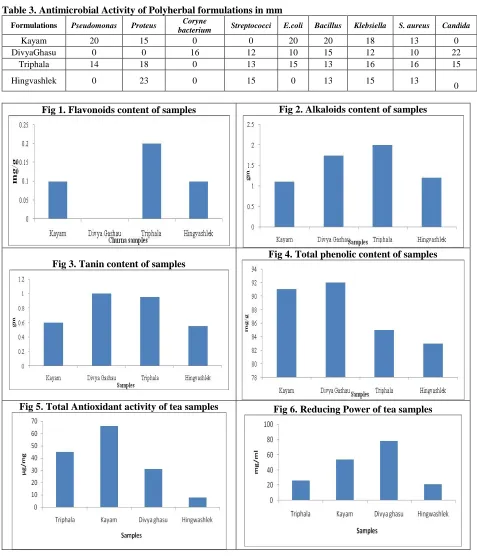
The phytochemical analysis of the polyherbal formulations (Churna) extracts gave the results as depicted in Table-1.
The curative properties of polyherbal formulations are perhaps due to the presence of various secondary metabolites such as alkaloids, flavonoids, phenols, saponins, tanin etc. The successive extracts of these of all the four samples have revealed the presence of alkaloids, flavonoids,
phenols, saponins, and tannins (Table 1 and Fig. 1, 2, 3, 4)
The values of flavonoids in different samples varied between 0.2 and 0 mg/g and were significantly lower in Divya Ghasu formulation. The average values of flavonoids of different samples showed no significant difference (p< 0.05) indicating that these phytochemicals are likely to be responsible for the free radical scavenging activity (Figure 1). Unlike what was observed in the analysis of total phenols, a lower number of brands were significantly different (p< 0.05) when considering the same type of tea. Flavonoids are reportedly responsible for the antioxidant activities of plants (Das NP and Pereira TA, 1990) through their scavenging or chelating activity (Kessler M et al., 2003).
The values of Alkaloids in different polyherbal formulations varied between 1.99g and 12g and were significantly lower in Kayam churna (Figure 2). The average values of alkaloids of different samples showed significant difference indicating that these phytochemicals are likely to be responsible for the free radical scavenging activity.
Tannin content of different polyherbal formulations were observed in the range of 1.0 g -0.55g. The highest tannin content was found in DivyaGhasu extract (Figure 3). Tannins have stringent properties, hasten the healing of wounds and inflamed mucous membranes.
Phenolics are well established to show antioxidant activity and contribute to human health. In this study, the total phenolic content was determined using the Folin–Ciocalteu method, with gallic acid as a standard. The content of phenolics was evaluated and expressed in GAE as milligrams per gram of extract (mg GAE/g extract). The total phenolic content of extracts of different polyherbal formulations showed large variations. The DivyaGhasu extracts contained the highest total phenol content (92.00 ± 0.62 mg GAE/g extract), followed by Kayam extracts (91 ± 2.32 mg GAE/g extract) (Figure 4).The levels of total phenols obtained in this study are in agreement with those reported in the literature.
19 | P a g e
produced in excess, they can be destructive leading to inflammation, ischemia, lung damage and other degenerative diseases (Halliwell B et al., 1992). The antioxidant activity of phenolic compounds is mainly due to their redox properties, which can play an important role in absorbing and neutralizing free radicals, quenching singlet and triplet oxygen, or decomposing peroxides (Osawa T, 1994). Phenolic compounds contribute to the quality and nutritional value regarding modifying color, taste, aroma, and flavor and also in providing health benefits effects. They also serve in plant defense mechanisms to counteract reactive oxygen species (ROS) to survive and prevent molecular damage and damage by microorganisms, insects, and herbivores (Vaya J et al., 1997).
Antioxidant activity
The analysis of the antioxidant activity of the herbal formulations extracts gave the results as depicted in Table-2
Among the different extracts, the greatest antioxidant activity was observed in Kayam churna extracts, which exhibited inhibition of linoleic acid per- oxidation (Figure 5). Polyphenols are the most abundant group of compounds in extracts, and the catechins constitute the major component and seem to be responsible for the antioxidant activity. Therefore, extracts were electron donors and can react with free radicals to convert them to more stable products and terminate radical chain reaction. Hence, it is supposed that those antioxidant activities may be due to high level of total phenolic compounds (Hwang Pet al., 2010). Antioxidant capacity of Kayamchurna due to its polyphenol content, as polyphenols plays an important role as antioxidants in living systems due to the presence of hydroxyl groups in ortho- and para positions.
Iron(III) to Iron(II) reducing activity: The reducing ability of a compound generally depends on the presence of reductants (Duh PD et al., 1999) which have been exhibiting antioxidative potential by breaking the free radical chain and donating a hydrogen atom (Gordon MH, 1990). The presence of reductants in polyherbal formulations extract causes the reduction of the Fe3+/ferricynide complex to the ferrous form. Therefore, the Fe2+ can be monitored by measuring the formation of Perl‟s Purssian blue at 700 nm. Figure 6 shows the reductive capabilities of
the polyherbal formulations extract compared to ascorbic acid. The highest reducing powers of Divyaghasu is 78 at a dose of 1 mg extracts, respectively. Reducing power of different polyherbal formulations extract range from 78 ± 0.1 to 21 ± 0.2 mg Asc AE/gm.
Hydrogen peroxide is a weak oxidizing agent and can inactivate a few enzymes directly, usually by oxidation of essential thiol (-SH) groups. It can cross cell membranes rapidly and inside the cell. H2O2 probably reacts with Fe
2+
and possibly Cu2+ ions to form hydroxyl radical which may be the origin of many of its toxic effects (Miller MJ et al.,
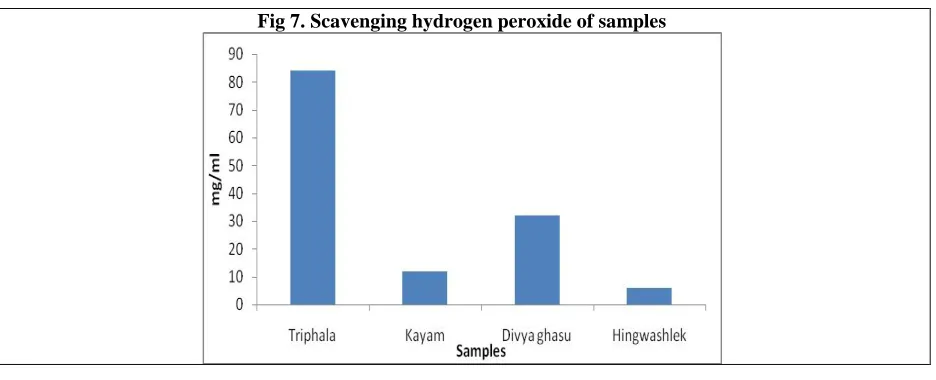
1993). It is therefore biologically advantageous for cells to control the amount of hydrogen peroxide that is allowed to accumulate. The scavenging activity of the “Triphala” extract is shown in Figure 7. Ascorbic acid was used as the positive control. The IC50 was found to be 84 ± 2.01 μg/ml for “Triphala” and for standard ascorbic acid, it was found to be 86.77 ± 1.64 μg/ml. “Triphala” scavenged H2O2 and this may be attributed to the presence of phenols and tannins which could donate electrons, thereby neutralizing it into water.
Antimicrobial Activity
The antimicrobial activity of different polyherbal formulations are depicted in Table 4.
Results showed that Triphala churna possess strong antibacterial activity against Proteus vulgaris
while moderate against S. aureus and Klebsiella pneumonia (Tambekar DH et al., 2007).Extracts of Kayam churna was strong antibacterial agents against P. Aeruginosa, E. Coli,B. Subtilis, K. pneumonia and mild against Proteus vulgaris (Table 3). When tested by the well diffusion method, the extracts of Divya Ghasu showed significant activity against Candida sp (22mm) and Hingvashlek against
Proteus vulgaris (23 mm). Extract of Kayam churna exhibit maximum inhibition activity against all bacterial species. Hence diseases caused by test organism such as skin infections (impetigo, folliculitis), invasive diseases (wound infections, osteomyelitis, bacteremia), wound infection, urinary tract infections, endocarditis, septicemia, respiratory tract infection, eye infections, etc. may be prevented or controlled by the use of above tested ayurvedic preparations (Tambekar DH and Dahikar SB, 2011).
Table 1. Phytochemical analysis of different samples
Churna Samples Flavanoids (mg/ml) Alkaloids (gm) Tanin (gm) Total Phenols (gm)
Kayam 0.1 1.1 0.6 0.91
DivyaGashau 0 1.74 1 0.92
20 | P a g e
Table 2. Antioxidant activity of different samples
Samples Total Antioxidant activity (µg/mg)
Hydrogen Peroxide activity (mg/ml)
Reducing Power (mg/ml)
Triphala 45±2.54 84±2.01 26± 0.4 Kayam 66±0.02 12±0.01 54± 0.02 Divyaghasu 31±2.04 32±1.08 78± 0.1 Hingwashlek 8±3.54 6±1.10 21± 0.2
Table 3. Antimicrobial Activity of Polyherbal formulations in mm
Formulations Pseudomonas Proteus Coryne
bacterium Streptococci E.coli Bacillus Klebsiella S. aureus Candida
Kayam 20 15 0 0 20 20 18 13 0
DivyaGhasu 0 0 16 12 10 15 12 10 22
Triphala 14 18 0 13 15 13 16 16 15
Hingvashlek 0 23 0 15 0 13 15 13
0
Fig 1. Flavonoids content of samples Fig 2. Alkaloids content of samples
Fig 3. Tanin content of samples
Fig 4. Total phenolic content of samples
21 | P a g e
Fig 7. Scavenging hydrogen peroxide of samples
CONCLUSION
It can be concluded that the extracts of different polyherbal formulations were rich source of antibacterials and phytoconstituents and all the samples were found similar on the basis of phytochemicals and antibacterials. Our findings suggested that, ayurvedic herbal preparations extracts have great potential as antimicrobial activity against enteric bacterial pathogens and they can be used in the treatment of infectious diseases. The data obtained in these studies justify the use of these ayurvedic herbal preparations in medical practice by majority of the populations in India. The studyalso
supports the use of these herbal preparations not only as the dietary supplement but also as agent to prevent or control the enteric bacterial infections. Further research is required for isolation and identification of main active compounds in the extracts of polyherbal formulations.
ACKNOWLEDGEMENT
None.
DECLARATION OF INTEREST
None declared.
REFERENCES
Anonymous. The Ayurvedic Formulary of India. Government of India, Ministry of Health and Family Welfare, New Delhi, 2003, 113.
Das NP and Pereira TA. Effects of flavonoids on thermal auto-oxidation of Palm oil: Structure activity relationship.
J. Am. Oil Chem. Soc, 67, 1990, 255-258. ]
Davies KJ. Oxidative stress: the paradox of aerobic life. BiochemSocSymp 61, 1995, 1-31.
Duh PD, Tu YY, Yen GC. Antioxidant activity of water extract of HarngJyur (Chrysanthemum moifolium Ramat).
Lebensm-Technol, 32, 1999, 269-277.
Fejes S, Blazovics A, Lugasi A, Lemberkovics E, Petri G, Kery A. In vitro antioxidant activity of Anthriscuscerefolium L. (Hoffm.) extracts. JEthnopharmacol, 69, 2000, 259– 265.
Gil MI, Ferreres F, Tomás FA. Effect of postharvest storage and processing on the antioxidant constituents (Flavonoids and Vitamin C) of fresh-cut spinach. J Agric Food Chem, 47, 1999, 2213-7.
Gordon MH. The mechanism of the antioxidant action in vitro. In: Food antioxidants, Hudson BJF (Ed.). London, Elsevier, 1990, 1-18.
Halliwell B, Gutteridge JMC, Cross CE. Free radicals, antioxidants, and human diseases: where are we now? J Lab Clin Med, 119, 1992, 598-620.
http://www.bimbima.com/ayurveda/divya-churna-benefits-ingredients-dosage/547/ https://www.ayurtimes.com/kayam-churna-ingredients-benefits-dosage-side-effects/
Hwang P, Wu CH, Gau SY, Chien SY, Hwang DF. Antioxidant and immune-stimulating activities of hot-water extract from seaweed Sargassumhemiphyllum. J Mater SciTechnol, 18(1), 2010, 41-46.
Kahkonen MP, Hopia AI, Vuorela HJ, Rauha JP, Pihlaja K, Kujala TS. Antioxidant activity of plant extracts containing phenolic compounds. J Agric Food Chem, 47, 1999, 3954-62.
22 | P a g e
Lee EB, Shin KH, Woo WS. Pharmacological study on piperine. Archives of Pharmacal Research, 7(2), 1984, 127 - 132.
Miller MJ, Sadowska-Krowicka H, Chotinaruemol S, Kakkis JL, Clark DA. "Amelioration of chronic ileitis by nitric oxide synthase inhibition." J. Pharmacol. Exp. Ther, 264(1), 1993,11-16.
Osawa T. Novel natural antioxidants for utilization in food and biological systems. Japan Scientific Societies Press; 1994.
RiceEvans C, Sampson J, Bramley PM, Holloway DE. Why do we expect carotenoids to be antioxidants in vivo?
Free Radical Res, 26, 1997, 381-98.
Ruch RJ, Cheng SJ, Klaunig JE. Prevention of cytotoxicity and inhibition of intercellular communication by antioxidant catechins isolated from Chinese green tea. Carcinogenesis, 10, 1989, 1003–1008.
Satyanarayana S, Kumar PP and Visweswaram D, Antiulcer activity of Agnitundirasa and its comparison with cimetidine in shay rat. Ancient Sci Life, 3-4, 1989, 207.
Singh PK .Mycotoxin elaboration in triphala and its constituents. Indian Phytopathol, 56, 2003,380-383.
Srikumar R, Jeya PN, SheelaDR . "Immunomodulatory activity of triphala on neutrophil functions." Biol. Pharm. Bull, 28(8), 2005, 1398-1403.
Tambekar DH and DahikarSB . Antibacterial activity of some Indian Ayurvedic preparations against enteric bacterial pathogens. J Adv Pharm Technol Res, 2(1), 2011, 24–29.
Tambekar DH, Khante BS, Dahikar SB, Banginwar YS. Antibacterial properties of contents of Triphala: A traditional Indian herbal preparation. Continental J Microbiol, 1(8), 2007, 1-12.
Trease GE, Evans WC. A Text book of Pharmacognosy, 13th edition 1989; 83, 685. BailliereTindall Ltd., London, ISBN: 0702013617
Valko M, Rhodes CJ, Moncol J, Izakovic M, Mazur M. Oxidants and antioxidants in oxidative stress-induced cancer. Mini review. ChemBiol Interact,160,2006,1-40.
Vaya J, Belinky PA, Aviram. Antioxidant constituents from licorice root: isolation, structure elucidation and antioxidative capacity towards LDL oxidation. Free Radical Biol Med, 23, 1997, 302-13.
Vinson JA, Dabbagh YA, Serry MM, Jang J. Plant flavonoids, especially tea flavonols, are powerful antioxidants using an in vitro oxidation model for heart disease. J Agric Food Chem, 43, 1995,2800-2.
Cite this article:
Sonia Sethi, Sukanyabhowad, Kajalgurav. Evaluation of antimicrobial and antioxidant activity of polyherbal formulation. International Journal of Phytopharmacology, 2017;7(1):16-22.
DOI: http://dx.doi.org/10.21276/ijp.2017.8.1.4