ISSN 2374-2666 (Print) 2374-2658 (Online) Copyright © The Author(s). All Rights Reserved. Published by American Research Institute for Policy Development DOI: 10.15640/jibf.v4n1a5 URL: https://doi.org/10.15640/jibf.v4n1a5
Financial Stability of Islamic Banks: Empirical Evidence
Akeem Kolawole Odeduntan
1, Abideen Adeyemi Adewale
2& Salisu Hamisu
3Abstract
The present paper seeks to analyze the financial stability of Islamic banks in Malaysia. Using the time frame of 2008 to 2012, the paper adopts Z-score analysis, Liquidity ratio, Nonperforming financing as well as Credit risk ratio to assess financial stability of Islamic banks. The relevant data were collected from the annual reports of sixteen Islamic banks in Malaysia as obtainable in the bank-scope data base. The finding of the paper reveals that the Z-score is relatively high and thus suggests that Islamic banks at the moment are on the whole financially stable. The paper however finds that Islamic banks at present grant excessive financing while the total assets they invest on financing are on the increase. This therefore portrays an impending financial crisis for Islamic banks if their current financing mechanism is not revisited. The implication of this paper is that Islamic banks have the potentials of absorbing shock and are not likely to experience financial mess in the immediate term provided their liquidity ratios and loan to deposit ratios are regularly kept under check.
Keywords: Financial Stability, Islamic banks, Z-score
Introduction
The financial development report (2012) of the world economic forum held that the global real sector accounts for only about a quarter of the world’s Gross Domestic Product (GDP). The financial sector obviously accounts for the remaining three quarter which makes the sector to be over stretched. This state has caused over concentration on financial activities and according to Fapohunda, (2012) and Asa’ad and Imane (2012) has gingered financial crisis that the whole world is still battling with. Although, the world has faced a number of financial crises since the first quarter of the last century, it climaxed in 2006 with subprime mortgage that kicked off in the US and spread sporadically to the entire world in 2007/2008.
This situation gives a picture of multifaceted crisis that the world is facing; which in particular manifests in the high rate of poverty, injustice, ecological destruction and many others (Fapohunda, 2012). The conventional financial system has played critical and significant role in the persistent problem of increasing inequality in the distribution of income and wealth (Fapohunda, 2012). The system has been so structured as to continue to transfer wealth from the poor to the rich and from developing or emerging economy to the developed ones thereby impoverishing the poor the more. The excessive use of structured debt, securitisation and usury (Interest) are manifestations of this.
Realizing the devastating role interest has played in the global economic meltdown, Lord Josiah Stamp, former director, Bank of England was credited to a statement during a speech delivered in 1927 at the University of Texas:
1 Senior Associate Consultant, Ahmed Zakari & Co. (Chartered Accountants), Lagos, Nigeria. 2
Asst. Prof. Kulliyyah of Economics and Management International Islamic University Malaysia, Kuala Lumpur, Malaysia.
“The modern banking system manufactures money out of nothing. The process is perhaps the most outstanding piece of sleight of
hand that was ever invented... If you wish to be slaves to the Bankers, and pay the costs of your own slavery, then let the bank create money”
This is why Furqani (2011) argued that the conventional system is unstable because of fragile foundation upon which it was built which has led to bubble growth and a steady stream of attendant crisis. One basic lesson that can be drawn from the global financial meltdown is the need to take into cognizance mechanisms of maintaining financial stability.
Meanwhile, it is noteworthy at this juncture to remark that a French economist, Maurice Allias, who won the 1998 Nobel Prize, once predicted the inevitability of the current global financial meltdown and warned against its consequences. He therefore held that regulating interest rate to zero percent and amending the tax rate to about 2 percent are two components that can sustain stability in the economic and financial system. His proposal agrees with the concept and principles of Islamic banking and finance which advocates an interest-free economic system and imposes Zakat at the rate of two and half percent on the wealthy faithful.
The modern practice of Islamic banking has been declared to be booming at a remarkable rate, to such a great extent that many Muslim and non-Muslim countries have begun to set up banking system in line with the provisions of Shariah. While so many Muslim countries now have Islamic banking system either as full-fledged or window operations, some Muslim minorities’ places that patronize Islamic banking include England, Singapore, Hong Kong, United States of America, South Africa and so on. It is even remarkable that at the point when global financial crisis was worrisome especially in 2008; some Islamic banks such as European Finance House and Gatehouse Bank were opened. Hitherto, there have been many new entrants into Islamic banking and finance markets which has continued to spur growth and development for the industry. The World Islamic Banking Competitiveness report (2013) by Ernst and Young reported that global Islamic finance assets invested in Shariah compliant products is expected to reach 1.8 trillion US dollars, up to 38.5 percent year on year. However, by the end of 2011, the global Islamic finance asset had already hit 1.3 trillion US dollars which represents a 150 percent increase over the previous five years.
Undoubtedly, it is on record that the growth of Islamic finance has been very impressive. A number of reasons are responsible for this steady growth. These according to Derbel, Bouuraoui and Dammak (2010) include the rise of Muslim population who are really craving for Shariah compliant financial products; other reason is the efficiency and laudable performance of Islamic banks. Yet another reason according to the study is the fact that Islamic banking is a system based on high ethical value which does not condone speculation and which prohibits illicit investment activities such as interest, speculation, alcohol, gambling, pork, pornography and prostitution but only allows investments in real assets.
Giving the platform upon which Islamic finance is placed, several studies have shown established stability of Islamic banks. Some views posited that Islamic banks are stable because they do not transact on riba-based, Gharar and Maysir contacts. Ali (2012) in his opinion opined that operating a bank in the profit and loss approach as obtained in the Islamic banking increases the viability of the structure. This is so the principle of Islamic banks encourages banks to diversify their investments to minimize risk and increase profit. Furthermore, an IMF survey (2010) observed that the growth of credit and asset of Islamic banks during the global financial crises doubled that of conventional.
Therefore, this paper attempts to analyse the financial stability Islamic banks in Malaysia using various mechanisms for maintaining financial stability so as to appraise their unassailability against any financial shocks. Also, the paper seeks investigate the factors that explain financial stability of Islamic banks in Malaysia and the strength of each factor.
Literature Review
In comparing financial stability of Islamic banks and Conventional banks, the study of Cihak and Hesse (2008) is one of the popular studies. This study gathered its relevant data from the database of bank-scope where seventy-seven (77) Islamic banks and three hundred and ninety-seven (397) conventional banks over a time frame from 1993 to 2004 were included in the research. The study utilized Z-score model to analyze its data and found that Islamic banks were sound and stable than conventional banks only on a small scale but on a large scale Islamic banks were found to be less stable than the conventional banks. The study maintained that large Islamic banks were less stable because of the complexity involved in regulating their credit risk monitoring system as a result of expansion since at that level they do more of profit and loss business. The study also believed that the small scale Islamic banks were more stable because they only concentrate low-risk investment and fee income
Equally, Shahid and Abbas (2012) adopted Z-score and econometric model to study the financial stability of Islamic banking in Pakistan. The research gathered its data from the annual financial data for 2006 to 2009 for all the six (6) existing Islamic banks in Pakistan and top ten (10) conventional banks based on the ranking of Credit Rating Agency. The finding of the research showed that small scale Islamic banks were stronger than small conventional banks as well as large Islamic banks. It found that large scale Islamic banks were stronger than large conventional banks; this finding is however contradictory to the finding of Cihak and Hesse (2008).
Besides, the finding of a study by Farook, Hassan and Qinch (2012) that assessed the overall differences in the financial stability of Islamic banks in sharp contrast with conventional banks showed that Islamic banks were not as stable as conventional banks. The research also employed Z-score to analyze the data it collected from the database of Bank-scope. The study comprised fifty (50) Islamic banks and one hundred and fifty (150) conventional banks and ran from the year 1991 to 2005.
In the same vein, Mat Rahim and Zakaria (2013) undertook a research on relative financial stability between Islam banks and conventional banks in Malaysia. The study used the banks‘ annual reports together with bank statement for various financial institutions in Malaysia drawn from online database and published copies. The time-frame for the research was from 2005-2010 and the result showed that Islamic banks were relatively more stable than conventional banks. Similarly, Umar Islam and Kozokov (2009) compared financial stability of Islamic banks and their conventional counterparts in Malaysia. Using z-score model to analyze its data, the study found that although conventional banks demonstrated high variability and volatility as weighed against Islamic banks, the result of the NPL/asset ratio indicated that Islamic banks were stronger than conventional banks as far as operation is concerned.
Conversely, the finding of Abdi (2011) who conducted an empirical study to substantiate whether Islamic banks were more stable than their conventional peers especially during the global financial meltdown using regression and descriptive statistical tools for data analysis held that Islamic banking was less stable than conventional banking.
Methodology
The data for this paper was collected from sixteen (16) Islamic banks in Malaysia. The timeframe covered from 2008 to 2012. The timeframe was so selected so as to allow same years of analysis as some banks are relatively new in the operation. The data on all the variables were collected from the widely used bankscope database that is assembled by International Bank Credit Analysis Limited (IBCA). The paper uses two statistical techniques: the Z – score and the financial ratios (NPL ratio, liquidity ratio and Loan-to-Deposit ratio). These techniques were used to measure financial stability of Islamic banks in Malaysia.
Z score
NPF Ratio
Nonperforming financing, NPF (known as nonperforming loan, NPL in the conventional system) refers to loans that have stopped producing income (payments) for the banks that own them. This includes principals and margin due on the financing. A financing is generally considered nonperforming after it has been in default for three consecutive months (usually 90 days) or as each bank stipulates. To measure the quality of outstanding loans, it is the norm for the banks to report their ratios of nonperforming financing to total financing. Therefore, a smaller NPF ratio indicates smaller losses for the banks while a larger (or increasing) NPF ratio implies larger losses for the bank.
Liquidity Ratio
Liquidity ratio tells to what extent an organization is able to meet its recurring financial obligations. It helps a lot to avoid defaulting on the financial obligations of the organization and helps it to keep away from experiencing financial distress (Allen and Bolton, 2004). Generally, a high liquidity ratio suggests that the bank has the wherewithal to cover its short term obligations. Loan to asset ratio is used in this paper to measure liquidity because it measures the liquidity condition of the bank by estimating the percentage of total assets the bank has invested in financings. A bank with low loan to asset ratio is considered liquid and so it is stable financially. In contrast, a bank with high loan to asset ratio may indicate a potential high profitability but it is imbued with risks.
Loan-to-deposit ratio
Loan to deposit ratio (LDR) is adopted to measure the credit risk circumstance of the banks. In this context, the loan is the advance for the conventional banks and the financings for the Islamic banks. Since Islamic banks are prohibited to grant loans and receive interest (Riba), they are conversely permitted to utilize their deposits by providing financings through different Shariah-compliant financial products. Consequently, a bank whose loan-to-deposit ratio is low has less credit risk and thus is viable financially. On the contrary, a bank whose loan-to-loan-to-deposit ratio is high suggests that the bank is engulfed in additional financial stress by making excessive financings. Hence, the higher the LDR the more vulnerable the banks may be to a funding shock.
Results and Findings
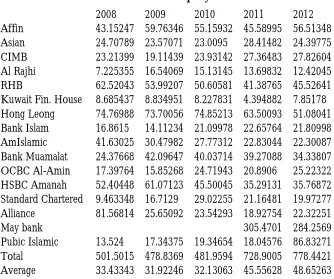
The table below shows the Z-scores of the banks as calculated by the authors.
Table 1: Z-Score per year
2008 2009 2010 2011 2012
Affin 43.15247 59.76346 55.15932 45.58995 56.51348 Asian 24.70789 23.57071 23.0095 28.41482 24.39775 CIMB 23.21399 19.11439 23.93142 27.36483 27.82604 Al Rajhi 7.225355 16.54069 15.13145 13.69832 12.42045 RHB 62.52043 53.99207 50.60581 41.38765 45.52641 Kuwait Fin. House 8.685437 8.834951 8.227831 4.394882 7.85178 Hong Leong 74.76988 73.70056 74.85213 63.50093 51.08041 Bank Islam 16.8615 14.11234 21.09978 22.65764 21.80998 AmIslamic 41.63025 30.47982 27.77312 22.83044 22.30087 Bank Muamalat 24.37668 42.09647 40.03714 39.27088 34.33807 OCBC Al-Amin 17.39764 15.85268 24.71943 20.8906 25.22322 HSBC Amanah 52.40448 61.07123 45.50045 35.29131 35.76872 Standard Chartered 9.463348 16.7129 29.02255 21.16481 19.97277 Alliance 81.56814 25.65092 23.54293 18.92754 22.32251
May bank 305.4701 284.2569
Z-score = Total Equity/Total Asset + ROAA Standard deviation of ROAA
ROAA means Return on Average Assets
Look at the Z-score of the sixteen banks in the study from 2008 to 2012, the lowest happens to be about 4.39 in 2011 by Kuwait Finance house. The lowest average Z-score of all the banks is 31.9 in 2009 while the highest average score is 48.65 in 2012.
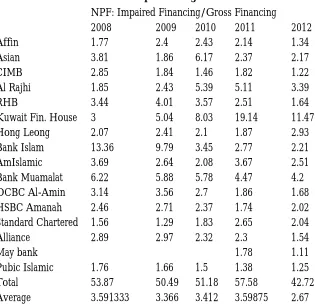
Table 2: Non-performing Finance
NPF: Impaired Financing/Gross Financing
2008 2009 2010 2011 2012
Affin 1.77 2.4 2.43 2.14 1.34
Asian 3.81 1.86 6.17 2.37 2.17
CIMB 2.85 1.84 1.46 1.82 1.22
Al Rajhi 1.85 2.43 5.39 5.11 3.39
RHB 3.44 4.01 3.57 2.51 1.64
Kuwait Fin. House 3 5.04 8.03 19.14 11.47
Hong Leong 2.07 2.41 2.1 1.87 2.93
Bank Islam 13.36 9.79 3.45 2.77 2.21
AmIslamic 3.69 2.64 2.08 3.67 2.51
Bank Muamalat 6.22 5.88 5.78 4.47 4.2
OCBC Al-Amin 3.14 3.56 2.7 1.86 1.68
HSBC Amanah 2.46 2.71 2.37 1.74 2.02
Standard Chartered 1.56 1.29 1.83 2.65 2.04
Alliance 2.89 2.97 2.32 2.3 1.54
May bank 1.78 1.11
Pubic Islamic 1.76 1.66 1.5 1.38 1.25
Total 53.87 50.49 51.18 57.58 42.72
Average 3.591333 3.366 3.412 3.59875 2.67
Table 3: Loan-to-Deposit Ratio
Credit risk: Loan /Deposit
2008 2009 2010 2011 2012
Affin 58.65 63.79 65.86 59.78 57.66
Asian 26.83 63.6 68.26 88.1 95.57
CIMB 44.98 93.7 100.35 97.8 94.94
Al Rajhi 72.55 87.62 109.53 101.68 94.86
RHB 75.43 74.88 90.85 76 93.9
Kuwait Fin. House 149.34 175.95 144.81 136.26 111.25
Hong Leong 69.78 49.12 54.68 59.39 76.08
Bank Islam 50.37 42.48 45.68 51.5 61.28
AmIslamic 120.93 99.22 89.63 90.18 103.81
Bank Muamalat 51.69 50.84 47.14 46.24 52.31
OCBC Al-Amin 81.73 58.84 87.5 73.07 97.53
HSBC Amanah 92.49 131.57 125.55 144.85 102.88
Standard Chartered 31.42 132.66 180.54 99.62 103.02
Alliance 118.08 91.03 86.27 74.08 87.01
May bank 89.15 87.34
Pubic Islamic 125.64 111.6 108.38 97.32 86.16
Total 1169.91 1326.9 1405.03 1385.02 1405.6
Average 77.994 88.46 93.66867 86.56375 87.85
From the foregoing table, it is evident that the average loan to deposit ratio from 2008 to 2012 is 77.99 (about 80), 88.46, 93.67, 86.56 and 87.85 respectively. The least was 77 in 2008 and highest was 93 in 2010. A crisscross was also noted with a rise of about 1.3 (from 86.56 to 87.85) from 2011 to 2012. This result shows that loan-to-deposit ratio is on the rise and this trend could lead to a financial imbalance which may threaten the viability of Islamic banks.
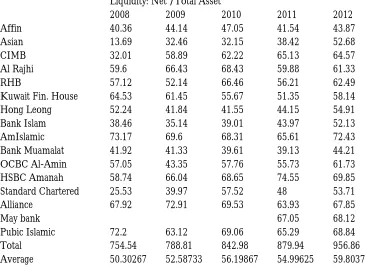
Table 4: Liquidity Ratio
Liquidity: Net /Total Asset
2008 2009 2010 2011 2012
Affin 40.36 44.14 47.05 41.54 43.87
Asian 13.69 32.46 32.15 38.42 52.68
CIMB 32.01 58.89 62.22 65.13 64.57
Al Rajhi 59.6 66.43 68.43 59.88 61.33
RHB 57.12 52.14 66.46 56.21 62.49
Kuwait Fin. House 64.53 61.45 55.67 51.35 58.14
Hong Leong 52.24 41.84 41.55 44.15 54.91
Bank Islam 38.46 35.14 39.01 43.97 52.13
AmIslamic 73.17 69.6 68.31 65.61 72.43
Bank Muamalat 41.92 41.33 39.61 39.13 44.21
OCBC Al-Amin 57.05 43.35 57.76 55.73 61.73
HSBC Amanah 58.74 66.04 68.65 74.55 69.85
Standard Chartered 25.53 39.97 57.52 48 53.71
Alliance 67.92 72.91 69.53 63.93 67.85
May bank 67.05 68.12
Pubic Islamic 72.2 63.12 69.06 65.29 68.84
Total 754.54 788.81 842.98 879.94 956.86
The liquidity is measured by loan to asset ratio as shown in the table above. The result indicates that the loan to total asset ratio of Islamic banks shows an increase from 2008 to 2012, there was a gradual and consistent increase with a slight fall in 2011. The value ranges from 50.30 in 2008 to 59.80 in 2012. The higher the ratio, the lesser the liquidity of the bank; in this result, an increase in the ratio is observed and this implies Islamic banks face liquidity problem. In other word, based on this result, increase in the ratio portrays great danger for the liquidity of Islamic banks.
Discussion
From this analysis, the paper shows that Islamic banks are stable and viable financially and have the potentials to withstand any economic shocks. Since Z-score is used for predictive measures in the interim, this result may hold sway for the next two years. To predict what might be the state of affairs after two years from now, another study may be required. Meanwhile, the outcome of this paper supports the findings of Said (2012) who held that even during the economic crises in middle-eastern and non-middle eastern countries, the efficiency of Islamic banks increased considerably. The study of Cihak and Hesse (2008) also agreed with the result of the findings of this paper but observed that Islamic banks are more stable when on a small scale than when operating on a large scale. Furthermore, this paper found that Islamic banks are able to control their NPF leading rise to their high Z-score. Sehrish, Saleem, Yasir, Shehzad and Ahmad (2012) confirmed the outcome of this work in their study as they held that Islamic banks possess higher ability to absorb financial losses and to deal with NPF. Besides, based on the result the high loan-to-deposit ratio suggests that Islamic banks are taking more financial stress by making excessive financing. This portrays a dangerous signal to Islamic banks and a redress is highly required before it gets out of hand.
Conclusion
This paper opines that Islamic banks in Malaysia are financially stable and strong and can withstand any financial shock. They are also able to control their NPFs but their liquidity and loan-to-deposit ratios are deficient. This poses a great financial impediment to them in years to come. The result of the Z-score was high, commendable and thus portrayed that Islamic banks are stable financially. However, the excessive practice of debt financing model could impact on their financially stability. Of course, they were able to manage the NPF, their loan to deposit ratio as well as the loan to asset ratio (i.e. liquidity) depict some potential financial impediment for them. All hands must be on deck to ensure that those equity based models and products are given more attention and patronage.
References
Ali AbdElrahman ElzahiSaaid (2012). Islamic Banking Structures: Implications for Risk and Financial Stability. Islamic
Research and Training Institute (IRTI). Vol. 20, No. 2
Ali Salman Syed (2007). Financial Distress and Bank Failure: Lessons from closure of Ihlas Finans in Turkey. Islamic
Economics Studies. Vol. 14, No 1 & 2
Allen Franklin and Bolton Patrick (2004). Liquidity and Financial Instability: An Introduction. Journal of the European
Economic Association.
Asa’ad Hamied O. Al-Ali and Imane Abdlouahab Yousfi (2012). Investigation of Jordanian Islamic and Conventional Banks’ stability: Evidence from the recent financial crisis. European Journal of Economics, Finance and
Administrative Sciences. Issue 44
Cihak Martin, Munoz Sonia, Sharifuddin ShakiraTeh and Tintcher Kalin (2012). Financial Stability Reports: What Are They Good For? IMF Working Paper WP/12/1
Cihak Martin and Hesse Heiko (2008). Islamic Banks and Financial Stability: An Empirical Analysis. IMF Working
Paper WP//08/16
Derbel Hatem, Bouraoui Taoufik and Dammak Neila (2011). Can Islamic Finance Constitute A Solution to Crisis?
International Journal of Economics and Finance. Vol. 3, No. 3
Fapohunda Tinuke M. (2012). The Global Economic Recession. Impact and Strategies for Human Resources Management in Nigeria. International Journal of Economics and Management Sciences. Vol. 1, No.6 pp 07-12
Furqani Hafas (2011). Islamic Economics, Banking and Finance: Contemplating Raisons D’etre and Future Directions. ISRA Research Paper (No. 27/2011). International Shari’ah Research Academy for Islamic Finance. Kuala Lumpur
Haenlein Micheal and Kaplan Andreas M. (2004). A beginner’s Guide to Partial Least Squares Analysis. Lawrence Erlbaum Associates, Inc.
Hair, Joseph F., Sarstedt Marko, Pieper Torsten M. and Ringle Christian M. (2012). The use of Partial Least Squares Structural Equation Modeling in Strategic Management Research: A Review of Past Practices and Recommendations for future applications. Elsevier Ltd.
Klarner Patricia, Sarstedt Marko, Hoeck Micheal and Ringle Christian M. (2013). Disentangling the Effects of Team Competences, Team Adaptability, and Client Communication on the performance of Management Consulting Teams. Long Range Planning, Vol 46 pp 258-286
Said Ali (2012). Efficiency in Islamic Banking during a financial crisis: An Empirical Analysis of Forty-Seven Banks.
Journal of Applied Finance and Banking, Vol.2 No. 3, pp 163-197. International Scientific Press
Sehrish Saba, Saleem Faiza, Yasir Muhammad Shehzad Farhan and Ahmad Kamran (2012). Financial Performance Analysis of Islamic Banks and Conventional Banks in Pakistan: A Comparative Study. Interdisciplinary Journal of
Contemporary Research in Business. Vol.4, No.5, pp 186-200. Institute of Interdisciplinary Business Research
Shahid Muhammad Ali and Abbas Zaheer (2012). Financial Stability of Islamic Banking in Pakistan: An Empirical Study. African Journal of Business Management. Vol. 6 (10), pp 3706-3714
Siddiqi, Mohammad Nejatullah (2006). Islamic Banking and Finance in Theory and Practice: A survey of state of the Art. Islamic Economic Studies. Vol 13, No. 2
Sitti Rohaya Mat Rahim, Norsilawati Mohd Hassan and Roza Hazli Zakaria (2012). Islamic Vs. Conventional Bank Stability: A case study of Malaysia. PERKEM VII: Perak.
The Financial Development Report (2012). World Economic Forum, New York
Umar Islam Muhammad and Kozokov Shakhboz (2009). Stability of Islamic and Conventional banks, an empirical comparative