ISSN: 2334-2986 (Print), 2334-2994 (Online) Copyright © The Author(s). All Rights Reserved. Published by American Research Institute for Policy Development DOI: 10.15640/jea.v3n1a3 URL: http://dx.doi.org/10.15640/jea.v3n1a3
Green Building Design Related to Feng Shui Issues in Taiwan
Shihchien Chan
1Abstract
With growing awareness of climate change and the increasing importance of sustainability, green building design has become an important trend in architectural design in Taiwan. The Taiwan government encourages people to participate in the promotion of green buildings, and has also established building regulations and accreditation which require newly constructed buildings to satisfy related requirements. The green building accreditation system being executed in Taiwan includes the architectural characteristics of ecology, energy saving, waste reduction, and health (EEWH) issues. On the other hand, the ancient concept of Feng Shui for dwellings, which concerns environmental living issues for people, is still exerting a strong influence on dwelling space arrangement. The concept of Feng Shui emphasizes harmony between people and the natural environment; it has strong connection with green building as it respects the sustainable environment. Interviews of experts, literature review and content analysis methods were applied in this study. The results indicate that design issues of green planting, water retention, energy saving, water resource, and sewage have strong connection between green building designs and Feng Shui concepts in some aspects. If designers can consider the relevant aspects of Feng Shui during the initial design process of green buildings, it would greatly facilitate the promotion of green building policies.
Keywords: green building design, Feng Shui, traditional Chinese culture
1. Introduction
The increasing severity of climate change has caused many countries around the world to strive more for a sustainable environment and energy conservation to actively control greenhouse gas emissions. In fact, the industries related to building construction contribute a lot to carbon dioxide emissions in Taiwan, accounting for 28.8% of total carbon dioxide emissions in the entire country (Lin, 2011). As a result, in recent years, the government has been strongly promoting green building to reduce the amount of carbon emissions in the construction industry. Hence, green building has been of more concern recently. In Taiwan, the concept of green building emphasizes ecology, energy saving, waste reduction, and health, also known as EEWH system. Government departments and scholars are actively promoting green building by developing green building design techniques and strategies, and incorporating them into architectural design specifications as well as publishing green building technique manuals. In 2004, government departments established the green building evaluation system which includes nine major indicators for green building accreditation (Chiang, 2009). The nine indicators are biodiversity, greenery, water retention, energy savings, CO2 emissions reduction, waste reduction, water resource, garbage and sewage improvements, and indoor environmental quality. It is obvious that green building design in Taiwan must take living and environmental issues into consideration when developing building strategies. On the other hand, the ancient Chinese concept of Feng Shui for dwellings still asserts strong influence on Chinese societies in the planning and arrangement of residences and offices. A recent survey indicated that almost 73% of the general public in northern Taiwan holds positive views toward the influence of Feng Shui for dwellings (Chen, 2011).
1
As it is part of the national ideology, and not considered to be superstition, it plays a significant role in the behavioral patterns and culture of daily life for Chinese people (Han, 1998). The concept of Feng Shui has been passed down from ancient China, and it emphasizes harmony between inhabitants and the natural environment with heavy consideration on wind, light, plants, landscape, direction, location, soil, mountains, and rivers surrounding the dwelling, and was considered to comprise the scientific rules for building residential structures in ancient times, as well as a domain of knowledge regarding space and the geological environment. It is an ancient dwelling philosophy that seeks for harmony among heaven, earth and people (Wu, 2005). The concept of Feng Shui presents people’s respect of natural environment and harmony between people and universal belief. It also delves into the small environment of the house from the perspective of the ecological and geological environments (Kuo, 2004). From the discussion above, it is clear that both green building design and Feng Shui concept accentuate integration with the ecological and natural environment and involve issues related to the living environment, thereby rendering them worthy of deeper study in tandem. The primary motive for this study is to search out the connection between these two subjects and that more understanding of the Feng Shui issue may also prevent Feng Shui problems from being obstructions for promoting of green building. With more clarity on the relation between green building design techniques and Feng Shui, we can understand better the common design principles that satisfy both systems. This would help to facilitate the promotion of green building design while respecting and passing down traditional Feng Shui culture.
1.1 Research Objectives
The field of green building is a component of the energy saving and sustainable design of buildings whereas Feng Shui for dwellings is a geomantic art that previously had no direct connection to the green building field. In professional architectural work, these two systems consider fairly similar concepts, but their contents are extremely different and complex. This study is only a preliminary exploration of the connection between the two fields, which merely marks the beginning of research in this area. This study tried to compare practical techniques associated with green building design issues involved in contents of Feng Shui concern. Finally, this study tries to identify the related portions between both concepts and understand which elements both consider important. The results will enable the incorporation of Feng Shui for dwellings into green building design to prevent alarm among property owners and designers should green building design conflict with opinions of Feng Shui. The objectives of this study include: 1. Collating the contents of green building design related to Feng Shui issues;
2. Analyzing and comparing the intersecting content of green building and Feng Shui; and 3. Understanding the linkage between green building and Feng Shui contents.
1.2 Scope and limitations of Study
The promotion of green building design by Taiwan government entities and scholars has made available a considerable amount of information regarding green building design techniques to the public. In Taiwan, green building design, for the most part, arise from practical considerations, for which this primarily comprises technical strategies and methods founded on the nine major indicators of the green building accreditation system. Humanistic, social, and economic aspects, which are included in the wider definitions of green buildings in some countries, are excluded from this study. As for Feng Shui, there are two main schools of thought: Form School and Compass School, that emphasize different matters and take into consideration different affecting elements. This research will employ the Form School of Feng Shui for dwellings because it comprises more complete and systematic discussions about the living environment, and more integrated information is available (Kang, L. and Kang Y., 1999). Form School emphasizes the harmonious balance of natural environment, mountain forms, water environment, and location situations. As the contents established by the Compass School are more complex and mysterious, even metaphysical, it will not be discussed in this study. The Compass school is related to Yin and Yang, which is the philosophic theory of cosmic dual forces, the reciprocal effect of the Five elements (metal, wood, water, fire and earth) in Chinese cosmology, and the effects of numerology on directions. The Compass school also has many factions and lacks an integrated system and statements, making it hard to really discriminate and authenticate (Wang, 1994). Furthermore, the majority of Feng Shui references comprise ancient texts, the rhetoric of which can be abstruse for modern people, so ancient books are not included in this discussion.
2. Literature Review
ABRI has been extremely active in researching and formulating green building techniques and evaluation methods, publishing the Evaluation Manual for Green Buildings in Taiwan, which contains detailed descriptions of the evaluation system, strategies, and methods for green building (Architecture and Building Research Institute, Ministry of the Interior, 2010). Hsien-Te Lin, on the faculty of the Graduate School of Architecture at National Cheng Kung University, has put a great deal of effort into the issue of green building. In fact, the majority of green building regulations, energy-saving evaluation methods, and green building techniques in Taiwan are the results of his research. In 2010, the Technology Guides for Green Building Design was published, describing feasible techniques and strategies for green building based on each of the nine major indicators of the EEWH evaluation system and providing essential design technical information for green building design practice in Taiwan (Lin, 2010). In regard to Feng Shui for dwellings, in 2001, San-Shian Wang noted that traditional Feng Shui for dwellings is philosophical thinking regarding the relationship between people and the natural environment, and the use of Feng Shui can achieve the coexistence and continuing prosperity of both. If one were to combine Feng Shui for dwellings with the perspectives of modern sociology, environmental studies, and ecology, it would greatly benefit land development, ecological protection, and landscape design (Wang, 2001).
However, during the evolution of Feng Shui, superstition and mystery became attached to it; excessive focus on the mysterious side of Feng Shui techniques also led to the neglect of the harmonious relationship with the ecological environment and nature; thereby resulting in some negative comments and judgment. In recent years, some western scholars have acknowledged the importance of Chinese Feng Shui, which emphasizes harmony between man and nature and integration with the environment; it has further received positive regard as a type of universal ecology (Chiang, 2003). C.Y. Wu investigated the contents and taboos of Feng Shui for dwellings based on environmental themes, emphasizing that by studying the historical development of Feng Shui, one can gain perspective on the true implications of Feng Shui for dwellings (Wu, 2005, 2006). P.T. Han examined the connections between Feng Shui and the environment. He also considers Feng Shui concepts to be a part of the daily lives of people in Chinese society, such that it cannot be seen as a superstitious belief (Han, 1998). However, from an environmental psychology perspective, Feng Shui proponents should be demonstrated by more scientific tests to prove their influences in future development, because there is currently no scientific foundation (Bonaiuto et al, 2010). Although green building design and Feng Shui belong to different professional domains, their practices present similar concepts and important issues in architectural design, emphasizing a building’s relationship to the ecological environment, geological and climatic conditions. Due to the active promotion of green building by government departments, experts, and scholars, there is a significant amount of complete information available on the topic. As Bonaiuto et al. point out, Feng Shui needs more scientific foundation to be convincing. After thousands of years of evolution and development, Feng Shui has become complicated, mysterious, and difficult to understand. However, Feng Shui is a common consideration in the planning of residential spaces in Chinese societies still today despite its complex principles. This study endeavors to conduct a systematic collation and analysis to derive the correlation between green building design techniques and Feng Shui for dwellings to facilitate future interdisciplinary research.
2.1 Concept of Feng Shui
3. Methodology
In-depth interviews with experts have been processed as the main research method. Due to limited understanding of Form School knowledge, there are very few such Feng Shui experts in Taiwan. In this study, six Form School experts were invited to participate in interviews, who have an average professional experience of about 12 years. To avoid misunderstanding about green building design contents and the meaning interpreted by these experts, the interviewer clearly explained the purpose and strategies of green building design as plainly as possible during the interview process. This study comprised three main steps. The first phase of this study involved collating and analyzing relevant literature before analyzing relationships between the technical content of the two practices. Following, expert interviews were carried out to collect information for the analysis of connections between green building design and Feng Shui concepts. Finally, a panel of 12 Feng Shui experts, including the six involved in the aforementioned step of analysis, evaluated the proposed connections to confirm the analysis results. Government departments and academic units provided the green building strategies used in this study. These sources are complete and credible. The theories of Form School of Feng Shui have been distinguished; then through systematic expert interview collation, content comparison and expert evaluation, we confirmed the associated practices in the two systems.
4. Analysis of Connections
For understanding the connections between green building design and Feng Shui, a series of analyses was undertaken. The following section discusses several connections collated from experts’ investigations and analysis of relevant research materials. There are three main points discussed in the analysis. The first is clarifying the potential connection between the two subjects; the second is discovering which contents are related, and the last is confirming the connections between green building design and Feng Shui.
4.1 Green Building Design Related to Feng Shui
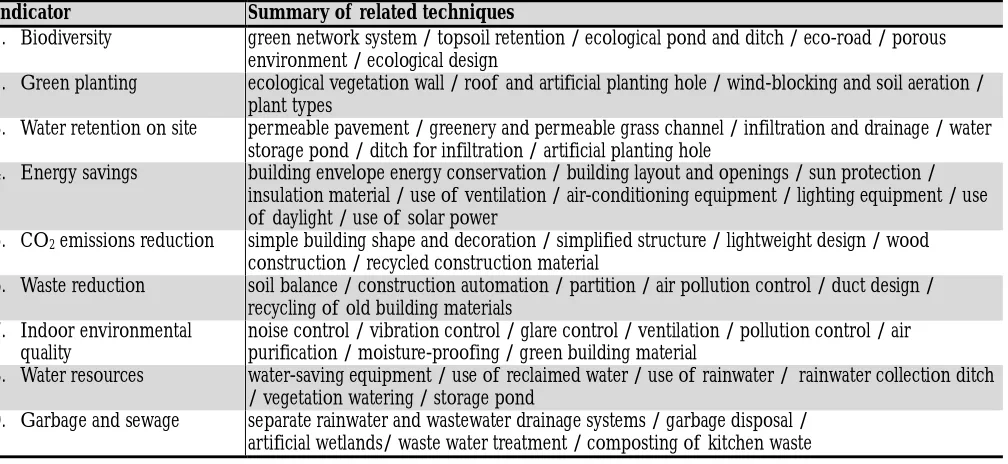
Regarding evaluation of green building design, the government created a nine-indicator system for green building certification, and encourages the public to construct buildings that save energy and produce less pollution so that a comfortable, healthy, and sustainable living environment can be established. Active promotion of these principles by the government has led to complete, accessible green building design information. Because the accreditation and regulations of green building design in Taiwan are based on the nine major indicators, the majority of the available information is strategically and technically developed to expound on these indicators. For the subsequent comparisons, this study arranged the concise relevant technical contents into Table 1.
Table 1: Summary of Techniques Related to Various Green Building Indicators
(Source: Lin, 2010; collated by author)
Indicator Summary of related techniques
1. Biodiversity green network system / topsoil retention / ecological pond and ditch / eco-road / porous
environment / ecological design
2. Green planting ecological vegetation wall / roof and artificial planting hole / wind-blocking and soil aeration /
plant types
3. Water retention on site permeable pavement / greenery and permeable grass channel / infiltration and drainage / water
storage pond / ditch for infiltration / artificial planting hole
4. Energy savings building envelope energy conservation / building layout and openings / sun protection /
insulation material / use of ventilation / air-conditioning equipment / lighting equipment / use of daylight / use of solar power
5. CO2 emissions reduction simple building shape and decoration / simplified structure / lightweight design / wood
construction / recycled construction material
6. Waste reduction soil balance / construction automation / partition / air pollution control / duct design /
recycling of old building materials
7. Indoor environmental
quality
noise control / vibration control / glare control / ventilation / pollution control / air purification / moisture-proofing / green building material
8. Water resources water-saving equipment / use of reclaimed water / use of rainwater / rainwater collection ditch
/ vegetation watering / storage pond
9. Garbage and sewage separate rainwater and wastewater drainage systems / garbage disposal /
To make sure Feng Shui experts comprehend what green building design comprises, Table 1 contents were compiled to explain techniques of green building design to the experts. Table 2 presents the results of experts’ choices. It is interesting that those experts with more experience in Feng Shui believed that more content of green building design has more connection to Feng Shui concepts. Table 2 shows six indicators completely related to Feng Shui issues: biodiversity, green planting, water retention, energy savings, water resources, and garbage and sewage.
Table 2: Experts’ Views on Relationship of Feng Shui to Green Building Indicators
(Source: collated by author) 4.2. Detail Strategies and Contents
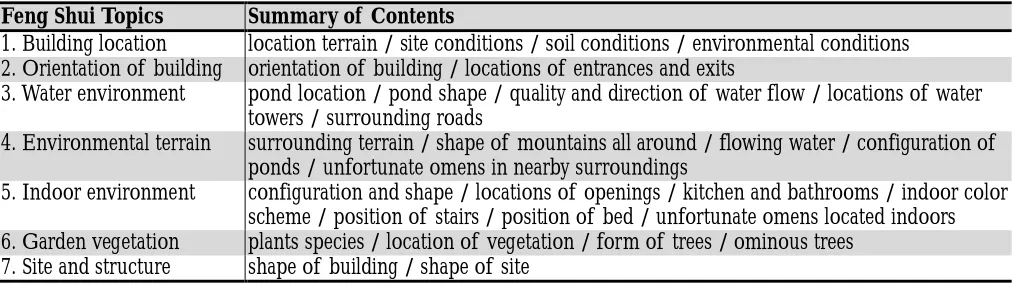
Form School in Feng Shui places importance on a structure’s relationship with the natural environment, the climate, and the terrain; the water environment and the soil are also taken into consideration. Following the analysis of collected information, this study derived the concepts of Feng Shui for dwellings into seven major topics following the information provided by Wu’s and Wang’s books: building location, orientation, the water environment, the environmental terrain, the indoor environment, garden vegetation, and the site and structural form of the building (Wang, 1994; Wu, 2005, 2006). These topics and related contents are shown in Table 3.
Table 3: Summary of Concepts Related to Feng Shui for Dwellings
(Collated by author)
From the perspective of six Feng Shui experts, the techniques of green building design related to the Feng Shui concepts are presented in Table 4. Although not all experts are in complete agreement on the related items, this study selected items that most experts considered related. Among the related content shown, in the biodiversity indicator the techniques of ecological pond and ditch focus on the same issue as the storage pond and ditch in the water retention indicator. Apart from this, in the garbage and sewage indicator, rainwater and wastewater drainage systems are also similar to the items of water resources. Moreover, these techniques are also present among the Feng Shui issues.
Experts Indicator
Expert 1 Expert 2 Expert 3 Expert 4 Expert 5 Expert 6
1. Biodiversity environment ▲ ▲ ▲ ▲ ▲ ▲
2. Green planting ▲ ▲ ▲ ▲ ▲ ▲
3. Water retention ▲ ▲ ▲ ▲ ▲ ▲
4. Energy savings ▲ ▲ ▲ ▲ ▲ ▲
5. CO2 emissions reduction ▲ ▲
6. Waste reduction ▲
7. Indoor environmental quality ▲ ▲ ▲
8. Water resources ▲ ▲ ▲ ▲ ▲ ▲
9. Garbage and sewage ▲ ▲ ▲ ▲ ▲ ▲
Feng Shui Topics Summary of Contents
1. Building location location terrain / site conditions / soil conditions / environmental conditions 2. Orientation of building orientation of building / locations of entrances and exits
3. Water environment pond location / pond shape / quality and direction of water flow / locations of water towers / surrounding roads
4. Environmental terrain surrounding terrain / shape of mountains all around / flowing water / configuration of ponds / unfortunate omens in nearby surroundings
5. Indoor environment configuration and shape / locations of openings / kitchen and bathrooms / indoor color scheme / position of stairs / position of bed / unfortunate omens located indoors 6. Garden vegetation plants species / location of vegetation / form of trees / ominous trees
Table 4: Summary of Green Building Techniques Related to Feng Shui issues from Experts’ Views
(Source: collated by author)
4.3 Relationship between Green Building Strategies and Feng Shui
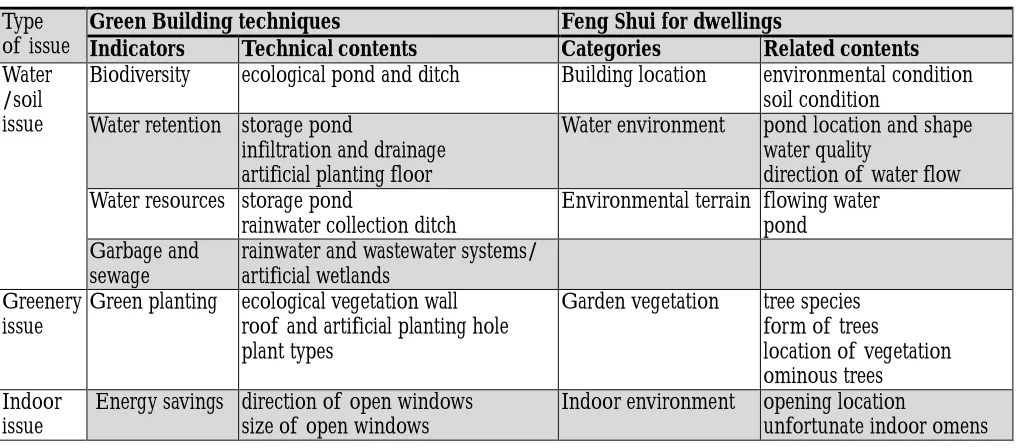
When examining the green design technical contents and the related content of Feng Shui concepts, it is discovered that concepts regarding water resources, water retention, wastewater, and biodiversity involved in the ecological pond are related to Feng Shui, namely the portions concerning the water environment, the environmental terrain, and soil condition of the building location. Moreover, the green planting indicator is closely connected to the garden vegetation concept in Feng Shui. The energy savings indicator, which involves open window positions, is closely related to Feng Shui locations of openings in the indoor environment topic. Table 5 compares some connected concepts in green building techniques and Feng Shui.
Table 5: Connected Concepts in Green Building Design Techniques and Feng Shui
After gaining insight from experts’ investigations and information analysis of green building design techniques and Feng Shui concepts, it is obvious that there exists some strong relationship between them, such as water and soils, greenery and indoor issues. In fact, ancient Feng Shui strives for a harmonious living environment balancing human life and the natural environment (Huang, 1997). This conforms to principles of environmental ecology and sustainability in green building design. Therefore, it is possible that green building design and ancient Feng Shui for dwellings can coexist beneficially. The next step is to further confirm and explain more details regarding the connections between these two considerations for buildings.
4.4. Confirmation of the Connections
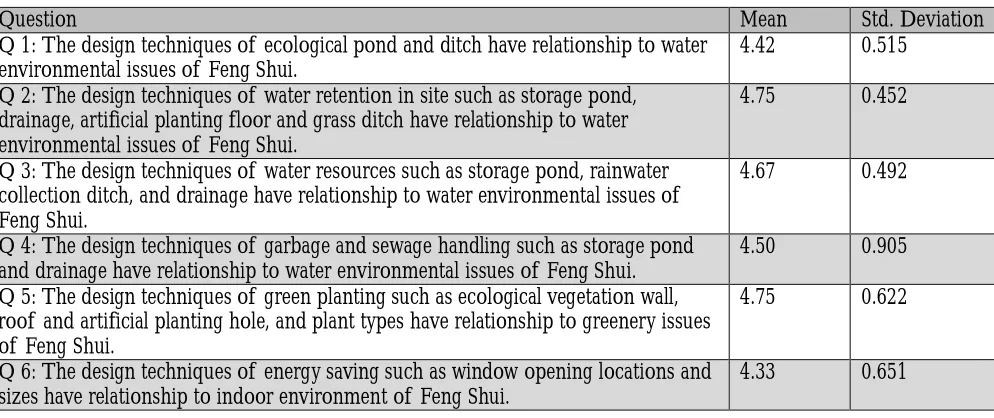
To confirm the connections presented in the previous finding, besides the six experts consulted in the aforementioned in-depth interviews, another six less experienced experts were invited to participate in this investigation; totally 12 samples were collected. Table 6 shows the mean and the standard deviation calculated from expert investigation results.
Green Building Indicators Specific Green Building Techniques related to Feng Shui
1. Biodiversity ecological pond and ditch
2. Green planting ecological vegetation wall / roof and artificial planting hole / plant types 3. Water retention infiltration and drainage / water storage pond / ditch for infiltration 4. Energy savings building layout and openings
5. Water resources rainwater collection ditch / storage pond 6. Garbage and
sewage
rainwater and wastewater drainage systems
Type of issue
Green Building techniques Feng Shui for dwellings
Indicators Technical contents Categories Related contents
Water /soil issue
Biodiversity ecological pond and ditch Building location environmental condition soil condition
Water retention storage pond
infiltration and drainage artificial planting floor
Water environment pond location and shape water quality
direction of water flow Water resources storage pond
rainwater collection ditch
Environmental terrain flowing water pond
Garbage and sewage
rainwater and wastewater systems/ artificial wetlands
Greenery issue
Green planting ecological vegetation wall roof and artificial planting hole plant types
Garden vegetation tree species form of trees location of vegetation ominous trees
Indoor issue
Energy savings direction of open windows size of open windows
Indoor environment opening location
The measure for the test is a 5-point Likert scale, with 5 meaning completely connected and 1, no connection. The results indicate that all the experts agreed strongly about the connections between the two subjects listed in each of the six questions. Notably, the means of all questions are above 4 points. From this result, the connections between some green building design techniques and Feng Shui are well confirmed.
Table 6: Confirmation for Relationship between green Building Design Techniques and Feng Shui Issues, Mean and Standard Deviation Results (from Expert Investigation)
Question Mean Std. Deviation
Q 1: The design techniques of ecological pond and ditch have relationship to water environmental issues of Feng Shui.
4.42 0.515
Q 2: The design techniques of water retention in site such as storage pond, drainage, artificial planting floor and grass ditch have relationship to water environmental issues of Feng Shui.
4.75 0.452
Q 3: The design techniques of water resources such as storage pond, rainwater collection ditch, and drainage have relationship to water environmental issues of Feng Shui.
4.67 0.492
Q 4: The design techniques of garbage and sewage handling such as storage pond and drainage have relationship to water environmental issues of Feng Shui.
4.50 0.905
Q 5: The design techniques of green planting such as ecological vegetation wall, roof and artificial planting hole, and plant types have relationship to greenery issues of Feng Shui.
4.75 0.622
Q 6: The design techniques of energy saving such as window opening locations and sizes have relationship to indoor environment of Feng Shui.
4.33 0.651
5.Discussion
Upon further examination of the content of Table 5, green building design techniques of ecological storage pond and ditch, rainwater and wastewater drainage systems are closely related to water environmental topic in Feng Shui; thus this study combines these as water and soil environment issues in the following discussion. Besides,, these also intersect with green planting and indoor environment issues.
5.1 Water and Soil Issues
Green building indicators involving water environment include biodiversity, water retention, water resources, and garbage and sewage systems. Permeable water ditches and the installation of water storage ponds are related to the water environment category in Feng Shui. In addition, the water retention indicator also considers the soil-water retained by the site soil condition. The objective of soil-water techniques is to maintain the water content of soil and create an organic environment in urban soil through the installation of permeable ponds and ditches (Architecture and Building Research Institute, 2010). Meanwhile, the soil in a good Feng Shui situation is moist but not wet, and dry but not completely dried out. The soil must hold a certain amount of moisture (Wu, 2005). The concepts of soil in green building design and Feng Shui are very well aligned. In green building design, water retention, water resources and ecological ponds involve the installation of water ponds and their locations, water storage tanks, and drainage facilities. These techniques bear resemblance to the installation of ponds and the direction of drainage in the water environment of Feng Shui. Besides, the storage and recycling facilities for water resources involve ponds and drainage, which are associated with the shape and location of ponds and the direction of drainage, also in the water environment portion of Feng Shui. It is obvious that water and soil environment are important factors for both green building design and Feng Shui concepts.
5.2 Greenery Issue
The green building design techniques of ecological vegetation, wall foliage, vegetation on the roof, species of the trees, and the method of installation are closely related to the Feng Shui emphasis on the species of the trees, the location of the vegetation, the form of the trees, and avoiding ominous trees. Hence, one can say that the green building design concept of greenery is directly and closely associated with the garden vegetation concept in Feng Shui. 5.3 Indoor Issue
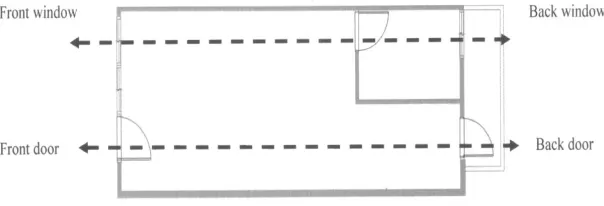
The green building design concept of energy savings takes into account the thermal and light environment of the building. By utilizing the physical environment and space of the building, natural lighting and ventilation can reduce the amount of energy needed, which is indirectly connected to the issues of open windows in the indoor environment category of Feng Shui. In Feng Shui concept, when front doors or windows allow one to see straight through to back doors or windows without any blocks, this is an unfortunate omen, due to unsuitable openings in indoor space, called straight through arrow (Wang, 1994). Figure 1 shows the typical situation of straight-through arrow. . Correspondingly, green building design for energy conservation emphasizes suitable openings in indoor environments..
Figure 1: Typical Straight through Arrow Situation of Feng Shui for Dwellings (Source: Drawn by Author)
The discussion above shows that Feng Shui concepts involving the water environment are directly related to water conservation techniques in green building design. With regard to greenery, Feng Shui has particular perspectives and taboos on vegetation and trees; for this reason, vegetation should be handled with care when considering what to incorporate for green building design. Furthermore, the applying of natural physical conditions such as wind and light flow to the placement of openings for energy conservation in the building, should take into consideration the taboos and principles related to Feng Shui regarding the importance of the locations of openings in the indoor environment of buildings.
5. Conclusions and Recommendations
This study was not conducted with the objective of encouraging people to believe in Feng Shui, but with the hope that moderate respect may be shown to this traditional art when designing green buildings. Furthermore, the author hopes that more interdisciplinary research will be carried out to derive solutions that satisfy both systems. In this manner, the promotion of green building will not be hindered by Feng Shui factors; moreover, some effort may be made in passing down this ancient art. This study merely marks the beginning of interdisciplinary research on green building and Feng Shui. Future studies can conduct more in-depth investigations on the techniques that satisfy issues in both. This will greatly benefit the further development of green building, and incorporate the concepts of Feng Shui into modern green building.
Acknowledgments
I wish to thank my colleague Miss LeAnn Eyerman for assistance in proof reading of this paper. Sincere thanks is extended to the 12 Feng Shui experts who helped me to process the interviews and investigation. I also want to thank my departmental colleagues who encouraged me to finish the paper as soon as possible and gave me some useful advice for the structure of the paper.
References
Architecture and Building Research Institute, Ministry of Interior, 2010. Evaluation Manual for Green Building Renovation. Taipei: Architecture and Building Research Institute.
Bonaiuto et al., 2010. Feng Shui and Environmental Psychology: A Critical Comparison, Journal of Architectural and Planning Research, 27:11, pp.23-34.
Chiang, T. C., 2003. The Dwelling Selection Culture and Feng shui Thoughts for Chin and Han Dynasty, Doctoral Dissertation, National Taiwan Normal University, Taipei, Taiwan.
Chan, P. Y., 2011. A Study of Dwelling Feng shui for Population Based in Northern Taiwan Area, Master’s Thesis, Ming Chuan University, Taoyuan, Taiwan.
Chiang, 2009. Introduction to Sustainable Building, Taipei: Sustainable & Health Building Laboratory. Han, P. T., 1998. Environment and Feng shui. Taipei: LinKing Publishing.
Huang, Y. C., 199. Environment and Feng shui. Kaohsiung: Kao-Guang Publishing Limited. Kao, Y. C. 2004. Chinese Feng shui Culture. Peking: Unify Publisher.
Lin, H. T., 2011. Green Architecture - An Asian Perspective. Hong Kong: PACE.
Lin, H. T., 2010. Technology Guides for Green Building Design. Taipei: Chan’s Bookstore.
Wang, S. S., 2001. Initial Studies of China Traditional Feng shui Thoughts in Houses, Villages and Cities, Master’s Thesis, Nanhua University, Chiayi, Taiwan.