An NC Algorithm for Sorting Real Numbers
in
𝑶(
𝒏𝒍𝒐𝒈𝒏
√𝒍𝒐𝒈𝒍𝒐𝒈𝒏
)
Operations
Yijie Han, Sneha Mishra and Md Usman Gani Syed
School of Computing and Engineering University of Missouri at Kansas City
Kansas City, MO 64110, USA
[email protected], [email protected], [email protected]
Abstract
We apply the recent important result of serial sorting of real numbers in
𝑂(𝑛√𝑙𝑜𝑔𝑛)
time to
the design of a parallel algorithm for sorting real numbers in O(log
1+n) time and
𝑂(
𝑛𝑙𝑜𝑔𝑛 √𝑙𝑜𝑔𝑙𝑜𝑔𝑛)
operations. This is the first NC algorithm known to take o(nlogn) operations for sorting real
numbers.
Keywords: Parallel algorithms, sorting, sort real numbers, complexity.
1
Introduction
It is known widely that serial comparison sorting takes (nlogn) time [4]. Although integer sorting can outperform the (nlogn) lower bound for sorting integers [2,5,7,8,9,10], these algorithms generally do not apply to the problem of sorting real numbers. It has been known that integers can be sorted in O(nloglogn) time and linear space [7,8], the O(nlogn) time bound remains for sorting real numbers ever since. Only very recently Han showed that real numbers can be converted to integers for the sorting purpose in 𝑂(𝑛√𝑙𝑜𝑔𝑛) time [6], thus enabling the serial sorting of real numbers in 𝑂(𝑛√𝑙𝑜𝑔𝑛) time.
Parallel sorting algorithms for sorting real numbers run on the PRAM (Parallel Random Access Machine) model are known [1,3]. The AKS sorting network [1] can be transformed into an EREW (Exclusive Read Exclusive Write) PRAM algorithm with O(logn) time and O(nlogn) operations. Cole’s parallel merge sort [3] sorts n numbers in O(logn) time using n processors on the EREW PRAM. On the CRCW (Concurrent Read Concurrent Write) PRAM Cole showed [3] that his parallel merge sort can run in O(logn/loglog(2p/n)) time using p processors. Also see [12].
Volume 58, 2019, Pages 93–98
There are also parallel algorithms for integer sorting[2,5,7,8,9,10]. In the case of integer sorting the operation bound can be improved to below O(nlogn). In particular, [9] presents a CRCW PRAM integer sorting algorithm with O(logn) time and O(nloglogn) operations and [8] presents an EREW PRAM integer sorting algorithm with O(logn) time and 𝑂(𝑛√𝑙𝑜𝑔𝑛) operations.
For sorting real numbers the previous best serial algorithm sorts in O(nlogn) time. It was also known that for comparison sorting (nlogn) is the tight lower bound. Thus if we use comparison sorting to sort real numbers then in serial algorithms we cannot avoid the (nlogn) time bound and in parallel algorithms we cannot avoid the (nlogn) operation bound. In the past no other sorting methods are known to sort real number in less than O(nlogn) time and comparison sorting remained the norm for sorting real numbers.
However the situation is recently changed completely as Han found a way to convert real numbers to integers for sorting purpose and he showed that real numbers can be sorted in 𝑂(𝑛√𝑙𝑜𝑔𝑛) time [6]. This result enables us to move further to improve the operation bound of parallel algorithms for sorting real numbers to below O(nlogn), as in the past all parallel algorithms for sorting real numbers has an operation bound at least O(nlogn).
In this paper we will apply the 𝑂(𝑛√𝑙𝑜𝑔𝑛) time serial real number sorting algorithm to the design of an NC algorithm with O(log1+n) time and 𝑂( 𝑛𝑙𝑜𝑔𝑛
√𝑙𝑜𝑔𝑙𝑜𝑔𝑛) operations on the CREW (Concurrent Read
Exclusive Write) PRAM. NC algorithms are parallel algorithms with polylog time and polynomial operations. Algorithm in [6] is an inherently serial algorithm without much parallelism within it. Here we use it in the design of an NC algorithm with O(log1+n) time and 𝑂( 𝑛𝑙𝑜𝑔𝑛
√𝑙𝑜𝑔𝑙𝑜𝑔𝑛) operations.
The computation model used for designing our algorithm is the CREW PRAM. On this model in one step any processor can read/write any memory cell. Concurrent read of one memory cell by multiple processors in one step is allowed and concurrent write of one memory cell by multiple processors in one step is prohibited. Parallel algorithms can be measured with their time complexity and the number of processors used. They can also be measured with time complexity and operation complexity which is the time processor product. The operation complexity (Tpp, with Tp time using p processors) of a
parallel algorithm is often compared with the time T1 of the best serial algorithm. In general TppT1.
When Tpp=T1 the parallel algorithm is said to be an operation optimal algorithm.
2
The Algorithm
Consider an algorithm for sorting n real numbers. Suppose each of the n/m lists with m real numbers in each list have already been sorted, we are to merge these n/m lists into one sorted list. We will do k-way merge in each pass to merge every k-lists into 1 sorted list and there are log(n/m)/logk passes to have all n/m lists merged into 1 sorted list.
For simplicity, let us break down n elements into lists with m elements in each list. We can do parallel sort on the individual list of m elements recursively. Now we pick every k-lists and have them merged together.
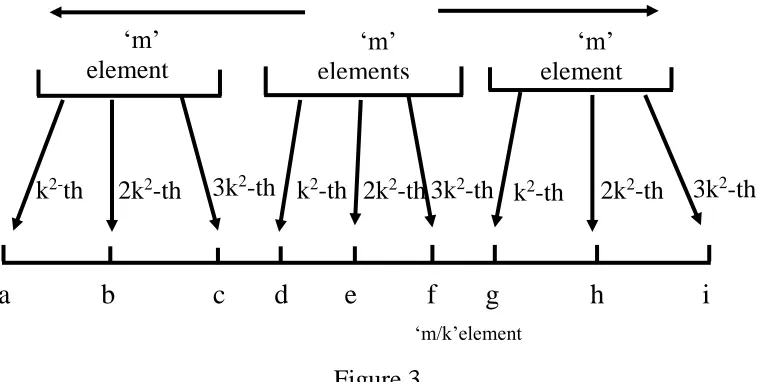
The k-way merging of sorted lists L0, L1, …, Lk-1 is done as follows. For each sorted list of m real
numbers we pick every k2-th real number, i.e. we pick the 0th real number, the k2-th real number, the
2k2-th real number, the 3k2-th real number, and so on. Thus from each list L
i we picked m/k2 real
numbers and these m/k2 real numbers form a sorted list L
i’. and from these k lists we picked m/k real
and O(loglogm) time and O(m/k) operations in each pass. Thus the total time for merging L0’, L1’, ..,
Lk-1’ is O(logkloglogm) and the total operation is O(mlogk/k).
Now for each real number r in Li’ and for any Lj’, r knows the largest real number s in Lj’ that is
smaller than r and smallest real number l in Lj’ that is larger than r. s and l are actually neighbors in Lj’.
There are k2 elements between s and l in L
j. r then uses binary search in O(logk) time to find the largest
real number among these k2 real numbers that is smaller than r and the smallest real number that is
larger than r. That is, r finds the exact insertion point of r in Lj. Because there are k-lists and there are
m/k real numbers in L’ thus the time for this binary search is O(logk) and the operation is O(mlogk). The operation for all lists is O(nlogk/k) because there are n/m lists and every k-lists are merged in the k-way merge, we picked n/k2 real numbers and every one of them has to use k processors to check
k-lists in the k-way merging. Because r is arbitrary picked and thus we know that every real number in L’ knows its insertion point in every Lj. Let the real numbers in sorted order in L’ be r0, r1, …, rm/k-1. To
merge L0, L1, …, Lk-1 we need now to merge or sort all real numbers between the insertion points of ri
and ri+1 in L0, L1, …, Lk-1. There are no more than k2 real numbers in Lj between the insertion points of
ri and ri+1 and therefore the total number R(i, i+1) of real numbers (call them a block) in L0, L1, …, L
k-1 between the insertion points of ri and ri+1 is no more than k3 (i.e. R(i, i+1)≤k3). When R(i, i+1) <k3 we
will combine multiple blocks together to reach k3 real numbers. We use the 𝑂(𝑛√𝑙𝑜𝑔𝑛) serial sorting
algorithm to sort them in 𝑂(𝑘3√𝑙𝑜𝑔𝑘) time. This represents 𝑂(𝑘3√𝑙𝑜𝑔𝑘) time and 𝑂(𝑛√𝑙𝑜𝑔𝑘)
operations in our parallel algorithm.
Thus the time for each stage is 𝑂(𝑘3√𝑙𝑜𝑔𝑘) and the operation for each stage is 𝑂(𝑛√𝑙𝑜𝑔𝑘). When
we start with m as a constant then there are logn/logk stages and therefore the time of our algorithm is
𝑂(𝑘3𝑙𝑜𝑔𝑛
√𝑙𝑜𝑔𝑘) and the operation is 𝑂( 𝑛𝑙𝑜𝑔𝑛 √𝑙𝑜𝑔𝑘).
Pick k=logn, we get O(log1+n) time and 𝑂( 𝑛𝑙𝑜𝑔𝑛
√𝑙𝑜𝑔𝑙𝑜𝑔𝑛) operations.
3
Procedure
Step 1: Lets say we have ‘m’ sorted elements in each list, and we have a total of ’n’ elements to sort.
This implies that we have ’n/m’ lists to sort. To sort these blocks, we will apply k-way merging.
‘m’
elements
‘m’
elements
‘m’
elements
’n'
elements
Step 2: Each stage of k-way merging is to merge every k sorted lists into 1 sorted list. This is repeatedly
until all n/m lists are merged into one list.
Step 3: To merge k lists into 1 list, we need to pick the ‘0-th’, ‘k2-th’, ‘2k2-th’,‘3k2-th’,… real numbers
in each list Li to form a new list Li’ of m/k2 elements. This is shown as the figure below.
a b c d e f g h i
Step 4: We merge L0’, L1’, .., Lk-1’ into one sorted list L’. The elements of this new formed list L’ then
use binary search to find their exact insertion point in L0, L1,….,Lk-1. These insertion points then
, …, L
‘
‘
‘
‘
‘
‘
‘
‘
‘
‘
‘k’ lists
‘k’ lists
…
‘k’ lists
….
Figure 2
i
‘m’
elements
‘m’
element
s
‘m’
element
s
k
2-th
2k
2-th
3k
2-th
k
2-th 2k
2-th 3k
2-th k
2-th
2k
2-th 3k
2-th
‘m/k’element s
Figure 3
Step 5: When every one of these m/k blocks are sorted we effectively merged L0, L1, …, Lk-1 into one
sorted list L.
Main Theorem: n real numbers can be sorted in O(log1+n) time and 𝑂( 𝑛𝑙𝑜𝑔𝑛
√𝑙𝑜𝑔𝑙𝑜𝑔𝑛) operations on the
CREW PRAM.
References
[1] A. Ajtai, J. Komlós, E. Szemerédi. 1983. An O(nlogn) sorting network. Proc. 1983 ACM Symp.
On Theory of Computing (STOC’83), 1-9.
[2] P. C. P Bhatt, K. Diks, T. Hagerup, V. C. Prasad, T. Radzik, S. Saxena.1991. Improved deterministic
parallel integer sorting. Information and Computation, 94, 1, 29-47.
[3] R. Cole. 1988. Parallel merge sort. SIAM J. Comput., Vol. 17, No. 4, 770-785(1988). Correction:
Parallel merge sort. SIAM J. Comput., 22(6), 1349(1993).
[4] T. H. Corman, C. E. Leiserson, R. L. Rivest, C. Stein. 2009. Introductionto Algorithms. Third
Edition, The MIT Press.
[5] T. Hagerup. 1987. Towards optimal parallel bucket sorting. Information and Computation, 73,
39-51.
[6] Y. Han. 2017. Sort real numbers in 𝑂(𝑛√𝑙𝑜𝑔𝑛) time and linear space. In arXiv.org with paper id 1801.00776
[7] Y. Han. 2004. Deterministic sorting in O(nloglogn) time and linear space. Journal of Algorithms,
50, 96-105.
[8] Y. Han. 2015. A linear time algorithm for ordered partition. Proc. 2015 International Frontiers in
Algorithmics Workshop (FAW'15), LNCS 9130, 89-103.
[9] Y. Han, X. Shen. 1995. Conservative algorithms for parallel and sequential integer sorting. Proc.
1995 International Computing and Combinatorics Conference, Lecture Notes in Computer Science 959,
[10] Y. Han, X. Shen. 2002. Parallel integer sorting is more efficient than parallel comparison sorting
on exclusive write PRAMs. Proc. 1999 Tenth Annual ACM-SIAM Symposium on Discrete Algorithms
(SODA'99), Baltimore, Maryland, 419-428(January 1999). Also in SIAM J. Comput.31, 6, 1852-1878.
[11] C. P. Kruskal. 1983. Searching, merging, and sorting in parallel computation. IEEE Trans.
Comput., C-32, 942-946.
[12] S. Saxena, P. Chandra, P. Bhatt, V. C. Prasad, 1994. On parallel prefix computation. Parallel
Processing Letters 4, 429-436.