Vol. 9, No. 4, 2017 Article ID IJIM-01034, 7 pages Research Article
Another Method for Defuzzification Based On Characterization of
Fuzzy Numbers
Rahim Saneifard ∗†
————————————————————————————————–
Abstract
Here we consider approaches to the ranking of fuzzy numbers based upon the idea of associating with a fuzzy number a scalar value, its signal/noise ratios, where the signal and the noise are defined as the middle-point and the spread of eachγ-cut of a fuzzy number, respectively. We use the value of a as the weight of the signal/noise ratio of eachγ-cut of a fuzzy number to calculate the ranking index of each fuzzy number. The proposed method can rank any kinds of fuzzy numbers with different kinds of membership functions.
Keywords: Ranking; Fuzzy number; Defuzzification; Signal/noise ratios.
—————————————————————————————————–
1
Introduction
I
nis an important component of the decision pro-many applications, ranking of fuzzy numbers cess. In addition to a fuzzy environment, rank-ing is a very important decision makrank-ing proce-dure. Since Jain [2, 3] employed the concept of maximizing set to order the fuzzy numbers in 1976(1978), many authors have investigated var-ious ranking methods. Some of these ranking methods have been compared and reviewed by Bortolan and Degani [4], and more recently by Chen and Hwang [5]. Other contributions in this field include: an index for ordering fuzzy numbers defined by Choobineh and Li [6], ranking alter-natives using fuzzy numbers studied by Dias [7], automatic ranking of fuzzy numbers using artifi-cial neural networks proposed by Requena et al. [8], ranking fuzzy values with satisfaction func-tion investigated by Lee et al. [9], ranking and∗Corresponding author. [email protected],
Tel:+989149737077.
†Department of Mathematics, Urmia Branch, Islamic
Azad University, Urmia, Iran.
defuzzification methods based on area compen-sation presented by Fortemps and Roubens [10], and ranking alternatives with fuzzy weights using maximizing set and minimizing set given by Raj and Kumar [11]. However, some of these meth-ods are computationally complex and difficult to implement, and others are counterintuitive and not discriminating. Furthermore, many of them produce different ranking outcomes for the same problem. In 1988, Lee and Li [12], proposed a comparison of fuzzy numbers by considering the mean and dispersion (standard deviation) based on the uniform and the proportional probabil-ity distributions. Having reviewed the previous methods, this article proposes a method to use the concept of median value, so as to find the order of fuzzy numbers. This method can distin-guish the alternatives clearly. The main purpose of this article is that, the median value can be used as a crisp approximation of a fuzzy num-ber. Therefore, by the means of this defuzzifica-tion, this article aims to present a new method for ranking of fuzzy numbers. In addition to its ranking features, this method removes the
guities resulted from the comparison of previous ranking. In Section 2, we recall some fundamen-tal results on fuzzy numbers. In Section3, a crisp approximation of a fuzzy number is obtained. In this Section some theorems and remarks are pro-posed and illustrated. Propro-posed method for rank-ing fuzzy numbers is in this section.
2
Basic Definitions and
Nota-tions
The basic definitions of a fuzzy number are given in [12,13,14,15,16,17,18,19] as follows:
Definition 2.1 A fuzzy number A is a mapping
µA(x) : ℜ→[0,1]with the following properties:
1. µA is an upper semi-continuous function on ℜ,
2. µA(x) = 0 outside of some interval[a1, b2]⊂
ℜ.
3. There are real numbers a2, b1 such thata1 ≤ a2 ≤b1 ≤b2 and
3.1 µA(x) is a monotonic increasing
func-tion on [a1, a2],
3.2 µA(x) is a monotonic decreasing
func-tion on [b1, b2],
3.3 µA(x) = 1 for allx in [a2, b1].
The set of all fuzzy numbers is denoted byF.
Definition 2.2 Let ℜ be the set of all real num-bers. We assume a fuzzy number A that can be expressed for all x∈ ℜ in the form
A(x) =
g(x) = (
x−a b−a
)n
when x∈[a, b),
1, when x∈[b, c],
h(x) = (
d−x d−c
)n
, when x∈(c, d],
0 otherwise .
(2.1) where a, b, c, d are real numbers such that a < b ≤ c < d and g is a real valued function that is increasing and right continuous andh is a real valued function that is decreasing and left con-tinuous. A fuzzy number A with shape func-tion g and h, where n > 0, will be denoted by
A = ⟨a, b, c, d⟩n. If n = 1, we simply write
A = ⟨a, b, c, d⟩, which is known as a trapezoidal fuzzy number. If n ̸= 1, a fuzzy number A∗ =
⟨a, b, c, d⟩n is a concentration of A. If 0< n <1,
thenA∗ is a dilation of A. Concentration of A by
n= 2 is often interpreted as the linguistic hedge ”very”. Dilation of A by n = 0.5 is often in-terpreted as the linguistic hedge ”more or less”. More about linguistic hedges can be found in [21].
Another important notion connected with fuzzy number Ais an cardinality of a fuzzy number A.
Definition 2.3 [1]. Cardinality of a fuzzy num-berAdescribed by (2.1) is the value of the integral
cardA= ∫ b
a
A(x)dx= ∫ 1
0
(bα−aα)dα. (2.2)
If A=⟨a, b, c, d⟩n then
cardA= b−a
n+ 1+ (c−d) +
d−c
n+ 1. (2.3)
In this paper we will always refer to fuzzy number
A described by (2.1).
3
A novel method for ranking
fuzzy numbers
In this section, we present a new method for ranking fuzzy numbers. The proposed method integrates many concepts, such as the approx-imate area measure [19], the belief feature [12] and the signal/noise ratio [13]. Assume that a decision maker wants to determine the ranking order of m fuzzy numbers A1, A2,· · ·, and Am. The kth γ-cut Aγki of fuzzy number Ai is defined as follows:
Aγki =
{x|fAi(x)≥γk, x∈X}, γk =
k
n, k ∈ {0,1,· · ·, n},
(3.4)
n∈N
where ndenotes the number ofγ-cuts.
The minimal valueli,k and the maximal valueri,k of the kth γ-cut of the fuzzy number Ai are de-fined as follows:
li,k = inf
x∈X{x|fAi(x)≥γk}. (3.5)
ri,k = sup x∈X{
respectively. The maximal barrierUand the min-imal barrierLof themfuzzy numbersA1, A2,· · ·,
and Am are defined as follows:
U = max
∀i {x|x∈A γ
i, 0≤γ ≤hAi,1 = 1,2,· · ·, m}, (3.7)
L= min
∀i {x|x∈A γ
i, 0≤γ ≤hAi,1 = 1,2,· · ·, m}. (3.8) where Aγi denotes the γ-cut of the fuzzy number
Ai and hAi denotes the height of Ai defined as follows:
hAi = sup x∈X
fAi(x). (3.9)
The signal/noise ratioηi,k of thekthγ-cut of the fuzzy numberAi used in the proposed method is defined as follows:
ηi,k =
mi,k−L
δi,k+c
, (3.10)
where mi,k and di,k denote the middle-point and the spread ofAγk
i , respectively, defined as follows:
mi,k =
ri,k+li,k
2 , (3.11)
δi,k =ri,k−li,k. (3.12)
L denotes the minimal barrier of the m fuzzy numbers A1, A2,· · ·, Am defined by Eq. (3.8), c is a parameter, andc > 0. The parameterc > 0 is used to avoid the case that if the fuzzy number
Ai is the crisp value ”0”, the signal/noise ratio will be indeterminate. From Eq. (3.10), we can find that the larger the value of c, the smaller the influence ofδi,k on the signal/noise ratioηi,k. Therefore, we think that the influence of δi,k on
ηi,k should be smaller than the influence of mi,k on ηi,k. The value of c should be greater than the value of R−L in order to avoid the special case that if we want to obtain the ranking order of two equal crisp valuesA1 andA2, the values of R−Landδi,kof thekthγ-cut of the fuzzy number
A1 and A2 will be all zero and the signal/noise
ratio will be indeterminate or undefined, where
γk∈[0,1]. In the following, we present a new ap-proach for comparing fuzzy numbers based on the distance method. The method not only consid-ers the signal/noise ratio of a fuzzy number, but also considers the minimum crisp value of fuzzy numbers. The proposed method for ranking fuzzy numbers A1, A2,· · ·, Am is now presented as fol-lows:
Use the point (RI(Aj),0) to calculate the ranking
value sn/r(Aj) = D(RI(Aj), xmin) of the fuzzy numbers Aj, where Aj , where 1 ≤ j ≤ m, as follows:
D(RI(Aj), xmin) =∥RI(Aj)−xmin∥ (3.13)
From formula (3.13), we can see that sn/r(Aj) =
D(RI(Aj), xmin) can be considered as the Eu-clidean distance between the point (RI(Aj),0) and the point (xmin,0). We can see that the larger the value ofsn/r(Aj), the better the rank-ing of Aj, where 1 ≤ j ≤ m. When ranking
n fuzzy numbers A1, A2,· · ·, Am, the minimum crisp value xmin is defined as:
xmin =min{x|x∈Domain(A1, A2,· · ·, Am)}. (3.14) The index RI(Aj) of fuzzy numbers Ai is calcu-lated as RI(Aj) =
hAi∑nk=1γk×ηi,k ∑n
k=1γk , where γ = hAi×kn, k∈ {1,2,· · ·, n}, n∈N, andndenotes the number of γ-cuts.
3.1 Using The Proposed Ranking Method In Selecting Army Equip System
From experimental results, the proposed method with some advantages: (a) without normalizing process, (b) fit all kind of ranking fuzzy num-ber, (c) correct Kerre’s concept. Therefore we can apply median value of fuzzy ranking method in practical examples. In the following, the algo-rithm of selecting equip systems is proposed, and then adopted to ranking a army example.
3.1.1 An algorithm for selecting equip system
We summarize the algorithm for evaluating equip system as below:
Step 1: Construct a hierarchical structure model for equip system.
Step 2: Build a fuzzy performance matrix ˜A. We compute the performance score of the sub factor, which is represented by triangular fuzzy numbers based on expert’s ratings, average all the scores corresponding to its criteria. Then, build a fuzzy performance matrix ˜A.
Step 3: Build a fuzzy weighting matrix ˜W. Ac-cording to the attributes of the equip systems, ex-perts give the weight for each criterion by fuzzy numbers, and then form a fuzzy weighting matrix
˜
Table 1: Linguistic values for the ratings
Linguistic value TFNs
Very Poor(VP) (0,0,0.16)
Poor (0,0.16,0.33)
Slightly(SP) (0.16,0.33,0.5)
Fair(F) (0.33,0.5,0.66)
Slightly good(SG) (0.5,0.66.0.83)
Good(G) (0.66,0.83,1)
Very good(VG) (0.83,1,1)
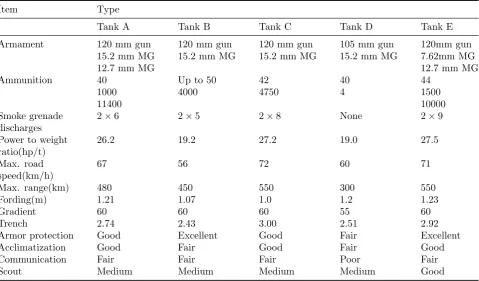
Table 2: Basic performance data for five types of main battle Tanks.
Item Type
Tank A Tank B Tank C Tank D Tank E Armament 120 mm gun 120 mm gun 120 mm gun 105 mm gun 120mm gun
15.2 mm MG 15.2 mm MG 15.2 mm MG 15.2 mm MG 7.62mm MG
12.7 mm MG 12.7 mm MG
Ammunition 40 Up to 50 42 40 44
1000 4000 4750 4 1500
11400 10000
Smoke grenade 2×6 2×5 2×8 None 2×9 discharges
Power to weight 26.2 19.2 27.2 19.0 27.5 ratio(hp/t)
Max. road 67 56 72 60 71
speed(km/h)
Max. range(km) 480 450 550 300 550
Fording(m) 1.21 1.07 1.0 1.2 1.23
Gradient 60 60 60 55 60
Trench 2.74 2.43 3.00 2.51 2.92
Armor protection Good Excellent Good Fair Excellent Acclimatization Good Fair Good Fair Good Communication Fair Fair Fair Poor Fair Scout Medium Medium Medium Medium Good
Table 3: Linguistic values of the importance weights
Linguistic value TFNs
Very low(VL) (0,0,0.167)
Low(L) (0,0.167,0.333)
Slightly (0.167,0.333,0.5)
Medium(M) (0.333,0.5,0.667)
Slightly high(SH) (0.5,0.667,0.833)
High(H) (0.667,0.833,1)
Very High(VH) (0.833,1,1)
Step 4: Aggregate evaluation. To multiple fuzzy performance matrix and fuzzy weighting matrix
˜
W, then get fuzzy aggregative evaluation matrix ˜
R. (i.e. ˜R= ˜A⊗W˜t).
Step 5: Determinate the best alternative. After step 4, we can get the fuzzy aggregative
Table 4: The importance weights of linguistic criteria and its mean
Criteria Experts Mean of TFNs
D1 D2 D3
Attack ( ˜W1) VH H H (0.72,0.89,1)
Mobility ( ˜W2) VH H VH (0.78,0.94,1)
Self-defence ( ˜W3) M VH SH (0.56,0.72,0.83)
Communication and command ( ˜W4) M M M (0.33,0.5,0.67)
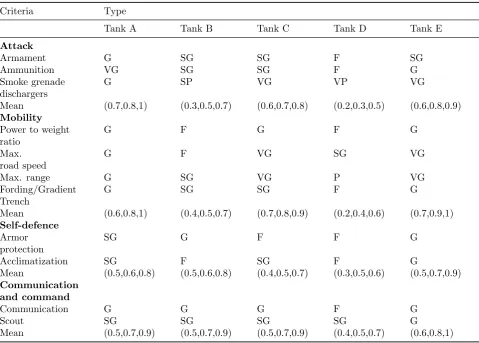
Table 5: Basic performance data for five types of main battle Tanks
Criteria Type
Tank A Tank B Tank C Tank D Tank E
Attack
Armament G SG SG F SG
Ammunition VG SG SG F G
Smoke grenade G SP VG VP VG
dischargers
Mean (0.7,0.8,1) (0.3,0.5,0.7) (0.6,0.7,0.8) (0.2,0.3,0.5) (0.6,0.8,0.9)
Mobility
Power to weight G F G F G
ratio
Max. G F VG SG VG
road speed
Max. range G SG VG P VG
Fording/Gradient G SG SG F G
Trench
Mean (0.6,0.8,1) (0.4,0.5,0.7) (0.7,0.8,0.9) (0.2,0.4,0.6) (0.7,0.9,1)
Self-defence
Armor SG G F F G
protection
Acclimatization SG F SG F G
Mean (0.5,0.6,0.8) (0.5,0.6,0.8) (0.4,0.5,0.7) (0.3,0.5,0.6) (0.5,0.7,0.9)
Communication and command
Communication G G G F G
Scout SG SG SG SG G
Mean (0.5,0.7,0.9) (0.5,0.7,0.9) (0.5,0.7,0.9) (0.4,0.5,0.7) (0.6,0.8,1)
3.1.2 The selecting of best main battle tank
In [22], the authors have constructed a practical example for evaluating the best main battle tank, and they selected x1 = M1A1 (USA), x2 = Challenger2 (UK), x3 = Leopard2
(Ger-many) as alternatives. In [22], the experts opinion were described by linguistic terms, which can be repressed in triangular fuzzy numbers. The fuzzy Delphi method is adopted to adjust the fuzzy rating of each expert to achieve the consensus condition. The evaluating criteria of main battle tank are a1 : attackcapability, a2 : mobilitycapability,a3:self −def encecapability
and a4 : communicationandcontrolcapability.
In this example, we adopted the hierarchical structure constructed in [22] for selection of five main battle tanks, and the step-by-step illustrations based on Sec. 3.1.1s algorithm are described bellow:
Step 1: Construct a hierarchical structure model for equip system.
The aggregative fuzzy weights of four criteria, according to the linguistic values of importance in Table2, are shown in Table4.
Step 4: Aggregate evaluation. To multiple fuzzy performance matrix ˜Aand fuzzy weighting matrix ˜W, then get fuzzy aggregative evaluation matrix ˜R = ˜A⊗W˜t. Therefore, from Table 4 and 5, we have
˜
R=
(0.38,0.61,0.82) (0.27,0.48,0.69) (0.36,0.58,0.77) (0.18,0.34,0.55) (0.40,0.64,0.84)
.
Step 5: Determinate the best alternative. Accord-ing to Eq. 3.14, we can get the signal value of fuzzy numbers of Tanks A-E, which are equal to 0.234, 0.423, 0.236, 0.323 and 0.289, respectively. There-fore, we find that the ordering of median value is
T ank A < T ank C < T ank F < T ank D < T ank B. So, the best type of main battle Tank is TankF.
4
Conclusion
In this paper, we have presented a new approach for ranking of fuzzy numbers. First, we present a new method for ranking fuzzy numbers based on the γ -cuts, the belief features and the signal/noise ratios of fuzzy numbers. The proposed method calculates the signal/noise ratio of eachγ-cut of a fuzzy number to evaluate the quantity and the quality of a fuzzy number, where the signal and the noise are defined as the middle-point and the spread of eachγ-cut of a fuzzy number, respectively. We use the value of a as the weight of the signal/noise ratio of eachγ-cut of a fuzzy number to calculate the ranking index of each fuzzy number. The proposed fuzzy ranking method can rank any kinds of fuzzy numbers with different kinds of membership functions.
Acknowledgment
This paper is based on the Masters project at the Department of Mathematics, Urmia Branch, Islamic Azad University, Urmia in Iran, under graduate re-search fellowship and fundamental rere-search grant scheme.
References
[1] S. Bodjanova, Median value and median inter-val of a fuzzy number, Infomation Sciences 172 (2005) 73-89.
[2] R. Jain, Decision-making in the presence of fuzzy variable, IEEE Trans. Systems Man and Cyber-net.SMC. 6 (1976) 698-703.
[3] R. Jain, A procedure for multi-aspect decision making using fuzzy sets, Internat. J. Systems Sci. 8 (1978) 1-7.
[4] G. Bortolan and R. Degani, A review of some methods for ranking fuzzy numbers, Fuzzy Sets and Systems 15 (1985) 1-19.
[5] S. J. Chen and C. L. Hwang, Fuzzy Multi-ple Attribute Decision Making, Springer- Verlag, Berlin, (1972).
[6] F. Choobineh, H. Li, An index for ordering fuzzy numbers, Fuzzy Sets and Systems 54 (1993) 287-294.
[7] O. Dias, Ranking alternatives using fuzzy num-bers: A computational approach, Fuzzy Sets and Systems 56 (1993) 247-252.
[8] I. Requena, M. Delgado and J. I. Verdegay, Au-tomatic ranking of fuzzy numbers with the crite-rion of decision maker leant by an artificial neural network, Fuzzy Sets and Systems 64 (1994) 1-9.
[9] H. Chu, H. Lee-Kwang, Ranking fuzzy values with satisfaction function, Fuzzy Sets and Sys-tems 64 (1994) 295-311.
[10] P. Fortemps, M. Roubens, Ranking and defuzzi-fication methods based on area compensation, Fuzzy Sets and Systems 82 (1996) 319-330.
[11] P. A. Raj, D. N. Kumar, Ranking alternatives with fuzzy weights using maximizing set and min-imizing set, Fuzzy Sets and Systems 105 (1999) 365-375.
[12] R. Saneifard, Defuzzification method for solving fuzzy linear systems, International Journal of In-dustrial Mathematics 4 (2009) 321-331.
[13] R. Saneifard, Ranking L-R fuzzy numbers with weighted averaging based on levels, International Journal of Industrial Mathematics 2 (2009) 163-173.
[14] R. Saneifard, T. Allahviranloo, F. Hosseinzadeh, N. Mikaeilvand, Euclidean ranking DMUs with fuzzy data in DEA, Applied Mathematical Sci-ences 6 (2007) 2989-2998.
[15] R. Saneifard, A method for defuzzification by weighted distance, International Journal of In-dustrial Mathematics 3 (2009) 209-217.
[16] R. Saneifard, R. Ezatti, Defuzzification Through a Bi Symmetrical weighted Function, Aust. J. Ba-sic Appl. Sci. 10 (2010) 4976-4984.
[18] R. Saneifard and A. Asgari, A Method For De-fuzzification Based on Probability Density Func-tion (II), Applied Mathematical Sciences 5 (2011) 1357-1365.
[19] Rahim Saneifard and Rasoul Saneifard, Evalua-tion of Fuzzy Linear Regression Models by Para-metric Distance, Australian Journal of Basic and Applied Sciences 5 (2011) 261-267.
[20] L. A. Zadeh, Fuzzy sets, Inform. Control 8 (1965) 338-353.
[21] L. A. Zadeh, A fuzzy-set-theoretic interpretation of linguistic hedges, Journal of Cybernetics 2 (1972) 4-34.
[22] CH. Cheng, Y. Lin, Evaluating weapon system by analitic hierarchy process based on fuzzy scales, Fuzzy Sets and Systems 63 (2002) 1-10.