Navigating a Geography of Sustainability Worldviews: A Developmental Map
Abigail Lynam, MS
Abstract
Given the importance of understanding and learning to work effectively with a diversity of perspectives and values in the sustainability field, this article offers a developmental map of the worldviews of sustainability. It includes an introduction to developmental theory and research, an overview of the diversity of worldviews, how they differ and relate to one another and to sustainability practice and leadership, and how these worldviews develop over time. A developmental perspective suggests that every sustainability practitioner/educator/leader has a worldview that is made up of the beliefs that person holds and their definition for sustainability emerges out of those beliefs. Moreover, there are consistent patterns observed cross-culturally in the ways that these worldviews develop. Understanding and learning to work with the diversity of perspectives and their developmental trajectory is vitally important for sustainability
education and leadership in that it helps us to design curriculum, and sustainability campaigns, policy and actions in ways that are more holistic, include a diversity of worldviews, address conflict between them and contribute to the development of the worldviews themselves.
Navigating a Geography of Sustainability Worldviews: A Developmental Map
Journal of Sustainability Education http://www.susted.org/
“Sustainability is as much about the mindset through which the world is seen as it is about the activities taken in support of it” (McKewan and Schmidt, 2007).
Take a moment to think about how you define sustainability and how or whether your definition has changed over time, as well as how it might differ in different contexts. What kinds of sustainability definitions appeal to you, and which ones are you uncomfortable with or do you actively disagree with?
Sustainability is a values-based, moral concept, not simply a technical term. In fact the field of sustainability itself continues to develop and evolve and the changing definitions reflect this development. Varey shares that “at this stage of the development of the concept by
discourse, no one can tell you what sustainability means, only what they mean by it” (2003). Francisco Varela further illustrates this statement by saying, “in contrast with what is commonly assumed, a description, when carefully inspected, reveals the properties of the observer” (1975, p.22).
Envisioning sustainability in a way that has room to grow, evolve and change is an important way of, as Otto Scharmer of the Presencing Institute recommends, listening to and leading from the future as it emerges (2007). Defining what we mean by sustainability is also important, because articulating a definition puts boundaries around what we mean by the term and what we intend by our actions. “A sustainability definition is the way to translate vision into action – to define the path through the maze” (Varey, 2004). Varey goes on to suggest that we clarify the following three questions in our definitions: sustain what, for whom and for how long. These questions address scale, depth and span.
How people respond to these questions varies widely, and the variation itself points towards some important opportunities for effective and transformative sustainability leadership and education. By paying close attention to the geography of perspectives in the field of
sustainability; the diversity of visions and actions and how these develop over time for both individuals and collectives, we begin to develop a map that helps us navigate the diversity of the terrain, one that includes the beauty and unique qualities of each part of the landscape, while offering an overview of the landscape as a whole.
Interiors and Exteriors
In the sustainability field, emerging research applying Ken Wilber’s AQAL (all quadrants, levels, lines, types, and states) Integral framework (Wilber, 2001) to analyze
successful sustainability initiatives, paints a comprehensive picture of the critical components of success. The Integral framework seeks to weave together the many threads of human knowledge in an inclusive way. It includes objective and subjective, and individual and collective ways of knowing, scientific and spiritual knowledge and Eastern and Western knowledge within a coherent framework. It is also sensitive to the development of people and cultures over time and the impact this has on the way individuals and groups perceive and interact with the world (Brown & Riedy, 2006).
A study of ten prominent sustainability organizations reveals that a “focus on interiors (subjective factors) and exteriors (objective factors) at both individual and
collective/organizational levels are required for success” (McEwen & Schmidt, 2007, p.5). This research suggests that one factor without the other may be insufficient. Uniquely, the importance of interiors (mindsets and collective worldviews) is revealed, adding a newer area of exploration and practice to the field. The following is a diagram of the four quadrants of the integral model, pointing towards the role that collective and individual interiors (culture and worldviews) play in sustainability initiatives.
Figure 1: Four Quadrants of the AQAL (all quadrants, levels, lines, types, and states) integral model, revealing the importance of and relationships between the interiors and exteriors of individuals and collectives. Applied to sustainability, it reveals the psychology, behavior, culture and systems of any sustainability issue or question (Brown and Riedy, 2006).
Navigating a Geography of Sustainability Worldviews: A Developmental Map
Journal of Sustainability Education http://www.susted.org/ Human Development
In the past thirty years, developmental psychology researchers have begun to radically transform our understanding of the development of consciousness (or worldviews) in adults. Consciousness can be defined as the “experiential awareness consisting of feelings, thoughts, intentions and the personal sense of identity” (McIntosh, 2007, p.11). Until recently it was generally assumed that when an individual reaches eighteen they are essentially complete in their development. The field of human development research now recognizes that psychological development continues throughout life, and that there are very distinctive cross-cultural patterns to this development. These developmental patterns have profound implications for sustainability and offer us an insightful map for navigating the landscape of sustainability education, as well as insight into what is meant by transformative learning and leadership.
Suzanne Cook Greuter (2004), a developmental researcher, clarifies that there are two primary ways we develop: horizontally and vertically. Both are instrumental in human growth; yet occur in different ways at varying rates. Horizontal development refers to increasing
capacities related to knowledge and skill development within a current mindset, whereas vertical development refers to a transformation of someone’s entire way of perceiving and experiencing the world. As developmental researcher and Harvard professor Robert Kegan offers, “what gradually happens is not just a linear accretion of more and more that one can look at or think about, but a qualitative shift in the very shape of the window or lens through which one looks at the world.” (2002, p. 148). With vertical development (also referred to as stage development) comes an increase in what an individual can be aware of and, therefore, that which they can integrate and influence. These changes in worldview, the emergence of new meaning-making systems, are often far more powerful than any degree of horizontal growth (Cook-Greuter, 1999).
Developmental research reveals that there are fundamentally different ways of making meaning of our world. Some of the patterns to this development directly relate to the three critical components of a sustainability definition that Varey articulated: depth, span and scale (2004). In other words how we perceive sustainability; what we value, whom we include and the time frame we envision, is significantly influenced by mindset development. For instance one person might value sustainability because it helps their immediate community address resource needs, or because caring for the Earth is caring for God’s creatures. Another person might value sustainability because it gives their company a competitive edge in the market. And yet another person values sustainability because caring for the inherent rights of nature and all of humanity feels like the right thing to do. All of these motivations for sustainability differ markedly from one another and their difference is influenced by the individual’s worldview development.
Attuning to development can help leaders and educators more effectively navigate the landscape of sustainability, by helping them identify and understand different values systems and perceptions of sustainability, translate sustainability communication and education so that it speaks directly to the values of the people they are interacting with, and by being aware of the developmental patterns, communicating/educating in a way that is more likely to contribute to transformative development.
care and responsibility for human communities globally and the natural world, awareness of and capacity to recognize the interdependence and interconnectedness of ecological and social systems, and increasing capacity to empathize with and take multiple perspectives on an issue or topic, capacities that are considered foundational for sustainability leadership, are capacities that emerge as someone moves along the developmental trajectory. Therefore stage development may be a central leverage point for moving towards sustainability. Finally, learning about
developmental trajectories offers educators and leaders an opportunity to see what their own development might look like and how this can support the deepening and effectiveness of their work in the world. Esbjorn-Hargens and Zimmerman emphasize the widening circle of care in the following:
“Each level of interior moral development enables people to respect more life, human and non-human, thereby undermining not only ethnocentrism (as well as sexism, racism etc.), but also the anthropocentrism that regards nonhuman beings as nothing but resources for human power and security” (2009, p. 82).
Constructive-Developmental Theory
Cook-Greuter (1999, p. 29) describes development as “the gradual unfolding of people’s capacity to embrace ever-vaster mental horizons and to plumb ever-greater depths of the heart.” Human development is seen as a sequence of integrated and increasingly complex meaning-making stages or systems, each potentially more effective at addressing the complexities of life. This is a nested hierarchical process, where each development to a new stage results in a
transformation of the previous way of making meaning, while also including the previous stages (Cook-Greuter, 1999).
Some of the cross cultural patterns that developmental researchers find, are increasing capacities to engage with complexity, to recognize and take multiple perspectives, and widening or deepening circles of identity, care and responsibility.
Constructive-developmental theory shares the following summarized assumptions (Cook Greuter, 2004, McCauley, et al. 2006, p. 636):
People actively construct their understanding and way of making sense of themselves and the world.
Growth occurs in a logical progression of stages, evolving from less to more complex and from static to dynamic.
Later stages are reached only by journeying through earlier stages—each stage transcends and includes previous stages.
Each later stage is more differentiated, inclusive, and integrated—and capable of more optimal functioning in a complex and changing world.
As development unfolds, tolerance for difference and ambiguity increases, while defenses decrease.
Development occurs through interplay between the person and the environment, not just one or the other.
A person’s stage of development influences what someone notices or can become aware of, and therefore, what they can describe, articulate, reflect on, influence and change.
Navigating a Geography of Sustainability Worldviews: A Developmental Map
Journal of Sustainability Education http://www.susted.org/
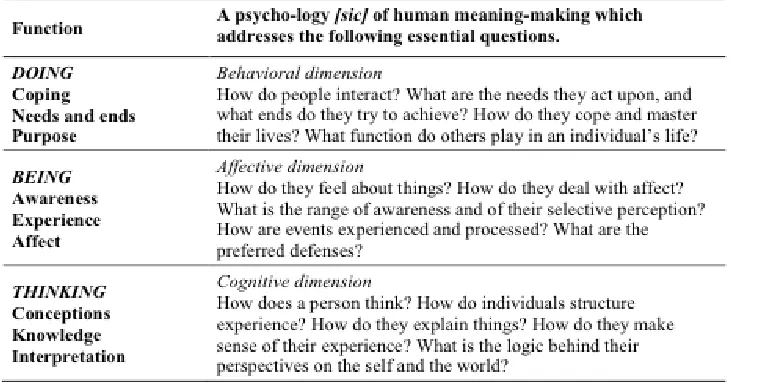
with additional research by Susanne Cook-Greuter (1999, 2004) and Terri O’Fallon (2011). Ego development includes self-identity, meaning making structures and cognitive, behavioral and emotional development. Torbert’s Leadership Development Framework (LDF) is one of the more finely tuned and validated assessment tools in the field, with over 7000 database profiles. Overall, the LDF framework describes nine ways of adult meaning making. The LDF refers to stages as action logics because it focuses on how adults tend to reason and behave in response to their experience (see Table 1 for more detail).
Table 1: Details of the action logics system, the constructive-developmental framework for ego development (self-identity and meaning making) that forms the basis for the developmental map of sustainability worldviews (Cook Greuter, 2005).
When discussing development, it is important to remember that humans are complex beings and how they think and behave is influenced by a variety of factors, their action logic being only of these factors. Don Beck who researches the development of value systems, talks about a value system being like a musical note, while its expression is more like a chord or a melody. Beck goes on to describe values systems in this way (1996):
“These Value Systems describe types in rather than types of people. None of these worldviews is inherently better or worse than any other. They differ in levels of complexity, capacity to deal with diverse situations, and degrees of personal commitment. They do not reflect intelligence or character, or
temperament, as those dimensions run across worldviews. People value different things because they think in different ways. Everyone is motivated, but we are not motivated by the same things. Each Value System has a particular set of driving forces that stimulate it to action.”
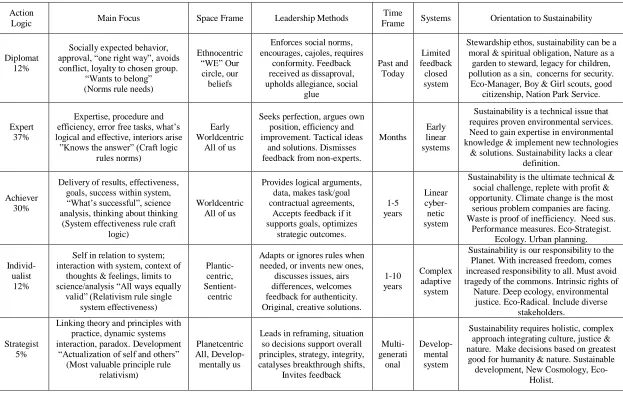
The following table describes six (of the nine) action logics that are most relevant to and prevalent in the field of sustainability. The table summarizes some of the patterns and features of the action logics that are revealed through research. These patterns are then extrapolated to how each action logic is likely to define and approach sustainability and how these develop with the development of worldviews.
Each action logic or worldview experiences, values and acts upon sustainability in remarkably distinct ways; each one is essentially operating in a landscape that is unique to their way of being, and seeing and acting in the world. However, in the field as a whole, it serves educators and leaders to have a sense of the geography of these landscapes; describing the unique contours and landforms of each, seeing the ways that these landscapes are different and similar, how they fit together, and their relative strengths and challenges. The table draws on developmental research by Rooke and Torbert (2005), Cook Greuter (2004), and O’Fallon (2011), and includes theoretical research on the development of sustainability perspectives and worldviews by Brown (2005, 2011), Boiral et al. (2009), Esbjorn-Hargens and Zimmerman (2009), Brown and Riedy (2006) and McEwen and Schmidt (2007).
The general patterns to the development of action logics include (as mentioned previously) an increasing time frame, an expanded perspective taking capacity (first, second, third, fourth person perspectives and beyond), widening circles of care, identity and
Journal of Sustainability Education Vol. 3, March 2012 ISSN: 2151-7452 Table 2: Six (of the nine) action logics most prevalent in the field of sustainability. Included are some developmental patterns and features of each action logic (Rooke & Torbert, 2005; Cook Greuter, 2004; O’Fallon, 2011), and the percentage of each action logic found in a sample of 4,500 adults in the U. S. (Cook Greuter, 2004). Theoretical research on the action logic’s orientation to sustainability is also included (Brown, 2005, 2011; Boiral et al., 2009; Esbjorn-Hargens & Zimmerman, 2009; Brown & Riedy, 2006; McEwen & Schmidt, 2007).
Action
Logic Main Focus Space Frame Leadership Methods
Time
Frame Systems Orientation to Sustainability
Diplomat 12%
Socially expected behavior, approval, “one right way”, avoids conflict, loyalty to chosen group.
“Wants to belong” (Norms rule needs)
Ethnocentric “WE” Our
circle, our beliefs
Enforces social norms, encourages, cajoles, requires
conformity. Feedback received as dissaproval, upholds allegiance, social
glue Past and Today Limited feedback closed system
Stewardship ethos, sustainability can be a moral & spiritual obligation, Nature as a
garden to steward, legacy for children, pollution as a sin, concerns for security.
Eco-Manager, Boy & Girl scouts, good citizenship, Nation Park Service.
Expert 37%
Expertise, procedure and efficiency, error free tasks, what’s logical and effective, interiors arise
”Knows the answer” (Craft logic rules norms)
Early Worldcentric
All of us
Seeks perfection, argues own position, efficiency and improvement. Tactical ideas
and solutions. Dismisses feedback from non-experts.
Months
Early linear systems
Sustainability is a technical issue that requires proven environmental services. Need to gain expertise in environmental knowledge & implement new technologies
& solutions. Sustainability lacks a clear definition.
Achiever 30%
Delivery of results, effectiveness, goals, success within system, “What’s successful”, science analysis, thinking about thinking
(System effectiveness rule craft logic)
Worldcentric All of us
Provides logical arguments, data, makes task/goal contractual agreements,
Accepts feedback if it supports goals, optimizes
strategic outcomes. 1-5 years Linear cyber-netic system
Sustainability is the ultimate technical & social challenge, replete with profit & opportunity. Climate change is the most
serious problem companies are facing. Waste is proof of inefficiency. Need sus.
Performance measures. Eco-Strategist. Ecology. Urban planning.
Individ-ualist
12%
Self in relation to system; interaction with system, context of
thoughts & feelings, limits to science/analysis “All ways equally
valid” (Relativism rule single system effectiveness)
Plantic-centric, Sentient-centric
Adapts or ignores rules when needed, or invents new ones,
discusses issues, airs differences, welcomes feedback for authenticity. Original, creative solutions.
1-10 years
Complex adaptive system
Sustainability is our responsibility to the Planet. With increased freedom, comes increased responsibility to all. Must avoid tragedy of the commons. Intrinsic rights of Nature. Deep ecology, environmental
justice. Eco-Radical. Include diverse stakeholders.
Strategist 5%
Linking theory and principles with practice, dynamic systems interaction, paradox. Development
“Actualization of self and others” (Most valuable principle rule
relativism)
Planetcentric All, Develop-mentally us
Leads in reframing, situation so decisions support overall principles, strategy, integrity, catalyses breakthrough shifts,
Invites feedback Multi-generati onal Develop-mental system
Sustainability requires holistic, complex approach integrating culture, justice & nature. Make decisions based on greatest
good for humanity & nature. Sustainable development, New Cosmology,
Aware 2%
self and others. Complexity of meaning making. Constructs. (Deep processes & intersystemic
evolution rule principles)
Early Kosmcentric
Feedback part of natural system, essential & held lightly. Generates social
transformation
Cosmic Time-frame
evolu-tionary systems
understands they are contsructed & reified through belief systems. Bring incredible
adaptability to the navigation & interweaving of all of these views. Integral
Navigating a Geography of Sustainability Worldviews: A Developmental Map
Journal of Sustainability Education http://www.susted.org/ Relevance for Sustainability Education and Leadership
The value of taking a developmental perspective for leaders and educators includes the following:
1. An awareness of the role that interiors play in sustainability visions, behaviors and initiatives: Recognizing that mindsets and worldviews play a significant role in the choices that people make, and valuing and attending to this in our visions, communications and practices, can positively influence the outcome of a sustainability initiative.
2. Understand and appreciate that there will always be a diversity of sustainability worldviews and that an individual’s worldviews may be slow to change:
Being aware of this can help educators and leaders avoid trying to convince others of their way of seeing the world, or judging others for not taking their perspective. Instead leaders and educators can attempt to take others’ perspectives, listening deeply to what matters,
cultivating empathy and understanding, and find ways to build relationships around shared values and/or common goals.
3. Navigate conflict between different sustainability worldviews:
One of the patterns that developmental researchers observe is that up until the Strategist stage of development, there is a belief that one’s own worldview is the right one. This often translates into discrediting or being in conflict with other worldviews. An additional pattern is that as someone moves into a new worldview or action logic, they tend to reject the views and values of the previous stage, which also contributes to conflict and not valuing other
perspectives. This is seen in the sustainability field when for instance, deep ecologists critique so-called shallow ecologists and those that think we need to dismantle capitalism don’t value eco-entrepreneurship or market solutions to sustainability challenges. And those that believe nature has inherent value are less likely to value the stewardship approach to caring for God’s creation. These approaches differ in their depth, span and scope. It’s useful to recognize these differences and to discern what might work better for a particular sustainability challenge, however, its critical not to discredit the contributions of any of these approaches and to find ways of collaborating across the differences.
4. Guide collectives (organization, classroom, community) towards common goals and navigate conflict and disagreement:
As a leader or educator aware of the different action logics in a group, you can work more effectively to weave together different voices and perspectives, finding goals and strategies that transcend and include a diversity of perspectives, while addressing conflict and
misunderstanding as it arises. A case study of this approach to leadership in a community forestry initiative can be found at Next Step Integral –
http://nextstepintegral.org/branches/ecology
5. Translate communication so that it relates to stakeholders’/clients’/students’ natural motivational flows:
A fair amount of communication in the field is aimed at transforming worldviews by trying to encourage or convince others to adopt more sustainable perspectives. While this is important and understandable, the transformation of mindsets is a complex and little understood phenomena and can’t be forced. It can be more immediately effective (and respectful) to
2003). Brown and Riedy (2006) offer an overview of developmentally appropriate sustainability communications and case studies of those employing these methods.
6. Teach and lead transformatively by stretching and challenging individuals’ awareness, perspective and capacities without overstretching and stimulating reactions or failure:
For instance, creating opportunities for self-reflection and to take perspectives other than their own, is valuable for students with an Expert action logic. Learning to pay attention to the role that social contexts play in influencing identity and perspectives is useful at the Achiever stage. Barrett Brown’s research on how later stage sustainability leaders design sustainability initiatives, points towards emerging leadership capacities in the later stages. These capacities can be instrumental in developing later stage leaders (Brown, 2011).
7. Catalyze the development of sustainability leaders and educators themselves, and the field as a whole:
As we become more aware of our own developmental trajectory and that development is ever unfolding, we gain a sense of where we might be headed and how our own transformation can contribute to the effectiveness and sustainability of our work. This can encourage continued engagement with transformative learning and growth opportunities, recognizing that
sustainability is a journey, not a destination that has been arrived at. 8. Teach and lead with greater inclusivity and discernment:
Each of the stages of development has something unique and valuable to contribute to sustainability, while also missing something. In other words every sustainability view and practice is both whole and partial. Recognizing the diversity of perspectives on sustainability, leaders and educators can better appreciate the value and contribution of the different
perspectives, rather than rejecting approaches that differ from their own sustainability vision and values. For instance, it is critical that sustainability initiatives and leaders ultimately transcend the downside of science, technology and economics, while including what is valuable and needed from these realms of human innovation and practice.
In addition to inclusivity, discerning when a particular action logic might be a better fit for a particular challenge. For example, those that can embrace and engage with greater complexity, more perspectives and shape adaptive systems might be a better fit for a more complex sustainability challenge (McEwen & Schmidt, 2007).
9. Recognize that individual and collective stage development is an important fulcrum for sustainability itself:
It is at the worldcentric and planet-centric stages of development that sustainability values naturally emerge (Esbjorn-Hargens & Zimmerman, 2009). Therefore supporting the healthy development of individuals towards these stages of development contributes significantly to creating a critical mass of people supporting the principles and practices of sustainability. Understanding the developmental trajectory and how to catalyze development can aid educators and leaders in these endeavors. Esbjorn-Hargens states, “Interior development … is the crucial ingredient in moving humankind toward different kinds of (and more eco-friendly) attitudes, practices, beliefs, institutions, politics, and economics.”(As cited in Brown, 2005, p.9).
Conclusion
Navigating a Geography of Sustainability Worldviews: A Developmental Map
Journal of Sustainability Education http://www.susted.org/
The developmental trajectories outlined by developmental theorists point towards the possibility for development within the field of sustainability itself. They open up new horizons, cultivate humility and heighten our awareness and recognition of developmental differences. They also point towards some of the limits of the worldview out of which sustainability naturally arises and call for a deeper potential for collaboration across worldviews. With an awareness and
understanding of a developmental map of sustainability worldviews, we can begin to design
References
Beck, D. & Cowan, C. (1996). Spiral dynamics: Mastering values, leadership, and change. Oxford: Blackwell.
Boiral, O., Cayer, M., & Baron, C. M. (2009). The action logics of environmental leadership: A developmental perspective. Journal of Business Ethics, 85, 479-499.
Bridle, S. (2005). Comprehensive compassion: An interview with brian swimme. What is Enlightenment. Retrieved from http://www.enlightennext.org/magazine/j19/swimme.asp
Brown, B.C. (2005), "Theory and Practice of Integral Sustainable Development: Part 2 – Values, Developmental Levels, and Natural Design", AQAL: Journal of Integral Theory and Practice, Vol. 1, No. 2, pp. 386-448
Brown, B. C., & Riedy, C. (2006). Use of the integral framework to design developmentally appropriate sustainability communications. In Walter Leal Filho (Ed.), Innovation, Education, and Communication for Sustainable Development (Vol. 24). New York: Peter Lang Scientific Publishers.
Brown, B. C. (2011). Conscious leadershio for sustainability: How leaders with a late-stage action logic design initiatives. (Unpublished doctoral dissertation). Fielding Graduate University, California.
Cook-Greuter, S. R. (1999). Postautonomous ego development: A study of its nature and measurement. Dissertation Abstracts International, 60, 06B(UMI No. 993312)
Cook-Greuter, S. R. (2004). Making the case for a developmental perspective. Industrial and Commercial Training, 36(6/7), 275.
Cook-Greuter, S. R. (2005). Ego development: Nine levels of increasing embrace. Retrieved from
http://www.cook-greuter.com/9%20levels%20of%20increasing%20embrace%20update%201%2007.pdf
Esbjorn-Hargens, S., Zimmerman, M. E. (2009). Integral ecology: Uniting multiple perspectives on the natural world. Boston, MA: Integral Books.
Kegan, Robert (2002). Epistemology, fourth order consciousness, and the subject-object
relationship (Interview with Robert Kegan). What is Enligtenment? Fall/Winter, 144-154.
Loevinger, J., & Wessler, R. (1970). Measuring ego development: Vol. 1. Construction and use of a sentence completion test. San Francisco: Jossey-Bass.
McCauley, C. D., Drath, W. H., Palus, C. J., O'Connor, P. M. G., & Baker, B. A. (2006). The use of constructive-developmental theory to advance the understanding of leadership. The
Leadership Quarterly, 17(6), 634.
McEwen, C. A. & Schmidt, J. D. (2007). Leadership and the corporate sustainability challenge: Mindsets in action, Retrieved from http://ssrn.com/abstract=1118071
McIntosh, S. (2007). Integral consciousness and the future of evolution. New York: Paragon House.
O'Fallon, T. (2011). StAGES: Growing up is waking up--interpenetrating quadrants, states and structures. Retrieved from Pacific Integral website:
http://www.pacificintegral.com/docs/StAGES_OFallon.pdf
Rooke, D., & Torbert, W. R. (2005). Seven transformations of leadership. Harvard Business Review, 83, 66.
Navigating a Geography of Sustainability Worldviews: A Developmental Map
Journal of Sustainability Education http://www.susted.org/
Torbert, W. R., Cook-Greuter, S. R., Fisher, D., Foldy, E., Gauthier, A., Keeley, J., et al. (2004).
Action inquiry: The secret of timely and transformational leadership. San Francisco: Berrett-Koehler.
Varela, F. J. (1975). Calculus for self reference. International Journal of General Systems, 2, 5-24.
Varey, W. (2003). Sustainability: From buzzword to business practice. Reflections in excellence articles series, Retrieved from http://www.fcg.com.au/reflections/sustex5.html
Varey, W. (2004). Transforming sustainability: An integral leader's sustainability framework.
Spirituality, Leadership and Management Inc. Retrieved from
http://www.slam.net.au/html/s02_article/article_view.asp?view=print&id=257&nav_cat_id= 222&nav_top_id=92&artgen=1&t=0.6501537293661386