Volume 2007, Article ID 78439,6pages doi:10.1155/2007/78439
Research Article
Efficient Multichannel NLMS Implementation for
Acoustic Echo Cancellation
Fredric Lindstrom,1Christian Sch ¨uldt,2and Ingvar Claesson2
1Konftel AB, Research and Development, Box 268, 90106 Umea, Sweden
2Department of Signal Processing, Blekinge Institute of Technology, 37225 Ronneby, Sweden
Received 31 May 2006; Revised 9 November 2006; Accepted 14 November 2006
Recommended by Kutluyil Dogancay
An acoustic echo cancellation structure with a single loudspeaker and multiple microphones is, from a system identification per-spective, generally modelled as a single-input multiple-output system. Such a system thus implies specific echo-path models (adap-tive filter) for every loudspeaker to microphone path. Due to the often large dimensionality of the filters, which is required to model rooms with standard reverberation time, the adaptation process can be computationally demanding. This paper presents a selec-tive updating normalized least mean square (NLMS)-based method which reduces complexity to nearly half in practical situations, while showing superior convergence speed performance as compared to conventional complexity reduction schemes. Moreover, the method concentrates the filter adaptation to the filter which is most misadjusted, which is a typically desired feature.
Copyright © 2007 Fredric Lindstrom et al. This is an open access article distributed under the Creative Commons Attribution License, which permits unrestricted use, distribution, and reproduction in any medium, provided the original work is properly cited.
1. INTRODUCTION
Acoustic echo cancellation (AEC) [1,2] is used in telecon-ferencing equipment in order to provide high quality full-duplex communication. The core of an AEC solution is an adaptive filter which estimates the impulse response of the loudspeaker enclosure microphone (LEM) system. Typical adaptive algorithms for the filter update procedure in the AEC are the least mean square, normalized least mean square (LMS, NLMS) [3], affine projection (AP), and recursive least squares (RLS) algorithms [4]. Of these, the NLMS-based al-gorithms are popular in industrial implementations, thanks to their low complexity and finite precision robustness.
Multimicrophone solutions are frequent in teleconfer-encing equipment targeted for larger conference rooms. This paper considers a system consisting of one loudspeaker and three microphones. The base unit of the system contains the loudspeaker and one microphone and it is connected to two auxiliary expansion microphones, as shown inFigure 1. Such multimicrophone system constitutes a single-input multiple-output (SIMO) multichannel system with several system im-pulse responses to be identified, Figure 2. Thus, the signal processing task can be quite computational demanding.
Several methods for computational complexity reduction of the LMS/NLMS algorithms have been proposed and
ana-lyzed, for example, [5–14]. In this paper a related low com-plexity algorithm for use in a multimicrophone system is proposed.
2. COMPLEXITY REDUCTION METHODS
The LEM system can be modelled as a time invariant lin-ear system, h(k) = [h0(k),. . .,hN−1(k)]T, where N −1 is the order of the finite impulse response (FIR) model [11] andkis the sample index. Thus, the desired (acoustic echo) signal d(k) is given by d(k) = h(k)Tx(k), where x(k) = [x(k),. . .,x(k−N+ 1)]Tandx(k) is the input (loudspeaker) signal. The measured (microphone) signal y(k) is obtained as y(k) = d(k) +n(k), wheren(k) is near-end noise. As-suming an adaptive filter h(k) of lengthN is used, that is,
h(k)=[h0 (k),. . .,hN−1(k)]T, the NLMS algorithm is given by
e(k)=y(k)−d(k)=y(k)−x(k)Th(k), (1)
β(k)= μ
x(k)2+,
h(k+ 1)=h(k) +β(k)e(k)x(k),
MIC3 MIC1 MIC2 LS
Figure1: AEC unit with expansion microphones.
h1 h2
h3
h1
h2
h3
Figure2: Schematic picture over multimicrophone system mod-elled as a single-input multiple-output system.
whered(k) is the estimated echo,e(k) the error (echo can-celled) signal, β(k) the step-size, x(k)2 = x(k)Tx(k) the squared Euclidian norm,μthe step size control parameter, anda regularization parameter [4].
Low-complexity periodical and partial updating schemes reduce the computational complexity of the LMS/NLMS by performing only a part of the filtering update, (2). The peri-odic NLMS performs the filter update only at periperi-odical sam-ple intervals. This updating can be distributed over the in-termediate samples [5]. The sequential NLMS updates only a part of theN coefficients at every sample in a sequential manner [5]. Several methods for choosing which coefficients to update at what sample instant have been proposed, for ex-ample, choosing a subset containing the largest coefficients in the regressor vector [6], low-complexity version of largest re-gressor vector coefficient selection [7], block-based regressor vector methods [8,9], and schemes based on randomization in the update procedure [10]. The updating can also be based on assumptions of the unknown plant [11,12]. Another ap-proach of omitting updates is possible in algorithms where the step size is zero for a large number of updates [13,14].
In a SIMO-modelledMmicrophone system, there areM adaptive filtershm(k) withm∈ {1,. . .,M}, to be updated at each sample, that is,
hm(k+ 1)=hm(k) + μem (k)x(k)
x(k)2
+ m=1,. . .,M, (3)
see Figure 2 for an example with M = 3. The updating scheme proposed in this paper explores the possibility of choosing between the different update equations based on comparison between theMdifferent error signalsem(k).
3. THE PROPOSED ALGORITHM
An adaptive linear filtering process can generally be divided in two parts the filtering (1) and theadaptation(2). In an echo cancellation environment, the filtering part generally is performed at every sample instant in order to produce a constant audio stream. Although it is most often efficient
Table1: Example to illustrate the matrixE(k).
Sample index Filter 1 Filter 2 Filter 3
k e1(k) e2(k) e3(k)
k−1 Update e2(k−1) e3(k−1)
k−2 X e2(k−2) Update
k−3 X Update X
(in terms of convergence) to perform filter updating at ev-ery sample instant, it is not necessary. In practice, this might not even be possible due to complexity issues. This especially applies to acoustic echo cancellation environments where the dimension of the system filters is large.
One approach in aM-microphone system is to update only one adaptive filter every sample in a round-robin man-ner, that is, periodic NLMS. This also ensures equal (for all filters) and predictable convergence since the update occur-rences are deterministic. The disadvantage is that conver-gence is slow.
This paper proposes another updating method which in-stead updates the filter with the largest output error. To illus-trate the method, assume thatM=3 (3 adaptive filters), the present sample index isk, and filter 1 was updated at sample indexk−1, filter 3 atk−2, and filter 2 atk−3, as illus-trated inTable 1. Thus, the available errors that can be used in the update at the present sample indexkaree1(k) for filter 1,e2(k),e2(k−1) ande2(k−2) for filter 2, ande3(k) and e3(k−1) for filter 3. For example, the errore1(k−2) cannot be used since it is related to the configuration of filter 1 prior to the latest update. From the available errors, the algorithm chooses the error with the largest magnitude and then per-forms the corresponding update (compare with (6) and (7) below).
An algorithm for the method is as follows. After filter-ing allM-output channels according to (1), the output errors from all filters are inserted in aL×Mmatrix
E(k)=
e1(k) e2(k) e3(k) . . . eM(k)
E(k−1)
, (4)
whereMis the number of adaptive filters (channels) andL determines the number of previous samples to consider. The L−1×MmatrixE(k−1) consists of theL−1 upper rows ofE(k−1), that is,
E(l+ 1,m,k)=E(l,m,k−1) l=1,. . .,L−1, m=1,. . .,M, (5)
wherelandmdenote row and column indexes, respectively, andE(l,m,k) is the element at rowland columnminE(k).
The decision of which filter to update and with what out-put error (and corresponding inout-put vector) is determined by the element inE(k) with maximum absolute value,
emax(k)=max l,m
E(l,m,k) l=1,. . .,L,
m=1,. . .,M. (6)
For clarity of presentation, the sample index is omitted, that is,lmax=lmax(k) andmmax=mmax(k).
The filter corresponding to the row indexmmax, that is, the filterhmmax(k), is then updated with
hmmax(k+ 1)=hmmax(k) +
μemax(k)xk−lmax+ 1
x
k−lmax+ 12+ . (7)
This filter update of filterhmmax(k) will make the error
el-ementsE(l,mmax,k),l=1,. . .,Lobsolete, since these are er-rors generated byhmmax(k) prior to the update. Consequently,
to avoid future erroneous updates, these elements should be set to 0, that is, set
El,mmax,k=0 forl=1,. . .,L. (8)
An advantage over periodic NLMS is that the proposed struc-ture does not limit the update to be based on the current in-put vectorx(k), but allows updating based on previous input vectors as well, since the errors not yet used for an update are stored inE(k). Further, largest output-error update will con-centrate the updates to the corresponding filter. This is nor-mally a desired feature in an acoustic echo cancellation envi-ronment with multiple microphones. For example, consider the setup inFigure 1with all adaptive filters fairly converged. If then one of the microphones is dislocated, this results in an echo-path change for the corresponding adaptive filter. Nat-urally, it is desired to concentrate all updates to this filter.
4. ANALYSIS
In the previously described scenario, where several input vectors are available but only one of them can be used for adaptive filter updating (due to complexity issues), it might seem intuitive to update with the input vector correspond-ing to the largest output error magnitude. In this section, it is shown analytically that, under certain assumptions, choos-ing the largest error maximizes the reduction.
The error deviation vector for themth filtervm(k) is de-fined asvm(k)=hm(k)−hm(k), and the mean-squared de-viation as D(k) = E{vm(k)2}, where E{·} denotes ex-pectation [4]. Assume that no near-end sound is present, n(k) = 0, and no regularization is used, = 0, and that the errors available for updating filtermareem(k−lm) with lm=0,. . .,LmandLm< L, that is, the available errors in ma-trixE(k) that correspond to filterm. Updating filtermusing errorem(k−lm) gives
vm(k+ 1)2=vm(k)−β(k)em
k−lm
xk−lm2 (9)
and by using
em
k−lm
=xk−lm
T
vm(k)=vm(k)Tx
k−lm
(10)
in (9), the following is obtained:
vm(k+ 1)2
=vm(k)Tvm(k)−
2μ−μ2
xk−lm 2e2m
k−lm
.
(11)
Thus, the difference in mean-square deviation from one sam-ple to the next is given by
Dm(k+ 1)−Dm(k)= −
2μ−μ2E e2m
k−lm
xk−lm2
,
(12)
which corresponds to a reduction under the assumption that 0< μ <2.
Further, assuming small fluctuations in the input energy x(k)2from one iteration to the next, that is, assuming
x(k)2
=x(k−1)2= · · · =xk−Lm+ 12, (13) gives [4],
Dm(k+ 1)−Dm(k)= −
2μ−μ2E
e2 m
k−lm
Ex(k)2 . (14) The total reductionr(k) in deviation, considering allM fil-ters is thus
r(k)= M
m=1
Dm(k+ 1)−Dm(k). (15)
Only one filter is updated each time instant. Assume error E(l,m,k) is chosen for the update. Thenr(k) is given by
r(k)= −2μ−μ2E
E2(l,m,k)
Ex(k)2 . (16) From (16), it can be seen that the reduction is maximized if emax(k), (see (16)), is chosen for the update, that is, as done in the proposed algorithm.
The proposed algorithm can be seen as a version of the periodic NLMS. Analysis of convergence, stability, and ro-bustness for this branch of (N)LMS algorithms are provided in, for example, [5,15].
5. COMPLEXITY AND IMPLEMENTATION
Suppose anM-channel system with the same number of adaptive filters, all with the length ofN. The standard NLMS updating thus requires 3MNDSP instructions.
Updating the matrixE(k), (4), can be implemented using circular buffering and thus requires onlyMstore instructions (possible pointer modifications disregarded), while clearing of E(k), (8), takes a maximum of Linstructions (also dis-regarding possible pointer modifications). Searching for the maximum absolute valued element in E(k), (6), requires a maximum of 2LM instructions (LM abs-instructions and LM max-instructions). The parameterx(k)2 can be cal-culated very efficient through recursion, that is,
x(k)2
=x(k−1)2+x2(k)−x2(k−N), (17)
and its computational complexity can be disregarded in this case.
All together, this means that the number of DSP instruc-tions required for the proposed solution can be approxi-mated with
MN+M+L+ 2ML+ 2N. (18)
For acoustic echo cancellation, N is generally quite large (>1000) due to room reverberation time. In this case, we typ-ically haveN LandN M, which means that (18) is approximatelyN(M+ 2). The complexity reduction in com-parison with standard NLMS updating is then
M+ 2
3M , (19)
which forM=3 gives a complexity reduction of nearly a half (5/9). For higher values ofM, the reduction is even larger. Further reduction in complexity can also be achieved if up-dates are performed say every other or every third sample.
6. SIMULATIONS
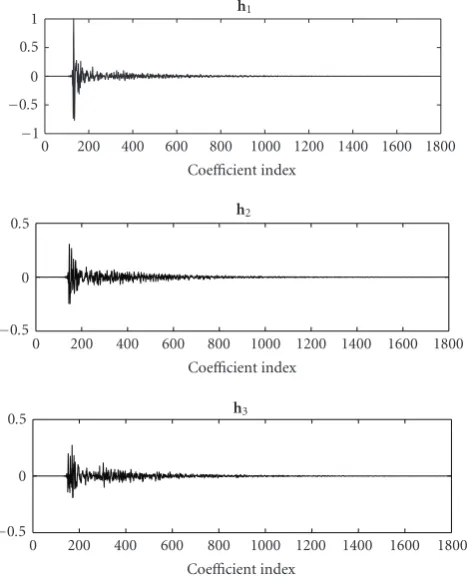
The performance of the proposed method was evaluated through simulations with speech as input signal. Three im-pulse responses (h1, h2, and h3), shown in Figure 3, all of length N = 1800 were measured with three micro-phones, according to the constellation inFigure 1, in a nor-mal office. The acoustic coupling between the loudspeaker and the closest microphone, AC1, was manually normal-ized to 0 dB and the coupling between the loudspeaker and the second and third microphones, AC2 and AC3, were then estimated to −6 dB and −7 dB, respectively. Thus, 10 log10(h22/h12) = −6 dB and 10 log10(h32/h12) = −7 dB.
Output signalsy1(k),y2(k), andy3(k) were obtained by filtering the input signalx(k) with the three obtained impulse responses and adding noise,
y1(k)=x(k)Th1+n1(k), y2(k)=x(k)Th2+n2(k), y3(k)=x(k)Th3+n3(k).
(20)
0 200 400 600 800 1000 1200 1400 1600 1800 Coefficient index
1 0.5 0 0.5
1 h1
0 200 400 600 800 1000 1200 1400 1600 1800 Coefficient index
0.5 0
0.5 h2
0 200 400 600 800 1000 1200 1400 1600 1800 Coefficient index
0.5 0
0.5 h3
Figure3: Impulse responses used in the simulations.
The noise sources n1(k), n2(k), and n3(k) were indepen-dent, but had the same characteristics (bandlimited flat spec-trum). Echo-to-noise ratio was approximately 40 dB for mi-crophone 1 and 34 dB and 33 dB for mimi-crophones 2 and 3, respectively.
In the simulations four low-complexity methods of sim-ilar complexity were compared; the periodic (N)LMS [5], random NLMS (similar to SPU-LMS [10]) selecting which filter to be updated in a stochastic manner (with all filters having equal probability of an update), M-Max NLMS [6], and the proposed NLMS. The performance of the full update NLMS is also shown for comparison. The periodic NLMS, random NLMS, and the proposed method limit the updates to one whole filter at each time interval, while M-Max NLMS instead updates all filters but only does this for a subset (1/3 in this case) of all coefficients. However, since M-Max NLMS requires sorting of the input vectors, the complexity for this method is somewhat larger (2 log2N+ 2 comparisons and (N−1)/2 memory transfers [9]). Zero initial coefficients were used for all filters and methods. The result is presented in
Figure 4, where the normalized filter mismatch, calculated as
10 log10 hm−hm(k) 2
hm2
m=1, 2, 3, (21)
0 20 40 60 80 100 120 Seconds
50 40 30 20 10 0
Mi
sm
at
ch
(d
B
)
Filter 1
NLMS updated every sample Periodic NLMS
Proposed NLMS updating scheme
Random NLMS M-Max NLMS
0 20 40 60 80 100 120
Seconds 40
30 20 10 0
Mi
sm
at
ch
(d
B
)
Filter 2
NLMS updated every sample Periodic NLMS
Proposed NLMS updating scheme
Random NLMS M-Max NLMS
0 20 40 60 80 100 120
Seconds 40
30 20 10 0
Mi
sm
at
ch
(d
B
)
Filter 3
NLMS updated every sample Periodic NLMS
Proposed NLMS updating scheme
Random NLMS M-Max NLMS
Figure4: Mismatch for the the evaluated methods.
NLMS and also to the random NLMS. The performance of the M-Max NLMS and the proposed solution is comparable, although the proposed solution performs better or equal for all filters.
The algorithm automatically concentrates computational resources to filters with large error signals. This is demon-strated in Figure 5, where filter 2 undergoes an echo-path change, that is, a dislocation of the microphone. InFigure 5,
0 20 40 60 80 100 120
Seconds 50
40 30 20 10 0
Mi
sm
at
ch
(d
B
)
Filter 1
NLMS updated every sample Periodic NLMS
Proposed NLMS updating scheme
Random NLMS M-Max NLMS
0 20 40 60 80 100 120
Seconds 40
30 20 10 0
Mi
sm
at
ch
(d
B
)
Filter 2
NLMS updated every sample Periodic NLMS
Proposed NLMS updating scheme
Random NLMS M-Max NLMS
0 20 40 60 80 100 120
Seconds 40
30 20 10 0
Mi
sm
at
ch
(d
B
)
Filter 3
NLMS updated every sample Periodic NLMS
Proposed NLMS updating scheme
Random NLMS M-Max NLMS
Figure5: Mismatch for the the evaluated methods, where an echo-path change occurs for filter 2 after 55 seconds.
it can be seen that the proposed algorithm basically follows the curve of the full update NLMS immediately after the echo-path changes.
the time. This problem can be reduced by setting a limit on the lowest rate of updates for a filter, that is, if filtermhas not been updated for the lastUsamples it is forced to update the next iteration. However, this does not resolve the issue opti-mally. A more sophisticated method is to monitor the echo reduction of the filters and bypass or reduce the resources allocated to filters not providing significant error reduction. Implementing these extra functions will of course add com-plexity.
7. CONCLUSIONS
In an acoustic multichannel solution with multiple adaptive filters, the computation power required to update all filters every sample can be vast. This paper has presented a solution which updates only one filter every sample and thus signifi-cantly reduces the complexity, while still performing well in terms of convergence speed. The solution also handles echo-path changes well, since the most misadjusted filter gets the most computation power, which often is a desirable feature in practice.
ACKNOWLEDGMENT
The authors would like to thank the Swedish Knowledge Foundation (KKS) for funding.
REFERENCES
[1] E. H¨ansler and G. Schmidt,Acoustic Echo and Noise Control: A Practical Approach, John Wiley & Sons, New York, NY, USA, 2004.
[2] M. M. Sondhi, “An adaptive echo canceler,”Bell System Tech-nical Journal, vol. 46, no. 3, pp. 497–510, 1967.
[3] B. Widrow and S. D. Stearns, Adaptive Signal Processing, Prentice-Hall, Englewood Cliffs, NJ, USA, 1985.
[4] S. Haykin,Adaptive Filter Theory, Prentice-Hall, Englewood Cliffs, NJ, USA, 4th edition, 2002.
[5] S. C. Douglas, “Adaptive filters employing partial updates,”
IEEE Transactions on Circuits and Systems II: Analog and Digi-tal Signal Processing, vol. 44, no. 3, pp. 209–216, 1997. [6] T. Aboulnasr and K. Mayyas, “Complexity reduction of the
NLMS algorithm via selective coefficient update,”IEEE Trans-actions on Signal Processing, vol. 47, no. 5, pp. 1421–1424, 1999.
[7] P. A. Naylor and W. Sherliker, “A short-sort M-Max NLMS partial-update adaptive filter with applications to echo can-cellation,” inProceedings of IEEE International Conference on Acoustics, Speech, and Signal Processing (ICASSP ’03), vol. 5, pp. 373–376, Hong Kong, April 2003.
[8] K. Doganc¸ay and O. Tanrikulu, “Adaptive filtering algorithms with selective partial updates,”IEEE Transactions on Circuits and Systems II: Analog and Digital Signal Processing, vol. 48, no. 8, pp. 762–769, 2001.
[9] T. Schertler, “Selective block update of NLMS type algo-rithms,” in Proceedings of IEEE International Conference on Acoustics, Speech, and Signal Processing (ICASSP ’98), vol. 3, pp. 1717–1720, Seattle, Wash, USA, May 1998.
[10] M. Godavarti and A. O. Hero III, “Partial update LMS algo-rithms,”IEEE Transactions on Signal Processing, vol. 53, no. 7, pp. 2382–2399, 2005.
[11] E. H¨ansler and G. Schmidt, “Single-channel acoustic echo cancellation,” inAdaptive Signal Processing, J. Benesty and Y. Huang, Eds., Springer, New York, NY, USA, 2003.
[12] S. M. Kuo and J. Chen, “Multiple-microphone acoustic echo cancellation system with the partial adaptive process,”Digital Signal Processing, vol. 3, no. 1, pp. 54–63, 1993.
[13] S. Gollamudi, S. Kapoor, S. Nagaraj, and Y.-F. Huang, “Set-membership adaptive equalization and an updator-shared im-plementation for multiple channel communications systems,”
IEEE Transactions on Signal Processing, vol. 46, no. 9, pp. 2372– 2385, 1998.
[14] S. Werner, J. A. Apolinario Jr., M. L. R. de Campos, and P. S. R. Diniz, “Low-complexity constrained affine-projection algo-rithms,”IEEE Transactions on Signal Processing, vol. 53, no. 12, pp. 4545–4555, 2005.
[15] W. A. Gardner, “Learning characteristics of stochastic-gradient-descent algorithms: a general study, analysis, and cri-tique,”Signal Processing, vol. 6, no. 2, pp. 113–133, 1984. [16] ADSP-BF533 Blackfin processor hardware reference, Analog