P R O T O C O L
Open Access
Parent experiences and information needs
relating to procedural pain in children: a
systematic review protocol
Allison Gates
1,2, Kassi Shave
1,2, Robin Featherstone
1,2, Kelli Buckreus
3, Samina Ali
2,4, Shannon Scott
3and Lisa Hartling
1,2*Abstract
Background:There exist many evidence-based interventions available to manage procedural pain in children and neonates, yet they are severely underutilized. Parents play an important role in the management of their child’s pain; however, many do not possess adequate knowledge of how to effectively do so. The purpose of the planned study is to systematically review and synthesize current knowledge of the experiences and information needs of parents with regard to the management of their child’s pain and distress related to medical procedures in the emergency department.
Methods: We will conduct a systematic review using rigorous methods and reporting based on the PRISMA statement. We will conduct a comprehensive search of literature published between 2000 and 2016 reporting on parents’experiences and information needs with regard to helping their child manage procedural pain and distress. Ovid MEDLINE, Ovid PsycINFO, CINAHL, and PubMed will be searched. We will also search reference lists of key studies and gray literature sources. Two reviewers will screen the articles following inclusion criteria defined a priori. One reviewer will then extract the data from each article following a data extraction form developed by the study team. The second reviewer will check the data extraction for accuracy and completeness. Any disagreements with regard to study inclusion or data extraction will be resolved via discussion. Data from qualitative studies will be summarized thematically, while those from quantitative studies will be summarized narratively. The second reviewer will confirm the overarching themes resulting from the qualitative and quantitative data syntheses. The Critical Appraisal Skills Programme Qualitative Research Checklist and the Quality Assessment Tool for Quantitative Studies will be used to assess the quality of the evidence from each included study.
Discussion: To our knowledge, no published review exists that comprehensively reports on the experiences and information needs of parents related to the management of their child’s procedural pain and distress. A systematic review of parents’ experiences and information needs will help to inform strategies to empower them with the knowledge necessary to ensure their child’s comfort during a painful procedure.
Systematic review registration: PROSPERO CRD42016043698
Keywords: Procedural pain, Emergency medicine, Pediatrics, Information needs, Parents
* Correspondence:[email protected]
1
Alberta Research Centre for Health Evidence (ARCHE), University of Alberta, 11405-87 Avenue, Edmonton, Alberta T6G 1C9, Canada
2Department of Pediatrics, University of Alberta, 11405-87 Avenue,
Edmonton, Alberta T6G 1C9, Canada
Full list of author information is available at the end of the article
Background
The World Health Organization asserts that each child has the right to health and the right to be spared avoidable pain [1]. In this regard, a substantial number of children and neonates have been underserved. Procedures frequently carried out in the emergency department (ED) represent one of the most common sources of
acutely painful stimuli for children. These may
include venipuncture, intravenous (IV) insertion and removal, capillary sampling, stapling and suturing, fracture reductions, oral and nasal suctioning, and tape removal [2]. Simply visiting the ED and the thought of a potentially painful procedure can pro-voke distress for children. In many cases, the pain and distress induced by these procedures is prevent-able or could be substantially relieved [3]. Though many evidence-based interventions are widely avail-able to manage procedural pain in children and neo-nates, they remain severely underutilized in pediatric populations [4–7].
Inadequate management of procedural pain in
children and neonates has been linked with numerous psychological and physiological consequences. In neo-nates, poorly managed procedural pain may have a lasting negative impact on their pain responses [8]. Infants who have experienced multiple painful proce-dures (e.g., heel lance) are more pain sensitive as adolescents and are more likely to report somatic symptoms than infants who did not experience mul-tiple painful procedures [9, 10]. For children, poorly managed procedural pain may result in greater anx-iety, pain, and avoidance of health care as adults [9]. Inadequate procedural pain management early in life may also decrease the effectiveness of adequate anal-gesia in subsequent procedures [11].
Watching their child undergo a painful procedure can also negatively impact the physiological and psycho-logical wellbeing of parents [12]. This experience may lead to increases in heart rate, blood pressure, and self-reported anxiety [12]. Parent distress around their child’s procedure also positively predicts increased child pain and distress, suggesting that parents play an important role in their child’s procedural pain management [12]. Primary components of providing family-centered pediatric emergency care involve alleviating patient and family distress and fear around treatments, incorporating the family’s knowledge and preferences into their child’s treat-ment plan, and communicating information and providing the family with necessary education for their active involve-ment in their child’s care [13].
In the context of an unscheduled visit to the ED, children and their parents are particularly vulnerable; they may have no experience managing painful proce-dures and have little time to prepare for what is about to
happen. Although also painful, community-based proce-dures like vaccinations are predictable and can be prepared for. Moreover, children who are inpatients or who are living with chronic conditions experience painful medical procedures much more frequently than otherwise healthy children in the ED. As such, their parents likely have very different experiences, knowledge, and information needs.
To date, research has focused primarily on child and/ or caregiver outcomes pertaining to interventions for procedural pain management (e.g., distraction, topical anesthetics, breastfeeding). Recognizing the vulnerability of a parent whose child requires a painful medical procedure in the ED, we aim to design and implement relevant strategies to help parents understand and effect-ively manage their child’s pain and distress specific to this context. First, a comprehensive understanding of their experiences and information needs is required. To the authors’knowledge, a comprehensive review of rele-vant literature has yet to be published on this topic. In response to this knowledge gap, the primary objective of the proposed study is to systematically review primary research, published since the year 2000, investigating parent information needs and experiences around children’s distress and pain during painful medical procedures in the ED. We aim to answer the follow-ing key research questions:
1. What are parents’experiences surrounding the management of their child’s pain and distress during painful medical procedures in the ED?
2. What information do parents need to understand and manage their child’s pain and distress during a painful medical procedure in the ED?
Methods
The proposed systematic review will be undertaken between July and November 2016, following an a priori protocol, as described herein. The protocol for the review was designed in accordance with the Preferred Reporting Items for Systematic Review and Meta-Analysis Protocols (PRISMA-P) guidelines (see Additional file 1) [14]. Any methodological changes from the protocol to the final systematic review will be documented in the subsequent manuscript and submitted for publication.
Experiences and information needs
emotional, and psychological sensations. Experiences are subjective and deeply personal, such that parents going through similar situations may react differently based on myriad factors (e.g., preparedness, know-ledge, co-morbid stressors). Information needs include the content (i.e., topic), mode of delivery (e.g., elec-tronic, paper-based, verbal), and amount of informa-tion that parents desire to receive about managing their child’s procedural pain. Information needs are not entirely distinct from experiences. How timely the information is and the context in which it is provided (e.g., noisy, calm) can impact how it is received. This, in turn, may impact a parent’s experience of the procedure and their ability to comfort their child.
Search strategy
The search strategy will combine subject headings and keywords for concepts: pain, ED procedures and visits, parents, and information needs. The author team includes pain research (SA), systematic review method-ology (LH), and knowledge translation (SS) specialists, as well as a medical research librarian (RF). The team convened to decide on relevant keywords and subject heading to include in the search, including procedures that are common to the ED setting (e.g., venipuncture, IV insertion). Database searches will be limited to English language records published since January 2000. The author team selected 2000 as the start date for the search after conducting a preliminary investigation of systematic reviews on pediatric procedural pain in the hospital setting. To our knowledge, the earliest system-atic review was conducted in 1999 [15] and reported small sample sizes and inconsistent findings from included studies. Since then, the evidence-base for pediatric pain management has improved significantly [16, 17]. In order to identify parents’ experiences and information needs as they pertain to current practices in pediatric pain care, we will exclude studies published prior to 2000, as these are likely not reflective of the current parental experience.
We will search the following online databases: Ovid MEDLINE In-Process & Other Non-Indexed Citations and Ovid MEDLINE (1946 to present), Ovid PsycINFO (1987 to present), CINAHL via EBSCOhost (1937 to present), and PubMed via NCBI Entrez (electronic pub-lications only). These databases will provide coverage of literature in the health and biomedical sciences, as well as behavioral sciences, psychology, and mental health. To identify studies not published in indexed journals, we will search selected gray literature sources including Pro-Quest Dissertations and Theses Global, and conference proceedings (e.g., Canadian Pain Society, American Pain Society, International Association for the Study of Pain, International Symposium on Pediatric Pain). Authors of
conference abstracts will be contacted via email to inquire as to the availability of related full-text records. To further reduce the likelihood that a relevant article is omitted, we will review the reference lists of included articles. Our search strategy for Ovid MEDLINE is shown in an additional file (Additional file 2).
Study selection
Search results will be uploaded to EndNote (v. X7, Thomson Reuters, Toronto, Canada), a reference management tool accessible locally to the study team members. All duplicates will be removed from the EndNote Library. Two independent reviewers will screen records for inclusion. In the first-level screen-ing, the reviewers will screen the records by title and
abstract for relevance. Eligible records will be
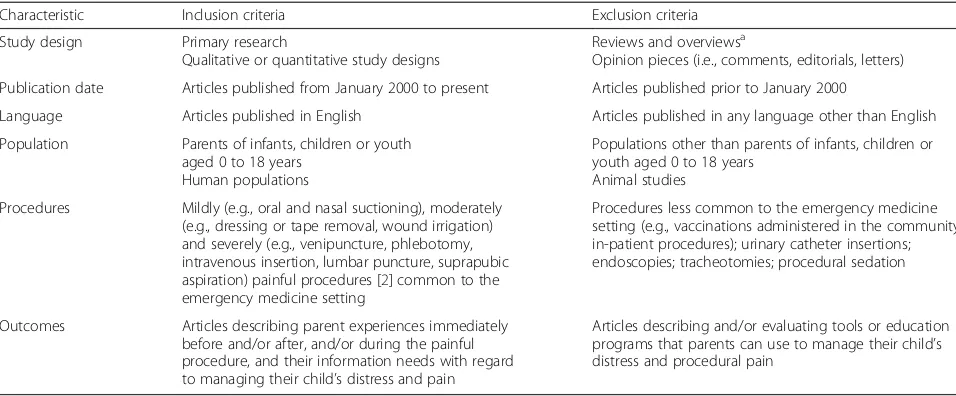
retrieved and will undergo second-level screening where full-text studies will be reviewed for inclusion. Disagreements between reviewers will be resolved through discussion or involvement of a third-party with subject area expertise. All decisions regarding the exclusion of studies will be documented and reported on. Inclusion and exclusion criteria for art-icle selection are detailed in Table 1. The study team will convene monthly throughout the study selection process to discuss findings to date and refine the inclusion and exclusion criteria, if necessary. A flow diagram, adapted from the PRISMA guidelines [18], will be developed to demonstrate the movement of articles throughout the review process.
Data extraction
Data extracted from each article will include publication year, country, population and sample size, and study design. We will also extract data on procedure type, clin-ical setting in which the procedure was conducted, and child age to determine the clinical context of included studies. In accordance with the primary objective of the proposed review, we will extract the main findings as they pertain to parent experiences and information needs related to their child’s procedural pain and how these were measured in each respective study. The data extraction for each study will be completed by one reviewer using a data extraction form developed by the research team. A second reviewer will check the data extraction for accuracy and completeness. Any disagree-ments between the two reviewers will be resolved via discussion to reach consensus. The data will be pre-sented using a summary table that describes the included studies.
Data synthesis
be qualitative. Studies reporting quantitative findings may also be included. For qualitative studies, presenting the findings in a tabular format will not adequately represent the richness of the data. Therefore, we plan to employ a thematic synthesis approach [19] to generate key analytical themes describing the amalgamated find-ings from the included articles. Thematic synthesis is the recommended approach for summarizing qualitative data from systematic, comprehensive reviews of the literature [20]. All data from the“Results” or “Findings” sections of each qualitative study will first be extracted verbatim to NVivo (v. 10, QSR International, Melbourne, Australia) data management software. After reading through the text, we will employ line-by-line coding, assigning one or more codes to each line of text. These codes will then be organized into analytical themes. The coding will be inductive, as to not impose any a priori theories or expectations onto the data, allowing the themes to emerge from the data themselves. To reduce the risk of bias (e.g., confirmative bias), the thematic synthesis will be conducted by one reviewer, while a second reviewer will appraise the preliminary coding. A debriefing meeting will then be used to ensure transpar-ency in the coding and agreement between the reviewers. The two reviewers will ultimately agree on the final over-arching themes that emerge from the analyses, which will be presented narratively. The findings of the quantitative studies will be presented either in a tabular format or nar-ratively, depending on the quantity of records identi-fied. For example, the results of surveys or validated questionnaires will be described with proportions, means and standard deviations, or any other measures that are reported in the original publication. Because we will be excluding intervention studies, we do not
plan to conglomerate the findings of the studies using a meta-analytic approach.
Quality of evidence and risk of bias
Risk of bias and methodological quality will be deter-mined for each study utilizing tools specific to quali-tative and quantiquali-tative methodologies. Two reviewers will independently assess each study using the appro-priate assessment tool based on study methodology. Discrepancies in decisions will be resolved through discussion.
Risk of bias and methodological quality of individual qualitative studies included in our review will be assessed using CASP, the Critical Appraisal Skills Programme Qualitative Research Checklist [21]. This commonly used appraisal tool broadly seeks to assess the validity and local utility of the results of qualitative research [20]. Ten com-ponents of a study are systematically assessed, including the aims of the research, methodology, research design, recruitment strategy, data collection, relationship between researcher and participant, ethical issues, data analysis, findings, and overall value of the research. All items will be reported on.
Risk of bias and methodological quality of individual quantitative studies included in our review will be assessed using the Quality Assessment Tool for Quanti-tative Studies [22]. This rating tool assesses studies on eight domains: selection bias, study design, confounders, blinding, data collection methods, withdrawals and drop-outs, intervention integrity, and analyses. Based on assessments of each domain, the article is then ranked globally as strong, moderate, or weak. All items and global rankings will be reported on.
Table 1Inclusion and exclusion criteria for the selection of studies relevant to the review
Characteristic Inclusion criteria Exclusion criteria
Study design Primary research
Qualitative or quantitative study designs
Reviews and overviewsa
Opinion pieces (i.e., comments, editorials, letters)
Publication date Articles published from January 2000 to present Articles published prior to January 2000
Language Articles published in English Articles published in any language other than English
Population Parents of infants, children or youth aged 0 to 18 years
Human populations
Populations other than parents of infants, children or youth aged 0 to 18 years
Animal studies
Procedures Mildly (e.g., oral and nasal suctioning), moderately (e.g., dressing or tape removal, wound irrigation) and severely (e.g., venipuncture, phlebotomy, intravenous insertion, lumbar puncture, suprapubic aspiration) painful procedures [2] common to the emergency medicine setting
Procedures less common to the emergency medicine setting (e.g., vaccinations administered in the community, in-patient procedures); urinary catheter insertions; endoscopies; tracheotomies; procedural sedation
Outcomes Articles describing parent experiences immediately before and/or after, and/or during the painful procedure, and their information needs with regard to managing their child’s distress and pain
Articles describing and/or evaluating tools or education programs that parents can use to manage their child’s distress and procedural pain
a
Confidence in cumulative evidence
Regardless of the results of the risk or bias and quality assessments, all relevant studies will be included in the review. We will report the conglomerate findings of included studies in light of the results of these assess-ments. For qualitative studies, those that score “yes” on items 1–3 (e.g., clear statement of the aims of the research, qualitative methodology is appropriate, and research design is appropriate) will be considered to be of adequate quality. The findings of lower quality studies will thus have less bearing on the main emergent themes from the qualitative analysis. For the quantitative stud-ies, those ranked “strong” will, accordingly, have greater influence on the cumulative evidence reported as compared to those ranked“moderate”or“weak.”
Discussion
Pediatric procedural pain has been widely reported as undermanaged throughout the published literature [3, 5, 7]. Caregivers of children undergoing painful procedures in the ED demonstrate interest and commit-ment to ensuring their child has a pain- and distress-free experience. The vast majority of caregivers express that, if possible, they would choose to make their child’s proced-ure painless and would be willing to spend additional time in the ED if required to make this possible [23]. Emer-gency departments across North America continue to face time and resource constraints, including long wait times and high patient volumes [24–27]. Caregivers represent a captive audience who is motivated to eliminate the dis-tress and pain their children face when undergoing painful procedures and, in most cases, has the time to have a role in doing so.
Our proposed review will establish a more comprehen-sive understanding of parent experiences and information needs relating to children’s procedural pain. We will apply the findings to the development and evaluation of tailored, innovative knowledge translation tools to facilitate parents taking on an engaged role in managing their child’s distress and pain related to medical procedures in the ED. Besides parents, we plan to disseminate the findings of this review to other relevant stakeholders, who may include health care practitioners, academics with an interest in pediatric procedural pain management, and experts in public health, health promotion, and knowledge translation. A multi-modal dissemination plan (e.g., publication, presentations, knowledge translation tools) will ensure a broad reach.
Additional files
Additional file 1:Completed PRISMA-P Checklist. (DOCX 28 kb)
Additional file 2:Sample Search Strategy for Ovid MEDLINE. (DOCX 16 kb)
Abbreviations
IV:Intravenous; CASP: Critical Appraisal Skills Programme; ED: Emergency department; PRISMA: Preferred Reporting Items for Systematic Reviews and Meta-Analyses; PRISMA-P: Preferred Reporting Items for Systematic Review and Meta-Analysis Protocols
Acknowledgements
Not applicable.
Funding
This project was supported in part through the Network of Centres of Excellence in Knowledge Mobilization, TREKK (TRanslating Emergency Knowledge for Kids) and the Women and Children’s Health Research Institutes in Edmonton, Canada. LH receives salary support through a New Investigator Award from the Canadian Institutes of Health Research. SS is a Canada Research Chair (Tier II) for Knowledge Translation in Child Health and is also supported by an Alberta Innovates Health Solutions Population Health Investigator Award. The funders played no role in the design of the study or in the writing of the manuscript and decision to submit it for publication.
Availability of data and materials
Not applicable.
Authors’contributions
AG and KS provided input on the study design and wrote the drafts of the manuscript. RF provided input on the study design, designed and implemented the search strategy, and contributed to the drafts of the manuscript. KB provided input on the study design and reviewed the manuscript prior to submission. SA provided input on the study design and reviewed and edited the manuscript prior to submission. SS led the needs assessment that informed the clinical topic, helped to receive funding for the project, provided input on the study design, and reviewed and edited the manuscript prior to submission. LH conceived the study, provided input on the study design, and reviewed and edited the manuscript prior to submission. All authors agreed to the content of the manuscript before submission. All authors read and approved the final manuscript.
Competing interests
The authors declare that they have no competing interests.
Consent for publication
Not applicable.
Ethics approval and consent to participate
Not applicable.
Publisher’s Note
Springer Nature remains neutral with regard to jurisdictional claims in published maps and institutional affiliations.
Author details
1
Alberta Research Centre for Health Evidence (ARCHE), University of Alberta, 11405-87 Avenue, Edmonton, Alberta T6G 1C9, Canada.2Department of Pediatrics, University of Alberta, 11405-87 Avenue, Edmonton, Alberta T6G 1C9, Canada.3Faculty of Nursing, University of Alberta, 11405-87 Avenue, Edmonton, Alberta T6G 1C9, Canada.4Women and Children’s Health Research Institute, University of Alberta, 11405-87 Avenue, Edmonton, Alberta T6G 1C9, Canada.
Received: 8 September 2016 Accepted: 11 May 2017
References
1. World Health Organization. WHO guidelines on the pharmacological treatment of persisting pain in children with medical illnesses. Geneva, Switzerland: World Health Organization; 2012.
2. Stevens BJ, Abbott LK, Yamada J, Harrison D, Stinson J, Taddio A, et al. Epidemiology and management of painful procedures in children in Canadian hospitals. CMAJ. 2011;183:E403–10.
Adolescents. The assessment and management of acute pain in infants, children, and adolescents. Pediatrics. 2001;108:793–7.
4. Curtis S, Wingert A, Ali S. The Cochrane Library and procedural pain in children: an overview of reviews. Evid Based Child Health Cochrane Rev J. 2012;7:1363–99.
5. Committee on Fetus and Newborn and Section on Anesthesiology and Pain Medicine. Prevention and management of procedural pain in the neonate: An update. Pediatrics. 2016;137:1-13.
6. MacLean S, Obispo J, Young KD. The gap between pediatric emergency department procedural pain management treatments available and actual practice. Pediatr Emerg Care. 2007;23:87–93.
7. Ali S, Chambers A, Johnson DW, Newton AS, Vandermeer B, Williamson J, et al. Reported practice variation in pediatric pain management: a survey of Canadian pediatric emergency physicians. CJEM. 2014;16:352–60. 8. Zempsky WT, Cravero JP. Relief of pain and anxiety in pediatric patients in
emergency medical systems. Pediatrics. 2004;114:1348–56.
9. Young KD. Pediatric procedural pain. Ann Emerg Med. 2005;45:160–71. 10. Buskila D, Neumann L, Zmora E, Feldman M, Bolotin A, Press J. Pain
sensitivity in prematurely born adolescents. Arch Pediatr Adolesc Med. 2003; 157:1079–82.
11. Weisman SJ, Bernstein B, Schechter NL. Consequences of inadequate analgesia during painful procedures in children. Arch Pediatr Adolesc Med. 1998;152:147–9.
12. Smith RW, Shah V, Goldman RD, Taddio A. Caregivers’responses to pain in their children in the emergency department. Arch Pediatr Adolesc Med. 2007;161:578–82.
13. Byczkowski TL, Gillespie GL, Kennebeck SS, Fitzgerald MR, Downing KA, Alessandrini EA. Family-centered pediatric emergency care: a framework for measuring what parents want and value. Acad Pediatr. 2016;16:327–35. 14. Moher D, Shamseer L, Clarke M, Ghersi D, Liberati A, Petticrew M, et al.
Preferred Reporting Items for Systematic Review and Meta-Analysis Protocols (PRISMA-P) 2015 statement. Syst Rev. 2015;4:1.
15. Kleiber C, Harper DC. Effects of distraction on children's pain and distress during medical procedures: a meta-analysis. Nurs Res. 1999;48:44–9. 16. Stinson J, Yamada J, Dickson A, Lamba J, Stevens B. Review of systematic
reviews on acute procedural pain in children in the hospital setting. Pain Res Manag. 2008;13:51–7.
17. Yamada J, Stinson J, Lamba J, Dickson A, McGrath PJ, Stevens B. A review of systematic reviews on pain interventions in hospitalized infants. Pain Res Manag. 2008;13:413–20.
18. Moher D, Liberati A, Tetzlaff J, Altman DG. Preferred Reporting Items for Systematic Reviews and Meta-Analyses: the PRISMA statement. Int J Surg. 2010;8:336–41.
19. Thomas J, Harden A. Methods for the thematic synthesis of qualitative research in systematic reviews. BMC Med Res Methodol. 2008;8:45. 20. Tong A, Flemming K, McInnes E, Oliver S, Craig J. Enhancing transparency in
reporting the synthesis of qualitative research: ENTREQ. BMC Med Res Methodol. 2012;12:181.
21. CASP UK. Critical Appraisal Skills Programme Qualitative Research Checklist. 2013. http://www.casp-uk.net/#!casp-tools-checklists/c18f8. Accessed 27 July 2016. 22. Thomas H. Quality assessment tool for quantitative studies. Effective Public
Health Practice Project. Toronto: McMaster University; 2003. 23. Walsh BM, Bartfield JM. Survey of parental willingness to pay and
willingness to stay for“painless”intravenous catheter placement. Pediatr Emerg Care. 2006;22:699–703.
24. Canadian Institute for Health Information. Understanding emergency department wait times: Who is using emergency departments and how long are they waiting? Ottawa: Canadian Institute for Health Information; 2005. 25. Institute of Medicine. IOM report: the future of emergency care in the
United States health system. Acad Emerg Med. 2006;13:1081–5. 26. Derlet R, Richards J, Kravitz R. Frequent overcrowding in U.S. emergency
departments. Acad Emerg Med. 2001;8:151–5.
27. Canadian Association of Emergency Physicians, the National Emergency Nurses Affiliation. Access to acute care in the setting of emergency department overcrowding. CJEM. 2003;5:81–6.
• We accept pre-submission inquiries
• Our selector tool helps you to find the most relevant journal
• We provide round the clock customer support
• Convenient online submission
• Thorough peer review
• Inclusion in PubMed and all major indexing services
• Maximum visibility for your research
Submit your manuscript at www.biomedcentral.com/submit