R E S E A R C H
Open Access
Shrinking projection algorithms for equilibrium
problems with a bifunction defined on the dual
space of a Banach space
Jia-wei Chen
1, Yeol Je Cho
2*and Zhongping Wan
1* Correspondence: [email protected] 2
Department of Mathematics Education and the RINS, Gyeongsang National University, Chinju 660-701, Republic of Korea Full list of author information is available at the end of the article
Abstract
Shrinking projection algorithms for finding a solution of an equilibrium problem with a bifunction defined on the dual space of a Banach space, in this paper, are
introduced and studied. Under some suitable assumptions, strong and weak convergence results of the shrinking projection algorithms are established,
respectively. Finally, we give an example to illustrate the algorithms proposed in this paper.
2000 Mathematics Subject Classification:47H09; 65J15; 90C99.
Keywords:equilibrium problem, strong and weak convergence, shrinking projection algorithm, sunny generalized nonexpansive retraction, fixed point
1 Introduction
Let Ωbe a nonempty closed subset of a real Hilbert space H. Let gbe a bifunction
fromΩ×ΩtoR, whereRis the set of real numbers.The equilibrium problemforgis as follows: Find x¯∈ such that
g(x¯,y)≥0, ∀y∈.
Many problems in structural analysis, optimization, management sciences, econom-ics, variational inequalities and complementary problems coincide to find a solution of the equilibrium problem. Various methods have been proposed to solve some kinds of equilibrium problems in Hilbert and Banach spaces (see [1-8]).
In [9], Takahashi and Zembayashi proved strong and weak convergence theorems for finding a common element of the set of solutions of an equilibrium problem and the set of fixed points of a relatively nonexpansive mapping in Banach spaces. Ibaraki and Taka-hashi [10] introduced a new resolvent of a maximal monotone operator in Banach spaces and the concept of the generalized nonexpansive mapping in Banach spaces. Honda et al. [11], Kohsaka and Takahashi [12] also studied some properties for the gen-eralized nonexpansive retractions in Banach spaces. Takahashi et al. [13] proved a strong convergence theorem for nonexpansive mapping by hybrid method. In 2009, Ceng et al. [2] proved strong and weak convergence theorems for equilibrium problems and dealt maximal monotone operators by hybrid proximal-point methods. Motivated by Ibaraki
and Takahashi [10] and Takahashi et al. [13], Takahashi and Zembayashi [14] considered the following equilibrium problem:
Let E be a smooth Banach space with dual spaceE* andC be a nonempty closed
subset of Esuch that J(C) is a closed and convex subset ofE*, whereJ is the normal-ized duality mapping from E ontoE*. Let f:J(C) ×J(C)® Rbe a mapping. Consider the equilibrium problem as follows: Find x¯∈C such that
f(J(x¯),J(y))≥0, ∀y∈C. (1:1)
Then they proved a strong convergence theorem for finding a solution of the equili-brium problem (1.1) in Banach spaces. Forward, we denote the set of solutions of the problem (1.1) by EP(f):
Inspired and motivated by Ceng et al. [2], Takahashi and Zembayashi [14], Takahashi and Zembayashi [9], the main aim of this paper is to introduce and investigate a new iterative method for finding a solution of the equilibrium problem (1.1). Under some appropriate assumptions, strong and weak convergence results of the iterative algo-rithms are established, respectively. Furthermore, we also give an example to illustrate the algorithms proposed in this paper.
2 Preliminaries
Throughout this paper, we denote the sets of nonnegative integers and real numbers by Z+andR, respectively.
Let E be a real Banach space with the dual space E*. The norm and the dual pair
betweenEand E* are denoted by║·║and〈·,·〉, respectively. The weak convergence and
strong convergence are denoted by ⇀and®, respectively. LetCbe a nonempty closed
subset ofE. We denote thenormalized duality mappingfromEtoE*byJdefined by
J(x) =j(x)∈E∗:j(x),x=j(x)x=j(x)2=x2, ∀x∈E.
J is said to beweakly sequentially continuousif the strong convergence of a sequence {xn} toxinEimplies the weak* convergence of {J(xn)} toJ(x) inE*.
Many properties of the normalized duality mapping Jcan be found in [15-17] and,
now, we list the following properties: (p1)J(x) is nonempty for anyxÎE;
(p2)Jis a monotone and bounded operator in Banach spaces;
(p3)Jis a strictly monotone operator in strictly convex Banach spaces; (p4)Jis the identity operator in Hilbert spaces;
(p5) If E is a reflexive, smooth and strictly convex Banach space andJ*:E* ® 2E is the normalized duality mapping on E*, then J-1=J*;JJ* =IE* andJ*J =IE; whereIE* and IE*are the identity mappings onEandE*, respectively.
(p6) IfEis a strictly convex Banach space, thenJ is one to one, that is,
x=y ⇒ J(x)∩J(y) =∅;
(p7) IfEis smooth, then Jis single-valued;
(p8)Eis a uniformly convex Banach space if and only ifE* is uniformly smooth; (p9) IfEis uniformly convex and uniformly smooth Banach space, thenJis uniformly
norm-to-norm continuous on bounded subsets of E and J-1 = J* is also uniformly
Let Ebe a smooth Banach space. Let a functionj:E×E®Rbe defined as follows:
φ(x,y) =x2−2x,J(y)+y2, ∀x,y∈E.
Then we have
φ(x,y) =φ(x,z) +φ(z,y) + 2x−z,J(z)−J(y), ∀x,y,z∈E.
Remark 2.1. (see [17,18]) The following statements hold:
(1) IfE is a reflexive, strictly convex and smooth Banach space, then, for allx,y ÎE, j(x;y) = 0 if and only ifx=y;
(2) IfEis a Hilbert space, then j(x,y) = ║x- y║2for allx;y ÎE; (3) For all x,yÎE, (║x║-║y║)2 ≤j(x, y) ≤(║x║+║y║)2.
For solving the equilibrium problem (1.1), we assume that f:J(C) ×J(C)® R satisfies the following conditions (A1) - (A4) [9]:
(A1)f(x*,x*) = 0 for allx* ÎJ(C);
(A2)fis monotone, that is,f(x*;y*) +f(y*,x*)≤0 for allx*,y*ÎJ(C); (A3)fis upper hemicontinuous, that is, for allx*,y*,z*ÎJ(C),
lim sup
t→0+
f(x∗+t(z∗−x∗),y∗)≤f(x∗,y∗);
(A4) For allx*Î J(C),f(x*, ·) is convex and lower semicontinuous. In the sequel, we recall some concepts and results.
Definition 2.1. (see [11]) LetC be a nonempty closed subset of a smooth Banach spaceE. A mappingT:C® Cis said to begeneralized nonexpansiveifF(T) is none-mpty and
φ(Tx,p)≤φ(x,p), ∀x∈C,p∈F(T),
whereF(T) denotes the set of fixed points ofT, that is,F(T) = {xÎC:Tx =x}.
Definition 2.2. (see [11]) LetC be a nonempty closed subset ofE. A mappingR:
E ®Cis called:
(1) a retractionifR2 =R;
(2)sunnyifR(Rx+t(x-Rx)) =Rxfor allxÎEandt> 0.
Definition 2.3. (see [11]) A nonempty closed subsetCof a smooth Banach spaceE
is called a sunny generalized nonexpansive retractofEif there exists a sunny general-ized nonexpansive retractionRfromEontoC.
Lemma 2.1. (see [19]) Let E be a uniformly convex and smooth Banach space, and let {xn} and {yn} be two sequences of E. If j(xn, yn) ® 0 and either {xn} or {yn} is bounded, thenxn-yn®0.
Lemma 2.2. (see [18]) LetEbe a uniformly convex Banach space. Then, for anyr> 0; there exists a strictly increasing, continuous and convex functionh: [0, 2r]®Rsuch that
h(0) = 0 and
tx+ (1−t)y2≤tx2+ (1−t)y2−t(1−t)h(x−y), ∀x,y∈Br,t∈[0, 1],
whereBr= {zÎ E:║z║≤r}.
E, there existszÎ Csuch that
f(J(z),J(y)) + 1
rz−x,J(y)−J(z) ≥0, ∀y∈C.
Lemma 2.4. (see [14]) Let Cbe a nonempty closed subset of a uniformly smooth,
strictly convex and reflexive Banach space E such that J(C) is closed and convex.
Assume that a mappingf: J(C) ×J(C)®Rsatisfies the conditions (A1)-(A4). For anyr
> 0 and xÎE, define a mappingTr:E® Cby
Tr(x) =
z∈C:f(J(z),J(y)) +1
rz−x,J(y)−J(z) ≥0,∀y∈C
, ∀x∈E.
Then the following statements hold: (1)Tris single-valued;
(2) For all x,yÎE,
Tr(x)−Tr(y),J(Tr(x))−J(Tr(y)) ≤ x−y,J(Tr(x))−J(Tr(y));
(3)F(Tr) =EP(f) andJ(EP(f)) is closed and convex;
(4)j(x,Tr(x)) +j(Tr(x),p)≤j(x,p) for allxÎE andpÎ F(Tr).
Lemma 2.5. (see [9]) LetCbe a nonempty closed subset of a smooth, strictly convex and reflexive Banach space E, and letRbe a retraction ofEontoC. Then the following statements are equivalent:
(1)Ris sunny generalized nonexpansive;
(2)〈x-Rx,J(y) -J(Rx)〉≤0 for all (x,y)ÎE×C.
Lemma 2.6. (see [20]) LetCbe a nonempty closed sunny generalized nonexpansive
retract of a smooth and strictly convex Banach space E. Then the sunny generalized
nonexpansive retraction fromEontoCis uniquely determined.
Lemma 2.7. (see [10]) LetC be a nonempty closed subset of a smooth and strictly convex Banach space Esuch that there exists a sunny generalized nonexpansive retrac-tion RfromEontoC. Then, for anyxÎE andzÎC, the following statements hold:
(1)z=Rxif and only if〈x-z,J(y)≤J(z)〉≤0 for ally ÎC; (2)j(x,Rx) +j(Rx, z)≤j(x,z).
Lemma 2.8. (see [12]) Let Cbe a nonempty closed subset of a smooth, strictly con-vex and reflexive Banach spaceE. Then the following statements are equivalent:
(1)Cis a sunny generalized nonexpansive retract ofE; (2)J(C) is closed and convex.
Remark 2.2. IfEis a Hilbert space, then, from Lemmas 2.6 and 2.8, a sunny
general-ized nonexpansive retraction fromE ontoCreduces to a metric projection operatorP
fromEontoC.
Lemma 2.9. (see [12]) LetCbe a nonempty closed sunny generalized nonexpansive retract subset of a smooth, strictly convex and reflexive Banach space E. LetRbe the sunny generalized nonexpansive retraction fromEontoC. Then, for anyxÎEandzÎC,
z=Rx ⇔ φ(x,z) = miny∈Cφ(x,y).
an+1≤an+bn, ∀n∈Z+.
If ∞
n=0bn<∞, then limn®∞anexists.
3 Main results
In this section, we propose iterative algorithms for finding a solution of the equilibrium problem (1.1) and prove the strong and weak convergence for the algorithms in a Banach space under some suitable conditions.
Theorem 3.1. LetCbe a nonempty closed subset of a uniformly convex and
uni-formly smooth Banach space E such that J(C) is closed and convex. Assume that a
mapping f: J(C) ×J(C) ®Rsatisfies the conditions (A1)-(A4). Define a sequence {xn} inCby the following algorithm:
⎧ ⎨ ⎩
x0∈C,
un∈Csuch thatf(J(un),J(y)) +r1nun−xn,J(y)−J(un) ≥0, ∀y∈C,
xn+1=αnx0+ (1−αn)(βnxn+ (1−βn)un), ∀n∈Z+,
where {an}, {bn}⊂[0, 1] such that
∞
n=0
αn<∞, lim inf
n→∞ βn(1−βn)>0, lim infn→∞ rn>0.
Then the sequence {REP(f)xn} converges strongly to a pointωÎ EP(f), whereREP(f)is
the sunny generalized nonexpansive retraction from EontoEP(f).
Proof. For the sake of simplicity, let un=Trnxn andyn=bnxn+ (1 -bn)un. Then xn+1 =anx0+ (1 - an)yn. From Lemma 2.4, it follows thatEP(f) is a nonempty closed and convex subset of E.
First, we claim that {xn} is bounded. Indeed, letωÎEP(f). Since
φ(yn,ω) = ||βnxn+ (1−βn)un||2−2βnxn+ (1−βn)un,J(ω) +||ω||2
≤βn||xn||2+ (1−βn)||un||2−2βnxn,J(ω) −2(1−βn)un,J(ω) +||ω||2
=βnφ(xn,ω) + (1−βn)φ(un,ω)
=βnφ(xn,ω) + (1−βn)φ(Trnxn,ω)
≤φ(xn,ω),
we have
φ(xn+1,ω)≤αnφ(x0,ω) + (1−αn)φ(yn,ω)
≤αnφ(x0,ω) + (1−αn)φ(xn,ω)
≤αnφ(x0,ω) +φ(xn,ω).
By virtue of ∞n=0αn<∞ and Lemma 2.10, it follows that the limit of {j(xn, ω)} exists. Therefore, {j(xn,ω)} is bounded and so {xn}, {un} and {yn} are also bounded. Let zn=REP(f)xn. ThenznÎEP(f) and so, from Lemma 2.7, we have
φ(xn,zn) =φ(xn,REP(f)xn)≤φ(xn,ω)−φ(REP(f)xn,ω)≤φ(xn,ω).
φ(xn+1,zn+1) =φ(xn+1,REP(f)xn+1)
≤φ(xn+1,zn)−φ(REP(f)xn+1,zn)
≤φ(xn+1,zn)
≤αnφ(x0,zn) +φ(xn,zn).
Since {j (x0, zn)} is bounded, there exists M >0 such that |j(x0, zn)| ≤ M. By
∞
n=0αn<∞, we have
∞
n=0
αnφ(x0,zn)≤M
∞
n=0
αn<∞,
that is, ∞n=0αnφ(x0,zn)<∞ From Lemma 2.10, it follows that {j(xn,zn)} is a con-vergent sequence. For anymÎZ+\{0}, one can get
φ(xn+m,ω)≤φ(xn,ω) + m−1
j=0
αn+jφ(x0,ω).
Then we have
φ(xn+m,zn)≤φ(xn,zn) + m−1
j=0
αn+jφ(x0,zn).
Fromzn+m=REP(f)xn+mand Lemma 2.7, it follows that
φ(xn+m,zn+m) +φ(zn+m,zn)≤φ(xn+m,zn)≤φ(xn,zn) + m−1
j=0
αn+jφ(x0,zn)
and so
φ(zn+m,zn)≤φ(xn,zn)−φ(xn+m,zn+m) + m−1
j=0
αn+jφ(x0,zn).
Setr = sup{║zn║: n ÎZ+}. Then, from Lemma 2.2 and [19], it follows that there is a
strictly increasing, continuous and convex function h:[0, 2r]® Rsuch thath(0) = 0 and
h(||zn−zn+m||)≤φ(zn+m,zn)≤φ(xn,zn)−φ(xn+m,zn+m) + m−1
j=0
αn+jφ(x0,zn).
Since {j(xn,zn)} is convergent, {j(x0,zn)} is bounded and
∞
n=0αn is convergent, it
follows that, for any mÎZ+,
lim
n→∞||zn−zn+m|| = 0,
which shows that {zn} is a Cauchy sequence. Since EP(f) is closed, there exists ωÎ EP(f) such thatzn® ω. Therefore, the sequence {REP(f)xn} converges strongly to theω Î EP(f). This completes the proof.□
Theorem 3.2. Let Cbe a nonempty closed subset of a uniformly convex and
mapping f: J(C) ×J(C)®Rsatisfies the conditions (A1)-(A4). Define a sequence {xn} in Cby the following algorithm:
⎧ ⎨ ⎩
x0∈C,
un∈Csuch thatf(J(un),J(y)) +r1nun−xn,J(y)−J(un) ≥0, ∀y∈C,
xn+1=αnx0+ (1−αn)(βnxn+ (1−βn)un), ∀n∈Z+,
where {an}, {bn}⊂[0, 1] such that ∞
n=0
αn<∞, lim inf
n→∞ βn(1−βn)>0, lim infn→∞ rn>0.
If J is weakly sequentially continuous, then the sequence {xn} converges weakly to a point ωÎ EP(f), whereω= limn®∞REP(f)xnandREP(f)is the sunny generalized
nonex-pansive retraction fromE ontoEP(f).
Proof. For the sake of simplicity, let un=Trnxn,yn=bnxn+ (1 -bn)unandzn=REP(f) xn. As in the proof of Theorem 3.1, we have {xn}, {un}, {zn}, {J(xn)} and {yn} are bounded. Setr = sup{║xn║,║zn║:nÎZ+}. It follows from Lemma 2.2 that there exists
a strictly increasing, continuous and convex function h: [0, 2r]® Rsuch that h(0) = 0 and
||βnxn+ (1−βn)un||2≤βn||xn||2+ (1−βn)||un||2−βn(1−βn)h(||xn−un||).
Since
φ(yn,ω) =φ(βnxn+ (1−βn)un,ω)
≤βn||xn||2+ (1−βn)||un||2−βn(1−βn)h(||xn−un||)
−2βnxn,J(ω) −2(1−βn)un,J(ω) +||ω||2
=βnφ(xn,ω) + (1−βn)φ(un,ω)−βn(1−βn)h(||xn−un||)
=βnφ(xn,ω) + (1−βn)φ(Trnxn,ω)−βn(1−βn)h(||xn−un||) ≤φ(xn,ω)−βn(1−βn)h(||xn−un||),
we have
φ(xn+1,ω) =φ(αnx0+ (1−αn)yn,ω)
≤αnφ(x0,ω) + (1−αn)φ(yn,ω)
≤αnφ(x0,ω) +φ(yn,ω)
≤αnφ(x0,ω) +φ(xn,ω)−βn(1−βn)h(||xn−un||).
Moreover, one has
βn(1−βn)h(||xn−un||)≤φ(xn,ω)−φ(xn+1,ω) +αnφ(x0,ω).
From lim infn®∞bn(1 -bn) > 0,
∞
n=0αn<∞ and the limit existence of {j(xn,ω)}, we have
lim
n→∞h(||xn−un||) = 0.
By the property ofh, we get
lim
Since J is uniformly norm-to-norm continuous on the bounded subset of E, we obtain
lim
n→∞||J(xn)−J(un)|| = 0.
Since {J(xn)} is bounded, we have thatJ(xn)⇀p* (here we may take a subnet {xnk} of {xn} if necessary). Then J(un) ⇀ p*. From lim infn®∞ rn > 0, it follows that
limn→∞||xn−rnun|| = 0. Note that
f(J(un),J(y)) +
1 rn
un−xn,J(y)−J(un) ≥0.
By (A2), we obtain
f(J(y),J(un))≤ −f(J(un),J(y))≤
1 rn
un−xn,J(y)−J(un).
Therefore, it follows that f(J(y), p*) ≤ 0. Let y∗t =tJ(y) + (1−t)p∗ for anyt Î(0,1).
Then yt∗∈J(C). Since
0 =fy∗t,y∗t≤tfy∗t,J(y)+ (1−t)fy∗t,p∗≤tfyt∗,J(y),
we get f(y∗t,J(y))≥0. By (A3), one has f(p*,J(y))≥0.Therefore,p*ÎJ(EP(f)). Let zn=REP(f)xn. From Theorem 3.1, one can get thatzn® ωand so
xn−zn,p∗−J(zn) ≤0.
Since Jis weakly sequentially continuous, we have
J−1(p∗)−J−1(J(ω)),J(ω)−p∗≥0. (3:1)
By the monotonicity of J-1,
J−1(p∗)−J−1(J(ω)),J(ω)−p∗≤0. (3:2)
Thus, from both (3.1) and (3.2), it follows that
J−1(p∗)−J−1(J(ω)),J(ω)−J(J−1(p∗))= 0,
this together with the strictly monotonicity ofJ yields thatJ-1(p*) =ω. Therefore, the sequence {xn} converges weakly to the point ω Î EP(f), whereω = limn®∞REP(f)xn. This completes the proof. □
4 Numerical test
In this section, we give an example of numerical test to illustrate the algorithms given in Theorems 3.1 and 3.2.
Example 4.1. LetE=R, C= [-1000, 1000] and definef(x,y): = -5x2+xy+ 4y2. Find ¯
x∈C such that
f(x¯,y)≥0, ∀y∈C. (4:1)
(A3) For allx,y,zÎ[-1000, 1000],
lim sup
t→0+ f(x+t(z−x),y) = lim supt→0+ −5((1−t)x+tz)
2+ (1−t)xy+tzy+ 4y2
=−5x2+xy+ 4y2 ≤f(x,y).
(A4) For all xÎ [-1000, 1000],F(y) =f(x, y) = -5x2 +xy+ 4y2 is convex and lower semicontinuous.
From Lemma 2.4, Tris single-valued. Now, we deduce a formula forTr(x). For anyy Î C, r> 0,
f(z,y) +1
rz−x,y−z ≥0 ⇔ 4ry
2+ ((r+ 1)z−x)y+xz−(5r+ 1)z2≥0.
Set G(y) = 4ry2+ ((r+ 1)z -x)y +xz - (5r + 1)z2. ThenG(y) is a quadratic function ofywith coefficientsa= 4r,b= (r+ 1)z-xand c=xz- (5r+ 1)z2. So its discriminant Δ=b2- 4acis
= [(r+ 1)z−x]2−16r(xz−(5r+ 1)z2)
= (r+ 1)2z2−2(r+ 1)xz+x2−16rxz+ (80r2+ 16r)z2
= [(9r+ 1)z−x]2.
Since G(y)≥0 for ally ÎC, this is true if and only ifΔ ≤0. That is, [(9r+ 1)z-x]2≤ 0. Therefore, z= 9r+1x , which yields that Tr(x) = 9r+1x . Let rn= n+1n , βn= 3n+1n and
αn= 1
(3n+1)2. It is easy to check that
∞
n=0
αn<+∞, lim inf
n→∞ βn(1−βn) = 2
9 >0, lim infn→∞ rn= 1.
Thus, from Lemma 2.4, it follows that EP(f) = {0}. Therefore, all the assumptions in Theorems 3.1 and 3.2 are satisfied. Setting x0= 1 and using the algorithm in Theorem
3.1, we obtain the following sequences:
⎧ ⎪ ⎨ ⎪ ⎩
x0= 1,
un=Trn(xn) =
n+1 10n+1xn,
xn+1= (3n+1)1 2x0+ 108n
4+108n3+33n2+6n 270n4+297n3+117n2+19n+1xn.
Therefore, by Theorem 3.1, the sequence {PEP(f)xn} must converge strongly to a solu-tion of the problem (4.1). In fact, PEP(f)xn= 0 for allnÎZ+. Also, according to
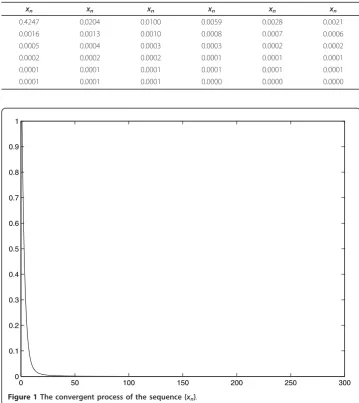
Theo-rem 3.2, the sequence {xn} converges weakly to a solution of the problem (4.1). For a numberε= 10-3, if we use MATLAB, then we generate a sequence {xn} as follows:
Selected values of {un} and {xn} computed by computer programs are listed below Tables 1 and 2, respectively. The convergent process of the sequence {xn} is described in Figure 1.
Table 1 Selected values of {un}
un un un un un un
0.1818 0.0607 0.0026 0.0012 0.0007 0.0003
From Table 1, we can see that the sequence {un} converges to 0. Moreover,F(Tr) = EP(f) = {0}. Table 2 shows that the iterative sequence {xn} converges to 0, which is indeed a solution of the problem (4.1). Moreover, limn→∞PEP(f)xn= 0.
Acknowledgements
The authors would like to thank three anonymous referees for their invaluable comments and suggestions, which led to an improved presentation of the results. This work was supported by the Natural Science Foundation of China (71171150, 70771080), the Korea Research Foundation Grant funded by the Korean Government (KRF-2008-313-C00050), the Academic Award for Excellent Ph.D. Candidates Funded by Wuhan University and the Fundamental Research Fund for the Central Universities (201120102020004).
Author details 1
School of Mathematics and Statistics, Wuhan University, Wuhan, Hubei 430072, China2Department of Mathematics Education and the RINS, Gyeongsang National University, Chinju 660-701, Republic of Korea
Authors’contributions
J-WC, YJC and ZW carried out the studies on nonlinear analysis and applications, wrote this article together and participated in its design of this paper. All authors read and approved the final manuscript.
Competing interests
The authors declare that they have no competing interests.
Table 2 Selected values of {xn}
xn xn xn xn xn xn
0.4247 0.0204 0.0100 0.0059 0.0028 0.0021
0.0016 0.0013 0.0010 0.0008 0.0007 0.0006
0.0005 0.0004 0.0003 0.0003 0.0002 0.0002
0.0002 0.0002 0.0002 0.0001 0.0001 0.0001
0.0001 0.0001 0.0001 0.0001 0.0001 0.0001
0.0001 0.0001 0.0001 0.0000 0.0000 0.0000
0 50 100 150 200 250 300
0 0.1 0.2 0.3 0.4 0.5 0.6 0.7 0.8 0.9 1
Received: 16 July 2011 Accepted: 30 November 2011 Published: 30 November 2011
References
1. Blum, E, Oettli, W: From optimization and variational inequalities to equilibrium problems. Mathe Stud.63, 123–145 (1994)
2. Ceng, LC, Mastronei, G, Yao, JC: Hybrid proximal-point methods for common solutions of equilibrium problems and zeros of maximal monotone operators. J Optim Theory Appl.142, 431–449 (2009). doi:10.1007/s10957-009-9538-z 3. Cho, YJ, Argyros, IK, Petrot, N: Approximation methods for common solutions of generalized equilibrium, systems of
nonlinear variational inequalities and fixed point problems. Comput Math Appl.50, 2292–2301 (2010)
4. Cho, YJ, Qin, X, Kang, JI: Convergence theorems based on hybrid methods for generalized equilibrium problems and fixed point problems. Nonlinear Anal (TMA).71, 4203–4214 (2009). doi:10.1016/j.na.2009.02.106
5. Combettes, PL, Hirstoaga, SA: Equilibrium programming in Hilbert spaces. J Nonlinear Convex Anal.6, 117–136 (2005) 6. Takahashi, S, Takahashi, W: Viscosity approximation methods for equilibrium problems and fixed point problems in
Hilbert space. J Math Anal Appl.331, 506–515 (2007). doi:10.1016/j.jmaa.2006.08.036
7. Takahashi, S, Takahashi, W: Strong convergence theorems for a generalized equilibrium problem and a nonexpansive mapping in Hilbert space. Nonlinear Anal (TMA).69, 1025–1033 (2008). doi:10.1016/j.na.2008.02.042
8. Yao, Y, Cho, YJ, Chen, R: An iterative algorithm for solving fixed point problems, variational inequality problems and mixed equilibrium problems. Nonlinear Anal (TMA).71, 3363–3373 (2009). doi:10.1016/j.na.2009.01.236
9. Takahashi, W, Zembayashi, K: Strong and weak convergence theorems for equilibrium problems and relatively nonexpansive mappings in Banach spaces. Nonlinear Anal(TMA).70, 45–57 (2009). doi:10.1016/j.na.2007.11.031 10. Ibaraki, T, Takahashi, W: A new projection and convergence theorems for the projections in Banach spaces. J Approx
Theory.149, 1–14 (2007). doi:10.1016/j.jat.2007.04.003
11. Honda, T, Takahashi, W, Yao, JC: Nonexpansive retractions onto closed convex cones in Banach spaces. Taiwanese J Math.14, 1023–1046 (2010)
12. Kohsaka, F, Takahashi, W: Generalized nonexpansive retractions and a proximal-type algorithm in Banach spaces. J Nonlinear Convex Anal.8, 197–209 (2007)
13. Takahashi, W, Takeuchi, Y, Kubota, R: Strong convergence theorems by hybrid methods for families of nonexpansive mappings in Hilbert spaces. J Math Anal Appl.341, 276–286 (2008). doi:10.1016/j.jmaa.2007.09.062
14. Takahashi, W, Zembayashi, K: A Strong convergence theorem for the equilibrium problem with a bifunction defined on the dual space of a Banach space. Proceeding of the 8th International Conference on Fixed Point Theory and its Applications. pp. 197–209.Yokohama Publish:Yokohama (2008)
15. Alber, Y: Generalized projection operators in Banach spaces: properties and applications. In Proceedings of the Israel Seminar Ariel, vol. 1, pp. 1–21.Israel Funct Differ Equat (1994)
16. Alber, Y: Metric and generalized projection operators in Banach spaces: properties and applications. In: Kartsatos AG (ed.) Theory and Applications of Nonlinear Operators of Monotonic and Accretive Type. pp. 15–50. Dekker:New York (1996)
17. Takahashi, W: Nonlinear Functional Analysis-Fixed Point Theory and Its Applications. Yokohama Publishers. (2000) 18. Xu, HK: Inequalities in Banach spaces with applications. Nonlinear Anal (TMA).16, 1127–1138 (1991).
doi:10.1016/0362-546X(91)90200-K
19. Kamimura, S, Takahashi, W: Strong convergence of a proximal-type algorithm in a Banach space. SIAM J Optim.13, 938–945 (2003)
20. Deimling, K: Nonlinear Functional Analysis. Springer, Berlin (1985)
21. Tan, KK, Xu, HK: Approximating fixed points of nonexpansive mappings by the Ishikawa iteration process. J Math Anal Appl.178, 301–308 (1993). doi:10.1006/jmaa.1993.1309
doi:10.1186/1687-1812-2011-91
Cite this article as:Chenet al.:Shrinking projection algorithms for equilibrium problems with a bifunction defined on the dual space of a Banach space.Fixed Point Theory and Applications20112011:91.
Submit your manuscript to a
journal and benefi t from:
7Convenient online submission
7Rigorous peer review
7Immediate publication on acceptance
7Open access: articles freely available online
7High visibility within the fi eld
7Retaining the copyright to your article