The Thirty-Third AAAI Conference on Artificial Intelligence (AAAI-19)
Context-Aware Self-Attention Networks
Baosong Yang
1Jian Li
2Derek F. Wong
1Lidia S. Chao
1Xing Wang
3Zhaopeng Tu
3* 1NLP2CT Lab, Department of Computer and Information Science, University of Macau[email protected],{derekfw,lidiasc}@umac.mo
2The Chinese University of Hong Kong 3Tencent AI Lab
[email protected] {brightxwang,zptu}@tencent.com
Abstract
Self-attention model has shown its flexibility in parallel com-putation and the effectiveness on modeling both long- and short-term dependencies. However, it calculates the depen-dencies between representations without considering the con-textual information, which has proven useful for modeling dependencies among neural representations in various nat-ural language tasks. In this work, we focus on improving self-attention networks through capturing the richness of con-text. To maintain the simplicity and flexibility of the self-attention networks, we propose to contextualize the transfor-mations of the query and key layers, which are used to calcu-late the relevance between elements. Specifically, we leverage the internal representations that embed both global and deep contexts, thus avoid relying on external resources. Experi-mental results on WMT14 English⇒German and WMT17 Chinese⇒English translation tasks demonstrate the effective-ness and universality of the proposed methods. Furthermore, we conducted extensive analyses to quantify how the context vectors participate in the self-attention model.
Introduction
Self-attention networks (SANs) (Lin et al. 2017) have shown promising empirical results in various NLP tasks, such as machine translation (Vaswani et al. 2017), nature language inference (Shen et al. 2018), and acoustic modeling (Sperber et al. 2018). One strong point of SANs is the strength of capturing long-range dependencies by explicitly attending to all the signals, which allows the model to build a direct relation with another long-distance representation.
However, SANs treat the input sequence as a bag-of-word tokens and each token individually performs atten-tion over the bag-of-word tokens. Consequently, the con-textual information is not taken into account in the calcula-tion of dependencies between elements. Several researchers have shown that contextual information can enhance the ability of modeling dependencies among neural representa-tions, especially for the attention models. For example, Tu et
*Zhaopeng Tu is the corresponding author. Work was done when Baosong Yang and Jian Li were interning at Tencent AI Lab. Copyright © 2019, Association for the Advancement of Artificial Intelligence (www.aaai.org). All rights reserved.
al. (2017) and Zhang et al. (2017) respectively enhanced the query and memory of a standard attention model (Bahdanau, Cho, and Bengio 2015) with internal contextual representa-tions. Wang et al. (2017) and Voita et al. (2018) enhanced the two components with external contextual representations that summarizes previous source sentences.
In this work, we propose to strengthen SANs through cap-turing the richness of context, and meanwhile maintain their simplicity and flexibility. To this end, we employ the internal representations as context vectors, thus avoid relying on ex-ternal resources, e.g. the embeddings of previous sentences. Specifically, we contextualize the transformations from the input layer to the query and key layers, which are used to calculate the relevance between elements. We exploit sev-eral strategies for the contextualization, including: 1)global contextthat represents the global information of a sequence; 2)deep contextthat embeds syntactic and semantic informa-tion summarized by multiple-layer representainforma-tions; and 3) deep-global context that combines information of both the above two context vectors.
Some researchers may doubt that, for a multi-layer self-attentive model (e.g. TRANSFORMER(Vaswani et al. 2017)),
each input state has summarized the global information from its lower layer through the weighted sum operation. Our study dispels the doubt by showing that such summariza-tion does not fully captures the richness of contextual in-formation. We conducted experiments on two widely-used WMT14 English⇒German and WMT17 Chinese⇒English translation tasks. The proposed approach consistently im-proves translation performance over the strong TRANS -FORMER baseline, while only marginally decreases the
speed. Extensive analyses reveal that there exists separate re-quirement of contextual information for different representa-tions, e.g., the representation of the function words distinctly require more contexts than that of the content words.
Background
se-quence, thus can capture long-range dependency more di-rectly than their RNN counterpart.
Formally, given an input layer H = {h1, . . . , hn}, the
hidden states in the output layer are constructed by attending to the states of input layer. Specifically, the input layerH∈ Rn×dis first transformed into queriesQ∈Rn×d, keysK∈ Rn×d, and valuesV∈Rn×d:
"Q K V #
=H
"W Q
WK
WV #
, (1)
where{WQ,WK,WV} ∈ Rd×d are trainable parameter
matrices withdbeing the dimensionality of input states. The output layerO∈Rn×dis constructed by
O = ATT(Q,K)V, (2)
where ATT(·) is an attention model, which can be imple-mented as either additive attention (Bahdanau, Cho, and Bengio 2015) or dot-product attention (Luong, Pham, and Manning 2015). In this work, we use the latter, which achieves similar performance with its additive counterpart while is much faster and more space-efficient in prac-tice (Vaswani et al. 2017):
ATT(Q,K) = sof tmax(QK T √
d ), (3)
where√dis the scaling factor.
Motivation
The strength of SANs lies in the ability of directly captur-ing dependencies between layer hidden states (Vaswani et al. 2017). However, the calculation of similarity between query and key in the self-attention model is merely controlled by two trained parameter matrices:
QKT = (HWQ)(HWK)T =H(WQWKT)HT, (4)
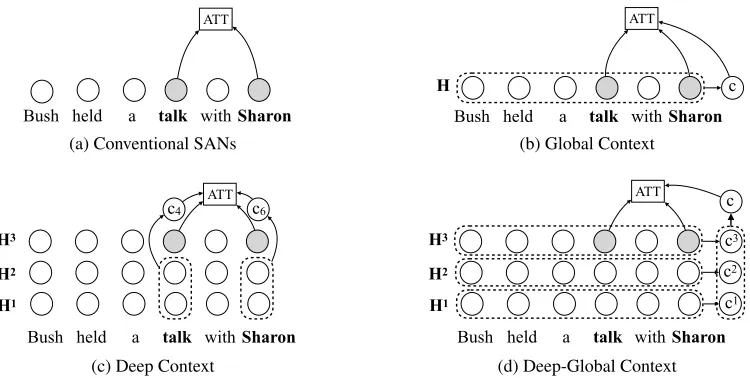
which miss the opportunity to take advantage of useful con-texts. For example, as seen in Figure 1 (a), self-attention model individually calculate the relevance between the word pair (”talk” and ”Sharon”) without considering the contex-tual information. We expect that modeling context can fur-ther improve the performance of SANs.
Approach
In this study, we propose a context-aware self-attention model. We describe several types of context vectors and in-troduce how to incorporate the context vectors into the SAN-based sequence-to-sequence models.
Context-Aware Self-Attention Model
In order to alleviate the lack of contextual information and to maintain the flexibility on parallel computation for self-attention networks, we propose to contextualize the transformations from the input layer H to the query and key layers. Specifically, we follow Shaw, Uszkoreit, and Vaswani (2018) to propagate contextual information to
transformation using addition, which avoids significantly in-creasing computation:
b Q
b K
= (1−
λQ
λK
)
Q K
+
λQ
λK
(C
UQ UK
), (5)
whereC ∈Rn×dc is the context vector, and{U
Q,UK} ∈ Rdc×d are the associated trainable parameter matrices.
To effectively leverage these hierarchical representations,
{λQ, λK} ∈ Rn×1are assigned to weight the expected
im-portance of the context representations.
Britz et al. (2017) and Vaswani et al. (2017) noted that a large magnitude of Q and K may push the softmax function (Equation 3) into regions where it has extremely small gradients. To counteract this effect, {λQ, λK} can
also be treated as factors to regulate the magnitude of Qb andKb.1 Inspired by the prior studies on multi-modal net-works (Xu et al. 2015; Calixto, Liu, and Campbell 2017; Yang et al. 2017), we assign a gating scalar to learn the fac-tors:
λQ
λK
=σ(
Q K
VHQ VHK
+C
UQ UK
VCQ VKC
), (6)
where{VHQ,VHK} ∈ Rd×1 and{VCQ,VCK} ∈ Rdc×1 are
trainable parameters.σ(·)denotes the logistic sigmoid
func-tion. The gating scalar enables the model to explicitly quan-tify how much each representation and the context vector contribute to the prediction of attention weight.
Accordingly, the output representation is constructed based on the contextualized query and key representations:
O = ATT(Qb,Kb)V. (7)
As seen, the proposed approach does not require specific at-tention functions, thus is applicable to all atat-tention models.
Choices of Context Vectors
One principle of our approach is to maintain the simplic-ity and flexibilsimplic-ity of the self-attention model. With this in mind, we employ the internal states as context vectors, thus avoid relying on external resources. Specifically, we exploit several types of context vectors, which can either be used individually or combined together.
Global Context Global context is a function of the entire input layer, which represents the global meaning of a se-quence. In this work, we use mean operation to summarize the representations of the input layer, which is commonly used in Seq2Seq models (Cho et al. 2014):
c=H ∈Rd (8)
1We conduct experiments on the effectiveness of the factors. The experimental results reveal that without{λQ, λK}, there is a big drop (-5.23 BLEU) on the final translation qualities. This in-dicates that the large magnitude ofQand Kexactly hinder the convergence of SANs, and the trainable linear projections (Equa-tion 5) insufficiently learn to regular the magnitude.
Bush held a talk with Sharon O:
V:
K:
Q: e:
W
eighted
Similarity
Bush held a talk withSharon b) Global Context
Bush held a talk withSharon a) Conventional SAN
Bush held a talk with Sharon b) Global Context c) Deep Context
Bush held a talk withSharon
d) Deep Global Context
Bush held a talk withSharon
ATT ATT
ATT ATT
H c
c4 c6
H1
H2
H3
H1
H2
H3
c1 c2 c3 c (a) Conventional SANs
Bush held a talk with Sharon O:
V:
K:
Q: e:
W
eighted
Similarity
Bush held a talk withSharon
b) Global Context
Bush held a talk withSharon
a) Conventional SAN
Bush held a talk with Sharon b) Global Context c) Deep Context
Bush held a talk withSharon
d) Deep Global Context
Bush held a talk withSharon
ATT ATT
ATT ATT
H c
c4 c6
H1
H2
H3
H1
H2
H3
c1 c2 c3 c (b) Global Context
Bush held a talk with Sharon
O:
V:
K:
Q: e:
W
eighted
Similarity
Bush held a talk withSharon b) Global Context
Bush held a talk withSharon a) Conventional SAN
Bush held a talk with Sharon
b) Global Context c) Deep Context
Bush held a talk withSharon
d) Deep Global Context
Bush held a talk withSharon
ATT ATT
ATT ATT
H c
c4 c6
H1
H2
H3
H1
H2
H3
c1
c2
c3
c
(c) Deep Context
Bush held a talk with Sharon
O:
V:
K:
Q: e:
W
eighted
Similarity
Bush held a talk withSharon
b) Global Context
Bush held a talk withSharon
a) Conventional SAN
Bush held a talk with Sharon
b) Global Context c) Deep Context
Bush held a talk withSharon
d) Deep Global Context
Bush held a talk withSharon
ATT ATT
ATT ATT
H c
c4 c6
H1 H2 H3
H1 H2 H3
c1 c2 c3 c
(d) Deep-Global Context
Figure 1: Illustration of the proposed models. As seen, the conventional self-attention networks (a) individually calculate the attention weight of two items (“talk” and “sharon”) without covering the contextual information. The global context strategy (b) and the deep-context strategy (c) capture the global meaning of a sentence and the syntactic information from the lower layers respectively. Figure (d) shows a deep-global context model which summarizes the historical global context vectors.
Note that the global context is a vector instead of a matrix, which is shared across layer states.
Intuitively, the global context can be regarded as an instance-specific bias (Hariharan et al. 2015) for the self-attention model, which is expected to complement the uni-fied parameters{WQ,WK}shared across instances in the
training data. The pair-wised features in conjunction with the global features produce an instance-specific prior which has been shown its effectiveness on several recognition and detection tasks (Hariharan et al. 2015; Gkioxari, Girshick, and Malik 2015; Zhu, Porikli, and Li 2016).
Deep Context Deep context is a function of the inter-nal layers stacked below the current input layer. Advanced neural models are generally implemented as multiple lay-ers, which are able to capture different types of syntactic and semantic information (Shi, Padhi, and Knight 2016; Peters et al. 2018; Anastasopoulos and Chiang 2018). For example, Peters et al. (2018) show that higher-level layer states capture the context-dependent aspects of word mean-ing while lower-level states model the aspects of syntax, and simultaneously exposing all of these signals is highly bene-ficial.
Formally, letHlbe the current input layer at thel-th level, the deep context is a concatenation of the layers underneath the input layer:
C= [H1, . . . ,Hl−1] ∈Rn×(l−1)d (9)
The deep context enables the self-attention model to fuse different types of syntactic and semantic information cap-tured by different layers.
Note that we employ a dense connection strategy (Huang et al. 2017) instead of linear combination (Peters et al. 2018). We believe the former is a more suitable strategy in this sce-nario, since the weight matrices {UQ,UK} ∈ R(l−1)d×d
in Equation 5 plays the role of combination. Our strategy differs from Peters et al. (2018) at: (1) they use normalized weights while we directly use parameters that could be ei-ther positive or negative numbers, which may benefit from more modeling flexibility; (2) they use a scalar that is shared by all elements in the layer states, while we assign a distinct “scalar” to each element. The latter offers a more precise control of the combination by allowing the model to be more expressive than scalars (Tu et al. 2017).
Deep-Global Context Intuitively, we can combine the concepts of global and deep context, and fuse global con-text across layers:
c= [c1, . . . ,cl] ∈Rld (10)
whereclis the global context of thel-th layerHl, which is calculated via Equation 8. We expect the deep-global context to provide different levels of linguistic biases, ranging from lexical, through syntactic, to semantic levels.
As seen, the above context vectors embed different types of information, either global or state-wise context, which may be complementary to each other. To exploit the advan-tages of all of them, an intuitive strategy is to concatenate multiple context vectors to form a new vector, which serves asCin Equation 5. The proposed approach can be easily in-tegrated into the state-of-the-art SAN-based SEQ2SEQ
mod-els (Vaswani et al. 2017), in which both encoder and decoder are composed of a stack ofLSAN layers.2
# Model Applied to Context Vectors # Para. Train Decode BLEU
1 BASE n/a n/a 88.0M 1.28 1.52 27.31
2
OURS
encoder
global context 91.0M 1.26 1.50 27.96
3 deep-global context 99.0M 1.25 1.48 28.15
4 deep context 95.9M 1.18 1.38 28.01
5 deep-global context+deep context 106.9M 1.16 1.36 28.26
6 decoder deep-global context 99.0M 1.23 1.44 27.94
7 deep-global context+deep context 106.9M 1.15 1.35 28.02
8 both 5 + 7 125.8M 1.04 1.20 28.16
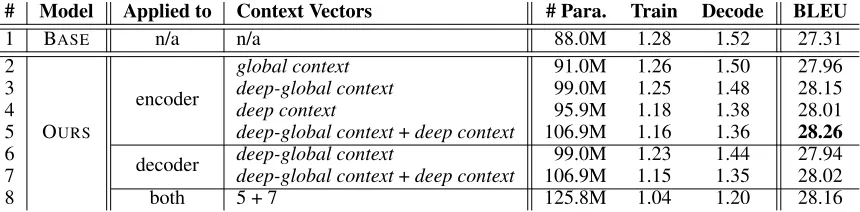
Table 1: Experimental results on WMT14 En⇒De translation task using TRANSFORMER-BASE. “# Para.” denotes the trainable
parameter size of each model (M = million). “Train” and “Decode” denote the training speed (steps/second) and the decoding speed (sentences/second), respectively.
Experiments
Setup
Following (Vaswani et al. 2017), we evaluated the proposed approach on machine translation tasks. To compare with the results reported by previous SAN-based NMT mod-els (Vaswani et al. 2017; Hassan et al. 2018), we con-ducted experiments on both English⇒German (En⇒De) and Chinese⇒English (Zh⇒En) translation tasks. For the En⇒De task, we trained on the widely-used WMT14 dataset consisting of about4.56million sentence pairs. The
mod-els were validated on newstest2013 and examined on new-stest2014. For the Zh⇒En task, the models were trained using all of the available parallel corpus from WMT17 dataset, consisting of about 20.62 million sentence pairs.
We used newsdev2017 as the development set and new-stest2017 as the test set. The English and German sentences were tokenized using the scripts provided in Moses. Then, all tokenized sentences were processed by byte-pair encod-ing (BPE) to alleviate the Out-of-Vocabulary problem (Sen-nrich, Haddow, and Birch 2016) with 32K merge operations for both language pairs. We used BLEU score (Papineni et al. 2002) as the evaluation metric.
We evaluated the proposed approaches on our re-implemented TRANSFORMERmodel (Vaswani et al. 2017). We followed (Vaswani et al. 2017) to set the configurations and reproduced their reported results on the En⇒De task. We tested both theBaseandBigmodels, which differ at the layer size (512 vs. 1024) and the number of attention heads (8 vs. 16). All the models are trained on eight NVIDIA P40 GPUs, each of which is allocated a batch of 4096 tokens. In consideration of the computation cost, we studied the varia-tions of theBasemodel on En⇒De task, and evaluated the overall performance with theBigmodel on both En⇒De and Zh⇒En translation tasks.
Ablation Study on the Context Vector
In this section, we conducted experiments to evaluate the impact of different types of context vector on the WMT14 En⇒De translation tasks using the TRANSFORMER-BASE.
First, we investigated the effect of different context vec-tors for the encoder-side self-attention networks. Then, we examined whether modeling contextual information on the decoder-side SANs is able to gain consistent improvement.
Finally, we checked whether the context-aware model on encoder-side and decoder-side SANs can be complementary to each other. To eliminate the influence of control variables, we conducted the first two ablation studies on encoder-side or decoder-side self-attention networks only.
Applied to Encoder As shown in Table 1, all the proposed context vector strategies consistently improve the model per-formance over the baseline, validating the importance of modeling contextual information in self-attention networks. Among them, global context (Model #2) and deep context (Model #4) gained comparable improvements. Deep-global context outperforms its global counterpart, showing that the different levels of global linguistic biases benefit to the ac-curacy of translation. Moreover, we evaluated whether the global and deep manners are complementary to each other. By simply summing them to the final context vectors, the model “deep-global context + deep context” (Model #5) gains further improvements. According to the results, we ar-gue that the two types of context vectors are able to improve the SANs in different aspects.
Applied to Decoder In this group of experiments, we investigated the question of which types of context vec-tor should be applied to the decoder-side self-attention networks. As shown in Table 1, both “deep-global text” (Model #6) and “deep-global context + deep con-text” (Model #7) consistently improve the SANs. Still, the later outperforms the former one, which is same to the phe-nomenon appeared in the experiments in terms of encoder. Noted that, Zhang, Xiong, and Su (2018) pointed out that the decoder-side SANs tends to only focus on its nearby rep-resentation. However, our improvements show that all the forward (global) and lower layer (deep) representations are still necessary for the decoder-side SANs.
Applied to Both Encoder and Decoder Finally, we in-tegrated the strategies into both the encoder and decoder. As seen, this strategy (Model #8) even slightly harms the translation quality (compare to encoder-side models). We at-tribute the drop of BLEU score to the fact that the conven-tional encoder-decoder attention model in TRANSFORMER
exploits the top-layer of encoder representations, which al-ready embeds useful contextual information. The context-aware model may benefit more on encoder-side SAN under
System Architecture # Para. Train BLEUZh⇒En # Para. Train BLEUEn⇒De
Existing NMT systems
(Vaswani et al. 2017) TTRANSFORMERRANSFORMER-B-BASEIG n/an/a n/a n/an/a n/a 213M65M n/a 27.30n/a 28.40 (Hassan et al. 2018) TRANSFORMER-BIG n/a n/a 24.20 n/a n/a n/a
Our NMT systems
this work
TRANSFORMER-BASE 107.9M 1.21 24.13 88.0M 1.28 27.31
+ Context-Aware SANs 126.8M 1.10 24.67⇑ 106.9M 1.16 28.26⇑ TRANSFORMER-BIG 303.9M 0.58 24.56 264.1M 0.61 28.58
+ Context-Aware SANs 379.4M 0.41 25.15⇑ 339.6M 0.44 28.89
Table 2: Comparing with the existing NMT systems on WMT17 Zh⇒En and WMT14 En⇒De test sets. “⇑”: significant over the conventional self-attention counterpart (p <0.01), tested by bootstrap resampling.
System Architecture # Para. Train BLEUZh)En # Para. Train BLEUEn)De
Existing NMT systems
(Vaswani et al. 2017) TTRANSFORMER-BASE n/a n/a n/a 65M n/a 27.30
RANSFORMER-BIG n/a n/a n/a 213M n/a 28.40
(Hassan et al. 2018) TRANSFORMER-BIG n/a n/a 24.20 n/a n/a n/a
Our NMT systems
this work
TRANSFORMER-BASE 107.9M 1.21 24.13 88.0M 1.28 27.31
+ Context-Aware SANs 126.8M 1.10 24.67* 106.9M 1.16 28.26*
TRANSFORMER-BIG 303.9M 0.58 24.56 264.1M 0.61 28.58
+ Context-Aware SANs 379.4M 0.41 25.15* 339.6M 0.44 28.89
Table 2: Comparing with the existing NMT systems on WMT17 Zh)En and WMT14 En)De test sets. “*”: significant over
the conventional self-attention counterpart (p <0.01), tested by bootstrap resampling.
Figure 2: Visualization of the importance of each type of context vector on different layers. The importance is assessed by
averaging the scalar factors in Equation 5 over the validation set and distinguished by Q(blue) and K (red).
ready embeds useful contextual information. The context-aware model may benefit more on encoder-side SAN under
the architecture of TRANSFORMER.
Unless otherwise stated, considering the training speed, we only applied the context-aware model to the encoder-side SANs in the following experiments, which employs a “deep-global context + deep context ” strategy (Row #5 in Table 1).
Main Results
Table 2 lists the results on WMT17 Zh)En and WMT14
En)De translation tasks. Our baseline models, both
TRANSFORMER-BASE and TRANSFORMER-BIG,
outper-form the reported results on the same data, which makes the evaluation convincing. As seen, modeling contex-tual information (“Context-Aware SANs”) consistently im-proves the performance across language pairs and model variations, demonstrating the efficiency and universality of the proposed approach. It is encouraging to see that TRANSFORMER-BASE with context-aware model achieves
comparable performance with TRANSFORMER-BIG, while
the training speed is nearly twice faster and only requires half of parameters.
Analysis
We conducted extensive analyses to better understand our
works. All the results are reported on En)De validation set
with TRANSFORMER-BASE.
Deep Context vs. Global Context
In this section, we investigated the details of difference be-tween deep context and global context to answer the ques-tion: how do they harmonically work with queries and keys in multiple layers?
Stable Necessity of Deep Context As seen in Figure 2 (a),
in deep based context-aware models, the weights of scalar factors are consistently close to 0.5, meaning the equivalent importance of the information in the current layer and that of the historical layers. The improvements on the translation quality and the stable necessity jointly verified our claim that the conventional self-attention mechanism is insufficient to fully capture the richness of the context through weighted averaging its input layer. Opportunely utilizing the historical context benefits the performance of SANs.
The Lower Layer, The More Global Context Required Concerning the global-based approaches, obviously, the av-erage weights of global context vectors in Figure 2 (b), (c) and (d) drop at high-level layers. The trends demonstrate that the higher layers require less global information, while the lower layers require more global context. The phenomenon
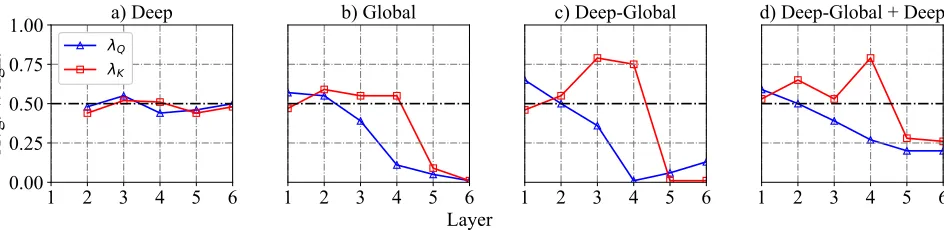
Figure 2: Visualization of the importance of each type of context vector on different layers. The importance is assessed by averaging the scalar factors in Equation 5 over the validation set and distinguished byλQ(blue) andλK(red).
the architecture of TRANSFORMER.
Unless otherwise stated, considering the training speed, we only applied the context-aware model to the encoder-side SANs in the following experiments, which employs a “deep-global context + deep context ” strategy (Row #5 in Table 1).
Main Results
Table 2 lists the results on WMT17 Zh⇒En and WMT14 En⇒De translation tasks. Our baseline models, both TRANSFORMER-BASE and TRANSFORMER-BIG, outper-form the reported results on the same data, which makes the evaluation convincing. As seen, modeling contex-tual information (“Context-Aware SANs”) consistently im-proves the performance across language pairs and model variations, demonstrating the efficiency and universality of the proposed approach. It is encouraging to see that TRANSFORMER-BASEwith context-aware model achieves comparable performance with TRANSFORMER-BIG, while
the training speed is nearly twice faster and only requires half of parameters.
Analysis
We conducted extensive analyses to better understand our models in terms of their compatibility with self-attention networks. All the results are reported on En⇒De validation set with TRANSFORMER-BASE.
Deep Context vs. Global Context
In this section, we investigated the details of difference be-tween deep context and global context to answer the ques-tion: how do they harmonically work with queries and keys in multiple layers?
Stable Necessity of Deep Context As seen in Figure 2 (a), in deep based context-aware models, the weights of scalar factors are consistently close to 0.5, meaning the equivalent importance of the information in the current layer and that of the historical layers. The improvements on the translation quality and the stable necessity jointly verified our claim that the conventional self-attention mechanism is insufficient to fully capture the richness of the context through weighted averaging its input layer. Opportunely utilizing the historical context benefits the performance of SANs.
The Lower Layer, The More Global Context Required
the increasing number of layers, this is the reason why the higher layers hardly need the global information. We believe the global context vector is more beneficial to the lower lay-ers on modeling semantic meanings.
Model Query Key Dev
TRANSFORMER-BASE - - 25.84
+ Context-Aware X× XX 26.4226.36
X × 26.20
Table 3: BLEU scores on the En⇒De validation set with respect to integrate context vector into queries and keys.
Keys Required More Global Information Another com-mon interesting phenomenon appears in all the global-based approaches is that the weights of global context vectors for keys are usually higher than that for queries, especially in the mid-level layers. We believe this is caused by the dif-ferent usage of query and key. Considering the normaliza-tion insof tmaxfunction (Equation 3) which is effected on the keys, each key should consider its relationships to other items. This is why the keys require more semantic informa-tion in SANs. The results in Table 3 show that self-atteninforma-tion networks indeed benefit more from incorporating global in-formation into keys than that of queries. However, it should be noted that enhancing the queries with context representa-tions can further improves the performance.
Source Context vs. Target Context
ing the global meaning, resulting in the high weights of global context vector in lower layers. However the global contextual information can be gradually accumulated with the increasing number of layers, this is the reason why the higher layers hardly need the global information. We believe the global context vector is more beneficial to the lower lay-ers on modeling semantic meanings.
Model Query Key Dev
TRANSFORMER-BASE - - 25.84
+ Context-Aware X× XX 26.4226.36
X × 26.20
Table 3: BLEU scores on the En)De validation set with
respect to integrate context vector into queries and keys.
Keys Required More Global Information Another
com-mon interesting phenomenon appears in all the global-based approaches is that the weights of global context vectors for keys are usually higher than that for queries, especially in the mid-level layers. We believe this is caused by the dif-ferent usage of query and key. Considering the
normaliza-tion insof tmaxfunction (Equation 3) which is effected on
the keys, each key should consider its relationships to other items. This is why the keys require more semantic informa-tion in SANs. The results in Table 3 show that self-atteninforma-tion network indeed benefits more from incorporating global in-formation into keys than that of queries. However, it should be noted that enhancing the queries with context representa-tions can further improves the performance.
Source Context vs. Target Context
Figure 3: Visualization of weights learned for source-side context vectors and target-side context vectors when we
inte-grate the context-aware model on the both sides of TRANS
-FORMER. Obviously, target context vectors are allocated
with much lower weights than its source-side counterpart.
In this part, we investigated why integrating encoder-side and decoder-side context vectors fails to further improve the self-attention model. We took a deep look into the Model #8 (See Table 1), and averaged the gating scalar of the source-side and target-side context vectors, respectively. As observed in Figure 3, the target-side context vectors con-sistently gain minor weights, resulting in less contribution from the target-side contextual information. Concerning the
source-side context vectors, the factors automatically allo-cate larger proportion. The result verified our claim that the top-layer of encoder representations has already embed-ded with useful contextual information, which has exploited to the target-side representations through the conventional encoder-decoder attention network. Thus, the decoder-side context-aware model does not further improve the transla-tion quality as expected.
Linguistic Analysis
The last, we provided linguistic analyses to the proposed models in terms of: 1) whether the proposed model is flexi-bly as expected to utilize the contextual information for dif-ferent words; and 2) how the proposed models perform on sentences of different lengths.
Figure 4: The weights of deep-global context vectors corre-sponding to different POS. Grey line indicates the average weight of all the words. As observed, the function words re-quire more contextual information than content words.
Analysis on Part-of-Speech Since the context
represen-tations are element-wised added to the SAN model, an in-teresting question is whether different words are assigned with distinct weights. We categorized the words in validation set using the Part-of-Speech (POS) tag set.3Figure 4 shows
the factors learned for controlling the weight of context vec-tors. The function words, which have very little substantive meaning (e.g, “SYM”, ‘DET”, “CONJ”, “PRT”, “PRON” and “ADP”), require more contextual information than that of content words such as the nouns, verbs, adjectives, and adverbs. We attribute the phenomena to the fact that the rep-resentations of function words profit more from contextual information, which also noted by Wang et al. (2018) who suggested to reconstruct the function words (e.g. the pro-nouns) to alleviate the problem of dropped pronoun.
Analysis on Long Sentences We followed Tu et al. (2016)
to evaluate the effect of context-aware models on long sen-tences. The sentences were divided into 10 disjoint groups
3Including: “SYM”-symbols, ‘DET”- determiner, “CONJ”-conjuntion, “PRT”-partical, “PRON”-pronoun, “ADP”-adposition, “NOUN”-noun, “VERB”-verb, “ADV”-adverb, “Num”-number, “ADJ”-adjective, and “X”-others.
Figure 3: Visualization of weights learned for source-side context vectors and target-side context vectors when we inte-grate the context-aware model on the both sides of TRANS -FORMER. Obviously, target context vectors are allocated
with much lower weights than its source-side counterpart.
In this part, we investigated why integrating encoder-side and decoder-side context vectors fails to further improve the self-attention model. We took a deep look into the Model #8 (See Table 1), and averaged the gating scalar of the source-side and target-side context vectors, respectively. As observed in Figure 3, the target-side context vectors con-sistently gain minor weights, resulting in less contribution from the target-side contextual information. Concerning the source-side context vectors, the factors automatically allo-cate larger proportion. The result verified our claim that the top-layer of encoder representations has already embed-ded with useful contextual information, which has exploited
to the target-side representations through the conventional encoder-decoder attention network. Thus, the decoder-side context-aware model does not further improve the transla-tion quality as expected.
Linguistic Analysis
The last, we provided linguistic analyses to the proposed models in terms of: 1) whether the proposed model is flexi-bly as expected to utilize the contextual information for dif-ferent words; and 2) how the proposed models perform on sentences of different lengths.
ing the global meaning, resulting in the high weights of global context vector in lower layers. However the global contextual information can be gradually accumulated with the increasing number of layers, this is the reason why the higher layers hardly need the global information. We believe the global context vector is more beneficial to the lower lay-ers on modeling semantic meanings.
Model Query Key Dev
TRANSFORMER-BASE - - 25.84
+ Context-Aware X× XX 26.4226.36
X × 26.20
Table 3: BLEU scores on the En)De validation set with respect to integrate context vector into queries and keys.
Keys Required More Global Information Another com-mon interesting phenomenon appears in all the global-based approaches is that the weights of global context vectors for keys are usually higher than that for queries, especially in the mid-level layers. We believe this is caused by the dif-ferent usage of query and key. Considering the normaliza-tion insof tmaxfunction (Equation 3) which is effected on the keys, each key should consider its relationships to other items. This is why the keys require more semantic informa-tion in SANs. The results in Table 3 show that self-atteninforma-tion network indeed benefits more from incorporating global in-formation into keys than that of queries. However, it should be noted that enhancing the queries with context representa-tions can further improves the performance.
Source Context vs. Target Context
Figure 3: Visualization of weights learned for source-side context vectors and target-side context vectors when we inte-grate the context-aware model on the both sides of TRANS -FORMER. Obviously, target context vectors are allocated with much lower weights than its source-side counterpart.
In this part, we investigated why integrating encoder-side and decoder-side context vectors fails to further improve the self-attention model. We took a deep look into the Model #8 (See Table 1), and averaged the gating scalar of the source-side and target-side context vectors, respectively. As observed in Figure 3, the target-side context vectors con-sistently gain minor weights, resulting in less contribution from the target-side contextual information. Concerning the
source-side context vectors, the factors automatically allo-cate larger proportion. The result verified our claim that the top-layer of encoder representations has already embed-ded with useful contextual information, which has exploited to the target-side representations through the conventional encoder-decoder attention network. Thus, the decoder-side context-aware model does not further improve the transla-tion quality as expected.
Linguistic Analysis
The last, we provided linguistic analyses to the proposed models in terms of: 1) whether the proposed model is flexi-bly as expected to utilize the contextual information for dif-ferent words; and 2) how the proposed models perform on sentences of different lengths.
Figure 4: The weights of deep-global context vectors corre-sponding to different POS. Grey line indicates the average weight of all the words. As observed, the function words re-quire more contextual information than content words.
Analysis on Part-of-Speech Since the context represen-tations are element-wised added to the SAN model, an in-teresting question is whether different words are assigned with distinct weights. We categorized the words in validation set using the Part-of-Speech (POS) tag set.3Figure 4 shows the factors learned for controlling the weight of context vec-tors. The function words, which have very little substantive meaning (e.g, “SYM”, ‘DET”, “CONJ”, “PRT”, “PRON” and “ADP”), require more contextual information than that of content words such as the nouns, verbs, adjectives, and adverbs. We attribute the phenomena to the fact that the rep-resentations of function words profit more from contextual information, which also noted by Wang et al. (2018) who suggested to reconstruct the function words (e.g. the pro-nouns) to alleviate the problem of dropped pronoun.
Analysis on Long Sentences We followed Tu et al. (2016) to evaluate the effect of context-aware models on long sen-tences. The sentences were divided into 10 disjoint groups 3Including: “SYM”-symbols, ‘DET”- determiner, “CONJ”-conjuntion, “PRT”-partical, “PRON”-pronoun, “ADP”-adposition, “NOUN”-noun, “VERB”-verb, “ADV”-adverb, “Num”-number, “ADJ”-adjective, and “X”-others.
Figure 4: The weights of deep-global context vectors corre-sponding to different POS. Grey line indicates the average weight of all the words. As observed, the function words re-quire more contextual information than content words.
Analysis on Part-of-Speech Since the context represen-tations are element-wised added to the SAN model, an in-teresting question is whether different words are assigned with distinct weights. We categorized the words in validation set using the Part-of-Speech (POS) tag set.3Figure 4 shows the factors learned for controlling the weight of context vec-tors. The function words, which have very little substantive meaning (e.g, “SYM”, ‘DET”, “CONJ”, “PRT”, “PRON” and “ADP”), require more contextual information than that of content words such as the nouns, verbs, adjectives, and adverbs. We attribute the phenomena to the fact that the rep-resentations of function words profit more from contextual information, which also noted by Wang et al. (2018) who suggested to reconstruct the function words (e.g. the pro-nouns) to alleviate the problem of dropped pronoun.
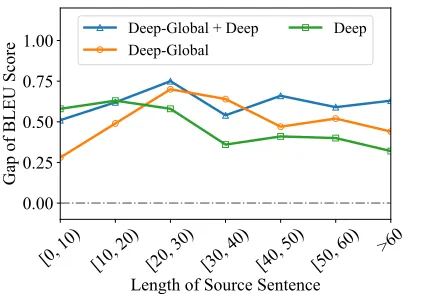
Analysis on Long Sentences We followed Tu et al. (2016) to evaluate the effect of context-aware models on long sen-tences. The sentences were divided into 10 disjoint groups according to their lengths and their BLEU scores were eval-uated, as shown in Figure 5.
The proposed approaches outperform the baseline model in almost all the length segments. There are still consid-3Including: “SYM”-symbols, “DET”- determiner, “CONJ”-conjuntion, “PRT”-partical, “PRON”-pronoun, “ADP”-adposition, “NOUN”-noun, “VERB”-verb, “ADV”-adverb, “Num”-number, “ADJ”-adjective, and “X”-others.
> > > > > >
!
/HQJWKRI6RXUFH6HQWHQFH
*DSRI%/(86FRUH
'HHS*OREDO'HHS 'HHS*OREDO
'HHS
Figure 5: Performance improvement according to various in-put sentence lengths. Y-axis denotes the gap of BLEU score between our model and baseline (grey line).
erable differences between the global-based and the deep-based variations. Global-deep-based strategies consistently out-perform the deep-context model on sentences with more than 20 words, while the opposite situation appears on the shorter sentences. One possible reason is that translating long sentences require more long-distance dependency in-formation which can be supplemented by the global con-textual information. For short sentences, the effect of global context is relatively minor, while the complex syntactic and semantic dependencies from deep context provide more im-pact on the translation quality.
Related Work
Neural representations embed complex characteristics of word use (e.g., syntax and semantic) (Choi, Cho, and Ben-gio 2017). Several researchers have shown that contextual information can enhance the ability of modeling dependen-cies among neural representations, especially for the at-tention models (Bahdanau, Cho, and Bengio 2015; Luong, Pham, and Manning 2015). For example, Tu et al. (2017) and Zhang et al. (2017) respectively enhanced the query and memory of a conventional attention model with internal con-textual representations. Their studies verified the necessity of global contextual information for modeling the dependen-cies between representations. Moreover, Peters et al. (2018) pointed out that deeply modeling syntactic and semantic contexts from multiple layers benefits to the performance of multi-layer neural networks. Contrary to the prior stud-ies explored on RNN-based approaches or required external resources, our work focuses on improving the self-attention networks with contextual information.
Although self-attention model has shown its strength in modeling discrete sequence on different tasks, e.g machine translation (Vaswani et al. 2017), natural language infer-ence (Shen et al. 2018) and acoustic modeling (Sperber et al. 2018), several studies have mentioned the limitations in con-ventional self-attention networks (Chen et al. 2018). Among them, Yang et al. (2018a) noted that restricting the attention model to a local space may benefit to the performance,
sup-porting that the conventional SAN model insufficiently fully capturing the context of a sequence. Tang et al. (2018) found that the conventional SANs fail to fully take the advantages of direct connections between elements. Moreover, Shaw, Uszkoreit, and Vaswani (2018) succeed on incorporating rel-ative positions into the SAN models, supporting that the con-ventional model requires necessary information for model-ing relations between the states. Bawden et al. (2018) and Voita et al. (2018) enhanced the attention network with ex-ternal contextual representations that summarizes previous source sentences. Unlike their work which requires the em-beddings of previous sentences, our approaches contextual-ize the transformations in SANs, thus avoid relying on ex-ternal resources and maintain the simplicity and flexibility.
Conclusion
In this work, we improved the self-attention networks with contextual information. We proposed several simple but ef-fective strategies to model the contexts, and found that the deep and global approaches are complementary to each other. Experimental results across language pairs demon-strate the effectiveness and universality of the proposed approach. Extensive analyses show that how the context-aware model enhances the original representations in the self-attention model, and our model is able to flexibly model the contextual information for different representations.
It is interesting to validate the model in other tasks, such as reading comprehension, language inference, and stance classification (Xu et al. 2018). Another promising direction is to design more linguistic context-aware techniques, such as incorporating the linguistic knowledge (e.g. phrases and syntactic categories). It is also interesting to combine with other techniques (Shaw, Uszkoreit, and Vaswani 2018; Li et al. 2018; Dou et al. 2018; 2019; Kong et al. 2019; Yang et al. 2018b) to further boost the performance of Transformer.
Acknowledgments
This work was supported in part by the National Natu-ral Science Foundation of China (Grant No. 61672555), the Joint Project of Macao Science and Technology De-velopment Fund and National Natural Science Foundation of China (Grant No. 045/2017/AFJ) and the Multiyear Re-search Grant from the University of Macau (Grant No. MYRG2017-00087-FST). We thank the anonymous review-ers for their insightful comments.
References
Anastasopoulos, A., and Chiang, D. 2018. Tied Multitask Learning for Neural Speech Translation. InNAACL. Bahdanau, D.; Cho, K.; and Bengio, Y. 2015. Neural Ma-chine Translation by Jointly Learning to Align and Trans-late. InICLR.
Bawden, R.; Sennrich, R.; Birch, A.; and Haddow, B. 2018. Evaluating Discourse Phenomena in Neural Machine Trans-lation. InNAACL.
Calixto, I.; Liu, Q.; and Campbell, N. 2017. Doubly-Attentive Decoder for Multi-modal Neural Machine Trans-lation. InACL.
Chen, M. X.; Firat, O.; Bapna, A.; Johnson, M.; Macherey, W.; Foster, G.; Jones, L.; Schuster, M.; Shazeer, N.; Parmar, N.; Vaswani, A.; Uszkoreit, J.; Kaiser, L.; Chen, Z.; Wu, Y.; and Hughes, M. 2018. The Best of Both Worlds: Combining Recent Advances in Neural Machine Translation. InACL. Cho, K.; van Merrienboer, B.; G¨ulc¸ehre, C¸.; Bahdanau, D.; Bougares, F.; Schwenk, H.; and Bengio, Y. 2014. Learn-ing Phrase Representations usLearn-ing RNN Encoder-Decoder for Statistical Machine Translation. InEMNLP.
Choi, H.; Cho, K.; and Bengio, Y. 2017. Context-dependent word representation for neural machine translation. CSL. Dou, Z.; Tu, Z.; Wang, X.; Shi, S.; and Zhang, T. 2018. Ex-ploiting Deep Representations for Neural Machine Transla-tion. InEMNLP.
Dou, Z.; Tu, Z.; Wang, X.; Wang, L.; Shi, S.; and Zhang, T. 2019. Dynamic Layer Aggregation for Neural Machine Translation. InAAAI.
Gkioxari, G.; Girshick, R.; and Malik, J. 2015. Contextual Action Recognition with R* CNN. InICCV.
Hariharan, B.; Arbel´aez, P.; Girshick, R.; and Malik, J. 2015. Hypercolumns for Object Segmentation and Fine-grained Localization. InCVPR.
Hassan, H.; Aue, A.; Chen, C.; Chowdhary, V.; Clark, J.; Fe-dermann, C.; Huang, X.; Junczys-Dowmunt, M.; Lewis, W.; Li, M.; et al. 2018. Achieving Human Parity on Automatic Chinese to English News Translation. arXiv:1803.05567. Huang, G.; Liu, Z.; van der Maaten, L.; and Weinberger, K. Q. 2017. Densely Connected Convolutional Networks. InCVPR.
Kong, X.; Tu, Z.; Shi, S.; Hovy, E.; and Zhang, T. 2019. Neural Machine Translation with Adequacy-Oriented Learning. InAAAI.
Li, J.; Tu, Z.; Yang, B.; Lyu, M. R.; and Zhang, T. 2018. Multi-Head Attention with Disagreement Regularization. In EMNLP.
Lin, Z.; Feng, M.; Santos, C. N. d.; Yu, M.; Xiang, B.; Zhou, B.; and Bengio, Y. 2017. A structured self-attentive sentence embedding. InICLR.
Luong, T.; Pham, H.; and Manning, C. D. 2015. Effective Approaches to Attention-based Neural Machine Translation. InEMNLP.
Papineni, K.; Roukos, S.; Ward, T.; and Zhu, W.-J. 2002. BLEU: A Method for Automatic Evaluation of Machine Translation. InACL.
Peters, M. E.; Neumann, M.; Iyyer, M.; Gardner, M.; Clark, C.; Lee, K.; and Zettlemoyer, L. 2018. Deep Contextualized Word Representations. InNAACL.
Sennrich, R.; Haddow, B.; and Birch, A. 2016. Neural Ma-chine Translation of Rare Words with Subword Units. In ACL.
Shaw, P.; Uszkoreit, J.; and Vaswani, A. 2018.
Self-Attention with Relative Position Representations. In NAACL.
Shen, T.; Zhou, T.; Long, G.; Jiang, J.; Pan, S.; and Zhang, C. 2018. DiSAN: Directional Self-Attention Network for RNN/CNN-Free Language Understanding. InAAAI. Shi, X.; Padhi, I.; and Knight, K. 2016. Does String-based Neural MT Learn Source Syntax? InEMNLP.
Sperber, M.; Niehues, J.; Neubig, G.; St¨uker, S.; and Waibel, A. 2018. Self-Attentional Acoustic Models. arXiv:1803.09519.
Tang, G.; M¨uller, M.; Rios, A.; and Sennrich, R. 2018. Why Self-Attention? A Targeted Evaluation of Neural Machine Translation Architectures. InEMNLP.
Tu, Z.; Lu, Z.; Liu, Y.; Liu, X.; and Li, H. 2016. Modeling Coverage for Neural Machine Translation. InACL.
Tu, Z.; Liu, Y.; Lu, Z.; Liu, X.; and Li, H. 2017. Context Gates for Neural Machine Translation.TACL.
Vaswani, A.; Shazeer, N.; Parmar, N.; Uszkoreit, J.; Jones, L.; Gomez, A. N.; Kaiser, Ł.; and Polosukhin, I. 2017. At-tention is All You Need. InNIPS.
Voita, E.; Serdyukov, P.; Sennrich, R.; and Titov, I. 2018. Context-Aware Neural Machine Translation Learns Anaphora Resolution. InACL.
Wang, L.; Tu, Z.; Way, A.; and Liu, Q. 2017. Exploiting Cross-Sentence Context for Neural Machine Translation. In EMNLP.
Wang, L.; Tu, Z.; Way, A.; and Liu, Q. 2018. Learning to Jointly Translate and Predict Dropped Pronouns with a Shared Reconstruction Mechanism. InEMNLP.
Xu, K.; Ba, J.; Kiros, R.; Cho, K.; Courville, A. C.; Salakhutdinov, R.; Zemel, R. S.; and Bengio, Y. 2015. Show, Attend and Tell: Neural Image Caption Generation with Vi-sual Attention. InICML.
Xu, C.; Paris, C.; Nepal, S.; and Sparks, R. 2018. Cross-Target Stance Classification with Self-Attention Networks. InACL.
Yang, B.; Wong, D. F.; Xiao, T.; Chao, L. S.; and Zhu, J. 2017. Towards Bidirectional Hierarchical Representa-tions for Attention-based Neural Machine Translation. In EMNLP.
Yang, B.; Tu, Z.; Wong, D. F.; Meng, F.; Chao, L. S.; and Zhang, T. 2018a. Modeling Localness for Self-Attention Networks. InEMNLP.
Yang, B.; Wang, L.; Wong, D. F.; Chao, L. S.; and Tu, Z. 2018b. Convolutional Self-Attention Network. arXiv:1810.13320.
Zhang, B.; Xiong, D.; Su, J.; and Duan, H. 2017. A Context-Aware Recurrent Encoder for Neural Machine Translation. TASLP.
Zhang, B.; Xiong, D.; and Su, J. 2018. Accelerating Neural Transformer via an Average Attention Network. InACL. Zhu, G.; Porikli, F.; and Li, H. 2016. Beyond Local Search: Tracking Objects Everywhere with Instance-specific Pro-posals. InCVPR.