R E S E A R C H A R T I C L E
Open Access
An iterative method for common solutions of
equilibrium problems and hierarchical fixed
point problems
Abdellah Bnouhachem
1,2†, Suliman Al-Homidan
3†and Qamrul Hasan Ansari
3,4*†*Correspondence:
3Department of Mathematics &
Statistics, King Fahd University of Petroleum & Minerals, Dhahran, Saudi Arabia
4Department of Mathematics,
Aligarh Muslim University, Aligarh, 202002, India
†Equal contributors
Full list of author information is available at the end of the article
Abstract
The purpose of this paper is to investigate the problem of finding an approximate point of the common set of solutions of an equilibrium problem and a hierarchical fixed point problem in the setting of real Hilbert spaces. We establish the strong convergence of the proposed method under some mild conditions. Several special cases are also discussed. Numerical examples are presented to illustrate the proposed method and convergence result. The results presented in this paper extend and improve some well-known results in the literature.
MSC: Primary 49J30; 47H09; secondary 47J20; 49J40
Keywords: equilibrium problems; variational inequalities; hierarchical fixed point problems; fixed point problems; projection method
1 Introduction
LetHbe a real Hilbert space whose inner product and norm are denoted by·,·and · , respectively. LetCbe a nonempty closed convex subset ofHandF:C×C→Rbe a bifunction. The equilibrium problem (in short, EP) is to findx∈Csuch that
F(x,y)≥, ∀y∈C. (.)
The solution set of EP (.) is denoted byEP(F).
The equilibrium problem provides a unified, natural, innovative and general framework to study a wide class of problems arising in finance, economics, network analysis, trans-portation, elasticity and optimization. The theory of equilibrium problems has witnessed an explosive growth in theoretical advances and applications across all disciplines of pure and applied sciences; see [–] and the references therein.
IfF(x,y) =Ax,y–x, whereA:C→His a nonlinear operator, then EP (.) is equiva-lent to find a vectorx∈Csuch that
y–x,Ax ≥, ∀y∈C. (.)
It is a well-known classical variational inequality problem. We now have a variety of tech-niques to suggest and analyze various iterative algorithms for solving variational inequal-ities and the related optimization problems; see [–] and the references therein.
The fixed point problem for the mappingT:C→His to findx∈Csuch that
Tx=x. (.)
We denote byF(T) the set of solutions of (.). It is well known thatF(T) is closed and convex, andPF(T) is well defined.
LetS:C→Hbe a nonexpansive mapping, that is,Sx–Sy ≤ x–yfor allx,y∈C. The hierarchical fixed point problem (in short, HFPP) is to findx∈F(T) such that
x–Sx,y–x ≥, ∀y∈F(T). (.)
It is linked with some monotone variational inequalities and convex programming prob-lems; see []. Various methods have been proposed to solve HFPP (.); see, for example, [–] and the references therein. In , Yaoet al.[] studied the following iterative algorithm to solve HFPP (.):
yn=βnSxn+ ( –βn)xn, xn+=PC
αnf(xn) + ( –αn)Tyn
, ∀n≥,
(.)
wheref:C→His a contraction mapping and{αn}and{βn}are sequences in (, ).
Un-der certain restrictions on the parameters, They proved that the sequence{xn}generated
by (.) converges strongly toz∈F(T), which is also a unique solution of the following variational inequality:
(I–f)z,y–z≥, ∀y∈F(T). (.)
In , Cenget al.[] investigated the following iterative method:
xn+=PC
αnρU(xn) + (I–αnμF)
T(yn)
, ∀n≥, (.)
whereUis a Lipschitzian mapping, andFis a Lipschitzian and strongly monotone map-ping. They proved that under some approximate assumptions on the operators and pa-rameters, the sequence{xn}generated by (.) converges strongly to a unique solution of
the variational inequality:
ρU(z) –μF(z),x–z≥, ∀x∈Fix(T).
2 Preliminaries
We present some definitions which will be used in the sequel.
Definition . A mappingT:C→His said to bek-Lipschitz continuous if there exists a constantk> such that
Tx–Ty ≤kx–y, ∀x,y∈C.
• Ifk= , thenT is called nonexpansive. • Ifk∈(, ), thenTis called contraction.
Definition . A mappingT:C→His said to be
(a) monotone if
Tx–Ty,x–y ≥, ∀x,y∈C;
(b) strongly monotone if there exists anα> such that
Tx–Ty,x–y ≥αx–y, ∀x,y∈C;
(c) α-inverse strongly monotone if there exists anα> such that
Tx–Ty,x–y ≥αTx–Ty, ∀x,y∈C.
It is easy to observe that everyα-inverse strongly monotone mapping is monotone and Lipschitz continuous. Also, for every nonexpansive mappingT:H→H, we have
x–T(x)–y–T(y),T(y) –T(x)≤
T(x) –x
–T(y) –y, (.)
for all (x,y)∈H×H. Therefore, for all (x,y)∈H×Fix(T), we have
x–T(x),y–T(x)≤
T(x) –x
. (.)
The following lemma provides some basic properties of the projection ontoC.
Lemma . Let PCdenote the projection of H onto C.Then we have the following inequal-ities:
(a) z–PC[z],PC[z] –v ≥,∀z∈H,v∈C;
(b) u–v,PC[u] –PC[v] ≥ PC[u] –PC[v],∀u,v∈H;
(c) PC[u] –PC[v] ≤ u–v,∀u,v∈H;
(d) u–PC[z]≤ z–u–z–PC[z],∀z∈H,u∈C.
Assumption .[] LetF:C×C→Rbe a bifunction satisfying the following assump-tions:
(A) F(x,x) = ,∀x∈C;
(A) For eachx,y,z∈C,limt→F(tz+ ( –t)x,y)≤F(x,y);
(A) For eachx∈C,y→F(x,y)is convex and lower semicontinuous.
Lemma .[] Let C be a nonempty closed convex subset of a real Hilbert space H and F:
C×C→Rsatisfy conditions(A)-(A).For r> and x∈H,define a mapping Tr:H→C as
Tr(x) = z∈C:F(z,y) +
ry–z,z–x ≥,∀y∈C
.
Then the following statements hold:
(i) Tris nonempty single-valued;
(ii) Tris firmly nonexpansive,that is,
Tr(x) –Tr(y)
≤Tr(x) –Tr(y),x–y
, ∀x,y∈H;
(iii) F(Tr) =EP(F);
(iv) EP(F)is closed and convex.
Lemma .[] Let C be a nonempty closed convex subset of a real Hilbert space H.If T:
C→C is a nonexpansive mapping withFix(T)=∅,then the mapping I–T is demiclosed at
,that is,if{xn}is a sequence in C converges weakly to x and{(I–T)xn}converges strongly to,then(I–T)x= .
Lemma .[] Let U :C→H be aτ-Lipschitzian mapping and F:C→H be a k-Lipschitzian andη-strongly monotone mapping.Then,for≤ρτ<μη,μF–ρU is(μη–
ρτ)-strongly monotone,that is,
(μF–ρU)x– (μF–ρU)y,x–y≥(μη–ρτ)x–y, ∀x,y∈C.
Lemma .[] Letλ∈(, ),μ> ,and F:C→H be an k-Lipschitzian andη-strongly monotone operator.In association with a nonexpansive mapping T:C→C,define a map-ping Tλ:C→H by
Tλx=Tx–λμFT(x), ∀x∈C.
Then Tλis a contraction providedμ<η
k,that is, Tλx–Tλy≤( –λν)x–y, ∀x,y∈C,
whereν= – –μ(η–μk).
Lemma .[] Let C be a closed convex subset of a real Hilbert space H and{xn}be a
bounded sequence in H.Assume that
(i) the weakw-limit setww(xn)⊂C,whereww(xn) ={x:xni x}
(ii) for eachz∈C,limn→∞xn–zexists.
Lemma .[] Let{an}be a sequence of nonnegative real numbers such that
an+≤( –υn)an+δn,
where{υn}is a sequence in(, )andδnis a sequence such that
(i) ∞n=υn=∞;
(ii) lim supn→∞δn/υn≤or
∞
n=|δn|<∞. Thenlimn→∞an= .
3 An iterative method and strong convergence results
In this section, we propose and analyze an iterative method for finding the common solu-tions of EP (.) and HFPP (.).
LetCbe a nonempty closed convex subset of a real Hilbert spaceH. LetF:C×C→R be a bifunction that satisfy conditions (A)-(A), and letS,T:C→Cbe nonexpansive mappings such thatF(T)∩EP(F)=∅. LetF:C→Cbe ak-Lipschitzian mapping and
η-strongly monotone, and letU:C→Cbe aτ-Lipschitzian mapping.
Algorithm . For any givenx∈C, let the iterative sequences{un}, {xn}, and{yn}be
generated by ⎧ ⎪ ⎨ ⎪ ⎩
F(un,y) +rny–un,un–xn ≥, ∀y∈C; yn=βnSxn+ ( –βn)un;
xn+=PC[αnρU(xn) +γnxn+ (( –γn)I–αnμF)(T(yn))], ∀n≥.
(.)
Suppose that the parameters satisfy < μ < ηk and ≤ ρτ < ν, where ν = –
–μ(η–μk). Also,{γ
n},{αn},{βn}, and{rn}are sequences in (, ) satisfying the
fol-lowing conditions:
(a) limn→∞γn= ,γn+αn< ,
(b) limn→∞αn= and
∞
n=αn=∞,
(c) limn→∞(βn/αn) = ,
(d) ∞n=|αn––αn|<∞,
∞
n=|γn––γn|<∞and
∞
n=|βn––βn|<∞,
(e) lim infn→∞rn> and
∞
n=|rn––rn|<∞.
Remark . Algorithm . can be viewed as an extension and improvement for some well-known methods.
• Ifγn= , then the proposed method is an extension and improvement of a method
studied in [, ].
• IfU=f,F=I,ρ=μ= , andγn= , then we obtain an extension and improvement of
a method considered in [].
• The contractive mappingf with a coefficientα∈[, )in other papers [, , ] is extended to the cases of the Lipschitzian mappingUwith a coefficient constant
γ ∈[,∞).
Lemma . Let x∗∈F(T)∩EP(F).Then{xn},{un},and{yn}are bounded.
We prove that the sequence{xn}is bounded. Without loss of generality, we can assume
thatβn≤αnfor alln≥. From (.), we have
xn+–x∗
=PC[Vn] –PC
x∗
≤αnρU(xn) +γnxn+
( –γn)I–αnμF
T(yn)
–x∗
=αn
ρU(xn) –μF
x∗+γn
xn–x∗
+( –γn)I–αnμF
T(yn)
–( –γn)I–αnμF
Tx∗
≤αnρU(xn) –μF
x∗+γnxn–x∗
+ ( –γn)×
I– αnμ –γn
FT(yn)
–
I– αnμ –γn
F
Tx∗
=αnρU(xn) –ρU
x∗+ (ρU–μF)x∗+γnxn–x∗
+ ( –γn)×
I– αnμ –γn
FT(yn)
–
I– αnμ –γn
F
Tx∗
≤αnρτxn–x∗+αn(ρU–μF)x∗+γnxn–x∗
+ ( –γn)
– αnν
–γn
yn–x∗
=αnρτxn–x∗+αn(ρU–μF)x∗+γnxn–x∗
+ ( –γn–αnν)βnSxn+ ( –βn)un–x∗
≤αnρτxn–x∗+αn(ρU–μF)x∗+γnxn–x∗
+ ( –γn–αnν)
βnSxn–Sx∗+βnSx∗–x∗
+ ( –βn)Trn(xn) –x∗
≤αnρτxn–x∗+αn(ρU–μF)x∗+γnxn–x∗
+ ( –γn–αnν)
βnSxn–Sx∗+βnSx∗–x∗+ ( –βn)xn–x∗
≤αnρτxn–x∗+αn(ρU–μF)x∗+γnxn–x∗
+ ( –γn–αnν)
βnxn–x∗+βnSx∗–x∗+ ( –βn)xn–x∗
= –αn(ν–ρτ)xn–x∗+αn(ρU–μF)x∗
+ ( –γn–αnν)βnSx∗–x∗
≤ –αn(ν–ρτ)xn–x∗+αn(ρU–μF)x∗+βnSx∗–x∗
≤ –αn(ν–ρτ)xn–x∗+αn(ρU–μF)x∗+Sx∗–x∗
= –αn(ν–ρτ)xn–x∗+
αn(ν–ρτ)
ν–ρτ (ρU–μF)x
∗+Sx∗–x∗
≤max xn–x∗,
ν–ρτ(ρU–μF)x
where the third inequality follows from Lemma .. By induction onn, we obtain
xn–x∗≤max x–x∗,
ν–ρτ(ρU–μF)x
∗+Sx∗–x∗,
forn≥ andx∈C. Hence,{xn}is bounded, and consequently, we deduce that{un},{yn},
{S(xn)},{T(yn)},{F(T(yn))}, and{U(xn)}are bounded.
Lemma . Let x∗∈F(T)∩EP(F)and{xn} be a sequence generated by Algorithm.. Then the following statements hold.
(a) limn→∞xn+–xn= .
(b) The weakw-limit setww(xn) ={x:xni x} ⊂F(T).
Proof From the definition of the sequence{yn}in Algorithm ., we have
yn–yn–
≤βnSxn+ ( –βn)un–
βn–Sxn–+ ( –βn–)un– =βn(Sxn–Sxn–) + (βn–βn–)Sxn–
+ ( –βn)(un–un–) + (βn––βn)un– ≤βnxn–xn–+ ( –βn)un–un–
+|βn–βn–|
Sxn–+un–
. (.)
Sinceun=Trn(xn) andun–=Trn–(xn–), we have
F(un,y) +
rn
y–un,un–xn ≥, ∀y∈C, (.)
and
F(un–,y) +
rn–
y–un–,un––xn– ≥, ∀y∈C. (.)
Takey=un–in (.) andy=unin (.), we get
F(un,un–) +
rn
un––un,un–xn ≥, (.)
and
F(un–,un) +
rn–
un–un–,un––xn– ≥. (.)
Adding (.) and (.), and using the monotonicity ofF, we obtain
un–un–,
un––xn–
rn–
–un–xn
rn
which implies that
≤
un–un–,
rn rn–
(un––xn–) – (un–xn)
=
un––un,un–un–+
– rn
rn–
un––xn+ rn rn–
xn–
=
un––un,
– rn
rn–
un––xn+
rn rn–
xn–
–un–un–
=
un––un,
– rn
rn–
(un––xn–) + (xn––xn)
–un–un–
≤ un––un – rn rn–
un––xn–+xn––xn
–un–un–,
and then
un––un ≤
– rn
rn–
un––xn–+xn––xn.
Without loss of generality, assume that there exists a real numberχsuch thatrn>χ>
for all positive integersn. Then we get
un––un ≤ xn––xn+
χ|rn––rn|un––xn–. (.)
It follows from (.) and (.) that
yn–yn–
≤βnxn–xn–+ ( –βn) xn–xn–+
χ|rn–rn–|un––xn–
+|βn–βn–|
Sxn–+un–
=xn–xn–+ ( –βn)
χ|rn–rn–|un––xn–
+|βn–βn–|
Sxn–+un–
. (.)
Next, we estimate that
xn+–xn=PC[Vn] –PC[Vn–]
≤αnρ
U(xn) –U(xn–)
+ (αn–αn–)ρU(xn–) +γn(xn–xn–)
+ (γn–γn–)xn– + ( –γn)×
I– αnμ –γn
FT(yn)
–
I– αnμ –γn
F
+( –γn)I–αnμF
T(yn–)
–( –γn–)I–αn–μF
T(yn–)
≤αnρτxn–xn–+γnxn–xn–+ ( –γn)
– αnν
–γn
yn–yn–
+|γn–γn–|
xn–+T(yn–)
+|αn–αn–|ρU(xn–)+μF
T(yn–), (.)
where the second inequality follows from Lemma .. From (.) and (.), we have
xn+–xn
≤αnρτxn–xn–+γnxn–xn–
+ ( –γn–αnν) xn–xn–+
χ|rn–rn–|un––xn–
+|βn–βn–|
Sxn–+un–
+|γn–γn–|
xn–+T(yn–)
+|αn–αn–|ρU(xn–)+μF
T(yn–)
≤ – (ν–ρτ)αn
xn–xn–+
χ|rn–rn–|un––xn–
+|βn–βn–|
Sxn–+un–
+|γn–γn–|
xn–+T(yn–)
+|αn–αn–|ρU(xn–)+μF
T(yn–)
≤ – (ν–ρτ)αn
xn–xn–
+M
χ|rn––rn|+|βn–βn–|+|γn–γn–|+|αn–αn–|
, (.)
where
M=max
sup n≥
un––xn–,sup n≥
Sxn–+un–
,sup
n≥
xn–+T(yn–),
sup n≥
ρU(xn–)+μF
T(yn–).
It follows from conditions (b), (d), (e) of Algorithm ., and Lemma . that
lim
n→∞xn+–xn= .
Next, we show thatlimn→∞un–xn= . SinceTrnis firmly nonexpansive, we have
un–x∗ =Trn(xn) –Trn
x∗
≤un–x∗,xn–x∗
=
un–x
∗
+xn–x∗
–un–x∗–
xn–x∗
.
Hence, we get
un–x∗
≤xn–x∗
–un–xn
From above inequality, we have
xn+–x∗
=PC[Vn] –x∗,xn+–x∗
=PC[Vn] –Vn,PC[Vn] –x∗
+Vn–x∗,xn+–x∗
≤αn
ρU(xn) –μF
x∗+γn
xn–x∗
+( –γn)I–αnμF
T(yn)
–( –γn)I–αnμF
Tx∗,xn+–x∗
=αnρ
U(xn) –U
x∗,xn+–x∗
+αn
ρUx∗–μFx∗,xn+–x∗
+γn
xn–x∗
,xn+–x∗
+ ( –γn)
I– αnμ –γn
FT(yn)
–
I– αnμ –γn
FTx∗,xn+–x∗
≤(αnρτ+γn)xn–x∗xn+–x∗+αn
ρUx∗–μFx∗,xn+–x∗
+ ( –γn–αnν)yn–x∗xn+–x∗ ≤γn+αnρτ
xn–x
∗
+xn+–x∗
+αn
ρUx∗–μFx∗,xn+–x∗
+( –γn–αnν) yn–x
∗
+xn+–x∗
≤( –αn(ν–ρτ))
xn+–x
∗
+γn+αnρτ xn–x
∗
+αn
ρUx∗–μFx∗,xn+–x∗
+( –γn–αnν)
βnSxn–x∗
+ ( –βn)un–x∗
≤( –αn(ν–ρτ))
xn+–x
∗
+γn+αnρτ xn–x
∗
+αn
ρUx∗–μFx∗,xn+–x∗
+( –γn–αnν)
βnSxn–x∗+ ( –βn)xn–x∗–un–xn
, (.)
which implies that
xn+–x∗
≤ γn+αnρτ
+αn(ν–ρτ)
xn–x∗
+ αn +αn(ν–ρτ)
ρUx∗–μFx∗,xn+–x∗
+( –γn–αnν)βn +αn(ν–ρτ)
Sxn–x∗
+( –γn–αnν)( –βn) +αn(ν–ρτ)
xn–x∗
–un–xn
≤ γn+αnρτ
+αn(ν–ρτ)
+ αn +αn(ν–ρτ)
ρUx∗–μFx∗,xn+–x∗
+( –γn–αnν)βn +αn(ν–ρτ)
Sxn–x∗
+xn–x∗
–( –γn–αnν)( –βn) +αn(ν–ρτ)
un–xn.
Hence,
( –γn–αnν)( –βn)
+αn(ν–ρτ)
un–xn
≤ γn+αnρτ
+αn(ν–ρτ)
xn–x∗
+ αn +αn(ν–ρτ)
ρUx∗–μFx∗,xn+–x∗
+( –γn–αnν)βn +αn(ν–ρτ)
Sxn–x∗
+xn–x∗
–xn+–x∗
≤ γn+αnρτ
+αn(ν–ρτ)
xn–x∗
+ αn +αn(ν–ρτ)
ρUx∗–μFx∗,xn+–x∗
+( –γn–αnν)βn +αn(ν–ρτ)
Sxn–x∗
+xn–x∗+xn+–x∗xn+–xn.
Sincelimn→∞xn+–xn= ,αn→,βn→, we have
lim
n→∞un–xn= . (.)
SinceT(xn)∈C, we have
xn–T(xn)
≤ xn–xn++xn+–T(xn)
=xn–xn++PC[Vn] –PC
T(xn)
≤ xn–xn++αn
ρU(xn) –μF
T(yn)
+γn
xn–T(yn)
+T(yn) –T(xn)
≤ xn–xn++αnρU(xn) –μF
T(yn)+γnxn–T(yn)+yn–xn
≤ xn–xn++αnρU(xn) –μF
T(yn)+γnxn–T(yn)
+βnSxn+ ( –βn)un–xn
≤ xn–xn++αnρU(xn) –μF
T(yn)+γnxn–T(yn)
Sincelimn→∞xn+–xn= ,γn→,αn→,βn→, andρU(xn) –μF(T(yn))and
Sxn–xnare bounded, andlimn→∞un–xn= , we obtain
lim
n→∞xn–T(xn)= .
Since{xn}is bounded, without loss of generality, we can assume thatxn x∗∈C. It
fol-lows from Lemma . thatx∗∈F(T). Therefore,ww(xn)⊂F(T).
Theorem . The sequence{xn} generated by Algorithm .converges strongly to z ∈ F(T)∩EP(F),which is also a unique solution of the variational inequality:
ρU(z) –μF(z),x–z≤, ∀x∈F(T)∩EP(F). (.)
Proof From Lemma ., we havew∈F(T) since{xn}is bounded andxn w. We show
thatw∈EP(F). Sinceun=Trn(xn), we have
F(un,y) +
rn
y–un,un–xn ≥, ∀y∈C.
It follows from the monotonicity ofFthat
rn
y–un,un–xn ≥F(y,un), ∀y∈C,
and
y–unk,
unk–xnk rnk
≥F(y,unk), ∀y∈C. (.)
Sincelimn→∞un–xn= andxn w, it is easy to observe thatunk→w. For any <t≤
andy∈C, letyt=ty+ ( –t)w. Then we haveyt∈C, and from (.) we obtain
≥–
yt–unk,
unk–xnk rnk
+F(yt,unk). (.)
Sinceunk →w, it follows from (.) that
≥F(yt,w). (.)
SinceFsatisfies (A)-(A), it follows from (.) that
=F(yt,yt)≤tF(yt,y) + ( –t)F(yt,w)≤tF(yt,y), (.)
which implies thatF(yt,y)≥. Lettingt→+, we have
F(w,y)≥, ∀y∈C,
which implies thatw∈EP(F). Thus, we have
Observe that the constants satisfy ≤ρτ<νand
k≥η ⇐⇒ k≥η
⇐⇒ – μη+μk≥ – μη+μη
⇐⇒ –μη–μk≥ –μη ⇐⇒ μη≥ –
–μη–μk ⇐⇒ μη≥ν,
therefore, from Lemma ., the operatorμF–ρUisμη–ρτ strongly monotone, and we get the uniqueness of the solution of variational inequality (.), and denote it by
z∈F(T)∩EP(F).
Next, we claim thatlim supn→∞ρU(z) –μF(z),xn–z ≤. Since{xn}is bounded, there
exists a subsequence{xnk}of{xn}such that
lim sup n→∞
ρU(z) –μF(z),xn–z
=lim sup k→∞
ρU(z) –μF(z),xnk–z
=ρU(z) –μF(z),w–z≤. Next, we show thatxn→z. We have
xn+–z
=PC[Vn] –z,xn+–z
=PC[Vn] –Vn,PC[Vn] –z
+Vn–z,xn+–z
≤
αn
ρU(xn) –μF(z)
+γn(xn–z)
+ ( –γn)
I– αnμ –γn
FT(yn)
–
I– αnμ –γn
FT(z),xn+–z
=αnρ
U(xn) –U(z)
,xn+–z
+αn
ρU(z) –μF(z),xn+–z
+γnxn–z,xn+–z + ( –γn)
I– αnμ –γn
FT(yn)
–
I– αnμ –γn
FT(z),xn+–z
≤(γn+αnρτ)xn–zxn+–z+αn
ρU(z) –μF(z),xn+–z
+ ( –γn–αnν)yn–zxn+–z ≤(γn+αnρτ)xn–zxn+–z+αn
ρU(z) –μF(z),xn+–z
+ ( –γn–αnν)
βnSxn–Sz+βnSz–z
+ ( –βn)un–z
xn+–z
= (γn+αnρτ)xn–zxn+–z+αn
ρU(z) –μF(z),xn+–z
+ ( –γn–αnν)
βnSxn–Sz+βnSz–z
≤(γn+αnρτ)xn–zxn+–z+αn
ρU(z) –μF(z),xn+–z
+ ( –γn–αnν)
βnxn–z+βnSz–z+ ( –βn)xn–z
xn+–z
= –αn(ν–ρτ)
xn–zxn+–z+αn
ρU(z) –μF(z),xn+–z
+ ( –γn–αnν)βnSz–zxn+–z ≤ –αn(ν–ρτ)
xn–z+xn+–z
+αn
ρU(z) –μF(z),xn+–z
+ ( –γn–αnν)βnSz–zxn+–z, which implies that
xn+–z
≤ –αn(ν–ρτ)
+αn(ν–ρτ)
xn–z+
αn
+αn(ν–ρτ)
ρU(z) –μF(z),xn+–z
+( –γn–αnν)βn +αn(ν–ρτ)
Sz–zxn+–z
≤ –αn(ν–ρτ)
xn–z
+ αn(ν–ρτ) +αn(ν–ρτ)
ν–ρτ
ρU(z) –μF(z),xn+–z
+( –γn–αnν)βn
αn(ν–ρτ)
Sz–zxn+–z
.
Letυn=αn(ν–ρτ) and
δn=
αn(ν–ρτ)
+αn(ν–ρτ)
ν–ρτ
ρU(z) –μF(z),xn+–z
+( –γn–αnν)βn
αn(ν–ρτ)
Sz–zxn+–z
.
We have∞n=αn=∞and
lim sup n→∞
ν–ρτ
ρU(z) –μF(z),xn+–z
+( –γn–αnν)βn
αn(ν–ρτ)
Sz–zxn+–z
≤.
It follows that
∞
n=
υn=∞ and lim sup n→∞
δn
υn
≤.
Thus, all the conditions of Lemma . are satisfied. Hence, we deduce thatxn→z. This
completes the proof.
Puttingγn= in Algorithm ., we obtain the following result, which can be viewed as
an extension and improvement of the method studied in [].
mappings such that F(T)∩EP(F)=∅.Let F :C→C be a k-Lipschitzian mapping and
η-strongly monotone,and let U:C→C be aτ-Lipschitzian mapping.For a given x∈C,
let the iterative sequences{un},{xn}and{yn}be generated by
F(un,y) +
rn
y–un,un–xn ≥, ∀y∈C;
yn=βnSxn+ ( –βn)un; xn+=PC
αnρU(xn) + (I–αnμF)
T(yn)
, ∀n≥,
where {rn},{αn} ⊂(, ), {βn} ⊂(, ). Suppose that the parameters satisfy <μ< ηk, ≤ρτ<ν,whereν= – –μ(η–μk).Also,{α
n},{βn},and{rn}are sequences satis-fying conditions(b)-(e)of Algorithm..Then the sequence{xn}converges strongly to some element z∈F(T)∩EP(F),which is also a unique solution of the variational inequality:
ρU(z) –μF(z),x–z≤, ∀x∈F(T)∩EP(F).
PuttingU=f,F=I,ρ=μ= , andγn= , we obtain an extension and improvement of
the method considered in [].
Corollary . Let C be a nonempty closed convex subset of a real Hilbert space H.Let F:C×C→Rbe a bifunction that satisfies(A)-(A)and S,T:C→C be nonexpansive
mappings such that F(T)∩EP(F)=∅.Let f :C→C be aτ-Lipschitzian mapping.For a given x∈C,let the iterative sequences{un},{xn},and{yn}be generated by
F(un,y) +
rn
y–un,un–xn ≥, ∀y∈C;
yn=βnSxn+ ( –βn)un; xn+=PC
αnf(xn) + ( –αn)T(yn)
, ∀n≥,
where{rn},{αn},{βn}are sequences in(, )which satisfy conditions(b)-(e)of Algorithm.. Then the sequence{xn}converges strongly to some element z∈F(T)∩EP(F)which is also a unique solution of the variational inequality:
f(z) –z,x–z≤, ∀x∈F(T)∩EP(F).
4 Examples
To illustrate Algorithm . and the convergence result, we consider the following exam-ples.
Example . Letαn=n,γn=n,βn=n andrn=nn+. Then we haveαn+γn=n< ,
lim
n→∞αn=n→∞limγn=
n→∞lim
n= ,
and
∞
n=
αn=
∞
n=
The sequences{αn}and{γn}satisfy conditions (a) and (b). Since
lim n→∞
βn
αn
= lim n→∞
n= ,
condition (c) is satisfied. We compute
αn––αn=
n– –
n
=
n(n– ).
It is easy to show∞n=|αn––αn|<∞. Similarly, we can show
∞
n=|γn––γn|<∞and
∞
n=|βn––βn|<∞. The sequences{αn},{γn}, and{βn}satisfy condition (d). We have lim inf
n→∞ rn=lim infn→∞ n n+ = ,
and
∞
n=
|rn––rn|= ∞
n=
nn– – n
n+
=
∞
n=
n(n+ )
≤
∞
n=
n <∞.
Then the sequence{rn}satisfies condition (e).
Let the mappingsT,F,S,U:R→Rbe defined as
T(x) =x
, ∀x∈R,
F(x) =x+
, ∀x∈R,
S(x) =x
, ∀x∈R,
U(x) = x
, ∀x∈R,
and let the mappingF:R×R→Rbe defined by
F(x,y) = –x+xy+ y, ∀(x,y)∈R×R.
It is easy to show that T andSare nonexpansive mappings,F is -Lipschitzian and -strongly monotone andUis-Lipschitzian. It is clear that
From the definition ofF, we have
≤F(un,y) +
rn
y–un,un–xn
= –un+uny+ y+
rn
(y–un)(un–xn).
Then
≤rn
–un+uny+ y
+yun–yxn–un+unxn
= rny+ (rnun+un–xn)y– rnun–un+unxn.
LetB(y) = rny+ (rnun+un–xn)y– rnun–un+unxn. ThenB(y) is a quadratic function
ofywith coefficienta= rn,b=rnun+un–xn,c= –rnun–un+unxn. We determine the
discriminantofBas follows:
=b– ac
= (rnun+un–xn)– rn
–rnun–un+unxn
=un+ rnun+ unrn– xnun– xnunrn+xn
= (un+ unrn)– xn(un+ unrn) +xn
= (un+ unrn–xn).
We haveB(y)≥,∀y∈R. If it has at most one solution inR, then= , and we obtain
un= xn
+ rn
. (.)
For everyn≥, from (.), we rewrite (.) as follows:
yn=xnn+ ( –n)(+xnrn);
xn+=ρxnn+xnn+ ( –n)yn–μyn+n.
In all the tests we takeρ=,μ=, andN= for Algorithm .. In this exampleη=,
k= ,τ =. It is easy to show that the parameters satisfy <μ< ηk, ≤ρτ<ν, where
ν= – –μ(η–μk).
The values of{un},{yn}, and{xn}with differentnare reported in Tables and . All codes
were written in Matlab.
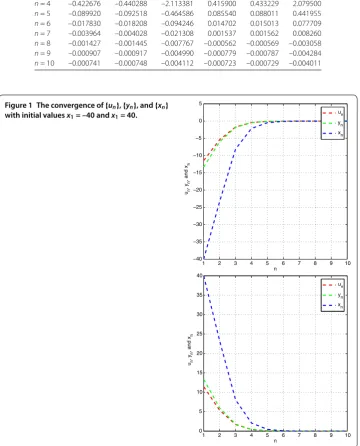
Remark . Table and Figure show that the sequences{un},{yn}, and{xn}converge
to , where{}=F(T)∩EP(F).
Example . In this example we take the same mappings and parameters as in Exam-ple . exceptT andFi.
LetT: [, ]→[, ] be defined by
T(x) =x+
Table 1 The values of{un},{yn}, and{xn}with initial valuesx1= –40 andx1= 40
x1= –40 x1= 40
un yn xn un yn xn
n= 1 –11.428571 –13.333333 –40.000000 11.428571 13.333333 40.000000
n= 2 –5.382261 –5.980290 –23.323129 5.368132 5.964591 23.261905
n= 3 –1.702305 –1.812640 –8.085951 1.691401 1.801028 8.034153
n= 4 –0.422676 –0.440288 –2.113381 0.415900 0.433229 2.079500
n= 5 –0.089920 –0.092518 –0.464586 0.085540 0.088011 0.441955
n= 6 –0.017830 –0.018208 –0.094246 0.014702 0.015013 0.077709
n= 7 –0.003964 –0.004028 –0.021308 0.001537 0.001562 0.008260
n= 8 –0.001427 –0.001445 –0.007767 –0.000562 –0.000569 –0.003058
n= 9 –0.000907 –0.000917 –0.004990 –0.000779 –0.000787 –0.004284
n= 10 –0.000741 –0.000748 –0.004112 –0.000723 –0.000729 –0.004011
Figure 1 The convergence of{un},{yn}, and{xn} with initial valuesx1= –40 andx1= 40.
andF: [, ]×[, ]→Rbe defined by
F(x,y) = (y–x)(y+ x– ), ∀(x,y)∈[, ]×[, ].
It is clear to see that
By the definition ofF, we have
≤F(un,y) +
rn
y–un,un–xn= (y–un)(y+ un– ) +
rn
(y–un)(un–xn).
Then
≤rn(y–un)(y+ un– ) +
yun–yxn–un+unxn
=rny+ (rnun+un–xn– rn)y+ rnun–un– rnun+unxn.
LetA(y) =rny+ (rnun+un–xn– rn)y+ rnun–un– rnun+unxn. ThenA(y) is a quadratic
function ofywith coefficienta=rn,b=rnun+un–xn– rn,c= rnun–un– rnun+unxn.
We determine the discriminantofAas follows:
=b– ac
= (rnun+un–xn– rn)– rn
rnun–un– rnun+unxn
= rn– rnun– rnun+un+ rnun+ rnun+ rnxn– unxn– rnunxn+xn
= (un– rn+ unrn–xn).
We haveA(y)≥,∀y∈R. If it has at most one solution inR, then= , we obtain
un=
xn+ rn
+ rn
. (.)
For everyn≥, from (.), we rewrite (.) as follows:
yn=xnn+ ( –n)(x+n+rrnn);
xn+=P[,][ρxnn+nxn+ ( –n)(yn+)–μyn+n ].
(.)
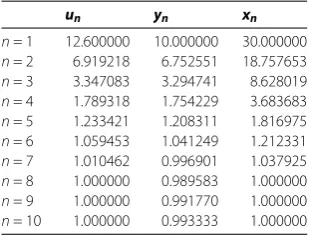
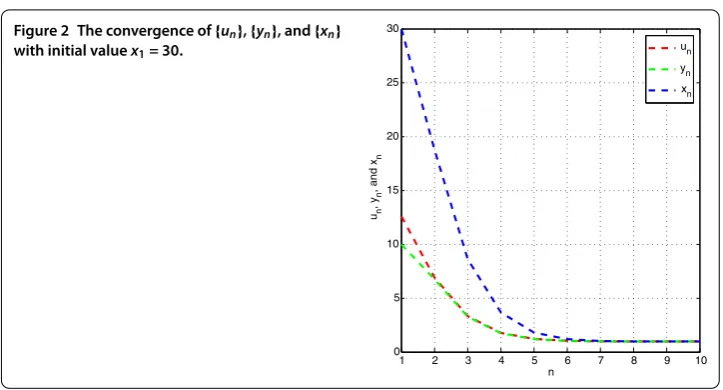
Remark . Table and Figure show that the sequences{un},{yn}, and{xn}converge
to , where{}=F(T)∩EP(F).
Table 2 The values of{un},{yn}, and{xn}with initial valuex1= 30
un yn xn
n= 1 12.600000 10.000000 30.000000
n= 2 6.919218 6.752551 18.757653
n= 3 3.347083 3.294741 8.628019
n= 4 1.789318 1.754229 3.683683
n= 5 1.233421 1.208311 1.816975
n= 6 1.059453 1.041249 1.212331
n= 7 1.010462 0.996901 1.037925
n= 8 1.000000 0.989583 1.000000
n= 9 1.000000 0.991770 1.000000
Figure 2 The convergence of{un},{yn}, and{xn} with initial valuex1= 30.
5 Conclusions
In this paper, we suggested and analyzed an iterative method for finding an element of the common set of solutions of (.) and (.) in real Hilbert spaces. This method can be viewed as a refinement and improvement of some existing methods for solving vari-ational inequality problem, equilibrium problem and a hierarchical fixed point problem. Some existing methods, for example, [, , , , , ], can be viewed as special cases of Algorithm .. Therefore, Algorithm . is expected to be widely applicable. In the hi-erarchical fixed point problem (.), ifS=I– (ρU–μF), then we can get the variational inequality (.). In (.), ifU= then we get the variational inequalityF(z),x–z ≥, ∀x∈F(T)∩EP(F), which just is a variational inequality studied by Suzuki [].
Competing interests
The authors declare that they have no competing interests.
Authors’ contributions
All authors contributed equally and significantly in writing this article. All authors read and approved the final manuscript.
Author details
1School of Management Science and Engineering, Nanjing University, Nanjing, 210093, P.R. China.2Ibn Zohr University,
ENSA, BP 32/S, Agadir, Morocco.3Department of Mathematics & Statistics, King Fahd University of Petroleum & Minerals,
Dhahran, Saudi Arabia.4Department of Mathematics, Aligarh Muslim University, Aligarh, 202002, India.
Acknowledgements
In this research, the second and third author were financially supported by King Fahd University of Petroleum & Minerals (KFUPM), Dhahran, Saudi Arabia. It was partially done during the visit of third author to KFUPM, Dhahran, Saudi Arabia.
Received: 30 May 2014 Accepted: 5 September 2014 Published:24 Sep 2014
References
1. Blum, E, Oettli, W: From optimization and variational inequalities to equilibrium problems. Math. Stud.63, 123-145 (1994)
2. Combettes, PL, Hirstoaga, SA: Equilibrium programming using proximal like algorithms. Math. Program.78, 29-41 (1997)
3. Combettes, PL, Hirstoaga, SA: Equilibrium programming in Hilbert space. J. Nonlinear Convex Anal.6, 117-136 (2005) 4. Ceng, LC, Yao, JC: A hybrid iterative scheme for mixed equilibrium problems and fixed point problems. J. Comput.
Appl. Math.214, 186-201 (2008)
5. Takahashi, S, Takahashi, W: Strong convergence theorem for a generalized equilibrium problem and a nonexpansive mapping in a Hilbert space. Nonlinear Anal.69, 1025-1033 (2008)
6. Reich, S, Sabach, S: Three strong convergence theorems regarding iterative methods for solving equilibrium problems in reflexive Banach spaces. In: Optimization Theory and Related Topics. Contemp. Math., vol. 568, pp. 225-240 (2012)
8. Chang, SS, Joseph Lee, HW, Chan, CK: A new method for solving equilibrium problem fixed point problem and variational inequality problem with application to optimization. Nonlinear Anal.70, 3307-3319 (2009)
9. Latif, A, Ceng, LC, Ansari, QH: Multi-step hybrid viscosity method for systems of variational inequalities defined over sets of solutions of equilibrium problem and fixed point problems. Fixed Point Theory Appl.2012, 186 (2012) 10. Marino, C, Muglia, L, Yao, Y: Viscosity methods for common solutions of equilibrium and variational inequality problems via multi-step iterative algorithms and common fixed points. Nonlinear Anal.75, 1787-1798 (2012) 11. Suwannaut, S, Kangtunyakarn, A: The combination of the set of solutions of equilibrium problem for convergence
theorem of the set of fixed points of strictly pseudo-contractive mappings and variational inequalities problem. Fixed Point Theory Appl.2013, 291 (2013)
12. Yao, Y, Cho, YJ, Liou, YC: Iterative algorithms for hierarchical fixed points problems and variational inequalities. Math. Comput. Model.52(9-10), 1697-1705 (2010)
13. Mainge, PE, Moudafi, A: Strong convergence of an iterative method for hierarchical fixed-point problems. Pac. J. Optim.3(3), 529-538 (2007)
14. Moudafi, A: Krasnoselski-Mann iteration for hierarchical fixed-point problems. Inverse Probl.23(4), 1635-1640 (2007) 15. Cianciaruso, F, Marino, G, Muglia, L, Yao, Y: On a two-steps algorithm for hierarchical fixed point problems and
variational inequalities. J. Inequal. Appl.2009, 208692 (2009)
16. Marino, G, Xu, HK: Explicit hierarchical fixed point approach to variational inequalities. J. Optim. Theory Appl.149(1), 61-78 (2011)
17. Crombez, G: A hierarchical presentation of operators with fixed points on Hilbert spaces. Numer. Funct. Anal. Optim. 27, 259-277 (2006)
18. Ceng, LC, Anasri, QH, Yao, JC: Some iterative methods for finding fixed points and for solving constrained convex minimization problems. Nonlinear Anal.74, 5286-5302 (2011)
19. Bnouhachem, A: A modified projection method for a common solution of a system of variational inequalities, a split equilibrium problem and a hierarchical fixed-point problem. Fixed Point Theory Appl.2014, 22 (2014)
20. Ceng, LC, Anasri, QH, Yao, JC: Iterative methods for triple hierarchical variational inequalities in Hilbert spaces. J. Optim. Theory Appl.151, 489-512 (2011)
21. Tian, M: A general iterative algorithm for nonexpansive mappings in Hilbert spaces. Nonlinear Anal.73, 689-694 (2010)
22. Geobel, K, Kirk, WA: Topics in Metric Fixed Point Theory. Stud. Adv. Math., vol. 28. Cambridge University Press, Cambridge (1990)
23. Suzuki, N: Moudafi’s viscosity approximations with Meir-Keeler contractions. J. Math. Anal. Appl.325, 342-352 (2007) 24. Xu, HK: Iterative algorithms for nonlinear operators. J. Lond. Math. Soc.66, 240-256 (2002)
25. Acedo, GL, Xu, HK: Iterative methods for strictly pseudo-contractions in Hilbert space. Nonlinear Anal.67, 2258-2271 (2007)
26. Wang, Y, Xu, W: Strong convergence of a modified iterative algorithm for hierarchical fixed point problems and variational inequalities. Fixed Point Theory Appl.2013, 121 (2013)
27. Cianciaruso, F, Marino, G, Muglia, L, Yao, Y: A hybrid projection algorithm for finding solutions of mixed equilibrium problem and variational inequality problem. Fixed Point Theory Appl.2010, 383740 (2010)
10.1186/1687-1812-2014-194