adjustment of students with learning disability
Saifollah Khodadadi1, Narges Adibsereshki2, Guita Movallali3,
Enayatollah Bakhshi4
Abstract
Learning disability includes wide range of educational problems which treating these problems need child's social, emotional and behavior treatment. As prevalence of learning disabilities among children and their difficulties, the purpose of this study was to investigate the effect of coping with stress training on social adjustment of students with learning disabilities. The statistical population consists of all boy student with learning disabilities in learning disabilities center, in which 34 students were selected by convenience sampling. The social adjustment questionnaire was used. The experimental group had coping strategies training in 9 sessions for 90 minutes every week. Covariance analysis was used to compare the scores. The results showed that there was significant difference in pretest and posttest of experimental group. The findings also indicated that coping strategies training increased social adjustment, affective and educational adjustments of experimental group in comparison of control group. Appropriate strategies can be used for dealing with stress in students with learning disabilities. Coping training can be used as supplemental program in schools and centers of learning disabilities to improve the adjustment problems of these students.
Keywords: Coping Skills, Learning Disabilities, Social Adjustment Journal of Research & Health
Social Development & Health Promotion Research Center
Vol. 7, No. 4, Jul & Agu 2017 Pages: 915 - 920 DOI: 10.18869/acadpub.jrh.7.4.915
Original Article
1. Department of Behavioral Sciences, School of Psychology and Education of Exceptional Children, University of Social Welfare and Rehabilitation Sciences, Tehran, Iran
2. Correspondence to: Department of Behavioral Sciences, School of Psychology and Education of Exceptional Children, Pediatric Neurorehabilitation Research Center, University of Social Welfare and Rehabilitation Sciences, Tehran, Iran
Emeil: [email protected]
3. Department of Behavioral Sciences, School of Psychology and Education of Exceptional Children, Pediatric Neurorehabilitation Research Center, University of Social Welfare and Rehabilitation Sciences, Tehran, Iran 4. Department of Education and Social Welfare, School of Psychology, School of Biostatistics University of Social Welfare and Rehabilitation Sciences, Tehran, Iran
Received: 8 Agu 2015 Accepted: 2 Nov 2015
How to cite this article: Khodadadi S, Adibsereshki N, Movallali G, Bakhshi E, Ghasemi N. Effect of coping with stress training on the social adjustment of students with learning disability. J Research & Health2017; 7(4): 915 - 920.
Introduction
Learning disabilities could be the most important cause of poor academic performance and each year many students suffer from this disorder and have difficulties in learning contents. Students with Learning Disability (LD) are in the range of average intelligence or higher than normal but have lower academic performance than other students. Despite being in proper educational environment, lack of
obvious biological lesions and lack of non-acute mental health problems they are not able to learn in specific academic areas (reading, writing and arithmetic) [1].
problem for these students because these skills can affects the various areas of life [3]. Social adjustment includes idividual's adjustment to the social environment which can be achieved by involvement, matching, reconciliation and cope with oneself and the environment [4]. Social adjustment in students with learning disabilities arises in communication, problem solving, decision-making and managing behaviors. Since social adjustment is related to the acceptance by classmates, teacher and their success in the school, and due to lack of guidance at hom and school or lack of education about valuse, these students can not show appropriate behavior in different social situation [5]. Social problems and aggressive behaviors among children can be resulted from their disability also bad experiences and continuous defeats can cause stress, anxiety, frustration and violence [3]. When individuals are in stressful situation, emotional regulation enable them to evaluate the emotional impact of the condition and help them to decide what kinds of emotion or reaction is appropriate [6]. Tension and stress have become important and inevitable part of human life. studies in this field have focused on whatever endangers health which may not be tension but is individual assessment of tension and methods of coping with it [7]. Coping strategies have been defined as set of cognitive and behavioral responses that aim to minimize stressful situations pressures [8]. The important point is that all of these skills are learnable and can help the person in controlling problems such as proper adjustment to depression, anxiety, shyness, interpersonal relationships and failure [9]. Researchers have shown that stress coping strategies have some significant effects on the individuals' adjustments. A study about the relationship between optimism and coping strategies indicated that students who used cognitive coping and social support showed more social adjustments and academic achievement in school [10]. The result of a study on 84 adolescents 12 to 16 years old who had a chronic disease indicated that the coping strategies are effective on self-esteem, social anxiety and social adjustment. [11]
Another study's results implied that the stress coping strategies are effective on reducing the level of stress and also recognizing social adjustments [12]. The research was conducted on teaching coping strategies and showed that after training people mentioned greater life satisfaction, reduction of stress and more academic adjustment [13]. The results of study suggested that students who have passed the training course have shown better educational and social adjustment [9]. Research on effectiveness of life skills training on coping and social adjustment indicated that the training had positive effect on students' coping with stress and social adjustment [14]. The results in relation to training mental health and emotional coping strategies in sample of 500 students showed that teaching strategies increased mental and physical health, reduced behavior problems and enhanced social adaptation [15]. Most of the studies in the field of social adjustment are related to normal students and fewer were conducted on students with learning disabilities. Also more studies in this area seems necessary by considering high prevalence of learning disabilities and the role of different aspects of coping for success, health promotion and reducing the problems of students with learning disabilities. This study seeks to answer the question of whether training coping strategies will impact on the social adjustment of students with learning disabilities.
Method
and posttest in each group were compared. Sinha and Singh Social Adjustment Scale which has been translated by Karami [16] was used. The scale includes social, emotional and educational adjustment measures.The answers in this test are as yes and no and the high score (31 and more) indicates the maladjustment and the low score indicates adjustment (5 and less). The reliability coefficient of test is reported by Split-half, test-retest and Kuder Richardson coefficient, 0.95, 0.93 and 0.94 respectively. The reliability of the social, emotional, educational and total subscales is reported 0.92, 0.96 and 0.94. Also its content validity has been confirmed by 2 psychology experts that showed high reliability and validity [17].
Procedure: The experimental group had coping strategies training in 9 sessions for 90 minutes every week. The content for each session is included.
First session: Introducing members of the group together and creating positive relationships and awareness of the benefits of teamwork than individual work and strengthen the spirit of partnership and cooperation.
Second session: Strengthen relationship based on cooperation, definition of role of thoughts and beliefs in the incidence of people's stress, mental pressure andmental health.
Third session: training about I am a unique person with goal that the children consider themselves as unique, become familiar with their strengths and capabilities, develop self-esteem and promote adaptation, training relaxation and breathing. Fourth session: training self-awareness, the ability to recognize emotions and the relationship between thoughts, feelings and reactions, helping to identify and express feelings of individual, assessing the efficacy of relaxation techniques. Fifth Session: Identifying negative thoughts and combat them, creating negative propaganda against the spirit of resistance.
Sixth session: Training methods of problem solving and cope with the problems and methods of making the right decisions and training the mental imagery visualization in mind.
Seventh session: Training positive thinking and positive self-expression.
Eighth session: Training of distraction techniques, satisfaction and happiness in life.
Table 1 Sessions content Content Sessions
Introducing participants to start positive interaction, explaining the purpose, reinforcing cooperation
1
Definition of stress, roles of ideas and beliefs 2
Training of awareness, recognizing feelings and abilities, reinforcing self-confidence and promotion adjustment, being realistic about abilities and weaknesses 3-4
Identifying negative thoughts and combat with them, a spirit of resistance to negative publicity
5
Training of proper decisions and cope with problems 6
Positive self-expression, Life satisfaction 7
Communication role in human interactions, the volubility of self-expression 8
Conclusion 9
Ninth session: Summary and analysis of the techniques which have been taught.
Data was analyzed by using descriptive statistics such as mean and standard deviation with respect to test assumptions by using Multivariate analysis of variance with SPSS 19.
Results
In this part the information about implementation of the social adjustment scale on participants of the two groups were
analyzed descriptively. The information includes frequency; mean and standard deviation in both groups. This data was first briefly summarized by using descriptive data and then inferential analyses were studied in details.
Table 2 Descriptive data for adjustments in pretest and posttest
Variables Group Mean ± SDPretest Mean ± SDPosttest
Social adjustments Experimental 10.24 ± 1.95 6.06±1.52
Control 9.65±1.58 9.53±1.55
Affective adjustments Experimental 10.71±2.64 5.82±1.42
Control 9.65±1.58 9.53±1.55
Educational adjustments Experimental 9.18±1.98 6.06±1.20
Control 9.24±1.60 8.88±2
As shown in Table 3, the results showed that the data are normally distributed by social adjustment scale (Kolmogorov-Smirnov test is not significant in any of the components). Therefore, assumption of normal distribution of data is met.
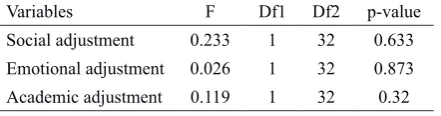
As can be seen in Table 4, the results showed that Levene test is not significant in any of the components of social adjustment scale which represents that the variances are, so homogeneous multivariate analysis of covariance testis applicable.
Table 3 Probability distribution
Variables Z Smirnov p-value
Social adjustment 0.61 0.85
Affective adjustment 0.84 0.47
Educational adjustment 0.94 0.29
Table 4 Leven test for different variables
Variables F Df1 Df2 p-value
Social adjustment 0.233 1 32 0.633
Emotional adjustment 0.026 1 32 0.873
Academic adjustment 0.119 1 32 0.32
As can be observed in the Table 5, comparing the posttests of two groups indicated that the social adjustment scores for experimental group were decreased
significantly (p<0.005, F=174.125) which means the social adjustment of this group was improved and the coping strategies training was effective.
Table 5 Covariance analysis
Variables Df F p-value Effect size p-value
Social adjustment 1 1.141 0.294 0.038 0.178
Affective adjustment 1 5.091 0.032 0.149 0.588
Educational adjustment 1 6.635 0.015 0.186 0.702
Group
Social adjustment 1 174.13 0 0.857 1
Affective adjustment 1 51.544 0 0.64 1
Educational adjustment 1 46.36 0 0.615 1
Error 29
tTotal 34
Also, the posttests for two groups indicated that the affective adjustment scores for experimental group were decreased significantly (p<0.005, F=51.544) which means the affective adjustment in this group was improved and the coping strategies training was effective.
strategies training was effective.
Discussion
The findings suggest that coping with stress strategies training have been effective in increasing the emotional, educational adjustment and generally social adjustment of students with learning disabilities. Results of this study are consistent with some previous studies in this area [10-15]. Learning disabilities causes problems in the social, emotional and educational areas for students [18]. Learning disabilities of students can cause social, emotional and educational adjustment problems for them. Social adjustment means adopting individual's ability in social environment which cannott be achieved by students with LD but may be achievable by changing the self or the environment. Emotional adjustment means good mental health, life satisfaction and harmony between feelings and thoughts. In other words, the emotional adjustment is mechanism by which person is emotionally stable. Capabilities and competencies of social and emotional factors are critical in influencing academic adjustment [6]. Social adjustment is on top of compatibility issues and if anyone in this field is able to carry out its mandate, in other areas also will not faced with the problem [19]. Research's results have shown that there is significant relationship between educational, social and emotional achievement [20]. The results of study showed that children with learning disabilities have higher rates of emotional and social adjustment problems compared to their normal peers [21]. Usually, students with learning disabilities are reluctant to their peers, especially in academic activities [22]. These groups of students cannot face severe stressful situation and they show less consistency. They feel more stress and danger than others when they are in stressful situations and cannot make proper emotional decisions, avoid impulsive behavior and have self-control on irrational beliefs. Therefore, teaching coping with stress strategies can lead to avoiding impulsive behaviors and emotional decisions in encountering with stressful
situations. Also, appropriate adjustment in the academic, emotional and social adjustment would achieve by reducing stress and anxiety and the use of appropriate cognitive and metacognitive strategies such as self-regulation and effective communication with community members.
It is also necessary to mention that despite the strategies and methods of coping with it, there have been attracted attention in recent years by psychologists, professionals and researchers but experimental data is still low that support the impact of these interventions in patients with disability. Thus, researchers can examine the coping strategies on other psychological variables in this group and group with other disorders so it will help to broaden the scope of these studies. Each research has some limitations. One of the limitations of this study was the lack of follow-up and convenience sampling which is recommended these points to be considered in the future research to achieve fruitful results.
Conclusion
The findings of this study indicated that coping strategies training enhanced the social adjustments of students with learning disabilities. It seems that teaching these strategies can reduce the stress and anxiety of students in stressful situations and help them to have better mental health. Considering that students with learning disabilities have emotional problems, coping skills training can prevent or decrease their mental disorders and increase their emotional adjustment.
Acknowledgments
This paper is part of master’s thesis and was proven by University of Social Welfare and Rehabilitation Sciences. We thank the university, education administration, school personnel, teachers and students.
Contribution
Study design: SKh, NA
Conflict of Interest
The authors declare that they have no conflict of interests.
Funding
The author (s) received no financial support for the research, authorship and/or publication of this article.
References
1- Karande S, Mhajan V, Kulkarni M. Recollections of learning disabled adolescent of their schooling experiences: a qualitative study. Indian J Med Sci2009; 63(9): 382-91
2- Sideridis GD. Classroom goal structures and hopelessness as predictorsofday-to-day experience at school: differences between students with and withoutlearning disabilities. Int J Educ Res2005; 43(4-5): 308-28.
3- Lavoie RD. It's so much work to be your friend:
helping the child with learning disabilities find social
success. Preface by: Michele Reiner and Rob Reiner. Foreword by: Mel Levine Trade Paperback. New York: Simon & Schuster; 2005
4- Fooladi A. Peer counseling, perspectives, concepts and skills of mental health. Tehran: Tolo-e-Danesh publication; 2004.
5- McIntyre T. Teaching social skills to kids who don't have them. Dr. Mac's Amazing behavior management advice site. [4 screens]. Available at URL: http://www. ldonline.org/article/Teaching_Social_Skills_to_Kids_
Who_Don't_Yet_Have_Them?theme=print. Accessed
July 16, 2003.
6- Wang M, Saudino KJ. Emotion regulation and stress.
J Adult Dev2011; 18: 95-103.
7- Thoits PA. Social support as coping assistants. J Consult ClinPsycho1986; 54(4): 416-23.
8- Lazarus RS, Folkman S. Sterss, appraisal, and coping. New York: Springer-Verlag; 1984.
9- Narimani M, Rajabi S. Investigation of prevalence and learning disability factors in Ardebil primary students.
Research on Exceptional Children2005; 17(3): 231-52. 10- Millova K, Dosedlova J. Optimism and coping strategies in high school student. Journal Psychology of Education2010; 13(3): 100-10.
11- Meijer SA, Sinnema G, Bijstra JO, Mellenbergh GJ,
Wolters WH. Coping styles and locus of control as predictors for psychological adjustment of adolescents with a chronic illness. Soc Sci Med2002; 54(9): 1453-61.
12- Øverli Ø, Sørensen C, Pulman KG, et al. Evolutionary background for stress-coping styles: relationships between physiological, behavioral, and cognitive traits in non-mammalian vertebrates.
Neurosci Biobehav Rev2007; 31(3): 396-412.
13- Mishara BL, Ystgaard M. Effectiveness of a mental health promotion program to improve coping skills in yong children: zippos friends. Early Child Res Q2006; 21: 110-23.
14- Nahang A, Mehriyar A, Jahanian S. Effectiveness of life skills training on social adjustment and coping with stress among second grade high school male students in region 4 of Tehran. Journal UMP-Social Sciences and Technology Management2015; 3(3): 736-43.
15- Ramesht M, Farshad C. Study of life skills training in prevention of drug abuse in students. Third seminar of students' mental health. 2009. pp:70-2.
16- Karami A. Normalization of adjustment inventory for high school students. Tehran: Sina Psychological Institute publication; 1998. pp: 18
17- Saqi MH, Rajai AR. The relationship between adolescents' perceptions of family functioning and adapt them. Journal of Thought and Behavior2008; 10(3): 71-82.
18- Freilich, R, Shechtman, Z. The contribution of art therapy to the social, emotional, and academic adjustment of children with learning disabilities. Arts Psychother2010; 37: 97-105.
19- Bineshi A. The relationship between self-concept and social adjustment of students gather cultural and Shahid Beheshti University. [dissertation]. Tehran: Shahid Beheshti University 2006; pp: 42-4.
20- Elias M, Arnold H. The educator’s guide to emotional intelligence and Academic achievement. Thousand Oaks, CA: Corwin press; 2006.
21- Auerbach JG, Groos- Tsur V, Manor O, Shalev RS. Emotional and behavioral characteristics over a sex year period in youth with persistent and non perisistent dyscalculia. J Learn Disabityl2008; 4: 263-73. 22- Hajloo N, Rezaisharif A. Psychometric properties
of colorado learning difficulties questionnaire (CLDQ). J Learn Disabil2011; 1(1): 24-43.