International Journal of Engineering
J o u r n a l H o m e p a g e : w w w . i j e . i r
Element Free Galerkin Method for Static Analysis of Thin Micro/Nanoscale Plates
based on the Nonlocal Plate Theory
A. Naderi *, G. H. Baradaran
Department of Mechanical Engineering, Shahid Bahonar University of Kerman, Kerman, Iran
P A P E R I N F O
Paper history:
Received 07 November 2012
Received in revised form 24 December 2012 Accepted 24 January 2013
Keywords:
Element Free Galerkin Method Nonlocal Theory, Micro/Nanoscale Plates Graphene Sheet
A B S T R A C T
In this article, element free Galerkin method is used for static analysis of thin orthotropic micro/nanoscale plates based on the nonlocal plate theory. Equilibrium equation is obtained based on the nonlocal Kirchoff plate theory. Weak form of the equilibrium equation is discretized based on the moving least square (MLS) approximation functions. Since MLS approximation functions do not satisfy the Kronecker’s delta property, the penalty method is used to impose the essential boundary conditions. Discrete form of the weak form is then solved and the plate deflection is obtained. Numerical results show that the number of nodes scattered in the plate domain, support domain radius and the number of Gauss quadrature points affect the results. Therefore, before presentation of the final results, the method is calibrated using some exact results. Finally, the plate deflection is obtained for various boundary conditions and the small scale effect is studied. In addition, as an example bending problem of nano graphene sheets is solved for different boundary conditions.
doi: 10.5829/idosi.ije.2013.26.07a.14
1. INTRODUCTION1
Micro/nano plates (such as graphene) are used frequently in micro-electromechanical systems (MEMS) and nano-electromechanical systems (NEMS) because of their superior electrical, mechanical and thermal properties. Thus, they have received considerable attention by researchers. Scale parameter plays a substantial role in the mechanical behavior of small scale structure. As the length scale becomes smaller, long-range interatomic and intermolecular cohesive forces have more important effects on the mechanical behavior of the structures. Further, experimental and atomistic simulation results have shown that the size parameter affects the mechanical properties when dimensions of the structures become smaller [1, 2].
Experiments and molecular dynamic simulations are appropriate methods for accurate mechanical analysis of micro/nano structures. However, controlled experiments in nano scale are difficult. On the other hand, molecular dynamic simulations are computationally expensive. Hence, modified continuum models capturing small
1* Corresponding AuthorEmail:[email protected], [email protected] (A. Naderi)
scale effects have been introduced for studying mechanical behavior of these structures [3-5]. Among the continuum models capturing the small scale effects, nonlocal elasticity theory [5] has received more attention.
Some researchers studied bending, buckling and vibration problems of small scale plates using the nonlocal elasticity theory. For example, Lu et al. [6] investigated bending and free vibration of simply supported rectangular plates. Murmu and Pradhan [7] solved buckling problem of orthotropic small scale plates under biaxial compression based on the Kirchhoff plate theory. Pradhan [8] performed buckling analysis of single layer graphene sheet based on higher order shear deformation theory. Pradhan and Phadikar [9] carried out vibration analysis of multilayered graphene sheets embedded in polymer matrix. Based on the third order shear deformation plate theory, Aghababaei and Reddy [10] investigated effect of nonlocal theory on bending and free vibration of simply supported orthotropic rectangular plates. Pradhan and Phadikar [11] solved for vibration of single and double layered nanoplates based on the both Kirchhoff and first order shear deformation plate theories. Narendar [12] carried out buckling analysis of isotropic nanoplates using the two-variable
refined plate theory. All of these works investigated simply supported micro/nano plates and solved the problems using the Navier’s approach. In addition, there are some works solving free vibration and buckling problems of nonlocal plates with the other boundary conditions [13-16]. However, on bending problem of nonlocal plates, researches have been limited to the plates with either all edges simply supported or with at least two opposite edges simply supported. Since the problem with arbitrary boundary conditions cannot be solved analytically, numerical methods are required to solve the problem. According to our knowledge, this issue has not been considered yet.
In recent years, mesh free methods have been developed to structural analysis of plates and shells [18-26]. A mesh free method is a method used to establish a system of algebraic equations for the whole problem domain without the use of a predefined mesh for the domain discretization [17]. All of the mesh free methods use a set of nodes scattered in the problem domain without any element connectivity among them.
Various versions of mesh free methods have been applied for structural analysis of plates [18-26]. Element free Galerkin method (EFGM) is a well-known mesh free method using moving least square (MLS) approximation function. Since MLS approximation functions do not satisfy the Kronecker’s delta property, enforcement of the essential boundary conditions requires special techniques for example, direct collocation methods, Lagrange multipliers method, penalty method, coupling with the finite element method (FEM), d’Alembert’s principle, transformation method, displacement constraint equations method, etc [19]. Some researchers applied the EFGM to solve bending and free vibration problems of beams, plates and shells. For example, Krysl and Belytschko [27, 28] investigated static analysis of thin plates and shells. Liu and Chen [29] studied static and free vibration of thin plates of complicated shape with clamped and simply supported edges. Ouatouati and Johnson [30] carried out modal analyses of Euler-Bernoulli beams and Kirchhoff plates. Moreover, Belinha and Dinis [31] used the EFGM in the analysis of laminated composite Mindlin plates.
In the present work, static problem of orthotropic micro/nano plates is solved based on the EFGM for different boundary conditions. Small scale effect is incorporated into the model using the nonlocal elasticity theory. Equilibrium equation of the plate is obtained based on the Kirchhoff plate theory. Weak form of the equilibrium equation is obtained. Natural boundary conditions are satisfied automatically on the weak form and essential boundary conditions are enforced using the penalty method. Deflection of the plate is obtained and compared with those obtained from the local plate theory. In addition, the effects of support domain radius, the number of nodes on the plate domain, Gauss
quadrature points, small scale parameter, aspect ratio and boundary conditions are studied in detail. Finally, bending problem of nano graphene sheets as orthotropic thin nonlocal plates is solved for different boundary conditions.
2. NONLOCAL CONSTITUTIVE RELATIONS
Nonlocal elasticity theory assumes that stress at a point is a function of strain at all points of the continuum, while in the classical elasticity theory, it is assumed that stress at a point depends only on the strain at that point. Constitutive relation of a nonlocal continuum is written in the following form
) ( ) ( ) ( )
(x x x σ x x
σ =
ò
¢- L ¢ dV ¢V
y (1)
where, σ is nonlocal stress tensor, x is a reference point in the body, y(x¢-x) is the nonlocal kernel function and σLis local (classical) stress tensor at any point x¢ in the body. Eringen [5] showed that it is possible to represent the integro-partial differential Equation (1) in an equivalent differential form as
L
a
e Ñ σ=σ
-( ) )
1
( 0 0 2 2 (2)
where, a0 is an internal characteristic length, e0 is a
constant and Ñ2 is the Laplacian operator.
3. EQULIBRIUM EQUATION
Consider a rectangular orthotropic thin plate with thickness h, length a and width b under a distributed transverse load p(x,y). According to the Kirchhoff plate theory strain-displacement relations of the plate in Cartesian coordinate system are written as
ï þ ï ý ü
ï î ï í ì
-= ï þ ï ý ü
ï î ï í ì
xy yy xx
xy y x
w z
w z
w z
, , ,
2 g
e e
(3)
in which, w is lateral displacement of the mid-plane, index “,” refers to the partial derivative and z is the through-thickness axis. Constitutive equations for a nonlocal orthotropic plate are written in the following form:
ï þ ï ý ü
ï î ï í ì
ú ú ú
û ù
ê ê ê
ë é = ï þ ï ý ü
ï î ï í ì Ñ
-ï þ ï ý ü
ï î ï í ì
y x
y x
y x
y x
y x
y x
Q Q Q
Q Q Q
Q Q Q a
e
g e e
t s s
t s s
66 26 16
26 22 12
16 12 11 2
2 0 0 )
in which, Qij’s (i,j=1,2,6) are reduced off-axis stiffness defined in terms of the reduced on-axis coefficients Qij’s as [32].
ï ï þ ï ï ý ü ï ï î ï ï í ì ú ú ú ú ú ú ú ú û ù ê ê ê ê ê ê ê ê ë é -+ = ï ï ï ï þ ïï ï ï ý ü ï ï ï ï î ïï ï ï í ì 66 12 22 11 2 2 2 2 2 2 2 2 2 2 2 3 3 3 3 2 2 4 2 2 4 2 2 3 3 3 3 2 2 2 2 4 4 2 2 2 2 4 2 2 4 66 26 22 16 12 11 ) ( 2 ) ( 2 4 ) ( 2 4 4 2 Q Q Q Q s c s c s c s c s c sc s c cs s c cs s c c s c s s c sc cs s c cs s c s c s c s c s c s c s s c c Q Q Q Q Q Q (5)
where, s=sin(q), c=cos(q) and Qij’s are defined in terms of the engineering constants as:
. , ) 1 ( , ) 1 ( , ) 1 ( 12 66 21 12 1 21 12 21 12 2 22 21 12 1 11 G Q E Q E Q E Q = -= -= -= n n n n n n n (6)
q
is the off-axis angle which for armchair and zigzag nano graphene sheets is equal to 0 and o 90 , orespectively.
Using the principle of virtual work equilibrium equation of the plate is obtained in the following form
0 ) , ( 2 2 2 2 2 2 = + ¶ ¶ + ¶ ¶ ¶ + ¶ ¶ y x p y M y x M x
Mx xy y (7)
where, moment resultants Mx, My and Mxy are defined in the following form:
ï þ ï ý ü ï î ï í ì = ï þ ï ý ü ï î ï í ì Ñ -ï þ ï ý ü ï î ï í ì L xy L y L x y x y x y x y x M M M M M M a e M M M 2 2 0 0 ) ( (8)
in which, local moment resultants L x
M , L y
M and L
xy
M
are defined as follows:
ï þ ï ý ü ï î ï í ì ú ú ú û ù ê ê ê ë é = ï þ ï ý ü ï î ï í ì xy yy xx L xy L y L x w w w D D D D D D D D D M M M , , , 66 26 16 26 22 12 16 12 11 2 (9)
where,
ò
-= /2 2 / 2 h h ij ij z Q dz
D (i,j =1,2,6 ). Using Equation (8), the equilibrium Equation (7) can be rewritten in the following form: . 0 ) , ( ) ) ( 1 (
2 2 0 0 2 2
2 2 2 2 = Ñ -+ ¶ ¶ + ¶ ¶ ¶ + ¶ ¶ y x p a e y M y x M x
MxL xyL Ly (10)
The plate boundary conditions can be written as follows:
For simply supported edges:
0
= =Mn
w (11)
For clamped edges:
0
, =
=wn
w (12)
For free edges: 0
= =
= n nt
n M M
V (13)
where, n is the unit normal on the boundary and t is the tangent to the edge of the plate. Analytical solutions for bending problem of plates based on the nonlocal plate theory are limited to the plates with simply supported edges [6]. Thus, for the plates with the other boundary conditions, numerical methods are required. In the next section, element free Galerkin method is used to solve the equilibrium Equation (10) together with any combination of the boundary conditions of (11), (12) and (13).
4. ELEMENT FREE GALERKIN METHOD
Element free Galerkin method is a mesh free method using moving least square (MLS) approximation functions. These approximation functions are continuous on the global domain [33]. MLS approximation for the plate deflection w at an arbitrary point ξ=(x,y) can be defined as follows [33].
å
= = p n j j jp a w 1 ) ( )(ξ ξ (14)
where, pj(ξ)’s are monomial basis functions and aj’s are coefficients which are obtained by minimizing the following weighted least-square L2 norm [33].
å
= -= nx i i ii w w
W J 1 2 ] ˆ ) ( )[
(ξ ξ (15)
where, nx is the number of nodes in support domain of point ξ and Wi(ξ)=Wi(ξ-ξi) is the weight function of the ith node at ξ. Based on the EFGM, nodes in the support domain of ξ are those which their weight function at ξ is nonzero. In the above equation, wˆi’s
are called nodal parameters at ξi because they are not the same as the deflection at that point. Coefficients
j
a ’s ( j=1,2,..., np) which are obtained from
0
/¶ =
¶J aj are continuous functions of ξ on the global domain because the EFGM uses weight functions which are continuous on the global domain. Final form of the approximation function for the plate deflection can be obtained by substituting aj(ξ)’s into Equation (14) in
the form of:
å
= = nx i i iw w 1 ˆ )where, ji’s are the MLS approximation functions which do not satisfy the Kronecker’s delta property. The above Equation can be easily rewritten in the following form [33].
w Φ
ξ) ˆ ˆ
(
1
T N
i i i
w
w =
å
==
j (17)
where, N is the number of nodes scattered in the global domain. Moreover, the approximation function vector
Φ and the nodal parameter vector wˆ are defined as T
N
T { ... }
1
1 j j
j
=
Φ (18)
T N T {wˆ wˆ ... wˆ }
ˆ = 1 2
w (19)
Furthermore, partial derivatives of the approximation functions with respect to x and y are required and they can be easily obtained. The detailed construction procedure has been given in reference [33] by Liu and Gu.
5. SOLUTION BASED ON THE EFGM
The EFGM uses the global weak form of the equilibrium equation. Weak form of the equilibrium Equation (10) is written as
0 ) ( ) ) ( 1 ( ) 2 ( , , 2 2 0 0 , , , = G + + + W Ñ -+ W + +
ò
òò
òò
G W W d w M w M w V d w p a e d w M w M w M s t L nt n L n L n yy L y xy L xy xx L x d d d d d d d (20)where, W refers to the plate domain and Gs refers to the plate edges having natural boundary condition. Since the MLS approximation functions do not satisfy the Kronecker’s delta property, penalty method is used to enforce the essential boundary conditions. To this end, the following terms must be added to the weak form (20). ÷÷ ÷ ø ö çç ç è æ G -+ G -
ò
ò
G G d w w d w w w w n n 2 , , 2 21( ~) ( ~ )
2
1d a a
(21)
where, a1 and a2 are penalty coefficients whose magnitude are limited by magnitude of the stiffness matrix components because very large penalty coefficients may cause singularity in the matrix inversion procedures. In addition, Gw refers to the edges with essential boundary condition. In the above relation, w~=w~,n =0 for clamped edges, w~=a2=0 for
simply supported edges and a1=a2 =0 for free edges.
Upon substituting Equation (9) together with Equation (17) into the variational form (20), final discrete form of the equilibrium equation is obtained as follows
p
F w K
K+ ]ˆ =
[ a (22)
in which,
òò
ò
òò
W ´ G ´ W ´ W Ñ -= G + = W + + + + + + ´ + F + = d y x p a e d d D D D D D D D D D N P T n n T N N T xy xy T yy xy T xx xy T xy yy T yy yy T xx yy T xy xx T yy xx T xx xx N N ) , ( ) ) ( 1 ( ) ( ] [ ) 4 2 2 2 2 ( ] [ 2 2 0 0 1 , 2 , 1 , 66 , , 26 , , 16 , , 26 , , 22 , , 12 , , 16 , , 12 , , 11 , Φ F Φ Φ Φ Φ K Φ Φ Φ Φ Φ Φ Φ Φ Φ Φ Φ Φ Φ Φ Φ Φ Φ K a a a (23)where, [K+Ka] is the stiffness matrix. By solving algebraic Equation (22), nodal parameters vector wˆ is obtained. Finally, the plate deflection at ξ=(x,y) can be obtained by substituting wˆ into Equation (17).
6. IMPLEMENTATION OF THE METHOD
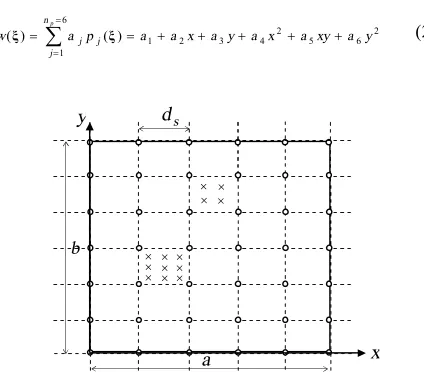
Here, it is assumed that nodes are scattered regularly in the plate domain. A system of rectangular background cells and straight boundary cells is applied for Gaussian quadrature numerical integration so that the nodes are located at the vertices of these cells as shown in Figure 1. In the integration procedure, it is possible to use 2´2 or 3´3 Gauss points as shown in Figure 1.
Since the governing weak form contains second-order derivatives, w is approximated in the form of a quadratic polynomial (np =6) as
2 6 5 2 4 3 2 1 6 1 ) ( )
( a p a a x a y a x a xy a y w
p n
j j
j = + + + + +
=
å
=
=
ξ
ξ (24)
Figure 1. Nodes on the plate domain ( ), background cells and Gauss points on each background cell (´)
Because of requirement of continuity of the weight function and its first and second order derivatives, it is chosen as the quartic spline in the following form
ï î ï í ì
> £ £
-+ -=
i i i
i i i
R r
R r R
r R
r R
r r
W
0
0 ) ( 3 ) ( 8 ) ( 6 1 ) (
4 3 2
(25)
where, ( )2 ( )2
i i y y
x x
r= - + - is distance between an
arbitrary point ξ and ξi (i=1,2,...,N ). Ri is the support domain radius of the weight function Wi(r). Here, Ri’s are assumed to be the same for all weight functions (Ri=R, i =1,2,..., N ).
As mentioned earlier, based on the EFGM nodes in the support domain of an arbitrary point ξ are those which their weight function at ξ is nonzero. From Equation (25), it is concluded that the support domain radius of an arbitrary point ξ, Rs, is the same as the support domain radius of the weight functions, R.
The support domain radius Rs is defined in the following form
s s
s d
R = a (26)
where, ds is the mesh size which is here assumed to be the same as the longer side of the rectangular mesh as shown in Figure 1. Furthermore, as is a constant which is obtained by performing some numerical experiments.
7. NUMERICAL STUDIES
Consider a micro/nano rectangular thin plate with thickness h, length a and width b subjected to the following transverse distributed load
) sin( )
sin( x y
p
p= lm zl hm (27)
where, zl =lp/a and hm=mp/b in which l and m are the half wave numbers. Analytical solutions to this problem are limited to the plates with simply supported edges. The problem is solved here for the plates not only with the simply supported boundary conditions but also with arbitrary combinations of clamped (C), free (F) and simply supported (F) boundary conditions based on the EFGM.
EFGM numerical results depend on the support domain parameter as=Rs/ds and the number of Gauss points. Thus, before presentation of the numerical results, this method must be calibrated using the exact results. To this end, deflection of the nonlocal plate is obtained for e0a0=0 and compared with those obtained from the local plate theory.
For a simply supported plate the EFGM is calibrated using the following closed form solution
) sin( ) sin(
) )
2 ( 2 (
)) (
) ( 1 ( )
,
( 4
22 2 2 66 12 4 11
2 2 2 0 0
y x p
D D
D D
a e y
x w
m l lm
m m l l
m l
h z
h h z z
h z
´
+ +
+
+ +
=
(28)
which can be easily obtained from Equation (10) together with Equation (9).
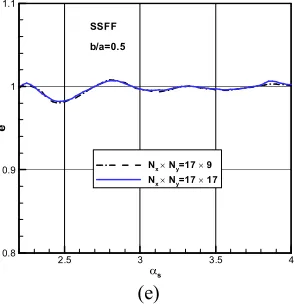
Figures (2-a) and (2-b) show e=w/wexact at the
plate center versus as =Rs/ds using four and two Gauss points in each background cell and boundary cell, respectively. It can be seen from these figures that as both as and the number of nodes (N=Nx´Ny) increase, e approaches 1.
These figures show that the presented results based on the EFGM are in good agreement with the analytical results.
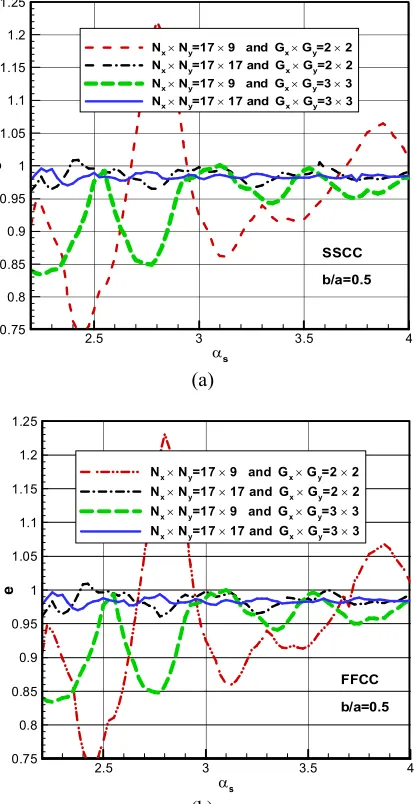
For plates with the other boundary conditions since there is no analytical solution to calibrate the method, fine meshes finite element results from the ANSYS software are used as exact solutions. Figures 2, 3 and 4 depict the parameter e at the plate center versus as for the plates with different aspect ratios and boundary conditions. In these figures, Gx´Gy is the number of Guass quadrature points in each background cell. These figures show that as the number of nodes in the plate domain, the number of Guass quadrature points in each background cell and the support domain parameter as increase, numerical results converge to the finite element results. It can be also seen from these figures that the numerical results are the same as the exact results for some values of Gx´Gy and as , so they can be used to calibrate the EFGM. According to these figures, numerical results for 2.9£as£3.1 are acceptable; thus, the support domain parameter as can be selected in this interval. Nonetheless, for each boundary condition it is possible to find a more appropriate value for as as reported in Table 1.
Table 1 represents non-dimensional deflection
parameter 4
11/p a
wD
w= lm for an isotropic nanoscale plate with e0a0/b=0.2. It can be seen from this table that for l=m=1, plates with stiffer boundary conditions have less deflection
To study the small scale effect on the plate deflection let us introduce the nonlocal effect parameter
k as
L NL
w w
k= (29)
as
e
2.5 3 3.5 4
0.8 0.9 1 1.1
Nx´Ny=17´9
Nx´Ny=17´17
SSSS b/a=0.5
(a)
as
e
2.5 3 3.5 4
0.8 0.9 1 1.1
Nx´Ny=17´17
Nx´Ny=21´21
SSSS b/a=1
(b)
as
e
2.5 3 3.5 4
0.8 0.9 1 1.1
Nx´Ny=17´9
Nx´Ny=17´17
FFSS b/a=0.5
(c)
as
e
2.5 3 3.5 4
0.8 0.9 1 1.1
Nx´Ny=17´17
Nx´Ny=21´21
FFSS b/a=1
(d)
as
e
2.5 3 3.5 4
0.8 0.9 1 1.1
Nx´Ny=17´9
Nx´Ny=17´17
SSFF b/a=0.5
(e)
Figure 2. The parameter e versus as for l=m=1
as
e
2.5 3 3.5 4
0.75 0.8 0.85 0.9 0.95 1 1.05 1.1 1.15 1.2 1.25
Nx´Ny=17´9 and Gx´Gy=2´2 Nx´Ny=17´17 and Gx´Gy=2´2 Nx´Ny=17´9 and Gx´Gy=3´3 Nx´Ny=17´17 and Gx´Gy=3´3
CCCC b/a=0.5
(a)
as
e
2.5 3 3.5 4
0.75 0.8 0.85 0.9 0.95 1 1.05 1.1 1.15 1.2 1.25
Nx´Ny=17´17 and Gx´Gy=2´2 Nx´Ny=21´21 and Gx´Gy=2´2 Nx´Ny=17´17 and Gx´Gy=3´3 Nx´Ny=21´21 and Gx´Gy=3´3
CCCC b/a=1
as
e
2.5 3 3.5 4
0.75 0.8 0.85 0.9 0.95 1 1.05 1.1 1.15 1.2 1.25
Nx´Ny=17´9 and Gx´Gy=2´2
Nx´Ny=17´17 and Gx´Gy=2´2
Nx´Ny=17´9 and Gx´Gy=3´3 Nx´Ny=17´17 and Gx´Gy=3´3
CCFF b/a=0.5
(c)
as
e
2.5 3 3.5 4
0.75 0.8 0.85 0.9 0.95 1 1.05 1.1 1.15 1.2 1.25
Nx´Ny=17´9 and Gx´Gy=2´2
Nx´Ny=17´17 and Gx´Gy=2´2
Nx´Ny=17´9 and Gx´Gy=3´3
Nx´Ny=17´17 and Gx´Gy=3´3
CCFF b/a=1
(d)
as
e
2.5 3 3.5 4
0.75 0.8 0.85 0.9 0.95 1 1.05 1.1 1.15 1.2 1.25
Nx´Ny=17´9 and Gx´Gy=2´2 Nx´Ny=17´17 and Gx´Gy=2´2 Nx´Ny=17´9 and Gx´Gy=3´3 Nx´Ny=17´17 and Gx´Gy=3´3
CCSS b/a=0.5
(e)
as
e
2.5 3 3.5 4
0.75 0.8 0.85 0.9 0.95 1 1.05 1.1 1.15 1.2 1.25
Nx´Ny=17´17 and Gx´Gy=2´2
Nx´Ny=21´21 and Gx´Gy=2´2
Nx´Ny=17´17 and Gx´Gy=3´3
Nx´Ny=21´21 and Gx´Gy=3´3
CCSS
b/a=1
(f)
Figure 3. The parameter e versus as for l=m=1
as
e
2.5 3 3.5 4
0.75 0.8 0.85 0.9 0.95 1 1.05 1.1 1.15 1.2 1.25
Nx´Ny=17´9 and Gx´Gy=2´2
Nx´Ny=17´17 and Gx´Gy=2´2
Nx´Ny=17´9 and Gx´Gy=3´3
Nx´Ny=17´17 and Gx´Gy=3´3
SSCC b/a=0.5
(a)
as
e
2.5 3 3.5 4
0.75 0.8 0.85 0.9 0.95 1 1.05 1.1 1.15 1.2 1.25
Nx´Ny=17´9 and Gx´Gy=2´2
Nx´Ny=17´17 and Gx´Gy=2´2
Nx´Ny=17´9 and Gx´Gy=3´3
Nx´Ny=17´17 and Gx´Gy=3´3
FFCC b/a=0.5
(b)
Figure 4. The parameter e versus as for l=m=1
TABLE 1. Optimum as and w(a/2,b/2)´103 for b/a=0.5, ´ =17´17
y
x N
N and Gx´Gy=2´2
SSSS CCCC CCSS SSCC CCFF SSFF FFCC FFSS
s
a 2.975 3 2.95 3 2.925 2.95 3 3.1
l m w(a/2,b/2)´103
1 1 0.6134 0.1768 0.5308 0.1798 2.0581 10.2040 0.1793 0.7072 1 3 -0.0352 -0.1078 -0.0353 -0.1094 1.9486 10.7886 -0.1093 -0.0355 3 1 -0.1387 -0.1058 -0.1951 -0.1007 -0.6237 -0.1804 -0.1022 -0.0086 3 3 0.0278 0.0525 0.0277 0.0505 -0.4199 -0.0489 0.0506 0.0275
TABLE 2. Nonlocal effect parameter k for b/a=0.5 )
1 , 1 ( ) ,
(l m = (l,m)=(1,3) b
a
e0 0/ Equation (30) Present Eq. (30) Present
0 1 1 1 1
0.1 1.1234 1.12334 1.9129 1.9129 0.2 1.4935 1.4935 4.6518 4.6518 0.3 2.1103 2.1103 9.2164 9.2164 0.4 2.9739 2.9739 15.6070 15.6070 0.5 4.0842 4.0842 23.8235 23.8235 0.6 5.4413 5.4413 33.8658 33.8658 0.7 7.0451 7.0451 45.7340 45.7340 0.8 8.8957 8.8957 59.4280 59.4280 0.9 10.9930 10.9930 74.9480 74.9480 1 13.3370 13.3370 92.2938 92.2938
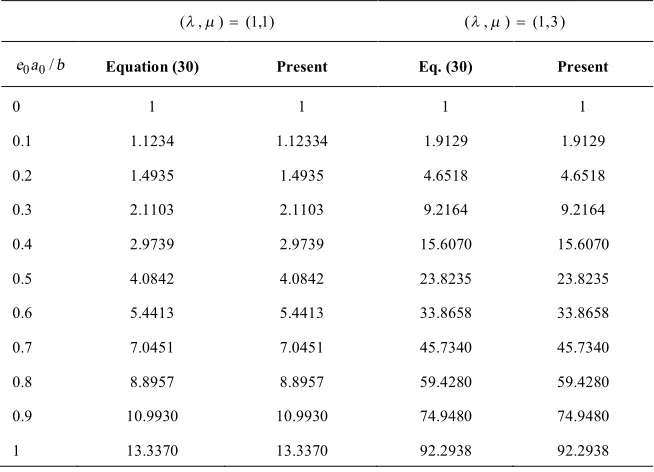
Table 2 represents parameter k for various e0a0/b. This table shows that the results are in good agreement with those which can be obtained from the following closed form solution reported by Lu et al. [6]
) (
) (
1+ 0 0 2 zl2+hm2
= e a
k (30)
Furthermore, Table 2 reveals that as the nonlocal parameter e0a0/b increases, small scale effect increases considerably. This table shows that the small scale effect is more important at higher parameters l and m. Finally, deflection of armchair and zigzag nano graphene sheets with the following properties are obtained.
Armchair1:
GPa G
GPa E
GPa E
nm a
e
nm h
nm b
nm a
1039 ,
197 . 0
, 2473 ,
2434 ,
67 . 0
, 129 . 0 , 844 . 4 , 519 . 9
12 12
2 1
0 0
= =
= =
=
= =
=
n
Zigzag1:
GPa G
GPa E
GPa E
nm a
e
nm h
nm b
nm a
938 ,
223 . 0
, 2097 ,
2145 ,
47 . 0
, 145 . 0 , 877 . 4 , 496 . 9
12 12
2 1
0 0
= =
= =
=
= =
=
n
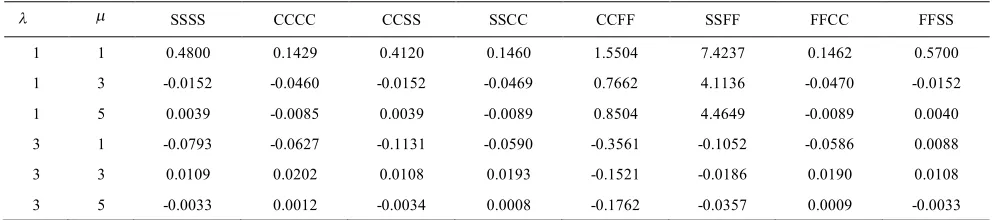
Tables 3 and 4 present the best support domain parameter as and non-dimensional deflection parameter w for armchair1 and zigzag1 graphene sheets, respectively. These tables show that for
1
=
=m
TABLE 3. Non-dimensional deflection w(a/2,b/2)´103for Armchair1 graphene sheet ( ´ =17´17
y x N
N and
2 2´ = ´ y x G
G ,as=2.95)
l m SSSS CCCC CCSS SSCC CCFF SSFF FFCC FFSS
1 1 0.5416 0.1602 0.4659 0.1635 1.7423 8.2063 0.1635 0.6361 1 3 -0.0229 -0.0691 -0.0228 -0.0704 1.1498 6.0719 -0.0704 -0.0229 1 5 0.0069 -0.0150 0.0069 -0.0156 1.4935 7.7136 -0.0155 0.0070 3 1 -0.1013 -0.0796 -0.1438 -0.0750 -0.4452 -0.1359 -0.0752 0.0042 3 3 0.0171 0.0318 0.0170 0.0304 -0.2326 -0.0301 0.0302 0.0170 3 5 -0.0060 0.0021 -0.0060 0.0015 -0.3079 -0.0648 0.0017 -0.0059
TABLE 4. Non-dimensional deflection w(a/2,b/2)´103for Zigzag1 graphene sheet ( ´ =17´17
y x N
N and Gx´Gy=2´2, as=2.95)
l m SSSS CCCC CCSS SSCC CCFF SSFF FFCC FFSS
1 1 0.4800 0.1429 0.4120 0.1460 1.5504 7.4237 0.1462 0.5700 1 3 -0.0152 -0.0460 -0.0152 -0.0469 0.7662 4.1136 -0.0470 -0.0152 1 5 0.0039 -0.0085 0.0039 -0.0089 0.8504 4.4649 -0.0089 0.0040 3 1 -0.0793 -0.0627 -0.1131 -0.0590 -0.3561 -0.1052 -0.0586 0.0088 3 3 0.0109 0.0202 0.0108 0.0193 -0.1521 -0.0186 0.0190 0.0108 3 5 -0.0033 0.0012 -0.0034 0.0008 -0.1762 -0.0357 0.0009 -0.0033
8. CONCLUSION
In this article, nonlocal bending problem of micro/nano thin plates has been solved using the element free Galerkin method. Equilibrium equation has been derived based on the nonlocal thin plate theory. Weak form of the equilibrium equation has been discretized using the MLS approximation functions which do not satisfy the Kronecker’s delta property. Thus, to enforce the essential boundary conditions penalty method was used. The plate deflection has been obtained for various boundary conditions, including the cases where analytical solution does not exist. Numerical results showed that as the number of nodes on the plate domain, the number of Gauss quadrature points on each background cell and the support domain radius increases numerical results converge to the exact results. Numerical results reveal that by increasing the nonlocal parameter the small scale effect increases. Finally, deflection of both armchair and zigzag nano graphene sheets has been obtained and compared for various boundary conditions.
9. REFERENCES
1. Sorop, T. and de Jongh, L., "Size-dependent anisotropic diamagnetic screening in superconducting sn nanowires",
Physical Review B, Vol. 75, No. 1, (2007), 014510.
2. Wong, E. W., Sheehan, P. E. and Lieber, C. M., "Nanobeam mechanics: Elasticity, strength, and toughness of nanorods and nanotubes", Science, Vol. 277, No. 5334, (1997), 1971-1975. 3. Zhou, S. and Li, Z., "Length scales in the static and dynamic
torsion of a circular cylindrical micro-bar", Journal of
Shandong university of technology, Vol. 31, No. 5, (2001),
401-407.
4. Fleck, N. and Hutchinson, J., "Strain gradient plasticity",
Advances in applied mechanics, Vol. 33, No., (1997), 295-361.
5. Eringen, A. C., "On differential equations of nonlocal elasticity and solutions of screw dislocation and surface waves", Journal
of Applied Physics, Vol. 54, No. 9, (1983), 4703-4710.
6. Lu, P., Zhang, P., Lee, H., Wang, C. and Reddy, J., "Non-local elastic plate theories", Proceedings of the Royal Society A:
Mathematical, Physical and Engineering Science, Vol. 463,
No. 2088, (2007), 3225-3240.
7. Murmu, T. and Pradhan, S., "Buckling of biaxially compressed orthotropic plates at small scales", Mechanics Research
Communications, Vol. 36, No. 8, (2009), 933-938.
8. Pradhan, S., "Buckling of single layer graphene sheet based on nonlocal elasticity and higher order shear deformation theory",
Physics Letters A, Vol. 373, No. 45, (2009), 4182-4188.
9. Pradhan, S. and Phadikar, J., "Small scale effect on vibration of embedded multilayered graphene sheets based on nonlocal continuum models", Physics Letters A, Vol. 373, No. 11, (2009), 1062-1069.
10. Aghababaei, R. and Reddy, J., "Nonlocal third-order shear deformation plate theory with application to bending and vibration of plates", Journal of Sound and Vibration, Vol. 326, No. 1, (2009), 277-289.
12. Narendar, S., "Buckling analysis of micro-/nano-scale plates based on two-variable refined plate theory incorporating nonlocal scale effects", Composite Structures, Vol. 93, No. 12, (2011), 3093-3103.
13. Pradhan, S. and Kumar, A., "Vibration analysis of orthotropic graphene sheets embedded in pasternak elastic medium using nonlocal elasticity theory and differential quadrature method",
Computational Materials Science, Vol. 50, No. 1, (2010),
239-245.
14. Pradhan, S. and Kumar, A., "Vibration analysis of orthotropic graphene sheets using nonlocal elasticity theory and differential quadrature method", Composite Structures, Vol. 93, No. 2, (2011), 774-779.
15. Ansari, R., Arash, B. and Rouhi, H., "Vibration characteristics of embedded multi-layered graphene sheets with different boundary conditions via nonlocal elasticity", Composite
Structures, Vol. 93, No. 9, (2011), 2419-2429.
16. Aksencer, T. and Aydogdu, M., "Levy type solution method for vibration and buckling of nanoplates using nonlocal elasticity theory", Physica E: Low-dimensional Systems and
Nanostructures, Vol. 43, No. 4, (2011), 954-959.
17. Liu, G.-R., "Meshfree methods: Moving beyond the finite element method", CRC PressI Llc, (2010).
18. Li, Q., Soric, J., Jarak, T. and Atluri, S. N., "A locking-free meshless local petrov–galerkin formulation for thick and thin plates", Journal of Computational Physics, Vol. 208, No. 1, (2005), 116-133.
19. Bui, T. Q. and Nguyen, M. N., "A moving kriging interpolation-based meshfree method for free vibration analysis of kirchhoff plates", Computers & Structures, Vol. 89, No. 3, (2011), 380-394.
20. Liew, K., Zhao, X. and Ferreira, A. J., "A review of meshless methods for laminated and functionally graded plates and shells", Composite Structures, Vol. 93, No. 8, (2011), 2031-2041.
21. Xiao, J., Gilhooley, D., Batra, R., Gillespie Jr, J. and McCarthy, M., "Analysis of thick composite laminates using a higher-order shear and normal deformable plate theory (hosndpt) and a meshless method", Composites Part B: Engineering, Vol. 39, No. 2, (2008), 414-427.
22. Xia, P., Long, S. and Cui, H., "Elastic dynamic analysis of moderately thick plate using meshless lrpim", Acta Mechanica
Solida Sinica, Vol. 22, No. 2, (2009), 116-124.
23. Ferreira, A., Batra, R., Roque, C., Qian, L. and Martins, P., "Static analysis of functionally graded plates using third-order shear deformation theory and a meshless method", Composite
Structures, Vol. 69, No. 4, (2005), 449-457.
24. Qian, L., Batra, R. and Chen, L., "Static and dynamic deformations of thick functionally graded elastic plates by using higher-order shear and normal deformable plate theory and meshless local petrov–galerkin method", Composites Part B:
Engineering, Vol. 35, No. 6, (2004), 685-697.
25. Xia, P., Long, S., Cui, H. and Li, G., "The static and free vibration analysis of a nonhomogeneous moderately thick plate using the meshless local radial point interpolation method",
Engineering Analysis with Boundary Elements, Vol. 33, No.
6, (2009), 770-777.
26. Dinis, L., Jorge, R. and Belinha, J., "Static and dynamic analysis of laminated plates based on an unconstrained third order theory and using a radial point interpolator meshless method",
Computers & Structures, Vol. 89, No. 19, (2011), 1771-1784.
27. Krysl, P. and Belytschko, T., "Analysis of thin plates by the element-free galerkin method", Computational Mechanics, Vol. 17, No. 1-2, (1995), 26-35.
28. Krysl, P. and Belytschko, T., "Analysis of thin shells by the element-free galerkin method", International Journal of Solids
and Structures, Vol. 33, No. 20, (1996), 3057-3080.
29. Liu, G. and Chen, X., "A mesh-free method for static and free vibration analyses of thin plates of complicated shape", Journal
of Sound and Vibration, Vol. 241, No. 5, (2001), 839-855.
30. El Ouatouati, A. and Johnson, D., "A new approach for numerical modal analysis using the element‐free method",
International Journal for Numerical Methods in Engineering,
Vol. 46, No. 1, (1999), 1-27.
31. Belinha, J. and Dinis, L., "Analysis of plates and laminates using the element-free galerkin method", Computers & Structures, Vol. 84, No. 22, (2006), 1547-1559.
32. Shen, L., Shen, H.-S. and Zhang, C.-L., "Nonlocal plate model for nonlinear vibration of single layer graphene sheets in thermal environments", Computational Materials Science, Vol. 48, No. 3, (2010), 680-685.
Element Free Galerkin Method for Static Analysis of Thin Micro/Nanoscale Plates
based on the Nonlocal Plate Theory
A. Naderi, G. H. Baradaran
Department of Mechanical Engineering, Shahid Bahonar University of Kerman, Kerman, Iran
P A P E R I N F O
Paper history:
Received 07 November 2012
Received in revised form 24 December 2012 Accepted 24 January 2013
Keywords:
Element Free Galerkin Method Nonlocal Theory, Micro/Nanoscale Plates Graphene Sheet
هﺪﯿﮑﭼ
وﺮﮑﯿﻣ ﯽﮑﯿﺗﺎﺘﺳاﻞﯿﻠﺤﺗ ﺖﻬﺟ،ﻦﯿﮐﺮﻟﺎﮔنﺎﻤﻟانوﺪﺑيدﺪﻋشورزاﻪﻟﺎﻘﻣﻦﯾارد
-قروﻮﻧﺎﻧ
هدﺎﻔﺘﺳاﮏﯿﭘوﺮﺗﻮﺗراكزﺎﻧيﺎﻫ
ﯽﻣ دﻮﺷ
.
قروﯽﻠﺤﻣﺮﯿﻏيرﻮﺌﺗزاهدﺎﻔﺘﺳاﺎﺑقرولدﺎﻌﺗﻪﻟدﺎﻌﻣ
ﯽﻣﺖﺳﺪﺑكزﺎﻧيﺎﻫ
ﺪﯾآ
.
زاﺲﭘلدﺎﻌﺗﻪﻟدﺎﻌﻣﻒﯿﻌﺿمﺮﻓ
ﺮﺨﺘﺳا
ﺐﯾﺮﻘﺗﻊﺑاﻮﺗزاهدﺎﻔﺘﺳاﺎﺑ،جا
MLS
ﯽﻣﻪﺘﺷﻮﻧﻪﺘﺴﺴﮔمﺮﻓﻪﺑ
دﻮﺷ
.
ﺐﯾﺮﻘﺗﻊﺑاﻮﺗﻪﮑﯿﯾﺎﺠﻧآزا
MLS
يﺎﺘﻟدﻊﺑﺎﺗﯽﮔﮋﯾو
دﻮﺷﯽﻣهدﺎﻔﺘﺳاﯽﺳﺎﺳايزﺮﻣﻂﯾاﺮﺷيﺎﺿراﺖﻬﺟﻪﻤﯾﺮﺟشورزا،ﺪﻧراﺪﻧارﺮﮑﻧوﺮﮐ
.
ردوهﺪﺷﻞﺣﻞﺻﺎﺣﻪﺘﺴﺴﮔمﺮﻓ
ﯽﻣﺖﺳﺪﺑقروﺰﯿﺧﺖﯾﺎﻬﻧ
ﺪﯾآ
.
ﯽﻣنﺎﺸﻧيدﺪﻋﺞﯾﺎﺘﻧ
ﻨﻫد
هﺮﮔداﺪﻌﺗﻪﮐﺪ
،نﺎﺒﯿﺘﺸﭘﻪﻨﻣادعﺎﻌﺷ،قروﻪﻨﻣادردهﺪﺷﻊﯾزﻮﺗيﺎﻫ
ﻪﻈﺣﻼﻣﻞﺑﺎﻗﺮﯿﺛﺄﺗسﻮﮔطﺎﻘﻧداﺪﻌﺗﻦﯿﻨﭽﻤﻫ
باﻮﺟﺮﺑيا
ﺪﻧرادﺎﻫ
.
ﺮﯾدﺎﻘﻣزاهدﺎﻔﺘﺳاﺎﺑﻞﺣشور،ﯽﯾﺎﻬﻧﺞﯾﺎﺘﻧﻪﺋارازاﻞﺒﻗاﺬﻟ
ﯽﻣهﺮﺒﯿﻟﺎﮐﻖﯿﻗد
دﻮﺷ
.
ﯽﻣﺖﺳﺪﺑﻒﻠﺘﺨﻣيزﺮﻣﻂﯾاﺮﺷيازاﻪﺑقروﺰﯿﺧﺖﯾﺎﻬﻧرد
ﺪﯾآ
درﻮﻣﺰﯿﺧﺮﺘﻣارﺎﭘﺮﺑﮏﭼﻮﮐسﺎﯿﻘﻣﺮﺛاو
ﯽﻣراﺮﻗﯽﺳرﺮﺑ
دﺮﯿﮔ
.
قروﻮﻧﺎﻧﯽﮑﯿﺗﺎﺘﺳاﻞﯿﻠﺤﺗﻪﺑ،ﻪﻠﺌﺴﻣﻦﯾازايدﺮﺑرﺎﮐناﻮﻨﻋﻪﺑﻦﯿﻨﭽﻤﻫ
دﻮﺷﯽﻣﻪﺘﺧادﺮﭘﻦﯿﻓاﺮﮔيﺎﻫ
.