Please cite this article as: M. Mousavi, R. Tavakkoli-Moghaddam, Group Decision Making based on a New Evaluation Method and Hesitant Fuzzy Setting with an Application to an Energy Planning Problem, International Journal of Engineering (IJE), TRANSACTIONS C: Aspects Vol. 28, No. 9, (September 2015) 1303-1311
International Journal of Engineering
J o u r n a l H o m e p a g e : w w w . i j e . i rGroup Decision Making based on a New Evaluation Method and Hesitant Fuzzy
Setting with an Application to an Energy Planning Problem
M. Mousavi a, R. Tavakkoli-Moghaddam b,c *
a Department of Energy Economics, Faculty of Economics, University of Tehran, Tehran, Iran
b School of Industrial Engineering, College of Industrial Engineering, University of Tehran, Tehran, Iran c Research Center for Organizational Processes Improvement, Sari, Iran
P A P E R I N F O
Paper history:
Received 28 April 20154
Received in revised form 31 August 2015 Accepted 03 September 2015
Keywords:
Group Decision Analysis Hierarchical Complex Proportional Assessment
Hesitant Fuzzy Sets Renewable Energy Planning
A B S T R A C T
In recent two decades, countries focused on extraction of the minimum amount of fossil fuels and utilization of the renewable energies based on their policies and environmental considerations. Thus, choosing the best renewable energy alternative plays a significant role on the investments. Among the classical decision approaches used in the literature, a hesitant fuzzy sets (HFSs) theory is an appropriate tool to deal with uncertain and imprecise conditions. The HFSs can help the decision makers or experts in an energy sector to consider some membership degrees for a renewable energy alternative regarding to the conflicted criteria under a set. The aim of this paper is to propose a hierarchical complex proportional assessment (COPRAS) method to consider subjective judgments and objective opinions based on the HFS theory for multi-criteria group decision making (MCGDM) problems. In addition, the hesitant fuzzy decision matrix and main criteria along with sub-criteria are defined based on linguistic variables and then are converted to hesitant fuzzy elements. In the proposed approach, weights of experts are different and computed by a proposed hesitant fuzzy entropy method. Also, the weights of main criteria are determined by a new relation in n levels of the hierarchy structure with experts' risk preferences. Finally, a real case study in Iran on the renewable energy selection in the hierarchy structure is presented and a hesitant fuzzy hierarchical complex proportional assessment (HF-HCOPRAS) method is applied in order to show the applicability of the proposed approach.
doi: 10.5829/idosi.ije.2015.28.09c.07
1. INTRODUCTION1
Since the beginning of civilization and natural resources have been significant for humans and countries, the renewable energies are recognized as one of important factors for social and economical development and for future life. These energies compared with fossil fuels are some main advantages such as reducing environmental pollutions (e.g., greenhouse gases and air pollutions), saving the nonrenewable energies and reducing production costs [1-4]. In this regard, choosing the most appropriate potential energy alternative among the criteria is very important for governments. To address the issues, multi-criteria decision making
*Corresponding Author’s Email: [email protected](R. Tavakkoli-Moghaddam)
(MCDM) methods are utilized in many studies for dealing with this condition.
projects. Pohekar and Ramachandran [8] reviewed numerous published papers in energy planning decisions to analyze some decision-making methods based on priority setting, weighted averages, fuzzy principles, outranking and regarding to their combinations.
Ulutas [2] utilized the analytical network process (ANP) method to assess the energy policy problem and to determine the most suitable energy resources alternatives among the interactive attributes in Turkey. Loken [9] considered the multi-attributes decision making (MADM) methods to select the optimal solution for energy planning problems. Diakoulaki and Karangelis [10] assessed some varies scenarios based on cost-benefit analysis and MADM approaches for extending the power generation sector in Greece. Wang et al. [11] proposed a hierarchical decision making model to evaluate the nonrenewable and renewable energy resources for China. The results of their studies indicated that the renewable and coal energy could select as most energy alternatives. Banos et al. [12] expressed that the optimization methods could be applied in the sustainable energy. San Cristóbal [13] applied the MADM for selecting the best renewable energy plans regarding to renewable energy projects launched by the Spanish government. Erol and Kılkıs [14] utilized the AHP method for selecting the best energy source policy in Turkey. In their study, the energy policies were considered as sustainable, long-term and robust.
In many hesitant situations and decision making problems, the experts or decision makers’ (DMs) opinions are not expressed by crisp values, and it is difficult for them to determine exact values for the potential alternatives among the conflicted attributes or criteria. Thus, most of the assessment potential alternatives could be considered under uncertainty and expressed based on a fuzzy sets theory [e.g., 15, 16]. The fuzzy sets theory was first formalized and utilized by Zadeh [17] to cope with uncertain information based on membership values in interval [0, 1]. In last decade, the classical/modern fuzzy set theory and their extensions are very attractive and powerful tool for the authors to solve the decision making problems under uncertain conditions in energy fields. In this respect, Kahraman et al. [18] proposed the AHP and axiomatic design (AD) methods under the fuzzy environment to evaluate the renewable energy alternatives among the objective and subjective criteria. Kahraman and Kaya [19] proposed a MCDM methodology based on AHP method in fuzzy setting to choose the best policy among the energy policies alternatives. Kaya and Kahraman [20] presented an integrated VIKOR (vlsekriterijumska optimizacija i kompromisno resenje in the Serbian language)-AHP method based on the fuzzy sets theory to determine the most suitable renewable energy alternative in Istanbul. In addition, in their study, the best alternative among the energy production sites
alternatives was determined by the same approach. Sadeghi et al. [21] focused on two decision making methods in a fuzzy environment to select the best renewable energy sources alternative among the criteria in Iran. In their study, the fuzzy AHP method was presented to specify the attributes’ weights and then applied the TOPSIS (Technique for Order of Preference by Similarity to Ideal Solution) method to evaluate and rank the potential alternatives.
As represented in the literature review, the fuzzy sets theory could be successfully applied to deal with imprecise or hesitant situations. Hence, among the extensions of fuzzy sets, the hesitant fuzzy set (HFS) is suitable tool by considering some membership degrees for energy alternatives versus the attributes under a set. Thus, it is worthwhile for researchers to choose the HFS theory for solving the decision-making problems in an energy area. In this regard, Xu and Zhang [22] proposed an MADM approach based on a compromise ranking method in hesitant fuzzy setting to determine the most suitable energy policy alternative. In their study, a maximizing deviation method was presented to determine the optimal weight of attribute regarding to incomplete information. Zhang and Xu [23] presented an interval programming method based on linear programming technique for multi-dimensional analysis of preference to solve the MCGDM problems under hesitant fuzzy set environment. Then, they showed the applicability of the proposed method in energy project selection. Tavakkoli-Moghaddam et al. [24] proposed interval-valued hesitant fuzzy TOPSIS (IVHF-TOPSIS) method in order to compute the criteria weights. They considered a location problem to find the best site selection for a new factory with four DMs, three potential alternative and six criteria.
This paper proposes a hierarchical complex proportional assessment (COPRAS) method based on group decision analysis in hesitant fuzzy setting, namely HF-HCOPRAS to select the best energy alternative among the renewable energy alternatives versus the 15 subjective and objective main criteria. In sum, the main contributions of this study are expressed as follows:
Proposing a complex proportional assessment method in a hierarchy structure based on HFSs theory;
Establishing a group of experts to evaluate the renewable energy alternatives by linguistic variables that then converted to the hesitant fuzzy elements (HFEs);
Determining the experts’ weights based on the proposed hesitant fuzzy entropy method;
Considering the subjective and objective attributes simultaneously with the experts' risk preferences. This paper is arranged as follows. In Section 2, some basic mathematical preliminaries and concepts on the HFS are illustrated. In Sections 3 and 4, a case study about energy selection is presented and then the proposed HF-HCOPRAS method is applied to energy selection problem to indicate the feasibility of the proposed approach, respectively. In Section 5, some concluding remarks are represented.
2. PRELIMINARIES
Definition 1. Consider X as a reference set, then Xia and Xu [25] have indicated the HFS by function
h
E(x)
that X returns to [0, 1].{ , E(x) | x X}
E x h (1)
where
h
E(x)
is denoted as set of membership degree for an object under [0,1], expressing the membership degree of objectx
X
toE
.Definition 2. Some basic relations are introduced by Xia and Xu [25] as follows:
1 2
1 2
1 2 1 2 1 2
, .
h h
h h
(2)
1 2
1 2
1 2 h, h 1. 2
h h
(3)
h
h (4)
1 (1 )
h
h
(5)
Definition 3. Consider some HFEs, and then the summation and subtraction relations are represented as follows:
1 1,2 2,..., 1
1
1 (1 )
n n
n n
i h h h i
i
i
h
(6)1 1 2 2
1 2 , ,...,
1 ....
n n
n
n h h h i
i
h h h
(7)Definition 4. The subtraction and division operations for HFEs introduced by Liao and Xu [26] as follows:
1 1 2 2
1 2
1 2 2
2
1 2 ,
1; 1 0 h h if and h h otherwise (8)
1 1 2 2
1
1 2 2
1 2 , 2 0; 1 h h if and h h otherwise (9)
Definition 5. Xia and Xu [25] defined some hesitant fuzzy aggregation relations. In this regard, the hesitant fuzzy averaging (HFA) and the hesitant fuzzy weighted averaging (HFWA) relations are represented respectively as follows:
1 1 2 2
1
1 2 , ,...,
1
1
1
, ,..., 1 1
n n
n n
n
n j h h h j
j
j
HFA h h h h
n
(10)1 2 1
1 1,2 2,...,
1
, ,..., 1 1 j
n n
n
n w
n j j h h h j
j
j
HFWA h h h w h
(11)where
w
w w
1,
2,...,
w
n
Tare the weight vector of
1, 2,...,
j
h j n .
Definition 6. Zhu et al. [27] state that the normalized hesitant fuzzy decision matrix
ij
m n
B b can be obtained by the following relation. In this regard, let
ij m nH h
be a hesitant fuzzy decision matrix, then we have:
for possitive criteria
1,..., ; 1,..., 1 for negative criteria
ij ij
ij
ij t b
ij
b i m j n
(12)
3. PROPOSED HF-HCOPRAS METHOD
The following steps are given to present the proposed method.
Step 1. Establish the hesitant fuzzy decision matrix
according to a group of experts (k=1, 2, …, K).
Step 2. Compute the importance of the experts proposed
the hesitant fuzzy entropy method.
Step 2.1. Normalize the hesitant fuzzy decision matrix for each expert based on definition 6.
1 2
1 11 12 1
1 2
n
k k k
n
k
k k k
m m m mn m n
C C C
A P A (13)
Step 2.2. Construct the
ijk matrix for each expert as follows:1 1
1
f 1 (1 ) and 1 (1 ) 0
1 (1 )
1 Otherwise
k m m
ij k k k
ij ij ij
m
k k i i
Step 2.3. Determine the hesitant fuzzy entropy
k for the experts by the following relation.
1 1 1 1 k ij Ln m m n Ln k k ij i j
(15)Step 2.4. Compute the weight of each expert
k
according to a degree of deviation for each expert.
1 1 1 k k K k k
(16)Step 3. Determine the normalized significance of each
main criterion
*j
by the following relation in n levels of a hierarchy structure.
1 * 1 1 1 , ,..., 1 1 k k K k JJ k n
j K
k J
j J k
J j j j
(17)Step 4. Normalize the hesitant fuzzy decision matrix
based on definition 6 and then construct the weighted normalized hesitant fuzzy decision matrix.
1 2
* 1 2 * 1 2 * 1 2
1 11 11 11 2 12 12 12 1 1 1
1
* 1 2 * 1 2 * 1 2
1 1 1 1 2 2 2 2
, ,..., , ,..., , ,...,
, ,..., , ,..., , ,...,
n
k k k
n n n n
k
k k k
m m m m m m m n mn mn mn
m n
C C C
A A (18)
Step 5. Calculate the sums
i of criteria valuesregarding to positive criteria for each candidate alternative.
1
1 1
1 (1 ) 1, 2,...,
K r K
k i ij k j i m
(19)where the number of positive criteria is denoted by r.
Step 6. Compute the sums
i of criteria valuesaccording to negative criteria for each candidate alternatives.
1
1 1
1 (1 ) 1, 2,...,
K n K
k
i ij
k j r
i m
(20)Step 7. Determine the smaller value of
i as below:
min mini i i 1, 2,...,m
(21)
Step 8. Calculate the relative importance of each
candidate alternatives (i ).
min
min
1 1
1 1, 2,...,
1 1
i
m i i
i i i
m i i i m (22)
Step 9. Compute the utility degree (
i) in whatfollowing for each alternative.
100max i i i i
(23)
Step 10. Select the best alternative based on maximum
value of utility degrees values and rank them by mentioned procedure.
4. CASE STUDY FOR THE ENERGY PLANNING PROBLEM
In this section, a real case study for renewable energy selection is considered to indicate the feasibility of the proposed HF-HCOPRAS method. Data are obtained by the SUNA Organization’ experts in Iran. To cope the issue, 15 alternatives ( , 1, 2,...,
i
A i m), four main
criteria ( , 1, 2,...,
j
C j n) and 15 criteria (
, 1, 2,...,
j
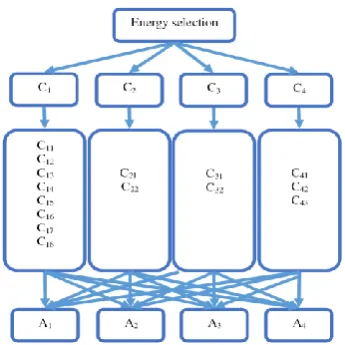
C j n) are considered for evaluating the renewable energy selection problem. The mentioned alternatives and criteria are defined below, and also the criteria are represented in Table 1. In addition, the hierarchical structure of the case study is depicted in Figure 1.
A1: Biomass energy; A2: Geothermal energy; A3: Hydropower; A4: Solar energy; A5: Wind energy, and,
C1: Technology; C2: Environmental; C3: Social; C4: Economical.
TABLE 1. Energy selection criteria Subjective criteria Objective criteria
C11: Feasibility C16: Maintenance and repair
C12: Confidence level C17: Longevity
C13: Reliability C18: Efficiency
C14: Duration of the implementation C41: Implementation cost
C15: Continuity and predictability of performance
C21: Pollution emission
C22: Land degradation
C31: Social acceptance
C32: Employment level
C42: Available budget
C43: Economic factors
TABLE 2. Linguistic terms for rating the significant criteria DM’s risk preferences
Hesitant linguistic variables
Hesitant interval-valued fuzzy
elements
Pessimist Moderate Optimist
Very high
(VH) [0.90, 0.90]
0.90 0.90 0.90
High (H) [0.75, 0.80] 0.75 0.775 0.80
Medium
(M) [0.50, 0.55]
0.50 0.525 0.55
Low (L) [0.35, 0.40] 0.35 0.375 0.40
Very low
(VL) [0.10, 0.10]
0.10 0.10 0.10
TABLE 3. Linguistic terms for rating the candidate alternatives DM’s risk preferences Hesitant
linguistic variables
Hesitant interval-valued fuzzy
elements
Pessimist Moderate Optimist
Extremely
high (EH) [1.00, 1.00] 1 1 1
Very very
high (VVH) [0.90, 0.90] 0.90 0.90 0.90
Very high
(VH) [0.80, 0.90] 0.80 0.85 0.90
High (H) [0.70, 0.80] 0.70 0.75 0.80
Moderately
high (MH) [0.60, 0.70] 0.60 0.65 0.70
Medium (M) [0.50, 0.60] 0.50 0.55 0.60
Moderately
low (ML) [0.40, 0.50] 0.40 0.45 0.50
low (L) [0.25, 0.40] 0.25 0.325 0.40
Very low
(VL) [0.10, 0.25] 0.10 0.175 0.25
Very very
low (VVL) [0.10, 0.10] 0.10 0.10 0.10
TABLE 4. Rating the energies under subjective main criteria by linguistic variables
Main
criteria Alternatives DM1 DM2 DM3
C11
A1 MH H M
A2 H H MH
A3 M M H
A4 VH VH VH
A5 H M VH
C12
A1 ML H ML
A2 M M MH
A3 L M L
A4 VH H H
A5 M M H
C13
A1 M H M
A2 MH H MH
A3 ML H M
A4 VVH VH VH
A5 H VH MH
C14
A1 MH L H
A2 ML M M
A3 MH H H
A4 VVL L VL
A5 L M ML
C15
A1 ML M M
A2 M M MH
A3 L M ML
A4 VH H H
A5 MH H MH
C21
A1 ML L ML
A2 VL L ML
A3 M ML M
A4 VVL VL VVL
A5 VVL VL VVL
C22
A1 MH M M
A2 ML M L
A3 MH H VH
A4 VL L VVL
A5 ML L VL
C31
A1 MH M MH
A2 H M H
A3 ML H M
A4 H H VVH
A5 VH H H
C32
A1 H M MH
A2 H M H
A3 ML H L
A4 VVH H VVH
A5 H H VH
C42
A1 M M M
A2 MH M MH
A3 L M VL
A4 VH H VVH
A5 VH H VH
C43
A1 MH M M
A2 MH M H
A3 ML H ML
A4 VH H VVH
TABLE 5. Rating renewable energies under objective criteria Maintenance
and repair Longevity Efficiency
Implementation cost
A1 35 30 38 1500
A2 30 30 85 1750
A3 120 30 75 2000
A4 15 30 33 2250
A5 40 20 35 1000
TABLE 6. Values under objective criteria Maintenance
and repair Longevity Efficiency
Implementation cost
A1 0.15 0.21 0.14 0.18
A2 0.13 0.21 0.32 0.21
A3 0.50 0.21 0.28 0.24
A4 0.06 0.21 0.12 0.26
A5 0.17 0.14 0.13 0.12
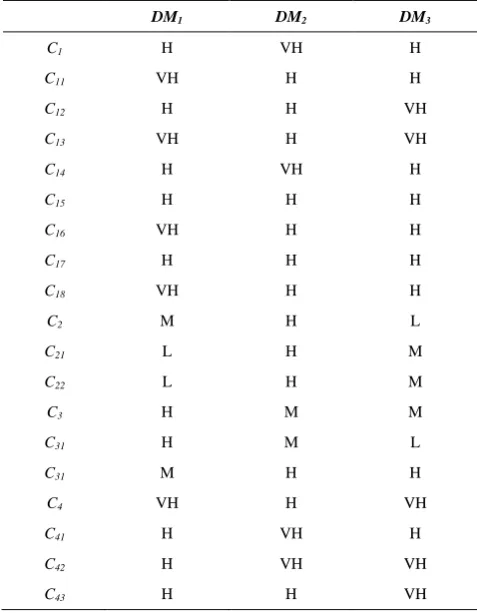
TABLE 7. Rating of the criteria weights by the linguistic variables
DM1 DM2 DM3
C1 H VH H
C11 VH H H
C12 H H VH
C13 VH H VH
C14 H VH H
C15 H H H
C16 VH H H
C17 H H H
C18 VH H H
C2 M H L
C21 L H M
C22 L H M
C3 H M M
C31 H M L
C31 M H H
C4 VH H VH
C41 H VH H
C42 H VH VH
C43 H H VH
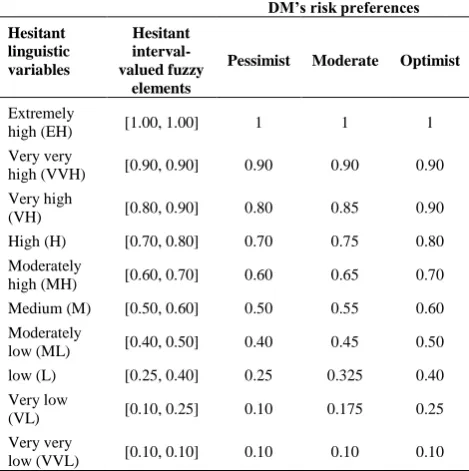
The linguistic terms and their hesitant fuzzy values for evaluating the significance of criteria and possible alternatives versus the criteria according to experts’ risk
preferences are represented in Tables 2 and 3, respectively. In the energy selection problem, three DMs are considered, in which the first DM is pessimistic, the second DM is moderate and other is optimistic.
In this respect, the hesitant fuzzy decision matrix for the subjective criteria regarding to DMs’ risk preferences is represented in Table 4 by the linguistic variables. In addition, the evaluation of possible alternatives under the objective attributes or criteria is expressed by crisp values that transformed to hesitant fuzzy values and then the final hesitant fuzzy decision matrix for the subjective and objective criteria. The mentioned results are shown in Tables 5-9.
TABLE 8. Criteria weights by the HFEs, final DMs and criteria weights
DM1 DM2 DM3
*
j
k
0.3333 0.3333 0.3333C1 0.75 0.90 0.80
C11 0.90 0.775 0.80 0.07558
C12 0.75 0.775 0.90 0.07443
C13 0.90 0.775 0.90 0.07867
C14 0.75 0.90 0.80 0.07505
C15 0.75 0.775 0.80 0.07025
C16 0.90 0.775 0.80 0.07558
C17 0.75 0.775 0.80 0.07025
C18 0.90 0.775 0.80 0.07558
C2 0.50 0.775 0.40
C21 0.35 0.775 0.55 0.03860
C22 0.35 0.775 0.55 0.03860
C3 0.75 0.525 0.55
C31 0.75 0.525 0.40 0.03985
C31 0.50 0.775 0.80 0.04885
C4 0.90 0.775 0.90
C41 0.75 0.90 0.80 0.07867
C42 0.75 0.90 0.90 0.08202
C43 0.75 0.775 0.90 0.07802
TABLE 9. Computational results of the proposed ranking method
i
i
i
i(%)A1 0.30399 0.12937 0.35789 82.52
A2 0.33503 0.13902 0.38653 89.12
A3 0.29502 0.10570 0.34962 80.61
A4 0.38619 0.17028 0.43373 100
A5 0.35803 0.16140 0.40775 94.01
min
0.10570
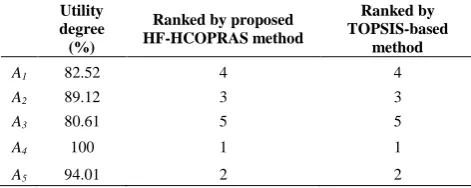
TABLE 10. Ranking of the potential alternatives and comparison analysis
Utility degree (%)
Ranked by proposed HF-HCOPRAS method
Ranked by TOPSIS-based
method
A1 82.52 4 4
A2 89.12 3 3
A3 80.61 5 5
A4 100 1 1
A5 94.01 2 2
In this regard, the complex proportional assessment method is extended in the hierarchy structure with experts' risk preferences to consider n levels of the criteria under the hesitant fuzzy conditions. Also, the HF-HCOPRAS assist the experts to decrease the errors by assigning some membership degrees under a set for an object according to adopt the HFS theory. Hence, evaluations of the possible alternatives among the subjective criteria and the criteria/main criteria weight are considered by linguistic variables because of difficulty of judgments in [0, 1]. In addition, the relative significance of criteria and main criteria are calculated by new operations. Also, the experts’ weights are determined by new operations based on the proposed entropy method that is applied in the procedure of the proposed HF-HCOPRAS approach.
5. CONCLUSIONS
The renewable energy selection is an important issue for making the decision in planning. Countries have focused on this issue for social and economical development regarding to decrease the environmental pollutions. Hence, selecting the most appropriate candidate renewable energy alternative is very important, in which the group decision analysis under extension of the fuzzy sets theory could deal with these complex situations. The goal of this study is to propose a complex proportional assessment method in the hierarchy structure under a hesitant fuzzy environment. In addition, an entropy method in the hesitant fuzzy
setting condition is proposed to compute weights of experts. Also, the optimal weights of main criteria are determined based on a new relation for n levels of the hierarchy structure. Then, these weights are applied in a procedure of the proposed HF-HCOPRAS method with experts' risk preferences. Finally, the proposed approach is considered to solve the renewable energy selection problem under four criteria and 15 main criteria. The same ranking results of the proposed method and the conventional TOPSIS method show the suitability of the proposed HF-HCOPRAS approach. However, this proposed approach is preferable to the classical methods or fuzzy decision making methods. In the proposed approach, a group of experts is established to assign their preferences opinions by some membership degrees for a renewable energy alternative among the 15 main criteria under a set to margin of errors. Also, the hierarchy structure of the proposed HF-HCOPRAS assists to solve the problems by n levels of the hierarchy structure. Therefore, based on this study, the solar energy is an appropriate alternative for the studied region. It is obvious that ranking of the energy resources does not mean that we eliminate the energy resources with lower scores in the planning; however, it shows the relative importance of each energy resource versus others and more attention to these energy resources for making the decision in the energy area. In addition, the spatial and temporal factors (e.g., seasons, duration of day and geographic regions) should be more attention for an appropriate investment on energy resources. About the solar energy as the first rank can be denoted that affordable acquisition and exploitation from the solar energy requires the information gathering on the basis of radiation levels in each region. This goal is reached from the country by considering some factors such as average daily air temperature, relative humidity, sunny hours, evaporation, wind speed and soil temperature. Moreover, about the wind energy as the second rank can be explained, in which the maximum power density of the wind energy has been observed on average in warm seasons (i.e., spring and summer), and the minimum power density of the wind energy has been provided in autumn. However, the wing speed and its continuous throughout the year are appropriate in some regions of the country for constructing wind turbines due to their geographical conditions (e.g., valleys, strait and peaks). For future research, other MCGDM methods (e.g., VIKOR and PSI) can be utilized and their ranking results can be compared with the proposed approach.
6. REFERENCES
2. Ulutaş, B.H., "Determination of the appropriate energy policy for Turkey". Energy, Vol. 30, No. 7, (2005), 1146-1161. 3. Zamani, M., Energy consumption and economic activities in
Iran. Energy Economics, Vol. 29, No. 6, (2007), 1135-1140. 4. Keyhani, A., et al., "An assessment of wind energy potential as a
power generation source in the capital of Iran, Tehran", Energy, Vol. 35, No. 1, (2010), 188-201.
5. Akash, B.A., Mamlook, R., and Mohsen, M.S., "Multi-criteria selection of electric power plants using analytical hierarchy process", Electric Power Systems Research, Vol. 52, No. 1, (1999), 29-35.
6. Goletsis, Y., Psarras, J. and Samouilidis, J.-E., "Project ranking in the Armenian energy sector using a multicriteria method for groups", Annals of Operations Research, Vol. 120, (2003), 135-157.
7. Polatidis, H. and Haralambopoulos D., "Local renewable energy planning: a participatory multi-criteria approach", Energy Sources, Vol. 26, No. 13, (2004), 1253-1264.
8. Pohekar, S. and Ramachandran M., "Application of multi-criteria decision making to sustainable energy planning—a review", Renewable and Sustainable Energy Reviews, Vol. 8, No. 4, (2004), 365-381.
9. Løken, E., "Use of multicriteria decision analysis methods for energy planning problems", Renewable and Sustainable Energy Reviews, Vol. 11, No. 7, (2007), 1584-1595.
10. Diakoulaki, D. and Karangelis F., "Multi-criteria decision analysis and cost–benefit analysis of alternative scenarios for the power generation sector in Greece. Renewable and Sustainable Energy Reviews, Vo. 11, No. 4, (2007), 716-727.
11. Wang, B., et al., "A decision model for energy resource selection in China", Energy Policy, Vol. 38, No. 11, (2010), 7130-7141.
12. Banos, R., et al., "Optimization methods applied to renewable and sustainable energy: A review", Renewable and Sustainable Energy Reviews, Vol. 15, No. 4, (2011), 1753-1766.
13. San Cristóbal, J., "Multi-criteria decision-making in the selection of a renewable energy project in spain: The Vikor method", Renewable Energy, Vol. 36, No. 2, (2011), 498-502. 14. Erol, Ö. and Kılkış, B., "An energy source policy assessment
using analytical hierarchy process", Energy Conversion and Management, Vol. 63, (2012), 245-252.
15. Gitinavard, H., Mousavi, S.M., and Vahdani, B., "A new balancing and ranking method based on hesitant fuzzy sets for solving decision-making problems under uncertainty".
International Journal of Engineering (IJE) Transactions B: Applications, Vol. 28, No. 2, (2015), 214-223.
16. Mousavi, S.M., Gitinavard, H., and Siadat, A., "A new hesitant fuzzy analytical hierarchy process method for decision-making problems under uncertainty", in IEEE International Conference on Industrial Engineering and Engineering Management, (2014). 17. Zadeh, L.A., Fuzzy sets. Information and Control, Vol. 8, No.
3, (1965), 338-353.
18. Kahraman, C., Kaya, İ., and Cebi, S., "A comparative analysis for multiattribute selection among renewable energy alternatives using fuzzy axiomatic design and fuzzy analytic hierarchy process", Energy, Vol. 34, No. 10, (2009), 1603-1616. 19. Kahraman, C. and Kaya İ., "A fuzzy multicriteria methodology
for selection among energy alternatives", Expert Systems with Applications, Vol. 37, No. 9, (2010), 6270-6281.
20. Kaya, T. and Kahraman C., "Multicriteria renewable energy planning using an integrated fuzzy VIKOR & AHP methodology: The case of Istanbul", Energy, Vol. 35, No. 6, (2010), 2517-2527.
21. Sadeghi, A., Larimian T., and Molabashi, A., "Evaluation of renewable energy sources for generating electricity in province of Yazd: a fuzzy MCDM approach", Procedia-Social and Behavioral Sciences, Vol. 62, (2012), 1095-1099.
22. Xu, Z. and Zhang, X., "Hesitant fuzzy multi-attribute decision making based on TOPSIS with incomplete weight information",
Knowledge-Based Systems, Vol. 52, (2013), 53-64.
23. Zhang, X. and Z. Xu, "Interval programming method for hesitant fuzzy multi-attribute group decision making with incomplete preference over alternatives", Computers & Industrial Engineering, Vol. 75, (2014), 217-229.
24. Tavakkoli-Moghaddam, R., Gitinavard, H., Mousavi, S.M., and Siadat, A., "An interval-valued hesitant fuzzy TOPSIS method to determine the criteria weights", in: B. Kaminski, G.E. Kersten and T. Szapiro, (Eds.), Outlooks and Insights on Group Decision and Negotiation, Lecture Notes in Business Information Processing, Springer-Verlag, Switzerland, Vol. 218, (2015), 157-169.
25. Xia, M. and Xu, Z., "Hesitant fuzzy information aggregation in decision making", International Journal of Approximate Reasoning, Vol. 52, No. 3, (2011), 395-407.
26. Liao, H. and Xu, Z., "Subtraction and division operations over hesitant fuzzy sets",Journal of Intelligent and Fuzzy Systems,
Vol. 27, (2014), 65-72.
Group Decision Making based on a New Evaluation Method and Hesitant Fuzzy
Setting with an Application to an Energy Planning Problem
M. Mousavi a, R. Tavakkoli-Moghaddam b,c
a Department of Energy Economics, Faculty of Economics, University of Tehran, Tehran, Iran
b School of Industrial Engineering, College of Industrial Engineering, University of Tehran, Tehran, Iran c Research Center for Organizational Processes Improvement, Sari, Iran
P A P E R I N F O
Paper history:
Received 28 April 20154
Received in revised form 31 August 2015 Accepted 03 September 2015
Keywords:
Group Decision Analysis Hierarchical Complex Proportional Assessment
Hesitant Fuzzy Sets Renewable Energy Planning
ديكچ ه
و دنا هدش یلیسف عبانم جارختسا لقادح رب زکرمتم اهروشک ،ریخا ههد ود رد زا
یاهتسایس یانبم رب ریذپدیدجت یاه یژرنا
دهاوخ صوصخ نیا رد ییازسب شقن یژرنا هنیزگ نیرتهب باختنا نیاربانب .دنا هدرک هدافتسا یطیحم تاظحلام و اهروشک
میمصت یاهدرکیور نایم زا .تشاد یریگ
رازبا کی یدیدرت یزاف یاه هعومجم یروئت ،عوضوم تایبدا رد دوجوم یتنس
ب یارب بسانم نتفرگ رظنرد اب یژرنا شخب رد ناریگ میمصت و ناگربخ هب دناوت یم رازبا نیا .تساهتیعطق مدع اب دروخر
یبایزرا لدم کی هئارا هلاقم نیا فده .دیامن کمک رایعم کی اب لباقم رد یژرنا هنیزگ کی یارب تیوضع عبات نیدنچ
رب یفیک و یمک یاهرایعم نتفرگ رظن رد اب یهورگ یبتارم هلسلس لئاسم یارب یدیدرت یزاف یاه هعومجم یروئت یانبم
ساسا رب اهرایعم و اهرایعمریز و یدیدرت یزاف یهورگ میمصت سیرتام .دشاب یم هرایعم دنچ یهورگ یریگ میمصت
و هدوب توافتم ناگربخ نزو درکیور نیا رد .دنوش یم لیدبت یدیدرت یزاف رصانع هب و هدش فیرعت ینابز یاهریغتم
ی ساسارب دیدج هطبار کی زا هدافتسا اب اهرایعم نزو نینچ مه .دنوش یم هبساحم یپورتنا یداهنشیپ یدیدرت یزاف شور ک
صوصخ رد ناریا رد یدروم هعلاطم کی ماجنارس .دوش یم نییعت ناگربخ کسیر یاهتیولوا اب یبتارم هلسلس حطس دنچ رد
هئارا یبتارم هلسلس راتخاس اب ریذپ دیدجت یژرنا باختنا هب یهورگ یبتارم هلسلس یدیدرت یزاف یبایزرا لدم و دوش یم
.دوش هداد شیامن درکیور نیا یریذپدربراک ات دوش یم هتفرگراک