A Monthly Double-Blind Peer Reviewed Refereed Open Access International e-Journal - Included in the International Serial Directories Indexed & Listed at:
Ulrich's Periodicals Directory ©, ProQuest, U.S.A., EBSCO Publishing, U.S.A., Index Copernicus Publishers Panel, Poland, Open J-Gage, India [link of the same is duly available at Inflibnet of University Grants Commission (U.G.C.)]
VOLUME NO.2(2012),ISSUE NO.1(JANUARY) ISSN2231-5756
CONTENTS
Sr.
No.
TITLE & NAME OF THE AUTHOR (S)
Page No.
1. THE INTERMEDIATE COMMUNITY: A BEHAVIORAL/BARGAINING APPROACH FOR CONFLICT RESOLUTION AT THE LOCAL LEVEL/BAYESIAN ANALYSIS
DR. LEONIDAS A. PAPAKONSTANTINIDIS
1
2. IMPACT OF NEW REFORM ON PRODUCTIVITY OF ETHIOPIAN COTTON TEXTILE INDUSTRY DR. BREHANU BORJI AYALEW
7
3. SIGNIFICANCE OF TOTAL QUALITY MANAGEMENT IN ORGANIZATIONAL PERFORMANCE: AN EMPIRICAL ANALYSIS FROM SMES SECTOR
FAROOQ ANWAR, IRFAN SALEEM & AYESHA ZAHID
13
4. INDEPENDENCE AND IMPARTIALITY OF AUDITORS FROME THR VIEWPOINTS OF INDEPENDENT AUDITORS AND INVESTMENT COMPANIES
MOHAMADREZA ABDOLI
17
5. COMPARATIVE ANALYSIS OF SELECTED HOUSING FINANCE COMPANIES IN INDIA DR. D. GURUSWAMY
20
6. MUNICIPAL SERVICE QUALITY IN SOUTHERN THAILAND: AN EMPIRICAL INVESTIGATION OF CUSTOMER PERCEPTIONS SAFIEK MOKHLIS
30
7. THE IMPERATIVES OF LEADERSHIP QUESTION IN MEDIA MANAGEMENT BELLO SEMIU & KASALI TAOFEEK
36
8. PERCEIVED PURCHASE RISK IN THE TECHNOLOGICAL GOODS PURCHASE CONTEXT: AN INSTRUMENT DEVELOPMENT AND VALIDATION
IMAM SALEHUDIN
41
9. STUDY ON TRADITIONAL VERSUS CONTINUOUS ACCREDIATION PROCESS & EXPLORING LEADERSHIP DISPARITY HARINI METHUKU & HATIM R HUSSIEN
49
10. VOLATILITY OF AGGREGATE MARKET INDICES NALINA K B & B SHIVARAJ
56
11. STUDENT FEED BACK: A TOOL TO ENHANCE QUALITY IN ENGINEERING EDUCATION VEERANNA.D.K & DR. ANAND.K.JOSHI
63
12. JOB SCHEDULING OF NURSE STAFFING: A DYNAMIC PROGRAMMING APPROACH KAVITHA KOPPULA & DR. LEWLYN L. RAJ RODRIGUES
66
13. INFLUENCE OF PERSONAL FACTORS ON ORGANISATIONAL CLIMATE IN IT COMPANIES R. DARWIN JOSEPH & DR. N. PANCHANATHAN
70
14. ANALYSIS OF CUSTOMER SATISFACTION OF THE HOTEL INDUSTRY IN INDIA USING KANO MODEL & QFD PARUL GUPTA & R. K. SRIVASTAVA
74
15. BEHAVIOUR OF STOCK MARKET VOLATILITY IN DEVELOPING COUNTRIES DR. S. S. CHAHAL & SUMAN
82
16. FINANCIAL DERIVATIVES IN INDIA: DEVELOPMENT PATTERN AND TRADING IMPACT ON THE VOLATILITY OF NSE E.V.P.A.S.PALLAVI & DR. P. S. RAVINDRA
89
17. CHANGING FACE OF CAR MARKET: A REVIEW OF MARKET GROWTH AND CHANGING SALES TRENDS IN INDIAN PASSENGER CAR MARKET
DEEPTHI SANKAR & DR. ZAKKARIYA K.A.
94
18. PERFORMANCE APPRAISAL: ALIGNING PERSONAL ASPIRATIONS TO ORGANIZATIONAL GOALS (A SPECIAL REFERENCE TO DAIRY SECTOR IN RAJASTHAN)
DR. SHWETA TIWARI (MISHRA)
99
19. INDIA’S BANKING SECTOR REFORMS FROM THE PERSPECTIVE OF BANKING SYSTEM RAJESH GARG & ASHOK KUMAR
103
20. INFORMATION TECHNOLOGY AND COMMUNICATION IN BUSINESS C. ARUL VENKADESH
108
21. IMPACT OF ORGANIZED RETAIL ON UNORGANIZED SECTOR: A STUDY IN JAMMU REGION URVASHI GUPTA
112
22. ISLAMIC BANKING IN INDIA: RELIGIOUS AND SOCIO-ECONOMIC PERSPECTIVES AFFECTING MUSLIM INVESTORS OF AHMEDABAD DISTRICT IN GUJARAT
URVI AMIN
116
23. ICT DEVELOPMENT IN INDIA: A CASE STUDY OF INFOSYS LTD. MUNISH KUMAR TIWARI
122
24. DATA WAREHOUSING AND TESTING
VENKATESH RAMASAMY & ABINAYA MURUGANANDHAN
130
25. POLITICAL IMPACT OF MICRO FINANCE ON RURAL POOR IN ANDHRA PRADESH DR. NANU LUNAVATH
135
INTERNATIONAL JOURNAL OF RESEARCH IN COMMERCE, IT & MANAGEMENT
CHIEF PATRON
PROF. K. K. AGGARWAL
Chancellor, Lingaya’s University, Delhi
Founder Vice-Chancellor, Guru Gobind Singh Indraprastha University, Delhi
Ex. Pro Vice-Chancellor, Guru Jambheshwar University, Hisar
PATRON
SH. RAM BHAJAN AGGARWAL
Ex. State Minister for Home & Tourism, Government of Haryana
Vice-President, Dadri Education Society, Charkhi Dadri
President, Chinar Syntex Ltd. (Textile Mills), Bhiwani
CO-ORDINATOR
AMITA
Faculty, Government M. S., Mohali
ADVISORS
DR. PRIYA RANJAN TRIVEDI
Chancellor, The Global Open University, Nagaland
PROF. M. S. SENAM RAJU
Director A. C. D., School of Management Studies, I.G.N.O.U., New Delhi
PROF. M. N. SHARMA
Chairman, M.B.A., Haryana College of Technology & Management, Kaithal
PROF. S. L. MAHANDRU
Principal (Retd.), Maharaja Agrasen College, Jagadhri
EDITOR
PROF. R. K. SHARMA
Professor, Bharti Vidyapeeth University Institute of Management & Research, New Delhi
CO-EDITOR
DR. BHAVET
Faculty, M. M. Institute of Management, Maharishi Markandeshwar University, Mullana, Ambala, Haryana
EDITORIAL ADVISORY BOARD
DR. RAJESH MODI
Faculty, Yanbu Industrial College, Kingdom of Saudi Arabia
PROF. SANJIV MITTAL
University School of Management Studies, Guru Gobind Singh I. P. University, Delhi
PROF. ANIL K. SAINI
Chairperson (CRC), Guru Gobind Singh I. P. University, Delhi
DR. SAMBHAVNA
Faculty, I.I.T.M., Delhi
DR. MOHENDER KUMAR GUPTA
VOLUME NO.2(2012),ISSUE NO.1(JANUARY) ISSN2231-5756
DR. SHIVAKUMAR DEENE
Asst. Professor, Government F. G. College Chitguppa, Bidar, Karnataka
MOHITA
Faculty, Yamuna Institute of Engineering & Technology, Village Gadholi, P. O. Gadhola, Yamunanagar
ASSOCIATE EDITORS
PROF. NAWAB ALI KHAN
Department of Commerce, Aligarh Muslim University, Aligarh, U.P.
PROF. ABHAY BANSAL
Head, Department of Information Technology, Amity School of Engineering & Technology, Amity University, Noida
PROF. A. SURYANARAYANA
Department of Business Management, Osmania University, Hyderabad
DR. ASHOK KUMAR
Head, Department of Electronics, D. A. V. College (Lahore), Ambala City
DR. SAMBHAV GARG
Faculty, M. M. Institute of Management, Maharishi Markandeshwar University, Mullana, Ambala, Haryana
DR. V. SELVAM
Divisional Leader – Commerce SSL, VIT University, Vellore
DR. PARDEEP AHLAWAT
Reader, Institute of Management Studies & Research, Maharshi Dayanand University, Rohtak
S. TABASSUM SULTANA
Asst. Professor, Department of Business Management, Matrusri Institute of P.G. Studies, Hyderabad
SURJEET SINGH
Asst. Professor, Department of Computer Science, G. M. N. (P.G.) College, Ambala Cantt.
TECHNICAL ADVISOR
AMITA
Faculty, Government H. S., Mohali
MOHITA
Faculty, Yamuna Institute of Engineering & Technology, Village Gadholi, P. O. Gadhola, Yamunanagar
FINANCIAL ADVISORS
DICKIN GOYAL
Advocate & Tax Adviser, Panchkula
NEENA
Investment Consultant, Chambaghat, Solan, Himachal Pradesh
LEGAL ADVISORS
JITENDER S. CHAHAL
Advocate, Punjab & Haryana High Court, Chandigarh U.T.
CHANDER BHUSHAN SHARMA
Advocate & Consultant, District Courts, Yamunanagar at Jagadhri
INTERNATIONAL JOURNAL OF RESEARCH IN COMMERCE, IT & MANAGEMENT
CALL FOR MANUSCRIPTS
Weinvite unpublished novel, original, empirical and high quality research work pertaining to recent developments & practices in the area of Computer, Business, Finance, Marketing, Human Resource Management, General Management, Banking, Insurance, Corporate Governance and emerging paradigms in allied subjects like Accounting Education; Accounting Information Systems; Accounting Theory & Practice; Auditing; Behavioral Accounting; Behavioral Economics; Corporate Finance; Cost Accounting; Econometrics; Economic Development; Economic History; Financial Institutions & Markets; Financial Services; Fiscal Policy; Government & Non Profit Accounting; Industrial Organization; International Economics & Trade; International Finance; Macro Economics; Micro Economics; Monetary Policy; Portfolio & Security Analysis; Public Policy Economics; Real Estate; Regional Economics; Tax Accounting; Advertising & Promotion Management; Business Education; Business Information Systems (MIS); Business Law, Public Responsibility & Ethics; Communication; Direct Marketing; E-Commerce; Global Business; Health Care Administration; Labor Relations & Human Resource Management; Marketing Research; Marketing Theory & Applications; Non-Profit Organizations; Office Administration/Management; Operations Research/Statistics; Organizational Behavior & Theory; Organizational Development; Production/Operations; Public Administration; Purchasing/Materials Management; Retailing; Sales/Selling; Services; Small Business Entrepreneurship; Strategic Management Policy; Technology/Innovation; Tourism, Hospitality & Leisure; Transportation/Physical Distribution; Algorithms; Artificial Intelligence; Compilers & Translation; Computer Aided Design (CAD); Computer Aided Manufacturing; Computer Graphics; Computer Organization & Architecture; Database Structures & Systems; Digital Logic; Discrete Structures; Internet; Management Information Systems; Modeling & Simulation; Multimedia; Neural Systems/Neural Networks; Numerical Analysis/Scientific Computing; Object Oriented Programming; Operating Systems; Programming Languages; Robotics; Symbolic & Formal Logic and Web Design. The above mentioned tracks are only indicative, and not exhaustive.
Anybody can submit the soft copy of his/her manuscript anytime in M.S. Word format after preparing the same as per our submission guidelines duly available on our website under the heading guidelines for submission, at the email addresses: [email protected]or
GUIDELINES FOR SUBMISSION OF MANUSCRIPT
1. COVERING LETTER FOR SUBMISSION:
DATED: _____________
THE EDITOR IJRCM
Subject: SUBMISSION OF MANUSCRIPT IN THE AREA OF .
(e.g. Finance/Marketing/HRM/General Management/Economics/Psychology/Law/Computer/IT/Engineering/Mathematics/other, please specify) DEAR SIR/MADAM
Please find my submission of manuscript entitled ‘___________________________________________’ for possible publication in your journals.
I hereby affirm that the contents of this manuscript are original. Furthermore, it has neither been published elsewhere in any language fully or partly, nor is it under review for publication elsewhere.
I affirm that all the author (s) have seen and agreed to the submitted version of the manuscript and their inclusion of name (s) as co-author (s).
Also, if my/our manuscript is accepted, I/We agree to comply with the formalities as given on the website of the journal & you are free to publish our contribution in any of your journals.
NAME OF CORRESPONDING AUTHOR: Designation:
Affiliation with full address, contact numbers & Pin Code: Residential address with Pin Code:
Mobile Number (s): Landline Number (s): E-mail Address: Alternate E-mail Address:
NOTES:
a) The whole manuscript is required to be in ONE MS WORD FILE only (pdf. version is liable to be rejected without any consideration), which will start from the covering letter, inside the manuscript.
b) The sender is required to mention the following in the SUBJECT COLUMN of the mail:
New Manuscript for Review in the area of (Finance/Marketing/HRM/General Management/Economics/Psychology/Law/Computer/IT/ Engineering/Mathematics/other, please specify)
c) There is no need to give any text in the body of mail, except the cases where the author wishes to give any specific message w.r.t. to the manuscript. d) The total size of the file containing the manuscript is required to be below 500 KB.
e) Abstract alone will not be considered for review, and the author is required to submit the complete manuscript in the first instance.
f) The journal gives acknowledgement w.r.t. the receipt of every email and in case of non-receipt of acknowledgment from the journal, w.r.t. the submission of manuscript, within two days of submission, the corresponding author is required to demand for the same by sending separate mail to the journal.
2. MANUSCRIPT TITLE: The title of the paper should be in a 12 point Calibri Font. It should be bold typed, centered and fully capitalised.
3. AUTHOR NAME (S) & AFFILIATIONS: The author (s) full name, designation, affiliation (s), address, mobile/landline numbers, and email/alternate email address should be in italic & 11-point Calibri Font. It must be centered underneath the title.
VOLUME NO.2(2012),ISSUE NO.1(JANUARY) ISSN2231-5756 5. KEYWORDS: Abstract must be followed by a list of keywords, subject to the maximum of five. These should be arranged in alphabetic order separated by
commas and full stops at the end.
6. MANUSCRIPT: Manuscript must be in BRITISH ENGLISH prepared on a standard A4 size PORTRAIT SETTING PAPER. It must be prepared on a single space and single column with 1” margin set for top, bottom, left and right. It should be typed in 8 point Calibri Font with page numbers at the bottom and centre of every page. It should be free from grammatical, spelling and punctuation errors and must be thoroughly edited.
7. HEADINGS: All the headings should be in a 10 point Calibri Font. These must be bold-faced, aligned left and fully capitalised. Leave a blank line before each heading.
8. SUB-HEADINGS: All the sub-headings should be in a 8 point Calibri Font. These must be bold-faced, aligned left and fully capitalised. 9. MAIN TEXT: The main text should follow the following sequence:
INTRODUCTION
REVIEW OF LITERATURE
NEED/IMPORTANCE OF THE STUDY
STATEMENT OF THE PROBLEM
OBJECTIVES
HYPOTHESES
RESEARCH METHODOLOGY
RESULTS & DISCUSSION
FINDINGS
RECOMMENDATIONS/SUGGESTIONS
CONCLUSIONS
SCOPE FOR FURTHER RESEARCH
ACKNOWLEDGMENTS
REFERENCES
APPENDIX/ANNEXURE
It should be in a 8 point Calibri Font, single spaced and justified. The manuscript should preferably not exceed 5000 WORDS.
10. FIGURES &TABLES: These should be simple, centered, separately numbered & self explained, and titles must be above the table/figure. Sources of data should be mentioned below the table/figure. It should be ensured that the tables/figures are referred to from the main text.
11. EQUATIONS: These should be consecutively numbered in parentheses, horizontally centered with equation number placed at the right.
12. REFERENCES: The list of all references should be alphabetically arranged. The author (s) should mention only the actually utilised references in the preparation of manuscript and they are supposed to follow Harvard Style of Referencing. The author (s) are supposed to follow the references as per the following:
•
All works cited in the text (including sources for tables and figures) should be listed alphabetically.•
Use (ed.) for one editor, and (ed.s) for multiple editors.•
When listing two or more works by one author, use --- (20xx), such as after Kohl (1997), use --- (2001), etc, in chronologically ascending order.•
Indicate (opening and closing) page numbers for articles in journals and for chapters in books.•
The title of books and journals should be in italics. Double quotation marks are used for titles of journal articles, book chapters, dissertations, reports, working papers, unpublished material, etc.•
For titles in a language other than English, provide an English translation in parentheses.•
The location of endnotes within the text should be indicated by superscript numbers.PLEASE USE THE FOLLOWING FOR STYLE AND PUNCTUATION IN REFERENCES: BOOKS
•
Bowersox, Donald J., Closs, David J., (1996), "Logistical Management." Tata McGraw, Hill, New Delhi.•
Hunker, H.L. and A.J. Wright (1963), "Factors of Industrial Location in Ohio" Ohio State University, Nigeria.CONTRIBUTIONS TO BOOKS
•
Sharma T., Kwatra, G. (2008) Effectiveness of Social Advertising: A Study of Selected Campaigns, Corporate Social Responsibility, Edited by David Crowther & Nicholas Capaldi, Ashgate Research Companion to Corporate Social Responsibility, Chapter 15, pp 287-303.JOURNAL AND OTHER ARTICLES
•
Schemenner, R.W., Huber, J.C. and Cook, R.L. (1987), "Geographic Differences and the Location of New Manufacturing Facilities," Journal of Urban Economics, Vol. 21, No. 1, pp. 83-104.CONFERENCE PAPERS
•
Garg, Sambhav (2011): "Business Ethics" Paper presented at the Annual International Conference for the All India Management Association, New Delhi, India, 19–22 June.UNPUBLISHED DISSERTATIONS AND THESES
•
Kumar S. (2011): "Customer Value: A Comparative Study of Rural and Urban Customers," Thesis, Kurukshetra University, Kurukshetra.ONLINE RESOURCES
•
Always indicate the date that the source was accessed, as online resources are frequently updated or removed.WEBSITE
INTERNATIONAL JOURNAL OF RESEARCH IN COMMERCE, IT & MANAGEMENT
JOB SCHEDULING OF NURSE STAFFING: A DYNAMIC PROGRAMMING APPROACH
KAVITHA KOPPULA
ASST. PROFESSOR
DEPARTMENT OF MATHEMATICS
MANIPAL INSTITUTE OF TECHNOLOGY
MANIPAL UNIVERSITY
MANIPAL
DR. LEWLYN L. RAJ RODRIGUES
PROFESSOR & HEAD
DEPARTMENT OF HUMANITIES & SOCIAL SCIENCES
MANIPAL INSTITUTE OF TECHNOLOGY
MANIPAL UNIVERSITY
MANIPAL
ABSTRACT
Optimization of employee scheduling is of prime importance in healthcare sectors as they operate on shifts seven days a week round the clock. Several research investigations have been carried out to explore the possibilities of employee scheduling in compressed workweeks. Such research has translated into several positive outcomes in the healthcare organizations with a resultant increase in the productivity and reduction in the absenteeism of employees. Mathematical algorithms for varying compressed workweeks such as 5-day, 4-day have been proposed in the literature. However, there is dearth of literature in compressed workweek job scheduling which considers half-day work. Hence, the present study deals with the development of mathematical algorithm for solving workforce scheduling problem with 4.5-days workweek. The objective is to find a minimum staff size ensuring that each employee is entitled for 2.5 days as off-days. The results indicated the feasibility of using such workforce modeling with each employee being eligible for 2.5 off-days. The proposed algorithm is simple and will be useful in organizations working 7-days a week with multiple shifts such as general healthcare. The present model also ensures that no employee in the organization works continuously more than 5 days in a week. Even though the algorithm presented has been developed for a healthcare sector, it can be used for any organization operating in shifts with a requirement of overlapping of shifts in sectors such as call centers, workshops, etc. The algorithm presented can be implemented manually, or if desired, it can be computerized easily.
KEYWORDS
Health Service, Manpower planning, Optimization, Scheduling, Shift work.
INTRODUCTION
cheduling of the employees is the most challenging aspect in organizations that operate seven days week or 24 hours a day in shifts. Cheng and Gordon (1994) described a dynamic programming algorithm for workforce scheduling on a single machine involving batch deliveries. The algorithm proposed by them could also be used for several multiplicity jobshop scheduling problems. Narasimhan (2000) described various factors that are involved in the employee scheduling problems as number of shifts, number of employee skills or categories, pattern of labour demand, limits on the length of work stretches, limits on weekend work frequency, and number of workdays per week, whereas, Azmat and Widmer (2004) illustrated the employee scheduling problem in a single-shift or multiple-shift organization as a regular 5 workdays a week work schedules, or compressed 3 or 4 workdays a week work schedules, or other hierarchical schedules for a workforce with varying skill levels, and for annualized hours schedules. Extensive research has been carried out on the employee scheduling in compressed workweeks by several researchers including Hung (1996) and Ernst et al. (2004). Dynamic programming has found several applications such as scheduling of doctors at an emergency department to minimize the maximum absolute deviation from the requirement of each hour (Vassilacopoulos, 1985), minimization of expected cost of idle drivers and cancelled bus tours (Johnson, 1987, Easton and Rossin 1991).
Alfares and Bailey (1997) proposed an algorithm using dynamic programming to determine the number of off-days in an integrated model for minimum-cost scheduling of project tasks. Workforce scheduling problems at an emergency call center have also been addressed using dynamic programming (Caprara et al., 2003) whereas Koole and Pot (2005) studied the scheduling of multi-skilled workers at call centers. The applications of dynamic programming in workforce scheduling have been improved with the use of genetic algorithms, simulated annealing, and fuzzy logic (Mohamed et al., 2003).
STATEMENT OF THE PROBLEM
Scheduling of the staff, maintaining minimum workforce during each shift satisfying the shift changes and off-days of the employees is of prime importance in organizations operating seven days week. Optimization of workforce modeling with flexible workweek for the employees is a never ending endeavor. There has been a steady increase in the implementation of flexible workweek in the recent past in many organizations with considerable improvements in the productivity, reduction in the overtime and absenteeism of the employees. Drawing from the outcomes of these studies, present study makes an attempt to develop an algorithm to minimize the workforce size in the context of staff nurses required in a typical healthcare sector, subject to satisfying of the staffing requirements and work rules.
OBJECTIVES OF THE STUDY
Objectives of the present study were
To develop a workforce scheduling algorithm under 4.5-day workweek with different weekday and weekend manpower requirements. To satisfy the staffing requirements and to permit two and half-days as off-days in a week to all the employees.
WORKWEEK MODEL
The present model considers following work rules as applicable to a typical healthcare sector:
a) The organization operates seven days a week but not necessarily 24 hours a day with ‘k’ number of daily shifts (say, 3 shifts such as day, evening and night). During operation the shifts in the organization may overlap (in order to improve communication between the shifts, which is especially required in case of healthcare sectors).
b) Workforce requires that a minimum number of employees, Di, must be on duty on shift i on week days. A minimum of Ei employees must be on duty during
shift k on weekends. We assume, Di ≥ Ei where i = 1, . . . , k.
VOLUME NO.2(2012),ISSUE NO.1(JANUARY) ISSN2231-5756
c) Each worker can only work one shift per day and must receive at least one off-day (i.e., a day with no work on any shift) before changing shifts. Each worker must receive at least A out of every B weekends off, 0 ≤ A < B, and a work stretch of no more than five days (This indicates that no employee can be on duty for more than five consecutive days). Every employee must receive a minimum of two and half days as off-days in each week. The objective is to generate a workweek schedule for B weeks (i.e., a schedule that repeats itself every B weeks) with a minimum workforce size subject to the work rules described.
SCHEDULING ALGORITHM
In the present model, it is assumed that a week runs from Sunday through Saturday. The days in each week are abbreviated as Su, Mo, Tu, We, Th, Fr and Sa. Saturday of week p and Sunday of week (p+1) is designated as weekend (p+1). [x] is defined as the smallest integer equal to or greater than x and [x] is also defined as the greatest integer equal to or less than x.
Following cases are used to develop the scheduling algorithm: Number of shifts per day, k = 3.
D1 = 5 E1 = 5
D2 = 5 E2 = 4
D3 = 5 E3 = 3
(A, B) = (1,3) = at least one out of three weekends off
COMPUTING WORKFORCE SIZE
Let = =
=
∑
=∑
1 1 and k k i i i iD D E E
Let L2 = [BE/(B-A)] and Let L1 = [(5D + 2E)/4.5]
Then, W = workforce size = max
{ }
L L1,2In our present model
+ +
= = =
1
5 2 5 15 2 12
22
4.5 4.5
D E x x
L Where = =
∑
= 1 15 k i i D D = =∑
= 1 12 k i i E E = = = − 23 12 18 2 BE x L B A
{ }
= 1,2 =22
W Max L L
ASSIGNING WEEKENDS AS OFF-DAY
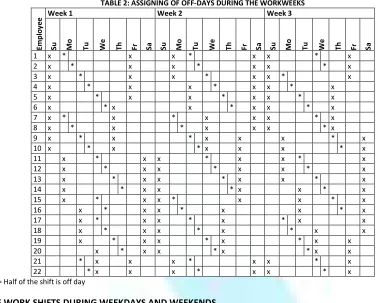
Let (W – E) employees take off-day on the first weekend, the next (W – E) employees take off-day on second weekend, and so on until (W – E) employees have been assigned to take off-day on weekend B, at which, one cycle of proposed model is complete. As a result, W – (W – E) = E workers are on duty during each weekend. In our example, (W - E) = 22-12 = 10(1 to 10) employees are taking off-day on first weekend. The next (W – E) (i.e., 11 to 20) employees are allotted to take off-day on second weekend. The remaining employees (21, 22 employees) will be assigned off –day on third weekend along with eight other employees (1 to 8 employees).
ASSIGNING WEEKDAY AS OFF-DAY
Total workforce in the organization has been divided into 4 classes depending on their duty schedule on Saturday and Sunday as shown in Table 1.
TABLE 1: CLASSIFICATION OF EMPLOYEES BASED ON DUTY SCHEDULE DURING WEEKENDS Class Week q
Su Sa
1 Off Off
2 Off On
3 On Off
4 On On
In each week, Friday is assigned as off-day until (W – D) off-Fridays are given out, giving first priority to Class 4 employees and second priority to Class 2 employees. Friday can be given out as off-day for (W – D) employees when workforce is in the even number. However, if the workforce is in odd number, at least one worker must get half-day-off on Friday.
In each week, if there are class 2 workers without an off-day on Friday then let each of those workers take Thursday as off-day.
In the present case, on week 1, the employees belonging to Class 4 employees are 21 and 22. For them, first assign Friday as off-day along with five other employees (1 to 5 employees). Five employees i.e., 6 – 10 employees will be assigned Thursday as off-day who belong to class 2 employees.
Also let an equal number of class 3 workers take Monday as off-day. Remaining employees those who are not getting two days as off-days in a particular week will be equally divided and will be assigned Tuesday and Wednesday as off-days (i.e., if ‘n’ number of employees are not getting two days as off-day in a particular week and when the ‘n’ is even number, then for n/2 workers assign Tuesday as day and for remaining n/2 employees assign Wednesday as off-day). However, if ‘n’ is odd, assign Tuesday of particular week (q) as off-day for (n+1)/2 employees and assign Wednesday of particular week (p) as off-day for (n-1)/2 employees. Similarly, in the following week (i.e., p+1), assign Tuesday as off-day for (n-(n-1)/2 employees whereas (n+(n-1)/2 employees will be assigned Wednesday as off-day.
Same number of employees as on Thursday i.e., 5 employees will be assigned Monday as off-day but these employees belong to class 3 (11 to 15 employees). For remaining employees, those who are not getting two days as off-day in week 1, assign Tuesday and Wednesday as off-day. Among remaining 7 employees(16 to 22 employees) assign Tuesday as off-day for 4 employees (16 to 19 employees) and Wednesday as off-day for remaining 3 employees (20 – 22 employees). Similar procedure is followed for all the three weeks.
ASSIGNING HALF-DAY AS OFF-DAY DURING WEEKDAYS
INTERNATIONAL JOURNAL OF RESEARCH IN COMMERCE, IT & MANAGEMENT
sequence, then it can be assigned randomly satisfying the workforce requirements. This process is repeated till all the employees are assigned half of the shift as off-day ensuring that (W – D) employees are assigned off-day on week days and (W – E) employees are assigned off-day on weekends. It is to be noted that half day of the weekends are not assigned as off-day (Table 2).TABLE 2: ASSIGNING OF OFF-DAYS DURING THE WORKWEEKS
E
m
p
lo
y
e
e
Week 1 Week 2 Week 3
S
u Mo Tu We Th Fr Sa Su Mo Tu eW Th Fr Sa Su oM Tu We Th Fr Sa
1 x * x x * x x * x
2 x * x x * x x * x
3 x * x x * x x * x
4 x * x x * x x * x
5 x * x x * x x * x
6 x * x x * x x * x
7 x * x * x x x * x
8 x * x * x x x * x
9 x * x * x x x * x
10 x * x * x x x * x
11 x * x x * x x * x
12 x * x x * x x * x
13 x * x x * x x * x
14 x * x x * x x * x
15 x * x x * x x * x
16 x * x x * x x * x
17 x * x x * x * x x
18 x * x x * x * x x
19 x * x x * x * x x
20 x * x x * x * x x
21 * x x x * x x * x
22 * x x x * x x * x
x = Off-day and * = Half of the shift is off day
ASSIGNING OF WORK SHIFTS DURING WEEKDAYS AND WEEKENDS
On Sunday of week 1, arbitrarily Ei number of employees are assigned duty. On Monday of week 1, if the employees of Ei do not have off-day, they must
continue with the same shift on Monday. If an employee is assigned with off-day on Monday, then the employee can change the shift on Tuesday. Similar procedure can be followed to assign the shifts for the remaining days in the week and following weeks. For example, on Sunday of week 1, arbitrarily select Ei on
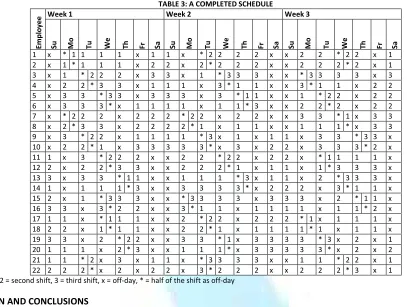
duty workers i.e. 11, 14, 17, 20 and 21 employees for shift 1; 12, 15, 18 and 22 employees are assigned to shift 2, and the remaining 3 employees (13, 16, 19) are assigned shift 3 on the same day. Employees 16 – 22 have Sunday and Monday as work days and for these employees same shift is assigned on both the days.
ASSIGNING HALF-DAY WORK
If the employee 1 is having first half of i shift as work day, assign the same i shift to employee 2 in the second half as work day. Similarly, assign half day as work day for all the employees satisfying that D number of employees are working on weekdays.
Employee 21 has been assigned half-day as off-day (first half of the shift on that day) on Tuesday and employee 22 has been assigned half-day off (second half of the shift on that day) on Tuesday. This means that they both together successfully completed shift 2 work along with 3, 4, 7, 9, 10 and 12 employees on that particular day. Among these, employee 7 and 12 will be working full time in the shift whereas 3, 4 and 9, 10 will be sharing the shift 2 equally and get half-day as off-day. Similarly, assign the work for all the employees in the workweek following the work rules. A completed work schedule is shown in Table 3.
NECESSARY WEEKDAY SHIFT ASSIGNMENT
If the employees are assigned work on jth day and (j+1)th day continuously, and they are not assigned shifts on (j+1)th day, for those employees assign same shifts
of jth day. Assign just enough on duty employees who have not been assigned shifts on that day to shift i to satisfy the staffing requirements D
i. For example,
when the shift assignments have already been made on Monday, Su ≤ Mo ≤ Th, consider those employees who have been assigned shifts on Monday and who are also working on Tuesday, but have not yet received shift assignments. If a worker is on shift 2 on Monday, assign the employee to shift 2 on Tuesday (i.e., occupying Monday’s assignment) so that the worker does not change shifts. After these assignments, if there are insufficient employees on duty on shift 2 on Tuesday, assign just enough on-duty employees who have not been assigned shifts on that day to shift 2 to satisfy the staffing requirement D2.
EXTRA WEEKDAY SHIFT ASSIGNMENT
VOLUME NO.2(2012),ISSUE NO.1(JANUARY) ISSN2231-5756 TABLE 3: A COMPLETED SCHEDULE
E m p lo y e e
Week 1 Week 2 Week 3
S
u Mo Tu We Th Fr Sa Su Mo Tu eW Th Fr Sa Su oM Tu We Th Fr Sa
1 x * 1 1 1 1 x 1 1 x * 2 2 2 2 x x 2 2 * 2 2 x 1
2 x 1 * 1 1 1 x 2 2 x 2 * 2 2 2 x x 2 2 2 * 2 x 1
3 x 1 * 2 2 2 x 3 3 x 1 * 3 3 3 x x * 3 3 3 3 x 3
4 x 2 2 * 3 3 x 1 1 1 x 3 * 1 1 x x 3 * 1 1 x 2 2
5 x 3 3 * 3 3 x 3 3 3 x 3 * 1 1 x x 1 * 2 2 x 2 2
6 x 3 3 3 * x 1 1 1 1 x 1 1 * 3 x x 2 2 * 2 x 2 2
7 x * 2 2 2 x 2 2 2 * 2 2 x 2 2 x x 3 3 * 1 x 3 3
8 x 2 * 3 3 x 2 2 2 2 * 1 x 1 1 x x 1 1 1 * x 3 3
9 x 3 * 2 2 x 1 1 1 1 * 3 x 1 x 1 1 x 3 3 * 3 3 x
10 x 2 2 * 1 x 3 3 3 3 3 * x 3 x 2 2 x 3 3 3 * 2 x
11 1 x 3 * 2 2 2 x x 2 2 * 2 2 x 2 2 x * 1 1 1 1 x
12 2 x 2 2 * 3 3 x x 2 2 2 * 1 x 1 1 x 1 * 3 3 3 x
13 3 x 3 3 * 1 1 x x 1 1 1 * 3 x 1 1 x 2 * 3 3 3 x
14 1 x 1 1 1 * 3 x x 3 3 3 3 * x 2 2 2 x 3 * 1 1 x
15 2 x 1 * 3 3 3 x x * 3 3 3 3 x 3 3 3 x 2 * 1 1 x
16 3 3 x 3 * 2 2 x x 3 * 1 1 x 1 1 1 1 x 1 1 * 2 x
17 1 1 x * 1 1 1 x x 2 * 2 2 x 2 2 2 * 1 x 1 1 1 x
18 2 2 x 1 * 1 1 x x 2 2 * 1 x 1 1 1 1 * 1 x 1 1 x
19 3 3 x 2 * 2 2 x x 3 3 * 1 x 3 3 3 3 * 3 x 2 x 1
20 1 1 1 x 2 * 3 x x 1 1 1 * x 3 3 3 3 3 * x 2 x 2
21 1 1 * 2 x 3 x 1 1 x * 3 3 3 3 x x 1 1 * 2 2 x 1
22 2 2 2 * x 2 x 2 2 x 3 * 2 2 2 x x 2 2 2 * 3 x 1
1 = First shift, 2 = second shift, 3 = third shift, x = off-day, * = half of the shift as off-day
DISCUSSION AND CONCLUSIONS
The model developed in this study for a general healthcare sector will be useful to any organization working on 7-days a week and multiple shifts looking for a change in workweek arrangement. In the present study, modeling of the workforce for 4.5 day workweek has been carried out. The results indicated the feasibility of using such workforce modeling with each employee being eligible for 2.5 off-days.
The present model also ensures that no employee in the organization works continuously more than 5 days in a week. In the present study, although, overlapping of the shifts has not been considered, it can be easily implemented with the present model simply by increasing the work time in each shift. Even though this work was based on a healthcare sector, this can be applied in other service sectors such as emergency hospitals, call centers, workshops etc., to improve the communication between the shifts.
REFERENCES
Alfares, H.K. and Bailey, J.E. (1997), “Integrated project task and manpower scheduling,” IIE transactions, Vol. 29, No. 9, pp. 711-718.
Azmat, C.S. and Widmer, M. (2004), “A case study of single shift planning and scheduling under annualized hours: A simple three-step approach,” European journal of operational research, Vol. 153, No. 1, pp. 148-175.
Brownell, W.S. and Lowerre, M.W. (1976), “Scheduling of Workforces Required in Continuous Operations Under Alternate Labour Policies,” Management Science, Vol. 22, No. 5, pp. 597-605.
Burns, R.N. and Carter, M.W. (1985), “Work force size and single shift schedules with variable demands,” Management Science, Vol. 31, No. 5, pp. 599-607. Caprara, A., Monaci, M. and Toth, P. (2003), “Models and algorithms for a staff scheduling problem,” Mathematical programming, Vol. 98, No. 1-3, pp. 445-476. Carter, M. and Lapierre, S. (2001), “Scheduling emergency room physicians,” Management science, Vol. 4, pp. 347-360.
Cheng, T.C.E. and Gordon, V.S. (1994), “Batch delivery scheduling on a single machine,” Journal of the operations research society, Vol. 45, No. 10, pp. 1211-1215.
Easton, F.F. and Rossin, D.F. (1991), “Sufficient working subsets for the tour scheduling problem,” Management science, Vol. 37, No. 11, pp. 1441-1451. Hesham, K.A. (2003), “Flexible 4-day workweek scheduling with weekend work frequency constraints,” Computers and industrial engineering, Vol. 44, pp. 325-338.
Hung, R. (1996), “An annotated bibliography of compressed work-weeks,” International journal of manpower, Vol. 17, No. 6-7, pp. 43-53.
Hung, R. (1994), “Multiple-shift workforce scheduling under the 3-4 workweek with different weekday and weekend labor requirements,” Management Science, Vol. 40, No. 2, pp. 280-284.
Hung, R. (1995), “Compressed workweeks in office-type environments,” Work study, Vol. 44, No. 1, pp. 5-7.
Itai Gurvich, Luedtke, J. and Tezcan, T. (2010), “Staffing Call Centers with Uncertain Demand Forecasts: A Chance-Constrained Optimization Approach,” Management Science, Vol. 56, pp. 1093 - 1115.
Jonsson, H. (1987), “Dimensioning of bus drive buffers subject to variations in the traffic load,” Engineering costs and production economics, Vol. 12, No. 1-4, pp. 29-38.
Júlíus, A., Marina, A.E., and Shane, G.H. (2008), “Optimizing Call Center Staffing Using Simulation and Analytic Center Cutting-Plane Methods,” Management Science, Vol. 54, pp.295 - 309.
Kenneth, R.B. and Michael, J.M. (1977), “Workforce Scheduling with Cyclic Demands and Day-Off Constraints,” Management Science, Vol. 24, pp. 161 - 167. Koole, G. and Pot, A. (2005), “Approximate dynamic programming in multi-skill call centers,” Proceedings of the 37th conference on winter simulation, Orlando,
FL, 4-7, pp. 576-583.
Miller, H.E., Pierskalla, W.P. and Rath, G.J. (1976), “Nurse Scheduling Using Mathematical Programming, Operational Research, Vol. 24, pp. 5-7.
Mohamed, K.A., Datta, A. and Kozera, R. (2003), “A knowledge-based technique for constraints satisfaction in manpower allocation,” Lecture notes in computer science, Vol. 2659, pp. 100-108.
Narasimhan, R. (2000), “An algorithm for multiple-shift scheduling of hierarchical workforce on four-day or three-day workweek,” INFOR, Vol. 38, No. 1, pp. 14-32.
INTERNATIONAL JOURNAL OF RESEARCH IN COMMERCE, IT & MANAGEMENT
REQUEST FOR FEEDBACK
Dear Readers
At the very outset, International Journal of Research in Commerce, IT and Management (IJRCM)
acknowledges & appreciates your efforts in showing interest in our present issue under your kind perusal.
I would like to request you to supply your critical comments and suggestions about the material published
in this issue as well as on the journal as a whole, on our E-mails i.e.
or
for further improvements in the interest of research.
If you have any queries please feel free to contact us on our E-mail
.
I am sure that your feedback and deliberations would make future issues better – a result of our joint
effort.
Looking forward an appropriate consideration.
With sincere regards
Thanking you profoundly
Academically yours
Sd/-