A Monthly Double-Blind Peer Reviewed (Refereed/Juried) Open Access International e-Journal - Included in the International Serial Directories Indexed & Listed at:
VOLUME NO.3(2013),ISSUE NO.04(APRIL) ISSN2231-5756
INTERNATIONAL JOURNAL OF RESEARCH IN COMMERCE, IT & MANAGEMENT
CONTENTS
CONTENTS
CONTENTS
CONTENTS
Sr.No.
TITLE & NAME OF THE AUTHOR (S)
Page No.
1. ISLAMIC FINANCE AWARENESS IN PUBLIC AND FINANCIAL SECTOR GHULAM MUSTAFA SHAMI, DR. MUHAMMAD RAMZAN & AFAQ RASOOL
1 2. GREEN MARKETING: THE INDIAN CORPORATE SCENARIO
RAVINDER PAL SINGH
5 3. EXCHANGE RATE MANAGEMENT: A CRITICAL LOOK INTO SEVERAL ALTERNATIVES
PURNASHREE DAS & SUJIT SIKIDAR
9 4. AN EMPIRICAL STUDY OF SERVQUAL, CUSTOMER SATISFACTION AND LOYALTY IN INDIAN BANKING SECTOR
RAVINDRA KUMAR KUSHWAHA, DR. MADAN MOHAN & DEBASHISH MANDAL
13 5. CHINA’S CURRENCY POLICY: WINNERS AND LOSERS OF AN INDIRECT EXPORT SUBSIDY
GHULAM MUSTAFA SHAMI, DR. MUHAMMAD RAMZAN & AFAQ RASOOL
19 6. SALES STYLES OF EXECUTIVES SELLING TWO AND FOUR WHEELERS
DR. NAVPREET SINGH SIDHU
23 7. FINANCIAL AND TAXATION ISSUES OF MICRO FINANCE BILL 2012: A MOVE TOWARDS RESPONSIBLE MICROFINANCE IN INDIA
DR DHARUV PAL SINGH
29 8. STUDENTS’ CRITERIA IN SELECTING A BUSINESS SCHOOL
DR. JEEMON JOSEPH
33 9. CONSUMER BEHAVIOR IN ELECTRONIC BANKING: AN EMPIRICAL STUDY
DHARMESH MOTWANI & DR. DEVENDRA SHRIMALI
38 10. A NEW NOTION PROXIMITY FOR DATA PUBLISHING WITH PRIVACY PRESERVATION
S. BOOPATHY & P. SUMATHI
41 11. A STUDY ON ATTITUDE TOWARDS KNOWLEDGE SHARING AMONG KNOWLEDGE WORKERS IN EDUCATIONAL INSTITUTIONS IN MYSORE CITY
NITHYA GANGADHAR & SINDU KOPPA
47 12. MARKOV CHAINS USED TO DETERMINE THE MODEL OF STOCK VALUE AND COMPARED WITH P/E MODEL
ROYA DARABI & ZEINAB JAVADIYAN KOTENAIE
56 13. APPLICATION OF PERT TECHNIQUE IN HEALTH PROGRAMME MONITORING AND CONTROL
DR. SUSMIT JAIN
63 14. ESTIMATION OF TECHNICAL EFFICIENCIES OF INDIAN MICROFINANCE INSTITUTIONS USING STOCHASTIC FRONTIER ANALYSIS
B.CHANDRASEKHAR
69 15. EFFECTIVE RETENTION STRATEGIES IN WORKING ENVIRONMENT
C. KAVITHA
76 16. A COMPARATIVE STUDY OF QUALITY OF WORK LIFE OF WOMEN EMPLOYEES WITH REFERENCE TO PRIVATE AND PUBLIC BANKS IN
KANCHIPURAM DISTRICT A. VANITHA
78
17. MANAGEMENT OF DISTANCE EDUCATION SYSTEM THROUGH ORGANIZATIONAL NETWORK MEENAKSHI CHAHAL
86 18. A STUDY ON CONSTRUCTION OF OPTIMAL PORTFOLIO USING SHARPE’S SINGLE INDEX MODEL
ARUN KUMAR .S.S & MANJUNATHA.K
88 19. A STUDY ON EMPLOYEE ENGAGEMENT OF SELECT PLANT MANUFACTURING COMPANIES OF RAJASTHAN
VEDIKA SHARMA & SHUBHASHREE SHARMA
99 20. RELIABLE AND DISPERSED DATA SECURITY MECHANISM FOR CLOUD ENVIRONMENT
C. PRIYANGA & A. RAMACHANDRAN
104 21. CONSTRUCTION OF OPTIMUM PORTFOLIO WITH SPECIAL REFERENCE TO BSE 30 COMPANIES IN INDIA
DR. KUSHALAPPA. S & AKHILA
108 22. INVESTIGATING QUALITY OF EDUCATION IN BUSINESS AND ECONOMICS PROGRAMS OF ADDIS ABABA UNIVERSITY (AAU) AND BAHIRDAR
UNIVERSITY (BDU) BIRUK SOLOMON HAILE
112
23. FACTORS AFFECTING APPLICABILITY OF SECURITY CONTROLS IN COMPUTERIZED ACCOUNTING SYSTEMS AMANKWA, ERIC
120 24. THE EFFECT OF POVERTY ON HOUSEHOLDS’ VULNERABILITY TO HIV/AIDS INFECTION: THE CASE OF BAHIR DAR CITY IN NORTH-WESTERN
ETHIOPIA
GETACHEW YIRGA & SURAFEL MELAK
128
25. STRATEGIC RESPONSES TO CHANGES IN THE EXTERNAL ENVIRONMENT: A CASE OF EAST AFRICAN BREWERIES LIMITED PATRICIA GACHAMBI MWANGI, MARTIN MUTWIRI MURIUKI & NEBAT GALO MUGENDA
134 26. DEMOGRAPHIC VARIABLES AND THE LEVEL OF OCCUPATIONAL STRESS AMONG THE TEACHERS OF GOVERNMENT HIGHER SECONDARY SCHOOLS
IN MADURAI DISTRICT DR. S. S. JEYARAJ
139
27. HUMAN RESOURCE INFORMATION SYSTEM DR. NEHA TOMAR SINGH
149 28. THE EFFECTS OF CORPORATE GOVERNANCE ON COMPANY PERFORMANCE: EVIDENCE FROM SRI LANKAN FINANCIAL SERVICES INDUSTRY
RAVIVATHANI THURAISINGAM
154 29. A STUDY ON FINANCIAL HEALTH OF TEXTILE INDUSTRY IN INDIA: Z – SCORE APPROACH
SANJAY S. JOSHI
159 30. REGULATORY FRAME WORK OF GOOD CORPORATE GOVERNANCE WITH REFERENCE TO INDIAN CORPORATE GOVERNANCE MECHANISMS
G. VARA KUMAR & SHAIK MAHABOOB SYED
165
CHIEF PATRON
CHIEF PATRON
CHIEF PATRON
CHIEF PATRON
PROF. K. K. AGGARWAL
Chancellor, Lingaya’s University, Delhi
Founder Vice-Chancellor, Guru Gobind Singh Indraprastha University, Delhi
Ex. Pro Vice-Chancellor, Guru Jambheshwar University, Hisar
FOUNDER
FOUNDER
FOUNDER
FOUNDER PATRON
PATRON
PATRON
PATRON
LATE SH. RAM BHAJAN AGGARWAL
Former State Minister for Home & Tourism, Government of Haryana
Former Vice-President, Dadri Education Society, Charkhi Dadri
Former President, Chinar Syntex Ltd. (Textile Mills), Bhiwani
CO
CO
CO
CO----ORDINATOR
ORDINATOR
ORDINATOR
ORDINATOR
AMITA
Faculty, Government M. S., Mohali
ADVISORS
ADVISORS
ADVISORS
ADVISORS
DR. PRIYA RANJAN TRIVEDI
Chancellor, The Global Open University, Nagaland
PROF. M. S. SENAM RAJU
Director A. C. D., School of Management Studies, I.G.N.O.U., New Delhi
PROF. M. N. SHARMA
Chairman, M.B.A., Haryana College of Technology & Management, Kaithal
PROF. S. L. MAHANDRU
Principal (Retd.), Maharaja Agrasen College, Jagadhri
EDITOR
EDITOR
EDITOR
EDITOR
PROF. R. K. SHARMA
Professor, Bharti Vidyapeeth University Institute of Management & Research, New Delhi
CO
CO
CO
CO----EDITOR
EDITOR
EDITOR
EDITOR
DR. BHAVET
Faculty, Shree Ram Institute of Business & Management, Urjani
EDITORIAL ADVISORY BOARD
EDITORIAL ADVISORY BOARD
EDITORIAL ADVISORY BOARD
EDITORIAL ADVISORY BOARD
DR. RAJESH MODI
Faculty, Yanbu Industrial College, Kingdom of Saudi Arabia
PROF. SANJIV MITTAL
University School of Management Studies, Guru Gobind Singh I. P. University, Delhi
PROF. ANIL K. SAINI
Chairperson (CRC), Guru Gobind Singh I. P. University, Delhi
DR. SAMBHAVNA
VOLUME NO.3(2013),ISSUE NO.04(APRIL) ISSN2231-5756
INTERNATIONAL JOURNAL OF RESEARCH IN COMMERCE, IT & MANAGEMENT
DR. MOHENDER KUMAR GUPTA
Associate Professor, P. J. L. N. Government College, Faridabad
DR. SHIVAKUMAR DEENE
Asst. Professor, Dept. of Commerce, School of Business Studies, Central University of Karnataka, Gulbarga
ASSOCIATE EDITORS
ASSOCIATE EDITORS
ASSOCIATE EDITORS
ASSOCIATE EDITORS
PROF. NAWAB ALI KHAN
Department of Commerce, Aligarh Muslim University, Aligarh, U.P.
PROF. ABHAY BANSAL
Head, Department of Information Technology, Amity School of Engineering & Technology, Amity
University, Noida
PROF. A. SURYANARAYANA
Department of Business Management, Osmania University, Hyderabad
DR. SAMBHAV GARG
Faculty, Shree Ram Institute of Business & Management, Urjani
PROF. V. SELVAM
SSL, VIT University, Vellore
DR. PARDEEP AHLAWAT
Associate Professor, Institute of Management Studies & Research, Maharshi Dayanand University, Rohtak
DR. S. TABASSUM SULTANA
Associate Professor, Department of Business Management, Matrusri Institute of P.G. Studies, Hyderabad
SURJEET SINGH
Asst. Professor, Department of Computer Science, G. M. N. (P.G.) College, Ambala Cantt.
TECHNICAL ADVISOR
TECHNICAL ADVISOR
TECHNICAL ADVISOR
TECHNICAL ADVISOR
AMITA
Faculty, Government M. S., Mohali
FINANCIAL ADVISORS
FINANCIAL ADVISORS
FINANCIAL ADVISORS
FINANCIAL ADVISORS
DICKIN GOYAL
Advocate & Tax Adviser, Panchkula
NEENA
Investment Consultant, Chambaghat, Solan, Himachal Pradesh
LEGAL ADVISORS
LEGAL ADVISORS
LEGAL ADVISORS
LEGAL ADVISORS
JITENDER S. CHAHAL
Advocate, Punjab & Haryana High Court, Chandigarh U.T.
CHANDER BHUSHAN SHARMA
Advocate & Consultant, District Courts, Yamunanagar at Jagadhri
SUPERINTENDENT
SUPERINTENDENT
SUPERINTENDENT
SUPERINTENDENT
SURENDER KUMAR POONIA
CALL FOR MANUSCRIPTS
CALL FOR MANUSCRIPTS
CALL FOR MANUSCRIPTS
CALL FOR MANUSCRIPTS
Weinvite unpublished novel, original, empirical and high quality research work pertaining to recent developments & practices in the area of Computer, Business, Finance, Marketing, Human Resource Management, General Management, Banking, Education, Insurance, Corporate Governance and emerging paradigms in allied subjects like Accounting Education; Accounting Information Systems; Accounting Theory & Practice; Auditing; Behavioral Accounting; Behavioral Economics; Corporate Finance; Cost Accounting; Econometrics; Economic Development; Economic History; Financial Institutions & Markets; Financial Services; Fiscal Policy; Government & Non Profit Accounting; Industrial Organization; International Economics & Trade; International Finance; Macro Economics; Micro Economics; Monetary Policy; Portfolio & Security Analysis; Public Policy Economics; Real Estate; Regional Economics; Tax Accounting; Advertising & Promotion Management; Business Education; Management Information Systems (MIS); Business Law, Public Responsibility & Ethics; Communication; Direct Marketing; E-Commerce; Global Business; Health Care Administration; Labor Relations & Human Resource Management; Marketing Research; Marketing Theory & Applications; Non-Profit Organizations; Office Administration/Management; Operations Research/Statistics; Organizational Behavior & Theory; Organizational Development; Production/Operations; Public Administration; Purchasing/Materials Management; Retailing; Sales/Selling; Services; Small Business Entrepreneurship; Strategic Management Policy; Technology/Innovation; Tourism, Hospitality & Leisure; Transportation/Physical Distribution; Algorithms; Artificial Intelligence; Compilers & Translation; Computer Aided Design (CAD); Computer Aided Manufacturing; Computer Graphics; Computer Organization & Architecture; Database Structures & Systems; Digital Logic; Discrete Structures; Internet; Management Information Systems; Modeling & Simulation; Multimedia; Neural Systems/Neural Networks; Numerical Analysis/Scientific Computing; Object Oriented Programming; Operating Systems; Programming Languages; Robotics; Symbolic & Formal Logic and Web Design. The above mentioned tracks are only indicative, and not exhaustive.
Anybody can submit the soft copy of his/her manuscript anytime in M.S. Word format after preparing the same as per our submission guidelines duly available on our website under the heading guidelines for submission, at the email address: [email protected].
GUIDELINES FOR SUBM
GUIDELINES FOR SUBM
GUIDELINES FOR SUBM
GUIDELINES FOR SUBMISSION OF MANUSCRIPT
ISSION OF MANUSCRIPT
ISSION OF MANUSCRIPT
ISSION OF MANUSCRIPT
1. COVERING LETTER FOR SUBMISSION:
DATED: _____________ THE EDITOR
IJRCM
Subject: SUBMISSION OF MANUSCRIPT IN THE AREA OF.
(e.g. Finance/Marketing/HRM/General Management/Economics/Psychology/Law/Computer/IT/Engineering/Mathematics/other, please specify)
DEAR SIR/MADAM
Please find my submission of manuscript entitled ‘___________________________________________’ for possible publication in your journals.
I hereby affirm that the contents of this manuscript are original. Furthermore, it has neither been published elsewhere in any language fully or partly, nor is it under review for publication elsewhere.
I affirm that all the author (s) have seen and agreed to the submitted version of the manuscript and their inclusion of name (s) as co-author (s).
Also, if my/our manuscript is accepted, I/We agree to comply with the formalities as given on the website of the journal & you are free to publish our contribution in any of your journals.
NAME OF CORRESPONDING AUTHOR: Designation:
Affiliation with full address, contact numbers & Pin Code: Residential address with Pin Code:
Mobile Number (s): Landline Number (s): E-mail Address: Alternate E-mail Address:
NOTES:
a) The whole manuscript is required to be in ONE MS WORD FILE only (pdf. version is liable to be rejected without any consideration), which will start from the covering letter, inside the manuscript.
b) The sender is required to mentionthe following in the SUBJECT COLUMN of the mail:
New Manuscript for Review in the area of (Finance/Marketing/HRM/General Management/Economics/Psychology/Law/Computer/IT/ Engineering/Mathematics/other, please specify)
c) There is no need to give any text in the body of mail, except the cases where the author wishes to give any specific message w.r.t. to the manuscript. d) The total size of the file containing the manuscript is required to be below 500 KB.
e) Abstract alone will not be considered for review, and the author is required to submit the complete manuscript in the first instance.
f) The journal gives acknowledgement w.r.t. the receipt of every email and in case of non-receipt of acknowledgment from the journal, w.r.t. the submission of manuscript, within two days of submission, the corresponding author is required to demand for the same by sending separate mail to the journal.
2. MANUSCRIPT TITLE: The title of the paper should be in a 12 point Calibri Font. It should be bold typed, centered and fully capitalised.
3. AUTHOR NAME (S) & AFFILIATIONS: The author (s) full name, designation, affiliation (s), address, mobile/landline numbers, and email/alternate email address should be in italic & 11-point Calibri Font. It must be centered underneath the title.
VOLUME NO.3(2013),ISSUE NO.04(APRIL) ISSN2231-5756
INTERNATIONAL JOURNAL OF RESEARCH IN COMMERCE, IT & MANAGEMENT
5. KEYWORDS: Abstract must be followed by a list of keywords, subject to the maximum of five. These should be arranged in alphabetic order separated by commas and full stops at the end.
6. MANUSCRIPT: Manuscript must be in BRITISH ENGLISH prepared on a standard A4 size PORTRAIT SETTING PAPER. It must be prepared on a single space and single column with 1” margin set for top, bottom, left and right. It should be typed in 8 point Calibri Font with page numbers at the bottom and centre of every page. It should be free from grammatical, spelling and punctuation errors and must be thoroughly edited.
7. HEADINGS: All the headings should be in a 10 point Calibri Font. These must be bold-faced, aligned left and fully capitalised. Leave a blank line before each heading.
8. SUB-HEADINGS: All the sub-headings should be in a 8 point Calibri Font. These must be bold-faced, aligned left and fully capitalised.
9. MAIN TEXT: The main text should follow the following sequence:
INTRODUCTION
REVIEW OF LITERATURE
NEED/IMPORTANCE OF THE STUDY
STATEMENT OF THE PROBLEM
OBJECTIVES
HYPOTHESES
RESEARCH METHODOLOGY
RESULTS & DISCUSSION
FINDINGS
RECOMMENDATIONS/SUGGESTIONS
CONCLUSIONS
SCOPE FOR FURTHER RESEARCH
ACKNOWLEDGMENTS
REFERENCES
APPENDIX/ANNEXURE
It should be in a 8 point Calibri Font, single spaced and justified. The manuscript should preferably not exceed 5000 WORDS.
10. FIGURES &TABLES: These should be simple, crystal clear, centered, separately numbered & self explained, and titles must be above the table/figure. Sources of data should be mentioned below the table/figure. It should be ensured that the tables/figures are referred to from the main text.
11. EQUATIONS:These should be consecutively numbered in parentheses, horizontally centered with equation number placed at the right.
12. REFERENCES: The list of all references should be alphabetically arranged. The author (s) should mention only the actually utilised references in the preparation of manuscript and they are supposed to follow Harvard Style of Referencing. The author (s) are supposed to follow the references as per the following:
•
All works cited in the text (including sources for tables and figures) should be listed alphabetically.•
Use (ed.) for one editor, and (ed.s) for multiple editors.•
When listing two or more works by one author, use --- (20xx), such as after Kohl (1997), use --- (2001), etc, in chronologically ascending order.•
Indicate (opening and closing) page numbers for articles in journals and for chapters in books.•
The title of books and journals should be in italics. Double quotation marks are used for titles of journal articles, book chapters, dissertations, reports, working papers, unpublished material, etc.•
For titles in a language other than English, provide an English translation in parentheses.•
The location of endnotes within the text should be indicated by superscript numbers.PLEASE USE THE FOLLOWING FOR STYLE AND PUNCTUATION IN REFERENCES: BOOKS
•
Bowersox, Donald J., Closs, David J., (1996), "Logistical Management." Tata McGraw, Hill, New Delhi.•
Hunker, H.L. and A.J. Wright (1963), "Factors of Industrial Location in Ohio" Ohio State University, Nigeria. CONTRIBUTIONS TO BOOKS•
Sharma T., Kwatra, G. (2008) Effectiveness of Social Advertising: A Study of Selected Campaigns, Corporate Social Responsibility, Edited by David Crowther & Nicholas Capaldi, Ashgate Research Companion to Corporate Social Responsibility, Chapter 15, pp 287-303.JOURNAL AND OTHER ARTICLES
•
Schemenner, R.W., Huber, J.C. and Cook, R.L. (1987), "Geographic Differences and the Location of New Manufacturing Facilities," Journal of Urban Economics, Vol. 21, No. 1, pp. 83-104.CONFERENCE PAPERS
•
Garg, Sambhav (2011): "Business Ethics" Paper presented at the Annual International Conference for the All India Management Association, New Delhi, India, 19–22 June.UNPUBLISHED DISSERTATIONS AND THESES
•
Kumar S. (2011): "Customer Value: A Comparative Study of Rural and Urban Customers," Thesis, Kurukshetra University, Kurukshetra. ONLINE RESOURCES•
Always indicate the date that the source was accessed, as online resources are frequently updated or removed. WEBSITESHUMAN RESOURCE INFORMATION SYSTEM
DR. NEHA TOMAR SINGH
LECTURER
BHARTIYA VIDYA BHAVAN- USHA & LAKSHMI MITTAL INSTITUTE OF MANAGEMENT
NEW DELHI
ABSTRACT
A HRIS, or Human Resource Information System, is a software solution for small to mid-sized businesses to help automate and manage their HR, payroll, and management and accounting activities. A HRIS generally should provide the capability to more effectively plan, control and manage HR costs; achieve improved efficiency and quality in HR decision making; and improve employee and managerial productivity and effectiveness .My research on HRIS is descriptive exploratory basically based on secondary data collected from various sources like internet, books, company’s websites. The study will have an important implication in throwing light on how technology can be used in human resource system and its benefits. as its an emerging area in India so much is not known and also not been practiced in India regarding HRIS. This paper however helps to provide information relating to this and would proof beneficial for the companies who are still using the old methods
KEYWORDS
HRIS, Human Resource, Benefits, Company, Automate and Manage.
INTRODUCTION
he Human Resource Information System (HRIS) is a software or online solution for the data entry, data tracking, and data information needs of the Human Resources, payroll, management, and accounting functions within a business.HRIS reports data on all employees to whom the company pays or reimburses salaries or benefits, regardless of funding sources or reporting system; maintains data on former and current employees; and stores historical personnel data for inquiry and analysis. HRIS also helps in complying with salary administration provisions, benefits, helps management in taking decisions regarding human resource issues like recruitment, selection, training & development etc. and analyze the use of their human resources
The Human Resource Information Systems (HRIS) provide overall:
• Management of all employee information.
• Reporting and analysis of employee information.
• Company-related documents such as employee handbooks, emergency evacuation procedures, and safety guidelines.
• Benefits administration including enrollment, status changes, and personal information updating.
• Complete integration with payroll and other company financial software and accounting systems.
• Applicant and resume management.
THE EVOLUTION OF THE HRIS
- First, paper files were located in the Personnel department. - Then, punched card and magnetic media files were located in IS.
- Government legislation in the 1960s and 70s eventually called management's attention to the importance of HR data. - In the late 1970's the concept of an HRIS was born.
HISTORY OF HRIS
- 1950’s – HRIS was virtually non-existent
- 1960’s – Only Few Organizations were used to implement HRIS - 1970’s – Organizations realize the need of HRIS
- 1980’s – HRIS was implemented by most of the organizations - 1990’s - There were numerous vendors of HRIS in the market
- Human resource information systems (HRIS) have increasingly transformed since it was first introduced at General Electric in the 1950s. HRIS has gone from a basic process to convert manual information keeping systems into computerized systems, to the HRIS systems that are used today. Human resource professionals began to see the possibility of new applications for the computer. The idea was to integrate many of the different human resource functions. The result was the third generation of the computerized HRIS, a feature-rich, broad-based, self-contained HRIS. The third generation took systems far beyond being mere data repositories and created tools with which human resource professionals could do much more.
WHY HRIS?
With an appropriate HRIS, Human Resources staff enables employees to do their own benefits updates and address changes, thus freeing HR staff for more strategic functions. Additionally, data necessary for employee management, knowledge development, career growth and development, and equal treatment is facilitated. Finally, managers can access the information they need to legally, ethically, and effectively support the success of their reporting employees. The HRIS that most effectively serves companies tracks:
• attendance and PTO use,
• pay raises and history,
• pay grades and positions held,
• performance development plans,
• training received,
• disciplinary action received,
• personal employee information, and occasionally,
• management and key employee succession plans,
• high potential employee identification, and
• applicant tracking, interviewing, and selection.
VOLUME NO.3(2013),ISSUE NO.04(APRIL) ISSN2231-5756
INTERNATIONAL JOURNAL OF RESEARCH IN COMMERCE, IT & MANAGEMENT
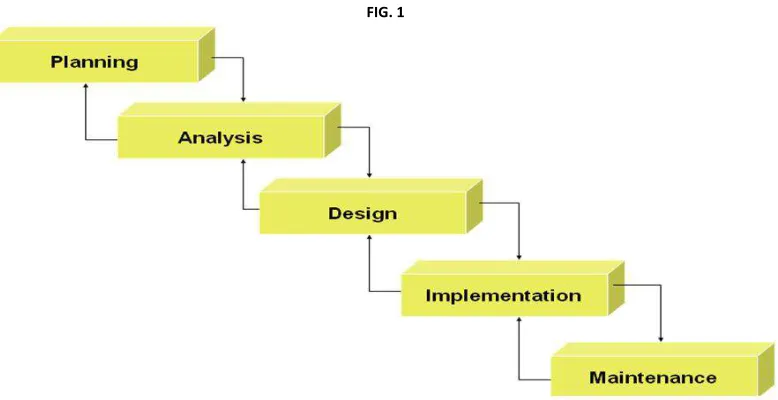
HRIS SYSTEM DEVELOPMENT LIFE CYCLE
FIG. 1
- First of all one should decide the objective of introducing and implementation of HRIS in the company
- Then identify various HRIS projects. After that set the company’s priorities and in accordance select the project. Then analyze the resources of the company and the resource requirement of the project. Then set a schedule and develop the HRIS plan. After that analyze the plan that whether it is fulfilling the requirements and needs of the company and it is feasible or not. Then design the HRIS system and finally implement it in the company. Lastly, maintain the HRIS in the company which is being implemented.
HRIS MODEL
FIG. 2
This model shows how actually the HRIS works and how it helps in various functioning of human resource department .Here human resource department can fetch various data and information from HRIS database which can be utilized in human resource planning, recruiting, compensation system, benefit system etc.
THE HRIS DATABASE
- Employee: 82.5% of the firms maintain only employee data
- Non- Employee: Only 8% of the firms maintain the data of external organization
These HRIS database is used by executives, non – HR managers, hr managers,hr directors on monthly and weekly basis .As with the help of the data and information they are able to take necessary decisions for the company benefit.
APPLICATIONS & UTILITIES
PERSONAL RECORDS
Tracking employee data is one of the central features of an HRIS. By
more complete overview of your HR picture and reduce administrative overhead personal details etc.
BENEFITS MANAGEMENT
Employees place enormous value on benefits like health insurance, vacation time, and retirement plans. The correct HRIS will time spent on enrollment forms, changes, and even simple reques
FEATURES TO LOOK FOR
•
Covers all your benefits: parenting leaves, flexible schedules, community service time, 401k or other retirement plans, health, dental, and vision insu and flexible spending or dependent care accounts•
Connects to external systems: can establish direct connections with yourTERMINATIONS
How long was Mr. X in our service? Why did he leave the company? What did he contribute to the Pension Scheme?
• On termination of an employee’s service the HRIS system allows for relevant details to be checked and recorded.
• Payroll Details include: outstanding loan balances, leave balances, service period information and salary information.
• Personnel Details include: outstanding items issued to the employee such as cell phones or laptops, details of training sessions planned for the empl and the recording of the exit interview conducted with the employee.
PAYROLL
Payroll is often the first aspect of HR to be automated, usually when a company outsources the job to a payroll service provider. Computerized payroll systems can drastically reduce the time your staff spends on payroll work and cut down on errors.
This can save some steps: if all your data is in one system, you can cut down on data exports and re scale of different employees falling under different grades.
TIME AND ATTENDANCE REPORTING
Either integrates with your existing time tracking system, or provides all the attendance tracking features you need. It give punctuality and attendance of the employees in the company.
HRIS TIME CLOCK CENTER
The empire payroll HRIS System comes with a basic time clock function which is accessed via PC and/or the Internet. Empire payroll offers s attendance systems including biometric as well as basic punch clocks.
RECRUITMENT AND SELECTION
HRIS provides for short-listing, search, and easy retrieval of resumes. This module is capable of processing large volumes of resumes and can also su resumes in many different formats. Status tracking and history record of every candidate / resume in the system wil
of a button. It helps in selecting right candidate for the right job. It shows all the information about the applicant which candidate It helps in viewing the selected person which is best suited for a particular job.
EMPLOYEE TURNOVER
HRIS furnishes information regarding employee’s turnover. It tells us how many employees have left the company and how much n helps in calculating employee turnover ratios.
FIG. 1
Tracking employee data is one of the central features of an HRIS. By centralizing information that may currently exist in multiple locations, an HRIS can give you a more complete overview of your HR picture and reduce administrative overhead It will encompass information about each employee, such as name address,
Employees place enormous value on benefits like health insurance, vacation time, and retirement plans. The correct HRIS will time spent on enrollment forms, changes, and even simple requests like "how much vacation time do I have left?"
parenting leaves, flexible schedules, community service time, 401k or other retirement plans, health, dental, and vision insu and flexible spending or dependent care accounts
can establish direct connections with your health insurance, and other benefit providers
How long was Mr. X in our service? Why did he leave the company? What did he contribute to the Pension Scheme? On termination of an employee’s service the HRIS system allows for relevant details to be checked and recorded. Payroll Details include: outstanding loan balances, leave balances, service period information and salary information.
e: outstanding items issued to the employee such as cell phones or laptops, details of training sessions planned for the empl and the recording of the exit interview conducted with the employee.
tomated, usually when a company outsources the job to a payroll service provider. Computerized payroll systems can drastically reduce the time your staff spends on payroll work and cut down on errors.
stem, you can cut down on data exports and re-keying. It contains all the information regarding the pay scale of different employees falling under different grades.
Either integrates with your existing time tracking system, or provides all the attendance tracking features you need. It give punctuality and attendance of the employees in the company.
roll HRIS System comes with a basic time clock function which is accessed via PC and/or the Internet. Empire payroll offers s attendance systems including biometric as well as basic punch clocks.
listing, search, and easy retrieval of resumes. This module is capable of processing large volumes of resumes and can also su resumes in many different formats. Status tracking and history record of every candidate / resume in the system will be available to HR professionals, at the click of a button. It helps in selecting right candidate for the right job. It shows all the information about the applicant which
person which is best suited for a particular job.
HRIS furnishes information regarding employee’s turnover. It tells us how many employees have left the company and how much n
centralizing information that may currently exist in multiple locations, an HRIS can give you a It will encompass information about each employee, such as name address,
Employees place enormous value on benefits like health insurance, vacation time, and retirement plans. The correct HRIS will help reduce the amount of staff
parenting leaves, flexible schedules, community service time, 401k or other retirement plans, health, dental, and vision insurance,
, and other benefit providers
Payroll Details include: outstanding loan balances, leave balances, service period information and salary information.
e: outstanding items issued to the employee such as cell phones or laptops, details of training sessions planned for the employee
tomated, usually when a company outsources the job to a payroll service provider. Computerized payroll systems
keying. It contains all the information regarding the pay
Either integrates with your existing time tracking system, or provides all the attendance tracking features you need. It gives all the details regarding the
roll HRIS System comes with a basic time clock function which is accessed via PC and/or the Internet. Empire payroll offers several other time &
listing, search, and easy retrieval of resumes. This module is capable of processing large volumes of resumes and can also support l be available to HR professionals, at the click of a button. It helps in selecting right candidate for the right job. It shows all the information about the applicant which ultimately helps in selecting the right
VOLUME NO.3(2013),ISSUE NO.04(APRIL) ISSN2231-5756
INTERNATIONAL JOURNAL OF RESEARCH IN COMMERCE, IT & MANAGEMENT
PERFORMANCE APPRAISAL
Employees are the most valuable and dynamic assets of an organization. Performance Appraisals Management System (IPMS) is an extensive andcomprehensive system that maintains and tracks information pertaining to the performance appraisals in an organization.
The system captures information related to eligibility criteria, appraisal groups or categories, multiple appraisal cycles, Key Result Areas (KRAs), workflow driven performance appraisals process with electronic protection. The appraisal process begins with Appraisal Cycle Initiation, Definition of KRAs by the Appraiser, Self Rating by the Appraisee, Rating by the Appraisers, Overall rating and Normalization. The system supports 360 degree paradigm for Performance Appraisal Review. HRIS formalizes and automates your review process, including self, peer, and manager reviews and all approvals
HRIS – BENEFITS
The various benefits of HRIS which a company can obtain can be summarized as below:- - Higher speed of retrieval and processing of data.
- Reduction in duplication of efforts leading to reduced cost. - Ease in classifying and reclassifying the data.
- Better analysis leading to more effective decision making. - Higher accuracy of information/report generated. - Fast response to answer queries.
- Improved quality of reports. - Better work culture.
- Establishing of streamlined and systematic procedure. - More transparency in the system.
- Employee – Self Management.
The importances of info system in HR processes are as follows:- - Better safety
- Better service - Competitive advantage - Fewer errors
- Greater accuracy - Higher quality products - Improved health care - Improved communication - Increased efficiency - Increased Productivity - More efficient administration - More opportunities - Reduced labor requirements - Reduced costs
- Superior managerial decision making - Superior control
HRIS – DISADVANTAGES
Besides having lot of advantages the HRIS system has also have certain disadvantages which can be summarized below:- - Unclear goals/objectives
- Management – unrealistic expectations - System solves the wrong problem - Lack of overall plan for record management - Improper vendor/product selection - Lack of flexibility and adaptability - Lower user involvement - Misinterpret HR specifications
- Planning overlooks impact on clerical procedures - Lack of HR/functional expertise in designing - Poor communication between HR/IS - Underestimate conversion efforts - Inadequate testing
HRIS SOFTWARE: SOME OF THE HRIS SOFTWARE ARE SUMMARIZED BELOW
Abra Suite for human resources and payroll management
ABS (Atlas Business Solutions) for general information, wages information, emergency information, reminders, evaluators, notes customer information, documents and photos, separation information.
CORT-HRMS for applicant tracking, attendance tracking and calendars, wage information, skills tracking, reports to information, status tracking, Job history tracking, cost center tracking, reviews and tracking, mass update and change tools etc.
HRSOFT for Identifying and track senior managers, assess management skills and talents, generate a wide range of reports, resumes, employee profiles, replacement tables and succession analysis reports, Identify individuals for promotion, skills shortages, unexpected vacancy, discover talent deep, competency management, career development, align succession plans etc.
Human Resource Micro Systems for sophisticated data collection and reporting, flexible spending accounts, compensation, employment history, time off, EEO, qualifications, applicant/requisition tracking, position control/succession planning, training administration, organization charts, HRIS-Pro Net (employee/managerial self-service), HR Automation (e-Notification and e-Scheduler), and performance pro (performance management)
ORACLE- HRMS for Oracle recruitment, Oracle self-service human resources, payroll, HR Intelligence,Oracle learning management, Oracle time and labor
VANTAGE-HRA 'Point-and-Click' report writing, internal messaging system for leaving reminders to yourself, to someone else or to everyone using HRA - very useful for Benefit Applications, disciplinary actions, special events, employee summary screen for basic, leave (Absenteeism) and salary/position history, skills & training module, leave tracking module
People-Track HR priced at a one-time fee of $20 per employee, People-Track is one of the more flexible offerings. Other versions are available that add features for additional costs.
EmpXTrack Starter Edition EmpXTrack combines payroll software with an employee database, featuring a self-service option that lets employees keep their own information up-to-date. Pricier editions add tools for performance evaluations, surveys and recruiting.
Microsoft Dynamics NAV and GP for some smaller companies, these offerings from Microsoft could be overkill, but they might be worth the investment for employers with robust growth who already rely heavily on Microsoft products
CONCLUSION
A HRIS facilitates communication processes and saves paper by providing an easily-accessible, centralized location for company policies, announcements, and links to external URL’s. Employee activities such as time-off requests and W-4 form changes can be automated, resulting in faster approvals and less paperwork. An affordable Human Resource Information System (HRIS )capabilities, allows companies to manage theirworkforce through two powerful main components: HR & Payroll. In addition to these essential software solutions, HRIS offers other options to help companies understand and fully utilize their workforce’s collective skills, talents, and experiences.
Some of the most popular modules are:
Organization charts(Create professional looking, dynamic organization charts),Employee self service (Employees can update personal information and view benefits elections, absence transactions, time-off balances and payroll information),Benefits Administration (Save paper and postage, take weeks off the benefits open enrollment period, reduce administration time, and improve data accuracy, Track training for employees. Selecting the right HRIS is important. Your company will need to make sure that they can customize the system to meet its specific and unique needs and that it is a system that will grow with your company.
REFERENCES
BOOKS
1. Developing Human Resource Information System - By Ashok Kumar Gupta 2. Handbook of Human Resource Information Systems- By Alfred J Walker 3. Human Resource Information Systems - By P K Gupta, & Susheel Chhabra
WEBSITES
4. www.best-software.com 5. www.businessballs.com 6. www.citehr.com 7. www.en.wikipedia.com 8. www.hr.com/
VOLUME NO.3(2013),ISSUE NO.04(APRIL) ISSN2231-5756
INTERNATIONAL JOURNAL OF RESEARCH IN COMMERCE, IT & MANAGEMENT
REQUEST FOR FEEDBACK
Dear Readers
At the very outset, International Journal of Research in Commerce, IT and Management (IJRCM)
acknowledges & appreciates your efforts in showing interest in our present issue under your kind perusal.
I would like to request you to supply your critical comments and suggestions about the material published
in this issue as well as on the journal as a whole, on our E-mail i.e.
for further
improvements in the interest of research.
If you have any queries please feel free to contact us on our E-mail
.
I am sure that your feedback and deliberations would make future issues better – a result of our joint
effort.
Looking forward an appropriate consideration.
With sincere regards
Thanking you profoundly
Academically yours
Sd/-