Copyright © 2012 (Kimberly Christen). Licensed under the Creative Commons Attribution Non-commercial No Derivatives (by-nc-nd). Available at http://ijoc.org.
Does Information Really Want to be Free?
Indigenous Knowledge Systems and the Question of Openness
KIMBERLY CHRISTEN
1Washington State University
The “information wants to be free” meme was born some 20 years ago from the free and open source software development community. In the ensuing decades, information freedom has merged with debates over open access, digital rights management, and intellectual property rights. More recently, as digital heritage has become a common resource, scholars, activists, technologists, and local source communities have generated critiques about the extent of information freedom. This article injects both the histories of collecting and the politics of information circulation in relation to indigenous knowledge into this debate by looking closely at the history of the meme and its cultural and legal underpinnings. This approach allows us to unpack the meme’s normalized assumptions and gauge whether it is applicable across a broad range of materials and cultural variances.
Post on Slashdot: News for nerds. Stuff that matters. Subject line: “Aboriginal archive uses new DRM”
Submitted by: ianare on Tuesday, January 29, 2008, @ 02:57PM
1 I’d like to thank the two anonymous reviewers for their comments and suggestions that have
strengthened this article. This article has been a work in progress for several years as the Mukurtu platform grew and took shape. During that time, I was lucky enough to be in conversation with wonderfully thought-provoking colleagues who pushed me to think about the politics of openness and access, including Jason Jackson, Chris Kelty, Tara McPherson, Craig Dietrich, Paul Dourish, Ramesh Srinivasan, Robin Boast, Gabriella Coleman, Rosemary Coombe, Matt Cohen, Jane Anderson, Kate Hennessy, and Robert Leopold. No amount of thanks is enough for Mukurtu’s Director of Development, Michael Ashley, who took Mukurtu CMS from its alpha version to a 1.0 release in record time, all the while reminding me not to let perfect be the enemy of good enough. My biggest debt of gratitude goes to the indigenous peoples who have worked with Mukurtu CMS to help create a platform that reflects their diverse needs.
“A new method of digital rights management which relies on a user’s profile has been pioneered by Aboriginal Australians for a multimedia archive. The need to create profiles based on a user’s name, age, sex and standing within their community come from traditions over what can and cannot be seen. For example, men cannot view women’s rituals, and people from one community cannot view material from another without first seeking permission. Meanwhile images of the deceased cannot be viewed by their families. This threw up issues surrounding how the material could be archived, as it was not only about preserving the information into a database in a traditional sense, but also how people would access it depending on their gender, their relationship to other people and where they were situated.” (Slashdot, n.d., para 1)
Comment #2
Subject line: How is this DRM?
Submitted by: Anonymous Coward on Tuesday January 29 2008, @07:13PM
“This doesn’t sound like DRM. It sounds like access control.”
Comment #182
Subject line: DRM/Censorship is ALWAYS bad!
Submitted by Auldclootie on Wednesday January 30 2008, @09:11AM
“No one elected some anthropologist and gave him/her the Godlike power to decide which aspects of Aboriginal culture are rigidly enforced. Culture is a dynamic process. It should not be fossilized with rigidly enforced rules about what is and is not permissible. Are Aboriginals not to be allowed to dissent? To be non-conformist? This kind of DRM/censorship should be thrown on the scrapheap with all the rest. It disenfranchises the ordinary people and puts their welfare into the hands of some supposedly benign protector. Total bullshit! Of course the Aboriginal elders support this - they are conservatives and resist change - what about the rising new generation? I worked with Aboriginal people in the 90’s in central Australia – it’s about time this kind of paternalist crap was consigned to the trash...”2
Slashdot <reply>
On January 29, 2008, about five months after several Warumungu people and I installed the Mukurtu Wumpurrarni-kari community digital archive in the Nyinkka Nyunyu Art and Culture Centre in the remote Central Australian town of Tennant Creek, we had our fifteen minutes of Internet fame, as the archive was debated on forums from Slashdot to the BBC.3 As far as I can piece together from the
e-traces of the above Slashdot commentary, it began with a post I made to my blog on January 6, 2008,
2 Original Slashdot comments archived at
http://yro.slashdot.org/story/08/01/29/2253239/Aboriginal-Archive-Uses-New-DRM; see also Dietrich and Bell (2011, pp. 208–209).
3 See Christen (2007, 2008, 2009). Slashdot online discussion archived at
announcing the launch of an online demo of the Mukurtu Wumpurrarni-kari archive.4 Less than a week
later, on January 11, Wendy Seltzer, an intellectual property lawyer, wrote a post on her blog lauding the archive as an example of “digital restrictions done right” (Seltzer, 2008, emphasis mine). The BBC’s Bill Thompson read Wendy’s post and told his colleagues from Digital Planet about our project. Digital Planet’s focus is on “reporting the human side of technology from around the world” (Titherington, 2011). On January 15, I received an e-mail inviting me to be on the show. I gladly accepted. The next week, I went to the local NPR station and recorded a 40-some minute interview with Gareth Mitchell, the host of Digital Planet.
On January 29, the edited segment aired, and a podcast was made available via the BBC website. Host Gareth Mitchell opened the segment framing the story this way: “A remote and ancient Aboriginal community in the Australian Outback has become the unlikely setting for a digital archive that’s turned received wisdom about digital rights management or DRM on its head.” As I sat listening to the show, the cultural anthropologist in me cringed at the “ancient” qualifier (how could a group of people living today be ancient?), and the digital humanist in me was less convinced by the invocation of DRM as a counterpoint to the cultural protocols built into the archive. However, by the end of the program I was quite pleased with the way the producers had edited the piece together, highlighting the community-focused, ground-up production of the system based on Warumungu cultural protocols. I appreciated the commentary at the end of the show from Bill Thompson, who discussed the system as one based on trust. I made the point, and Bill echoed it in his comments, that the system could give us a way to think about control and access in ways that didn’t have to mean an abuse of power or “locked down” culture.5
The same day the radio program aired, the BBC Online ran an article entitled “Aboriginal Archive Offers New DRM” (BBC, 2008), and Bill Thompson included the Mukurtu Wumpurrarni-kari archive in his article, “Locking Down Open Computing” (Thompson, 2008), in the technology section of the BBC Online. In contrast to the radio program segment, which covered the history of the project and the nuances of the Warumungu cultural protocols, the two articles made DRM central to the project, when in fact, my comments on DRM were in response to Mitchell’s query and analogy. They were certainly never central to the creation of the archive itself, or to my work at the time. Yet, over the course of a few weeks, the Mukurtu archive—a project with multiple goals and two years in development—became framed around one of the most controversial contemporary legal, social, and economic debates: digital rights management. The Slashdot commentary was bookended by equal parts racist diatribe and compassionate romanticism, with perhaps a third or more of the comments falling somewhere in the middle—not sure that Mukurtu amounted to DRM, but confident that technology should be put to diverse cultural uses.
In this article, I examine the reach of digital rights management (DRM) and commons talk as they extend to—and often push up against—indigenous articulations of information management and knowledge circulation protocols within the digital realm. DRM is a hot-button issue because of high-profile corporations using digital “locks” to regulate consumer use instead of copyright or other legal tools. Tarleton Gillespie argues that, after the Napster case in the United States, there has been a “fundamental
shift in strategy, from regulating the use of technology through law to regulating the design of technology so as to constrain use.” Further, he suggests that:
What we might call “social engineering” has come full circle back to actual engineering, where the tools and the environment are built to assure the right practices are facilitated, the wrong are inhibited. These technologies are largely being developed and deployed below our cultural radar, enamored as we are with the thrill of the “information revolution,” the faith in progress, and the freedom of individual agency. (2007, p. 6)
Gillespie charts the shift in managing what has been dubbed the “culture industry”—music, books, movies, video games, and other software—around corporate solutions to murky legal issues. He rightly points to the general fascination with technology and its associated progressive narratives that blind us to the reach of technology and its unintended consequences. However, off of Gillespie’s radar are the other uses for building “control” into systems for purposes that are not mired in greed, consumerism, and the circulation of commodities. Curation and circulation of indigenous digital cultural heritage materials are, in fact, activities that undo this neat alignment of control with the abuse of power. Highlighting these diverse and situational types of controls gives us another lens through which to view the notion of digital management of cultural materials and knowledge.
Almost three years after the first interview on February 22, 2011, I was once again on Digital Planet. This time, Mitchell invited me to participate in a discussion about “openness and ownership” and our conversation took off from two projects that stemmed directly from the Mukurtu Wumpurrarni-kari archive: the Plateau Peoples’ Web Portal (PPWP) and Mukurtu CMS.6 These two projects leverage the
backend software of the original archive to build digital platforms for indigenous cultural heritage management. The PPWP is an online educational portal of Plateau materials co-curated by tribal nations across the Pacific Northwest region of the United States. Mukurtu CMS is a free and open source digital archive and content management tool aimed at the specific needs of indigenous peoples globally. Whereas the Mukurtu Wumpurrarni-kari archive was a stand-alone archive, Mukurtu CMS is a tool that can be adapted to the local cultural protocols and dynamic intellectual property needs of any indigenous community.7 During the interview, Mitchell was once again curious about the potential of these projects to
upend dominant discussions about digital technology’s role in managing and controlling access to culture.
After describing the various ways in which both the PPWP and the scaled-up Mukurtu CMS allow those using the tools (indigenous communities, museums, libraries, and archives) to manage and define access, circulation, and licensing at granular levels, Ray Corrigan from Open University turned back to the general notion of DRM, critiquing it as a corporate “digital lock” put on by producers aiming to shut out
6 See http://www.mukurtu.org and http://plateauportal.wsulibs.wsu.edu
7 In Warumungu, “Mukurtu” translates to “dilly bag,” but was adapted by elders in the community to mean
consumers. He remarked, however, that “the interesting thing about Mukurtu is it turns that control stuff on its head, so it now gives the access control switches to the users” (Digital Planet, 2011). Exactly. And yet, this point is oftentimes lost in the cacophony calling for openness at any and all costs. The celebration of openness, something that began as a reaction to corporate greed and the legal straightjacketing of creative works, has resulted in a limited vocabulary with which to discuss the ethical and cultural parameters of information circulation and access in the digital realm. We are stuck thinking about open or closed, free or proprietary, public or private, and so on, even though in such common online experiences as using social media platforms Facebook and Twitter, or when reading through legal parameters for the use and reuse of digital information, these binaries rarely exist. These are not zero-sum games, and information sociality and creativity is more porous than these choices allow us to imagine.
In the remainder of this article, I address the contentious issues of access to knowledge and information freedom as they play out through assertions of control over digital materials, clarion calls for a more robust public domain, and expansive definitions of open access. I begin by exploring the narrative field of openness and access on which indigenous claims and practices are mapped, and then I move to examining the production of Mukurtu CMS in order to focus on the tensions produced when archival platforms and culturally diverse notions of information management, sharing, and privacy rub up against one another.8 By highlighting these tensions, I explicitly interrogate entrenched notions of the public
domain, appeals to openness, and the contours of information circulation in order to better understand the stakes of digital sociality as it is lived, imagined, and performed across cultures and within the messy spaces where different notions of collaboration, collection, and curation intersect.
Information Wants to be Free
Like all powerful and formative memes, “information wants to be free” has a genealogy that can tell us something about how supporters conceive of the connections between information, freedom, openness, and access in relation to digital technologies. Apparently, at the first Hacker conference in 1984, Stewart Brand suggested that:
On the one hand information wants to be expensive, because it’s so valuable. The right information in the right place just changes your life. On the other hand, information wants to be free, because the cost of getting it out is getting lower and lower all the time. So you have these two fighting against each other. (Brand, 1984)
Emphasizing the tension between particular types of social and economic practices born from information circulation, Brand highlighted the seemingly natural give and take between two factionalized aspects of information. They are “fighting against each other.” Pitting informational relations in an inherent squabble produces a problem to overcome, a side to choose. One must decide: free or expensive? Six years later, in 1990, Richard Stallman tweaked this notion and argued that,
8 I use the term “indigenous” in an inclusive manner and follow the United Nations (n.d.) in not creating a
I believe that all generally useful information should be free. By “free” I am not referring to price, but rather to the freedom to copy the information and to adapt it to one’s own uses. . . . When information is generally useful, redistributing it makes humanity wealthier no matter who is distributing and no matter who is receiving. (Denning, 1990, pp. 653–654, emphasis mine)
Here, Stallman emphasizes the benefits of information freedom as social freedom. Information that is “generally useful” is something that should be adaptable, open, and accessible. Reuse, in this formulation, is a form of social good. Stallman does not address—nor, perhaps, did his audience of software designers wonder—how one decides which information is generally useful, nor did he imagine the possibility that some information might, in fact, not be useful or beneficial in the hands of just anyone. That is, Stallman’s “humanity” seems to erase the cultural logics of many groups who view improper reuse and redistribution of their materials as possibly damaging to their cultural practices or traditional knowledge systems. In many indigenous communities, cultural knowledge is conferred and transferred based on systems of obligation and reciprocity that, while they need not be romanticized as somehow more natural than their non-indigenous counterparts, should nonetheless be respected and merged into a pluralistic understanding of information’s circulation routes (Chander & Sunder, 2004; Leach, 2005; Myers, 2005; Srinivasan, Boast, Becvar, & Enote, 2010). Stallman’s usage prompted an ideological shift within the debate about digital technology, cultural production, and remix, a shift whereby technology producers, users, and activists reimagined information in social and moral, rather than economic, terms.
A few years later, while cyber-utopist John Perry Barlow was busy declaring the “independence of cyberspace” (1994), he produced a laundry list of things that information wanted, including “to be free.” His bumper-sticker version of the tension-filled statements that preceded it became the tag line for a generation of individuals invested in defying corporate and legal attempts to control content and technology. “Information wants to be free” became a battle cry and rallying point for legal pundits, social activists, and academics against the rising regulation of “information,” whether through technological locks or expansive intellectual property rights laws. High profile legal cases pitted industry giants and corporations against media consumers and small-time creators, providing the ingredients for a David vs. Goliath-style drama to play out across mainstream news media and more marginal networks alike (Lessig, 2004; Gillespie 2007). Brand recognized the power of the meme, noting its reach beyond his first utterance. In April 1997, Wired magazine’s Jon Katz called it “the single dominant ethic in this community.”
natural and necessary without tainting it with colonial conquests or racist research agendas that pushed scientific exploration and collection practices. In this framing, it is easy to forget the following:
Many cultural and historical artifacts of indigenous life are spread across the collections of museums and private holdings. Such holdings may be viewed on site or, increasing, electronically through virtual museums. Still, many indigenous people have limited access to their own cultural heritage and may be excluded also from interpreting these objects even when publicly displayed. (Resta, Roy, De Montano, & Christal, 2002, p. 1482)
Although the “information wants to be free” meme emerged from 25 years of digital celebration, it was also successfully linked back to the nation’s beginnings to weave a narrative of information freedom as a bedrock of national freedom. In their quest for a benign and balanced intellectual property rights system, legal scholars and Internet freedom advocates delight in quoting founding father Thomas Jefferson as he inscribed the natural state of information:
That ideas should freely spread from one to another over the globe, for the moral and mutual instruction of man, and improvement of his condition, seems to have been peculiarly and benevolently designed by nature, when she made them, like fire, expansible over all space, without lessening their density in any point, and like the air in which we breathe, move, and have our physical being, incapable of confinement or exclusive appropriation. (Boyle, 2002, p. 15)
always been regulated and exclusive; they work precisely because they function within a system defined by many options for use. Commons were never free, nor did they promote an unregulated notion of freedom.
The power and appeal of information freedom comes, then, at least in part, from its connection to deeply emotive and ideological American narratives. In the 21st century, such bids for information freedom in the commons appear in tandem with the claim that digital technology and digital information have created a “revolution.” Overt claims of a “digital revolution” now appear in everything from marketing materials to the nightly news, to academic conferences. Digital utopianism slowed with the first dot-com bust, but it has seen a pronounced resurgence with the rise of social networking sites and the recent spate of political upheavals in the Arab world. From Tehran to Tunisia, revolutionaries employed and deployed social media, including Facebook and Twitter, to aid their practice and serve their cause. While CNN branded the Tunisian uprising a “Twitter Revolution,” digital skeptics like Malcolm Gladwell decried social media for producing slactivism, as opposed to the real activism taking place on the ground. The least compelling question about any of these revolutions and their intersection with, and use of, social media is the cause-and-effect type of query posed by some bloggers: “Is Tunisia the First Twitter Revolution?” What is striking about these claims in relation to technology is their reliance on revolution as the framing narrative device. Revolution is not just what is happening on the ground; it is embedded in technology itself. These platforms and tools do not just provide logistical support for revolutionaries; in these celebratory narratives, social media are anthropomorphized and become agents themselves within the revolution. Human agency is muted, and technology becomes the revolutionary figure.
Information freedom and digital revolution dovetail neatly with pre-existing American discourses about the primacy of individual liberties and the necessity of information circulation. Without inspection and divorced from their historical moorings, however, these dominant couplings tend to create a flat debate and produce a false choice between freedom and sociality on the one hand, and oppression and privacy on the other. At the same time, revolution’s pull and freedom’s appeal may lead us to both misunderstand the ethics of openness and de-historicize the public domain, where sociality is always already a matter of well-established power relations and historical relationships between nations, institutions, and the many publics that engage with each other as they circulate, create, and use information. The “information wants to be free” meme does a disservice to the task of understanding the ethics of information circulation, both within the digital realm and in a post-colonial world order where we cannot so neatly carve out the digital from the political and the historical.
Openness, Access, and the Public Domain
Open Access is a growing international movement that uses the Internet to throw open the locked doors that once hid knowledge. It encourages the unrestricted sharing of research results with everyone, everywhere, for the advancement and enjoyment of science and society. Open Access is the principle that all research should be freely accessible online, immediately after publication, and it’s gaining ever more momentum around the world as research funders and policy makers throw their weight behind it. (Scholar Works, n.d., para. 1)
For the OA movement, the goal appears to be making information—partitioned off as research— free to everyone, everywhere, with the assumption that information freedom will be a social and political benefit in all cases. In fact, open access is routinely marshaled in support of new models for scholarly publishing, commercial publishing, open source software production and licensing, music distribution, pharmaceutical production and distribution, intellectual property rights, traditional knowledge, traditional cultural expressions, academic research, commercial research, and so on. The crowdedness under the banner of open access should give us pause. It distracts from the specificity and historical context of various calls for, and definitions of, openness. In these vast calls, openness and unfettered access define the boundaries of information sharing; neither is questioned as a political stance or historical assumption. Instead, they are treated as de facto positive, beneficial aspects of knowledge circulation.
In his dissection of Google and its place in the social landscape, Siva Vaidhyanathan argues that we have a collective blind faith in Google that keeps us from looking critically at Google’s practices and the effects (intended or not) the company has on society. He argues that, “[b]ecause we focus on the miracles of Google we are too blind to the ways in which Google exerts control over its domain” (2011, p. 14). Similarly, I suggest that OA and public domain advocates have been guilty of a cultural blindness around the contours of access and openness in relation to varied types of information resources. These advocates’ faith in openness as an end in and of itself has distracted them from seeing the possibilities of alternative access regimes that are neither oppressive nor controlling, but based on divergent social and ethical systems and ways of imagining information and its movement between various groups of people.
is available because it is ‘out there’ is one of the central failings of the mainstream economic model and the associated public lands/stewardship model of the public domain” (Cohen, 2006, p. 154).
This framing of the digital landscape promotes a type of historical amnesia about how the public domain was initially populated. In the United States, the rise of public domain talk is linked to Westward expansion and the displacement of indigenous peoples; the use of this discourse signals an erasure of the destructive effects of colonization and obscures its ideological underpinnings (Chander & Sunder, 2004; Cohen, 2006; Sherman & Wiseman, 2006). Lewis Hyde documents the conflicting invocations of the commons in early America:
To solve the “Indian problem,” the Dawes Act began the process of breaking up tribal holdings and giving individual Indians deeds to private plots of land. . . . Thus did the founders’ vision of a nation of small freehold farms settle, a century later, over the Indian lands, a civilizing enclosure of a once native commons. (Hyde, 2010, p. 169)
Similarly, in her discussion of the legal and discursive frameworks of intellectual property rights, Boatema Boateng shows the inequitable power structures defined through the public domain:
The position of Third World nations has often been that their access to industrial property must be facilitated in order to achieve the technology transfer necessary for industrialization. On the other hand, much cultural production that Third World nations and indigenous peoples seek to protect is deemed by mainstream intellectual property law to reside in the public domain and therefore is legitimately open to exploitation by all and sundry. These positions are related to deep-seated differences over the terms by which the world’s resources should be distributed. Rather than being absolute and universal, therefore, the basic premises of intellectual property law have emerged in a process of struggle between different positions and through the reiteration and reinforcement of those positions that win out in the process. (2005, pp. 65–66, emphasis mine)
from the sociocultural systems in which they were and continue to be used, circulated, and made meaningful.
These dehistoricized notions of the public domain place privacy and sociality at opposites ends of the knowledge-circulation spectrum. Privacy is either an individual choice or a national necessity, while sociality is about “giving up” one’s privacy or opening the national window to others. In these narratives, governments, corporations, or new technologies “censor” freedoms, and individuals are assumed to willingly give up their privacy to be social. This tendency to polarize the circulation of ideas obscures the fact that privacy or secrecy are aspects of sociality that are crucial to the production of knowledge and materials within the public domain. Legal scholars, such as Pamela Samuelson, argue that the public domain is ill-defined, having shifted in scale and scope over the course of its history in relation to nation-building, international alliances, and treaties (2006b). Samuelson reminds us that:
Public domain concepts may have proliferated in recent years because “the public domain” does not really exist. It is a metaphor, a social-legal construct, that serves an instrumental purpose—to assist us in thinking of a complex issue, to organize our thoughts, to serve as a “short cut” to denote a mindset, a view, a perception about the legal status of different types of information and what can be done with this information. (2006a, p. 145)
In contrast, then, to commonplace perceptions of the public domain as a neutral space for creation that benefits all participants equally, a historicized account of the public domain instead acknowledges a variety of spaces that have violated indigenous peoples’ rights by defining their collective works as “folklore” and excluding their protection via copyright system (Christen, 2011; Dommann, 2008; Wendland, 2008). Monika Dommann reminds us of this legislative history:
Developed countries exported goods protected by intellectual property law, while developing countries exported folklore, falling into the public domain. Whereas developed countries could benefit commercially from their works, the cultural products of developing countries remained objects of commercial exploitation by others. (2008, p. 12)
This lesser-talked-about construction of the public domain must be incorporated into our larger conversations about the future of access, openness, and the circulation of information within the public domain—and outside it.
technologies widens the frame of digital analysis, re-defines the contours of digital sociality, and loosens the stranglehold of open access models on the way we imagine information circulation.
Indigenous peoples, historically shut out of national public spaces and civic life, are collaborating on a variety of projects that highlight alternative ways of imagining information creation, circulation, and the practices of access. Off the grid, Latin American and Australian indigenous peoples have used pirate satellites and radio programming to connect politically, socially, and culturally between dispersed communities. They have widely adapted and reworked geographic information system technologies to fight for land rights and mineral resources. Using GIS technologies to map and visualize their lands, indigenous peoples have brought social relations back to place-based mapping practices. Inserting their local knowledge and histories, they have provided GIS with a human face to incorporate into traditional geographic practices. Indigenous peoples’ concerns for the repatriation of their ancestors’ remains and cultural materials have led to innovative content management systems and archival databases, such as the Reciprocal Research Network and the Ara Iritija archive, that privilege indigenous knowledge while also promoting sharing between communities and institutions.9 Indigenous peoples’ creation, use, and
reuse of digital technologies and platforms provides the framework necessary for a new vocabulary that understands the historical and ethical dimensions of digital technology and information circulation (Christen, 2009; Ginsburg, 2008; Hennessy, 2009; Hunter et al., 2004; Johnson, 2003; Verran et al., 2007).
Mukurtu: A New Vocabulary for Openness
After the launch of the Mukurtu Wumpurrarni-kari archive in 2007, my collaborators and I consulted with and presented the archive’s capabilities to many groups: indigenous communities, archivists, librarians, and museum scholars. As I met with and received e-mails from indigenous communities interested in the archive, I encountered similar ethical systems of accountability in which access is determined by particular sets of relationships or knowledge systems. We soon recognized that indigenous communities across the globe share similar sets of archival, cultural heritage, and content management needs. The Squamish Nation in Canada wanted an archive whose protocols could accommodate their intricate clan and family system; the Citizen Potawatomi Nation in Oklahoma wanted a digital archive that could ground use and access within the 47 families to which all community members belong; in New Zealand, some Maori archivists wanted a system that could deal with extensive kin-based social networks; the Zuni libraries wanted to be able to exchange content and metadata with the Library of Congress through their own cultural-based standards; and in Kenya, the Maasai wanted a system that would allow them to differentiate materials meant for commercial purposes from those meant only for internal circulation through intellectual property management tools. Alongside these specific cultural and social needs was the general consensus that any widely adaptable tool must confront the low levels of literacy and computer literacy found within indigenous communities, as well as the necessity of accommodating various infrastructural needs—from a system that could be totally offline to a cloud solution for those communities without any technical support or server capacity. The alpha-version of the software followed a “two-click mantra” I had instilled in the developers, knowing that a user-friendly
interface must include a workflow process that took only two or fewer clicks to accomplish any task. The two-click mantra recognized that neither literacy nor computer literacy could be taken for granted within this system. Unlike the approaches underpinned by utopian narratives of total access that flow neatly from the “information wants to be free” meme, we recognized that large portions of the world not only don’t have access to the Internet or digital tools; they also don’t have the skills to implement them if they do have access (Ginsburg, 2008). To address this access and education need, each iteration of Mukurtu CMS has had educational and community empowerment (train the trainer) components embedded into every step of the process. Access cannot just be about providing hardware and software, otherwise we rehearse the technologically deterministic arguments of those who would champion the idea of a laptop on every desk without determining the human needs, desires, and attitudes of the people who will inhabit and bring the technology to life. Mukurtu CMS began as a grassroots effort to address specific cultural, social, and technological needs, and it continues as a community-driven platform.
Without digital tools, content management systems, and archival platforms that address their specific needs, many indigenous communities and their collaborators have produced expensive one-off projects to accommodate their own informational needs. These systems address specific needs, but they also lend themselves to obsolescence more quickly and are less sustainable without a community of users to continually adapt and update the software. We knew from the lessons of the open source software movement that producing an adaptable tool could be a powerful way to accommodate multiple use-case needs and thereby allow the communities to have ownership over their own archiving systems. Although many in the open source software movement are grounded in the axiomatic “information wants to be free” meme, they also, at the same time, provide a solid model for participatory creation and software development that relies on communities of users all contributing to a larger project. Rather than focus on one-off projects, then, we set out to produce a platform that could be adaptable to multiple indigenous contexts. Key to our success in producing just such a tool was our decision early on to build Mukurtu on top of the free and open source Drupal 7 content management platform.10 Mukurtu CMS can be thought of
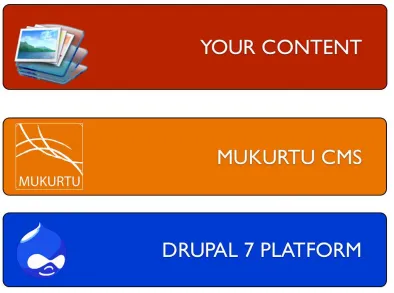
as a system with three layers: Drupal 7 is the bottom layer providing the scaffolding; in the middle, there is Mukurtu CMS providing the protocol-driven, sociocultural access levels; and on top, there is the specific community’s content.
Figure 1. Mukurtu CMS platform layers.
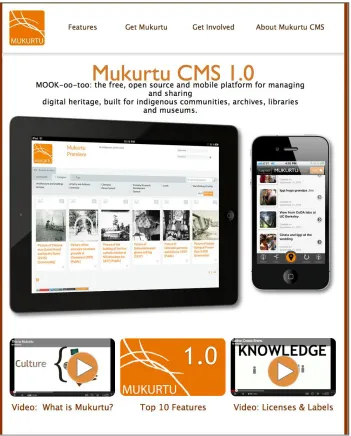
Figure 2. Mukurtu CMS homepage.
commercial-off-the-shelf and open source content management systems: 1) cultural protocols for content management, 2) granular level access parameters based on community protocols, 3) multiple and flexible licensing options, 4) extensive metadata fields to account for indigenous knowledge, and 5) built-in options for exchanging materials and metadata with other communities or institutions while maintaining community cultural protocols.
The crux of Mukurtu CMS is its emphasis on cultural protocols, both at a core level of its architecture and in all areas of its functionality. Working against either an open or closed option or the simple open-by-default framework found in most content management systems, Mukurtu CMS recognizes the granular level and socially malleable protocols that drive both access to and the circulation of cultural materials. That is, access based either on expansive parameters such as whether users are “friends,” or merely an on or off option for access cannot handle the mire of fine-grained and overlapping types of relationships that predicate access. For example, in the alpha version of the software, the Warumungu community managers at the Nyinkka Nyunyu Art and Culture Centre where the system was housed set out protocols based on family and place-based relations, followed by community status defined by peoples’ relations to both one another and traditional community knowledge. In practice, what this meant was that individuals self-identified within the system’s users database, and then the software pulled content that was matched to the person’s profile. A person could be a woman, from the Jones family, with relations to both the Patta and Parrta country. In the system, this person would be able to access only the content that was tagged with these same affiliations. These protocols flowed from the set of preexisting social norms concerning the creation, reproduction, and distribution of knowledge within the community.
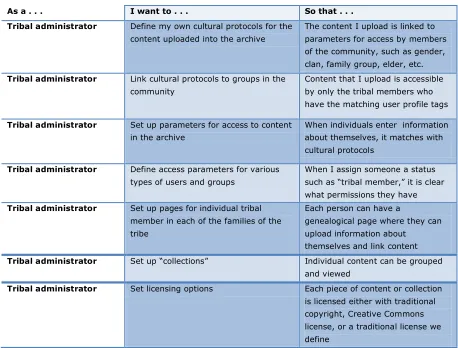
Scaling up the original system meant creating an adaptable, features-based platform that would allow any community to define and redefine their own access and circulation protocols based on their own cultural norms and priorities. Using interviews, face-to-face meetings, and case studies, we produced a set of community-driven narratives defined as “users stories” that drove our development.11
Table 1. User Story Narratives for Community Agile Development of Mukurtu CMS.
As a . . . I want to . . . So that . . . Tribal administrator Define my own cultural protocols for the
content uploaded into the archive
The content I upload is linked to parameters for access by members of the community, such as gender, clan, family group, elder, etc.
Tribal administrator Link cultural protocols to groups in the community
Content that I upload is accessible by only the tribal members who have the matching user profile tags
Tribal administrator Set up parameters for access to content in the archive
When individuals enter information about themselves, it matches with cultural protocols
Tribal administrator Define access parameters for various types of users and groups
When I assign someone a status such as “tribal member,” it is clear what permissions they have
Tribal administrator Set up pages for individual tribal member in each of the families of the tribe
Each person can have a
genealogical page where they can upload information about
themselves and link content
Tribal administrator Set up “collections” Individual content can be grouped and viewed
Tribal administrator Set licensing options Each piece of content or collection is licensed either with traditional copyright, Creative Commons license, or a traditional license we define
11 We used an “agile” software development method (http://www.agile-process.org/) and adopted it to our
These narratives form the basis for Mukurtu’s architecture. That is, we began from a radically different place than most content management systems or digital archive solutions. Instead of assuming that information wanted to or should be open, free, and available to “anyone with an Internet connection,” our development process emphasized the underlying sociality of information and its reliance on, and embeddedness within, ethical systems of relation and action in which people negotiate the creation, reproduction, and distribution of knowledge based on multiple and interrelated factors and situations. Beginning with the social life of information and the competing or overlapping circulation routes in which it moves, we sought to define and build a flexible tool whereby users would not have to give up on or erase their own knowledge systems in order to preserve, share, and manage their cultural heritage materials.
At its core, Mukurtu CMS allows for and is driven by relationships: community, individual, familial, clan, ancestral, etc. That is, the system takes as its philosophical and architectural starting points the already-existing social systems and information circulation routes of any given community. Mukurtu CMS allows users—from small community archives to tribal museums, to individual or family users—to infuse their voices, their cultural concerns, and their notions of sociality and historicity into the system. For as Helen Nissenbuam points out in her exhaustive study of privacy, “What people care most about is not simply restricting the flow of information but ensuring that it flows appropriately” (2010, p. 2). Perhaps restriction is the wrong word. Instead of making any type of access choice a negative, we might look at choices about circulation models as reflecting the diversity of peoples around the world—a diversity not to be celebrated in and of itself, but to be acknowledged within the spectrum of access models.
Copyright in the U.S. context has recently driven much of the dialogue about access, use, and “fair use.” Copyright is a particular social and legal solution to a tension between content creators, content consumers, and content distributers; it should not, however, be the benchmark for how we understand the range of possibilities for managing knowledge circulation (Boyle, 2008, pp. 2–5). Mukurtu CMS takes an agnostic view toward licensing that accounts for the diverse legal and social needs of indigenous communities globally as they manage and share their digital cultural heritage and knowledge with third parties. For any piece of content or collection, one can choose between traditional copyright, Creative Commons licenses, and our own traditional knowledge (TK) licenses and labels for any materials to be shared externally.12 This is key. Mukurtu’s protocols function internally, within the communities who use
Mukurtu based on their shared understandings of circulation. “Shared” does not, however, mean without deliberation or redefinition. Cultural protocols and practices are always and everywhere provisional and dynamic, not just within indigenous communities. Mukurtu CMS allows communities (however defined) to use protocols to decide on pathways for circulation within the system. Importantly, though, the TK license and label options within Mukurtu aim to answer the grassroots calls of individuals and communities who want to engage with a range of strategies to manage and maintain their cultural materials as these materials move out of their own communities to third parties. We developed the TK licenses and labels as a strategic solution to a very specific issue: the management of already-existing and circulating digital material, such as photographs, sound-recordings, films, and manuscripts that embody or represent traditional indigenous knowledge, cultures, and practices (Anderson & Christen, in press).
12 See http://www.youtube.com/user/mukurtu?feature=watch for a short introductory video:
Importantly, for a large portion of materials that are already in the public domain or owned by third parties, the TK label option takes the notion of fair use and extends it to illustrate culturally specific conditions of access and use for materials. In their 2011 book Reclaiming Fair-Use, Patricia Aufderheide and Peter Jaszi argue that fair-use offers an important component for ameliorating the harsh exclusions of copyright. It is precisely the built-in flexibility within the concept that allows for multiple interpretations of what constitutes fair-use to be developed. Further, they suggest that fair-use must, by definition, retain this flexibility, as social and cultural norms for what constitutes “fair” change over time and are often made in response to differently situated parties. The TK labels situate community-determined interpretations of what constitutes fair use at their core. They are adaptable and aim to be an educational and social “tag” informing people how materials should be used properly. The labels function to provide additional or missing information, and in doing so, they help users to make a more informed decision about the best and most appropriate way of using this material. At every step, Mukurtu CMS aims to integrate and promote not just a new way of archiving and sharing cultural materials, but also a new way of understanding the diverse modes of knowledge management that exist globally, systems that promote historically minded and culturally responsive technologies.
Slashdot <ending>
Clearly, Mukurtu CMS is not a DRM system in any sense. Contrary to the remarks on Slashdot that I quoted at the start of this article, the software neither locks anything up, nor closes anyone out. Mukurtu CMS provides software solutions that allow any community to define their own access parameters and protocols for sharing. These are all open, in the sense that the platform allows anyone who sets up an instance of Mukurtu CMS to constantly change, add, delete, and update their protocols, categories, and communities. In this way, the platform allows users—variously defined and self identified—to customize and adapt the system to their needs. Social networking sites are championed merely because they allow individual users to define who sees their posts or choose who can interact with them. Those who celebrate this functionality because it helps to ensure individual privacy are nonetheless confounded when an archiving and content management tool aimed at indigenous peoples incorporates access permissions for members of their own communities. The comments on Slashdot make it clear that the technology was not in question, but its application to specific communities: Individuals can make choices, but collectives, communities and groups are somehow suspicious.
In recent debates about digital technologies, access to the pubic domain, and privacy, there is a false choice between content creation and passive use; between open systems that promote democratic participation and closed systems that encourage oppression; between human beings as autonomous authors or communities as homogenous creators. What these arguments miss, when they move from a discussion of corporate attempts to control consumers to a consideration of smaller communities attempting to maintain, preserve, and protect cultural heritage materials, are the histories of exclusion and the present contexts of marginalization of indigenous peoples. We can recognize corporate greed in the expansion of copyright law without dismissing indigenous uses of access parameters and cultural protocols for information management within, between, and outside their dynamic and changing communities. We can create both movements and tools that allow for an expansive notion of openness and access, but do so without sacrificing diversity or appealing to universal goals and generalized needs.
References
Anderson, J. (2010). Indigenous knowledge/traditional knowledge and intellectual property. (Issues paper for the Center for the Public Domain, Duke University). Retrieved from
http://web.law.duke.edu/cspd/itkpaper
Anderson, J., & Christen, K. (in press). ‘Chuck a copyright on it’: Dilemmas of digital return and the possibilities for traditional knowledge licenses and labels. Museum Anthropology Review. Special Issue: Digital return: Indigenous knowledge and the circulation of culture, K. Christen, J. Bell, & M. Turin (Eds.).
Aufderheide, P., & Jaszi, P. (2011). Reclaiming fair-use: How to put balance back in copyright. Chicago: University of Chicago Press.
Barlow, J. P. (1994). Selling wine without bottles: The economy of mind on the global net. Retrieved from http://w2.eff.org/Misc/Publications/John_Perry_Barlow/HTML/idea_economy_article.html
BBC. (2008, January 29). Aboriginal archive offers new DRM. BBC Online. Retrieved from http://news.bbc.co.uk/2/hi/technology/7214240.stm
Boyle, J. (2002). Fencing off ideas: Enclosure and the disappearance of the public domain. Daedalus, 131(2), 13–25.
Boyle, J. (2008). The public domain: Enclosing the commons of the mind. New Haven, CT: Yale University Press. Retrieved from http://www.thepublicdomain.org/download
Boateng, B. (2005). Square pegs in round holes? Cultural production, intellectual property frameworks and discourses of power. In R. A. Ghosh (Ed,), CODE: Collaborative ownership and the digital economy (pp. 61–74). Cambridge, MA: MIT Press.
Brand, S. (1984). (Comments at the 1984 Hacker conference). Retrieved from http://www.rogerclarke.com/II/IWtbF.html
Burri-Nenova, M. (2008). The long tail of the rainbow serpent: New technologies and the protection and promotion of traditional cultural expressions. In C. Graber & M. Burri-Nenova, (Eds.), Intellectual property and traditional cultural expressions in a digital environment (pp. 205–236). Cheltenham, UK: Edward Elgar Press.
Carpenter, M. (2004). Intellectual property law and indigenous peoples: Adapting copyright to the needs of a global community. Yale Human Rights in Development Law Journal, 7, 51–78.
Chander, A., & Sunder, M. (2004). The romance of the public domain. California Law Review, 42, 1331– 1374.
Christen, K. (2008). Archival challenges and digital solutions in aboriginal Australia. SAA Archaeological Recorder, 8(2), 21–24.
Christen, K. (2009). Aboriginal business: Alliances in a remote Australian town. Santa Fe, NM: School of Advanced Research Press, Global Indigenous Politics Series.
Christen, K. (2011). Opening archives: Respectful repatriation. American Archivist, 74, 185–210.
Coombe, R. (2009). The expanding purview of cultural properties and their politics. Annual Review of Law and Social Sciences, 5, 393–412.
Cohen, J. (2006). Copyright, commodification and culture: Locating the public domain, in in the future of the public domain. In L. Guibault & B. Hugenholtz, (Eds.), The future of the public domain (pp. 121-166). The Hague: Klewar Law International.
Denning, D. (1990). Concerning hackers who break into computer systems. Proceedings of the 13th National Computer Security Conference, Washington, DC.
Dietrich, C., & Bell, J. (2011). Representing culture via agile collaboration. In G. Styliaras, D.
Koukopoulos, & F. Lazarinis (Eds.), Handbook of research on technologies and cultural heritage: Applications and environments (pp. 207-222). Hershey, PA.
Digital Planet. (2011, February 22). (Radio show episode). Retrieved from
http://www.bbc.co.uk/iplayer/episode/p00dt2rc/Digital_Planet_22_02_2011
Dommann, M. (2008). Lost in tradition? Reconsidering the history of folklore and its legal protection since 1800. In C. Graber and M. Burri-Nenova, (Eds.), Intellectual property and traditional cultural expressions in a digital environment (pp. 3–16). Cheltenham, UK: Edward Elger Press.
Gillespie, T. (2007). Wired shut: Copyright and the shape of digital culture. Cambridge, MA: MIT Press.
Ginsburg, F. (2008). Rethinking the digital age. In P. Wilson & M. Stewart (Eds.), Global indigenous media (pp. 287–306). Durham, NC: Duke University Press.
Hennessy, K. (2009, April). Virtual repatriation and digital cultural heritage: The ethics of managing online collections. Anthropology News, 5–6.
Hunter,,J., Schroeter,,R., Koopman,,B., & Henderson, M. (2004). Using the semantic grid to build bridges between museums and indigenous communities, pp. 46–61. Proceedings of the GGF11 Semantic Grid Applications Workshop.Honolulu, HI.
Hyde, L. (2010). Common as air: Revolution, art and ownership. New York: Farrar, Straus and Giroux.
Katz, J. (1997, April). The netizen: Birth of a digital nation. Wired. Retrieved from http://www.wired.com/wired/archive/5.04/netizen_pr.html
Leach, J. (2005). Modes of creativity and the register of ownership. In R. Ghosh (Ed.), CODE: Collaborative ownership and the digital economy (pp. 29–44). Cambridge, MA: MIT Press.
Lessig, L. (2004) Free culture: How big media uses technology and the law to lock down culture and control creativity. New York: Penguin Books.
Myers, F. (2005). Some properties of culture and persons. In R. Ghosh (Ed.), CODE: Collaborative ownership and the digital economy (pp. 45–60). Cambridge, MA: MIT Press.
Nissenbuam, H. (2010). Privacy in context: Technology, policy, and the integrity of social life. Palo Alto, CA: Stanford University Press.
Resta, P., Roy, L., De Montano, M. K., & Christal, M. (2002). Digital repatriation: Virtual museum partnerships with indigenous peoples (pp. 1482–1483). Proceedings of the 2002 International Conference on Computers in Education, Auckland, New Zealand.
Samuelson, P. (2006a). Enriching discourse on public domains. Duke Law Journal, 55, 783–834. UC Berkeley Public Law Research Paper No. 925052.
Samuelson, P. (2006b). Challenges in mapping the public domain. In L. Guibault and B. Hugenholtz, (Eds.), The future of the public domain (pp. 7–21). The Hague: Klewar Law International.
Scholar Works. (n.d.) Open access week@ umassamhurst. Retrieved from http://scholarworks.umass.edu/oa
Seeger, A. (2005). Who got left out of the property grab again: Oral traditions, indigenous rights, and valuable old knowledge. In R. Ghosh (Ed.), CODE: Collaborative ownership and the digital economy (pp. 75–84). Cambridge, MA: MIT Press.
Seltzer, W. (2008, January 11). Mukurtu contextual archiving: Digital “restrictions” done right. Legal Tags (blog post). Retrieved from http://wendy.seltzer.org/blog/archives/2008/01/11/mukurtu-contextual-archiving-digital-restrictions-done-right.html
Sherman, B., & Wiseman, L. (2006). Toward an indigenous public domain? In L. Guibault and B. Hugenholtz (Eds.), The future of the public domain (pp. 259–277. The Hague: Klewar Law International.
Slashdot. (n.d.) Aboriginal archive uses new DRM. Retrieved from
http://yro.slashdot.org/story/08/01/29/2253239/Aboriginal-Archive-Uses-New-DRM
Thompson, B. (2008, January 28). Locking down open computing. BBC Online. Retrieved from http://news.bbc.co.uk/2/hi/technology/7212803.stm
Titherington, S. (2011, March 29). Click and Digital Planet merge. BBC Online. Retrieved from http://www.bbc.co.uk/blogs/theeditors/2011/03/click_and_digital_planet_merge.html
United Nations. (n.d.) Who are indigenous peoples? UN Permanent Forum on Indigenous Issues. Retrieved from http://www.un.org/esa/socdev/unpfii/documents/5session_factsheet1.pdf
Vaidhyanathan, S. (2011). The googlization of everything and why we should worry. Los Angeles: University of California Press.
Verran, H., Christie, M., Anbins-King, B., van Weeren, T., & Yunupingu, W. (2007). Designing digital knowledge management tools with aboriginal Australians. Digital Creativity, 18(3), 129–142.
Wendland, W. (2008). It’s a small world (after all): Some reflections on intellectual property and