Chapter IV
LASER
Light Amplification by Stimulated Emission of Radiations
Lecture 4.4
Books:(1) Optics, 3
rdedition: Ajoy Ghatak, McGraw-Hill
Comapnies (chapter 23)
The first laser (solid state laser) to be operated successfully was the ruby laser which was fabricated by Maiman in 1960.
Ruby, which is the lasing medium, consists of a matrix of
aluminum oxide in which some of the aluminum ions are replaced by chromium ions. It is the energy levels of the chromium ions which take part in the lasing action.
The energy level diagram of the chromium ion is shown
in Fig.
As is evident from
figure this
The pumping of the chromium ions is performed with the help of flash lamp (e.g., a xenon or krypton flash lamp) and the chromium ions in the ground state absorb radiation around wavelengths of 5500 Å and 4000 Å and are excited to the levels marked E1 and E2.
The chromium ions excited to these levels relax rapidly through a non-radiative transition (in a time 10∼ –8–10–9s) to
the level M, which is upper laser level.
.
This phenomenon is known as spiking and can be understood as follows:
When the pump is suddenly switched on to a
value much above the threshold, the population inversion builds up and crosses the threshold value, as a consequence of which the photon number builds up rapidly to a value much higher than the steady-state value. Since the photon number
is higher than the steady-state value, the rate at which the upper level depletes (because of stimulated transitions) is
much higher than the pump rate. Consequently, the inversion becomes below threshold, and the laser action ceases. Thus the emission stops for a few microseconds, within which time the flash lamp again pumps the ground-state atoms to the
upper level, and laser oscillations begin again. This process
Thus the inversion goes beyond threshold when the
radiation density in the cavity builds up rapidly. Since
the inversion is greater than
threshold, the radiation density goes beyond the
steady-state value which in turn depletes the upper level
population and reduces the inversion below threshold.
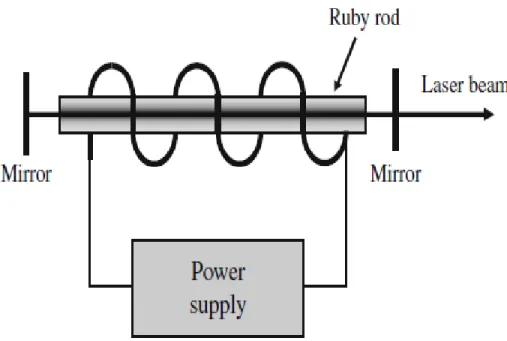
Figure shows a typical setup of a flash lamp pumped pulsed ruby laser. The helical flash lamp is surrounded by a cylindrical
reflector to direct the pump light onto the ruby rod efficiently.
The ruby rod length is typically 2–20 cm with diameters
In spite of the fact that the ruby laser is a three-level laser, it still is one of the important practical lasers. The absorption bands of ruby are very well matched with the emission spectra of
practically available flash lamps so that an efficient use of the pump can be made.
It also has a favourable combination of a long lifetime and a narrow line width.
The ruby laser is also attractive from an application point of view since its output lies in the visible region where photographic
He-Ne Laser:
The first gas laser to be operated successfully was the He–Ne laser. The pumping is usually done using a flash lamp
or a continuous high-power lamp. Such a technique is efficient if the lasing system has broad absorption bands.
In gas lasers since the atoms are characterized by sharp energy levels as compared to those in solids, one generally uses an electrical discharge to pump the atoms.
The He–Ne laser consists of a long and narrow discharge tube (diameter ~ 2–8 mm and length 10–100 cm) which is filled with helium and neon with typical pressures of 1 torr and 0.1 torr. The actual lasing atoms are the neon atoms and as we shall
Fig1.
The laser resonator may consist of either internal or external mirrors (see Fig).
Figure 2 shows the energy levels of helium and neon. When an electrical discharge is passed through the gas, the electrons which are accelerated down the tube collide with helium and neon
atoms and excite them to higher energy levels.
The helium atoms tend to accumulate at levels F2 and F3 due to their long lifetimes of 10∼ -4 and 5 × 10⁻⁶ s, respectively. Since the levels E4 and E6 of neon atoms have almost the same energy as F2 and F3, excited helium atoms colliding with neon
Transition between E6 and E3 produces the very popular 6328 Å line of the He–Ne laser. Neon atoms de-excite through spontaneous emission from E3 to E2 (lifetime 10∼ –8 s). Since this time is shorter than the lifetime of level E6 (which
is 10∼ –7 s) one can achieve steady-state population inversion between E6 and E3.
Level E2 is metastable and thus tends to collect atoms.
The atoms from this level relax back to the ground level
mainly through collisions with the walls of the tube. Since E2 is metastable it is possible for the atoms in this level to
absorb the spontaneously emitted radiation in the E3→E2 transition to be re-excited to E3. This will have the effect of reducing the inversion. It is for this reason that the gain in this laser transition is found to increase with decreasing tube
The other two important wavelengths from the He–Ne laser are 1.15 and 3.39 μm, which correspond to the E4→E3 and E6→E5 transitions. It is interesting to observe that both 3.39 μm and
6328 Å transitions share the same upper laser level.
Thus due to the very large gain, oscillations will normally tend to occur at 3.39 μm rather than at 6328 Å. Once the laser starts to oscillate at 3.39 μm, further build up of population in E6 is not possible. The laser can be made to oscillate at 6328 Å by either using optical elements in the path which strongly absorb
the 3.39 μm wavelength or increasing the line width through the
Zeeman effect by applying an inhomogeneous magnetic field across the tube.
Gas lasers are, in general, found to emit light, which is more directional and more monochromatic. This is so because of
the absence of such effects as crystalline imperfection, thermal distortion, and scattering, which are present in solid-state
Neodymium-Based Lasers: ND-YAG Laser:
The Nd:YAG laser (YAG stands for yttrium aluminum garnet
Which is Y3Al5O12) is a important
solid-state laser systems in which the energy levels of the neodymium ion take part in laser emission.
The laser emission occurs at λ0 ≈ 1.06 μm.
Since the energy difference between the lower laser level and the ground level is 0.26 eV, the ratio of its population to that of the ∼
ground state at room temperature (T= 300 K) is
.
Thus the lower laser level is almost unpopulated and hence inversion is easy to achieve.
The main pump bands for excitation of
the neodymium ions are in the 0.81 and 0.75 μm wavelength regions and pumping
Typical neodymium ion concentrations used are 1.38 × 10∼ 20 cm-3. The spontaneous lifetime corresponding
to the laser transition is 550 μs and the emission line corresponds to homogeneous broadening and has a width v 1.2×10∼ 11 Hz which corresponds to λ 4.5Å.∼
With the availability of high-power compact and efficient
semiconductor lasers, efficient pumping of Nd ions to upper laser level can be accomplished using laser diodes. This leads to very compact diode pumped Nd -based lasers.
Diode laser pumping is simpler than lamp pumping and also
produces much less heat in the laser medium leading to increased
overall efficiency. Since the laser diode output is narrow band unlike a normal lamp, the output at 808 nm can be efficiently used for
Typical output powers of 150 W are commercially available. In fact an intracavity second-harmonic generator can efficiently convert the laser wavelength to 532 nm (the second harmonic of 1064 nm of Nd:YAG) leading to very efficient green lasers.
Nd:YAG lasers find many applications in range finders, illuminators with Q switched operation giving about 10–50 pulses per second with output energies in the range of 100 mJ per pulse, and pulse width 10 ns. They also find applications ∼
In a CO2 laser one uses the transitions occurring between
different vibrational states of the carbon dioxide molecule.
Figure shows the
carbon dioxide molecule consisting of a central carbon atom with two oxygen atoms
attached one on either side. Such a molecule can vibrate in the three independent
modes of vibration shown in Fig.
These correspond to the symmetric stretch, the bending, and the asymmetric stretch modes. Each of these modes is characterized by a definite frequency of vibration.
According to basic quantum mechanics these vibrational
degrees of freedom are quantized, i.e., when a molecule vibrates in any of the modes it can have only a discrete set of energies. Thus if we call ν1 the frequency corresponding to the
Figure 2. shows the various vibrational energy levels taking part in the laser transition.
The laser transition at 10.6 μm
occurs between the (001) and (100) levels of carbon dioxide.
The excitation of the carbon dioxide molecules to the
long-lived level (001) occurs both through
collisional transfer from nearly resonant excited nitrogen molecules and also from the cascading down of carbon dioxide molecules
The CO2 laser possesses an extremely high efficiency of 30%. ∼
This is because of efficient pumping to the (001) level and also because all the energy levels involved are close to the ground level. Thus the atomic quantum efficiency which is the ratio
of the energy difference corresponding to the laser transition to the energy difference of the pump transition, i.e.,
is quite high ( 45%). Thus a large portion of the input power can ∼
Output powers of several watts to several kilowatts can be obtained from CO2 lasers. High-power CO2 lasers find
applications in materials processing, welding,
hole drilling, cutting, etc., because of their very high output
power. In addition, the atmospheric attenuation is low at 10.6 μm which leads to some applications of CO2
Semiconductor Laser:
The semiconductor or diode lasers are the smallest of all the known lasers; they have a size of a fraction of a millimeter. The laser consists of a semiconducting crystal, such as gallium
arsenide, lead selenide, etc, with parallel faces at the ends to serve as partially reflective mirrors.
A semiconductor, as the name implies, is half-way between a conductor and an insulator (non-metal), so far as its electrical conductivity is concerned.
The semiconducting materials containing gallium and arsenic compounds have been found to generate infrared rays when the current is passed through them. This implies that these
semiconductors convert electrical energy into photons. But, these were ordinary incoherent light rays and were not
However, when the gallium arsenide crystal is through it, the laser action does take place. Many semiconductors serve as laser
materials and they have been made to 'lase' under the
stimulation of electricity instead of light which is used for the other solid-state lasers.
There are two types of semiconductors, viz., n-type and p-type. To understand the functioning of these devices, it is necessary to know the nature of the electronic energy states in a
semiconductor. A typical semiconductor has bands of allowed energy levels separated by
In an intrinsic semiconductor, there are just enough
electrons present to fill the uppermost occupied energy band (valence band) leaving the next higher band (conduction
band) empty. In an n-type semiconductor, a small amount
of impurity is added intentionally so that the material is made to have an excess of electrons, which thus becomes negative. On the other hand, by adding a different type of
impurity in a p-type semiconductor, the material can be made to have an excess of holes
The photons travelling through the junction region stimulate more electrons during the transition, releasing more
photons in the process. The laser action takes place along the line of the junction. Due to the polished ends of the block, the stimulated emission grows
enormously and a beam of coherent light is emitted from one of the two ends gallium arsenide laser, a continuous beam of a few militates power is easily obtained.
The semi conducting lasers are also called junction lasers or junction diode lasers because they produce laser energy at the junction of two types of impurities in a semiconductor. They are also called injection lasers because electrons are injected into the junction
The semiconductor laser consists of a tiny block (about one square millimetre in area) of gallium arsenide (Fig). When the p- and n-type layers are formed in an intimate contact, the interface becomes a p-n junction. When direct current is applied across the block, the electrons move across the junction region from the n-type material to the p-type material, having excess of
holes. In this process of dropping of the electrons into the holes,
The semiconductor lasers, being simple in construction and light In weight with compact units and requiring little auxiliary equipment, are very suitable for applications where high powers are not
required. They are primarily used in the area of communication in which the near-infrared laser beams can be transmitted over long distances through low loss optical fibres. In addition, they have found a large market as reading devices for
Coherence Length:
Laser light is highly coherent.
Pure spectral line sources such as mercury and cadmium arcs
are less coherent than laser light but much more coherent than white light.
Coherence can be defined as the degree of stability of
phase of a wave (light wave in our case) both in space and in time.
By stability of phase in space we mean simply a fixed phase
relationship between two separate points on the wavefront,
The width of a spectral line is given by the width of the curve representing the line profile at half its maximum power—the so-called full-width-at-half-maximum (FWHM).
If we present this spectral width in terms of frequency by ∆v, then it can be shown that the coherence length LC of a given light source is
In terms of wavelength we can define the coherence length,
wavelength of given light
The coherence length of a light source can be thought of simply as the length of an uninterrupted wave train of light.
Thus, a highly coherent source that gives off light with no phase
change will produce a long wave train and will be characterized by a long coherence length.
A source that gives off short bursts of light, constantly interrupted by arbitrary and random phase changes, will produce short wave trains of light and, consequently, will be characterized as having a short coherence length.