ANALYTIC HIERARCHY PROCESS WHILE CHOOSING AUTHENTICATION
WITH RADIO FREQUENCY IDENTIFICATION (RFID) SYSTEMS
Mehmed Cihad Çağlayan, (MSc)
Istanbul Commerce University, Turkey
Mustafa Köksal, (PhD)
Istanbul Commerce University, Turkey
Abstract:
Nowadays, it cannot be thought that companies carry out their activities stand away from technology. Especially, with Fourth Industrial Revolution 4.0 (Industry 4.0) smart technologies has started to play big role in factories. One of the innovation of industry 4.0 is RFI technology, today used by various industries in multiple areas, and there are widespread researches about this subject thus aims that to improve these technologies one step further. Besides that, management of technology becomes more crucial from many points of view of companies. Inaccurate technology investment usually might cause loss for companies. In this context, in order to choose best RFID option with defined criteria, at a company in automotive sector where technological development is followed and implemented, hierarchical model is established and from based on this model analytical hierarchy process used and an application is carried out.
Keywords:
Energy, Energy Supply, Logistics
1.
Introduction
Usage of the Radio Frequency Identification Systems goes back to the years of 1940s; it is used to identifying live or ordinary objects with or without movement using radio frequencies. (Üstündağ, 2007, p.74) First active long range electromagnetic carriers were used on planes at the 2nd World War, for identifying allied and enemy planes (Landt, 2005, p.9). 1950’s can be determined as the year of discovery for RFID techniques. After reaching 1960s, many researchers and inventors worked on model systems and improved them. Sensor and control points “Electronic Article Surveillance” were released into the market to prevent certain commercial systems from being stolen.
In the year of 1970s, RFID applications are used for the purpose of identification more than inspection. RFID labels including integrated circuits are used for object tracking, object monitoring, identifying farm animals and monitoring them during the process of manufacturing (Üstündağ, 2008, p.9). Los Alamos Scientific Laboratory had become one of the leading centres with improving these RFID systems at the same years and developed a new tracking system to tracing nuclear materials.
Now seen as the technology of our day(with the 4th industry revolution), RFID Technologies gained more importance and with increasing interest at the business world, academic studies have become more common. Özmen and Birgün, in a study they conducted, taking the current state Air Forces Command implementation system following technological developments closely into consideration, while choosing a RFI D system, created a model for the purpose of choosing the most suitable RFID and a new application using Analytic Hierarchy Process (AHP) while taking investment criteria and supplier criteria into consideration (Özmen and Birgün, 2011, p.81).
In a study conducted by Chow, Choy, Lee and Lau, for storage operations, resource management situation focused RFID design was considered on a preferential basis, a new RFID focused resource manage system was presented that might help choosing the right appropriate resource usage package and at the same time give bonuses on time and on a financial approach (Harry and King, 2006, p.561).
Sounderperdian, Boppana and Chalasani, to the model that they created; taking application, label reading, communication network and other infrastructure costs into consideration, under the costs -benefits relationship, analysed RFID applications in the retail sector (Sounderpandian, 2007, p.107).
Erkan and Can in their studies, mentioned the benefit obtained by using barcodes and RFID, using Analytic Hierarchy Process and Fuzzy AHP methods they chose the most appropriate system amongst the RFID systems for data storing and gathering system. Criteria that effected the decisions are determined to be: costs, functionality, sustainability and performance (Erkan and Can, 2014, p.87).
Cebeci and Kılınç, in their studies, using AHP method, conducted a study that focused on a choosing an RFID system for a company that operates in the glass industry. In their studies, while there are many RFI D applications, this decision was seen to be very critical due to technological investment adaptation and high cost risks and because of this, they chose the most appropriate RFID system by using multiple criteria decision making approach.
Studies in literature about choosing RFID show that, RFID technology have superior qualities compared to other identification systems. The feature that makes this technology more important is, it having the capacity to perceive. As the last years improving technology RFID, with increasing demand caused a rise in the amount of antenna and system supplier and at the same time helped reduce investment costs. On the other hand, companies planning to make RFID come to life faced different alternatives. In this context, choosing the right system for users have become important and benefiting from an analytic system while doing so became a necessity. Used in a wide field and as a method for choosing the best alternative from choosing Analytic Hierarchy Method supplier to RFID systems.
2.RFID Technology
RFID, with the simplest explanation, is a system that delivers information about the object using radio frequencies. Information that is affixed on the object is saved with an electronic label and when required, information is transferred to a reader. (Fesçioğlu, Choi and Sheen, 2014, p.1369)
Figure 1. RFID system [11]
As a revolutionary information transfer system, RFID technology provides that every object is identified as being tagged with only one label automatically, be tracked and monitored. Data and energy transfer occurs without any contact between the label and the reader. For the information to be transmitted between RFID label and the reader, both system components create separate different radio waves. All labels at the same radio frequency clearance, receives the signals sent by the reader with the help of the antenna, solves the signal received in the form of code with the help of the reader labelling antenna and transfers that as data to the computer.
Components that create a RFID system aremade of 6 basic components as given below (Erkan and Can, 2014, p.89):
Tag, label
Reader
Antenna
Integrator
Controller
Special Software
Figure 2. RFID Labels (A. Zircanavo, "zircanavo-abyss.blogspot.d," [Online]. Available: http://zircanavo-abyss.blogspot.de/2015_05_01_archive.html.)
Readers, receives the signals sent by the labels and turns signals received as codes into data by the reader. It can either be stationary or hand-held in types and its components are the same.
Antenna is the device that spreads the radio signals produced by the reader. It can be mounted to be used in different ways at the storage entrances, on-site carriers, on the route determined on-site with a portal structure. For the antenna to work properly, most important factors are the reading antenna and the label antenna having the same polarization. Otherwise it causes signal loss and reduces the reading range. (Üstündağ, 2008, p.29)
RFID Software is a component that helps turn the data exchange between the label and the reader into meaningful information, keeping this data and print it out.
Benefits that come with using RFID technologies are, for real timed information to reach employees, reaching close to actual stock number values and connected to this, having the right amount and time for the orders.
On a business that manufactures with traction system, by providing visibility and real time data, overproduction for the subcomponents is another one of the benefits that are expected with using RFID. By doing so, costs, quality and delivery triangle can occur as expected.
3. Analytic Hiearchy Process
Analytic Hierarchy process is one of the important techniques used on making decisions with multiple criteria, developed by Thomas Saaty L. SAATY at the year of 1997 (Erkan and Can, 2014, p.87-93). Problems in complex state are turned into simple, useful and understandable state by turning them into hierarchic structures with AHP method. For AHP management to take qualitative and quantitative characters into consideration, is one of the main preferential reasons for them to be used in multiple criteria decision making problems.
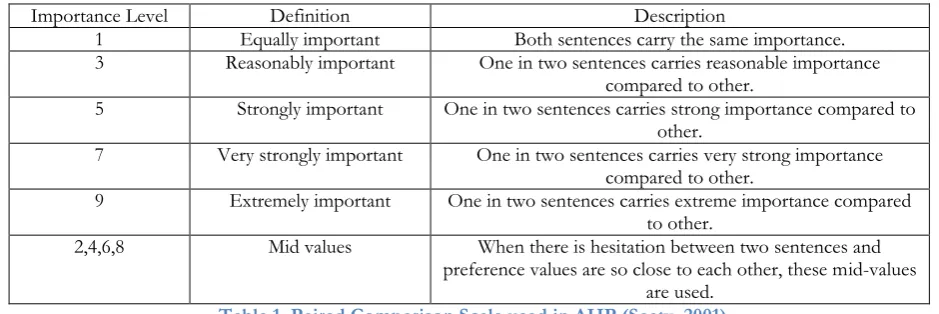
In AHP method, identifying the problem is the first step. Following the identification of the problem, using AHP method, every level can be turned into a hierarchic structure consisting of certain criteria. Paired comparisons are what make AHP’s building blocks. In order to obtain paired comparisons, relative and absolute measurements are used. While doing paired comparisons, paired comparison scaled suggested by Saaty is used. It is shown at Table1.
Importance Level Definition Description
1 Equally important Both sentences carry the same importance. 3 Reasonably important One in two sentences carries reasonable importance
compared to other.
5 Strongly important One in two sentences carries strong importance compared to other.
7 Very strongly important One in two sentences carries very strong importance compared to other.
9 Extremely important One in two sentences carries extreme importance compared to other.
2,4,6,8 Mid values When there is hesitation between two sentences and preference values are so close to each other, these mid-values
are used.
Table 1. Paired Comparison Scale used in AHP (Saaty, 2001)
Importance level, as shown at the table, is from 1 to 9. At the bottom of the table are the values of 2,4,6,8 mid-values. For example, if the decision maker hesitates between 5 and 7, it can use 6 from the table.
These criteria are then divided into sub criteria. To the bottom step, evaluated options are entered. By doing so, for a hierarchic structure to be formed and necessary criteria to be established, system as a whole, its components and their relations between each other should be monitored carefully.
After creating the model, next process is, determining the relative weight of the factors at the same hierarchy level. Same process is done by paired comparisons for the criteria at the sub level.
At the next step of AHP, comparison matrixes are created. Comparisons are done in accordance with choosing which criteria are superior compared to the other.
Relative weight of the criteria is obtained by taking eigenvector of the comparison matrix and normalizing it. (Madlberger, 2009, p.4)
While decision makers are doing paired comparisons between the criteria, in order to measure if they are consistent or not, Consistency Ratio (C.R) must also be calculated. In this calculation, assuming n is the amount of criteria; depending on that amount random index numbers are used. If the value at the end of the calculations reaches below 0.10, comparison matrix is deemed to be consistent. Otherwise comparison matrix should be corrected again (Rao, Chandran, 2009, p.2).
Last step for AHP is multiplication of the importance weight of the criteria and alternatives importance weight and having a priority level for each alternative. Sum of these values are equal to 1. Highest valued alternative is the best alternative for the decision problem.
4. Choosing RFID Systems with AHP Method
After deciding to use AHP method, at the first step, hierarchic model related to the problem was established, firstly aim of the study, then alternatives to it, main criteria and sub criteria are determined.
Purpose of this study is to obtain a more realistic data in logistics and manufacturing planning departments and actualize this using the best RFID system choice.
After determining the target, RFID system alternatives are determined with the steps following main and sub criteria. RFID system alternatives are determined to be as X,Y,Z systems, main criteria are determined to be; RFID System properties, Investment Criteria and Business Criteria and the following sub criteria is mentioned at the following step.
RFID System Properties:
o Label Features (LF): One of the essential reasons for failure in RFID applications is choosing the wrong label or not using the right label in the right manner.
o Antenna Performance (AP): Importance for the reader and label antenna having the same polarization is significantly high. Otherwise, antenna having different polarizations will cause signal loss and a reduction with the reading range.
o Working Frequency (WF): Working frequency factor that effects data transfer speed, reading range, single or multiple reading is one of the most important factors. In accordance with the frequency types, there are possibilities to use it in different fields.
o Flexibility (FLEX): Taking improvements in the future into consideration, system that needs to be established parallel to upcoming demand should be open to innovation.
o Crosstalk Integration Feature (CRS): is a software that is used for purposes that are important in internet with tracking and monitoring visualization Crosstalk, IoT (Internet of Things) and it carries an importance to evaluate the data received from RFID devices.
o Working Environment (WE): Temperature, steam, humidity, used chemicals might cause labels to
lose their features.
o Easy integration with SAP (SAP): Simple Integration of the RFID devices used by the company
with ERP (Enterprise Resource Planning) is also another criteria that evaluators give importance to.
Investment Criteria
o First Investment Cost (FIC): Total costs of the first investment and if consultancy service is taken, it is added to the cost of investments.
o Enterprise Costs (EC): During the adaptation period after the system is installed, all costs that might occur and adding monthly network service costs provided by the central information processing unit to it.
o Depreciation/Life (AMOR): Businesses use their purchased fixed assets that they use for more than a year in normal circumstances. For this reason, fixed assets should be written as costs for its whole economic life.
Operating System:
o Answering Customer Demands (ACD): Properties of the RFID device determined by the
o Compliance with Company Strategies/New Solutions (CCS): The device needs to be suitable for the changes in the direction of the strategies of the company and new improvements.
o Easy Installation (EI): Installed RFID system should also be understood easily by the users (user-friendly).
o Released by the Company (FC): For some companies to use this device within the company, central units should give freedom to use for its usage. Devices determined for evaluation has freedom of use given by the company.
In the subject of RFID, important criteria about choosing RFID was determined with competent individuals and doing a survey evaluation on the criteria at the next step, it was evaluated with prioritized important criteria once more and it was deducted that, as seen in Graph 1, using devices with “Power Ethernet Input” does not create much added-value compared to other criteria and it was removed from the criteria of choice.
Main and sub criteria that will be studied on took its shape as shown at Figure2. Established paired comparisons, again by competent people on the subject of RFID systems, was evaluated with the priority scale support as pushed forward by Saaty.
In order to calculate the priorities, provision values at the paired comparison matrix were exported to Microsoft Excel file and results were tried to be obtained.
5.Application
Based upon the created pairwise comparison matrixes, the main criteria the pairwise comparison matrixes were assessed by experts of RFID subjects and the importance levels in comparison to each other were established. Completely independent assessment from each other during the creation of pairwise comparison matrixes were requested, formulating each pairwise matrix created by decision makers in Microsoft Excel and presenting the results in the table.
Table2. Randomness Indicators
n 1 2 3 4 5 6 7 8 9 10 11 12 13 14 15
RI 0 0 0,58 0,90 1,12 1,24 1,32 1,41 1,45 1,49 1,51 1,54 1,56 1,57 1,59
Reference: Karagiannidis et al., 2010:225; Wang et al., 2010:1024 Table3. Pairwise comparison matrix according RFID System Properties criteria
RFID System Properties X Y Z
X 1 0,2 0,5
Y 5 1 3
Z 2 0,333333333 1
RFID System Properties X Y Z Importance Level
X 0,13 0,13 0,11 0,12
Y 0,63 0,65 0,67 0,65
Z 0,25 0,22 0,22 0,23
Total 1,00 1,00 1,00 1,00
3 Vector Readings Weighted Total Lamda Lamda Max Consistency Index Consistency Ratio
X 0,3667 3,0013
3,0037 0,0018 0,0032 Consistent
Y 1,9485 3,0071
Z 0,6902 3,0026
Three alternative companies established within the hierarchy according to the importance level scale recommended by Saaty at second step.
In the comparison conducted according to RFID System Properties criterion, the assessment was done based on the designated sub-criteria such as tag properties, antenna performance, operation frequency, flexibility… etc, and the Table3 according to those are given above.
Table4. Pairwise Comparison Matrix according to Investment Criteria
Investment Criteria
X Y Z
X 1,00 0,33 2,00
Y 3,00 1,00 3,00
Z 0,50 0,33 1,00
Column Totals 4,50 1,67 6,00
X Y Z Importance Level
X 0,22 0,20 0,33 0,25
Y 0,67 0,60 0,50 0,59
Z 0,11 0,20 0,17 0,16
3 Vector Readings Weighted Total Lamda Lamda Max Consistency Index Consistency Ratio
X 0,7667 3,0441
3,0539 0,0270 0,0465 Consistent
Y 1,8222 3,0943
Z 0,4815 3,0233
In the comparison done on investment criterion, the assessment was conducted taking sub-criteria such as investment cost, operation cost and depreciation factors into account, then presented in Table 4 above.
Table5. Pairwise Comparison Matrix according to Operation Criteria
Operating Criteria
X Y Z
X 1,00 2,00 1,00
Y 0,50 1,00 1,00
Z 1,00 1,00 1,00
Column Totals 2,50 4,00 3,00
X Y Z Importance Level
X 0,40 0,50 0,33 0,41
Y 0,20 0,25 0,33 0,26
Z 0,40 0,25 0,33 0,33
Total 1,00 1,00 1,00 1,00
3 Vector Readings Weighted Total Lamda Lamda Max Consistency Index Consistency Ratio
X 1,2611 3,0676
3,0537 0,0268 0,0463 Consistent
Y 0,7944 3,0426
Z 1,0000 3,0508
According to the obtained results, the preferred devices are; Y RFID device according to RFID System Properties, Y RFID device according to Investment Criteria and X RFID device according to Operation criteria. The consistency ratios of the created matrixes were calculated simultaneously and all readings were observed below 0,10.
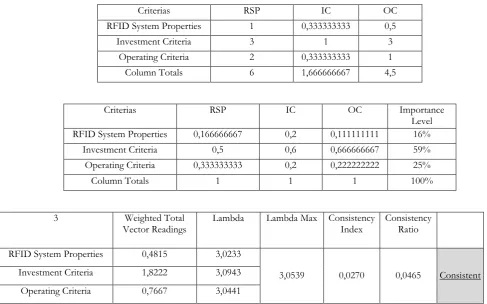
The fourth step in AHP is assessment of established criteria for RFID device selection and calculation of the priority values for each criterion. The matrix for this comparison is given below at Table 5 with the systematic constructed at Microsoft Excel like the previous matrixes.
Table 6. Pairwise comparison matrix according to the main criteria
Criterias RSP IC OC
RFID System Properties 1 0,333333333 0,5
Investment Criteria 3 1 3
Operating Criteria 2 0,333333333 1
Column Totals 6 1,666666667 4,5
Criterias RSP IC OC Importance
Level
RFID System Properties 0,166666667 0,2 0,111111111 16%
Investment Criteria 0,5 0,6 0,666666667 59%
Operating Criteria 0,333333333 0,2 0,222222222 25%
Column Totals 1 1 1 100%
3 Weighted Total
Vector Readings Lambda Lambda Max Consistency Index Consistency Ratio RFID System Properties 0,4815 3,0233
3,0539 0,0270 0,0465 Consistent
Investment Criteria 1,8222 3,0943
Operating Criteria 0,7667 3,0441
According to the obtained values, the primarily prioritized criterion is investment criterion with %59, Operation Criterion with %25 and RFID System Properties with %16.
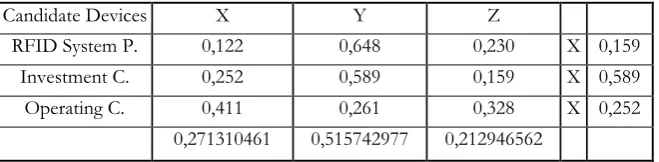
Table 7. Main criterion values and multiplication table of device readings
Candidate Devices X Y Z
RFID System P. 0,122 0,648 0,230 X 0,159
Investment C. 0,252 0,589 0,159 X 0,589
Operating C. 0,411 0,261 0,328 X 0,252
0,271310461 0,515742977 0,212946562
6.Conclusion and Evaluation
The utilization of RFID systems at production sites of the companies allows the production flow to become more transparent, in turn showing very close readings of actual physical quantities to the raw material and semi-finishing amount. However by using RFID, physical inventory and reduced inventory on the system can prevent extra costs that can occur with emergency orders.
This study recommended the AHP model to solve the RFID device selection problem; the sub-criteria under the main criteria are established by experts and assessed via a subjective approach. In studies on RFID technologies, it may be advisable to develop the hierarchical structure proposed in this study and based on the specified RFID implementation project phases, so that verbal indicators can be measured as numerically as possible.
How to apply AHP to RFID device selection problem and how to include a multitude of application criteria to the selection problem are shown in this paper. The values of the three determined devices were found as; 0,2713 for X device, 0,5157 for Y device and 0,2129 for Z device. As it can be inferred from these values, the device priority and importance values are very important in system selection. In this context, it is doubly important to focus on the device with the highest calculated importance level.
References
A. Kavas, (2007). Radyo Frekansı ile Tanımlama Sistemleri, Yıldız Teknik Üniversitesi Elektrik-Elektronik Fakültesi Mühendisliği Dergisi, pp.74-80.
J. Landt, (2005). The History of RFID, IEEE Potentials, p.9.
A. Üstündağ, (2008). RFID ve Tedarik Zinciri, İstanbul: Sistem Yayıncılık.
A. Üstündağ, (2008). Pazar ve Sektörel Uygulamalar, RFID ve Tedarik Zinciri, İstanbul: Sistem Yayıncılık. G. Özmen and S. Birgün, (2011). Radyo Frekansı ile Tanımlama Sistemi Seçiminde Analitik Hiyerarşi Prosesi
Uygulaması, Havacılık ve Uzay Teknolojileri Dergisi, Vol.5, no.1, pp.81-88.
C. Harry, C. L. King, L.B.W. and K. C. Lau, (2006). Design of a RFID case-based Resource Management System for Warehouse Operations, ELSEVIER, pp.561-576.
Sounderpandian, R.V. Boppana and S. Chalasani, (2007). Models for Cost-Benefit Analysis of RFID Implementations in Retail Stores, IEEE SYSTEM JOURNAL, Vol.1 pp.107-114.
T. E. Erkan and G. F. Can (2014). Selecting Best Warehouse Data Collecting System by Using AHP and FAHP Methods, Tehnički Vjesnik, vol. 21, no. 1, pp. 87-93, 2014.
U. Cebeci and S. Kılınç, Selecting RFID Systems for Glass Industry by Using Fuzzy AHP Approach," Department of Industrial Engineering.
D. J. Glasser and N. G. Goodman, (2007). "www.intechopen.com," Ethical Challenges for Radio Frequency Identification. Ethics and Information Technology. [Online]. Available:
http://www.intechopen.com/books/designing-and-deploying-rfid-applications/rfid-middleware-design-and-architecture.
T. E. Erkan and G. F. Can, (2014). Selecting the Best Warehouse Data Collecting System by Using AHP and FAHP Methods, Tehnicki Vjesnik, p.89.
A. Zincanova, (2015) "zircanavo-abyss.blogspot.d," [Online]. Available: http://zircanavo-abyss.blogspot.de/2015_05_01_archive.html.
A. Üstündağ, (2008).Radyo Frekanslı Tanıma (RFID) Teknolojisi,RFID ve Tedarik Zinciri, İstanbul, Sistem Yayıncılık, 2008, p. 29.
T. L. Saaty, (2001). Fundamentals of Decision Making and Priority Theory," Pittsburgh, RWS Publications. M. Madlberger, (2009). A Model of Antecedents of RFID Adoption Intention in the Supply Chain," in Proceedings of
the 42nd Hawaii International Conference on System Sciences, The Institute of Electrical and Electronics Engineers, Hawaii. K. S. Rao and K. R. Chandran, (2009). New and Efficient Data Warehousing Algorithm for Multi-level RFID
Readers, International Advance Computing Conference, The Institute of Electrical and Electronics Engineerings.
![Figure 1. RFID system [11]](https://thumb-us.123doks.com/thumbv2/123dok_us/279427.2024910/3.595.100.473.246.362/figure-rfid-system.webp)
![Figure 2. RFID Labels (A. Zircanavo, "zircanavo-abyss.blogspot.d," [Online]. Available: http://zircanavo-abyss.blogspot.de/2015_05_01_archive.html.)](https://thumb-us.123doks.com/thumbv2/123dok_us/279427.2024910/4.595.152.442.142.362/figure-zircanavo-zircanavo-blogspot-available-zircanavo-blogspot-archive.webp)