Attribute based coding, review and gap analysis of cotton
harvesting processes and machines
S. S. Kohli
1, Karun Sharma
2*, Manjeet Singh
2, Ankit Sharma
2, P. K. Mishra
2(1. Director and Scientist-F, Department of Science and Technology (DST), New Delhi, India;
2. Department of Farm Machinery and Power Engineering, Punjab Agricultural University, Ludhiana, Punjab, 141004.)
Abstract: Mechanical cotton harvesters, i.e. strippers and pickers are commercially available, but these cannot be used for cotton harvesting from varieties presently grown in India due to design constraints and agronomic practices. Higher initial cost and field capacity make cotton harvesters unsuitable and unaffordable for small and medium farms. Hence, a comprehensive review of cotton harvesting mechanisms developed till date was carried out. Under the study, different types of crop and machine attributes were identified and expressed in matrix form which could be utilized by researcher For the development and refinement of mechanical cotton harvesters for small and medium farms. The matrix depicts on academic work of each paper and each attribute and coding/grading of attributes was done as per their importance in the research publications. Summation of coded attributes was done publication-wise as well as category-wise so that the value of each attribute and each publication gets identified for the development of a need based mechanical cotton harvester. Attribute coding was assigned in two category i.e. publication wise and category wise. A total of 19 publications with 21 attributes were reviewed and related with the mechanical cotton harvesters and assigned a score 105. Under the category-wise attribute coding, attributes such as crop variety, yield, row spacing, plant height and plant population were considered and assigned grade more than 20 as most of the authors discussed these attributes in their studies. Other parameters like limb length, plant canopy (spread width) along and across the rows, height of lower and upper boll were accorded less importance as their grade was less than 10 out of a total 95 score. Defoliant attributes were discussed in 14 out of 19 papers reviewed and had 28 grade points as compared to desiccant, which was discussed in only 2 papers and assigned a grade of 5 only. Under the machine parameters, type of mechanism was assigned a grade point 66 as mechanical harvester performance was mainly dependent on this attribute.
Keywords: Cotton harvester, crop parameters, machine parameters, attributes coding
Citation: Kohli, S. S., K. Sharma, M. Singh, A. Sharma, and P. K. Mishra. 2015. Attribute based coding, review and gap analysis of cotton harvesting processes and machines. Agric Eng Int: CIGR Journal, 17(3): 120-127.
1 Introduction
1Cotton is cultivated in tropical and subtropical
countries, namely China, USA, India, Pakistan,
Uzbekistan, Turkey, Brazil, Greece, Egypt and Argentina.
These countries with temperatures ranging between 11°C
and 40°C contribute about 80% of the global cotton
production (Anonymous, 2010). Major crop production
operations for cotton include field preparation, planting,
weed control, spraying, picking and stalk uprooting.
Amongst all cotton picking is the most difficult, tiresome
Received date: 2015-04-06 Accepted date: 2015-07-24
*Corresponding author: Karun Sharma, Research Associate, Dept. of Farm Machinery and Power Engineering, PAU, Ludhiana, Punjab, 141004, E-mail:[email protected]
and tedious job. The labour requirement for cotton
picking is reported to be about 500 man h/ha. It was not
only tedious but also ten times costlier than irrigation and
about twice more costlier than the weeding operation
(Prasad and Majumdar, 1999). A grown up person can
pick about 15-20 kg/day of seed cotton, compared to an
average pick of 870-2180 kg/day by a single row spindle
type picker (Sandhar, 1999).
Cotton is mostly picked manually in most of the
developing countries. In advanced countries like USA,
Australia, Brazil and Russia, cotton picking is carried out
mechanically by cotton pickers (the most commonly used
machines) or cotton strippers. In India too, harvesting of
cotton is done manually and cost of cotton harvested by
Hence, there is an urgent need to develop a suitable
cotton harvester for small and marginal farmers in India.
Hence an exhaustive review of available cotton
harvesting machines and equipment was carried out.
The objective of this paper is to code the important
attributes of crop and machine performance and to help
the researchers, engineers and manufacturers in the
development of a suitable mechanical cotton harvester.
The crop and machine performance attributes of
mechanical cotton harvesters developed with different
mechanisms have been reviewed in this paper. Coding of
different attributes of crop and machine performance
showed the values of attributes range as well as the
importance in the research publications.
2 Material and methods
2.1 Identification of attributes
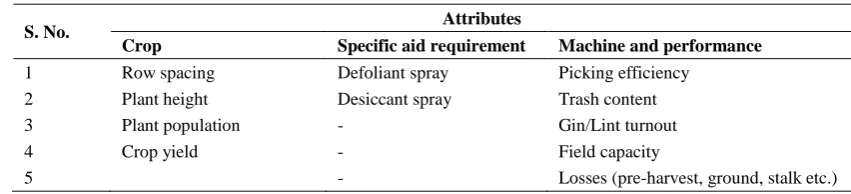
Different attributes were identified under three
categories viz. 1) crop attribute which includes row
spacing, plant height, plant protection, crop yield; 2)
specific requirement of harvesting aid like defoliant and
desiccant spray; 3) Machine and performance attributes
like picking efficiency, trash content, gin turnout, field
capacity, losses etc. as shown in Table 1. These attributes
are discussed briefly in the paragraphs as follow.
2.1.1 Attributes of cotton crop and agronomic practices
Crop attributes which affect the performance of a
harvesting machine include row spacing, plant height,
plant population and crop yield. These attributes are
discussed in this section and coding of these attributes is
done as per importance in their respective research study.
2.1.2 Attributes of specific requirement of harvesting aid
These include defoliant, desiccants and other
chemicals used in crop production to accelerate the
preparation of crops for mechanical harvesting. Farmers
use chemicals to enhance harvesting efficiency,
minimize lodging, trash and lint staining and control
insect population which is desirable by crop variety.
2.1.3 Attributes of machine and its performance
Machine and its performance include attributes
related to cotton harvesting machines i.e. harvesting
mechanism, picking efficiency, field capacity, different
types of Losses, gin or lint turnout and trash content. The
coding or grading of attributes is done as per their
importance and used by the authors during their study on
mechanical cotton harvesters. The coding/grading of crop
and machine parameters established from the publication
may be used into the design and development of the local
mechanical cotton harvester for Indian conditions.
There were three main causes such as crop, specific
requirement of harvesting aid and machine &
performance attributes which contributed in effect to the
mechanical cotton harvester. Under the crop attributes,
crop variety, row spacing, plant population and crop yield
put the major impact on the cotton harvesters rather than
the other crop parameters like plant height, plant canopy
spread along and across the row and limb length have
been discussed further in results and discussion. Specific
requirement of harvesting aid was another cause covered
the defoliant and desiccant as its attributes which affect
the picking efficiency of cotton harvester. Machine
attributes such as harvesting mechanism, picking
efficiency and trash content were the important attributes
which influenced the performance and development of
cotton harvester. The other attributes such as field
Table 1 Identification of different attributes
S. No. Attributes
Crop Specific aid requirement Machine and performance
1 Row spacing Defoliant spray Picking efficiency
2 Plant height Desiccant spray Trash content
3 Plant population - Gin/Lint turnout
4 Crop yield - Field capacity
capacity, field losses and gin/lint turnout influenced the
mechanical performance of cotton harvester.
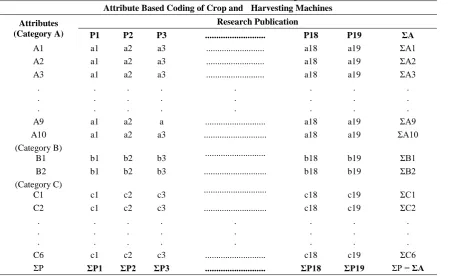
2.2 Matrix identification
A matrix is identified to express the importance of
each attribute in the reviewed paper is given in Table 2.
Summation of codes/grades has been done category-wise
as well as publication-wise so that the importance of each
attribute and every publication can be identified for the
development of mechanical cotton harvester. The
attribute grading/coding was generated in terms of
numerical values from 1 to 5 and the attribute having
code/grade close to 5 considered as the important
attribute for further studies and development of
mechanical cotton harvester. The grading /coding of
each parameter is given as per the importance given and
discussed in each paper reviewed. In this attribute coding
based review study, total 19 papers are reviewed and all
attributes are divided in three main categories i.e. crop
parameters, specific requirement of harvesting aid and
machine mechanism and its performance parameters.
2.3Rank distribution of attribute coding
Coding of attributes had been done as per their
importance in the research work. The highest numeric
grade points i.e. 5 points were decided to observe the
importance of attribute and distribution of rank to the
attribute was observed by the degree of closeness to that
highest grade points in the research work conducted by
researchers. The more the degree of closeness of
attribute to the highest grade points the more rank was
awarded to that attribute. Table 3 shows the rank
distribution of attribute coding as per their importance in
the conducted research work.
Table 3 Rank distribution of attribute coding
Sr. No. Attribute coding Rank
1 5 Excellent
2 4 Very good
3 3 Good
4 2 Average
5 1 Poor
The attribute awarded with 5 grade points was
ranked excellent because the attribute was discussed
thoroughly in the study with the help of graph, table and
text discussion and also explained its effect on the
performance of cotton harvester. Attribute carried 4
points was ranked under very good category. The reason
for awarding 4 grade points to the attribute was that that
the author had discussed different aspects such as text
Table 2 Matrix for different attributes of crop and machine
Attribute Based Coding of Crop and Harvesting Machines Attributes
(Category A)
Research Publication
P1 P2 P3 ... P18 P19 ΣA
A1 a1 a2 a3 ... a18 a19 ΣA1
A2 a1 a2 a3 ... a18 a19 ΣA2
A3 a1 a2 a3 ... a18 a19 ΣA3
. . . . . . . . . . . . . . . . . . . . . . . .
A9 a1 a2 a ... a18 a19 ΣA9
A10 a1 a2 a3 ... a18 a19 ΣA10 (Category B)
B1 b1 b2 b3 ... b18 b19 ΣB1 B2 b1 b2 b3 ... b18 b19 ΣB2 (Category C)
C1 c1 c2 c3 ... c18 c19 ΣC1
C2 c1 c2 c3 ... c18 c19 ΣC2
. . . . . . . . . . . . . . . . . . . . . . . .
C6 c1 c2 c3 ... c18 c19 ΣC6
description, data measurement and explanation with the
help of table formation, observations of data and effect
of that attribute on machine and other attributes in the
research work. Attribute having 3 grade points
represented the good rank. Under this category, the
author had discussed the attribute in textual form as well
as the data for that attribute was also measured but effect
of the attribute was not discussed in the conducted study.
Attribute coding 2 discussed and explained in the textual
form but no physical data was recorded regarding this
hence this attribute was come under the average rank
category. Under the poor rank carried 1 grade point only,
author had mentioned only the name of the attribute
without explaining its function and effect on the machine
and other attributes.
3 Results and discussion
3.1 Category-wise attribute coding
Different attributes relating to harvesting machine as
well as the resultant performance are discussed in detail
as below;
3.1.1 Crop attributes
Among all the attributes discussed under this
category, crop variety, yield, row spacing, plant height
and plant population received grades more than 20. But
crop variety was discussed and given importance by all
the papers reviewed and total grade points for this
attribute was highest i.e. 59 among all the attributes due
to its importance in the development of mechanical
harvester. It has been observed from the review that the
mechanical harvester need particular varieties that
should be semi dwarf, determinant and single
mono-poded. Second most important attribute was crop
yield which again dependent on crop variety. It indicated
that when researchers studied the effect of variety on the
performance of mechanical harvester, then yield is also
equally important for that particular variety. As far as
agronomic parameters like row spacing, plant population
and plant height are concerned; some of the authors have
given importance to these attributes but some of the
authors have not considered these parameters in their
studies. As row spacing and plant population are again
correlated with each other, hence in many of research
papers, in which crop spacing was discussed, the plant
population was not considered a parameter. Plant height
is also an important parameter for the performance of a
mechanical harvester as this parameter was discussed in 11 papers out of 19 papers and it’s having attribute
coding 27.
Other parameters like limb length, plant canopy
width along and across the row, height of lower and
upper boll were given lesser importance as their grade
was less than 10 out of total grade 95. These attributes
were considered by only 2 or 3 papers for discussion to
see their effect on the performance of mechanical cotton
harvesters. Although these attributes also affect the
performance of a mechanical harvester but not as above
discussed attributes.
3.1.2 Specific requirement of harvesting aid
Under this category, defoliant and desiccant were
considered to discuss their effect on the performance of
cotton harvester. Defoliant used for removing of green
leaves at the plants, is useful to increase the performance
of harvesters by increasing its cleaning efficiency as a
result of reducing the trash content in seed cotton.
Defoliant attribute was discussed in 14 papers out of
total 19 papers reviewed and is having 28 grade points as
compared to desiccant, which was discussed in only 2
papers and having grade of 5 only. Desiccant is chemical
used to dry leaves rapidly, but the leaves remain attached
to the plants as they do not shed off the plants.
3.1.3 Machine and its performance attributes
Two type of mechanisms were discussed either
mechanical type i.e. picker or stripper and pneumatic
type. Total of 16 researchers discussed about mechanical
type comprising of 10 discussed about spindle type and 6
about stripper type among the total 19 papers reviewed
under the study. This attribute obtained maximum grade
points i.e. 66 as mechanical harvester performance
performance of harvester is concerned, various
parameters like picking efficiency, trash content, lint
turnout and losses were discussed in different studies.
Among these attributes picking efficiency and trash
content are equally important parameters to judge the
performance of a mechanical harvester, as both attributes
are having grade points 58, which is also comparable
importance with lint turnout attribute having grade point
of 49. Seed cotton losses are considered in the form of
pre-harvest, ground, stalk or total losses during the
harvesting of cotton by using mechanical harvesters.
This is also an important parameter to judge the
performance of a mechanical harvester. Pre-harvest
loss, which is the loss before the operation of harvester is
mainly dependent on the crop variety suitable for the
mechanical harvester. Ground and stalk losses are the
losses after the operation of harvesters are dependent on
the variety selected as well as the working of a harvester.
3.2 Publication-wise attribute coding
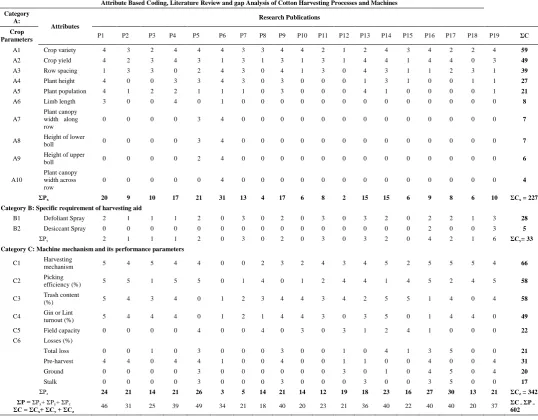
Total numbers of selected dependent and independent
attributes were 21, which are important for a mechanical
harvester. Total 19 numbers of publications were
reviewed related with the mechanical picker shown in
the columns of Table 4. Any publication in which all the
21 selected attributes would be discussed in detail would
get 105 grades.
Among the different researches reviewed under the
study, publication P5 received maximum grade points i.e.
49. The author has discussed crop parameters, specific
requirement of harvesting aid and machine mechanism
and performance parameters in details. In this paper,
spindle type harvesting mechanism was evaluated for the
LH 1556, CNH 120 MB, CNH (123, 155, 911, 2713 &
4736) and GSH 2 sown in India(Prasad et al.,
2007).Study (P1) received second highest grade points
i.e. 46 points comprising of crop parameters with 20
grade points, harvesting aid having 2 points and
mechanism and its performance parameters with 24
grade points(Corley and stokes, 1964).Publications P9,
P14, P16 and P17 received equal grade points i.e. 40
(Kapner et al., 1979, Faulkner et al., 2011, Tupper, 1966
and Khalilian et al., 1999), but Kapner et al., 1979 and
Faulkner et al., 2011 have emphasized on the crop
parameters and on the other hand, P16 and P17 have
discussed mainly mechanism and performance
parameters of a mechanical harvester(Tupper, 1966 and
Khalilian et al., 1999).(P8) received minimum grade
points i.e. 18 as the author has mainly discussed
mechanism and performance parameters of Pneumatic
suction harvesters for a particular variety without
discussing its agronomic practices(Rangaswamy et al.,
2006).
3.3 Grading/Coding of attributes
The attribute coding is done to find the importance of
each attribute for further applications. Table 4 shows the
grading/coding of attributes among and within the
3.4 Benefits of attribute coding
Different stake-holders like researchers/scientists,
designers/developers and manufacturers can take
benefits from attribute coding as per their applications.
3.4.1 For researchers/scientists
As this format consists of research publications
having different attributes of crop and machine
parameters, so the coding/grading of these attributes is
done to select the important attributes as per their
requirement. Researchers do not require to do exercise
for selection of design and operational parameters. It
Table 4 Paper wise coding for different attributes of crop and machines
Attribute Based Coding, Literature Review and gap Analysis of Cotton Harvesting Processes and Machines
Category A:
Attributes
Research Publications
Crop
Parameters P1 P2 P3 P4 P5 P6 P7 P8 P9 P10 P11 P12 P13 P14 P15 P16 P17 P18 P19 ΣC
A1 Crop variety 4 3 2 4 4 4 3 3 4 4 2 1 2 4 3 4 2 2 4 59
A2 Crop yield 4 2 3 4 3 1 3 1 3 1 3 1 4 4 1 4 4 0 3 49
A3 Row spacing 1 3 3 0 2 4 3 0 4 1 3 0 4 3 1 1 2 3 1 39
A4 Plant height 4 0 0 3 3 4 3 0 3 0 0 0 1 3 1 0 0 1 1 27
A5 Plant population 4 1 2 2 1 1 1 0 3 0 0 0 4 1 0 0 0 0 1 21
A6 Limb length 3 0 0 4 0 1 0 0 0 0 0 0 0 0 0 0 0 0 0 8
A7
Plant canopy width along row
0 0 0 0 3 4 0 0 0 0 0 0 0 0 0 0 0 0 0 7
A8 Height of lower boll 0 0 0 0 3 4 0 0 0 0 0 0 0 0 0 0 0 0 0 7
A9 Height of upper boll 0 0 0 0 2 4 0 0 0 0 0 0 0 0 0 0 0 0 0 6
A10
Plant canopy width across row
0 0 0 0 0 4 0 0 0 0 0 0 0 0 0 0 0 0 0 4
ΣPx 20 9 10 17 21 31 13 4 17 6 8 2 15 15 6 9 8 6 10 ΣCx = 227
Category B: Specific requirement of harvesting aid
B1 Defoliant Spray 2 1 1 1 2 0 3 0 2 0 3 0 3 2 0 2 2 1 3 28
B2 Desiccant Spray 0 0 0 0 0 0 0 0 0 0 0 0 0 0 0 2 0 0 3 5
ΣPy 2 1 1 1 2 0 3 0 2 0 3 0 3 2 0 4 2 1 6 ΣCy= 33
Category C: Machine mechanism and its performance parameters
C1 Harvesting
mechanism 5 4 5 4 4 0 0 2 3 2 4 3 4 5 2 5 5 5 4 66
C2 Picking
efficiency (%) 5 5 1 5 5 0 1 4 0 1 2 4 4 1 4 5 2 4 5 58
C3 Trash content (%) 5 4 3 4 0 1 2 3 4 4 3 4 2 5 5 1 4 0 4 58
C4 Gin or Lint
turnout (%) 5 4 4 4 0 1 2 1 4 4 3 0 3 5 0 1 4 4 0 49
C5 Field capacity 0 0 0 0 4 0 0 4 0 3 0 3 1 2 4 1 0 0 0 22
C6 Losses (%)
Total loss 0 0 1 0 3 0 0 0 3 0 0 1 0 4 1 3 5 0 0 21
Pre-harvest 4 4 0 4 4 1 0 0 4 0 0 1 1 0 0 4 0 0 4 31
Ground 0 0 0 0 3 0 0 0 0 0 0 3 0 1 0 4 5 0 4 20
Stalk 0 0 0 0 3 0 0 0 3 0 0 0 3 0 0 3 5 0 0 17
ΣPz 24 21 14 21 26 3 5 14 21 14 12 19 18 23 16 27 30 13 21 ΣCz = 342
ΣP = ΣPx+ ΣPy+ ΣPz
ΣC = ΣCx+ ΣCy + ΣCz 46 31 25 39 49 34 21 18 40 20 23 21 36 40 22 40 40 20 37
ΣC = ΣP = 602
In Table 4, notations P1, P2, P3---P18 represent the research publications and can be mentioned as
P1 - Corley and Stokes (1964) P11 - Sandhar N S (1999)
P2 - Oz and Karayol (2007) P12 - Asota C N (1996)
P3 - Faircloth et al. (2004) P13 - Tupper G R (1966)a
P4 - Corley T E (1970) P14 - Faulkner et. al. (2011)
P5 - Prasad et al. (2007) P15 - Ankit (2008)
P6 - Goyal et. al. (2009) P16 - Tupper G R (1966)b
P7 - Sandhar N S (1999) P17 - Khalilian et. al. (1999)
P8 - Rangaswamy et. al. (2006) P18 - Perish and Shelby (1974)
P9 - Kapner et al. (1979) P19 - Mathews and Tupper (1965)
also helps in selection of the parameters for field
evaluation of cotton harvesting machines. Cotton
breeders/Agronomist can obtain data regarding the
varieties, row spacing, height, canopy and plant
population suitable for cotton harvester.
3.4.2 For designers/engineers
Attribute coding provides opportunity to
designer/engineer to identify the important parameters
for designing a new machine or modify an existing
design. For developing a mechanical harvester, machine
parameters like picking mechanism, picking efficiency,
trash content and gin turn out are the important
parameters which can be considered by the
designer/engineers. Different machine parameters like
trash content and losses are needed to focus on by
designer/engineer to modify the existing machines.
Cleanliness of picked cotton is a main issue for the
mechanical cotton harvesters due to foreign materials
like leaves, shell, burs, sticks and dust particles. Hence,
designer/engineer needs to work on the design
ofon-board pre-cleaner and improvement of existing
technologies. So that trash content can be reduced to
improve the quality of seed-cotton.
3.4.3 For manufacturers
Both established and inexperienced manufacturers
can take benefits from attribute coding for production of
cotton harvesters. Type of harvesters and their
mechanisms mentioned in the reviewed paper can be a part of manufacturers’ interest. It helps them to
understand the kind of harvesters used for cotton picking
in different countries as per their field conditions.
4 Conclusions
From the review of research publications, different
attributes, expressed with the help of matrix were
identified under three categories such as crop attributes,
harvesting aid and machine& performance attributes as
per their effect on the performance and development of a
mechanical cotton harvester. Coding/grading of these
attributes was done as per their importance in the research
publications and summation of coded attributes was done
publication-wise as well as category-wise so that the
importance of each attribute and each publication could
be identified for the development of a mechanical cotton
harvester. Attribute coding helps Researcher/Scientist in
the selection of parameters for field evaluation of cotton
harvesting machines. Cotton breeders/Agronomist can
obtain data regarding the varieties, row spacing, height,
canopy and plant population suitable for cotton harvester.
Attribute coding provides opportunity to
designer/engineer to identify the important parameters
for designing a new machine or modify an existing
design. Different machine parameters like trash content
and losses are needed to focus on by designer/engineer
to modify the existing machines. Cleanliness of picked
cotton is a main issue for the mechanical cotton
harvesters due to foreign materials like leaves, shell, burs,
sticks and dust particles. Hence, designer/engineer needs
to work on the design of on-board pre-cleaner and
improvement of existing technologies. So that trash
content can be reduced to improve the quality of
seed-cotton. As the study suggested that the cotton
harvester with best mechanical performance was cotton
stripper with finger type of mechanism. Cotton stripper
was having picking efficiency more than 90% and was
easy to design due to its less components and moving
parts (Tupper, 1966a). Hence, small holder cotton
cultivation and manufacturers can be focused on to select,
design and development of mechanical cotton stripper
with finger type of mechanism. Attribute coding also
helps the manufacturers to understand the kind of
harvesters used for cotton picking in different countries
as per the field conditions.
Acknowledgements
The authors acknowledge the financial assistance
provided by the Department of Science and Technology
through the CSIR-CMERI Centre of Excellence for
Farm Machinery, Ludhiana, India. The work reported
References
Ankit.2008. Design, Development and Field evaluation of mechanical cotton picking aid. M. Tech Thesis, Punjab Agriculture University, Ludhiana.
Anonymous.2010.http://www.pdexcil.org/news/anrpt4/tab23.htm A site register in central library, Punjab Agricultural University, Ludhiana (Date of visit 26 Oct, 2010)
Asota, C. N. 1996. Field performance evaluation of a manually-operated cotton picker.Agricultural mechanization in Asia, Africa and Latin America,27(4): 24-26.
Corley, T. E., and C. M. Stokes. 1964. Mechanical cotton harvester performance as influenced by plant spacing and varietal characteristics. Trans of ASAE, 7(3): 306-308. Corley, T. E. 1970.Correlation of mechanical harvesting with
Cotton Plant Characteristics.Trans of ASAE, 13(6): 768-773.
Faircloth, J. C.,R.Hutchinson,J.Barnett,K.Paxson,A.Coco, and P.Price. 2004. An Evaluation of Alternative Cotton Harvesting Methods in Northeast Louisiana – A Comparison of the Brush Stripper and Spindle Harvester. The Journal of Cotton Science, 8(2): 55–61.
Faulkner, W. B.,J. D.Wanjura,R. K.Boman,B. W. Shaw, andC. B.Parnell. 2011. Evaluation of modern cotton harvest systems on irrigated cotton: economic returns.Applied Engineering in Agriculture, 27(4): 515‐522.
Goyal, R.,A. Singh,A. Dixit,and G. S. Manes. 2009. Study on the varietal characteristics of promising cotton varieties with reference to their suitability for using modern cotton picker. Journal of Research,SKUAST-J, 8(1): 18-24. Kapner, R. K.,R. G.Curley,C. R.Brooks, and V. T.Walhood. 1979.
A brush type stripper for double row cotton. Trans. of ASAE, 22(6): 1234-1237.
Khalilian, A.,M. J.Sullivan,and J. D. Mueller. 1999. Increasing picker efficiency by using a boll saver attachment. The Journal of Cotton Research, 3(3): 122-125.
Mathews, E.J., and G. R.Tupper. 1965. Coordinated development for new cotton production systems. Trans. of ASAE, 8(4): 568-571.
OZ, E., and T. Karayol. 2007. Harvesting Performance of a Tractor Mounted Mechanical Cotton Picker. Harvesting and ginning, Turkey.
Perish, R. L., and K. R. Shelby. 1974. Design of a cotton brush harvester for four narrow rows. Trans of ASAE, 17(6): 1076-1077.
Prasad,J., andG. Mujumdar.1999.Presentpractices and future needs for mechanization of cotton picking in India. Agricultural Engineering Today, 23(5-6):1-20.
Prasad, J.,T.Kapur,N. S.Sandhar,G. Majumdar,P. G.Patil,S. K.Shukla,B. N.Jaiswal,and A. B.Patil. 2007. Performance evaluation of spindle type cotton picker. Journal of Agricultural Engineering, 44(1): 38-42.
Rangaswamy, M., M. Muthamilselvan, and C. D. Durairaj. 2006. Optimisation of machine prameters of pneumatic knapsack cotton picker. Agricultural mechanization in Asia, Africa
and Latin America,37(3): 9-14. Sandhar, N. S. 1999.Mechanized picking of cotton in Punjab –
Some experiences.Agricultural Engineering Today, 23(5-6): 21-27.
Tajuddin, A.2008. Development and testing of engine operated pneumatic cotton picker. Agricultural mechanization in Asia, Africa and Latin America, 39(4): 37-38.
Tupper, G. R. 1966a.Stripperharvesting vs. Spindle picking of open boll and experimental stripper varieties of cotton, Trans of ASAE, 9(1): 110-113.