Wireless Sensor Traffic Information Collection System
Based on Congestion Control Algorithm
https://doi.org/10.3991/ijoe.v13i11.7751
Hongfeng Sun
Shandong Women's University, Shandong, China
Abstract—In order to develop a fast and convenient traffic information col-lection system, the wireless sensor traffic information colcol-lection system based on congestion control algorithm is designed. This new system reduces the oper-ation and maintenance costs and improves the efficiency of traffic informoper-ation collection. By analyzing the wireless sensor network, the application of wireless sensor network in intelligent traffic information collection system is discussed. In addition, the design scheme of traffic information collection system is de-signed. After analyzing the size of the network in the scheme, the congestion problem in the scheme is discussed finally. The simulation results show that the node communication radius is 50 m when the simulation scene is located in the monitoring area, while the MAC protocol is 802.11 DCF and the initial energy of all nodes is 1 J. Based on the above finding, it is concluded that the conges-tion control algorithm has better throughput, network delay and network energy consumption, which is suitable for the wireless sensor traffic information col-lection system.
Keywords—Traffic information collection; wireless sensor network; conges-tion control; shunt regulaconges-tion
1
Introduction
develop-ment and the process of modernization and civilization. The primary problem of ur-ban development is how to take effective measures to solve the traffic problems. Ac-cording to these social demands, traffic information collection and intelligent trans-portation system emerge as the times require. It is the basis for traffic state judgment and prediction, traffic flow control and emergency response [1].
2
Method
2.1 Overview of WSN congestion control
Wireless sensor networks (WSN) are widely used in many fields because of their low cost, easy local management and easy expansion [2]. Work modes can be divided into demand query mode, periodic reporting model, and event driven mode. In on-demand query mode, wireless sensor networks are generally deployed around the monitoring area and are normally asleep. When the user needs to know the situation of the monitored environment, it will be activated, collected, processed and transmit-ted, and finally transmit the data that meets the requirements to the user. In the period-ic reporting mode, the wireless sensor network will periodperiod-ically monitor the relevant information of the target object, and then transmit the monitoring results to the user through the scheduled time cycle. In unexpected event driven mode, because the probability of unexpected events is very low, the traffic flow is normal in general. But in the event of unexpected events, the network traffic changes greatly, and the sensor nodes will report the relevant situation quickly and initiatively, which is helpful for the accurate judgment of unexpected events. However, in the above three modes, there will be some congestion. At this point, a solution to the problem is how to quickly and effectively alleviate and avoid congestion. Congestion control in wireless sensor networks has been on the rise in recent years. Mainly because of the different applications in the actual environment, it causes a variety of network congestion prob-lems. Therefore, the solution of congestion is urgent. Congestion control technology is to avoid congestion or to make rapid and effective control of congestion through certain technical means.
2.2 Analysis of WSN congestion control algorithm
reduce energy consumption. But because of the feedback operation of gateway and multiple nodes, especially in large-scale network, the speed of closed loop control is relatively slow. ARC [5] protocol is a multiway split protocol based on traffic sched-uling. It creates multiple paths to increase the accuracy of the transmitted packets, avoids conflicts and retransmissions, and greatly saves the energy of nodes. CAR [6] protocol is similar to the ARC protocol, and it is suitable for many different priority data stream networks. But it lacks support for high mobile data sources, and it costs a lot to build high priority data routing. BGR [7] protocol is also a control protocol combined with multi-path routing. Compared with other protocols, its implementation mechanism is relatively simple, but the drawback is that it lacks the comprehensive consideration of the current situation of the neighbor nodes, resulting in the expansion of the surrounding congestion area. CONCERT [8] protocol uses the appropriate data aggregation method to reduce data traffic in the network to mitigate congestion, so as to achieve the purpose of prolonging the network cycle [9]. In recent years, some scholars have tried to propose an active queue management mechanism for wireless sensor networks based on system control and optimization [10]. Active queue man-agement technology predicts the possible congestion through the current state of the network, and notifies the source in advance by dropping or marking the packet to reduce the sending rate, thus achieving the purpose of congestion avoidance.
2.3 Congestion control algorithm for wireless sensor networks based on TOPSIS
Based on the above analysis, in order to ensure the real-time and reliability of traf-fic data acquisition, a high-performance congestion control algorithm is proposed in this paper. In view of the fact that single congestion detection cannot predict the net-work load accurately, the algorithm defines congestion prediction state index accord-ing to queue occupancy and congestion duration. And through the judgment of the congestion status index, the congestion trend is predicted accurately. In order to avoid the network failure caused by the failure of the optimal path, the algorithm constructs the selection model based on the theory of ding. A temporary optimal path is estab-lished around the congestion nodes to adjust the congestion level and analyze the congestion level. The residual energy, the distance from the original path, and the channel access rate are chosen as the basis for the next hop node. Experimental results show that the proposed algorithm can detect congestion effectively and accurately, reduce latency and network energy consumption. It guarantees the fidelity of the data and further improves the performance of the traffic information collection system.
dis-tance between the optimal scheme and the worst scheme. The above data is taken as an index of the research object, the general steps of TOPSIS analysis method are as follows: 4 3 2 1 m 24 23 22 21 14 13 12 11 m m
m V V
V V V V V V V V V V V ... ... ... ... = (1)
2) The normalized value of the node property in formula (1) is:
4 3 2 1 3 2 1 1
2 = =
=
!
= j m i x x v m i ij ijij / , ... (2)
Congestion control mechanism based on TOPSIS. Road traffic information col-lection system has the following characteristics: A large number of sensors are used on both sides of the road to monitor traffic flow data in real time. The nodes need to transmit the monitored road traffic data to the sink node quickly and accurately with multi hop or multiple to one transmission. Generally, sensor nodes and sink nodes do not change positions after deployment. In the event of unexpected events, a large amount of data will be generated in the sensor network. Wireless sensor networks for traffic information collection are different from those of general monitoring networks. In traffic information collection, some data is very important, and it is not allowed to reduce speed. It needs to be transmitted to monitoring center immediately. At the same time, the sensor covers a wide range of data streams and has a large number of redundant nodes. Because of these characteristics, the general congestion control is difficult to meet its needs. However, the traffic scheduling control method can sched-ule the data flow into the congestion region without decreasing the speed, so as to ensure the original transmission line smooth through the detour, relieve congestion diversion. Fast and accurate congestion detection is the premise and foundation of congestion control.
3
Algorithm simulations
3.1 Introduction to simulation tools
as an auxiliary teaching tool, has been widely used in the teaching of network tech-nology.
3.2 Simulation environment settings
In order to verify the accuracy of the model, the simulation results of the algorithm are compared and analyzed. NS2 simulation software is used to construct multi hop wireless sensor networks. Based on the above considerations, the simulation scene is located in the monitoring area, and the node communication radius is 50m. The MAC protocol is 802.11 DCF and the initial energy of all nodes is 1 J. In addition, the cache size is 80 packets, the congestion threshold is 0.8, and the packet size is 512 bytes.
4
Result and discussion
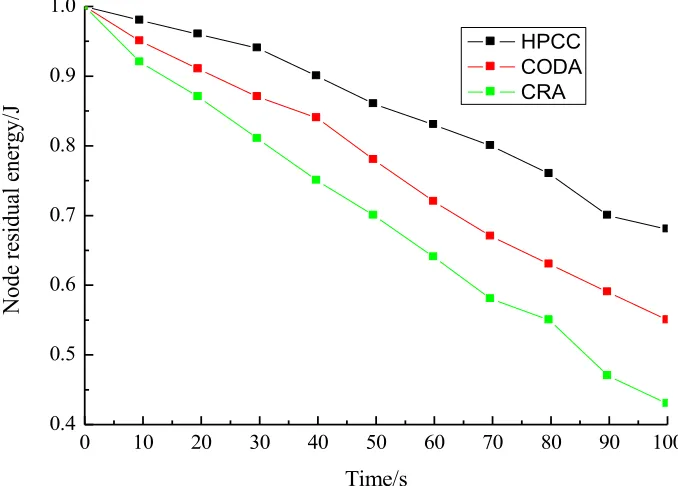
WSN is that it takes full account of the limited energy of nodes. The main feature of WSN is that it takes full account of the limited energy of nodes. Under the premise of ensuring the reliability of data transmission, users should minimize the energy con-sumption on the communication path, which will improve the energy efficiency and maximize the network lifetime.
0
10
20
30
40
50
60
70
80
90
100
0.0
0.2
0.4
0.6
0.8
1.0
End
-to-e
nd
dela
y/
s
Time/s
HPCC
CAR
CODA
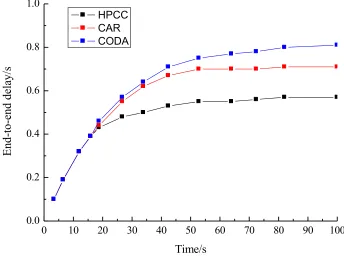
Fig. 1. Comparison of average end-to-end delay of CODA, CAR and HPCC
0 10 20 30 40 50 60 70 80 90 100 0.4
0.5 0.6 0.7 0.8 0.9 1.0
N
od
e
re
sid
ual e
ner
gy
/J
Time/s
HPCC CODA CRA
Fig. 2. Comparison of average end-to-end delay of CODA, CAR and HPCC
5
Conclusion
The wireless sensor networks for traffic information collection is studied, which aims to improve congestion in wireless sensor networks. In order to improve the net-work performance, the netnet-work model is established and the characteristics of the algorithm are analyzed. At present, most congestion control algorithms change the transmission speed of nodes to control congestion, but there is little research on multi-path shunting due to the constraints of application environment and the unpredictable nature of protocols. The main work of this paper includes:
1.Through the analysis of the requirements of the information collection system, the network architecture and networking scheme of the wireless sensor network for traffic information collection are designed, and some key problems of the wireless sensor network are analyzed.
2.Aiming at the congestion problem of wireless sensor networks for traffic infor-mation collection, a high performance congestion control algorithm for traffic in-formation collection is proposed on the basis of traffic scheduling.
6
References
[1]Gholipour, M., Haghighat, A. T., & Meybodi, M. R. (2015). Hop-by-hop traffic-aware routing to congestion control in wireless sensor networks. Eurasip Journal on Wireless Communications & Networking, 2015(1), 1-13. Https://doi.org/10.1186/s13638-015-0241-5.
[2]Prabha, R., & Gouda, P. K. (2015). Mtadf : multi hop traffic aware data for warding for congestion control in wireless sensor networks. , 7(1), 107-118. Https://doi.org/10.5121/ijwmn.2015.7107.
[3]Manshahia, M. S., Dave, M., & Singh, S. B. (2015). Congestion control in wireless sensor networks based on bioluminescent firefly behavior. Wireless Sensor Network, 07(12), 149-156. Https://doi.org/10.4236/wsn.2015.712013.
[4]Raman, C. J., & James, V. (2015). Fuzzy based congestion control for backpressure rout-ing algorithm in wireless sensor networks. Research Journal of Applied Sciences Engi-neering & Technology, 11(11), 1179-1189. Https://doi.org/10.19026/rjaset.11.2224. [5]Wei, K., Guo, S., Li, X., Zeng, D., & Xu, K. (2016). Congestion control in social-based
sensor networks: a social network perspective. Peer-to-Peer Networking and Applications, 9(4), 681-691. Https://doi.org/10.1007/s12083-015-0352-0.
[6]Uthra Rajan, A., Kasmir Raja, S. V., Jeyasekar, A., & Lattanze, A. J. (2015). Energy-efficient predictive congestion control for wireless sensor networks. Wireless Sensor Sys-tems Iet, 5(3), 115-123. Https://doi.org/10.1049/iet-wss.2013.0101.
[7]Venkataramanan, C., & Girirajkumar, S. M. (2015). Rermac congestion control protocol for wireless sensor networks. Indian Journal of Science & Technology, 8(35), 231-237.
Https://doi.org/10.17485/ijst/2015/v8i35/70201.
[8]Park, J. H., Kim, J. H., & Lee, S. K. (2015). A study on the enhanced congestion control mechanism for multimedia traffic in sensor networks. International Journal of Multimedia & Ubiquitous Engineering, 10(8), 391-400. Https://doi.org/10.14257/ijmue.2015.10.8.38. [9]Chen, W., Guan, Q., Jiang, S., Guan, Q., & Huang, T. (2016). Joint qos provisioning and
congestion control for multi-hop wireless networks. Eurasip Journal on Wireless Commu-nications & Networking, 2016(1), 19. Https://doi.org/10.1186/s13638-016-0519-2. [10]Mayandi, M., & Pillai, K. V. (2016). Probabilistic qos aware congestion control in wireless
multimedia sensor networks. Circuits & Systems, 07(9), 2081-2094.
Https://doi.org/10.4236/cs.2016.79181.
[11]Chen, W., Niu, Y., & Zou, Y. (2017). Congestion control and energy-balanced scheme based on the hierarchy for wsns. Iet Wireless Sensor Systems, 7(1), 1-8.
Https://doi.org/10.1049/iet-wss.2015.0097.
[12]Duan, S., Shah-Mansouri, V., Wang, Z., & Wong, V. W. S. (2016). D-acb: adaptive con-gestion control algorithm for bursty m2m traffic in lte networks. IEEE Transactions on Vehicular Technology, 65(12), 9847-9861. Https://doi.org/10.1109/icc.2015.7249249. [13]Mandloi, M., & Bhatia, V. (2015). Congestion control based ant colony optimization
algo-rithm for large mimo detection. Expert Systems with Applications, 42(7), 3662-3669.
Https://doi.org/10.1016/j.eswa.2014.12.035.
7
Author
Hongfeng Sun is with Shandong Women's University, Shandong, China.