Wing pattern morphology of three closely related
Melitaea
(Lepidoptera, Nymphalidae) species reveals highly inaccurate
external morphology-based species identification
Jure Jugovic
1,2, Toni Koren
21 University of Primorska, Faculty of mathematics, natural sciences and information technologies, SI-6000 Koper, Glagoljaška 8, Slovenia; [email protected]
2 University of Primorska, Science and Research Centre, Institute for Biodiversity Studies, SI-6310 Izola, Giordana Bruna 6, Slovenia; [email protected]
http://zoobank.org/29B3CAE5-7E75-416E-9555-D85F2818BBA0
Received 22 November 2013; accepted 5 May 2014; published: 15 June 2014 Subject Editor: Zdeněk F. Fric
Abstract. Wing morphology of the three closely related species of Melitaea – M. athalia (Rottemburg, 1775), M. aurelia (Nickerl, 1850) and M. britomartis Assmann, 1847 – co-occurring in the Balkans (SE Europe) was investigated in detail through visual inspection, morphometric analysis and multivariate statistical analysis. Results are compared to recent phylogenetic studies, searching for concordant patterns and discrepancies between the two approaches. The morphology of the genitalic structures is also com-pared with the results of the other two approaches. The main conclusions are as follows: (1) small albeit significant differences in wing morphology exist among the three species and (2) while the structure of male genitalia and phylogenetic position of the three species are concordant, they are (3) in discordance with the wing morphology. The present study represents another example where identification based on external morphology would lead to highly unreliable determinations, hence identification based on phy-logenetic studies and/or genitalia is strongly recommended not only for the three studied species but also more broadly within the genus. Furthermore, we show that some of the characters generally used in the identification of these three Melitaea species should be avoided in future.
Introduction
The genus Melitaea Fabricius, 1807 (Lepidoptera: Nymphalidae) as it is known today (Len-eveu et al. 2009), comprises approximately 80 species, all restricted to the Palaearctic region. A recent phylogenetic analysis showed that the genus can be divided into two clades (‘ Meli-taea clade’ and ‘Didymaeformia clade’) with high branch support from both maximum likeli-hood and Bayesian analyses (Leneveu et al. 2009). Within the ‘Melitaea clade’ five subclades have been recognized (sensu Leneveu et al. 2009): ‘cinxia’, ‘diamina’, ‘arcesia’, ‘minerva’ and ‘athalia’ groups. The latter subclade comprises fourteen species, three of which are pres-ent in the area of north-western Balkans: Melitaea athalia (Rottemburg, 1775), Melitaea au-relia (Nickerl, 1850) and Melitaea britomartis Assmann, 1847. These three species belong to two different monophyletic groups within the subclade ‘athalia’, one comprising M. aurelia
occurred about 11 million years ago (Serravallian period) while the subsequent speciation oc-curred during the Messinian Period (5.3–7.1 Mya) (Leneveu et al. 2009), when the continuous decrease of temperature coincided with the aridification of the climate in Eurasia and a subse-quent expansion of grassland of C4 plants (e.g. Maki et al. 2003; Quade et al. 1995). Although the separate evolution of those species has been in progress for a long period of time, the clear genetic differentiation (Bátori et al. 2012a) is not reflected in their external morphology (Tolman & Lewington 2008).
The external morphology of the three species is highly similar, rendering the accurate iden-tification based on external morphology questionable (Tolman & Lewington 2008). There are several morphological characters that have been proposed for species identification of M. athalia, M. aurelia and M. britomartis: the coloration of the marginal line of the hindwing underside; the spacing of the marginal, submarginal, postdiscal and discal line on the forewing upperside; and the colour of the submarginal spots on the hindwing underside (Tolman & Lew-ington 2008). The high variability of those characters, however, sometimes prevents proper identification (Tolman & Lewington 2008). The genitalia of these species are highly species specific, and have been known to be a good identification tool (Urbahn 1952; Paulavičiūtė & Tamutis 2009). Nevertheless, even when genitalia based identification is used, only males can be unambiguously recognized to a species rank, whereas this is not always possible in females (e.g. see Urbahn 1952).
Melitaea athalia is a trans-European species (except for south-western Europe, where Mel-itaeaceladussa Fruhstorfer, 1910, a former subspecies of M. athalia occurs (Leneveu et al. 2009)). M. aurelia and M. britomartis are absent from the majority of SW Europe (including the Iberian and Apennine peninsulas). M. britomartis is absent also from most of Central Eu-rope being present only in eastern parts of EuEu-rope. A part of its distribution, however, reaches the NW Balkans – Slovenia, Croatia and Bosnia and Herzegovina (Koren & Jugovic 2012) – where these three species live in sympatry. In this area the distribution of M. britomartis is separated from the center of its distribution (Tolman & Lewington 2008).
The ecology of the three species in the area of NW Balkans (Slovenia) is similar in terms of flight period, altitudinal distribution and habitat requirements including foodplant (Koren & Jugovic 2012; Verovnik et al. 2012). Since their habitat requirements and foodplants partly overlap, they often occur in the same habitat (Bátori et al. 2012a; Koren & Jugovic 2012).
Morphological traits can reflect either historical isolation and/or local adaptation despite re-current gene flow (Alexandrino et al. 2005). Some taxa remain morphologically unidentifiable despite detailed morphometric analysis, hence a consideration of a large set of morphometric characters from different anatomical regions may greatly increase the chances of revealing tax-onomic differences within seemingly cryptic or morphologically highly variable species (e.g. Jugovic et al. 2011).
of molecular distance between the taxa, meaning that M. aurelia should be the most distant in morphological space from the other two species.
Materials and methods
Samples and species identificationSamples of the three species of Melitaea were collected over the last 40 years all over the NW Balkans (see Koren & Jugovic 2012 for the list). Altogether, samples from 56 localities were collected, sample sizes ranging from 1 to 12 for males and 1 to 3 for females. The genitalia of each specimen were isolated using the standard procedure for genitalia isolation (see Koren & Jugovic 2012 for details). Specimens were attributed to a species according to the genitalia structure that is highly species-specific in males (Urbahn 1952; Paulavičiūtė & Tamutis 2009). Using these methods we were able to identify all of the collected males. A total of 42 males and 24 females of M. athalia, 29 males and 6 females of M. aurelia and 24 males and 4 females of
M. britomartis were used in further morphometric analysis.
Separation of these three species is possible using male genitalia as follows (see also Urbahn 1952): 1. uncus absent -> M. aurelia; 2. uncus present, long and slender, its processus longer than wide -> M. athalia; 3. uncus present, short and robus, its processus almost as long as wide -> M. britomartis.In females there are slight differences among the species, but not all speci-mens can be reliably identified in this way (Urbahn 1952; Bátori et al. 2012a).
Morphometric methods
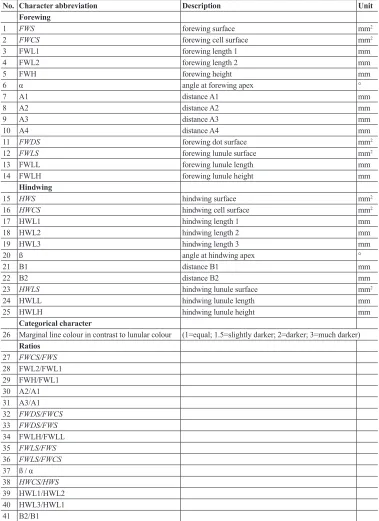
Specimens used in this study were mounted and photographed on a millimeter grid from the same angle (90°) using a DSLR camera (Canon 450D). Subsequently, 25 metric characters were measured from the photographs using freeware ImageJ (Abramoffet al. 2004), 14 on the forewing and 11 on the hindwing (Table 1, Fig. 1). The measurements included a wide range of morphometric characters (i.e. lengths, surfaces and angles between measured dis-tances of different parts of both wings). Moreover, one categorical character, i.e. marginal line colour in contrast to lunular colour (for categories see Table 1 and Appendix A) was also recorded. In order to exclude the impact of the animal’s size, all metric characters were transformed into 18 additional ratios (Table 1). The photographs of both wings were used for comparison and investigated in detail in order to find some other descriptive morphological species-specific characteristics and to describe intraspecific variability. Although no body asymmetry was detected, all characters were measured on the right side of an animal in order to exclude any possible influence of this phenomenon. The left side, however, was used in rare occasions when the right side was damaged.
Statistical analysis
Table 1. List of structures (with morphological characters, their explanation with measuring units) mea-sured in three species of Melitaea.
No. Character abbreviation Description Unit
Forewing
1 FWS forewing surface mm2
2 FWCS forewing cell surface mm2
3 FWL1 forewing length 1 mm
4 FWL2 forewing length 2 mm
5 FWH forewing height mm
6 α angle at forewing apex °
7 A1 distance A1 mm
8 A2 distance A2 mm
9 A3 distance A3 mm
10 A4 distance A4 mm
11 FWDS forewing dot surface mm2
12 FWLS forewing lunule surface mm2
13 FWLL forewing lunule length mm
14 FWLH forewing lunule height mm
Hindwing
15 HWS hindwing surface mm2
16 HWCS hindwing cell surface mm2
17 HWL1 hindwing length 1 mm
18 HWL2 hindwing length 2 mm
19 HWL3 hindwing length 3 mm
20 ß angle at hindwing apex °
21 B1 distance B1 mm
22 B2 distance B2 mm
23 HWLS hindwing lunule surface mm2
24 HWLL hindwing lunule length mm
25 HWLH hindwing lunule height mm
Categorical character
26 Marginal line colour in contrast to lunular colour (1=equal; 1.5=slightly darker; 2=darker; 3=much darker) Ratios 27 FWCS/FWS 28 FWL2/FWL1 29 FWH/FWL1 30 A2/A1 31 A3/A1 32 FWDS/FWCS 33 FWDS/FWS 34 FWLH/FWLL 35 FWLS/FWS 36 FWLS/FWCS 37 ß / α
also avoided the influence of possible sexual dimorphism. Only for the analysis of the marginal line colour were a few unambiguously identified females added to the sample (no sexual dimor-phism was noticed in this character). We also had to remove from the analysis three aberrant individuals which lacked measuring points for some characters, hence they are commented on separately.
For each species, the Kolmogorov-Smirnov test (at p = 0.05) and Normal Q-Q plots were used to examine the normality of the data distribution, and the homogeneity of variances was evaluated visually through scatterplots. The multivariate analysis of variance (MANOVA, at p = 0.001) was used to test for significant differences between species. One-way analysis of vari-ance (ANOVA) was used to assess the variation within a species for each character, significant variation in a character being accepted if the between species variation was significant at p < 0.001. Pearson’s correlation coefficients (r) were computed to evaluate the extent to which each character contributes unique information; only one character was chosen to represent a pair or a group of characters where |r| > 0.9. The Durbin-Watson test (at p = 0.05 and p = 0.01) was ap-plied to test for possible spatial (latitude, longitude, altitude) and temporal (year of collection) autocorrelations of morphometric data (Savin & White 1977; Farebrother 1980) in each of the three species. In subsequent multivariate statistical analyses, only selected characters (accord-ing to the limitations listed above) were used.
Multivariate Principal Component Analysis (PCA) was used to identify the structure of our data i.e. to detect the possible influence of the species specific characteristics. Also, Discrimi-nant Function Analysis (DFA) was carried out to examine possible separation of the three spe-cies. In DFA, the contribution of each species was weighted according to its sample size (num-ber of specimens). Post-hoc Games-Howell and Bonferonni tests were performed to assess the rates of morphological divergences between pairs of species in details. The analyses were performed using Microsoft Excell (2010), SPSS 14.0 for Windows (2005) (Norusis, 2005) and Past (PAlaeontological STatistics) software (Hammer et al. 2001).
Results
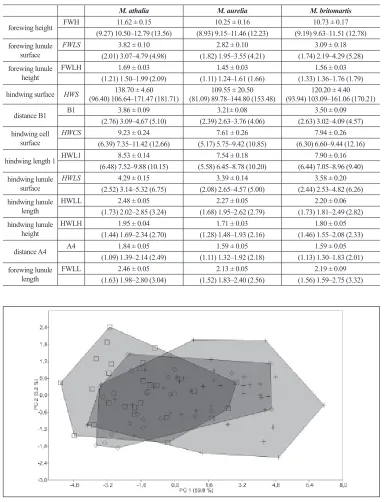
The multivariate analysis of variance (MANOVA) showed significant differences between species (p < 0.001). Out of 43 morphometric characters, 12 characters (without a single ratio) were selected after Kolmogorov-Smirnov (p < 0.05), ANOVA (p < 0.001) and Pear-son correlation (|r| < 0.9) tests. No spatial or temporal autocorrelation was detected in these characters neither at p = 0.01 nor at p = 0.05 (Durbin-Watson test). Statistic description of selected 12 characters (mean, standard error, 12th percentile, 88th percentile and extreme values) is presented in Table 2. When the Pearson correlation test was set to |r| < 0.7, only two morphometric characters (forewing height [FWH] and distance A4) were left after step-wise exclusion of characters, meaning that correlations among most pairs of morphological characters were high.
The principal result of the PCA (Fig. 2) run on 95 males from the NW Balkans, using 12 morphometric characters (Table 2), revealed a significant overlap of the three species along the first two principal components (PCs). PC 1 explained almost 70% of the total variance and PC2 explained an additional 8%. All characters are positively correlated to PC1, starting with the smallest M. aurelia and finishing with the largest of three species, M. athalia. Nevertheless, the overlap between the three species in the middle section along PC 1 is significant.
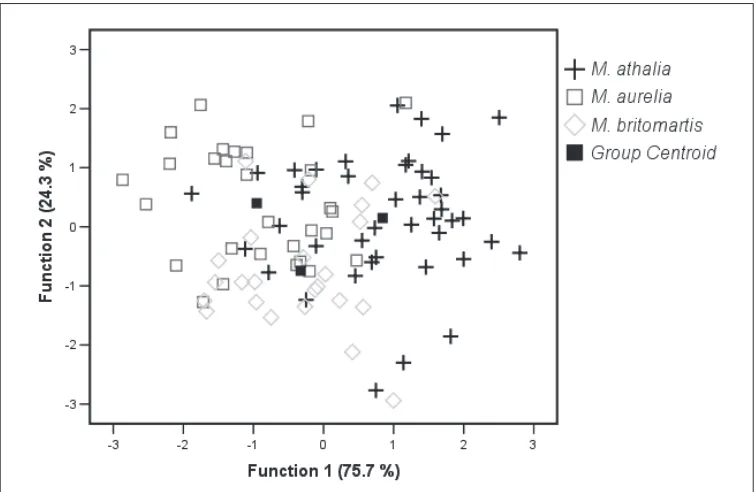
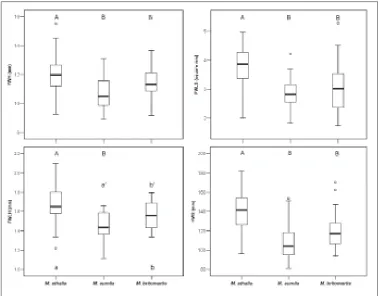
In the DFA (Fig. 3) run using the same morphometric characters as in the PCA, 95 males were analyzed to (1) provide adequate species-grouping according to external morphologi-cal characters and (2) detect intra-species variability of selected characters. Two Discriminant Functions (DFs) explain total variance, DF 1 explaining over 75% of the total variance. Species differ significantly only along DF 1 (p < 0.001), and only M. athalia differs significantly from the other two species (Games-Howell Test, p < 0.001). The characters most correlated with DF 1 (indicated by the standardized discriminant function coefficients: DC > 0.75, Table 3) are: forewing height (FWH), forewing lunule surface (FWLS), forewing lunule height (FWLH) and hindwing surface (HWS). For the differences among the three species in these four characters, see Fig. 4 and Table 2.
Table 2. Statistical description of twelve metric characters in males of three species of the genus Melitaea
that were used in subsequent Principal component and Discriminant Function analyses. Upper row: aver-age ± std. error; lower row: (min), 12th percentile–88th percentile (max).
M. athalia M. aurelia M. britomartis
forewing height FWH 11.62 ± 0.15 10.25 ± 0.16 10.73 ± 0.17 (9.27) 10.50–12.79 (13.56) (8.93) 9.15–11.46 (12.23) (9.19) 9.63–11.51 (12.78) forewing lunule
surface FWLS (2.01) 3.07–4.79 (4.98)3.82 ± 0.10 (1.82) 1.95–3.55 (4.21)2.82 ± 0.10 (1.74) 2.19–4.29 (5.28) 3.09 ± 0.18 forewing lunule
height FWLH (1.21) 1.50–1.99 (2.09)1.69 ± 0.03 (1.11) 1.24–1.61 (1.66)1.45 ± 0.03 (1.33) 1.36–1.76 (1.79)1.56 ± 0.03
hindwing surface HWS (96.40) 106.64–171.47 (181.71)138.70 ± 4.60 (81.09) 89.78–144.80 (153.48)109.55 ± 20.50 (93.94) 103.09–161.06 (170.21)120.20 ± 4.40
distance B1 B1 3.86 ± 0.09 3.21± 0.08 3.50 ± 0.09 (2.76) 3.09–4.67 (5.10) (2.39) 2.63–3.76 (4.06) (2.63) 3.02–4.09 (4.57) hindwing cell
surface HWCS (6.39) 7.35–11.42 (12.66)9.23 ± 0.24 (5.17) 5.75–9.42 (10.85)7.61 ± 0.26 (6.30) 6.60–9.44 (12.16)7.94 ± 0.26
hindwing length 1 HWL1 8.53 ± 0.14 7.54 ± 0.18 7.90 ± 0.16 (6.48) 7.52–9.88 (10.15) (5.58) 6.45–8.78 (10.20) (6.44) 7.05–8.96 (9.40) hindwing lunule
surface HWLS (2.52) 3.14–5.32 (6.75)4.29 ± 0.15 (2.08) 2.65–4.57 (5.00)3.39 ± 0.14 (2.44) 2.53–4.82 (6.26)3.58 ± 0.20 hindwing lunule
length HWLL (1.73) 2.02–2.85 (3.24) 2.48 ± 0.05 (1.68) 1.95–2.62 (2.79)2.27 ± 0.05 (1.73) 1.81–2.49 (2.82)2.20 ± 0.06 hindwing lunule
height HWLH (1.44) 1.69–2.34 (2.70)1.95 ± 0.04 (1.28) 1.48–1.93 (2.16)1.71 ± 0.03 (1.46) 1.55–2.08 (2.33)1.80 ± 0.05
distance A4 A4 1.84 ± 0.05 1.59 ± 0.05 1.59 ± 0.05 (1.09) 1.39–2.14 (2.49) (1.11) 1.32–1.92 (2.18) (1.13) 1.30–1.83 (2.01) forewing lunule
length FWLL (1.63) 1.98–2.80 (3.04)2.46 ± 0.05 (1.52) 1.83–2.40 (2.56)2.13 ± 0.05 (1.56) 1.59–2.75 (3.32)2.19 ± 0.09
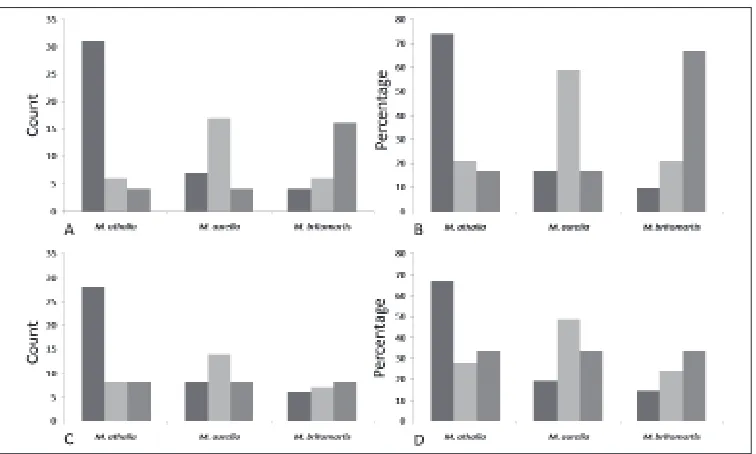
considering that this character was deviating from normal distribution (Kolmogorov-Smirnov test, all data pooled: Z = 2.642; p < 0.001). However, this did not improve the classification significantly (original grouping: 70.5%; cross-validation procedure: 55.8%).
In addition to the characters used in the DFA, two characters frequently mentioned in the literature as diagnostic for the recognition of (some of) Melitaea species should be mentioned.
Figure 3. Plot of the scores of 95 males of three species of Melitaea on both discriminant functions, using 12 morphometric characters. Centroids are larger and darker than symbols denoting individual specimens.
Table 3. Contributions of 12 metric characters (MC) to discrimination along both discriminant functions (DF). Discriminant function analysis run on 95 males of three species of Melitaea. Asterisk (*) denotes the highest absolute correlation between the character and DF.
MC (symbol) DF 1 DF 2
forewing height (FWH) 0.851* –0.002
forewing lunule surface (FWLS) 0.810* 0.110
forewing lunule height (FWLH) 0.791* –0.129
hindwing surface (HWS) 0.787* –0.022
distance B1 (B1) 0.680* –0.120
hindwing cell surface (HWCS) 0.651* 0.158
hindwing length 1 (HWL1) 0.624* –0.013
hindwing lunule surface (HWLS) 0.575* 0.128
forewing lunule length (FWLL) 0.571* 0.147
hindwing lunule height (HWLH) 0.562* –0.032
distance A4 (A4) 0.533* 0.285
For the characters like the spacing of the marginal, submarginal, postdiscal and discal line on the forewing upperside, the colour of the submarginal spots on the hindwing underside, the coloration of hairs on the palps as well as that of the marginal line in contrast to the lunular colour on the underside of the hindwing, no consistency with species attribution was found in our examination. For the latter, slight differences were found between the three species; however, species could not be identified with certainty using the lunular coloration on the hindwing underside due to the high intraspecific variability of this character. The coloration of the marginal line is in general equal to the coloration of the lunules in M. athalia, much darker in M. britomartis and only slightly darker in M. aurelia. Nevertheless, all of these categories were noticed in each species (Fig. 6, Appendix B).
The wing pattern and coloration show high intra- and interspecies variability. While in some species dark melanistic forms are common (e.g. in Melitaea britomartis ssp. michielii from Slovenian Karst and surroundings (Carnelutti 1992)), other peculiar forms also had been found. In some of these, the pattern deviated from normal form so much so that in these animals some
metric characters could not be measured. We found three such M. athalia specimens (i.e. with extremely reduced markings) from Kamniški Vrh and Smrekovec (both in Slovenia) and Vu-grovec (Croatia).
Figure 5. DFA classification results of 95 males of Melitaea athalia (first column), M. aurelia (second column) and M. britomartis (third column); A, B – original; C, D – cross-validation procedure.
Discussion
The genitalia structures (Urbahn 1952) and the phylogeny based on three genes (mitochondrial gene cytochrome oxidase subunit I, and two nuclear genes, elongation factor-1a, and wingless; Leneveu et al. 2009) of the three Melitaea species are in agreement, clearly showing that M. aurelia is more distant from the other two species. In our analysis this is proved by a genitalia based species identification of males without any questionable cases. However, the phylogenet-ic relationships and the differences in the genitalphylogenet-ic morphology are not reflected in the external morphology of the three species’ wing patterns.
asteria–M. aurelia, also within the same ‘athalia’ group; Tolman & Lewington 2008; Len-eveu et al. 2009).
The allozyme polymorphism of these three species was studied in samples from the Car-pathian basin, and revealed that M. britomartis and M. aurelia are more closely related, while
M. athalia appears to be a further relative (Bátori et al. 2012a). This result contradicts the phylogenetic analysis of Leneveu et al. (2009). The latter analysis, however, finds support also in the genitalia structures as follows: in males of M. athalia and M. britomartis, the spines on the uncus are well developed, whereas they are completely absent in M. aurelia
(Urbahn 1952). It should not be a surprise that the level of differentiation in genitalic struc-tures corresponds to the phylogenetic position of the species since sexual differentiation usually represents one of the most rapid and obvious taxon-specific events during speciation in many animal groups, invertebrates in particular (Mayr & Ashlock 1991). In addition, the genitalic structures are in comparison to the external morphology less subjected to envi-ronmental factors (Cesaroni et al. 1994; Dapporto et al. 2011). For example, M. celadussa, recently elevated to a species level by Leneveu et al. (2009) from a subspecies rank of M. athalia, has not yet been reliably recognized on the basis of wing pattern and coloration, whereas some differences from M. athalia were found in male genitalia alone (e.g. see Hig-gins & Riley 1978; Leneveu et al. 2009). As long as external differences are not found, this species pair could be treated as cryptic (sensu Hawksworth 2010: “populations which are phylogenetically distinct, but distinguished by molecular or other features that are either not evident macroscopically or generally overlooked”).
In contrast to the allozyme study, the phylogenetic analysis used as a framework for the explanation of our results (Leneveu et al. 2009) (1) included a vast majority of known species of Melitaea (whereas in Bátori et al. 2012a only M. athalia, M. aurelia and M. britomartis
were included) and (2) three different genes provided support for the same topology within the ‘athalia’ group discussed herein. Hence, no serious consideration was given to the study of Bátori et al. (2012a).
the populations, these differences cannot be assigned to a genetic background alone. They rather may through selection also be a result of an adaptation to local conditions (Bátori et al. 2012b), such as food availability, climate and microhabitat selection. This phenomenon is not uncommon since high levels of phenotypic plasticity are important for a response that ensures the survival of a population exposed to unstable environmental factors (Shapiro 1976; Brakefield & French 1999). High species plasticity together with accommodation to local conditions can in practice result in description of many subspecies and morphological forms within M. athalia as well as within some other Melitaea species. Nonetheless, the differences among populations in reality might have resulted from locally specific selection pressure (e.g. see Tolman & Lewington 2008). On the other hand, the three species exploit similar (and partly overlapping) resources (e.g see Verovnik et al. 2012; Koren and Jugovic 2012), which is probably the reason for the high similarity among them. It is important to note that the regional pattern of differentiation in M. athalia from the Caucasian basin was less expressed in genitalia than in wing characters (Bátori et al. 2012b).
The high variability of these species is further shown in their qualitative characters, for example in wing pattern and coloration. In M. athalia three out of more than 120 sampled specimens had a very peculiar coloration, with no visible marginal lines. Albeit unrecognized, we believe that differences in (some of) local conditions clearly show the importance of en-vironmental factors for the wing morphology. This further demonstrates the importance of genitalia or phylogeny based identification in the herein investigated Melitaea species. More-over, the latter two approaches should have a significant advantage also for the identification of (some) other species of the genus that should undergo thorough revision in the future (cf. Leneveu et al. 2009).
Conclusions
The morphometric analysis of three closely related Melitaea species (M. athalia, M. aurelia
and M. britomartis) revealed the following: (1) small albeit significant differences in wing morphology exist among the three species; (2) only characters describing the size of the spe-cies with no characters describing their wing shapes (ratios) were statistically important for the separation of the species; (3) whereas the structure of the male genitalia and the phylogenetic position of the three species are concordant, the sequence of phylogenetic splits is not reflected in the rate of external morphological differences among them; (4) our study represents another example where external morphology based identification would lead to highly unreliable deter-minations, hence a use of genitalia based identifications is strongly recommended.
Acknowledgements
References
Abramoff MD, Magalhaes PJ, Ram SJ (2004) Image Processing with ImageJ. Biophotonics International 11 (7): 36–42.
Alexandrino J, Ferrand N, Arntzen JW (2005) Morphological variation in two genetically distinct groups of the golden-striped salamander, Chioglossa lusitanica (Amphibia: Urodela). Contributions to Zool-ogy 74 (3/4): 213–222.
Bátori E, Pecsenye K, Bereczki J, Varga Z (2012a) Patterns of genetic and taxonomic differentiation in three Melitaea (subg. Mellicta) species (Lepidoptera, Nymphalidae, Nymphalinae). Journal of Insect Conservation 16 (5): 647-656. doi: 10.1007/s10841–011–9447–y
Bátori E, Pecsenye K, Tóth JP, Varga Z (2012b) Patterns of genetic and morphometric differentiation in
Melitaea (Mellicta) athalia (Lepidoptera: Nymphalidae). Biological Journal of the Linnean Society 107: 398–413.
Brakefield PM, French V (1999) Butterfly wings: the evolution of development of colour patterns. Bio-essays 21: 391–401.
Carnelutti J (1992) Metulji Kraškega roba. Proteus 54 (6–7): 254–259.
Cesaroni D, Lucarelli M, Allori P, Russo F, Sbordoni V (1994) Patterns of evolution and multidimension-al systematics in graylings (Lepidoptera: Hipparchia). Biological Journal of the Linnean Society 52: 101–119. doi: 10.1111/j.1095-8312.1994.tb00982.x
Dapporto L, Schmitt T, Vila R, Scalercio S, Biermann H, Dinca V, Gayubo SF, González JA, Lo Cascio P, Dennis RLH (2011) Phylogenetic island disequilibrium: evidence for ongoing long-term population dynamics in two Mediterranean butterflies. Journal of Biogeography 38: 854–867. doi: 10.1111/j.1365-2699.2010.02452.x
Farebrother RW (1980) Algorithm AS 153: Pan's procedure for the tail probabilities of the Durbin-Wat-son statistic. Journal of the Royal Statistical Society, Series C 29 (2): 224–227.
Hammer Ø, Harper DAT, Ryan PD (2001) PAST: Paleontological statistics software package for educa-tion and data analysis. Palaeontologia Electronica 4 (1): 9 pp. (http://palaeo–electronica.org/2001_1/ past/issue1_01.htm)
Hawksworth DL (2010) Cryptic speciation: how common is it and how should it be handled taxonomical-ly? <imc9.info/prog_sig3_detail_hawksworth.htm> (date of access: 10th December 2012).
Higgins LG (1950) A descriptive catalogue of the Palaearctic Euphydryas (Lepidoptera: Rhopalocera). Transactions of the Royal Entomological Society of London 101: 435–489. doi: 10.1111/j.1365-2311.1950.tb00745.x
Higgins LG, Riley ND (1978) Die Tagfalter Europas und Nordwestafrikas. Paul Parey, Hamburg, Berlin. 377 pp.
Higgins LG, Riley ND (1980) A field guide to the butterflies of Britain and Europe. 4th ed. Collins, Lon-don. 384 pp., 63 pls.
Jugovic J, Prevorčnik S, Blejec A, Sket B (2011) Morphological differentiation in the cave shrimps Tro-glocaris (Crustacea: Decapoda: Atyidae) of the Dinaric karst – a consequence ofgeographical isolation or adaptation? Journal of Zoological Systematics and Evolutionary Research 49 (3): 185–195. doi: 10.1111/j.1439-0469.2010.00611.x
Koren T, Jugovic J (2012) New data on the presence of three similar species of the genus Melitaea: M. athalia, M. aurelia and M. britomartis (Lepidoptera: Nymphalidae) in the North-Western Balkans. Annales Series Historia Naturalis 22 (1): 25–34
Leneveu J, Chichvarkhin A, Wahlberg N (2009) Varying rates of diversification in the genus Melitaea
(Lepidoptera: Nymphalidae) during the past 20 million years. Biological Journal of the Linnean Soci-ety 97: 346–361. doi: 10.1111/j.1095-8312.2009.01208.x
Maki T, Hase Y, Kawamuro K, Minoura K, Oda T, Miyoshi N (2003) Vegetation changes in the Baikal region during the Late Miocene based on pollen analysis of BDP–98–2 Core. Long Continental Re-cords from Lake Baikal. Springer, 123–137.
Norusis M (2005) SPSS 14.0 Advanced Statistical Procedures Companion, Prentice-Hall, Inc., Upper Saddle River, NJ.
Paulavičiūtė B, Tamutis V (2009) Melitaea (Nymphalidae) species from collections of T. Ivanauskas Zoological Museum. Acta Zoologica Lituanica 19 (4): 314–317. doi: 10.2478/v10043-009-0039-y Quade J, Cater JML, Ojha TP, Adam J, Harrison TM (1995) Late Miocene environmental change in Nepal
and the northern Indian subcontinent; stable isotopic evidence from Paleosols. Geological Society of America Bulletin 107: 1381–1397. doi: 10.1130/0016-7606(1995)107<1381:LMECIN>2.3.CO;2 Savin NE, White KJ (1977) The Durbin-Watson test for serial correlation with extreme sample sizes or
many regressors. Econometrica 45: 1989–1996. doi: 10.2307/1914122
Schluter D (2000) The ecology of adaptive radiation. Oxford Univ. Press, Oxford, New York. 296 pp. Shapiro AM (1976) Seasonal polyphenism. Journal of Evolutionary Biology 9: 259–333.
Tolman T, Lewington R (2008) Collins Butterfly Guide. HarperCollins Publishers Ltd., London. 384 pp. Urbahn E (1952) Die Unterschiede der Jugendstände und Falter von Melitaea athalia Rott., britomartis
Assm. und parthenie Bkh. = aurelia Nick. in Deutschland (Lep.). Zeitschrift der Wiener Entomolo-gischen Gesellschaft 37 (7/8): 105–121.
Van Swaay CAM, Warren MS (1999) Red Data Book of European Butterflies (Rhopalocera). Nature and Environment No. 99, Council of Europe Publishing, Strasbourg.
Van Swaay C, Cuttelod A, Collins S, Maes D, Lopez Munguira M, Šašić M, Settele J, Verovnik R, Ver-strael T, Warren M, Wiemers M, Wynhof I (2010) European Red List of Butterflies. Luxembourg: Publications Office of the Europaean Union.
Verovnik R, Rebeušek F, Jež M (2012) Atlas dnevnih metuljev (Lepidoptera: Rhopalocera) Sloveni-je. Atlas of Butterflies (Lepidoptera: Rhopalocera) of Slovenia. Center za kartografijo favne in flore, Miklavž na Dravskem polju. 456 pp.
Appendix A. Three categories of marginal line colour in contrast to lunular colour: 1=equal (a); 2=darker (b); 3=much darker (c) were used. In some cases when decision between categories 1 and 2 was hard (i.e. when the two authors disagree on whether the category should be assigned to category 1 or 2), value 1.5 was used.