A Study of Corrective Feedback in Integrated
English Classrooms
Xiaoling Liu
College of Foreign languages, Hunan University, Changsha, Hunan, China
Liqiao Peng
Furong District Experimental Primary School, Changsha, Hunan, China
Abstract—The study is designed to explore the main CF types frequently used by teachers in Integrated English classrooms, whether CF types are related to learner error types and whether there is a discrepancy in acceptability of CF types between teachers and students. Based on the analysis, the major findings are obtained as follows: (1) teachers frequently used recast and elicitation in Integrated English classrooms, which occupied 37.1% and 22.3% respectively; (2) CF types were related to learner error types. Teachers in Integrated English Classrooms adopted recast and explicit correction more frequently to deal with phonological errors, elicitation to correct lexical errors, metalinguistic feedback to do with grammatical errors and explicit correction to treat pragmatic errors; (3) there exists discrepancy in acceptability of CF types across different errors between teachers and students in Integrated English classrooms. Teachers accepted elicitation most to deal with lexical, grammatical and pragmatic errors while students accepted explicit correction to correct these errors. The study results bring implications for teachers to make use of CF to improve the pedagogical effects and help students produce more comprehensive output for the language acquisition development.
Index Terms—corrective feedback, feedback types, error types, Integrated English classrooms
I. INTRODUCTION
In the process of foreign language learning, learners inevitably commit different types of errors when using the target language. However, attitudes towards errors vary a lot. The behaviorists view errors as a sign of language failure, as a consequence, errors must be corrected while supporters of Communicative Language Teaching (CLT) hold that over-correction would have effect on the fluency of language expression. Thus, errors can be tolerated. It is believed that learner errors provide evidence of the system of the language that he is using at a particular point, and that errors are significant to teachers, researchers and learners themselves. Therefore, currently errors are treated more as a sign of language learning than a sign of language failure.
Theorists and researchers have recently re-emphasized the essential role of various approaches and methods related to error treatment in language learning and teaching (Iraji, Zoghi & Nemat-Tabrizi, 2014). Among them, corrective feedback has attracted the attention of both SLA researchers and educators. Teachers’ in-class CF on their students’ oral foreign language production has received considerable attention during the past 20 years. At present, studies on CF have been conducted to demonstrate the types of corrective feedback and learner uptake in different instructional settings at different learner proficiency levels (Panova and Lyster, 2002; Lee, 2013; Lee, 2016). In addition, most studies on CF examine the effectiveness of CF and learner uptake in terms of target language development by means of teacher-learner interaction (Keyu Zhai et al. 2018;Liu et al. 2018).
It can be clearly stated that the relationship of CF type and learner uptake is closely related to instructional settings, learner proficiency levels and so on. Most studies abroad on CF are set in second language classrooms. In China, however, English is learned as a foreign language, whose learning environment is not the same as that of Second Language in which in-class learning is the primary way of language learning. Therefore, teachers’ corrective feedback seems to be particularly important to learners. The study is designed to investigate teachers’ corrective feedback in Integrated English classrooms, especially aiming to find out the main frequent types of CF applied by teachers, the relationship between the use of CF types and learner errors and whether there is discrepancy in acceptability of CF types between teachers and students.
II. LITERATURE REVIEW
A. Theoretical Foundation
Interaction Hypothesis, proposed by Long (1985), holds that the development of language proficiency is prompted by
face-to-face interaction and communication. There are two forms of Interaction Hypothesis: the “strong” form and the “weak” form. The former is the condition that the interaction itself is conducive to language development, while the latter means the situation that interaction is as simple as the way in which learners find learning opportunities whether they make full use of them or not.
Both Krashen (1982) and Long (1985) hold that L2 acquisition relies on the comprehensible input. Krashen (1982) believes that input becomes comprehensible with the help of context or extra-linguistic information, while Long (1985) emphasizes the importance of interactional modifications that occur in negotiating meaning when a communicative breakdown occurs. During the process of interactional adjustments, both participants make their efforts to understand the meaning of each other. However, both the Comprehensible Input Hypothesis and the Interaction Hypothesis more emphasize the role of input, which later is challenged by Swain (1995), who criticizes the two hypotheses for their overlooking the significance of “comprehensible output”.
Swain (1995) maintains that comprehensible input, though important, is not sufficient for learners to fully develop their L2 proficiency. Learners need the opportunity for meaningful use of their linguistic resources to achieve full grammatical competence in the target language. According to her, “Output may stimulate learners to move from the semantic, open-ended, non-deterministic, strategic processing prevalent in comprehension to the complete grammatical processing needed for accurate production. Output, thus, would seem to have a potentially significant role in the development of syntax and morphology” (1995, p.128).
B. Definition of Corrective Feedback
When conducting studies on error treatment, researchers have adopted several terms to describe it. Lyster and Ranta maintain that “ the issue of how competent speakers (here referring to teachers) react to learners’ language errors takes on many guises depending on the disciplinary orientation of the researcher such as negative evidence by linguists, repair by discourse analysts, negative feedback by psychologists, corrective feedback or error correction by L2 teachers, and focus-on-form in more recent work in SLA”(1997, p.38). All these terms refer to the same thing and the term “corrective feedback” is used in the study.
CF refers to a pedagogical technique that teachers use to draw attention to students’ erroneous utterances, which could lead to students’ modified output (Suzuki, 2004). According to Ellis (2012), the term “corrective feedback”, used by researchers who draw on interactionist-cognitive theories of L2 acquisition, implies the specific move that corrects a learner’s error.
In a word, CF is any information to learners, provided by teachers, upon erroneous utterances, indicating incorrect or improper use of the target language as well as encouraging the learners to achieve accuracy in target language.
C. Classifications of Corrective Feedback
In the field of SLA studies, different types of CF have been put forward from diverse perspectives.
Doughty (1994) investigates whether or not L2 teachers finely tune their feedback to child language learners. The finely tuned feedback types include: 1) teacher clarification request, 2) teacher repetition, 3) teacher recast, 4) teacher expansion, 5) teacher translation and 6) teacher English.
Lyster and Ranta (1997) identify six corrective feedback strategies used by teachers, which are explicit correction, recast, clarification request, metalinguistic feedback, elicitation and repetition. As their model offers a systematic picture of types of interactional moves between teachers and students, and it has been quoted by other researchers (Panova & Lyster, 2002; Nassaji, 2007; Ahangari & Amirzdeh, 2011; Lee, 2013; Kartchava, 2013). Therefore, this study also adopts the taxonomy of Lyster’s (1997) and the frame of Lee’s (2013), as indicated in Table 1.
TABLE 1
CORRECTIVE FEEDBACK TYPES (BASED ON LYSTER &RANTA,1997)
CF types Definition Example
Explicit correction Indicates the teacher provides the correct form and points out what the student said is incorrect.
S: The program will start on May. T: Not on May, in May. We say “the program will start in May.”
Recast Reformulates all or part of the incorrect word or phrase, to show the correct form without explicitly identifying the error.
S: I have to find the answer on the book? T: In the book.
Clarification request Indicates that the students’ utterance was not understood and asks that the student reformulate it.
S: What did you spend with your friends yesterday?
T: What? (Or, Sorry?) Metalinguistic feedback Gives technical linguistic information about the
error without explicitly providing the correct answer.
S: There will be some influence people at the party.
T: Influence is a noun. Elicitation Prompts the student to self-correct by pausing
or using questions so the student can fill in the correct word or phrase.
S: This tea is very warm. T: It’s very...?
S: Hot. Repetition Repeats the students’ error while highlighting
the error or mistake by means of emphatic stress.
S: I will showed you. T: I will SHOWED you?
D. Attitudes towards Corrective Feedback
CF has always been controversial among studies on language acquisition. Krashen (1982), against CF, holds that positive evidence is enough for learners to acquire L2 while negative evidence is useless and may even be harmful to interlanguage development. However, supporters believe that negative evidence can facilitate language acquisition. Schmidt (1990) states that CF makes it possible for learners to catch the opportunity to notice the gap between interlanguage forms and target forms. Lightbown & Spada (2006) provide an evidence that CF is pragmatically feasible, potentially effective, and, in some cases, necessary. Besides, Ellis (2009) examines several controversies relating to CF, for example, whether CF contributes to L2 acquisition, what errors should be corrected, who should do the correcting, which type of CF is the most effective and what is the best timing for CF, and he maintains that CF can play an important role in enhancing both oral and written linguistic accuracy. Therefore, it can be concluded that researchers actually hold totally different attitudes to CF.
E. Relationship between Corrective Feedback Types and Learner Uptake
Most studies on CF examine the relationship between CF types and learner uptake, and results of those studies may vary a little in different situations.
Lyster (1998) conducts a study of the relationships among error types, feedback types, and immediate learner repair in 4 French immersion classrooms at the elementary level. Findings indicate that the negotiation of form proved more effective at resulting in immediate repair than did recasts and explicit correction, especially for lexical and grammatical errors. However, recasts could lead to more phonological repairs.
In 2002, Panova and Lyster carried an observational study of error treatment types in an adult ESL classroom, in which the range and types of feedback used by the teacher and their relationship to learner uptake and immediate repair of error were examined. The findings reveal that the implicit types of reformulated feedback, namely, recasts and translation are preferred and consequently, rates of learner uptake and immediate repair of error are low in this classroom.
Suzuki (2004) presents a study investigating the relationship between CF and learner uptake in adult ESL classrooms. In the study, recasts were used the most followed by clarification requests and the type of CF that led to the repair most was explicit correction with recasts being the second that generated repair.
Among studies on CF, those examining the relationships between CF types and learner uptake occupy a large proportion. And this perspective has been a focus of studies on CF in recent years, however, the results differ greatly as many factors may affect the relationships.
F. Factors Contributing to the Efficacy of Corrective Feedback
There are different factors contributing to the efficacy of CF, among which is proficiency level of learners in choosing CF types (Ahangari & Amirzadeh, 2011). And in that study, the results reveal that the recast was the most frequently used type of CF by teachers at all three levels of proficiency.
Lyster and Ranta (1997) conducted a study of CF and learner uptake in four immersion classrooms at elementary level and the findings showed that teachers overwhelmingly tended to use recasts in spite of its ineffectiveness at eliciting student-generated repair. And parallel findings appear in Esmaeili’s study (2004) in which recast was the most frequent feedback employed by teachers in three elementary EFL classrooms although it did not lead to a high amount of learner uptake.
However, Suzuki (2004) found that recasts led to a high proportion (94%) of learner uptake, ranking second to explicit correction (100%), and it was the most frequently used type in the two intermediate-level EFL classes.
Lee (2013) investigated the types of CF and learner uptake in advanced-level adult ESL classrooms and he found that the most frequent type of CF was recasts, which generated 92.09% learner repair.
Besides, Zhao Chen (2005,) reported a study of how teachers utilized CF following students’ language errors and how the CF affected students’ modified comprehensible output. The subjects were 30 China’s EFL classes of three proficiency levels. The findings showed that for grammatical errors, explicit correction was more useful for modified comprehensible output in primary classrooms while negotiation of form could bring about more modified comprehensible output in secondary classrooms. So, it can be clearly understood that proficiency levels will have an effect on the choice of CF types and the effectiveness of CF.
Apart from the proficiency levels, some studies focus on other factors such as gender, cognitive styles and so on. Iraji et al (2014) examined the role of teachers’ gender in providing CF, which results in learners’ uptake of various linguistic features. And the analysis revealed that female teachers use more CF moves than males, however, male learners take up more than females. Su Jianhong (2014) investigates the effects of learners’ cognitive styles on the efficacy of CF. And the results indicate that the learning outcome of linear-thinking learners is significantly better than that of nonlinear-thinking learners, but linear-thinking learners do not have an advantage over nonlinear-thinking ones in learning outcome when they receive meta-linguistic feedback.
III. RESEARCH DESIGN
A. Research Questions
To investigate the application of CF in Integrated English classrooms, the study mainly addressed the following research questions:
1.What are the corrective feedback types frequently used in Integrated English Classrooms?
2.Do teachers use different corrective feedback types toward different learner errors? If so, how are the corrective feedback and error types related?
3.Is there any discrepancy in acceptability of corrective feedback types across different errors between teachers and students? If so, what may account for the discrepancy?
B. Participants
The study is designed to choose 2 freshman classes respectively from 3 universities in China, totaling 6 teachers and 174 students. The three universities are selected as the stratified samples to represent universities of different types in China: Hunan University standing for top 39 universities, Hunan Normal University representing top 100 universities and, Central South Universities of Forestry and Technology on behalf of average four-year universities in China. Except observations, questionnaires will be distributed among 6 teachers and 174 students respectively. In addition, 3 teachers and 12 students from the three universities will be given a follow-up interview.
C. Instruments
The instruments used in the study mainly included observations, questionnaires, interviews and SPSS software. The observation instrument will be utilized to investigate the main CF types frequently used by teachers in Integrated English Classrooms. Two questionnaires, one for teachers and the other for students, will be designed to collect data as to whether there is any discrepancy in acceptability of CF types between teachers and students. Follow-up interviews will be used to find out the reasons for the discrepancy, if there is any between teachers and students. SPSS 19.0 will be employed to analyze data collected from the questionnaires.
D. Materials
The materials involved are observation scheme, two questionnaires and a follow-up interview.
The observation scheme is designed on the basis of CF model of Lyster & Ranta (1997) to record the errors committed by students and CF types used by teachers across error types. Horizontal grids stand for error types while vertical grids represent CF types.
Two questionnaires are designed based on four out of Hendrickson’s five questions (1978), key questions regarding the practice of CF. The four questions are: a) should learner errors be corrected? b) which learner errors should be corrected? c) when should learner errors be corrected? d) how should learner errors be corrected? Questionnaires of similar studies are also referred to (Hao Baogui, 2009). Questionnaires for both teachers and students are the same but from different perspectives. The questionnaires mainly consist of five parts: personal information, beliefs in CF, attitudes towards errors occurring in Integrated English classrooms, the acceptability in the timing of correcting errors, and the acceptability of CF types across different errors.
If discrepancy in acceptability of CF types across learner errors between teachers and students in Integrated English classrooms is revealed through the analysis of questionnaires data, two semi-structured interviews are designed respectively for teachers and students to find out the reasons for the discrepancy. Both interviews consist of eight questions, focusing on 1) their attitudes toward error correction and the reasons behind, 2) the errors to be corrected and why, 3) acceptability of CF types across different learner errors and why the CF types are accepted.
E. Procedures
Piloting is done among 3 teachers and 15 students to make sure the length of time required and the comprehensibility of the items. Then revisions have been made based on the feedback from both the students and teachers.
Firstly, in order to collect the classroom observation data concerning CF types frequently used by teachers in Integrated English classrooms, the author will observe 6 teachers from the three universities.
Following the observations, the questionnaires will be distributed to and collected from 6 teachers and 174 students. Then data collected will be analyzed by SPSS. If there is discrepancy, the interviews for 3 teachers and 15 students will be conducted.
F. Data Collection and Data Analysis
Data collected include 18 hours of observations from 6 freshmen Integrated English classrooms, data of 2 questionnaires for both teachers and students respectively, and data of interview. Mann-Whitney Test and Multiple Responses analysis of SPSS will be used to analyze the relevant data.
IV. RESULT AND DISCUSSION
CF types frequently used by teachers in Integrated English classrooms are presented in the following table:
TABLE 2
FREQUENCY AND RATE OF CFTYPES
CF Types Frequency of Moves Rate of Each Type
Explicit correction Recast Clarification request Metalinguistic feedback
Elicitation Repetition
39 17.0% 85 37.1% 18 7.8% 21 9.2% 51 22.3%
15 6.6% Total 229 100%
Based on observations of 6 English teachers, totaling 18 hours of audio-recordings, it can be seen that teachers employed varied CF techniques in Integrated English Classrooms and that comparatively teachers utilized recast and elicitation more frequently, at a rate of 37.1% and 22.3% respectively. The other types of corrective feedback were ranked as: explicit correction (17.0%), clarification request (7.8%), metalinguistic feedback (9.2%) and repetition (6.6%). Thus, recast and elicitation are the CF types frequently used by teachers in Integrated English Classrooms.
B. Corrective Feedback Types across Different Errors
Six Integrated English classrooms yielded 355 error sequences in total, coded as phonological errors, lexical errors, grammatical errors and pragmatic errors. The frequency and rate of Errors of these errors can be seen in the table below.
TABLE 3
FREQUENCY AND RATE OF ERRORS
Types of Errors Frequency of Errors Rate
Phonological errors Lexical errors Grammatical errors
Pragmatic errors
166 46.8% 93 26.2% 69 19.4% 27 7.6% Total 355 100%
As shown in the table, among 355 errors identified in the 6 Integrated English Classrooms, phonological errors ranked first (46.8%), followed by 26.2% of lexical errors, 19.4% of grammatical errors and 7.6% of pragmatic errors.
TABLE 4
RATE OF FEEDBACK PER ERROR TYPE
Types of Errors Frequency of Errors Feedback Received Rate of feedback
Phonological errors Lexical errors Grammatical errors
Pragmatic errors
166 96 57.8% 93 82 88.2% 69 35 50.7% 27 16 59.3% Total 355 229 64.5%
As for the rate at which each error type received CF, it is illustrated in Table 4 that lexical errors received 88.2% of the teachers’ corrective feedback in the classrooms, which was the highest feedback rate of all the error types, while the other three types of errors were corrected at a rate a bit higher than 50%. As a whole, among the 355 error sequences, 229 errors obtained teachers’ corrective feedback at a rate of 64.5%.
According to the classroom observations, it can be found that corrective feedback types are related to learner errors. And the distribution of corrective feedback types across different learner errors is revealed in Table 5.
TABLE 5
DISTRIBUTION OF CFTYPES ACROSS DIFFERENT ERROR TYPES
Phonological Lexical Grammatical Pragmatic F R F R F R F R
Explicit correction Recast Clarification request Metalinguistic feedback
Elicitation Repetition
21 21.9% 6 7.3% 5 14.3% 7 43.8% 70 72.9% 5 6.1% 7 20.0% 3 18.8% 2 2.1% 9 11.0% 3 8.6% 4 21.3% 0 0.0% 4 4.9% 17 48.6% 0 0.0% 0 0.0% 47 57.3% 2 5.7% 2 12.5% 3 3.1% 11 13.4% 1 2.8% 0 0.0% Total 96 100% 82 100% 35 100% 16 100% * F: Frequency; R: Rate
accounting for 57.3% of all the CF types. Regarding grammatical errors the most frequent CF moves involved is metalinguistic feedback (48.6%), followed by recast (20.0%) while pragmatic errors invited explicit correction more frequently, with a proportion of 43.8% and clarification request ranks the second, occupying 21.3% of all the CF types. On the whole, teachers used different corrective feedback types toward different learner errors in Integrated English Classrooms. They adopted recast and explicit correction more frequently to deal with phonological errors, elicitation to correct lexical errors, metalinguistic feedback to do with grammatical errors and explicit correction to treat pragmatic errors.
C. Discrepancy in Acceptability
Based on the questionnaire data, the following results can be obtained: 1) teachers’ and students’ attitudes towards error correction in Integrated English Classrooms; 2) teachers’ and students’ opinions on which errors should be corrected and the actual error correction in Integrated English Classrooms and 3) teachers and students’ acceptability of CF types across different error types.
1. Attitudes towards Error Correction
Items 1 to 4 inquire attitudes towards error correction, dealing with: 1) Oral errors in Integrated English Classrooms should be corrected, which can help students improve the accuracy of expression; 2) Only errors made frequently in students’ spoken English need to be corrected; 3) Teachers should only correct errors affecting the success of communication; 4) If teachers correct students’ errors too frequently, students may feel frustrated and unconfident. Teachers and students were asked to assess the 4 statements ranging from “strongly agree” to “strongly disagree”. The ratings were analyzed to determine teachers and students’ attitudes towards error correction.
Firstly, the normal distribution of the two groups was checked through the One-Sample Kolmogorov-Smirnov Test. And the following table demonstrated the results.
TABLE 6
NORMAL DISTRIBUTION CHECK
Null Hypothesis Test Sig. Decision
The distribution of Teachers ‘and One Sample Reject the null Students’ Attitudes towards Error Kolmogorov- 0.00 hypothesis Correction is normal With mean Smirnov Test
2.812 and standard deviation 0.58
* Asymptotic significances are displayed. The significance level is .05.
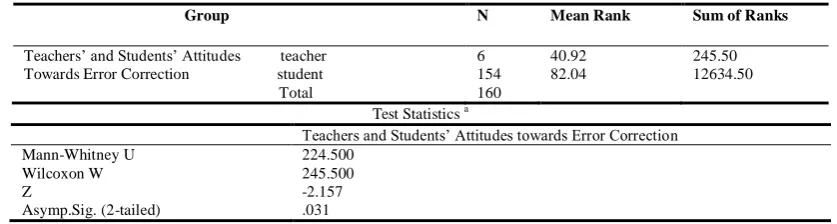
As displayed in Table 6, the value of Sig. is 0.00<0.05, so the data of the two groups do not distribute normally. Not satisfying the conditions for parametric tests, Man-Whitney U test is utilized to test whether there is discrepancy in attitudes to error correction between teachers and students in Integrated English Classrooms.
TABLE 7
ATTITUDES TO ERROR CORRECTION
Group N Mean Rank Sum of Ranks
Teachers’ and Students’ Attitudes teacher Towards Error Correction student Total
6 154 160
40.92 82.04
245.50 12634.50
Test Statistics a
Teachers and Students’ Attitudes towards Error Correction Mann-Whitney U
Wilcoxon W Z
Asymp.Sig. (2-tailed)
224.500 245.500 -2.157 .031
a. Grouping Variable: Group
Mann-Whitney U test revealed that there exists a discrepancy in teachers’ and students’ attitudes to error correction since the value of Asymp. Sig. is .031 (<0.05). Therefore, the results display that it is statistically significant in attitudes to corrective feedback between teachers and students as a whole, which can be shown by Table 8 exhibiting the responses to each statement in the questionnaires.
TABLE 8
ATTITUDES TO EACH STATEMENT OF ERROR CORRECTION
S1 S2 S3 S4
Mann-Whitney U Wilcoxon W Z
Asymp. Sig. (2 tailed)
371.500 12306.500 -. 920 .357
329.000 350.000 -1.283 .200
343.500 364.500 -1.247 .212
232.000 253.000 -2.210 .027
frequently in students’ spoken English need to be corrected; 3) Teachers should only correct errors affecting the success of communication. The values of Sig. are 0.357, 0.200 and 0.212 respectively, higher than the significance value of 0.05. But there indeed exists a discrepancy in attitudes to whether correcting errors very often will affect students’ enthusiasm in speaking English in class since the value of Sig. is 0.027, lower than 0.05. And Table 9 can show clearly the frequencies of teachers and students’ responses to the fourth statement.
TABLE 9
VIEWS ON FREQUENTLY CORRECTING ERRORS
Teacher Student
S4 S4
Count % Count %
Strongly agree Agree Unclear Disagree Strongly disagree Total 1 4 0 1 0 6 16.7% 66.7% 0.0% 16.7% 0.0% 100% 10 40 20 74 10 154 6.5% 26.0% 13.0% 48.1% 6.5% 100%
66.7% of the teachers agreed that correcting errors too frequently would affect students’ enthusiasm in class while almost one half (48.1%) of the students showed a disagreement on this view, holding that correcting too often would not make them feel frustrated and depressed.
2. Views on Errors to be Corrected
Items 5 to 8 investigate what errors should be first corrected by teachers, and what errors are actually most frequently corrected by teachers, what errors are made most frequently by students and what errors are repaired most easily by students. And the tables below demonstrate the distinct views on each respectively.
TABLE 10
VIEWS ON ERRORS IN INTEGRATED ENGLISH CLASSROOMS
Errors corrected first
Errors corrected
most frequently
Errors made most frequently Errors repaired most easily Mann-Whitney U Wilcoxon W Z
Asymp. Sig. (2-tailed)
397.000 418.000 -.616 .538 435.000 456.000 -.261 .794 232.500 12167.500 -2.143 .032 307.500 328.500 -1.470 .141
It can be seen from the table that there is no difference in views on errors to be corrected first by teachers, errors corrected most frequently by teachers and errors repaired by students as the values of significance are larger than the significance level of .05. But as for the errors made most frequently by students, teachers and students showed different opinions as is shown by the value of significance (.032), lower than the significance level of .05. Table 11 reveals in detail the frequency of teachers and students’ attitudes to what errors were made most frequently by students.
TABLE 11
VIEWS ON ERRORS MADE MOST FREQUENTLY
Teacher Student
Errors made most frequently Errors made most frequently
Count % Count %
Phonological errors Lexical errors Grammatical errors Pragmatic errors 0 0 3 3 0.0% 0.0% 50.0% 50.0% 48 23 47 36 31.2% 14.9% 30.5% 23.4%
Total 6 100% 154 100%
Table 11 clearly shows that all teachers believed students made grammatical and pragmatic errors most frequently while students held that they made more phonological errors, followed by grammatical errors and pragmatic errors.
To sum up, there is discrepancy in views on errors made most frequently by students between teachers and students. 50% of the teachers hold that students made grammatical errors most frequently and 50% view that students made pragmatic errors most frequently, while the highest proportion (31.2%) of the students think that they made phonological errors most frequently. As to errors corrected first and corrected most frequently by teachers, errors repaired most easily by students, both teachers and students shared similar views.
3. Discrepancy in Corrective Feedback Types across Different Errors
Multiple-choice tests were used in the questionnaire to check whether there is a discrepancy in acceptability of CF types (Lyster & Ranta, 1997) across error types between teachers and students in Integrated English Classrooms. The results are presented through the multiple response analysis of SPSS software in terms of these four types of errors involved.
TABLE 12
ACCEPTABILITY OF CFTYPES REGARDING FOUR TYPES OF ERRORS Group
Total teachers students
Phonological errors a
explicit correction Count 1 41 42
% within Group 16.7% 26.6 %
recast Count 2 59 61
% within Group 33.3% 38.3%
metalinguistic feedback Count 0 70 70
% within Group 0.0% 45.5%
repetition Count 4 47 51
% within Group 66.7% 30.5%
clarification request Count 1 36 37
% within Group 16.7% 23.4%
elicitation Count 4 68 72
% within Group 66.7% 44.2%
Total Count 6 154 160
Lexical errors a explicit correction Count 3 79 82
% within Group 50.0% 51.3%
recast Count 0 47 47
% within Group 0.0% 30.5%
metalinguistic feedback Count 4 46 50
% within Group 66.7% 29.9%
repetition Count 1 43 44
% within Group 16.7% 27.9%
clarification request Count 1 33 34
% within Group 16.7% 21.4%
elicitation Count 5 57 62
% within Group 83.3% 37.0%
Total Count 6 154 160
Grammatical
errors a explicit correction Count % within Group 2 33.3% 75 48.7% 77
recast Count 0 44 44
% within Group 0.0% 28.6%
metalinguistic feedback Count 0 46 50
% within Group 0.0% 29.9%
repetition Count 3 38 41
% within Group 50.0% 24.7%
clarification request Count 1 33 34
% within Group 33.3% 20.8%
elicitation Count 5 67 72
% within Group 83.3% 43.5%
Total Count 6 154 160
Pragmatic errors a explicit correction Count 2 79 81
% within Group 33.3% 51.3%
recast Count 0 50 50
% within Group 0.0% 32.5%
metalinguistic feedback Count 0 43 43
% within Group 0.0% 27.9%
repetition Count 3 32 35
% within Group 50.0% 20.8%
clarification request Count 2 36 38
% within Group 33.3% 23.4%
elicitation Count 5 65 70
% within Group 83.3% 42.2%
Total Count 6 154 160
Percentages and totals are based on respondents.
a
Dichotomy group tabulated at value 1.
Regarding phonological errors between teachers and students, Table 12 shows clearly that there exists difference in terms of the acceptability of CF types. 66.7% of the teachers accepted repetition and elicitation, while 45.5% of students accepted metalinguistic feedback most. And 33.3% of the teachers and 44.2% of the students considered recast and elicitation as a second option when dealing with phonological errors. Although students preferred metalinguistic feedback among the CF types to handle phonological errors, none of the teachers tended to accept this corrective strategy. Therefore, it can be concluded that the most acceptable CF type for phonological errors in teachers’ eyes is repetition or elicitation, and metalinguistic feedback for students. The least acceptable CF type of students is clarification request with a percentage of 23.4%, while that of teachers is metalinguistic feedback.
vividly depicts that teachers most accepted elicitation taking up 83.3%, followed by metalinguistic feedback (66.7%) and explicit correction (50.0%), while it is easier for students to accept explicit correction at a rate of 51.3%. In a word, to treat lexical errors, teachers most accepted elicitation while students may prefer explicit correction. And none of the teachers accepted recast to deal with lexical errors, but students least accepted clarification request regarding lexical errors.
As is shown in the crosstab, in terms of grammatical errors teachers’ most accepted type of CF was elicitation (83.3%), while no one favored recast or metalinguistic feedback dealing with grammatical errors. However, students’ most accepted CF types were explicit correction and elicitation, with only 33/154 selected clarification request to handle grammatical errors. It can thus be concluded that actually the acceptability of CF types regarding grammatical errors between teachers and students in Integrated English Classrooms is also various.
As for pragmatic errors, teachers and students also showed discrepancy. Teachers most accepted elicitation (83.3%), but no one preferred recast or metalinguistic feedback to deal with pragmatic errors. However, the students’ most accepted CF type was explicit correction (51.3%) while the least accepted was repetition (20.8%).
Therefore, it can be summed that there exists a discrepancy in acceptability of CF types across different error types between teachers and students in Integrated English Classrooms, which can be demonstrated in Table 13 below:
TABLE 13
THE MOST AND LEAST ACCEPTABLE CFTYPES ACROSS DIFFERENT ERRORS
The most acceptable CF type The least acceptable CF type
teachers students teachers students
Phonological errors repetition/ elicitation
metalinguistic feedback
metalinguistic feedback
clarification request Lexical errors elicitation explicit correction recast clarification
request Grammatical errors elicitation explicit correction recast/metalinguistic
feedback
clarification request Pragmatic errors elicitation explicit correction recast/metalinguistic
feedback
repetition
As is shown in the table, teachers and students did not reach an agreement on the most and least acceptable CF types across different errors. For phonological errors, teachers most accepted repetition or elicitation and least accepted metalinguistic feedback, which was exactly students’ most acceptable CF type in terms of phonological errors. Besides, it can be seen that teachers preferred elicitation to treat lexical, grammatical and pragmatic errors, but students more accepted explicit correction. In the meantime, recast and metalinguistic feedback were not favored by teachers across the four error types, and clarification request was least acceptable CF type in the eyes of students.
D. Reasons for the Discrepancy
4 teachers and 12 students from the 3 universities received the follow-up interview and yielded some information which can help further illustrate as to why teachers and students accepted some CF types more and some less.
1. Reasons for Teachers’ Acceptability
As shown above, teachers in this study preferred elicitation most among the 6 CF types, and the observations reaffirmed their actual practices in Integrated English Classrooms as elicitation was at a rate of 22.3%. Besides, the questionnaires revealed that teachers accepted recast and metalinguistic feedback least to respond to students’ errors in Integrated English Classrooms. In order to explore what might account for this phenomenon, 4 teachers were interviewed. What the teachers said during the interview can serve as thick description about their most and least acceptable CF types.
First of all, 3 out of 4 teachers interviewed held that corrective feedback should be orientated at making students notice their own errors and correct themselves. Elicitation is a good way to achieve that goal, which can help students gradually realize that they have made linguistic errors in speaking:
Giving students a chance to find out their linguistic errors and then repairing them by themselves is more beneficial to the development of spoken English. Sometimes, they indeed cannot notice their errors, so teachers may help them through elicitation. And excellent teachers should make students find out their errors and correct them by themselves (Teacher 1, from Central South University of Forestry and Technology).
Besides, teachers believed that elicitation can get students involved in the classroom interaction and help them arouse interest in English learning. It is informed that actually the students do not show great interest in learning when they first came to the university after years of hard work in the middle school, therefore, the motivation for English learning need to be inspired. Thus, teachers would consider CF types which do not discourage students’ participation, and elicitation is a compromising method to realize the aim.
I really hope that students can find out the linguistic errors prompted by me and repair them on their own initiatives. Besides, elicitation would not frustrate the students to learn English (Teacher 2, from Hunan Normal University).
Moreover, students would have senses of success in correcting their own errors with the help of teachers. They would be encouraged to participate in more classroom interactions.
them. And they would be more interested in interacting with me, so I like to use elicitation to correct their errors (Teacher 3, from Hunan University).
And teachers least accepted metalinguistic feedback and recast among the CF types. In the interviews, teachers conveyed that metalinguistic feedback was rather boring, which would affect the enthusiasm for English learning and it could not help teachers build a lively atmosphere. In addition, recast cannot help students notice the corrected words or expressions if the students do not listen carefully.
2. Reasons for Students’ Acceptability
As mentioned above, the students’ most accepted CF type was explicit correction and their least accepted was clarification request. The interview transcriptions of the 12 students disclosed the reasons why they preferred explicit correction and tended not to accept clarification requests.
9 out of 12 students pointed out that explicit correction could make them easily and clearly understand what errors they have made, where they went wrong, and how they had to correct their errors with the help of teachers:
In my opinion, error correction should be explicit and direct. I just hope teachers to explain to me where I was wrong and how to correct the errors. And I don’ think I would feel embarrassed. I think it’s natural to make errors or mistakes when learning a language (Student 7, from Hunan Normal University).
Besides, 6 students stated that by explicit correction they could obtain accurate and professional answers from teachers, which could impress them, and they felt they could learn directly:
When the teacher gives explicit correction, I can feel that I have made some errors and she is correcting my errors. And the correction can make me impressed and remember deeply. Moreover, teachers’ suggestions would be more professional and helpful (Student 5, from Hunan Normal University).
Additionally, a few students held that explicit correction could save a lot of time in figuring out the errors:
I like explicit correction as it is direct, so I could use my brain less, which saved me a lot of time (Student 1, from Hunan University).
In terms of the least acceptable CF type, the interviewed students gave their explanations why they least accepted clarification request. 10 out 12 of the students conveyed that clarification request was vague and unclear in that clarification request did not help them realize what the errors were, and they did not understand the intentions and purposes of teachers.
In fact, I really don’t like clarification request because it fails to provide any useful information for me, and it also makes feel confused and puzzled when the teacher says “Pardon?” or “Sorry?” to me. I might consider that whether my voice is too low or the teacher did not listen to me carefully. And I won’t realize I have made some errors just now. So, I do not think this way can help me a lot (Student 2, from Central South University of Forestry and Technology).
Overall, 12 in-depth follow-up interviews confirmed the reasons for the discrepancy in acceptability of CF types between teachers and students in Integrated English Classrooms. Students indicated that they most accepted explicit correction rather than the frequently-used recast, as explicit correction can assist in recognizing students’ linguistic errors quickly and get accurate and professional answers from teachers directly. Conversely, the students pointed out that they least accepted clarification request since it was vague and inconspicuous feedback, which is hard for them to notice their own errors and difficult to understand the corrective intentions and purposes of teachers. Therefore, the students insisted that clarification request is not of great help in correcting errors in spoken English.
V. CONCLUSION
Based on the results and discussion above, some major findings concerning the three research questions can be obtained, and some pedagogical implications can be suggested.
A. Major Findings
First of all, in Integrated English Classrooms the most frequently-used CF types were recast and elicitation, up to 37.1% and 22.3% respectively of all the feedback moves.
Secondly, Teachers used different CF types to deal with different learner errors. Teachers adopted recast and explicit correction more frequently to deal with phonological errors, elicitation to correct lexical errors, metalinguistic feedback to do with grammatical errors and explicit correction to treat pragmatic errors.
Thirdly, there was a discrepancy in acceptability of CF types across error types between teachers and students, with teachers accepting elicitation most to deal with lexical, grammatical and pragmatic errors while students accepting explicit correction to correct these errors. Additionally, teachers accepted metalinguistic feedback or recast least to treat the four types of errors, however, the students’ least accepted CF type is clarification request.
Lastly, there was also a discrepancy in teachers’ acceptability of CF types and their actual classroom CF practices. Teachers accepted elicitation most to treat phonological, grammatical and pragmatic errors, however, in actual classrooms, concerning students’ emotions, language proficiency, class hours and other factors, they used recast most frequently to correct phonological errors, metalinguistic feedback to deal with grammatical errors and explicit correction to handle pragmatic errors.
Firstly, phonological errors make up the largest proportion of all the errors (46.8%). Integrated English teachers should be encouraged to provide students with more CF to deal with phonological errors because the students interviewed persisted that most of them were confronted with phonological problems in their spoken English.
Secondly, teachers in Integrated English Classrooms are obliged to utilize more explicit correction to deal with all errors since explicit correction was the most acceptable CF type among students.
Finally, in order to promote the efficacy of foreign language teaching and learning, teachers should equip themselves with more information about CF and communicate more with their students to know the preferences of students for CF types across different errors.
REFERENCES
[1] Ahangari, S. & Amirzadeh, S. (2011). Exploring the Teachers’ Use of Spoken Corrective Feedback in Teaching Iranian EFL Learners at Different Proficiency Level. Procedia-Social and Behavioral Science (29), 1859-1868.
[2] Ellis, R. (2009). Corrective Feedback and Teacher Development. L2 Journal (1), 3-18.
[3] Ellis, R. (2012). Language Teaching Research and Language Pedagogy. Chichester: John Wiley & Sons, Inc.
[4] Esmaeili, F. (2014). A Study of Corrective Feedback and Learner Uptake in Classroom Interactions. International Journal of Applied Linguistics & English Literature (4), 204-212.
[5] Hao Baogui. (2009). A Comparative Study of Oral Error Correction in Senior High School Classroom Teaching. M.A Thesis. Changchun: Dongbei Normal University
[6] Hendrinkson, J. (1978). Error Correction in Foreign Language Teaching: Recent Theory, Research and Practice. Modern Language Journal (62), 387-398.
[7] Iraji, S. et al. (2014). Corrective Feedback and Learners’ Uptake across Gender in an EFL Context. Procedia-Social and Behavioral Sciences (98), 680-687.
[8] Kartchava, E. (2013). The Place of Corrective Feedback within the Major SLA Theories. US-China Foreign Language (11), 136-151.
[9] Keyu Zhai et al. (2018). Effects of corrective feedback on EFL speaking task complexity in China’s university classroom.
Cogent Education 1 (5), 1-13
[10] Krashen, S. D. (1982). Principles and Practice in Second Language Acquisition. Oxford: Pergamum.
[11] Lee, E. (2013). Corrective Feedback Preferences and Learner Repair among Advanced-level Adult ESL Students. System 41, 217-230.
[12] Lee, A. & Lyster, R. (2016). The effects of corrective feedback on instructed L2 speech perception. Studies in Second Language Acquisition, 38(1), 35–64.
[13] Liu Xiaoling & Zhou Changping. (2018). The Effect of Online Feedback Types on Foreign Language Writing. Theory and Practice in Language Studies. 8(7), 733-741
[14] Lightbown, P. & Spada, N. (2006). How Languages are Learned. Oxford: Oxford University Press. [15] Lyster, R. & Ranta, L. (1997). Corrective Feedback and Learner Uptake. SSLA (20), 37-66.
[16] Lyster, R., K. Saito & M. Sato. (2013). Oral corrective feedback in second language classrooms. Language Teaching 46(1), 1-40.
[17] Nassaji, H. (2007). Elicitation and Reformulation and Their Relationship with Learner Repair in Dyadic Interaction. Language Learning (57), 511-548.
[18] Panova, I. & Lyster, R. (2002). types of Corrective Feedback and Uptake in an Adult ESL classroom. TESOL Quarterly (36), 573-595.
[19] Rassaei, E. (2015). Oral Corrective Feedback, Foreign Language Anxiety and L2 Development. System (49), 98- 109. [20] Schmidt, R. (1990). The Role of Consciousness in Second Language Learning. Applied Linguistics (11), 128-158. [21] Sheen, Y. (2011). Corrective Feedback, Individual Differences and Second Language Learning. New York: Springer.
[22] Su Jianhong. (2014). Influence of Learners’ Thinking Style on the Effectiveness of Written Corrective feedback. Foreign Languages and Their Teaching (4), 45-50.
[23] Suzuki, M. (2004). Corrective Feedback and Learner Uptake in Adult ESL Classrooms. Columbia University Working Papers in TESOL & Applied Linguistics (4), 1-21.
[24] Xu Jingfen. (2015). Corrective Feedback and Foreign Language Teaching. Second Language Learning Research (1), 17-29 [25] Zhao Chen. (2005). A Corpus-based Study of Teachers’ Corrective Feedback in English Classroom Interaction Journal of PLA
University of Foreign Languages (3), 35-44.
Xiaoling Liu was born in Ningxiang, Hunan, P.R. China in 1964. She received her TESOL certificate from City University of New York and master’s degree from Hunan University, P.R. China in 1987. She is currently a full professor in the College of Foreign languages, Hunan University, Changsha, Hunan, P.R. China. Her research interests include Applied Linguistics, Foreign language Teaching and Learning.