ISSN: 2333-6390 (Print), 2333-6404 (Online) Copyright © The Author(s). 2014. All Rights Reserved. Published by American Research Institute for Policy Development
Problems and Prospect of Labour Management Relations in the Nigerian Oil and Gas Industry: Some Conceptual and Contextual Issues
Onyemaechi Joseph Onwe1
Abstract
The major issue of interest in this presentation is the observed current unstable nature of labour management relations in Nigeria, resulting in continuous labour disputes. The focus is on the Nigerian oil and gas industry. The presentation stresses the relative importance of this industry in the development of the Nigerian economy. Our methodology was purely analytical, with emphasis on inferences that were aimed at making valid contributions in management of labour relations in the Nigerian oil and gas industry. The analytical results revealed three major problems facing the managers of labour in the oil and gas industry: (i) the problem of change and change management; (ii) the problem of proliferation of trade unions; and, (iii) the problem of differential remunerations and employee benefits. With these observations, the presentation proposed relevant strategic management processes including: a survey-feedback strategy; team building; managerial grid; sensitivity training; effective leadership; workplace training; a functional management information system; and, sharing of common goals among the management and employees.
Introduction
The socio-economic conditions in Nigeria have had some rapid changes since its independence in 1960. Such changes were in response to the dynamic nature of the global economic environment.
Additionally, the Nigerian economy has undergone a process of transition from government ownership of the production and distribution process to an open and market driven process.
1 PhD, School of Management Sciences, National Open University of Nigeria, 14/16 Ahmadu Bello
In response to the emerging trends in globalisation, new approaches and responses to labour management relations have began to emerge as employees and other stakeholders in the oil and gas industry seek to find appropriate responses to shocks from technological advancement and foreign competition. The search for such responses often led to what we refer to as industrial disputes.
In addition to the changing economic conditions, the political and industrial relations environment in Nigeria has experienced rapid changes in recent decades. Observed implication of such changes has been continuous labour disputes leading to employee strikes and work stoppages.
This presentation examines the emerging issues in labour management relations in general and, in particular, in the Nigerian oil and gas industry. The aim is to make valid contribution to the strategic management of industrial/labour relations in the oil and gas industry. To achieve this aim, the rest of the paper is organised as follows: a brief review of the conceptual and contextual issues; examination of the nature of labour movements in Nigeria, with emphasis on trade unionism in the oil and gas industry; and, recommendations on the strategic approaches to labour relations management in the Nigerian oil and gas industry.
The Conceptual and Contextual Issues
The second version of the debate emphasises the calculative, quantitative, and strategic management aspects of managing the workforce in a rational way (Storey, 1989).
Some researchers in this area have developed models that demonstrate, analytically, the qualitative differences between conventional personnel management and human resources management issues. Such researchers included Beer et al (1984), Fombrun et al (1984), Guest (1987), Hendry and Pettigrew (1990), and Storey (1992). We examine the models proposed by first three of the listed researchers.
The Fombrun et al model emphasises the interrelatedness and coherence of labour management activities. The labour management cycle, according to this model consists of four key constituent components, including: selection, appraisal, development and rewards, as presented in figure 1 below.
Figure 1: The Fombrun, Tichy and Devanna Model of Labour Management
Source: Adapted from Braton and Jefrey (1999: 18)
These activities are aimed at increasing organizational performance.
The Fombrun model has however, been criticized for the fact that it appears to have ignored different stakeholder interests, situational factors, and the notion of management’s strategic choice.
Selection Performance Appraisal Human Resource Development
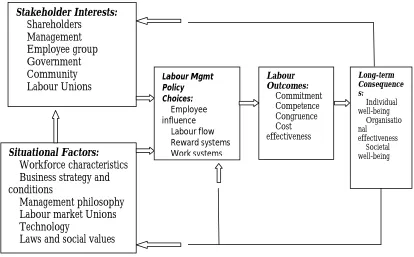
It was such shortfalls that led to Beer et al’s emphasis on the analytical framework on the ‘Harvard model’, illustrated in figure 2 that follows.
Figure 2: The Harvard Model of Labour Management
Source: Beer et al (1984)
The framework of the Harvard model, according to Beer et al (1984), and as can be inferred from figure 2, consists of six basic components:
Situational factors, which influences management’s decision on a labour management strategy.
Stakeholders’ interests, which recognizes the importance of trade-offs, either explicitly or implicitly, between the interests of owners or shareholders and those of the employees and their Unions.
Labour management policy choices, which emphasise the fact that management’s decisions and actions in the management of labour can be fully appreciated only if it is recognized that such decisions and actions result from interaction between constraints and choices.
Stakeholder Interests:
►Shareholders
►Management
►Employee group
►Government
►Community
►Labour Unions
Labour Mgmt Policy Choices:
►Employee influence
►Labour flow
►Reward systems
►Work systems
Labour Outcomes: ►Commitment ►Competence ►Congruence ►Cost effectiveness Long-term Consequence s: ►Individual well-being ►Organisatio nal effectiveness ►Societal well-being Situational Factors:
►Workforce characteristics
►Business strategy and conditions
►Management philosophy
►Labour market Unions
►Technology
Labour outcomes, reflecting high employee commitment to organizational goals and high individual performance leading to cost-effective products or services, assuming that employees have talents that are rarely fully utilised at work and they indicate the desire to experience growth through work.
Long-term consequences, which distinguishes between three levels: individual, organisation, and societal levels. At the individual employee level, the long-term consequences comprise the psychological rewards workers receive in exchange for their efforts. At the organisational level, increased effectiveness ensures the survival of the organization. At the societal level, some of the society’s goals (employment and growth) are attained as a result of full utilisation of people at work.
The feedback loop through which the outputs flow directly into the organization and to the stakeholders.
Finally, Guest (1989, 1997) developed what can be viewed as a more prescriptive theoretical framework that reflects the general view that a core set of integrated labour management practices can achieve superior individual and organizational performance. The central hypothesis of Guest’s model is that if an integrated set of labour management practices is applied in a coherent manner, with a view of achieving the normative goals of high employee commitment, high quality assurance, and task flexibility, the result would be a superior individual performance. The model also assumes that this will give rise to superior organisational performance. It has six components:
A set of labour management strategies
A set of labour management practices
A set of labour management outcomes
Behavioural outcomes
A number og performance outcomes
Financial outcomes
Figure 3: The Guest’s Model of Labour Management
Labour management strategiesLabour management practicesLabour management outcomesBehavioural outcomesPerformance outcomesFinancial outcomes
♦Differentiation (innovation) ♦Focus (quality
assurance)
♦Cost effectiveness (cost reduction) ♦Selection ♦Training ♦Appraisal ♦Rewards ♦Job design ♦Involvement ♦Status and security ♦Commitment ♦Quality products ♦Flexibility ♦Efforts/ Motivation ♦Cooperation ♦Involvement ♦Organisational Citizenship ♦High: Productivity Quality assurance Innovation ♦Low: Absenteeism Labour turnover Conflicts Customer complaint ♦Profits ♦High return on investment
Source: Adapted from Branton and Jeffrey (1999:21)
Guest’s model acknowledges the close links between labour management strategy and general business strategies: differentiation, focus, and cost-effectiveness strategies. The core principle of the model’s hypothesis is that labour management practices should be designed to lead to a set of labour management outcomes of high employee commitment, high quality employees, products, and services, and highly flexible employees. Guest views high employee commitment as a vital labour management outcome, concerned with the goals of binding the employees to the organization and obtaining behavioural outcomes of increased effort, cooperation, involvement, and organizational citizenship.
It is the gross misconception or ignorance of the above models and their prescriptions the can lead to clashes between organizational and employee interests. Such clashes appear to be the origin of industrial conflicts that can lead to industrial actions. In the following section, we examine briefly the nature of labour movements in Nigeria.
The Nature of Labour Movements in Nigeria and Emergence of Trade Unionism in Oil and Gas Industry
Labour movements in Nigeria exist for the primary purpose of protecting the interests of employees and the society at large. By implication, there exists disunity and lack of cooperation among employees and organisations in Nigeria.
Beginning from 1989 and under the leadership of Ibrahim Babangida, the major labour Union in Nigeria, the Nigerian Labour Congress (NLC) had the following affiliate labour Unions (NLC, 2009):
1. Agric and Allied Employees Union of Nigeria (AAEUN)
2. Amalgamated Union of Public Corporation, Civil Service Technical and Recreational Services Employees
3. Maritime Workers Union of Nigeria
4. Medical and Health Workers Union of Nigeria
5. National Association of Nigerian Nurses and Midwives 6. National Union of Air Transport Employees
7. National Union of Banks, Insurance and Financial Institutions Employees
8. National Union of Chemical, Footwear, Rubber, Leather and Non-Metallic Employees
9. National Union of Civil Engineering, Construction, Furniture and Wood Workers 10. National Union of Electricity Employees
11. National Union of Food, Beverages and Tobacco Employees 12. National Union of Hotels and Personal Services Workers 13. National Union of Petroleum and Natural Gas (NUPENG)
14. National Union of Posts and Telecommunication Employees (NUPTE) 15. National Union of Printing, Publishing and Paper Products Workers 16. National Union of Shop and Distributive Employees
17. National Union of Textile, Garment and Tailoring Workers of Nigeria 18. Nigeria Civil Service Union (NCSU)
19. Nigeria Union of Civil Service Secretariat Stenographic Workers 20. Nigeria Union of Journalists (NUJ)
21. Nigeria Union of Local Government Employees (NULGE) 22. Nigeria Union of Mine Workers (NUMW)
23. Nigeria Union of Pensioners 24. Nigeria Union of Railwaymen
25. Non-Academic Staff Union of Educational and Associated Institutions 26. Radio, Television and Theatre Workers Union
27. Steel and Engineering Workers Union of Nigeria (SEWUN) 28. National Union of Road Transport Workers (NURTW) 29. Nigeria Union of Teachers (NUT)
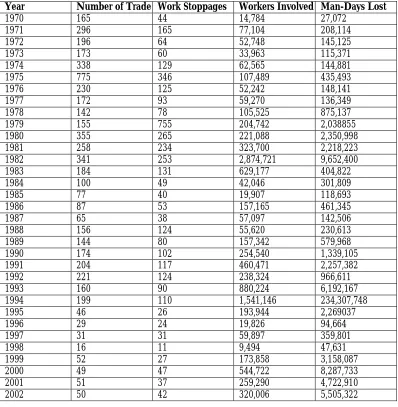
The above list gives the impression that labour management relationship in Nigeria is nothing to write home about. We can also appreciate the dynamic nature of the labour management problems most West African countries. A discouraging situation is that labour movements in Nigeria is grossly characterized by trade disputes and industrial conflicts that had always led to labour Union strikes, work stoppages, economic and political instabilities. According to available statistics, the structure of trade disputes in Nigeria is summarised in table 4 below.
Table 4: Structure of Trade Disputes in Nigeria, 1970 – 2000
Year Number of Trade DisputesWork Stoppages Workers Involved Man-Days Lost
1970 165 44 14,784 27,072
1971 296 165 77,104 208,114
1972 196 64 52,748 145,125
1973 173 60 33,963 115,371
1974 338 129 62,565 144,881
1975 775 346 107,489 435,493
1976 230 125 52,242 148,141
1977 172 93 59,270 136,349
1978 142 78 105,525 875,137
1979 155 755 204,742 2,038855
1980 355 265 221,088 2,350,998
1981 258 234 323,700 2,218,223
1982 341 253 2,874,721 9,652,400
1983 184 131 629,177 404,822
1984 100 49 42,046 301,809
1985 77 40 19,907 118,693
1986 87 53 157,165 461,345
1987 65 38 57,097 142,506
1988 156 124 55,620 230,613
1989 144 80 157,342 579,968
1990 174 102 254,540 1,339,105
1991 204 117 460,471 2,257,382
1992 221 124 238,324 966,611
1993 160 90 880,224 6,192,167
1994 199 110 1,541,146 234,307,748
1995 46 26 193,944 2,269037
1996 29 24 19,826 94,664
1997 31 31 59,897 359,801
1998 16 11 9,494 47,631
1999 52 27 173,858 3,158,087
2000 49 47 544,722 8,287,733
2001 51 37 259,290 4,722,910
2002 50 42 320,006 5,505,322
The oil and gas industry is known as a strategy industry supporting economic development. Statistics show that oil and gas industry constitute about 90 percent of Nigeria’s foreign exchange earning and 83 percent of the gross national product, GDP (Ogbeifun, 2008).
The history of oil and gas industry in Nigeria indicates that oil exploration began in 1908 in Lagos and Okitipupa coastal areas of the then Western Nigeria. The exploration was spearheaded by the then Nigerian Bitumen Company that was established by a German consortium of oil explorers. Between the periods of 1908 and 1956, oil was discovered in commercial quantity, and various explorations and exploitation began to take place in various parts of Nigeria. Commercial activities on oil began in 1956 at Oloibiri, the present day Bayelsa State, by Shell D’Arcy (Ihua, Ajayi, and Eloji, 2009).
This development signaled Nigeria’s interest in the membership of Organisation of Petroleum Exporting Countries (OPEC) in 1971. The exploration of oil and gas in commercial quantities was predominantly concentrated at the Niger Delta geographical zone, where multinational companies were engaged in the exploration and production of oil and gas.
The Nigerian oil and gas industry has three categories: the upstream sector; the downstream sector; and, the service sector. The upstream sector focuses on mining, exploration, production and exportation. Such oil companies as Chevron, Shell, Agip, Elf, Texaco, and Esso-Mobil were the pioneers in the upstream sector. The major focus of the downstream sector is in the refinery process. This sector is also responsible for the distribution of oil and gas products in the country, through petrochemical plants and fuel stations. The service sector is responsible for technical and consultancy services that aid the upstream sector. The activities of the service sector has been coordinated by the Nigerian National Petroleum Corporation (NNPC).
Imafidon (2009), identified the following categories of employment and/or labour relationships in the Nigerian upstream oil and gas companies:
♦Regular Employees: These are the direct employees with the standard employment contract, including nationals and expatriates of three categories, managerial, senior, and junior staff. The managerial staffs constitute between 10 and 15 percent of the regular employees are not unionized. The senior staff constitute between 75 and 80 percent of the regular employees and belong to the Petroleum and Natural Gas Senior Staff Association (PENGASSAN). The junior staff constitute between 5 and 10 percent of the regular employees and belong to the National Union of Petroleum and Natural Gas Workers (NUPENG).
♦Labour Contract Employees: These are employees working with regular employees but without direct employment relationship with the oil and gas companies. They equally belong to the above trade unions and do carry out periodic collective bargaining for enforceable collective agreements.
♦Service Contract Employees: These are service contractors for different kinds of works in the oil and gas companies.
♦Casual Employees: These are daily paid employees hired in most cases for three months fixed duration. They assist in non-continuous work.
The four categories of employees work together, but are governed by varying levels of compensation and welfare benefits. The differential compensation and benefit structure in the oil and gas industry, upstream sector has generated unfavourable issues on employment relationships. These issues appear to have formed a significant portion of trade disputes, work stoppages, and other forms of industrial disharmony in the Nigerian Oil and Gas industry. We examine briefly the depth of unionism in the Oil and Gas Industry.
1. Shell D’Arcy Workers’ Union 2. BP Workers Union
3. Consolidated Petroleum Workers Union 4. Texaco African Workers Union
5. Esso Workers Union 6. Union of Shell Operations
7. Petroleum Tanker Drivers Union.
Strategic Approaches to Labour Management Relations in the Nigerian Oil and Gas Industry
Our discussions so far appear to be proposing three major problems in the management of labour relations in the Nigerian oil and gas industry. First is the problem of dynamism, implying internal and external changes. Internal changes would refer to the changes in managerial initiatives due to external community pressures. External changes would refer to both domestic country-wide regulatory and environmental changes and changes due to globalization. The second problem is the proliferation of labour unions as a result of ineffective management of labour relations and employment insecurity. Finally, the third problem emanate from the differential nature of employee remunerations and benefits.
Before approaching these problems, we examine the important steps in problems solving as suggested by the literature . Most current models of problem-solving techniques emphasise the following steps (Poole and Warner, 1998):
Step 1: Identifying and analysing the problem. In this step, we gather the information needed for the identification and specification of the real problem. The problem can then be analysed.
Step 2: Setting objective and establishing the criteria for success. This involves having a clear view of the end result in the solution process and of how success at achieving the objective will be measured.
Step 4: Decision Making. Here, the options are evaluated and decision is taken on the best course of action.
Step 5: Implementation. This requires planning what needs to be done and implementing the action plan.
Step 6: Reviewing or Evaluating Success. This is a very critical step requiring the assessment of what went well, what did not go well and the implications for the future.
Each of these steps is important but, as Francis (1990) put it, it is sometimes useful to apply flexibility in the recommended structure. We can now address the problems of labour management relations in the Nigerian oil and gas industry.
The first problem, the problem of change management, can be approached using the basic change management principles. Akerele and Akerele (2000) cited the following strategic principles:
♦The Survey-feedback Principle: This is where employees’ views are sought through administration of survey questionnaire in order to establish the areas where employees will not resist or will require changes in the organization.
♦Team building Principle: The team building principle attempts to establish cooperative and trusting attitudes of members to accept mutual dependence and co-responsibility.
♦Managerial Grid Principle: This combines concern for both people and output to ensure effective implementation of change and its permanence in the organization.
♦Sensitivity Training: This encourages the development of awareness of, and sensitivity to, oneself and others.
There is another change management strategy that was proposed by Lewin (1947). The strategy involves three stage processes:
The second stage is the changing stage, where new responses to the change situation are developed based on available information. At this stage, the change subjects are encouraged to accept the new mode of responses, and such acceptance can be motivated by rewards.
The third stage is the refreezing stage, whereby the change subjects internalise the new position of things. When the change subjects observe small events from top management, that signifies the permanency of the new situation, refreezing will finally take place and the new mode of behaviour is internalised and integrated into the individual’s personality.
The second problem, the problem of proliferation of labour unions, can be approach through effective leadership, workplace learning, appropriate management information system, and encouraging management and workers to share common goals.
Effective Leadership can be used in building employee commitment and cooperation which can be an essential feature of organizational trust. A committed, and cooperating employee group are more likely to shorn unionism and trade disputes than non-cooperating, non-committed employee group.
Workplace Learning. Workplace learning is an interdisciplinary body of knowledge and theoretical inquiry that draws upon adult learning and management theory. In practice, it is that at the individual, group, and organizational level. For the workers and managers alike, workplace learning provides opportunity for progress or growth at work based on individual achievements. An organisation’s investment in workplace learning acts as a powerful signal of its intentions to develop employees. This can encourage individual and group commitment to the organization.
Appropriate Management Information System. A good management information system can be a powerful tool for avoiding unionism, employee unrests, and trade disputes. Research has indicated that a handful of trade disputes are caused by misinformation on management decisions among the employee groups.
There is the theoretical and practical belief that if all workers are fully integrated into the organization, they would identify with their organisation’s goals and management’s problems, so that what is good for the company and management is perceived by workers as also being good for them.
The last identified problem, differentiated employee remunerations and benefits, can be approached simply by full-time employment of workers. It can be said that contract and casual employments can do an organization more harm than good. With full-time employment, an organization can avoid pressures arising from employee dissatisfactions.
Conclusion
The presentation began by observing that changes in the socio-economic conditions in Nigeria due to globalization have called for new approaches to labour management relations. We proceeded by examining the emerging issues in labour management relations, with the aim of making valid contributions to the strategic management of industrial relations in Nigeria in general and specifically, in the oil and gas industry.
The theoretical issues suggest two schools of thought concerning the significance of management of human relations in general: one emphasising the importance of high commitment, workplace learning, and enlightened leadership; and the other emphasising the calculative, quantitative, and strategic management aspects of managing the workforce in a rational way.
Regarding the problems and prospects of labour management relations in the Nigerian oil and gas industry, we observed as follows:
● The problem of change and change management;
● The problems arising from the proliferation of trade unions; and,
Based on these observations, we recommend the following strategies for the way forward:
● The Survey-feedback strategy;
● Team building;
● Managerial grid;
● Sensitivity training;
● Effective leadership;
● Workplace training;
● A functional management information system; and,
● The Sharing of common goals among the management and employees.
References
Akerele Olufunke and Akerele Adebayo (1990). Organisational change in Nigeria: some empirical evidence, Nigerian Management Review, vol. 11, nos 1 – 7:794 – 808. Beer, M., Spector, B., Lawrence, P.R.(1984) Managing Human Assets, New York: Fress Press. Branton, J. and Jeffrey, G (1999) Human Resource Management: Theory and Practice, 2nd
Edition, New York: Palgrave.
Fajana, S. (2006) Industrial Relations in Nigeria, Lagos: Labofin and Company.
Fombrun, C, Tichy, N.M. and Devanna, M.A. (eds) (1984) Strategic Human Resource Management, New York: Wiley.
Francis, D. (1990) Effective Problem Solving, London: Routledge.
Guest, D. (1989) HRM: implications for industrial relations. In Storey, J. New Perspectives on Human Resource Management, London: Routledge.
Guest, D. (1997) Human resource management and performance: a review and research agenda, The International Journal of Human Resource Management, vol 8, no. 3: 263-76.
Hendry, C., Pettigrew, A. (1990). Human resource management: an agenda for the 1990s, International Journal of Human Resource Management, vol. 1, no. 1:17-44.
Herzberg, F. (1966) Work and the Nature of Man, Chicago, Ill.: World Publishing Company. Ihua, U.B., Ajayi, C. and Eloji, K.N. (2009) “Nigerian content policy in the oil and gas
industry: Implications for small to medium-sized oil services companies,” Proceedings of the 10th Annual Conference, IAABD
Imafidon, E.O (2009) “Culture, interests and institutions: A review of industrial relations and collective bargaining dynamics in the Nigerian upstream oil and gas industry.” An Unpublished Manuscript.
Legge, K. (1989) Human resource management: a critical analysis. In Storey, J. (ed.) New Perspectives on Human Resource Management, London: Routledge.
McGregor, D. (1960) The Human Side of Enterprise, New York: McGraw-Hill
Nigerian Labour Congress (2009). Affiliate unions to the Nigerian labour congress. Retrieved from: http://www.nlc.ng.org, February 25.
Ogbeifun, L.B. (2008) “Labour crisis in the oil and gas sector: Challenges to development in the oil and gas sector”. Paper Presented at a Workshop organised by NIM, Jos. Storey, J. (ed.) (1989) New Perspectives on Human Resource Management, London:
Routledge.