ISSN 1822–8402 EUROPEAN INTEGRATION STUDIES. 2012. No 6
CLIMATE CHANGE AND SUSTAINABLE DEVELOPMENT – AS EXPERIENCE IN THE
STUDY COURSES
Natalija Cudecka-Purina, Dzintra Atstaja
BA School of Business and Finance, Latvia e-mail: [email protected], [email protected]http://dx.doi.org/10.5755/j01.eis.0.6.1488
Sustainable development and climate change retain stable position in the study process. Technological possibilities and the inventiveness of teaching staff allow combine diverse methods, enabling the students to obtain not only theoretical knowledge, but also strengthen the conviction about the necessity to pursue environmentally friendly lifestyles and introduce green principles in entrepreneurship.
The Agenda 21 can be considered as a starting point in terms of pursuing a global model and global action plan of economic and social development. The importance of sustainable development was put on the agenda of many international organisations, not only the United Nations itself, but also governments from all over the world, business organisations, Non Governmental Organisations (NGOs) and also individuals. Since then, sustainable development is perceived as a collective responsibility rather than seen as someone else’s.
In its essence, sustainable development implies that all economic and technological progress must not jeopardize the survival of society as a whole and in particular put the environment at risk.
This remit puts an extraordinary pressure on innovation. It questions business as usual concerning, for instance, public affairs, corporate interests and human behaviours, in general. This will remain a continuous effort as new social and environmental challenges emerge.
Original approach to the study process is of vital importance for optimal result. Sustainable development and climate change open wide possibilities of illustrating and presenting comparisons for creative work. To teach sustainable development and climate change we can use models developed by other related disciplines, like ecological economics and environmental economics et al.
For teaching Sustainable development and climate change it is of vital importance to apply different methods in order the students would not only acquire theoretical knowledge, but also strengthen their confidence about environmentally friendly lifestyle and eco-efficiency principles in business, as well as encourage active involvement in sustainable development processes. This paper provides not only theoretical insight on the problem, but also gives an example of Latvian case in the field of waste management. The authors of the article sharing her teaching and researcher experience and present conclusions and practical samples for perfecting one’s knowledge and hope that this experience will be of use for they colleagues and will be grateful for any discussion, criticism and contributions to the topic under discussion.
Keywords: Case study, Climate change, regional waste management, study process, sustainable development.
Introduction
Adaption of climate change is increasingly becoming a management priority for government and private sector organizations across the globe, partly driven by a rationale that successful adaption will reduce the consequences of climatic impacts that are unavoidable Saleem J. et al., (2010).
The European Council in Göteborg (2001) adopted the
first EU Sustainable Development Strategy (SDS). This
was complemented by an external dimension in 2002 by the European Council in Barcelona in view of the World Summit on Sustainable Development in Johannesburg (2002). However, unsustainable trends in relation to climate change and energy use, threats to public health, poverty and social exclusion, demographic pressure and ageing, management of natural resources, biodiversity loss, land use and transport still persist and new challenges are arising. Since these negative trends bring about a sense of urgency, short- term action is required, whilst maintaining a longer term perspective. The main challenge is to gradually change our current
unsustainable consumption and production patterns and the non- integrated approach to policy-making.
The most common definition of sustainable development
was developed just in 1987 by United Nations in the report “Our Common Future” and is widespread used since United Nations Conference of Environment and Development, which took place in Rio de Janeiro in 1992. According to the UN, Sustainable development is one “which meets the needs of present without compromising the ability of future generation to meet their own needs” (McDoughall F., et al., 2003).
ISSN 1822–8402 EUROPEAN INTEGRATION STUDIES. 2012. No 6 enough capacity to develop new technologies for decoupling
the growth, they should pay more attention to education, awareness building and promotion of green lifestyles. In
order to find out the real possibilities to involve society in
the introduction of environment protection activities and to clarify a real situation regarding society’s attitude towards environmental problems we carried out surveyed the entrepreneurs in Latvia (Atstaja Dz., Dimante D. and Livina A., (2012).
Theoretical analysis of the scientific works and practical papers in this field was taken as the research method. Analysis
of statistical data and systems analyse was applied as well. Scientific originality and practical significance of the article is:
• There are highlighted the main examples of case study topics, included global warming problems and sustainable development.
• Proposed basic illustration of situation of case study.
• Explaining the knowledge and cooperation between BSR countries.
The research employed a combination of approaches; predominantly literature review, analyses of statistical date and interview methodologies. Recognising the need understand climate change adaption as an iterative learning process, the literature review, policy learning in the context sustainable development in the Latvia.
This article deals only with the ideas of some problems and results of climate change and sustainable development and the authors will be grateful for any discussion, criticism and contributions to the topic under discussion.
Results
Environmental education, environment protection law and cooperation
There are five objectives to start greening economy:
1) Awareness: to help social groups and individuals acquire an awareness of the total environment and its problems;
2) Attitudes: to help social groups and individuals acquire a set of values and feelings of concern for the environment, and the motivation for actively participating in environmental improvement and protection;
3) Participation: to provide social groups and individuals with an opportunity to be actively involved at all levels in working toward resolution of environmental problems;
4) Knowledge: to help social groups and individuals gain a variety of experience in, and acquire a basic understanding of the environment and its associated problems;
5) Skills: to help social groups and individuals acquire the skills for identifying and solving environmental problems (UNESCO/UNEP, (1978).
Basic issues of climate change and sustainable development
have already been defined in the Environment Protection
law (2006), taking of decisions related to the environment; involvement of the public in taking decisions related to the environment; role of the environmental consultative council and environmental education. More information about this will be provided in the article.
For example, the matters related to environmental education and education for sustainable development should be included in the mandatory curriculum of the subject or
course standard in accordance with the specific character
of each subject by co-ordinating and ensuring succession on different education levels. The environment protection course should be included in the mandatory part of all study programmes of higher education establishments and colleges; a course on sustainable development should be included in the study programmes of instructors of all higher education establishments and colleges.
Norway grant “Development of university curricula and study material”
A clear obstacle to education for sustainable development is the slow progress with introducing appropriate study materials in university curricula. The need to advance environmental education and education for sustainable development is stated in several political documents and declarations by the United Nations, the European Union, ministerial conferences (e.g. in the Bonn Declaration), regional initiatives and NGOs. Nevertheless an aspect of major concern remains the “training of trainers” and the introduction of environmental education and education for sustainable development at the university
level. It should be recognised that in these fields progress is not as fast as it should be and that significant achievements
are needed. This is a problem in Latvia. Until recently, only 1,5% of all university students chose to attend courses on environmental science and sustainable development. In order to encourage students to study these subjects, the University
of Latvia developed specific university courses. The initiative was supported by a project financed by Norwegian grants.
“New generations need to know what the real state of the
world is, and how to avoid possible difficulties in the future,”
says Professor Maris Klavins, senior expert of the project (Klavins M. and Zaloksnis J. (2011).
Fig. 1. Analytical Framework for Sustainable Development (J.I. Furtado (1991)
What is happening with consumption in Latvia and how to make it more sustainable?
Initiative by people is expected in various directions. The consumption habits of the Latvian residents have been changing over last years. People use their cars less and choose public transport or walking instead. The number of cyclists has increased. Also the heat consumption and related emissions have decreased. People are searching for possibilities to save, they are making their homes heat-proof and change for cheaper, renewable energy resources; also the food products consumption changes. This is attested not only by observations, but also statistics and sociological research. Since 2008 CO2 emissions caused by households have decreased by 10%, the menu of people has changed and people have started to eat less, also the number of registered cars and amount of waste per person have are experiencing a decrease trend.
Demographic data indicate that the population in Latvia is decreasing every year and according to the forecast this trend will continue. At the same time new buildings are constructed every year, considerable resources are allocated for construction of new roads. In cooperation with scientists from universities of Latvia the “Green Freedom” has prepared a report proposing recommendations how to improve the welfare of the society taking into account the demographic, economic and social trends by reducing the human impact upon the environment. Recommendations included in the report are directed towards a necessity to
adopt a comprehensive long-term view in planning policy, finance and daily decisions.
Proposals for action to ensure more sustainable consumption development have been elaborated for state authorities, businesses, non-governmental organisations and inhabitants in 3 categories of consumption – food, housing and transportation.
The research “Assessment of sustainable consumption in Latvia” was carried out within the framework of the EU 7
th
framework science project „Action Town – Research and Action for SCP” (www.action-town.eu) and is one of the 4 subprojects included therein. The goal of the project "Action Town" is to strengthen cooperation between scientific institutions and non-governmental organisations for achieving new contribution to research concerning sustainable consumption (Brizga J., et al (2011). For example, in March 2011 we learned that Ikskile municipality is supporting the public incentive to transform Ikskile into the first Transition Town in the Baltic States. Transition Towns is a movement that started in Totnes, United Kingdom (UK) in 2005 and now is very popular in UK, the United States, Canada and Australia. Transition Towns reduce environmental risks in a creative and unique way by putting into practice the famous principle – thinking globally, acting locally (Atstaja Dz. et al (2011).
New Incentives Loaded with Green Growth Potential
To avoid the situation when the future energy would become a heavy burden for development of the national Fig. 1. Analytical Framework for Sustainable Development (J.I. Furtado (1991)
What is happening with consumption in Latvia and how to make it more sustainable?
Initiative by people is expected in various directions. The consumption habits of the Latvian residents have been changing over last years. People use their cars less and choose public transport or walking instead. The number of cyclists has increased. Also the heat consumption and related emissions have decreased. People are searching for possibilities to save, they are making their homes heat-proof and change for cheaper, renewable energy resources; also the food products consumption changes. This is attested not only by observations, but also statistics and sociological research. Since 2008 CO2 emissions caused by households have decreased by 10%, the menu of people has changed and people have started to eat less, also the number of registered cars and amount of waste per person have are experiencing a decrease trend.
Demographic data indicate that the population in Latvia is decreasing every year and according to the forecast this trend will continue. At the same time new buildings are constructed every year, considerable resources are allocated for construction of new roads. In cooperation with scientists from universities of Latvia the “Green Freedom” has prepared a report proposing recommendations how to improve the welfare of the society taking into account the demographic, economic and social trends by reducing the human impact upon the environment. Recommendations included in the report are directed towards a necessity to adopt a comprehensive
long-term view in planning policy, finance and daily decisions.
Proposals for action to ensure more sustainable consumption development have been elaborated for state authorities, businesses, non-governmental organisations and inhabitants in 3 categories of consumption – food, housing and transportation.
The research “Assessment of sustainable consumption in Latvia” was carried out within the framework of the EU 7th framework science project „Action Town – Research
and Action for SCP” (www.action-town.eu) and is one of the 4 subprojects included therein. The goal of the project “Action Town” is to strengthen cooperation between
scientific institutions and non-governmental organisations for
achieving new contribution to research concerning sustainable consumption (Brizga J., et al (2011). For example, in March 2011 we learned that Ikskile municipality is supporting the
public incentive to transform Ikskile into the first Transition
Town in the Baltic States. Transition Towns is a movement that started in Totnes, United Kingdom (UK) in 2005 and now is very popular in UK, the United States, Canada and Australia. Transition Towns reduce environmental risks in a creative and unique way by putting into practice the famous principle – thinking globally, acting locally (Atstaja Dz. et al (2011).
ISSN 1822–8402 EUROPEAN INTEGRATION STUDIES. 2012. No 6 independence from fossil fuel. 3 parallel directions have been
developed in the energy strategy: modification of consumption
of energy resources by initiating energy management policy on the national level; introduction of new technological solutions in the national energy sector; and expansion of the
tasks of applicable scientific research starting from simulation
of the national energy policy up to creation of innovative energy technologies.
The large-scale new incentives in the Energy Strategy 2050 will help Latvia to develop economically and achieve that innovative energy technologies will contribute to the Green Growth of the country over the next 10 to 40 years. Priorities for the next 10 years will be as fallows:
1) regular analysis of the energy sector development and policy instruments using the system dynamics modelling method, which will enable to control and monitor the ongoing activities in the country and energy sector and draft proposals for adjustment;
2) reduction of energy consumption in all power system
elements due to increase in energy efficiency on the part
of energy producers and energy end-users and reduction in energy loss in power transmission systems, which will allow to reduce the volume of primary energy resources on the national level;
3) wider and more efficient use of biomass for energy purposes, starting from individual heating in a private house and ending with a 100 to 140 MWe CHP plant in Riga due to development of wood and forest residues, fast-growing shrubs and other cultivated crops, improvement of technological
solutions for biomass use and increase in energy efficiency;
4) energy efficient use of biogas is associated with establishment of two types of biogas systems: installation
of biogas purification facilities to allow biogas to enter the pipelines for natural gas and energy efficient use of biogas in
CHP plants, while producing heat and electricity;
5) use of wind energy in the Baltic Sea and on land is
associated with the problem of efficient consumption of a high
volume of produced electricity due to non-uniformity of wind speed, therefore the simultaneous construction of a wind farm and large accumulator plants (such as compressor plants) will
provide the possibility of creating an energy efficient system;
6) use of solar power for heat and electricity production is associated with the purchase of relatively expensive technologies, however the fact that solar energy costs will always be zero is the leading aspect for the future prospects of solar stations;
7) expansion of smart power grids throughout Latvia will provide an opportunity to regularly inform the end users of
the efficiency of energy consumption and options to reduce
energy consumption (Blumberga D. et.al. (2011).
„Latvia Green Energy Strategy 2050” has been developed by scientists of the Faculty of Energy and Electrical Engineering of the Riga Technical University, who have been
actively calling upon the society during last five years to
participate in the development processes of the energy sector and upon the government to coordinate the national energy policy.
Latvian case
As stated in the Environmental protection Policy of Latvia (1998), movement towards sustainable development
in Europe became more active after the conference of the European Ministers for Environmental Protection in Dobris (Czech Republic) in 1991.
According to the Renewed European Union Sustainable
Development Strategy (2006), it identifies waste prevention
and management as one of its top priorities.
Organic and biodegradable domestic and industrial waste disposal, incineration, as well as separate processing forms may cause emissions of carbon dioxide (CO2), methane (CH4), as well as nitrogen dioxides (N2O, NOX), which are gases causing greenhouse effect (GG) (Bendere R., Cudeckis V., (2011).
GG emission estimation performed in Latvia in 2009 showed that, while waste management, based on waste
disposal in landfills, improved qualitatively, decrease of GG
emissions was not established. Still, following factors have to be considered alongside with the abovementioned:
• only since 2004, a controlled waste generation and disposal volume has been introduced;
• until 2008, Latvia experienced rapid economic growth;
• as the illegal dumping was ceased, the waste amount,
disposed at the landfills significantly increased, alongside with the GG emissions in the landfills. • Cudecka N. (2007) outlines, that Latvia has started
it`s way towards sustainable development from 1995, when a overall country inventory was performed, which revealed 558 operating dumpsites and about 160 closed dumpsites, which did not comply with sanitary requirements and were the sources of air and water contamination.
First action was the development of “500 -” programme – National household waste management system development in Latvia. Followed by it, an Environmental protection Policy was released in 1998 and in 2002 Strategy for Sustainable Development of Latvia was issued. Strategy for Sustainable Development of Latvia foresaw forming of 10-12 waste
management regions, with one sanitary landfill in each of
them and closure and recultivation of all existing dumpsites. After evaluation of the situation, State waste management strategy 1998-2010 has been launched. According to it, main aims of the strategy are:
• decrease of environmental impact, produced by waste depositing in inappropriate places (dumpsites),
• decrease of dumpsite environmental impact, decrease generated waste amount and increase waste recycling and reuse of materials,
• involvement 100% of urban and not less than 75% of rural inhabitants into the waste management system and
• performing public education and awareness.
Besides abovementioned, in order to implement European waste management Directive Latvia had to develop an integrated approach to municipal waste management. Latvian sustainable waste management system had three main stages: 1) involvement of 100% of urban and at least 75% of
rural inhabitants;
2) implementation and development of sorted waste collection from 5% in 1995 to 25% in 2025;
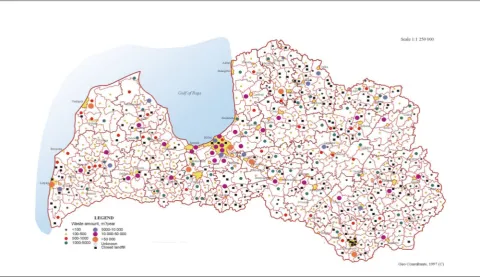
Fig. 2 Ranking of landfills by yearly disposed waste amount Source: Cudecka N (2007)
Figure 2 shows the map of Latvia on the time of country inventory, where all the dumpsites that did not comply EU sanitary requirements are shown.
As mentioned by Cudecka-Purina N. (2011), First two stages were in the awareness of the regions and
self-governments and the financing for their implementation
was state or regional. Third stage involved recultivation of
all existing dumpsites and construction of regional landfills. This stage required impressive financing and major part of it was obtained from European financial instruments – ISPA
(Instrument for structural pre-accession) fund until 2004 (when Latvia joined the EU member states) and Cohesion fund until now a totally new infrastructure has been created. Until the end of 2011 all the small dumpsites have been closed and
recultivated and 11 Sanitary landfills for household waste + 1 sanitary landfill for hazardous waste have been constructed. These activities involved respectable financing, from which
66% was obtained from European structural funds, mentioned above and 34% were local government investments.
According to State waste management plan (2000), the total estimations of all ten projects (excluding Riga region, but with Viduskurzeme region) were 43 000 000 EUR (prices of 1997), but the real investments reached 97 000 000 EUR,
which shows significant underestimations in calculations.
This is partly due to the fact of rapid economic growth which redounded on construction price and material price growth and also due to the fact, that each new region intended to build
more infrastructure, not only landfill and gas collection as it
was in preliminary calculations. Still each region had to judge
from their own abilities and available financing or loans.
Now it can be summarized, that Latvia has achieved the
first level of the waste hierarchy. Thus, it has been proven
already, that the hierarchy itself is too simplistic and contains many limitations (McDougall F., (2001), Brisson, (1997); UK Waste Strategy (1995)).
Main limitations of the hierarchy are:
• the hierarchy cannot be followed rigidly, since in particular situations the cost of a prescribed activity
may exceed the benefits, when all financial, social and
environmental considerations are taken into account
• The hierarchy has little scientific or technical basis. There is no scientific reason, for example, why
materials recycling should always be preferred to energy recovery.
• The hierarchy is of little use when a combination of options is used, as in an IWM system. In an IWM system, the hierarchy cannot predict, for example, whether composting combined with incineration of the residues would be preferable to materials recycling
plus landfilling of residues. What is needed is an overall
assessment of the whole system, which the hierarchy cannot provide.
• The hierarchy does not address costs. Therefore, it cannot help assess the economic affordability of waste management systems.
Figure 3 provides a view of Latvian waste management
system as it looks like today. Latvia has complied first stage
of European requirements and now, following goals become binding:
• decrease of landfilled biodegradable waste until 50%
of 1995 level;
• regeneration of 60% of packaging waste;
• increase of sorted waste collection to 25% until 2025; These goals are environmentally correct and focused on sustainable development, alongside with decrease of greenhouse gas emissions, but the main obstacle is found in the local governments, which used loaned money to construct
ISSN 1822–8402 EUROPEAN INTEGRATION STUDIES. 2012. No 6
The rates for waste disposal will be tended to increase, as the amount of waste disposed has to be decreased. The rate increase is obstacle by the ability of inhabitants to pay for expensive services. This is why, the Authors suggests, that it would be logical to unite regions and use the basis of existing
landfills to implement horizontal and vertical integration,
i.e. implement composting, waste sorting, pre-treatment of reusable materials, energy production (electricity and domestic heating) and even possible production.
All these activities may be brought into life with the use of Public Private Partnerships (PPP), which could grant
necessary investment, as the EU funds do not offer financing
for environmental projects with commercial activities. And
these activities would also decrease landfill operational costs
and maybe even would have an impact on disposal growth rate,making it less rapid, than it would have been in case all 10
regions would have their landfills in operation for forecasted
20-28 years.
One good example of sustainable approach to waste
management in Latvia can be found in Getlini landfill.
materials recycling should always be preferred to energy recovery.
• The hierarchy is of little use when a combination of options is used, as in an IWM system. In an IWM system, the hierarchy cannot predict, for example, whether composting combined with incineration of the residues would be preferable to materials recycling
plus landfilling of residues. What is needed is an overall assessment of the whole system, which the hierarchy cannot provide.
• The hierarchy does not address costs. Therefore, it cannot help assess the economic affordability of waste management systems.
Figure 3. Waste management regions in Latvia 2010, Source: State waste management plan (2012)
Figure 3 provides a view of Latvian waste management system as it looks like today. Latvia has complied first stage of European requirements and now, following goals become binding:
• decrease of landfilled biodegradable waste until 50% of 1995 level;
• regeneration of 60% of packaging waste;
• increase of sorted waste collection to 25% until 2025;
These goals are environmentally correct and focused on sustainable development, alongside with decrease of greenhouse gas emissions, but the main obstacle is found in the local governments, which used loaned money to construct landfills and who have calculated the waste disposal rate, taking in account increasing landfilled waste amount.
The rates for waste disposal will be tended to increase, as the amount of waste disposed has to be decreased. The rate increase is obstacle by the ability of inhabitants to pay for expensive services. This is why, the Authors suggests, that it would be logical to unite regions and use the basis of existing landfills to implement horizontal and vertical integration, i.e. implement composting, waste sorting, pre-treatment of reusable materials, energy production (electricity and domestic heating) and even possible production.
All these activities may be brought into life with the use of Public Private Partnerships (PPP), which could grant necessary investment, as the EU funds do not offer financing for environmental projects with commercial activities. And these activities would also decrease landfill operational costs and maybe even would have an impact on disposal growth rate,making it less rapid, than it would have been in case all
10 regions would have their landfills in operation for forecasted 20-28 years.
One good example of sustainable approach to waste management in Latvia can be found in Getlini landfill.
Getlini EKO an innovative waste management
Landfill Getlini, which is situated 20 km away from Riga, is the biggest and oldest in the country. It is in operation since 1970s. In 1999 financing from World Bank, GEF grant, SIDA grant, Riga City Council, and local financing, altogether over 25 mio UDS were invested in order to transform the dumpsite into a sanitary landfill. Now 300 000 – 400 000 t of waste are deposited yearly in the site.
As at that time there was part, that needed to be recultivated, a methane collection system was integrated into it, to collect the gas and decrease the emissions. Latest data available shows, that a gas flow 2000 – 2200 m
3 /h is provided with average gas content 52-54%. The generation of electricity in the landfill started in the end of 2002. During 2003 the generated amount was 17 887 MWh, reaching 31 295 MWh in 2011. Table 1 shows a detailed insight in produced power and burned methane. Until 2011, the landfill has not only become profitable, but it also sells electricity to State electricity supplier, in accordance with the price, stated in the Cabinet Regulations.
Now, the volume of generated electricity allows the landfill to be self-sufficient. Alongside with electricity, heat is being produced.
During last years, when the production of heat has increased and no sales function for it was found, the landfill Figure 3. Waste management regions in Latvia 2010, Source: State waste management plan (2012)
Getlini EKO an innovative waste management
Landfill Getlini, which is situated 20 km away from Riga,
is the biggest and oldest in the country. It is in operation since
1970s. In 1999 financing from World Bank, GEF grant, SIDA grant, Riga City Council, and local financing, altogether over
25 mio UDS were invested in order to transform the dumpsite
into a sanitary landfill. Now 300 000 – 400 000 t of waste are
deposited yearly in the site.
As at that time there was part, that needed to be recultivated, a methane collection system was integrated into it, to collect the gas and decrease the emissions. Latest
data available shows, that a gas flow 2000 – 2200 m3/h is
provided with average gas content 52-54%. The generation
of electricity in the landfill started in the end of 2002. During
2003 the generated amount was 17 887 MWh, reaching 31 295 MWh in 2011. Table 1 shows a detailed insight in produced
power and burned methane. Until 2011, the landfill has not only become profitable, but it also sells electricity to State
electricity supplier, in accordance with the price, stated in the Cabinet Regulations.
Table 1. Amounts of produced power and burnt methane
Year Power production, MWh Methane (CH4), m3 Methane (CH
4), t CO2 equivalent, t
2002 (October) 5 098 1 274 500 904 18 984
2003 17 887 4 507 624 3 200 67 200
2004 25 784 6 488 571 4 606 96 726
2005 25 425 6 407 100 4 549 95 529
2006 26 331 6 635 412 4 711 98 931
2007 27 361 6 894 972 4 895 102 795
2008 28 742 7 242 984 5 142 107 982
2009 31 130 7 844 760 5 569 116 949
2010 31 099 7 836 948 5 564 116 844
Now, the volume of generated electricity allows the
landfill to be self-sufficient. Alongside with electricity, heat
is being produced.
During last years, when the production of heat has
increased and no sales function for it was found, the landfill
administration has decided to use it for own needs. The heat produced provides greenhouses with cheap heating and results in lower prices of production. This was the time that the idea of constructing a greenhouse for tomatoes appeared. The constructed greenhouses are 5.5 m high and span area of 3625 m2.
It is planned, that the production output will reach 165 tonnes of tomatoes annually. This year it is planned to expand
the range of products, adding strawberries and flowers.
At the same time Getlini develop an environmentally friendly farming. As comparatively big land area (20 ha) of
the old part of the landfill is recultivated, in accordance to
latest European standards and is totally isolated with clay layer
and geomaterials, this part of the landfill, during spring and
summer times is being used for growing Latvian dark headed sheep. At the beginning of the grazing period in spring, the company leases 100 lambs from Latvian farms. The pastures, where the sheep are located are with no mineral fertilizers and pesticides. The analyses have shown that the grass grown at Getlini is cleaner and less harmful for animal nutrition than
grass, grown next to a road with intensive traffic. The drinking
water is delivered from outside and monitored by specialists. During the night time, the sheep are ensured with lean and a pen and surveillance is carried out. This life cycle concludes in autumn, when the sheep return to their farms and the new life-cycle waits in the early spring.
Conclusions
Scientists agree that the burning of fossil fuels is causing global warming. Since these fuels are burned for energy, and everyone uses energy, everyone can help stop global warming just by using less energy or energy from renewable sources.
Greenhouse gas emissions and climate changes did not occur rapidly, they are a result of long-term people actions, which means, that in order to decrease the negative impacts, long-term action plans have to be elaborated.
On Latvian case it can be seen, that despite eliminating all illegal dumping and creation of totally new infrastructure, many questions are still left unsolved and are to be managed on all levels (inhabitants, local governments, regions, state
and European Union), taking into account unified goals and
action plans.
Case of Getlini has shown that a landfill can become more,
than just a place, to discard waste. It can develop to be self-sustainable mechanism and to be able to bring goods and services back to its customers.
References
Anderson V. (1993) “Global warming and cost-benefit
analysis”, Energy Efficiency Policies, Routledge. Pp41-43
Anderson V. (2006) “Turning Economics Inside Out”, In International Journal of Green Economics, Volume 1, Nos. 1/2, -ISSN 1744-9928- Inderscience. Pp11-23
Assadourian E. (2010)“The Rise and fall of consumer societies”. In State of the world 2010 (eds.: Starke, L. and Mastny, L.). London: Earthscan. Pp3-20.
Atstaja D. (2010) “Environment friendly branches in Latvia from the point of view of sustainable development”. In 7 th international JTEFS/BBCC conference “Sustainable development. Culture. Education.” -ISBN 978-9984-14-512-9- (Part II). Pp7-23
Atstaja D., Dimante D., Brivers I., Malzubris J., Kenet M., Tambovceva, T., Sina, I., Livina, A., Ievins, J., Grasis, J., Pule, B., Abeltina, A. (2011) “Environment and Economy”. Monograph. (in Latvian) Riga: Academic Press of University of Latvia.- ISBN 978-9984-45-371-2- Pp 215-217
Atstaja D., Dimante D., Livina A. (2012) „Public
Activities in Developing Green Economy: Case Studies in Latvia”. Proceedings of the 2012International Conference “ECONOMIC SCIENCE FOR RURAL DEVELOPMENT” No 28. Rural Business and Finance ISSN 1691-3078, Jelgava, LLU EF, 26-27 April 2012 pp.14-19
Brizga J., Atstaja D., Dimante D. (2011) “Sustainable Consumption and Production in the Baltic Sea Region”. Chinese Business Review, ISSN 1537-1506, November 2011, Vol. 10, No 11. Pp 1021-1042.
Brizga J., Lice E., Abolina K., Murins S., Dimante D., Atstaja D., Austers I. (2011) „Valuation of sustainable consumption: Latvia’s project report in the EU 7th setting science programme’s projects “Action Town” subproject “Valuation of Participation sustainable consumption and production policy” (in Latvian) Participatory SCP policy assessments. Pp4-26
Blumberga D., Veidenbergs I., Rosa M. et.al. (2012) “Green Energy Strategy of Latvia”. Riga Technical University, Institute of Energy Systems and Environment. Pp 14. On-line: http://www.videszinatne.lv/index.php/raksti/ pasakumi/latvijas-zalas-energijas-strategija-2050 Bendere R., Cudeckis V. (2011) “The estimation of the
emission of greenhouse gases by the treatment of bio
waste or their disposal on sanitary landfill” proceedings
of ISWA Conference “Solid waste treatment and disposal: leading edge technologies”
Brivers, I, Atstaja, D., et.al. (2010) „Economics-the environment-growth”// Environment and Sustainable Development. Edited by Maris Klavins, Walter Leal Filho and Janis Zaloksnis. Riga -ISBN 978-9984-45-220-3- Academic Press of University of Latvia. Pp 29-147 Brisson, I.E. (1997) Assessing the Waste Hierarchy – a
Social Cost–Benefit Analysis of Municipal Solid Waste Management in the European Union. AKF, Institute of Local Government Studies, Denmark. On-line: www.akf. dk/eng
Council of The European Union (2006) Renewed European Union Sustainable Development Strategy, Brussels. On-line: http://register.consilium.europa.eu/pdf/en/06/st10/ st10117.en06.pdf
ISSN 1822–8402 EUROPEAN INTEGRATION STUDIES. 2012. No 6 Environmental congress. “Ecology and life protection of
industrial-transport complexes”. Proceedings of young scientists, vol. II, 369-374
Cudecka-Purina N (2011) “Evaluation of financial
investment effectiveness in Latvian waste management regions” Scientific Journal of Riga Technical University Safety of Technologic environment -ISSN 2255-6923- Serie 15, Vol. 1., Pp14-20
Daly, Herman E. (1996) Beyond growth: the economics of sustainable development -ISBN 978-0-8070-4709-5- Beacon Press books, USA, p245
Daly, Herman E. (1991) Steady-State Economics. 2nd ed. Washington, DC: Island Press. Pp302.
Department of Environment (1995). Making Waste Work: A National Strategy for Waste. London: HMSO.
Furtado, J.I. (1991) Multiple Approaches towards
Sustainable Development Seminar, Ecological Research, 6(2) IRRI, Los Banos; 30 September 2005 Ecological Research, 6 (2). On-line: beta.irri.org/news/bulletin/.../ Furtado%20Seminar.pps
Gavena I., Jekale I. et.al. (2011) “The public consultations as the tool of coordination of interests municipalities, residents and business interests”(in Latvian)
methodoligical material. Riga, VARAM, p. 70. On-line: http://www.varam.gov.lv/lat/publ/met/?doc=14074 Getlini Project (2012) “Gas recovery and Power production”.
On-line: getlini.lv/en/energija/Get_prezent_EN.pdf Jackson T. (2009) “Prosperity without growth: Economics
for a finite planet”. Sustainable Development Commission. London: Earthscan, p.132
Klavins M. and Zaloksnis J. (2011) “Development of university curricula and study material”. In Proc. The EcoRegion Perspectives, Innovation and Education for Sustainable Development (May 2011, Baltic 21 -ISSN 1029-7790- Series No. 3/2011). Pp 24-25
McDougall, F.R., (2001) ‘Life Cycle Inventory Tools: Supporting the Development of Sustainable Solid Waste Management Systems’ Corporate Environmental Strategy, Vol. 8, No. 2, Pp 142-147. http://dx.doi. org/10.1016/S1066-7938(01)00083-5
McDougall. F.R., White. P., Frankie M., Hindle P. (2003) Integrated solid waste management: A Life Cycle Inventory. Second edition Blackwell Science
Ministry of Environment (1998) State waste management strategy, Riga: Ministry of Environemt of Latvia Ministry of Environment (2000) State waste management
plan, Riga: Ministry of Environemt of Latvia
Ministry of Environment (2012) State waste management plan: Ministry of Environemt of Latvia
Read, R. (2007) „Economics is philosophy, economics is not science”, Int. J. Green Economics, Vol. 1, ISSN 1744-9928- Nos. 3/4, pp.307–325
Rockström, J., W. Steffen, K. Noone, Å. Persson, F. S. Chapin, III, E. Lambin, T. M. Lenton, M. Scheffer, C. Folke, H. Schellnhuber, B. Nykvist, C. A. De Wit, T. Hughes, S. van der Leeuw, H. Rodhe, S. Sörlin, P. K. Snyder, R. Costanza, U. Svedin, M. Falkenmark, L. Karlberg, R. W. Corell, V. J. Fabry, J. Hansen, B. Walker, D. Liverman, K. Richardson, P. Crutzen, and J. Foley (2009) Planetary boundaries:exploring the safe operating space for humanity. Ecology and Society 14 (2): 32. On-line: http://www.ecologyandsociety.org/vol14/iss2/art32/ Saleem, J., Ian, T. and Darryn, Mc (2010). “Framing climate
change adaption learning and action”/ Int.Journal of Climate Change Strategies and Management, Vol.2, Number 3 -ISSN 1756-8692- pp281-282
The Ministry of Environmental Protection and Regional Development (1998) Environmental protection Policy of Latvia Environmental, Protection Department
The article has been reviewed.