Study of Soil Cement with Admixture
Stabilization for Road Sub-Grade
Rupesh Kumar Singh Assistant Professor Department of Civil Engineering
K. J. Institute of Engineering & Technology, Savli, Vadodara, 2017
Abstract
Soil Cement with admixture can be used together to get the more stabilized subgrade on roads. When the soil is mixed with cement and then with admixture the properties of the soil get changed. The aim of the study is to review on stabilization of subgrade using soil cement with admixtures. In the experiment the soil sample has been taken from the Vadodara region, the soil is found granular soil with sufficient fines and many laboratory tests has been conducted on that soil sample and soil cement with admixtures with varying percentage of cement and admixture. The experiments which have performed are Standard Proctor Test, California Bearing Ratio Test (CBR) & Unconfined Compression Test (UCT) by adding 5 %, 10%, 15%, 20% of the cement content by volume of dry soil and the Admixture which has used is Lime of 5% by weight of the dry soil. Lime is chosen because lime alters the nature of the adsorbed layer and gives pozzolanic action.
Keywords: Cement, Admixtures, Lime, Standard proctor, California Bearing Ratio, Unconfined Compression
_______________________________________________________________________________________________________
I. INTRODUCTION
In geotechnical engineering the continue growing road network leads to the development of the high bearing capacity road subgrade for flexible pavement as well as for rigid pavement. But the soil found at different place are different hence their bearing capacity also differs location to location. Here the requirement of geotechnical engineering arises when the locally available soil do not fulfil the requirements and hence it requires improvement to transform this problematic material to a required one. This can be achieved by treating the soil with physical or chemical stabilization. There are many ways to impro ve the quality of the road subgrade material like Lime, Bitumen, Cement, Calcium Carbonate, Sodium Carbonate, Sodium Sulphate & Fly Ash etc.
Purpose
This experiment gives idea for improving the geotechnical engineering properties of the soil used for the pavement sub grade by using the additive and admixture which have mixed into the soil to get the desired improvement to fulfil the strength criteria. These criteria can also be applied to the roads and air fields having a much stabilized surface layer.
Use of Soil Cement & Admixture Stabilization
The use of soil cement along with admixture is for users and owners both for commercial purposes. Its cost is also reasonable as compared to granular base sub grades. This combination of soil cement and admixture give the more bearing strength of sub grade than other combination. Also the use of lime and cement gives the type of material which is easily available at low cost everywhere.
Mechanisms of Soil Stabilization
Lime may be used alone or in combination with cement, bitumen or fly ash. Sandy soils can also be stabilized with these combinations. Lime has been mainly used for stabilizing the road bases and the subgrade.
Study of Soil Cement with Admixture Stabilization for Road Sub-Grade (IJIRST/ Volume 3 / Issue 10/ 009)
Lime Stabilization
It is done by adding lime to a soil. It is useful for the stabilization of clayey soil. When lime is added a decrease in plasticity of the soil occurs. Hence the resulting material is more friable than previous one, hence more suitable for road sub grade.
II. METHODOLOGY
The soil cement along with admixture is used for soil stabilization for the sub grade in road and airfields. This can be achieved by mixing the pulverized soil and Ordinary Portland Cement with the water and compacting the mix to get a stronger composite material. The resultant material becomes hard and durable structural material as cement get hydrated and gained strength. The cement is added ranges from 5 to 20 % of the cement by volume and 5 % of the lime as admixture by weight of the dry soil.
III. EXPERIMENTS
Laboratory tests has performed on the sample to evaluate soil properties of the untreated and treated soil with cement and lime. The tests which was conducted in laboratory to get the results are as follows-
1) Grain Size Analysis 2) Standard Proctor Test
3) Unconfined Compression Test 4) California Bearing Ratio Test (CBR)
IV. TESTRESULTS
Grain Size Analysis
Sieve analysis:
Sr No.
Sieve Size
Mass of Soil Retain(g)
%Retained On each sieve (%)
%Cumulative Retain (%)
%Finer (%)
1 4.75mm 175 8.4 8.4 91.6
2 2mm 485 25 33.4 66.6
3 1mm 294 16.85 50.25 49.75
4 600µ 125 5 55.25 44.75
5 425µ 85 2 57.25 42.75
6 300µ 72 3.50 60.75 39.25
7 212µ 65 3.20 63.95 36.05
8 150µ 453 22.55 86.5 13.5
9 75µ 230 11.2 97.7 2.3
10 Pan 16 1 98.7 1.3
Total 2000 98.7
From above test D60=1.55 mm, D30=0.2 mm, D10=0.12 mm Hence Cu=12.91 & Cc=0.21
Hence the soil is SM i.e. Silty Sand as per Indian Standard Soil Classification System. Standard Proctor test:
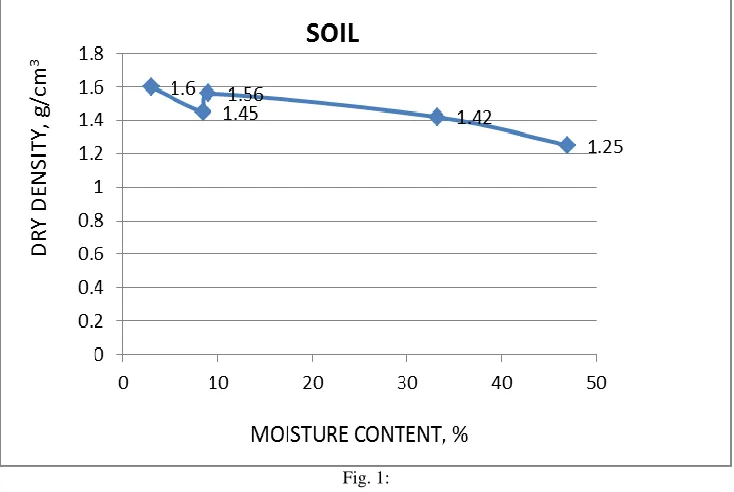
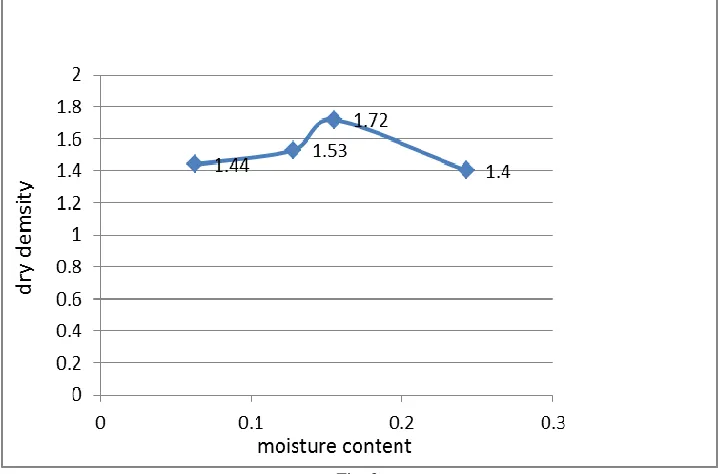
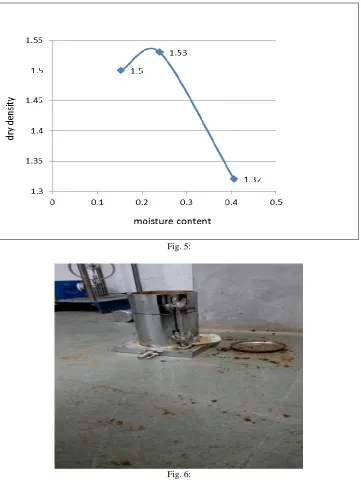
Aim of this test is to determine a relationship between moisture content and dry unit weight for a given soil sample. In this test we are conducting adding different ratio of cement adding with soil and determine the result which is shown in graph above.
Fig. 1:
Soil + cement (5%)+ lime (5%) Maximum dry density: 1.77 gm. /cm3 Optimum Moisture Content: 17%
Fig. 2:
Study of Soil Cement with Admixture Stabilization for Road Sub-Grade (IJIRST/ Volume 3 / Issue 10/ 009)
Fig. 3:
Soil + cement (15%) + Lime (5%) Maximum dry density: 1.78 gm. /cm3 Optimum Moisture Content: 13.7%
Fig. 4:
Fig. 5:
Fig. 6:
California Bearing Ratio Test
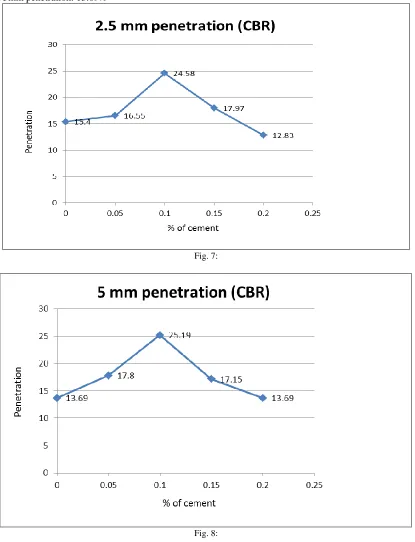
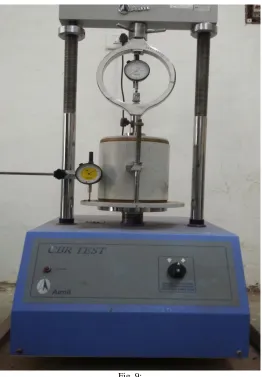
it is use for determine a relation between force and penetration when a cylindrical plunger with standard cross-section area is made to penetrate the soil at a given rate. In this test we are conducting adding different ratio of cement adding with soil and determine the result which is shown in graph above.
Study of Soil Cement with Admixture Stabilization for Road Sub-Grade (IJIRST/ Volume 3 / Issue 10/ 009)
Soil + cement (20%) + Lime (5%) CBR value at 2.5mm penetration: 12.82% CBR value at 5mm penetration: 13.69%
Fig. 7:
Fig. 9:
Unconfined Compression test:
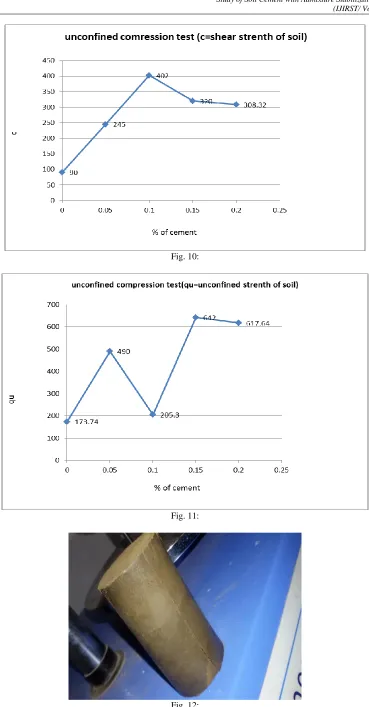
The aim to determine the unconfined compressive strength of the soil, test to obtain the shear strength parameters of cohesive soil either in undisturbed or remolded state, it is not applicable to cohesion less or coarse grained soils. In this test we are conducting adding different ratio of cement adding with soil and determine the result which is shown in graph above.
Soil + cement where,
qu = Unconfined compression strength of soil c = Shear strength of soil
soil + cement (0%) qu = 173.74 KN/M2
c = 90 KN/M2
Soil + cement (5%) qu = 490 KN/M2
c = 245 KN/M2
Soil + cement (10%) qu = 402 KN/M2
Study of Soil Cement with Admixture Stabilization for Road Sub-Grade (IJIRST/ Volume 3 / Issue 10/ 009)
Fig. 10:
V. CONCLUSION OF THE TESTS
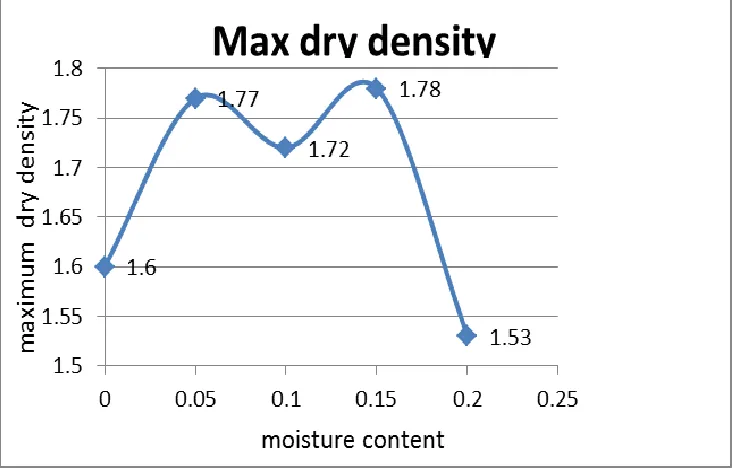
Proctor test:
Maximum Dry Density at different moisture content:
Fig. 13:
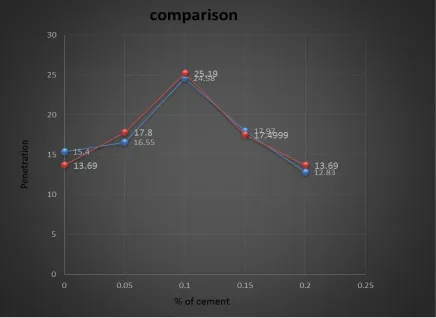
Comparison of soil and soil + cement (15%):
Study of Soil Cement with Admixture Stabilization for Road Sub-Grade (IJIRST/ Volume 3 / Issue 10/ 009)
Fig. 15:
Conclusion:
I have conducted different types of tests like Standard Proctor test, California Bearing Ratio test, and Unconfined Compression test. From this I got good result for
1) Standard Proctor test at 15% Cement MDD: 1.78 gm. /cm3 and OMC: 13.7%. 2) CBR test at 10% cement 2.5mm penetration: 24.58%
5mm penetration: 25.19% 3) Unconfined Compression test at 15% cement qu = 642 KN/M2
C = 320 KN/M2
REFERENCES
[1] AKOTO, BKA. (1988) Influence of Flyash on the Strength Characteristics of Lime Laterite Soil Mixtures. Australian Road Research Journal, 18(4), p224-231, December 1988.
[2] AUSTROADS. (1998) Guide to Stabilisation in Roadworks. AP-60/98 Austroads, Sydney, 1998. This replaced the 1986 NAASRA edition.
[3] AUSTROADS. (1992) Pavement Design: A Guide to the Structural Design of Road Pavements. Section 6.3: Cemented Materials. Austroads, July 1992. [4] BELL F.G. (1993) The Engineering Treatment of Soils. Chapter 10: Stabilization. Published by E&FN Spon, 1993.
[5] BRITISH LIME ASSOCIATION. (1990) Lime Stabilisation Manual. pp41, 2nd Edition, UK, 1990.
[6] CHADDOCK, B & V ATKINSON. (1997) Stabilised Sub-bases in Road Foundations: Structural Assessment and Benefits. TRL Report 248, Transport Research Laboratory, 1997.
[7] CHAN, J.W. & R.P.K LEE. (1996) The Use of Furnace Bottom Ash as Road Subbase Material in Hong Kong. 18th ARRB Conference, Christchurch, NZ. Part 3, p213-221. September 1996.
[8] Utilization Guidelines for Sabo Soil Cement (2002) The Society for Study of Sabo Soil Cement Utilization, Kajima Institute Publishing CO., LTD [9] Final Report on a Study of Cement Hardened Soil (Draft) (2003) Cement Hardened Soil Study Committee.