Effect of Bevel Angles and Heat Input on Hardness
Property and Microstructures of Mild Steel Weldments
Akinola Adebisi
1*, Kayode Joseph
2, Oyetunji Akinlabi
31 Department of Mechanical Engineering, The Federal University of Technology, Akure, Nigeria. 2 Department of Mechanical Engineering, The Federal University of Technology, Akure, Nigeria. 3 Department of Metallurgical and Materials Engineering, The Federal University of Technology, Akure,
Nigeria.
* Corresponding author. Tel.: +234 803 389 7286; email: [email protected]
Manuscript submitted May 30, 2016; accepted December 15, 2016.
Abstract: The effect of bevel angles and welding heat input on hardness property and microstructures of mild steel weldments was carried out in this work. A pair each of 150 x 50 x 10 mm mild steel specimens with bevel angles of 30o, 45o, 60o and 90o, were manually welded with electric arc welding process. The
welded specimens were machined to specification of the test samples. The samples were subjected to microstructural analysis of the weldments and the Heat Affected Zone (HAZ). This was followed by hardness test of the weldments and HAZ of the welded samples. Results showed that the heat input for optimum hardness property is 60o bevel angle (13.61 KJ/mm). The hardness is maximum for the weldment
at bevel angle of 60o (173.2 Hv) sample while for the HAZ and the base plate, maximum hardness was
attained at 45o (199.5 Hv and 174.5 Hv) bevel angle sample. The microstructures indicated the presence of
ferrite (α) and pearlite (α + FeC3). The microstructure has finest grain at 45o bevel angle sample as
compared with the base metal of as–received sample.
Key words: Bevel angles, Hardness, Heat Affected Zone, Heat input rate.
1. Introduction
Welding is a fabrication process used to join materials, usually metals or thermoplastic, together [1]. During welding, the pieces to be joined (the workpieces) are melted at the joining interface and usually a filler material is added to form a pool of molten material (the weld pool) that solidifies to become a strong joint. The size of bevel angle determines the volume of filler metal deposit and the welding parameters determines the heat input rate which has effect on the hardness of weld and Heat Affected Zone (HAZ). Heat transferred to the base metal alters its grains structure. One of the most remarkable features in arc welding is that the base metals is locally heated to a high temperature and sometimes even more and rapidly cooled during its process. Thus it will be evident that the range of temperature change is varied from at least the melting point of the material to the room temperature. Due to this, metallurgical problems in weld arise. It may, at the glance, be predicted that various difficulties associated with welded joints are related to the effects of welding heat which in turn affects the metallurgical structures in and around the welded joint and subsequently the mechanical properties of the joints [2], [3].
welding, applied heat and the subsequent cooling-rate influences the mechanical parameters of weldments to some extent [5], and hence the present work has been undertaken to study the effect of bevel angles and heat input on hardness property and microstructures of mild steel weldments. In the present investigation the welding parameter determined to reflect the heat conditions in the weldments is heat input rate. In the present study the mechanical property are hardness and welding parameter is the heat input rate which is obtained from the collected shop floor data. With a view to achieving the aforementioned aim, the hardness test and microstructure have been carried out to obtain the required information about the effects of heat input rate on the weld zone and Heat Affected Zone (HAZ) for mild steel weldments which is in line with the work of [6]. The results obtained are useful for selecting correct bevel angle geometry process variables for achieving desired hardness of weld and Heat Affected Zone (HAZ) [5].
2. Materials and Equipment
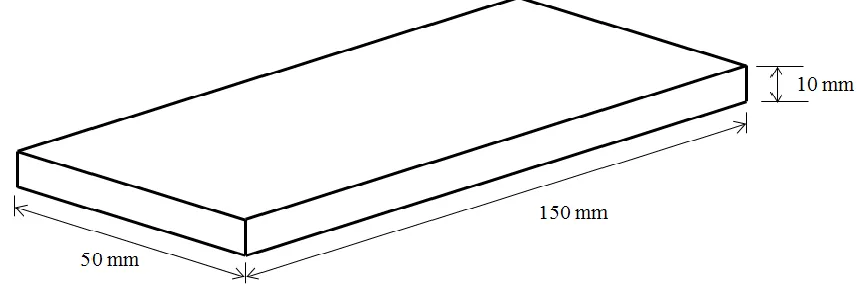
The mild steel plate of thickness 10 mm was procured locally and the chemical properties was analysed using spectrometric analyser. Four samples each having the edge preparation at varying bevel angle 30°, 45°, 60°, 90° and a pair as-received were made from the mild steel plates. Each sample consists of two plates having the size 150 mm lengths by 50 mm width before welding as shown Fig. 1. The composition of the base metal is given Table 1.
Fig. 1. Plate sample of the base metal as- received
Table 1. Chemical Composition of Mild Steel
Element C Al Si P S Ti V Cr
Content 0.0099 0.1671 0.1795 0.0249 0.0000 0.6115 0.0164 0.0365
Mn Fe Ni Cu W As Mo Sn
0.4769 98.3978 0.0600 0.0064 0.0077 0.0060 0.0000 0.0094
The following equipment were used for the research: EDXRF Spectrophotometer (EDX3600B) machine for XRF of the base metal, Electric Arc Welding Machine for the welding of the plates samples, Milling machine, Optical Metallurgical Microscope (Nicon Eclipse ME600) having 100x magnification for the microstructures of the samples and Leco Micro Hardness Tester LM700AT using 490 MN major loads and dwell time was 10 seconds for the hardness test.
2.1. Welding Procedure
currents. Each run was de-slagged by conventional method prior to successive welding runs. The samples were allowed to cool in air. The welding current and arc voltage were taken while time of weld was taken by stop watch. The number of runs for each of the weldments was noted.
2.2. Machining of the Samples
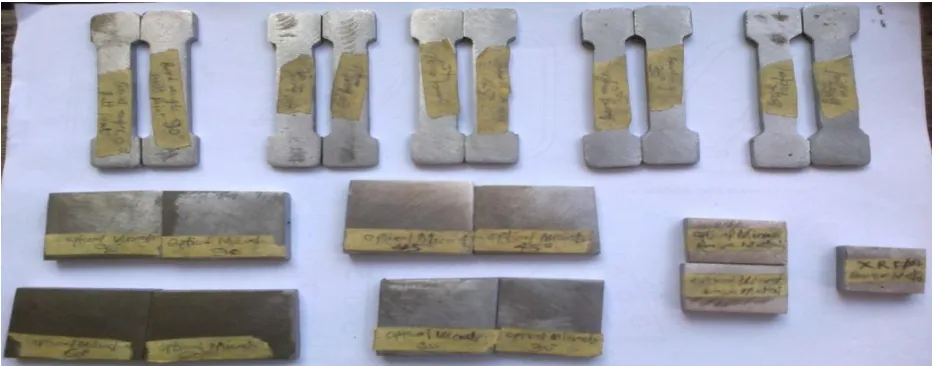
Test samples were milled from the welded specimens in pairs having dimension 50 mm lengths by 40 mm width by 8 mm thickness and 90 mm length by 18 mm width by 5 mm thickness respectively according to the specification of the Engineering Materials Development Institute (EMDI), Akure, Nigeria, as presented in Fig. 2.
Fig. 2. Machined (milled) tensile and microstructures test samples
2.3. Hardness Test
Hardness test of the weld and heat affected zone (HAZ) of all the samples were carried out by Leco Micro Hardness Tester LM700AT using 490 MN major loads and dwell time was 10 seconds. Hardness for each of the samples was measured on the surfaces of the weld and Heat Affected Zone (HAZ) and also the base metal in line with the work of [6].
2.4. Microstructures of the Welded Metal
There was a proper study of the metallurgical structure of the weld zone as well as heat affected zone (HAZ) of all the samples. The samples were ground to remove rough surfaces. These were molded with a plastic for proper holding; the surfaces were polished and cleaned by emery paper to remove dirt and finally etched (the weld zone and heat affected zone (HAZ) of all the samples were dipped in 2% Nital agent for etching and finally dried by using blower). The microstructures of weld zone and heat affected zone (HAZ) of all the samples were carried out using Optical Metallurgical Microscope (Nicon Eclipse ME600) having 100x magnification [7].
3. Results and Discussions
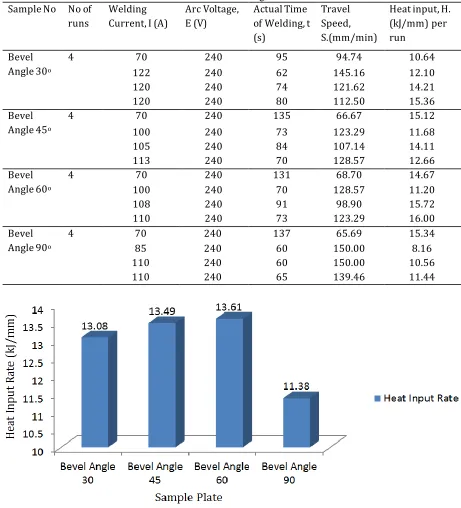
The welding parameters results for each run and travel speed are shown in Table 2
Table 2. Values of Welding Parameters
Sample No No of runs
Welding Current, I (A)
Arc Voltage, E (V)
Actual Time of Welding, t (s)
Travel Speed, S.(mm/min)
Heat input, H. (kJ/mm) per run
Bevel Angle 30o
4 70 240 95 94.74 10.64
122 240 62 145.16 12.10
120 240 74 121.62 14.21
120 240 80 112.50 15.36
Bevel Angle 45o
4 70 240 135 66.67 15.12
100 240 73 123.29 11.68
105 240 84 107.14 14.11
113 240 70 128.57 12.66
Bevel Angle 60o
4 70 240 131 68.70 14.67
100 240 70 128.57 11.20
108 240 91 98.90 15.72
110 240 73 123.29 16.00
Bevel Angle 90o
4 70 240 137 65.69 15.34
85 240 60 150.00 8.16
110 240 60 150.00 10.56
110 240 65 139.46 11.44
Fig. 3. Average Heat Input Rate (kJ/mm) for Varying Bevel Angles
The 600 bevel angle was found to have the highest average heat input of 13.61 kJ/mm; this implied slower
cooling rate which would affect the formation of grain structures while 900 bevel angles has the lowest
average heat input of 11.38 kJ/mm as shown Fig. 3; which implied rapid cooling. The heat input influenced the cooling rate, which may affect the mechanical properties and metallurgical structure of the weld and the HAZ. Higher heat input caused slower cooling rate and lower heat input led to faster cooling rate. The heat input increases from 30o to 45o to 60o as shown in Fig. 3. Metallurgical changes occurred during the cooling
from one phase to another which altered the mechanical and microstructural properties of the weldment and the Heat Affected Zone (HAZ) as the rate of cooling will affect the length of HAZ.
Table 3. Hardness test result for each bevel angle samples
Samples Weldment
(Hv)
HAZ (Hv)
Base Plate (Hv)
30o Bevel Angle 155.9 179.1 109.3
45o Bevel Angle 151.1 199.5 174.5
60o Bevel Angle 173.2 174.5 97.7
90o Bevel Angle 107.9 139.9 102.0
The hardness test of the Base metal as – received sample was 245 (Hv)
3.1. Effect of Bevel Angle on the Hardness
We observed from Table 3 that the hardness was highest for the weldment at 60o bevel angle while for the
HAZ and the base plate, maximum hardness was attained at 45o bevel angle.
Also, the hardness was lowest for the weldment and HAZ at bevel angle of 90o. This is due to the facts that
as the bevel angle increases, the heat input also increases, which makes the peak temperature value to increase. The hardness of HAZ is greater than the hardness of the weldment area (ex cept at 45o bevel angle
heat treated); this is due to the fact that the heat is more concentrated at the weldment than at the HAZ. Heat is transferred from the weld zone to the HAZ and the base plate. According to [8], as the peak temperature value increases, the hardness of the material decreases. We found that the hardness of weldment and HAZ for 60o bevel angle was greater than the hardness of weldment and HAZ for 70o bevel
angle by [5]. Increase in the bevel angle leads to increase in heat input as the number of passes or runs in 70o bevel angle is more than the number of passes in 60o bevel angle. [9] asserted that as the number of
passes increases, the tempering effect also increases and thus the hardness of weld and HAZ decreases.
3.2. Micrograph of the Welded Metal
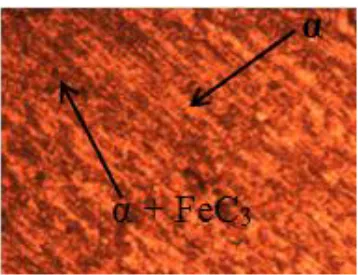
The result of the chemical composition analysis of the mild steel sample in Table 3.1 show ed that the percentage of the iron present is 98.3978% which constituted the volume fraction of the ferrite (α) present in the microstructures and the carbon content is 0.0099%. The carbon is interstitial solute in the iron. It formed a solid solution called ferrite. The %C in ferrite is 0.008%. The analysis shows that the sam ple is dead – mild steel based on the level of carbon composition. Generally, the phases are composed majorly of ferrite (α) and pearlite (α + FeC3) with more volume fraction of ferrite and pearlites were uniformly
distributed in the micrographs. Both phases are well dispersed all over the microstructures. This is depicted in Plate 1.
3.2. Effect of Heat Input Rate on the Hardness of Weld Zone and Heat Affected Zone
(HAZ)
We deduced in accordance to the mechanical properties that pearlite has properties intermediate to soft, ductile ferrite and hard, brittle cementite (in the micrograph, the dark areas were the FeC3 layers and light
phases were α – ferrite). Variation in volume fraction and the grain size of ferrite was observed in all the Heat Affected Zone (HAZ) microstructures examined. Pearlite phase was equally seen to be present in all the microstructures examined, also observed in the microstructures of HAZ samples were inclusions in form of dark spots which may have resulted from impurities such as moisture and dirt, porosities in form of pin holes which may be due to relative effectiveness of the arc welding process. Microstructures with different weld profiles due to vary bevel angle during edge preparations were obtained for 30o, 45o, 60o and
90o bevel angle geometries and as – received base metal both for treated. One of the major factors that
affected the hardness of the Heat Affected Zone (HAZ) was cooling rate. Now from the previous literature review it has been seen that the heat input is inversely proportional to cooling rate (Funderburk, 1999). That means as the heat input increases the cooling rate decreases and due to which the concentration of the pearlite increases as shown in Plate 2 (b), 3 (b), 4 (b), 5 (b).
Plate 2: Micrograph of the (a) Weldment (b) HAZ (c) Base Metal of 30
o Bevel Angle after etching in
2% nital solution at magnification 100x
Plate 3: Micrograph of the (a) Weldment (b) HAZ (c) Base Metal of 45o Bevel Angle after etching in 2%
nital solution at magnification 100x
4. Conclusion
The effect of bevel angles and heat input on mechanical properties and microstructural properties of mild were investigated; the mechanical and microstructural properties of welded samples were determined; and these properties were evaluated. The following conclusions were drawn:
(i) At constant voltage, the heat inputs rate were as follow for 30o (13.08 kJ/mm), 45o (13.49
kJ/mm), 60o (13.61 kJ/mm) and 90o (11.38 kJ/mm). The finding established that heat input for
optimum mechanical properties of the weldments was 60o bevel angle.
(ii) The result of the hardness showed that there was increase in the hardness values of the entire bevel angle at the HAZ. The hardness was highest for the weldment at bevel angle of 60o sample
while for the HAZ and the base plate, maximum hardness was attained at 45o bevel angle
untreated sample. There were decreases in the values of the hardness for the entire bevel angle as compare to the result of the hardness of the base metal as – received sample was found to be 245 Hv.
(iii) The microstructural analyses showed that the microstructure has finest grain at 45o bevel angle
sample as compared with the base metal as–received sample thereby give optimum hardness property and microstructures for engineering applications, welding and fabrication as well as oil and gas industries using mild steel.
References
[1] Goetsch, D. L., Chalk, W. S., Nelson, J. A., & Rickman, R. L. (2010). Technical Drawing and Engineering Communication, International Student Edition, 698–722.
[2] Palmer, T. A., Elmer, J. W., & Wong, J. (2002). In-situ observations of ferrite/austenite transformations in duplex stainless steel weldments using synchrotron radiation. Science and Technology of Welding and Joining, 7(3), 159–171.
[3] Babu, P. D., Buvanashekaran, G., & Balasubramanian, K. R. (2012). Experimental Study on the Microstructure and Hardness of Laser Transformation Hardening of Low-alloy Steel. Transactions of the Canadian Society for Mechanical Engineering, 36(3), 241 – 245.
[4] Funderburk, R. S. (1999). Key Concept in Welding Engineering. Welding Innovation, XVI(1).
[5] Majumder, A. (2011). Study of the effect of bevel angle and welding heat input on mechanical properties of mild steel weldments. Agartala, Tripura West, Tripura, India, International Journal of Mechanical and Materials Engineering (IJMME), 6(2), 280 – 290.
[6] Oyetunji, A., Kutelu, B. J., & Akinola A. O. (2013). Effects of welding speeds and power inputs on the hardness property of type 304L austenitic stainless steel heat affected zone (HAZ). Journal of Metallurgical Engineering (ME), 2(4). www.me-journal, 124 -129.
[7] Oyetunji, A., & Nwigboyi, N. (2014). Effect of welding process, type of electrode and electrode core Plate 5: Micrograph of the (a) Weldment (b) HAZ (c) Base Metal of 90o Bevel Angle after
diameter on the tensile property of 304L austenitic stainless steel. Leonardo Electronic Journal of Practices and Technologies, 25, 210–222
[8] Debroy, T., Szekely, J., & Eagar, W. T. (1982). Temperature profiles, the size of the heat-affected zone and dilution in electroslag welding. Material Science and Engineering, 56, 181–193.
[9] Payares-Asprino, M. C., Katsumoto, H., & Liu, S. (2008). Effect of martensite start and finish temperature on residual stress development in structural steel weld. American Welding Journal, 87, 279–289.
Akinola Adebisi is a Senior Lecturer in the Department of Mechanical Engineering of the Federal University of Technology, Akure, Nigeria. He received his B.Eng. in 1995 from M. Eng in 2000, and PhD in 2012 from the Federal University of Technology, Akure, Nigeria. He is a trained International Welding Engineer. His areas of research are in Thermofluids, Applied Energy Systems and Welding Engineering.
Oyetunji Akinlabi is a Senior Lecturer in the Department of Metallurgical and Materials Engineering of the Federal University of Technology, Akure, Nigeria. He received his B.Sc. in 1991 from Obafemi Awolowo University, Ile-Ife, Nigeria, M.Sc in 1995 from the University of Lagos, Nigeria and PhD in 2007 from the Federal University of Technology, Akure, Nigeria. His area of interest includes foundry engineering technology, welding and modeling of engineering materials.