Applied Research on English Language
Biannual Publication of the English Department of the
University of Isfahan
Volume 3, Issue 1
Fall-Winter, 2013-2014
ISSN (print) 2252-0198, ISSN (electronic) 2322-5343
The journal is currently indexed in/by:
Google Scholar
IndexCopernicus (Journals Master List) Ulrich's Web Global Serial Directory ResearchGate
LINGUIST List
The International Research Foundation (TIRF) Electronic Journals Library
1. Applied Research on English Language is published by the English department at the University of Isfahan, Iran. The journal disseminates peer reviewed original research. Contributions must be written exclusively in English and should address an issue in
applied linguistics or language teaching.
2. All submissions should report original, previously unpublished research results, experimental or theoretical. Articles submitted to the journal should meet these criteria and must not be under consideration for publication elsewhere.
3. Authors should note that it may take about 12 weeks for a review to be completed. All authors receive an acknowledgement upon receipt to confirm the arrival of their papers.
4. Manuscripts should not be longer than 6,000 words. An abstract of between 150 and 200 words followed by up to 7 keywords is also required.
5. Manuscripts must be written in MS WORD (font: Times New Roman 12). Keep the layout of the text as simple as possible. Divide your article into clearly defined (main sections in bold and subsections in italics) but unnumbered sections.
6. Applied Research on English Language publishes research using qualitative, quantitative or mixed methods.
7. Authors must strictly follow APA style:
One author
Williams, J. H. (2008). Employee engagement: Improving participation in safety.
Professional Safety, 53(12), 40-45.
Two to seven authors [List all authors]
Keller, T. E., Cusick, G. R., & Courtney, M. E. (2007). Approaching the transition to adulthood: Distinctive profiles of adolescents aging out of the child welfare system.
Social Services Review, 81, 453-484.
Chapter in a Book
Booth-LaForce, C., & Kerns, K. A. (2009). Child-parent attachment relationships, peer relationships, and peer-group functioning. In K. H. Rubin, W. M. Bukowski, & B. Laursen (Eds.), Handbook of peerinteractions, relationships, and groups (pp. 490-507). New York, NY: Guilford Press.
Journal Article
Senior, B., & Swailes, S. (2007). Inside management teams: Developing a teamwork survey instrument. British Journal of Management, 18, 138-153.
Biannual Publication of the English Department of the University of Isfahan Volume 3, Issue 1, Fall-Winter, 2013-2014, ISSN 2252-0198
Editorial Board
Mohammad Amoozadeh, Associate Professor, Department of Linguistics, University of Isfahan, Iran
Avon Crismore, Professor, Indiana University-Purdue University Fort Wayne, United States
Andrew Finch, Professor, Kyungpook National University, Republic of Korea
Leena Furtado, Professor, California State University, Dominguez Hills, United States
Shiva Kaivanpanah, Associate Professor, Department of English, University of Tehran, Iran
Zohre Kassaian,Associate Professor, Department of English, University of Isfahan, Iran
Saeed Ketabi,Associate Professor, Department of English, University of Isfahan, Iran
Mansoor Koosha, Associate Professor (Emeritus), Department of English, University of Isfahan, Iran
Ingrid Piller, Professor, Macquarie University, Australia
Reza Pishghadam, Associate Professor, Department of English, Ferdowsi University of Mashhad, Iran
Mansoor Tavakoli, Associate Professor, Department of English, University of Isfahan, Iran
Director: Abbass Eslami Rasekh Editor-in-Chief: Saeed Ketabi Managing Director: Vahid Parvaresh
Executive Director: Nadia Kazemi Typesetting and Formatting: Ebrahim Fotovat English Editor: Mohammad Taghi Shahnazari
Address: Applied Research on English Language, Faculty of Foreign Languages, University
of Isfahan, Hezar Jarib St., Azadi Sq., Isfahan, Islamic Republic of Iran. Postal code: 81744 - 73441.
Editorial
Saeed Ketabi
I-II
Designing reading tasks to maximise vocabulary learning
Paul Nation 1-8
Motivation, amount of interaction, length of residence, and ESL learners’ pragmatic competence
Zohreh R. Eslami and Soo Jin Ahn
9-28
The relationship between task repetition and language proficiency
Ahmad Mojavezi
The effect of increase in task cognitive complexity on Iranian EFL learners’ accuracy and linguistic complexity: A test of Robinson’s Cognition Hypothesis
Hassan Soleimani and Maryam Rezazadeh
29-40
41-54
The effect of reading purpose on incidental vocabulary learning and retention among elementary Iranian learners of English
Ahmad Reza Eghtesadi and Sakine Momeni
Pragmatic comprehension of apology, request and refusal: An investigation on the effect of consciousness-raising video-driven prompts
Parviz Birjandi and Ali Derakhshan
Investigating disagreements through a context-specific approach: A case of Iranian L2 speakers
Reza Ghafar Samar, Afsaneh Abaszadeh and Fatemeh Pourmohamadi
Persian abstracts
55-66
67-86
A few weeks before the publication of the current issue of “Applied Research on English Language” we were saddened by the death of Dr. Zohreh Kassaian, one of our senior colleagues at the University of Isfahan. She died after a long but courageous battle with cancer. We mourn her death and dedicate the present issue to her memory.
The current issue opens with an article by Paul Nation, who argues that vocabulary learning conditions, i.e. repetition, retrieval, creative use, and deliberate attention, can be maximized through the use of ‘narrow reading’, ‘repeated reading’, ‘linked skills reading’, ‘reading with discussion’, and ‘deliberate learning through reading with exercises’. In this respect, the author argues, computer-based activities can be effective in providing opportunities for deliberate learning, but it is important that deliberate learning does not take time away from extensive reading.
Zohreh R. Eslami and Soo Jin Ahn’s study examines how motivation for learning English, the amount of contact with English, and length of residence in the target language area affect Korean graduate students’ English pragmatic skills. The findings of the study reveal that (a) the level of motivation has a positive and moderate relationship with the ESL learners’ L2 pragmatic competence; and (b) the amount of L2 contact and length of residence have only a weak and insignificant impact on the participants’ pragmatic competence.
Task repetition is now considered as an important variable. However, as argued by Ahmad Mojavezi in the third study, in order to move towards theorizing the role of task
task repetition correlates with language proficiency and the differential effects that task repetition might have on the complexity, accuracy, and fluency of L2 learners with different levels of proficiency. The study reveals that participants with higher levels of L2 proficiency produce more complex, accurate, and fluent speech on the second encounter with the same task. Designing a task with reasonable level of cognitive complexity has always been important not only for syllabus designers but also for teachers and researchers. The fourth study, written by Hassan Soleimani and Maryam Rezazadeh, is an attempt to explore the effect of task manipulation on picture narration. The results of the study reveal that an increase in task cognitive complexity leads to greater accuracy and linguistic complexity.
the metapragmatic group outperformed the other treatment groups, and that form-search group had a better performance than role-play and control groups.
In the seventh study, Reza Ghafar Samar, Afsaneh Abaszedeh and Fatemeh Pourmohamadi investigate the expression of disagreement among Iranian advanced English learners. The data the authors draw on is recorded discussions of 26 male and female interlocutors in three different settings. The results of the study confirm that disagreement is a complex and multidirectional speech act. Therefore, the authors argue, linguistic markers cannot safely categorize disagreement turns into polite/impolite or preferred/dispreferred acts.
Last but not least, I wish to extend my profound gratitude to the many colleagues who generously provided reviews of manuscripts submitted to Applied Research on English Language. The journal would never have existed without the support of these professional colleagues.
Warmest regards,
Designing reading tasks to maximise vocabulary learning
Paul Nation
(Emeritus Professor, Victoria University of Wellington, New Zealand) [email protected]
(Received: 31.10.2013, Accepted: 10.11.2013)
Abstract
Most vocabulary learning should occur incidentally through listening and reading. This is one of the reasons why a substantial extensive reading program is an important part of an English course. Extensive reading requires the learners to do large quantities of reading using material that is at the right level for them. Vocabulary learning occurs through the conditions of repetition, retrieval, creative use, and deliberate attention. These conditions can be maximized when reading through the use of narrow reading, repeated reading, linked skills reading, reading with discussion, and deliberate learning through reading with exercises. Computer-based activities can be effective in providing opportunities for deliberate learning, but it is important that deliberate learning does not take time away from extensive reading.
Keywords: vocabulary learning, conditions, extensive reading
Introduction
A well-balanced language course has opportunities for incidental learning and deliberate learning. Incidental learning occurs when learners are reading, writing, listening, or speaking with their attention focused on the message. In spite of the focus on the message, they manage to learn some new words and phrases or become familiar with some unknown or partly known grammatical constructions. Incidental learning can occur through meaning-focused input when the learners are listening or reading, through meaning-focused output when the learners are speaking or writing, or through fluency development activities in any of the four skills.
Most vocabulary learning for native speakers occurs as incidental learning. However, learners of English as a foreign language need extra support in order for incidental learning to occur. This is because
enough contact with the language and enough contact with language which is at the right level for them for incidental learning to occur. The purpose of this article is to look at how teachers can provide this support through the careful design of activities.
Let us first look in detail at a very effective reading activity to see what conditions for incidental learning it provides.
Vocabulary learning from extensive reading
English Readers which are original texts specially written at several vocabulary levels (see Table 1).
Table 1: Levels of the Cambridge English Readers series
Level Different words
Approximate length
Example titles
Level
1 400 words 4000 words Bad love, Blood diamonds Level
2
800 words
10,000 words
Apollo’s gold, Jojo’s story Level
3
1,300 words
15,000 words
The Beast, Two lives Level
4 1,900 words 20,000 words Berlin express, Staying together Level
5
2,800 words
25,000 words
All I want, Tangled web Level
6
3,800 words
30,000 words
A love for life, Murder maker
For example, in level 2 of the Cambridge English Readers, all the books are written within the vocabulary of 800 words, so that if you know these words you can read the books with no difficulty. Note that the books are quite long, and this gives learners a lot of reading practice at a level which is easy enough for them. The books are written to be enjoyed and the stories are interesting and exciting.
Extensive reading can be carried out in the classroom (and it is best introduced by scheduling regular classroom time for it) or
it can be carried out outside of class as a homework activity. The learners choose books which are interesting for them to read at a level which is just beyond their present vocabulary level so that there are some unknown words in the books but not too many. Ideally only around two words out of every 100 running words should be unfamiliar to the learners. The learners then read the books to enjoy the stories and may fill in a brief report form after reading each book, but otherwise they are not required to do any other assessment activities related to the reading. The goal is to do a large amount of enjoyable reading.
How does extensive reading help vocabulary learning? As learners read they will meet words that they only partly know or that they have not met before. Each meeting provides a small opportunity to learn about the form, meaning and use of the word within the contexts in which it occurs. After the first meeting with the word, the learners may meet the word again in the book and when they do they have a chance to recall what they learnt from the previous meeting. This recall is probably done subconsciously. Each time a learner meets a word and is able to successfully recall some information from previous meetings, this is called a retrieval. Spaced retrievals help learning.
naturally provide these conditions. If we look at the occurrences of new words at a particular level in a graded reader (this can be done by running a computer text of the graded reader through a concordance program like AntConc or MonoPro), we find that such words typically occur in different contexts each time they occur. The different contexts help enrich knowledge of the words and make later retrievals easier. Sometimes when a learner meets an unknown word in a graded reader they are not able to guess its meaning from the context clues, and so the learner may look in a dictionary to find the meaning. Looking a word up in a dictionary is a form of deliberate learning and this can make a strong contribution to knowledge of the word.
Graded readers are texts written within a very controlled vocabulary. The main advantage of vocabulary control is that it excludes the many words that are well beyond the learners’ present vocabulary level. If a learner tried to read an unsimplified text that was way beyond their proficiency level, they would meet hundreds of words that are unknown to them. Most of these words would only occur once in the text and would therefore act as a barrier to reading without having much chance of being learnt (Nation & Deweerdt, 2001).
So, we can see that extensive reading naturally provides very supportive conditions for incidental vocabulary learning. By reading graded readers, learners meet a manageable number of unknown words in comprehensible contexts. By doing a reasonable amount of reading, they will have the chance to meet these words again and thus will have many opportunities to retrieve knowledge of the words that they have gained from previous meetings with them. They will also meet these words in a variety of contexts which will help enrich
their knowledge of these words and increase their retention of them.
How can we maximise the vocabulary learning opportunities provided by extensive reading? The major way to maximise vocabulary learning from extensive reading is by getting the learners to do a lot of extensive reading. Ideally, just under one quarter of the time in a well-balanced language course should be spent doing extensive reading for meaning-focused input and fluency development (Nation & Yamamoto, 2012). Vocabulary learning can also be maximized by making sure learners are reading books which are at the right level for them. In addition, vocabulary learning from extensive reading will be helped if the learners combine a little deliberate learning with the incidental learning. That is, when they meet some new words in their extensive reading, they can put them on word cards for later decontextualised study. Immediately they finish reading a graded reader, learners might like to spend a small amount of time to reflect back on any of the new words that they met during their reading.
Learning conditions
introduced at that level with enough repetitions for these to have a chance of being learnt.
Secondly, we have the condition of retrieval. Having an opportunity to recall something that has been met before strengthens learning. When meeting a word again in a graded reader, retrieval at least involves recognising the form of the word as being at least partly familiar and being able to recall the meaning or part of the meaning that was gained on previous meetings.
Thirdly, we have the condition of creative use (Joe (1998) calls it "generative use"). Creative use can be receptive or productive. Receptive creative use involves meeting a word through listening or reading in new contexts. Productive creative use occurs when a learner produces the word in speaking or writing using it in ways in which the learner has not met it or used it before.
Fourthly, we have the condition of deliberate attention. Deliberate attention means consciously focusing on the language item in order to understand or learn it. Deliberate attention occurs when we look up the word in a dictionary or in a glossary, or when we ask someone about the meaning of the word. As long as this does not interrupt the message-focused activity too much, deliberate attention is a very useful contributor to vocabulary learning.
Let us now look at a range of message-focused reading activities to see how these conditions of repetition, retrieval, creative use, and deliberate attention can be maximised so that such reading not only provides pleasure and improvement in reading skills, but also contributes to vocabulary growth.
Learning vocabulary through a range of reading activities
We saw that one of the most important effects of writing graded readers within a strictly limited vocabulary is to greatly reduce the vocabulary burden of a text. Unsimplified text contains vocabulary from a very wide range of frequency levels from the first 1000 to beyond the 20th 1000. One way to reduce the vocabulary load without simplification is to do what is called narrow reading (Hwang & Nation, 1989; Schmitt & Carter, 2000). Narrow reading involves reading texts that are closely related to each other. Reading closely related texts does reduce the overall vocabulary load (Sutarsyah, Kennedy & Nation, 1994), but it does this to only a small degree (see Webb & Rodgers, 2009a & b, for the effect of narrow listening on vocabulary load). It is thus an activity best suited to high intermediate and advanced learners who have a large enough vocabulary size to be able to cope with unsimplified text without a great deal of outside assistance. Narrow reading is especially useful for the learning of technical vocabulary, particularly when the learner can draw on background knowledge of the subject.
For beginning and intermediate learners,
readings of the text mean that the vocabulary in the text is met three times. The readings occur one after the other and this means that retrievals should be relatively easy to make. The activity does not involve creative use. There is however a deliberate element to repeated reading, especially on the first reading of the text. It is during this first reading that any word recognition problems or problems with unknown vocabulary are dealt with. For more proficient learners, repeated reading can be done silently with the intention of gaining deeper comprehension of the text on each reading.
Reading can occur in a series of linked skill activities. In linked skill activities the learner works on the same content material at least three times, but each time using a different one of the listening, speaking, reading, and writing skills. For example, the learners might read the text, then talk about it to each other in small groups or in pairs, and then write the main ideas from it. In this example, the activity moves from reading to speaking to writing. There are clearly many combinations possible in linked skill activities. From a vocabulary learning perspective, linked skill activities provide excellent opportunities for repetition (the same material is worked on three times), retrieval (both productive and receptive), and creative use (the three tasks in the series in a linked skills activity are different, but are focused on the same content and make use of the same language items). In a linked skills activity, the last activity in the series is the one that is typically done with the greatest fluency because the learners now bring a lot of background knowledge and language knowledge to the task from the first two parts of the activity. If the linked skills activity involves a pair or group speaking phase, then there could be the opportunity for the negotiation of unknown
vocabulary. Linked skills activities are very easy to prepare and provide the learners with a lot of useful work. A reading text is often a good starting point when designing such activities even though reading may be the second or third activity in the series.
Reading with discussion involves at least two learners reading the same text. The learners read to a predetermined point in the text, say for example to the end of the first paragraph. They then discuss what they have just read with their partner to clear up any problems in the reading. They then read the next part of the text silently and then discuss that. In this way the text is read making sure that a high level of comprehension is achieved (see Palincsar & Brown, 1986, for a similar and more elaborate reading strategy). This activity clearly provides useful conditions for vocabulary learning. The discussion will recycle the vocabulary met in the text allowing an opportunity for retrieval, and because the discussion is not simply an oral repetition of the text, the vocabulary is likely to occur in slightly different contexts in the discussion. The discussion also has some deliberate elements in that it may be necessary in the discussion to directly discuss the meaning of words and constructions in order to gain clear comprehension.
Tom Cobb’s website (www.lextutor.ca) has a very useful Read with resources program. Text can be pasted into the website and the following resources can be drawn on.
1 Spoken form. Clicking once on any word provides the spoken form of the word. In a separate program under the Text-to-Speech heading on Cobb’s web page, it is possible to link written texts to their spoken form where this exists.
2 Examples in context. Clicking twice on a word brings up several instances of the word in context (a concordance), like the one for the word laugh (see appendix). These extra contexts can be used to help guess the meaning of the unknown word, to gain information about the use of the word (grammar and collocates), and to gain information about the range of senses of the word.
3 Meaning. Clicking on a link brings up a substantial dictionary entry for a word from a range of possible dictionaries including learner dictionaries.
4 Revision. Holding down the Alt-key and clicking puts the word in a box at the top of the screen for later revision. These revision activities can include (a) a dictation test where the word is heard and the learner has to write the word, (b) a meaning test where a concordance appears but the pivot word is missing and must be chosen from the list in the box (Nation, 2008).
Reading with resources provides a range of deliberate focuses which result in repeated
attention to the words. The examples in context provide plenty of receptive creative use.
We have looked at a range of reading activities including those which are completely message-focused to those which have strong deliberate learning features. It is not too difficult to add deliberate learning features to reading, but it is important that the teacher's skill is also directed towards making sure that message-focused reading is also providing useful conditions for vocabulary learning. The major ways in which this can be done involve using graded material which is at the right level for the learners, ensuring that the learners do large amounts of reading, providing recycling of the vocabulary through repeated meeting of the content as in repeated reading and linked skills activities, and by providing occasional deliberate language focuses through the use of dictionaries, glossaries, hypertext, concordances, and vocabulary exercises. It is important that the deliberate language focus is not overdone at the expense of quantity of message-focused reading.
References
Hwang, K., & Nation, P. (1989). Reducing the vocabulary load and encouraging vocabulary learning through reading newspapers. Reading in a Foreign Language, 6(1), 323-335.
Joe, A. (1998). What effects do text-based tasks promoting generation have on incidental vocabulary acquisition?
Applied Linguistics, 19(3), 357-377. Nation, I. S. P. (2008). Teaching
vocabulary: strategies and techniques. Boston: Heinle Cengage Learning.
Nation, I. S. P., & Deweerdt, J. (2001). A defence of simplification. Prospect, 16(3), 55-67.
readers and vocabulary. Reading in a Foreign Language, 12(2), 355-380. Nation, I.S.P. & Yamamoto, A. (2012).
Applying the four strands.
International Journal of Innovation in English Language Teaching and Research, 1(2), 167-181.
Palincsar, A. S., & Brown, A. L. (1986). Interactive teaching to promote independent learning from text. The Reading Teacher, 40, 771-777. Paribakht, T. S., & Wesche, M. B. (1996).
Enhancing vocabulary acquisition through reading: a hierarchy of text-related exercise types. Canadian Modern Language Review, 52(2), 155-178.
Schmitt, N., & Carter, R. (2000). The lexical advantages of narrow reading for second language learners. TESOL Journal, 9(1), 4-9.
Sutarsyah, C., Nation, P., & Kennedy, G. (1994). How useful is EAP vocabulary for ESP? A corpus based study. RELC Journal, 25(2), 34-50. Waring, R., & Takaki, M. (2003). At what
rate do learners learn and retain new vocabulary from reading a graded reader? Reading in a Foreign Language, 15(2), 130-163.
Webb, S., & Rodgers, M. P. H. (2009a). The lexical coverage of movies. Applied Linguistics, 30(3), 407-427.
Appendix: The word ‘laugh’ in context
... don't talk about you.' 'I know you'll <laugh> at me,' replied Basil, 'but I can't ...
... much of myself into it.' Lord Henry <laughed>. 'Too much of yourself into it! You don’t ...
... the secret of my heart.' Lord Henry <laughed>. 'And what is this secret of your heart ...
... Later, Lady Brandon introduced us. We <laughed> at something that she said, and became ...
... Basil. 'You have to introduce me now,' <laughed> Lord Henry. Basil turned to him. 'Dorian ...
... are very amusing, of course, but you <laugh> at serious things. Don't take him away ...
... suit you.' 'Oh, it doesn't matter,' <laughed> Dorian. 'But it should matter to you, ...
... picture could grow old.' Lord Henry <laughed>. 'I don't think you would like that, ...
... happy to escape from it.' 'They say,' <laughed> the man next to Lady Agatha, 'that when ...
Motivation, amount of interaction, length of residence, and ESL learners’
pragmatic competence
Zohreh R. Eslami
(Associate Professor, Texas A&M University, USA) Corresponding author’s email: [email protected]
Soo Jin Ahn
(PhD, Texas A&M University, USA)
(Received: 01.12.2013, Accepted: 05.1.2014)
Abstract
This study examined how motivation for learning English, the amount of contact with English, and length of residence in the target language area affects Korean graduate students’ English pragmatic skills. The study attempted to account for differential pragmatic development among 50 graduate-level Korean students in relation to individual factors mentioned above. The data were collected using three types of elicitation instruments: a written background questionnaire, a discourse completion test, and the mini-Attitude/Motivation Test Battery. Descriptive and inferential statistics (correlation coefficients, and multiple regressions) were used to analyze the data. The findings of the study revealed that (a) the level of motivation had a positive and moderate relationship with the ESL learners’ L2 pragmatic competence; and (b) the amount of L2 contact and length of residence had only a weak and insignificant impact on the participants’ pragmatic competence.
Keywords: motivation, amount of interaction, ESL, pragmatic competence, length of stay
Introduction
In the past two decades, a substantial body of empirical research in interlanguage pragmatics has described how speech acts performed by non-native speakers differ from the target language norms. These studies have focused on either the production or comprehension of speech acts such as requests, refusals, apologies, and compliments. Compared to other studies of second-language acquisition (SLA), which have examined variation among individuals with respect to L2 language learning for quite some time, most ILP studies to date have been limited to finding how L2 learners perform a particular speech act, and there has been relatively little inquiry into how they acquire L2 pragmatics and which
pragmatics (Bardovi-Harlig, 1999; Kasper & Rose, 2002). Thus, ILP researchers have argued for additional inquiry into the variables that are known to potentially affect learners’ pragmatic development.
1999; Kasper & Rose, 2002). Furthermore, the inconsistency of research findings regarding the impact that individual differences such as length of residence and motivation might have on learners’ pragmatic development requires more research (Churchill & Dufon 2006; Félix-Brasdefer 2004; Kasper & Rose 2002).
A second-language context supports the acquisition of pragmatic issues as learners encounter more opportunities to use the language, and are generally exposed to the L2 more intensively (Eslami-Rasekh, 2005; Segalowitz & Freed, 2004). However, the assumption that that living abroad provides an ideal context for language learning has been questioned by other researchers (Yager, 1998). The factors that each individual brings to the learning context are both crucial and complex. Learners differ in terms of how ready they are linguistically and cognitively to seize and benefit from the opportunities provided for language learning (Segalowitz & Freed, 2004; DeKeyser, 1991). This study, thus, considers how different variables, such as motivation, the amount of contact with English, and type of contact, affect Korean graduate students’ English pragmatic skills. By examining the effects of these factors on L2 pragmatic competence, we hope to gain more knowledge about the dynamic interactions between learners’ pragmatic development and individual variables, creating a better understanding of the potential influence of these variables in L2 pragmatic acquisition success.
In what follows we will first present the theoretical framework of the study. Following that the methodology of the study will be presented. The results of the study are presented next, and at the end the findings are discussed and conclusions provided.
Theoretical framework
The role of individual variables in the development of second language pragmatics
Researching individual differences (ID) in language learning has a long tradition in SLA. However, the role of ID in the acquisition of L2 pragmatics has rarely been addressed. Existing research in SLA has investigated how the social, psychological, cognitive, and personal dimensions of L2 learning impact how much and how quickly the individual will learn an L2 (Collentine & Freed, 2004).
The final set of individual variables is related to age, gender, anxiety, self-esteem, tolerance of ambiguity, language learning styles, and language learning strategies (Larsen-Freeman, 2001). Research suggests that no single variable can account for the rate and success of language acquisition. Nevertheless, the study of SLA within and across various contexts of learning would lead to a broadening of our perspective concerning the most important variables that affect and impede L2 acquisition.
Length of residence
Length of residence is construed as one of the ID variables that affect learners’ different developmental stages of L2 pragmatics. Many studies have used length of stay in a target speech community as an indicator of L2 pragmatic acquisition (Han, 2005). Researchers argue that language learners living in a target speech community have many opportunities to interact in the L2, which leads to the learners’ successful acquisition of pragmatic competence. Blum-Kulka and Olshtain (1986) found a relationship between length of stay in the target speech community and the target-like perception of directness and politeness in an L2. Olshtain and Blum-Kulka’s study (1985) also showed that the amount of external modification used by L2 learners approximated community pragmatic norms after five to seven years of stay in the target language environment, and that such convergence correlated positively with duration of stay. Takahashi and Beebe (1987) compared Japanese EFL and ESL learners’ production of refusals and found that the ESL learners’ refusals were more target-like. House (1996) found that learners who had stayed in English-speaking countries consistently performed better than their peers who had not, both before and after instruction. Röver (1996) found that German EFL students who had spent as little
as six weeks in English-speaking countries outperformed learners who did not in the use of pragmatic routines. Bouton (1999) investigated how length of residence affects non-native speakers’ understanding of implicature in American English. Similarly, Churchill (2001) recorded a decrease in direct want statements in the English request realizations of his JFL learners over a month in the target language context. Overall, these studies suggest that longer residence in the target language community yield greater L2 pragmatic attainments.
Although the studies mentioned above provide evidence of the relation between pragmatic development and learners’ length of residence in the target language community, one might wonder to what extent pragmatic ability is influenced by the intensity of learners’ exposure to the target language, as opposed to the quantitative measure of length of residence in the target language community. Related to this, from their longitudinal study of learners’ acquisition of temporality, Klein, Dietrich, and Noyau (1995) concluded that what matters is intensity, not length, of interaction. Similarly, Matsumura (2003) asserted that acquisition of pragmatic competence is not associated with the length of stay, because learners vary individually in the amount of interaction in an L2 as well as opportunities to interact in the target culture. Thus, intensity of interaction may account for more of the learning process than duration of stay in the L2 speech community.
Kasper and Rose (2002), have raised concerns as to whether pragmatic ability is influenced by the quality of nonnative speakers’ exposure and social contacts or the quantitative measure of length of residence. These researchers consider intensity of interaction to be the important factor rather than the length of residence. For example, Bella’s (2011) study on invitation refusals by L2 learners of Greek revealed that opportunities for interaction are much more critical than length of residence in the target community for the development of learners’ pragmatic competence. Bella’s (2012) study revealed similar results in relation to request modification strategies. These findings suggest that the impact of length of residence in the target community and intensity of interaction with native speakers on pragmatic development remains an open question which is worth exploring further.
As suggested by Félix-Brasdefer (2004), the results of studies dealing with the effects of length of residence on pragmatic ability should be viewed with caution due to the variation research findings present regarding both the pragmatic measure used (comprehension, production, etc.) and the time span proposed for pragmatic development to take place.
Amount of interaction
Likewise, Edmondson and House (1991) suggested that exposure to proper pragmatic input in the target language does have a beneficial effect on the development of pragmatic competence. Kasper (1998) noted that “sustained contact with the target language and culture may be required to attain native pragmatic knowledge and skill” (p. 200). Resonating this, Wray (1999) proposed that interactions with native speakers helps language learners obtain the pragmatic rules of use in the target language. Additionally, in a study on Japanese ESL learners’ perception of appropriateness in advice situations, Matsumura (2003) found that the amount of exposure to the target language was a significant factor predicting learners’ pragmatic ability.
Motivation
Although there are a number of studies in SLA that suggest motivation is one of the variables that provide the primary impetus to initiate L2 learning, and the driving force to sustain the long-term learning process, there is a relative dearth of data that specifically focus on a possible link between motivation and L2 learners’ pragmatic competence. Additionally, depending on the domain of language to be examined, motivation has been found to have more or less effect. Au (1998) pointed out that a number of studies have revealed zero or even negative relationships between motivation and L2 proficiency (Clement, Gardner, & Smythe, 1980; Kasper & Schmidt, 1996). The importance of motivation in interlanguage pragmatics was raised as one of twelve basic questions by Kasper and Schmidt (1996). Niezgoda and Rover (2001) showed that environment may not be the only factor influencing the development of pragmatic competence and affective variables may also play an important role in learners’ L2 pragmatic acquisition. Schmidt (1993) observed that “those who are concerned with
establishing relationships with target language speakers are more likely to pay close attention to the pragmatic aspects of input and to struggle to understand than those who are not so motivated”(p. 36).
The first systematic studies to examine the effects of motivation on L2 pragmatics were by Takahashi, 2001 and 2005. Takahashi (2001) speculated that motivation could be one of the most influential individual variables influencing differences in learners’ noticing of target request forms. The study shows that highly motivated learners willingly adopt target standards for pragmatic action, whereas less-motivated learners are more likely to resist accepting target norms. Takahashi argued that learners’ personal values may influence how much effort they expend on understanding L2 pragmatics and sociolinguistic practices and how much of a positive affect they have toward a target-language community.
Evidence from research studies indicates that availability of input through interlocutors or models is a necessary condition for development of pragmatic competence. However, learner-internal factors may control the conversion of input to intake and consequently hinder or boost the development of pragmatic knowledge. Accordingly, the present study examines the role of motivation in interlanguage pragmatics.
Compliments
Compliments are one of the frequently used speech acts in everyday encounters, yet they are intricate and could be challenging for L2 learners. They are studied in different languages and compared across languages and cultures (e.g., Golato, 2005; Lorenzo-Dus, 2001; Maíz-Arévalo, 2012, Manes, 1983; Wolfson & Manes, 1981). One of the earliest studies is Wolfson and Manes (1981) empirical and descriptive work on compliments in American English. Wolfson and Manes (1981) argued that compliments in American English are highly patterned, with a very restricted set of syntax and lexicon. Wolfson and Manes (1981) also found that the most frequent topics of compliments fall into two major categories: those having to do with appearance/possessions, and those addressing ability/performance. Under the category of appearance/possessions, compliments tend to be on clothing and other personal features such as hairstyles and on possessions such as cars and household items.
Complimenting can be treated as a social strategy employed to start or maintain solidarity in mundane interactions between colleagues, neighbors, or close friends. Holmes (1988) essentially agreed with this view by treating compliments as “positively affective speech acts directed to the addressee that serve to increase or consolidate the solidarity between the speaker and addressee” (p. 486). According to Herbert (1989), compliments establish solidarity with the listener by praising some feature relevant to that listener, of which the listener approves. Compliments serve many other social functions as well. Under certain conditions, compliments replace speech acts such as apologies, thanking, and greetings. Compliments can also be used to soften the effects of criticism or other face-threatening
acts such as requests (Billmyer, 1990). As Wolfson (1983) suggested, compliments may even be used as sarcasm (e.g., “You play a good game of tennis — for a woman”) (pp. 86-93).
Compliment responses
Compliments trigger a number of response options for the addressee (Holmes, 1995; Maíz-Arévalo, 2012; Pomerantz, 1978). One early study focusing specifically on compliment responses is Pomerantz’s (1978) descriptive analysis of compliment responses in American English. Based on her data, Pomerantz posited that agreement/acceptance and disagreement/rejection were the predominant compliment response type in American English.
Gracefully accepting compliments without seeming to praise oneself can result in a dilemma for the recipient of the compliment (Herbert, 1986). Manes (1983) also recognized the dilemma posed to receivers of compliments and offered a set of strategies which enable speakers to both accept but not necessarily agree with the compliment.
inadvertently result in the opposite outcome by limiting opportunities to extend the interaction. As a result, interaction opportunities for the nonnative speakers may be hindered (Wolfson, 1989). Being able to compliment others and to respond to compliments effectively will enhance interaction possibilities for the learners and therefore, should promote their pragmatic development.
Purpose of the study
This study examined the Korean ESL learners’ level of approximation to native speakers’ use of giving compliments and responding to compliments, and the effect of the three research variables (motivation to learn English, the amount of interaction in English, and length of residence in the target-language area) on the pragmatic competence level attained. The following research questions were addressed:
1) How do differences in the Korean ESL learners’ degree of motivation correlate with their achievement of pragmatic competence?
2) How does the amount of interaction in English contribute to the differences in the Korean ESL learners’ pragmatic competence? 3) How do differences in the Korean
ESL learners’ length of residence contribute to the differences in the Korean ESL learners’ pragmatic competence?
Methodology
Participants
The participants of the study were 50 Korean graduate students majoring in different academic fields at Texas A&M University in the United States. The length of time the participants had spent in the United States ranged from two years to eight
various Korean communities (e.g., Korean students’ association, Korean churches).
Instrumentation
The data for the present study were collected using three types of elicitation instruments: a written background questionnaire, a discourse completion test, and the mini-Attitude/Motivation Test Battery.
Background Information Questionnaire The researchers used the background questionnaire to identify the amount of interaction in English the participants experienced in their daily encounters and their length of residence in the United States. The questionnaire elicited information on the total amount of time participants used English during a typical week, both inside and outside the classroom (e.g., the time spent speaking English, watching television or listening to the radio, reading books in English, and writing email), and the number of years spent in the United States.
Discourse Completion Test
Data for examining pragmatic competence of Korean ESL learners in the speech acts of compliment and compliment responses were collected via a written DCT. Social variables of power and distance were considered in designing the DCT situations and only complimenting scenarios assumed by the researchers to be experienced by the participants in their daily living in the L2 community were used for the study.
Table 1: DCT situations
Distance Dominance/Power Compliment Type
Situation 1 - = Ability
Situation 2 - - Performance
Situation 3 - + Appearance
Situation 4 - = Possession
Notes: “-“ indicates little distance or dominance; “ = “ indicates equal dominance; “ + ” indicates more dominance
The Mini-Attitude/Motivation Test Battery
The mini-attitude/motivation test battery (mini-AMTB) was used to measure the participants’ degree of motivation to learn English. Developed by Gardner (1985), the AMTB is the most frequently used assessment tool to measure students’ attitudes and motivation to learn another language, and to assess various individual difference variables based on the socio-educational model. The mini-AMTB is made up of 11 items that fall into five dimensions of motivational constructs: integrativeness (items 1-3), attitudes toward learning (items 4 and 5), motivation (items 6-8), instrumental orientation (item 9), and language anxiety (items 10 and 11). The mini-AMTB uses a seven-point interval scale anchored at the end points, with the mid-point as neutral. The mini-AMTB has recently been used in many studies of L2 motivation (e.g., Baker & Macintyre, 2000), because it reduces administration time while measuring the basic constructs of the original AMTB.
Data collection procedures
A pilot study was conducted prior to the main study to determine the practical feasibility of the inquiry and to ensure clarity of the questionnaire and the discourse completion test. In the main study, participants first signed a consent form confirming their willingness to participate. The researchers provided the participants with detailed instructions about the tasks in their L1. The instruments were administered individually and each participant was asked to complete the
written open DCT first and then the background information and motivation questionnaire.
Data analyses
A statistical analysis of the data was carried out using version 14.0 of the Statistical Package for the Social Sciences. Tests for normality of variables, multicollinearity among variables, and interrater reliability were taken to prevent against validity issues and to improve the reliability of the quantitative analyses. Descriptive statistics were used and the means for level of pragmatic competence, amount of interaction in English, length of residence in the target environment and motivation were converted to standardized scores (z scores) for each participant. The standardized data were then analyzed by performing a Pearson product-moment correlation and multiple regression (α = .05).
Pearson’s r correlation coefficients were carried out to examine if there is a statistically significant correlation among three independent variables (motivation for learning English, the amount of interaction in English, and length of residence in the L2 community) and Korean ESL learners’ L2 pragmatic competence.
coefficient analysis are upheld by the multiple regression analysis.
Results
This study aimed to account for the different levels of pragmatic development among fifty graduate-level Korean ESL learners and whether the learners’ pragmatic ability was influenced by motivation levels for learning English, the amount of interaction
in English, and length of their residence in the target-language community.
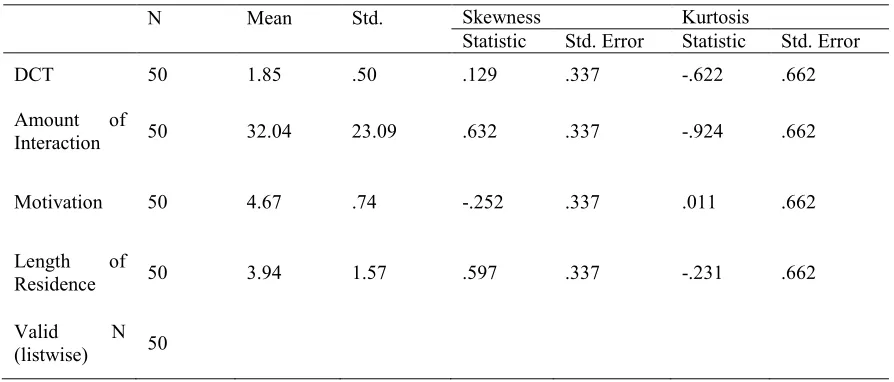
First, univariate descriptive statistics were conducted to obtain mean, standard deviation, skewness and kurtosis of the raw data for each observed variable. Table 2 displays a summary of univariate descriptive statistics for the three observed variables.
Table 2: Descriptive statistics of research variables
N Mean Std. Skewness Kurtosis
Statistic Std. Error Statistic Std. Error
DCT 50 1.85 .50 .129 .337 -.622 .662
Amount of
Interaction 50 32.04 23.09 .632 .337 -.924 .662
Motivation 50 4.67 .74 -.252 .337 .011 .662
Length of
Residence 50 3.94 1.57 .597 .337 -.231 .662
Valid N (listwise) 50
The mean level in the DCT representing the L2 pragmatic competence of the Korean ESL learners when performing complimenting behavior indicated that the Korean ESL subjects attained a relatively high level of English pragmatic competence. A mean of 1.85 suggests that the Korean ESL learners’ DCT rating is close to the “acceptable” category, which means that their dialogues contained small errors with respect to pragmatic norms. The total amount of time the participants spent interacting in English each week had a mean of 32.04. The seven-point scale to determine subjects’ level of motivation for learning English had a mean of 4.67, which implies that the participants had a favorable attitude toward learning English.
Measures of skewness and kurtosis were examined to ensure that the data of individual variables represented a normal distribution. As seen in Table 2, the skewness and kurtosis values of the three variables all lie between ± 1.0, which means that all three variables fall within the “excellent” range as acceptable variables for further analyses (George and Mallery, 2001).
Meanwhile, multicollinearity was found to pose no threat to the reliability of the subsequent regression analyses.
DCT rating results
Results of the DCT rating showed that 71 (35.5 percent) of the dialogues achieved a rating of 1 (native-like). A large number, 92 (46 percent), obtained a rating of 2 (acceptable) and contained small errors that did not affect understanding or appropriateness. Thirty-one dialogues (15.5 percent) received a rating of 3 (problematic) which meant that they contained errors that might cause misunderstandings. There were 6 dialogues (3 percent) that were rated as 4 (not acceptable) meaning that they were difficult to comprehend and/or there were instances of a violation of a social norm. The analysis of factors that contribute to success in achieving L2 pragmatics were performed using DCT scores as the criterion measure of learners’ pragmatic skills.
Correlation coefficient analysis was performed to investigate the relationship among the four variables of interest.
Research Question One
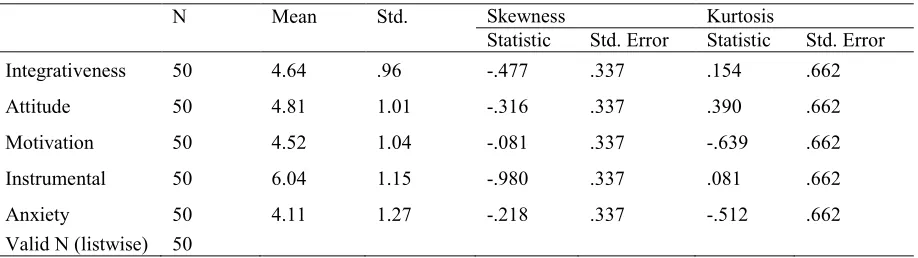
The first research question examined to what extent learners’ pragmatic competence is related to their degree of motivation. To examine this relationship, a Pearson product-moment correlation analysis with alpha set at .05 was performed. The analysis indicated a significant and strong relationship between DCT scores and the level of motivation (r = -.305, p = .031). Next, we examined which subcomponents of motivation are correlated with pragmatic competence. Descriptive statistics (table 3) show that the measures of skewness and kurtosis of the five motivation subscales were within acceptable levels and consistent with a relatively normal distribution. Thus we followed with the correlation analysis.
Table 3: Descriptive statistics of the motivation subscales
N Mean Std. Skewness Kurtosis
Statistic Std. Error Statistic Std. Error Integrativeness 50 4.64 .96 -.477 .337 .154 .662 Attitude 50 4.81 1.01 -.316 .337 .390 .662 Motivation 50 4.52 1.04 -.081 .337 -.639 .662 Instrumental 50 6.04 1.15 -.980 .337 .081 .662 Anxiety 50 4.11 1.27 -.218 .337 -.512 .662 Valid N (listwise) 50
As shown in table 4, motivation subscale showed the highest correlation (r = -.287, p
= .043) with participants’ DCT scores, followed by language anxiety with the second highest correlation (r = -.245, p
=.086). Both constructs show moderate, statistically significant correlations. The positive relationship between anxiety and pragmatic competence was rather unexpected because previous studies in
Table 4: Correlations between pragmatic competence and motivation subscales
Variables r p
Pragmatic Competence & Integrativeness -.169 .241 Pragmatic Competence & Attitude toward learning
situation -.151 .294 Pragmatic Competence & Motivation -.287 .043 Pragmatic Competence & Instrumental orientation -.156 .280 Pragmatic Competence & Language anxiety -.245 .086
The other subscales on motivation survey (integrative and instrumental orientation, attitude toward learning situation) and the pragmatic competence did not reveal any statistically significant relationships.
Research Question Two
The second research question examined whether learners’ pragmatic ability is related to amount of interaction in the target language. A Pearson product-moment correlation matrix was used to examine the relationship between the amount of interaction in English and the students’ level of L2 pragmatic ability.
Contrary to what was expected, the correlation coefficient for amount of interaction was not statistically significant (r
= -.194, p = .177). Research has shown that the type of interaction, rather than the amount of interaction, is instrumental in developing pragmatic ability (Parr, 1988; Freed, 1990; Ward & Rana-Deuba, 2000). Thus,a Pearson product-moment correlation matrix between separate types of interaction in the target language and the learners’ pragmatic competence was performed.
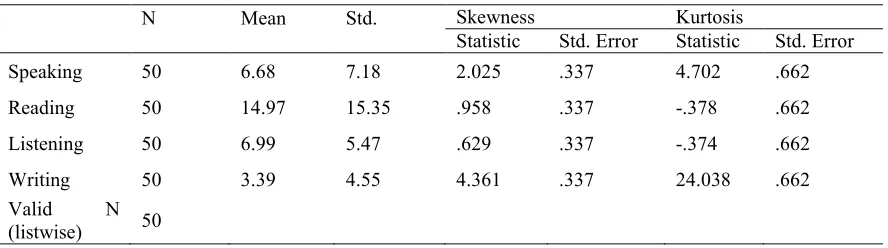
Descriptive statistics in Table 5 show mean, standard deviation, skewness and kurtosis of the raw data for the four types of interaction.
Table 5: Descriptive statistics of the amount of interaction variable
N Mean Std. Skewness Kurtosis
Statistic Std. Error Statistic Std. Error Speaking 50 6.68 7.18 2.025 .337 4.702 .662 Reading 50 14.97 15.35 .958 .337 -.378 .662 Listening 50 6.99 5.47 .629 .337 -.374 .662 Writing 50 3.39 4.55 4.361 .337 24.038 .662 Valid N
(listwise) 50
A review of the summary statistics showed an abnormal distribution for two of the subcomponents of amount of interaction variable (speaking and writing). Thus, a data transformation on the variables (speaking and writing) which did not show normal distribution was executed.
Table 6: Correlations between pragmatic competence and amount of interaction subscales
Variables r p
Pragmatic Competence & Sqrt (Speaking) .070 .628 Pragmatic Competence & Reading -.315 .026 Pragmatic Competence & Listening .046 .752
The correlation coefficients between the different types of interaction and the pragmatic competence were small and a salient relationship was identified only between time spent reading books and the DCT scores (r= -.315, p = .026).
Research Question Three
The third research question examined to what extent achievement of L2 pragmatic competence is related to the length of residence in the second language community. The correlation analysis showed that the relationship between the two variables was in the desired direction; that is, longer length of residence was more likely to lead to better outcomes in L2 pragmatics. However, the correlation coefficient (r= -.141, p = .329) was not significant.
Regression analysis
The third phase of our analysis consisted of multivariate statistical analyses. When examined individually, the regression model of the effect of motivation on pragmatic competence was significant and about 10 percent of the variation in the dependent variable (R2 =.093) was accounted for by motivation variable. However, the model including either amount of interaction or length of residence as the independent variable failed to demonstrate the powerful relationship between these variables and the dependent variable.
Multiple regression modeling was then used to analyze the overall contribution of each independent variable with the influence of other independent variables controlled for,
evaluating the contribution of total independent variables to the total explained variation in the dependent variable. The aim was to examine two questions: Was it possible that students’ L2 pragmatic achievement was best predicted as a combination of all three predictor variables of motivation, amount of interaction, and length of residence? Or did a single predictor variable yield greater predictability? To answer these questions, a series of multiple regressions were performed by first entering two predictor variables (amount of interaction and length of residence) after controlling for the strongest predictor identified based on the correlation analyses (motivation).
Inspection of the squared multiple correlations (R2) suggests that overall, 7.5 percent of the variance related to participants’ L2 pragmatic competence was explained by two variables (amount of interaction and length of residence). Based on Cohen (1988), this effect size is considered to be small and not significant (F
(2, 47) = 1,899, p = 0.161).
multiple correlations (R2) suggests that moderate and statistically significant relationships were found among these predictors, F (3, 46) = 2,802, p = 0.050. The three independent variables explained about 16 percent of the variance.
To explain the degree to which the independent variables (motivation, amount of interaction, and length of residence) affect the L2 pragmatic achievement of the learners, the weight of their respective standardized regression coefficient, or beta (β), was calculated for each predictor variable. The predictor variable of motivation yielded a beta of -.286 and a t
value of -2.083 resulting in a significant relationship (p = .043) while the predictor variable of the amount of interaction and length of residence yielded a beta of -.197/-.206 and a t of -1.395/-1.477 resulting in a non-significant relationship (p = .170/.147), respectively.
Findings from multivariate regression analysis are consistent with those obtained through examination of simple correlations, and suggest that among all predictors considered in the present study motivation was the main predictor of the criterion variable (pragmatic competence).
Discussion and conclusions
This study was undertaken in an attempt to account for Korean ESL learners’ pragmatic competence, as functions of their motivation levels for learning English, amount of interaction in English, and length of residence in the target-language community. Pearson’s r correlation coefficients were calculated to assess which variable was the better predictor of participants’ pragmatic competence. The correlation between pragmatic competence and motivation was moderately significant; contrary to what was expected, however, the correlation
coefficient for the amount of interaction and length of residence was relatively low.
The results support other research findings that indicate motivation as an important factor in second-language pragmatic acquisition (e.g., Cook, 2001; Niezgoda &Rover, 2001; Schmidt, 1993; Takahashi, 2001, 2005). With respect to this finding, data was further examined to check the extent to which the subcomponents of motivation were related to the participants’ L2 pragmatic competence. The results show that learners’ pragmatic competence is associated with some motivational factors but not with all motivation subscales. In particular, the learners’ motivational intensity was found to be closely related to their pragmatic competence. The one exception to this finding was a positive relationship between language anxiety and the participants’ pragmatic performance. This finding is incongruent with other research in which language anxiety has been shown to correlate negatively with language achievement (Gardner & Macintyre, 1993; Horwitz, 2001). Our results are not unexpected given that some studies indicate what would typically be labeled as detrimental anxiety could be sometimes facilitative for language learning (Brown, Robson, & Rosenkjar, 2001).
1994; Masumura, 2003). The fact that increased opportunities to interact in the L2 did not necessarily result in L2 pragmatic achievement is an important issue for future research. Possible explanations might be that the amount of interaction itself was insufficient and thus failed to contribute to increases of learners’ pragmatic knowledge. Lapkin, Hart, and Swain(1995) suggested that many factors affect how informal contact relates to acquisition, including the type and quality of informal contact, and individual differences, such as students’ second-language level, language experience, learning style, attitude toward the host culture, awareness of cultural differences in language use, and willingness to accommodate to pragmatic norms in a L2 and motivation. Related to this suggestion, Siegal (1994) and LoCastro (1998) focused on learners’ pragmatic development in relation to their subjectivity and agency. McKay and Wong (1996) argued that we should study L2 learners’ subjectivity when we examine their L2 use and development. As DuFon (1999) asserted, little is known about how individual learners take advantage of opportunities to interact, and what factors influence their willingness and ability to do so.
Additionally, Schmidt (1993) argued:
Simple exposure to appropriate input is unlikely to be sufficient for acquisition of L2 pragmatic knowledge because the specific linguistic realizations are sometimes opaque to learners and the relevant contextual factors to be noticed may be defined differently or may not be salient enough for the learner (p.36).
Also, Kasper (1998) proposed that while authentic L2 input is essential for pragmatic learning, it does not secure successful pragmatic development.
Another major finding of the study was the lack of correlation between the learners’ pragmatic competence with their length of residence in L2 community. This is contrary to the findings of studies which revealed the positive effects of length of residence on pragmatic competence (Churchill, 2001; House, 1996; Kuriseak, 2006). While these studies claim that a lengthy residence in the target-language area would tend to promote second-language learning, many questions remain about the validity of that assumption. Regarding this, the result in the present study supports findings from other studies that show length of residence may have a negligible effect on the eventual attainment of pragmatic skills in English (Bouton, 1994; Kondo, 1997; Roever, 2001; Rodriguez, 2001).