ISSN(Online): 2319-8753
ISSN (Print): 2347-6710
I
nternational
J
ournal of
I
nnovative
R
esearch in
S
cience,
E
ngineering and
T
echnology
(An ISO 3297: 2007 Certified Organization)
Vol. 6, Special Issue 11, September 2017
Towards Building a Competent Chatbot – An
Analogy of Development Framework, Design
Techniques and Intelligence
S. Geethanjali1, Birunda Antoinette Mary J.2
PG Scholar, Department of Computer Science, Stella Maris College, Chennai, India1
Assisstant Professor, Department of Computer Science, Stella Maris College, Chennai, India2
ABSTRACT: In the field of Human-Computer Interaction, certain programs are emerging prominently by becoming
more intelligent and productive in assisting people. One such program is a Chatbot. Chatbots are programs designed to converse with humans in textual or auditory formats. This paper provides a survey on the recent trends and techniques used in developing and designing efficient Chatbots across different fields of application in today’s world.
KEYWORDS: Chatbots; AIML; NLP; Turing Test; Machine Learning; Artificial Intelligence
I. INTRODUCTION
Of late, a number of researches are directed towards the field of Artificial Intelligence (AI). AI is the study of exhibition of any form of behavior, which is deemed intelligent, by a machine. A device is said to be an intelligent agent, if it can recognize what is happening around and make decisions based on the identified information. An intelligent machine must be able to imitate the cognitive functions performed by humans such as learning, reasoning, recognizing context, perception, linguistic intelligence and problem solving. The ultimate goal of AI is to build a machine that is indistinguishable from a human. In order to classify a machine as an intelligent agent, it must be able to interact with a human. This is dealt with in one of the many fields that contribute to AI, called as Human-Computer Interaction (HCI).
HCI is the study of the design and use of computers in conversing with a human user. A computer can interact with a human through any form of interface such as Graphical User Interface (GUI) or Voice User Interface (VUI). The goal of HCI is user satisfaction. One program that aims to communicate with humans and provide their expected level of satisfaction is a Chatbot.
A Chatbot, also known as Chatterbot or Talkbot, is a computer program that is designed to interact with users through textual or auditory conversations. Many of the Chatbots use simple pattern matching techniques to converse. But this is not true AI, as the Chatbot is not able to reason and make its judgment. Thus, to build truly intelligent conversational agents, proper knowledge about, what tools have to be used; how they can be utilized effectively; and how to evaluate the resultant program, is needed. This paper provides a survey on the Chatbot design and development techniques and aims to provide an insight to much of these frequently asked questions about Chatbot development. The discussions are focused on Chatbots of recent development.
The paper is organized as follows: 1. Introduction
2. Background of Chatbots: working, Turing test and history 3. Tools for building a Chatbot
ISSN(Online): 2319-8753
ISSN (Print): 2347-6710
I
nternational
J
ournal of
I
nnovative
R
esearch in
S
cience,
E
ngineering and
T
echnology
(An ISO 3297: 2007 Certified Organization)
Vol. 6, Special Issue 11, September 2017
II. METHODOLOGY
The review of existing literature about Chatbots included identifying, selecting and reviewing potential papers and theses as given below:
1. Publications were identified through online databases such as ResearchGate, DSpace and Google Scholar using the keywords “Chatbots”, “Chatbot AI”, “AIML”, “ALICE bot”.
2. For each publication selected, its bibliography was examined for new potential publications. 3. After reading, some publications were discarded.
4. The Chatbots in the selected publications were reviewed and classified based on their development framework and design techniques; and the bot’s special features, efficiency and intelligence.
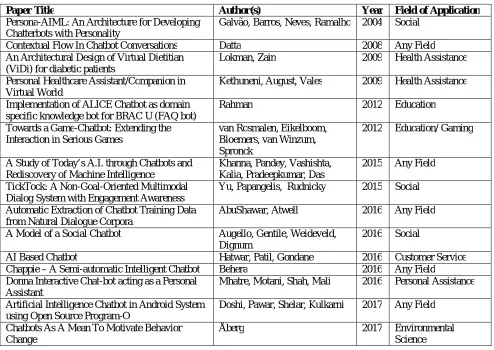
Table 1 presents the 15 publications chosen for the literature review.
Paper Title Author(s) Year Field of Application
Persona-AIML: An Architecture for Developing Chatterbots with Personality
Galvão, Barros, Neves, Ramalho 2004 Social
Contextual Flow In Chatbot Conversations Datta 2008 Any Field An Architectural Design of Virtual Dietitian
(ViDi) for diabetic patients
Lokman, Zain 2009 Health Assistance
Personal Healthcare Assistant/Companion in Virtual World
Kethuneni, August, Vales 2009 Health Assistance
Implementation of ALICE Chatbot as domain specific knowledge bot for BRAC U (FAQ bot)
Rahman 2012 Education
Towards a Game-Chatbot: Extending the Interaction in Serious Games
van Rosmalen, Eikelboom, Bloemers, van Winzum, Spronck
2012 Education/ Gaming
A Study of Today’s A.I. through Chatbots and Rediscovery of Machine Intelligence
Khanna, Pandey, Vashishta, Kalia, Pradeepkumar, Das
2015 Any Field
TickTock: A Non-Goal-Oriented Multimodal Dialog System with Engagement Awareness
Yu, Papangelis, Rudnicky 2015 Social
Automatic Extraction of Chatbot Training Data from Natural Dialogue Corpora
AbuShawar, Atwell 2016 Any Field
A Model of a Social Chatbot Augello, Gentile, Weideveld, Dignum
2016 Social
AI Based Chatbot Hatwar, Patil, Gondane 2016 Customer Service Chappie – A Semi-automatic Intelligent Chatbot Behera 2016 Any Field Donna Interactive Chat-bot acting as a Personal
Assistant
Mhatre, Motani, Shah, Mali 2016 Personal Assistance
Artificial Intelligence Chatbot in Android System using Open Source Program-O
Doshi, Pawar, Shelar, Kulkarni 2017 Any Field
Chatbots As A Mean To Motivate Behavior Change
Åberg 2017 Environmental
Science
Table-1: List of Publications
III. BACKGROUND
Chatbots are developed to produce natural language responses to human user inputs. A Chatbot must be a
dialogic agent-understand the user, rational agent-must be context-specific and embodied agent-have a personality [7].
ISSN(Online): 2319-8753
ISSN (Print): 2347-6710
I
nternational
J
ournal of
I
nnovative
R
esearch in
S
cience,
E
ngineering and
T
echnology
(An ISO 3297: 2007 Certified Organization)
Vol. 6, Special Issue 11, September 2017
Interpret the words and discover what the user meant Formulate a response or clarify any doubts with the user Construct the response
Display the response
3.1 Working of a Chatbot
Fig-1: Working of a Chatbot
As shown in Fig-1, the user provides the input through the User Interface. The input is passed to the Natural
Language Processing (NLP) unit, where the following main activities take place to identify keywords: Morphological
Segmentation where the root words are identified followed by Part-of-speech (POS) tagging which determines the
grammatical context of the word. During Parsing, a parse tree for the given input is constructed. The sentence is then broken down based on punctuation marks used. The words in a sentence are identified and separated. And finally the
keywords are extracted from the input. The keywords are used to find appropriate response from the data storage and
the response is formulated and presented to the user.
3.2 Turing Test
In 1950 Alan Turing proposed the ‘Turing Test’ [1] as the criteria to deem a machine as an intelligent agent. He put forth the question “Can a machine think?” and conceptualized the ‘Imitation Game’ (now referred to as the Turing Test) as a new form of the aforementioned question in terms of a game. The game is played with three people, a man, a woman and an interrogator, who may be of either sex. The objective of the game is for the interrogator to identify which of the two is the man and which the woman, through a series of interactions. The ultimate aim of the Turing Test is for the interrogator to identify whether he/she is conversing with a human or a machine.
3.3 History
ISSN(Online): 2319-8753
ISSN (Print): 2347-6710
I
nternational
J
ournal of
I
nnovative
R
esearch in
S
cience,
E
ngineering and
T
echnology
(An ISO 3297: 2007 Certified Organization)
Vol. 6, Special Issue 11, September 2017
was the first Chatbot to pass the Turing Test. ELIZA was followed by PARRY [3], a Chatbot that simulated a paranoid schizophrenia patient, developed by Kenneth Colby in 1972 at Stanford. Next came A.L.I.C.E. (Artificial Linguistic
Internet Computer Entity) [8] also known as Alicebot, that was developed by Richard Wallace in 1995. A.L.I.C.E. uses
AIML (Artificial Intelligence Markup Language) pattern matching rules to generate responses. A.L.I.C.E. has been
awarded the Loebner Prize, an annual competition held to identify the most intelligent machine through a series of Turing Tests, three times. Another significant Chatbot is Jabberwacky [24]. Jabberwacky created by Rollo Carpenter differs from the other bots in that, Jabberwacky is able to learn from user’s inputs. It stores inputs and incorporates deep learning and fuzzy logic to achieve its goal. Jabberwacky is a two-time winner of the Loebner Prize.
IV. TOOLS FOR BUILDING A CHATBOT
Chatbots can be designed using one or more of the following tools:
4.1 User Interface (UI)
UIs provide the platform for the users to interact with the Chatbot. UIs can be built using any programming language such as Java, Python etc. The main role of UI is to get the user input and forward it for processing. The result of the interaction is also delivered to the user via the UI. UI can provide its services through textual format (GUI) or auditory format (VUI). The UI is the only part of the Chatbot that is visible to the users; hence it is advisable to build an attractive and user-friendly UI to grope in more users. The UI must be relevant to the persona of the Chatbot. Traditional Chatbots used Command Line Interpreters.
4.2 NLP toolkits
It is used for revealing the structure and meaning of the user input. Some of the commonly used NLP functions include Morphological segmentation, POS tagging, Parsing, Sentence breaking, Word segmentation etc. NLP functions are provided by various toolkits such as Natural Language Toolkit (NLTK), Apache OpenNLP etc.
4.3 AIML
AIML or Artificial Intelligence Markup Language enables people to build a dialogue based pattern-matching knowledge base for Chatbots developed using the A.L.I.C.E. free software technology [4]. It is a derivative of XML
(Extensible Markup Language). AIML files require the help of an interpreter such as Program AB, Program O etc.
AIML consists of AIML objects, which are pairs of topics and categories. A ‘category’ is the basic unit of information in AIML and it consists of: input question called as ‘pattern’; output answer called as ‘template’; two types of optional context called as ‘that’ and ‘topic’. The AIML pattern language consists of words, spaces, wildcard characters (_ and *) and is case invariant. The general structure of AIML is given below.
<AIML version=”1.0”> <category>
<pattern>USER INPUT 1</pattern> <template>RESPONSE</template> </category>
</AIML>
In some cases there might be more than one answer for the same question. In that case, a random response can be generated from a list of possible responses. In this method, the <random> and <li> tags are used to specify the list of random responses as shown below.
<category>
<pattern>USER INPUT 2</pattern> <template><random>
ISSN(Online): 2319-8753
ISSN (Print): 2347-6710
I
nternational
J
ournal of
I
nnovative
R
esearch in
S
cience,
E
ngineering and
T
echnology
(An ISO 3297: 2007 Certified Organization)
Vol. 6, Special Issue 11, September 2017
<li>RESPONSE OPTION 3</li> </random></template>
</category>
Recursion can be achieved using <sr> (Symbolic Reduction) and <srai> (Simple Recursive Artificial
Intelligence) tags. There are many applications of recursion such as: Symbolic Reduction to reduce complex
grammatical forms; Divide and Conquer to split an input into two or more subparts and combine them to form responses; providing Synonyms by mapping different ways of saying the same thing to the same reply; spelling or
grammar corrections; detecting keywords anywhere in the input; conditional branching.
<category>
<pattern>ANOTHER FORM OF USER INPUT 2</pattern> <template><srai>USER INPUT 2</srai></template> </category>
4.4 SQL Database
A database is used to store any form of data such as the Chatbot knowledge base, chat history, user information etc., that is to be kept persistent. Relational Database Management Systems (RDBMS) are used for this purpose. The widely used Relational Database Language is Structured Query Language (SQL). The database can be accessed via ‘queries’ written according to the particular SQL chosen. Some commonly used SQL databases include MySQL, ORACLE and SQL Server etc.
4.4 Data Corpus
A corpus is large collection of sets of text which can be used for training the Chatbot. These corpora contain
annotated data, which ease the NLP functions. Apart from using corpora for training, it is also possible to use it as the
Chatbot’s knowledge base as demonstrated by Shawar et al. [5], by convert the dialogue corpus to AIML files. Some examples of corpora are British National Corpus (BNC), Oxford English Corpus etc.
V. LITERATURE REVIEW
In this section the Chatbots from the selected research and theses papers published between 2004 and 2017 are examined below.
Galvão et al. [6] proposed the Persona-AIML architecture for developing Chatbots using AIML, with a personality. Personality elements such as attitude, emotion, mood, physical traits and are incorporated into the Chatbot. The response to the user is greatly influenced by these traits. The main advantage of this architecture is flexibility in creating Chatbots with different personality. The efficiency of the bot was verified by the users of the Chatbot in Internet Relay Chat (IRC) environments and the web.
Datta [9] proposed yet another Chatbot model, which combines the features of A.L.I.C.E., Quartet architecture and
the internet. The proposed Chatbot acts as an information retrieval system and has the advantage of being a generic
Chatbot that can efficiently converse in natural language, by using the Bayesian Network Model, for smoothly navigating amongst different conversation topics. It makes use of the internet as its data corpora.
Lokman et al. [10] have proposed a Virtual Dietitian Chatbot (ViDi) for diabetic patients. ViDi makes use of Question and Answer pattern matching system. In order to provide correct diets, ViDi is made to keep track of the user’s conversation history through the use of a parameter called as vpath, which tells the path the user takes, during the QA session, across different levels. This gives ViDi the power to respond based on the entire conversation.
ISSN(Online): 2319-8753
ISSN (Print): 2347-6710
I
nternational
J
ournal of
I
nnovative
R
esearch in
S
cience,
E
ngineering and
T
echnology
(An ISO 3297: 2007 Certified Organization)
Vol. 6, Special Issue 11, September 2017
In his thesis paper, Rahman [12] uses a tailored version of A.L.I.C.E. as a domain specific FAQ bot for developing a student information system. The knowledge base consists of new AIML files of different categories apart from A.L.I.C.E.’s base knowledge, with the provision of navigating from one category to another. The bot is also capable of remembering the conversation.
Rosmalen et al. [13] showed that it is possible to create and integrate Chatbots with other environments, in this case, EMERGO – a serious gaming environment that is used to offer case studies to train students. The Chatbot acts as an interface between the user and EMERGO and provides resources from EMERGO based on the user’s request.
Khanna et al. [14] assess the strengths and weaknesses of current AI systems through the use of Chatbots. Apart from the regular functions provided by Chatbots, the authors have added additional functionality such as
embedding applications such as a calculator, data file handling and error handling to make the bot an efficient.
The drastic limitations to the current AI systems are discussed along with counter measures that need to be inculcated to redefine AI.
TickTock, a conversational agent developed by Yu et al. [15], is a multimodal dialog system, that was designed to keep users engaged in a social conversations as long as possible. The system uses confidence scores to guide the direction of the conversation. The system is supported by various other technologies such as Google Automatic Speech Recognition, MultiSense etc., to collect auditory and visual data from the user. These data are used to evaluate the user’s engagement.
Hand-coding of vast knowledge to create an efficient Chatbot is a cumbersome activity. To overcome this limitation Shawar et al. [16] developed a program to convert different types of corpora, such as dialogue, monologue and FAQ, into AIML categories. The result is an extended range of knowledge base for the Chatbot which gives it the flexibility to operate in different domains and serve different purpose.
In an effort to create a truly intelligent Chatbot, Augello et al. [17] proposed the architecture to develop a Social
Chatbot whose goal is to adhere to social conversation practices deemed necessary. The Chatbot uses Social-AIML
(S-AIML), an extension of AIML which includes specific tags to describe the social practice, activities etc.
In [18] Hatwar et al. have proposed a Chatbot that will serve as a shopping guide. The proposed Chatbot, which works on the web, will provide various details such as on-going sale and also provides navigation features to the desired shop.
Behera [19] talks about Chappie, a semi-automatic intelligent Chatbot. The author classifies the Chatbot as intelligent because it satisfies the three basic criteria for an intelligent system, namely: Understanding the intent of the user; ability to handle repetitive questions efficiently; and routing the conversation to a human agent. The resulting Chatbot had a positive effect and was able to fool people into thinking that it was a human.
In their paper Mhatre et al. [20] were able to create a web based Chatbot, Donna, which acts as a personal assistant and helps users in setting up meetings. Unlike few Chatbots which depend on e-mails being forwarded to it in order to process them, Donna automatically takes care of these functionalities. Donna gets the work done with help from Gmail API and Google Calendar API respectively. Donna proved to be an effective assistant.
V. Doshi et al. [22] present the model of an Android application Chatbot. The Chatbot uses AIML and Android application with a JSON parser acting as the middleware API. The resulting Chatbot has the advantages of both AIML and Android. This research has shown that Chatbots could be developed using a single platform and can be used in other platforms provided there is sufficient middleware. This takes us one step closer towards designing platform independent Chatbots.
Chatbots can be the guide pushing people towards a sustainable world through constant motivation for behavioral change. Åberg [23] in his paper has presented the prototypes for three Chatbots to bring about this change using eco-friendly technology. The three Chatbots performed the following:
a. Informative Chatbot – start conversation with the user daily to provide tips to consume food in a more
sustainable way
b. Goal-setting and rewarding Chatbot – set up goals to be accomplished
ISSN(Online): 2319-8753
ISSN (Print): 2347-6710
I
nternational
J
ournal of
I
nnovative
R
esearch in
S
cience,
E
ngineering and
T
echnology
(An ISO 3297: 2007 Certified Organization)
Vol. 6, Special Issue 11, September 2017
Presented below are two tables which provide a comparison of the various Chatbots that were used in the selected papers for the literary review. Table 2 illustrates the comparison based on the development framework and the design techniques used to develop these Chatbots. Table 3 provides a comparison of these Chatbots based on their special features, efficiency and intelligence.
Paper Development framework/
platform/ language used
Usage of AIML
Usage of SQL
Data Corpus used
Algorithm for matching keywords
VUI usage
GUI usage
[6] AIML interpreter YES NO A.L.I.C.E. AIML NO YES
[9] AIML interpreter YES YES Wikipedia Bayesian Networks
NO YES
[10] AIML interpreter YES YES VPbot QA matching NO YES
[11] RebeccaAIML YES YES DHIS AIML NO YES
[12] AIML interpreter YES NO A.L.I.C.E. + Custom corpus
AIML NO YES
[13] Program D; Grails 2.0; Groovy 1.8.6; MySQL; Java
YES YES A.L.I.C.E. + EMERGO
AIML NO YES
[14] C++ ; AIML interpreter YES YES A.L.I.C.E. AIML NO YES [15] Google ASR; MultiSense NO YES CNN interview
transcripts
Key term matching
YES YES
[16] Java; AIML interpreter YES NO BNC; Qur'an; web FAQs; A.L.I.C.E.
AIML NO YES
[17] S-AIML YES NO S-AIML AIML NO YES
[18] Verbot YES NO Verbot
Knowledge base
AIML YES YES
[19] AIML interpreter YES NO Custom corpus AIML NO YES
[20] Stanford CoreNLP; Chatscript; Gmail API; Calendar API; Program O; PHP; MySQL; Xampp;
YES YES Dbpedia AIML NO YES
[22] Program O; PHP; MySQL; JSON parser
YES NO A.L.I.C.E. AIML YES YES
[23] Chatfuel; Glitch; QnAmaker; Twinery
NO YES Custom corpus QA matching YES YES
Table-2: Comparison of the Chatbots based on development framework and design techniques
Paper Special features found in the Chatbot Factor(s) contributing to the
efficiency of the Chatbot
Exhibition of any form of
intelligence
[6] Personality traits affect the response generated Development of a Generic Architecture
YES
[9] Bayesian Networks produce accurate responses Navigate conversations YES [10] Remember user's previous response by tracking path ViDi controls the conversation YES [11] NVBG animated avatars Supports multi-users and
multi-bots
NO
[12] Occasionally throw random responses Navigate conversations even if no proper response is found
ISSN(Online): 2319-8753
ISSN (Print): 2347-6710
I
nternational
J
ournal of
I
nnovative
R
esearch in
S
cience,
E
ngineering and
T
echnology
(An ISO 3297: 2007 Certified Organization)
Vol. 6, Special Issue 11, September 2017
[13] Integrates with EMERGO and displays videos based on the topic and summarize contents of the course
Control and navigate the conversation
YES
[14] Provides embedded applications Error handling; Ambiguity handling; Data file handling
YES
[15] Real-time multimodal sensing Automatic navigation YES [16] Auto generate AIML files from corpus irrespective of
the language and structure
Accurate matching; Quality of response
NO
[17] Social etiquettes Accurate interpretation of user sentence
NO
[18] Provides accurate navigation instantly Shortest-path determination NO [19] Semi-automatic response generation No redundancy in responses YES [20] Automatically retrieves information for setting up
meeting from user's email without their intervention
Works quicker for smaller emails; Rated average to excellent for 95% of the responses
YES
[22] Works as a chat application that can run in any Android device
JSON parser takes care of converting code, irrespective of the underlying bot design
NO
[23] Informative; Goal-setting and rewarding; Comparative
Interacts regularly to bring about the desired change
YES
Table-3: Comparison of the Chatbots based on special features, efficiency and intelligence
VI. FUTURE WORK AND CONCLUSION
In this paper, a spread of Chatbots were selected for the literature review. The survey dealt with literature review of each bot and the classification of bots based on their field of application. A comparison of Chatbots based on their development framework and design techniques was provided, which showed that there are only few alternatives in designing a conversational agent. This is an indicator that there has been very little growth in the said area. Also discussed in this work, were the comparison of Chatbots based on their special features, effectiveness factors and intelligence, which shows the achievements of each Chatbot. These achievements are the stepping stones towards building a better Chatbot in the future. This prompts future researches to be focused on finding better alternatives to designing a truly intelligent system. The next generation Chatbots should be aimed at
providing better UI
extending the knowledge base through improved web connectivity increasing the efficiency of the algorithms in use
using better NLP tools to understand the context more accurately
having better rapport with the user by understanding the user’s personality, mood etc., and knowing the user’s expectations and needs
constantly evolve through cognitive learning
In conclusion, it can be said that Chatbot development is still in its infancy and offers no common solutions. Many techniques are yet to be discovered, that will lead to a future filled with Artificially Intelligent machines.
REFERENCES
[1] Turing, A. M. (1950). Computing machinery and intelligence. Mind, 59(236), (pp. 433-460).
[2] Weizenbaum, J. (1966). ELIZA—A computer program for the study of natural language communication between man and machine. Communications of the ACM, 9(1), (pp. 36-45).
[3] Colby, K. M. (1981). Modeling a paranoid mind. Behavioral and Brain Sciences, 4(4), (pp. 515-534). [4] Wallace, R. S. (2003). The elements of AIML style. Alice AI Foundation.
ISSN(Online): 2319-8753
ISSN (Print): 2347-6710
I
nternational
J
ournal of
I
nnovative
R
esearch in
S
cience,
E
ngineering and
T
echnology
(An ISO 3297: 2007 Certified Organization)
Vol. 6, Special Issue 11, September 2017
[6] Galvão, A. M., Barros, F. A., Neves, A. M., & Ramalho, G. L. (2004, July). Persona-aiml: An architecture developing Chatterbots with personality. In Proceedings of the Third International Joint Conference on Autonomous Agents and Multiagent Systems, Vol. 3 (pp. 1266-1267). IEEE Computer Society.
[7] Sansonnet, J. P., Leray, D., & Martin, J. C. (2006). Architecture of a framework for generic assisting conversational agents. In Intelligent Virtual Agents (pp. 145-156). Springer Berlin/Heidelberg.
[8] Wallace, R. S. (2007). Chapter 00. The anatomy of ALICE. Alice AI Foundation.
[9] Datta, A. (2008). Contextual flow in Chatbot conversations. Retrieved from https://cse.iitk.ac.in
[10] Lokman, A. S., & Zain, J. M. (2009, August). An architectural design of Virtual Dietitian (ViDi) for diabetic patients. In Computer Science and Information Technology, 2009. ICCSIT 2009. 2nd IEEE International Conference on (pp. 408-411). IEEE.
[11] Kethuneni, S., August, S. E., & Vales, J. I. (2009, October). Personal health care assistant/companion in virtual world. In 2009 AAAI Fall Symposium Series.
[12] Rahman, J. (2012). Implementation of ALICE Chatbot as domain specific knowledge bot for BRAC U (FAQ bot). Retrieved from http://dspace.bracu.ac.bd
[13] Van Rosmalen, P., Eikelboom, J., Bloemers, E., Van Winzum, K., & Spronck, P. (2012, October). Towards a game-Chatbot: Extending the interaction in serious games. In European Conference on Games Based Learning (p. 525). Academic Conferences International Limited. [14] Khanna, A., Pandey, B., Vashishta, K., Kalia, K., Pradeepkumar, B., & Das, T. (2015). A study of today’s AI through Chatbots and rediscovery
of machine intelligence. International Journal of u- and e- Service, Science and Technology, 8, (pp. 277-284).
[15] Yu, Z., Papangelis, A., & Rudnicky, A. (2015, March). TickTock: A non-goal-oriented multimodal dialog system with engagement awareness. In Proceedings of the AAAI Spring Symposium.
[16] AbuShawar, B., & Atwell, E. (2016). Automatic extraction of Chatbot training data from natural dialogue corpora. In RE-WOCHAT: Workshop on Collecting and Generating Resources for Chatbots and Conversational Agents-Development and Evaluation Workshop Programme (May 28 th, 2016) (p. 29).
[17] Augello, A., Gentile, M., Weideveld, L., & Dignum, F. (2016). A model of a social Chatbot. In Intelligent Interactive Multimedia Systems and Services 2016 (pp. 637-647). Springer International Publishing.
[18] Hatwar, N., Patil, A., & Gondane, D. (2016). AI based Chatbot. International Journal of Emerging Trends in Engineering and Basic Sciences, Vol. 3, Issue 2 (March-April 2016), (pp.85-87)
[19] Behera, B. (2016). Chappie-A semi-automatic intelligent Chatbot. Retrieved from https://www.cse.iitb.ac.in
[20] Mhatre, N., Motani, K., Shah, M., & Mali, S. (2016). Donna interactive Chat-bot acting as a personal assistant. International Journal of Computer Applications, 140(10).
[21] McTear, M., Callejas, Z., & Griol, D. (2016). Creating a conversational interface using Chatbot technology. In The Conversational Interface (pp. 125-159). Springer International Publishing.
[22] Doshi, S. V., Pawar, S. B., Shelar, A. G., Kulkarni, S. S. (2017). Artificial Intelligence Chatbot in android system using open source Program-O. International Journal of Advanced Research in Computer and Communication Engineering, Vol. 6, Issue 4 (April 2017), (pp. 816-821) [23] Åberg, J. (2017). Chatbots as a mean to motivate behavior change: How to inspire pro-environmental attitude with Chatbot interfaces
(Dissertation). Retrieved from http://urn.kb.se/resolve?urn=urn:nbn:se:umu:diva-13583