Review on Ant Colony Optimization and Zone
Based Routing Protocols in MANET
Shradhdha Bhalodia
1, Prof. Wasim Ghada
2PG Student, Dept. of CSE, B. H. Gardi College of Engineering, Rajkot, India1
Assistant Professor, Dept. of CSE, B. H. Gardi College of Engineering, Rajkot, India2
ABSTRACT: Mobile Ad Hoc Network (MANET) is a collection of wireless mobile nodes dynamically forming a network. There is no fix infrastructure in MANETs. Any time node can join or leave network because no centralized control in MANETs. Routing in MANET is biggest challenge for researchers. In Routing energy efficiency and scalability is one of the main challenge because the mobile ad hoc network has dynamic topology and frequent route change behaviour. In this paper we propose the technique which is used to make scalable and energy efficient network using Ant colony Optimization and Zone based routing algorithms.
KEYWORDS: MANET (Mobile Ad Hoc Network); ACO (Ant Colony Optimization); Zone Based Routing Protocol;
Scalable; Energy Efficient
I. INTRODUCTION
Mobile ad hoc network (MANET) is a self-configuring, self-organizing and infrastructure-less network of mobile nodes which allows the systems to be communicated without any wires. A few characteristics of MANETs are Packet should be forwarded via one or more intermediate nodes,Each node can function as both host and a router, Network topology may change randomly and at unpredictably, There is no centralized control of the network operations.
Some of the challenges [1] faced in MANETs are Dynamic topology, Overhead in Routing, Packet losses, frequent route changes, Hidden terminal problem, Security threats, Quality of Service (QoS), Limited Bandwidth, Limited power supply. Application [2] of MANETs are military battlefield, Emergency rescue operations, temporary information sharing in conferences, civilian environments like taxicab, sports stadium, boat and small aircraft.
Routing in mobile ad hoc network is challenging in these networks because the network infrastructure in not fixed and frequent topological changes occurs. For solve the routing challenge in mobile ad hoc network we can use bio inspired networking. It is the networks that takes inspiration from Biology and hence it can be used to solve the problems of computer networks. Swarm intelligent is a computational and behavioural metaphor solving distributed problems inspired from biological examples provided by social insects such as ants, termites, bees, etc. Ant Colony Optimization is the behaviour of real ants for food searching. It is use to solve problems like routing in MANETs. In this paper also we use the zone based routing for large scale network. If we can make the zone of network then we can increase the scalability of network. For energy efficiency we can use concept of Span design algorithm.
II. ROUTINGINMANET
Routing in mobile ad hoc network is the process of moving data packets form source to destination. Routing is the Key feature of the network. Grouping of routing protocols in MANET‟s can be done in different ways, but most of these are done depending on network structure and routing strategy. According to the network structure routing protocols are classified as hierarchical routing, geographic position assisted routing and flat routing, while depending on the routing strategy these are classified as Table-driven and source initiated. Both these protocols come under the flat routing. Some are based on swarm intelligence techniques, like Ant colony optimization.
2. Path selection 3. Data forwarding 4. Path maintenance
III.ANT COLONY OPTIMIZATION (ACO)
Ant Colony Optimization (ACO) Algorithm have been inspired by the behaviour of a real ant colony. ACO first put forward by Dorigo M. in the early 1990‟s, first developed for wired communications and that is named as Ant Net. Using ACO algorithm we can make complex task in distributed manner. This makes the network free from the overloaded network.[16]
The principle of the ACO is that ants can release some special chemical substance which is named pheromone. Moving ants deposits a certain amount of pheromone in the environment thus making the path by a trail of substance. First ants can choose random way for nest to food. After that if we put the obstacle on the way of nest to food as mention in fig 1. Then ants can select the shortest path. The longer the route ants gained, the smaller amount of pheromone they deposited. Then, when ants for a second time arrive at the intersection later, each of them prefers in possibility to choose the path richer in pheromone rather than the poorer one. So, the pheromone trail on the better paths gets stronger and stronger, and ants that choose those paths get more and more, while that of other paths fades away by iteration gradually, and ants choose them get less and less. Finally the ants get shortest path from nest to food.[17]
Figure 1: Ant Colony Optimization
IV.ZONE BASED ROUTING
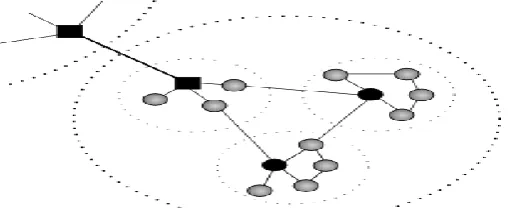
Zone Based routing uses the approach in which the whole network is divided into different zones and the routing can be done so we can increase the size of network and network lifetime. In this types of algorithm first the zone is created according to the geographical location of node, radius of network and number of hop. After selecting the zone, zone head can be selected using different parameters like degree of node (neighbours of node) and energy of node. Then communication between source and destination is started using the zone head of that particular zone.
V. RELATED WORK
In [3] authors used on-demand routing and novel meta heuristic Ant-E using the Blocking-ERS(Blocking Expanding Ring Search) to control the network traffic and local retransmission to improve the routing in mobile ad hoc network. This algorithm enhances the efficiency of MANET routing protocol. Ant-E utilizes a collection of mobile agents as “ants” to perform optimal routing activities.
In [4] authors used two approach for power saving: the basic energy-conserving algorithm (BECA) and adaptive fidelity energy conserving algorithm (AFECA). These approaches use dynamically switching the nodes between active, listening and sleeping states. The mobile nodes switch between these states with fixed intervals and in order to ensure the successful forwarding of messages, the active nodes may have to retransmit messages a number of times before the receiving node is listening or active.
In [5] authors used Each node in the mobile ad hoc network running Span makes local and periodic decisions on whether to stay awake as a coordinator or sleep. To preserve efficiency, a mobile node decides to volunteer to be a coordinator if it searches that two of its neighbors cannot communicate with each other directly or through an existing coordinator. To keep the redundant coordinators rotate this role amongst all nodes. In this each node work on its willingness with a random delay that takes two factors into considerations: the number of pairs of neighbors it can connect together and the amount of remaining battery energy.
In [6] authors used ARA which has very small overhead because there are no routing tables which are interchanged between the nodes. In this algorithm as compared to other the FANT and BANT packets do not transmit much routing information. Routing Packets are transmitted with unique sequence number. Most route maintenance is performed through data packets, thus they do not have to transmit additional routing information. This algorithm only needs the information in the IP header of the data packets.
In [7] authors proposed work is multicasting with multiple cores by adopting swarm intelligence. For selecting multiple cores swarm intelligent is used. These multiple cores used to connect to all group members. This work is designed to support group communication applications. That exhibit highly dynamic group membership changes and requires a large degree of coordination.
In [8] authors proposed HOPNET algorithm which is consists of reactive communication between the neighborhoods and the local proactive route discovery within a node‟s neighborhood. Network is divided into zones which are the node‟s local neighborhood. The size of the zone is determined by the radius length measured in hops. A node may be within multiple overlapping zones and zones could vary in size. The nodes can be categorized as boundary and interior nodes.
In [9] authors proposed PAR(Petal Ant Routing) is a routing algorithm of ant based multi-hop ad hoc network which extract few features from petal routing for computing width of the petal (Pw) and make two types of ant. P_FANT and P_BANT to find path between the source node and destination node within the petal region. PAR consists Route discovery, Route maintenance and Route repair.
In [10] authors proposed PACONET (imProved Ant Colony Optimization algorithm for mobile ad hoc NETworks) is a routing protocol which is inspired by the real behavior of ants. It uses two types of agents: FANT (Forward ants) and BANT (Backward ants).The FANT expand the paths of the network in a restricted broadcast manner in search of routes from a source to a destination. The BANT establishes the path from destination. These ant agents create a preference at each node for its neighbors by leaving a pheromone amount from its source. Data packets are stochastically transmitted near nodes with higher pheromone concentration beside the path to the destination.
built based on position information. A head manages the group membership and collects the positions of the member nodes in its zone. At the upper tier, the heads of the member zones report the zone membership to the sources directly along a virtual reverse-tree-based structure.
In [12] authors used Zone based Ant colony optimization using clustering which announces to search shortest route using the DIR principle. In this algorithm authors used Zone based Ant colony optimization to get shortest path with small number of control messages to minimize the overhead of network.
In [13] authors proposed ZBMRP (Zone Based Multicast Routing Protocol) for on demand routing in mobile ad hoc network. ZBMRP relates mesh based multicast routing zones along the path from multicast source node to the multicast destination. In this algorithm multicast overhead is massively reduced and good scalability can be achieved using the concept of control packet flooding is employed inside multicast zones. To overcome the network overhead and scalability problem of ODMRP a new hybrid multicast routing protocol ZBMRP is proposed. In this algorithm Zone heads are selected according to the First Declaration Wins (FDW) principle which is responsible for creating and maintaining zones at the same time intervals.
In [14] authors proposed an algorithm which makes use of reactive and proactive both mechanisms. Using HELLO messages a node comes to know about its neighbors. GPS is used for monitoring the speed and coordinates of the nodes. The collected information then stored in source tree. It is maintained for each and every node in a network. This algorithm makes use of request zone and expected zone to forward the data from source and destination. The source define the zone is equivalent to its request zone where the destination is resides in the expected zone. If the destination is in the request zone then with the help of neighbors, it will forward data to the destination otherwise we can expand the request zone in the direction of destination by including the immediate neighbor of the request zone.
In [15] authors uses the ZHLS algorithm which consists of the reactive routing between the zones and proactive routing within a zone. The network divides into non-overlapping zones which are the node‟s local neighborhood. The zone size depend on network density, transmission power, node mobility and propagation characteristics. Using GPS Each node knows its physical location. The nodes can be categorized as gateway and interior nodes.
VI. PROPOSEDALGORITHM
Phase-I: Zone formation
The Zone formation is not determined locally but by the radius length measured in hops. By Geographical location strategy like GPS (Global Positioning System) we can form the zone which nodes are covered in the radius of k hops it is selected for the same zone. In this way the zone is form in the mobile ad hoc network.
Phase-II: Selection of Zone Head
After the zone formation zone head selection factor (HSf) is calculated for each node. The value of HSf is
based on highest degree of the node and largest residual energy of the node. If a node has highest HSf than that
node is elected as head node which means that the node which is having the higher number of neighbour node and higher energy is elected as head node.
HSf = Degree of the node * Energy of the node
There may be a few cases when head reselection is required. If current head crashes, head reselection takes place. If the head node is found to be malicious it is blocked from the network immediately and the network chooses a new head again in the same way as described above.
Phase-III: Energy conserving routing
This power save mode approach focuses on inactive time of communication. Our approach is to design the system to elect a head node and let it head the communication on behalf of its neighbouring as non-head nodes. Now, non-head nodes can safely sleep most of time saving battery energy. Each non-head node periodically wakes up and communicates with the zone head node to find out if it has data to receive. Nodes are one of three states as mention here active, listening and sleeping. Initially, head nodes is in the active state. Remaining non head nodes are all in sleep state periodically goes to listening state and exchanges discovery messages including node IDs to find the particular destination. The head node remains active to handle routing for period of time that nodes remain active when no messages are being processed. After that the nodes changes its state to sleep state.
Phase-IV: Routing using Ant Colony Optimization
Data packets and control packets are two types of packets used in network. In ant routing data packets represent the information that end-users exchange with each other which stored at routing tables for travelling from the source to the destination node. Control packets like FANT (forward ant) and BANT (backward ant) are used to distribute information about the traffic load in the network and update the routing tables.
Apart from the above control packets, the neighbour control packets are used to maintain a list of available nodes in zone to which packets can be forwarded. The HELLO messages are broadcasted periodically from each head node to all its neighbour head nodes. It is necessary to check if the ant has arrived or not at destination, as the destination address will change at all visited node.
In route discovery phase new routes are created by FANT and BANT. A FANT is an agent which creates the pheromone track to the source node. At the other side BANT creates the pheromone track to the destination node. Nodes are able to distinguish duplicate packets due to the sequence number available in FANT packets. The source node would distribute FANT to the head node then head node will check if the destination is available in the same zone then information is transmitted to the destination otherwise the head node would keep forwarding the FANTs to other zone‟s head.
VII. CONCLUSION
We proposed an energy efficient and scalable routing algorithm for MANETs. The network is divided into zones and select on head for communication in network to achieve scalability. The algorithm supports reactive routing between zones and proactive routing within a zone. For energy conserving in network we can use one approach is to design the system to elect a head node and let it head the communication on behalf of its neighbouring as non-head nodes. Now, non-head nodes can safely sleep most of time saving battery energy. In this way we can say our proposed algorithm is more energy efficient and scalable as compared to other existing algorithm.
REFERENCES
1. N. Taraka and A. Emani, „Routing in Ad Hoc Networks Using Ant Colony Optimization‟, 2014 Fifth International Conference on Intelligent Systems, Modelling and Simulation
2. Dr M. Dash and Mrs M. Balabantaray, „Routing Problem: MANET And Ant Colony Algorithm‟ , International Journal of Research in Computer and Communication Technology, Vol 3, Issue9, September 2014
3. Srinivas Sethi, Siba K.Udagata, „The Efficient Ant Routing Protocol for MANET‟, International Journal on Computer Science and Engineering, vol. 2, no.7, pp. 2414-2420, 2010.
4. M. D. Kristensen and N. O. Bouvin, „Energy efficient MANET routing Using a Combination of Span and BECA / AFECA‟, Journal of Networks, vol 3, no 3, March 2008.
5. B. Chen, K. Jamieson, H. Balakrishnan, and R. Morris, „Span: an energy-efficient coordination algorithm for topology maintenance in ad hoc wireless networks‟, ACM Wireless Networks Journal, vol. 8, no. 5,pp. 481–494, 2002.
6. Mesut G¨unes¸, Udo Sorges, Imed Bouazizi, „The Ant-Colony Based Routing Algorithm for MANETs‟, Proceedings of the International Conference on Parallel Processing Workshops (ICPPW‟02), 2002.
8. J. Wang, E. Osagie, P. Thulasiraman and R. Thulasiram , „HOPNET: A hybrid ant colony optimization routing algorithmfor mobile ad hoc network‟, Ad Hoc Networks ,2009.
9. M. Manjunath and Dr. D. Manjaiah, „PAR: PETAL ANT ROUTING ALGORITHM FOR MOBILE AD HOC NETWORK‟,
International Journal of Computer Networks & Communications (IJCNC) Vol.7, No.2, March 2015.
10. E. Osagie, P. Thulasiramanand K. Thulasiram, „PACONET: imProved Ant Colony Optimization routing algorithm for mobile ad hoc NETworks‟, 22nd International Conference on Advanced Information Networking and Applications.
11. Mrs.K.Kavitha, Dr.K.Selvakumar, Mrs.T.Nithya, and Ms.S.Sathyabama, „Zone Based Multicast Routing Protocol for Mobile Ad-Hoc Network‟, 978-1-4673-5301-4/13/©2013 IEEE.
12. M. Bandyopadhyay and P. Bhaumik, „Zone Based Ant Colony Routing In Mobile Ad-hoc Network‟, 978-1-4244-5489-1/10 © 2010 IEEE.
13. J. Zhou, S. Wang, J. Deng and H. Feng, „ZBMRP: A Zone Based Multicast Routing Protocol for Mobile Ad Hoc Networks‟
14. B. Wilson, G. Bastian, V. Ann Regi and A. Soman, „EZR: Enhanced Zone Based Routing In Manet‟, International Journal of Modern Engineering Research (IJMER), Vol. 3, Issue. 3, May.-June. 2013 pp-1832-1836.
15. M. Rafsanjani, S. Asadinia, and F. Pakzad, „A Hybrid Routing Algorithm Based on Ant Colony and ZHLS Routing Protocol for MANET‟, © Springer-Verlag Berlin Heidelberg 2010.
16. D. Shalini and K. Jansirani, “Trust based Routing in Mobile Ad Hoc Networks using Ant Colony Optimization”, Special Issue of Engineering and Scientific International Journal (ESIJ), May 2015
17. V. Saroha and A. Malik, “Secure Checkpointing Approach on Ant Colony Optimization in MANET” ,International Journal for Research in Applied Science and Engineering Technology (IJRASET), Vol 2, Issue 7, July 2014
BIOGRAPHY
Shradhdha Bhalodia student Computer Engineering Department, B. H. Gardi College of Engineering and
Technology,Rajkot.