A GENETIC ANALYSIS
OF
VARIEGATION1*WILLIAM H
.
EYSTERUniversity of Missmri. Columbia. Missouri Received April 10. 1924 TABLE OF CONTENTS
PAGE
INTRODUCTION . . .
Previous studies of variegation . . . Terminology ... Source of material ... Methods of study ... Acknowledgements ... Inconstancy of orange pericarp ... Variation in color intensity of orange pericarp . . . Color changes in orange pericarp ... Relation of color intensiw to rate and direction of color changes ... Frequency of changes from orange to red ... Frequency of changes from orange to variegation ... Types of variegation originating from orange pericarp ... Inheritance of the different variegation patterns ...
Inheritance of the light-variegation patterns ... Inheritance of the heavy-variegation patterns ... Color changes in the variegated patterns. . . Frequency of changes in light variegations ... Frequency of changes in heavy variegations ... Frequency of changes to dark crown in the variegated types ... Frequency of changes from heavy to light variegations ... Reverse changes from variegation to orange pericarp ... Changes from pink variegation to red variegation ... Color changes in the cherry-red pericarp that originated from orange pericarp ...
Reverse changes from cherry-red to orange ... Reverse changes from cherry-red to variegation ... Stability of colorless pericarp originating from orange pericarp ... Summary of color changes in the orange-pericarp series ... Interpretation and discussion ... The nature of the gene ... : ... The nature of variegation ...
SUMMARY ...
LITERATURE CITED ...
ApPENDrx-Tables 1 to 10 ...
Frequency of changes from orange to lighter orange, light variegations or colorless . . .
Relation between color intensity of orange pericarp and type of variegation . . .
372 373 376 376 376 378 378 378 379 382 382 383 383 384 385 385 387 388 388 388 389 390 391 391 391 392 392 392 392 393 993 394 397 398 398 400 INTRODUCTION
Variegations refer to the presence of contrasting characters in the somatic tissues of individual plants and animals
.
They have been found*The GALTON AND MENDEL MEMOIUAL FUND has contributed toward the colored plate This study was made in the Department of Field Crops. MISSOURI AGRICULTURAL EX- accompanying this article
.
A GENETIC ANALYSIS OF VARIEGATION 373
in the higher animals, affecting coat color, and
in
many species of plants, affecting flower color, seed-coat color, the distribution of the chloroplastid pigments, and, less frequently, morphological characters, as the decom- pounding of leaf parts. Every variegation has two or more different types around and between which it varies, but to which it is limited. Variegated pericarp of maize fluctuates between colorless and red with all possible patterns, ranging from fine to coarse, and from light to heavy. Leaves variegated for the chloroplastid pigments fluctuate between green and white, or green and yellow, with a large number of intergrading patterns. I n several species of ferns compounding of the fronds occurs in patches of all sizes. The variety consists of individuals with compound fronds, individuals with typical fronds, and individuals with all possible combina- tions of typical and compounded pinnae.Wherever they occur, variegations are fundamentally alike in their inconstancy, giving rise more or less frequently to individuals with only one of the contrasting characters of the variegation, with a series of intergrading individuals extending from one extreme to the other. The more extreme variations, as for example a red kernel on a variegated ear of maize or a branch with colorless leaves on a variegated plant, have been variously called sports, bud-sports, mutations, somatic mutations, and the like. Since the same kind of variability is common to all variegations, in plants as well as in animals, there must be some fundamental cause for it. The present paper is concerned with a genetic interpretation of the inconstancy peculiar to variegated plants and animals.
Variegations in pericarp color of maize furnish excellent material for a genetic analysis because of the many different variegation patterns, the high frequencies of color and pattern changes, and the ease with which an abundance of suitable material may be obtained.
PREVIOUS STUDIES O F VARIEGATION
DE VRIES (1905) was among the first to call attention to the incon-
stancy so common in variegated plants. He studied a variety of Antir- rhinum with variegated flower color, in which he found a continuous range of variation from narrow- to broad-striped forms. These types, the narrow-striped less frequently than the broad-striped, gave rise to occasional self-red individuals. DE VRIES (1910) also studied a variety
of Hesperis matronalis L. which varied in flower color from whitish t b violet and gave rise more or less frequently to variegations. The-occur- rence and behavior of these flower-color variations seem to be exactly
3 74 WILLIAM H. EUSTER
like the color and pattern variations in orange pericarp as described in this paper. Of the color variations in Hesperis DE VRIES says:
“A glance at a large bed reveals the general distribution of color. At once the pale flowers are seen to be in the majority, whereas the whitish on the one hand and the lilac on the other are obviously rarer. The violet stand out con- spicuously because they are not connected with the rest by any gradations. Except for this the variation is so continuous that it is almost impossible to express it in numbers. I have tried to arrange the plants in groups and to count the numbers of each group. And I give the numbers obtained in this way, only with the object of conveying to the reader the general impression which a bed makes on the observer, for it is inevitable that the limits between the groups should be somewhat arbitrary.
.
. .
“For the purposes of these color valuations I picked a flowering cluster, if possible the terminal one, from each of the plants on a bed, brought them to my house and sorted them there. I made the following more or less clearly defined groups:
1 ,
W. Whitish, always without stripes. W1.
Wz. Wa.
Lilac, sometimes striped or spotted. L1.
Almost white; buds and withering petals almost white. White suffused with lilac; not darker when withering.
Very pale lilac; buds lilac; only slightly darker when withering. Definitely lilac, although pale; darker than Wa.
L.
Lz.
Violet, the color of the typical species.” Lilac; half as dark as V.
V.
The observations of DE VRIES indicate that the seed from the whitish-
flowered plants give rise to progenies that are prevailingly whitish- flowered, but a few plants with lilac flowers and still fewer plants with violet flowers are produced. The seeds of the lilac-flowered plants pro- duced plants with whitish flowers, plants with lilac flowers, and plants with violet flowers in approximately equal numbers. The lilac-flowered plants also produced a number of distinct variegations, which, DE VRIES says, can be split by selection in a plus and in a minus direction, into a pale lilac, or finely striped race on the one hand, and on the other into the dark lilac and frequently striped dame’s violet.
CORRENS (1910) reported a study of the inheritance of the self-green
condition which appeared as a bud sport on variegated-leaved plants of
Mirabilis Jalapa, and of the self-red color of the flower which appeared in striped-flowered plants of the same species.
A GENETIC ANALYSIS OF VARIEGATION 375
EAST
andHAYES
(191 1) found in a field of dent maize of unknownparentage a partly variegated and partly red ear, similar to the one
described by
HARTLEY.
The red kernels were found to be heterozygousfor self-color and no doubt represented a somatic color change from a light variegation.
EMERSON (1913, 1917) was the first to make a careful study of variega-
tion in maize. He attributed the changes in pericarp color or variegation pattern to mutations in the pericarp gene in the course of development, and found that the changes from variegation to self-color are reversible but with different frequencies. The amount of tissue affected by any
change
in
a gene varies from a fractional part of a single kernel to a patchcovering a number of kernels and sometimes an entire ear, depending upon the stage in development a t which the change occurred. He also found
that in homozygous variegated and self-colored strains only one of the
homologous genes mutates a t a given time; and
in
plants heterozygous forcolorless pericarp it is the variegation or self-color gene, never the colorless
one, that changes.
EMERSON
has clearly shown that his interpretation ofthe observed changes in maize pericarp fits equally well the results found by DE
VRIES
in Antirrhinum, and the changes in leaf color and flowercolor of Mirabilis reported by CORRENS.
HAYES (1917) found mosaic pericarp, a very coarsely variegated type,
to be equally or even more variable than the variegated patterns studied
by EMERSON. He states that his results could be brought into line with'
EMERSON'S by assuming a separate factor for medium mosaic,
M,,
whichis allelomorphic to a factor for light mosaic,
M I
and by further assump-tion of frequent germinal variations of
M L
to M , andvice
versa.HAYES
regards the hypothesis of slight germinal variations for the mosaic factors to be a simpler explanation of the results obtained. 'These germinal variations are thought to be due to certain heterozygous combinations which produce germinal instability.GREGORY (1911) described some experiments with a variegated, or
flaked, type of Primula, but made no mention of the occurrence of self- colored flowers on the variegated plants. His data indicate that the flaked type is inherited as a simple Mendelian recessive character.
PUNNETT (1922) described an interesting type of variegation in Lathy-
rus. The flowers of the strain in which the variegated individuals occur normally have a deep red standard and purple wings. I n the variegated
flowers the purple is replaced in part by a purplish pink, and thus forms
a typical variegation. PUNNETT assumes that the variegated plants pro-
duce three kinds of gametes: (1) a purple gamete which is pure, (2) a red
3 76 WIILIAM H.
msrm
gamete which also is pure, and ( 3 ) a flaked gamete which is a mosaic and thus impure. I n inheritance the variegated plants are inconstant.
TERMINOLOGY
I n maize there is a large series of multiple allelomorphs concerned in the production of pigments in the tissues of the cob and pericarp. An extended study of many of these allelomorphic genes was made by Doctor E.
G.
ANDERSON (unpublished). It was earlier believed by EMERSON (191 1) that
color in the pericarp and color in the cob are due t o separate but closely or completely linked genes. More recent investigations, especially EMERSON’S (1913, 1917) studies of variegated pericarp and ANDERSON’S study of allelomorphism, indicate that a single gene controls the develop- ment of color in both pericarp and cob. The genes for cob and pericarp color mentioned in this paper are listed below:
RR, pericarp red, cob red.
W R , pericarp white (colorless), cob red.
W W , pericarp white (colorless), cob white.
OW, pericarp orange, cob white.
VIVl, V z V 2 ,
.
.
.
V,Vn,
variegated pericarp, variegated cob.RW, pericarp red, cob white.
The genes for colorless pericarp and white cob, colorlesspericarp and red cob, and some of the genes for red pericarp and red cob are highly stable, while those for orange pericarp and white cob, and variegated pericarp and variegated cob are quite unstable. It has not yet been definitely deter- mined whether the gene for orange pericarp and white cob and the genes for variegated pericarp and cob to which it gives rise belong to the alle- lomorphs of
P
described by ANDERSON. Use was made of the stable genes in the study of the unstable orange-pericarp and variegated-pericarp genes, as will be indicated later.SOURCE OF MATERIAL
All of the material used in the present study originated in pedigreed cultures from a single ear, an illustration of which is shown in figure A , plate
1. It has a dilute red or orange pericarp and a white cob. Orange pericarp was found to be inconstant, giving rise to colors ranging from whitish to deep cherry red, and also a number of distinct variegations originate from it. The color variations and variegations will be described in a later part of the paper.
METHODS O F STUDY
A GENETIC ANALYSIS OF VARIEGATION 377
by using pollen from the plants having the gene for colorless pericarp and red cob. The FI plants from such crosses have colored pericarp and red cob, because the colored pericarp of the female parent is dominant over the colorless pericarp of the male parent and the red cob of the male parent is dominant over the white cob of the female parent.
These F1 plants were then back-crossed with strains having colorless pericarp and white cob. The progenies from. such back-crosses consist of ears with colorless pericarp and red cob and ears with colored pericarp and white cob in approximately equal numbers. The ears with colorless pericarp and red.cob represent the pericarp gene which was introduced in the original cross afid are discarded. The ears with the colored pericarp and white cob, together with an occasional self-red or variegated ear, represent the gene that is being studied. Such ears have the gene for pericarp and cob color associated with the gene for colorless pericarp and white cob. By thus associating the inconstant genes that are being studied with stable genes which produce no color in the pericarp it is possible to eliminate the genes that are introduced in the various crosses, and t o detect changes undergone by the gene under observation. For example, a strain with orange pericarp and white cob crossed with a strain with colorless pericarp and red cob will give F1 plants with orange pericarp
ow
and red cob, of the constitution
-
WR’ Such plants back-crossed with
plants having colorless pericarp and white cob give the following two kinds of ears in approximately equal numbers: (1) Ears with colorless
W R
pericarp and red cob, of the constitution
-
W W’ By discarding all ears
with colorless pericarp and red cob the W R gene, which was associated with the OW gene in the first cross, was eliminated. (2) Ears with orange
ow
pericarp and white cob of the constitution
-
WW’ Ears with variegated
pericarp, and ears with red pericarp are regarded as being due to modifi- cations of the OW gene.
The ears of each progeny were first studied for color intensity, variega- tion pattern, color changes, and the like, and grouped accordingly. Each ear was examined for color or pattern changes extending over more than a single kernel. The kernels were then shelled off the cob and each kernel was examined separately and classified as shown in the tables.
378 WILLIAM H. EYSTER
ACKNOWLEDGEMENTS
The writer is indebted to Doctors
R.
A. EMERSON and E . G. ANDERSON for the strain of orange-pericarp and white-cob maize used in this study, and for valuable suggestions as to the possible relationships of the various variegated patterns. Valuable assistance has also been rendered by Mr. GEORGE KLINE in making the drawings for figureC,
plate 1, and in coloring the photographs for figuresA
and B , plate 1, and by Mr.J.
F.BARHAM
in making all of the photographs in the accompanying figures. INCONSTANCY O F ORANGE PERICARPThe pericarp color which has been given the descriptive term “orange” is in fact a dilute red which is highly inconstant.
It
not only variesin intensity of color, but changes to colorless, to red, and to a number of distinct types of variegation.
Variation
incolor intensity
oforange pericarp
Since the ears with orange pericarp and white cob in each back-cross progeny came originally from the same gene, a certain uniformity in color intensity was expected. This expectation was not fulfilled. When orange kernels of a certain color intensity are planted progenies are produced which vary in color from almost colorless to deep cherry red. I n order to make a classification of these ears, arbitrary classes of color intensity were established, ranging from colorless, class A, to cherry red, class
J.
I n figure B , plate 1, is illustrated a series of ears representing color-intensity classes, from class B, with a slight tinge of color, to classI,
which is red.Plantings were made from pedigreed ears of the various color-intensity classes with the results recorded in table 1. The progenies consisted of ears with colorless pericarp and red cob and ears with orange pericarp and white cob in approximately equal numbers. Occasional ears are found with variegated pericarp and variegated cob. I n all cases the orange ears varied
in color intensity around the color intensity of the parent ear as the modal class. When these ears were grouped in the arbitrary color-intensity classes there resulted distributions which approach that of a normal or skewed curve. Even the lightest ears are capable of producing progenies which range in color from almost colorless to deep cherry red. That these color variations have a genetic basis is well shown by the ear illustrated in
A GENETIC ANALYSIS OF VARIEGATION 379
COLOR CHANGES IN ORANGE PERICARP
The orange color of maize pericarp is due apparently to
a
reducedamount of pigment which is uniformly distributed throughout the pericarp tissue. Variations in the amount of pigment produce colors of different
intwsities.
A
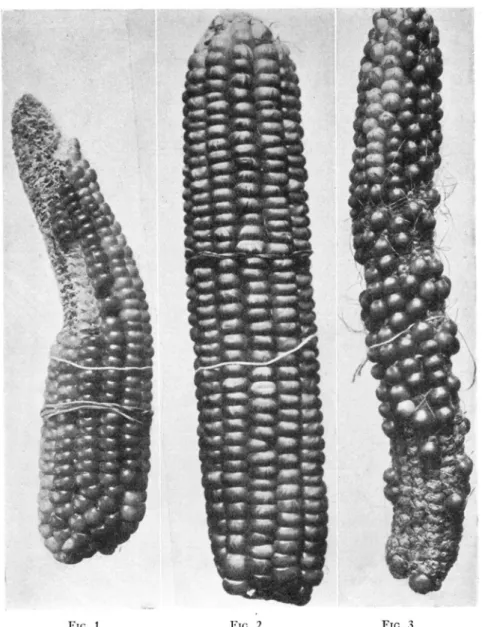
striking feature of orange pericarp is the separation intoits component colors, red and white (colorless), as may be seen on .the ear
illustrated in figure 2 and the kernels illustrated in figure
C,
plate 1.The orange may also change to darker orange and red, as well as to lighter
orange and colorless, with no apparent production of the other component
color. The ears of the different color-intensity classes were studied sepa- rately with the results given in tables 2, 3 and 4. I n recording these data a special effort was made to get an accurate classification of the changes
from orange to variegation.
A
kernel with a streak of colorless adjacentto a streak of red pericarp was classes as having a “line” of variegation.
Since changes from orange to colorless occur very rarely, most of the
apparently colorless areas represent changes to variegation. The data
on changes from orange to red are accurate for areas which covered
one-eighth of a kernel and larger areas. I t will be noted that color changes
of small size occur very frequently, while those large enough. to cover
more than a single kernel are exceedingly rare.
The orange ears were first studied for color changes extending over more
than a single kernel and only 17 such changes were found in the two lots
of ears studied. Most of these large changes were neither red, colorless,
nor variegated, but dark-crown (a non-inherited pattern described by
EMERSON (1917). Twelve of thelarge patches were changes to dark-crown,
and 5 were changes to red. No change to variegation covered more than
a single kernel. The kernels were then shelled off the ear and studied
individually and 42,622 color changes of various kinds were recorded. Of
these only 54 covered an entire kernel, 57 extended over approximately
three-fourths of a kernel, 117 were as large as a half kernel, 254 covered
one-fourth of a kernel, 1,222 were as large as one-eighth of a kernel, and
40,481 were smaller in size. If the size of color change is taken as an index
of the stage in development a t which the change occurred, these data indicate that the gene for orange pericarp persists until a later stage in development, when it may lose its stability, due possibly to changing
conditions in the protoplasm as the plant approaches maturity, or due to a
mechanical segregation of pigment-producing and non-pigment-producing gene elements as will be described later. Such gene changes are to be
expected to occur more frequently in later stages of development because
380 WILLIXhI H EYSTER
LEGEND FOR PLATE 1
FIGURE A.-The ear with orange pericarp from which all the material used in this study FIGURE B.-A series of ears showing the variation in color intensity of orange pericarp. FIGURE C.-Orange kernels with equal and adjacent segments of red and white (colorless). A variegation results when this process extends over the entire surface of the kernel. The inten- sity of the red segments varies with the intensity of the orange of the kernel.
EYSTER, W. H., A GENETIC ANALYSIS OF VARIEGATION
FIGURE A
FIGURE B
PLATE 1
h GENETIC ANALYSIS OF VARIEG.\TIOS 381
F I G . 1 F I G . 2 Frc. 3
FIGURE 1.-A light-orange e a r with a large patch of its surface changed to deep orange or red. This is evidence that such changes have a genetic basis and are due to a change in the gene concerned.
FIGURE 2.--;\n ear with medium-orange pericarp showing the breaking up of the orange color into adjacent segments of red and white (colorless).
FIGURE 3.--An orange ear with a large patch of its surface changed to a typical variegation. This shows that orange and variegated pericarp are expressions of changed conditions in the same gene.
382 WILLIAM H. EYSTER
of the increased number of cells, but the rate of change is accelerated in late stages of development far beyond the expectancy for the increased number of cells. A significant characteristic of orange pericarp is that it persists until a late stage in development, when it breaks up into its component colors, red and white (colorless), but growth stops before the segregation in the somatic cells is completed so that a large part of the pericarp remains orange self-colored.
RELATION OF COLOR INTENSITY TO RATE AND DIRECTION OF COLOR CHANGES
Orange pericarp of different color intensities changes to red, colorless and variegations, but with different frequencies.
Frequency of changes f r o m orange to red
To get a measure of the rate of the color changes from orange to red only those that were accurately classified can be used. As has already been mentioned only the changes to red which extended over approxi- mately one-eighth or more of a kernel were accurately recorded.
I n table 2 are recorded the color changes from orange to deeper orange and red. In family 1504 the number of changes in orange pericarp of different intensities varied from 6 to 12 per thousand kernels studied. I n the 41,564 kernels observed, 337 changes covering one-eighth of the sur- face of a single kernel, or larger areas, were recorded. This would be a frequency of 8.2 changes to red per thousand kernels. I n family 1525 the changes to darker orange and red were more frequent, varying in orange pericarp of different intensities from no changes to 36 changes per thousand kernels observed. A total of 260 changes to red covering one-eighth of the surface of a kernel, or larger areas, were found in the 15,603 kernels studied. This is a frequency of 17 changes to red per thousand kernels.
Considering the two families together there was a total of 597 changes to red covering one-eighth of a kernel, or larger areas, in the 57,167 kernels observed. This is an average frequency of change from orange to red of about 10 per thousand kernels. Only 5 of the observed changes to red extended over more than a single kernel, 17 were as large as a single kernel, and the remainder were of smaller size. These observations indi- cate that pericarp color-changes from orange to red are infrequent until late in development, when they occur with a relatively high frequency. In general it may be said the frequency of change from orange to red increases with the color intensity of the orange pericarp.
A GENETIC ANALYSIS OF VARIEGATION 383
intensities varied from 12 to 42 per thousand kernels observed.
In
the41,564 kernels studied there were 887 changes to dark crown recorded.
This is a frequency of 20 dark crowns per thousand kernels. I n family
1525 the number of dark crowns varied from 7 to 20 per thousand kernels,
with an average frequency of 13 per thousand kernels. I n the two families
studied there was a total of 1088 dark crowns observed in the 57,167
kernels studied. This would be an average frequency of about 19 changes
to dark crown per thousand kernels.
Frequency of changes
from
orangeto
lighter orange, light variegations orcolorless
It
was not possible to classify accurately the changes from orange tolighter colors. When small areas are concerned it is not possible to dis-
tinguish between colorless and variegations. I n table 3 are listed all
changes from orange to lighter colors. There was a total of 407 such
changes in the 57,167 kernels observed, or about
7
in every thousandkernels. I n general the frequencies c?f the changes to lighter colors vary inversely as the color intensity of the orange pericarp.
A
record was also made of the changes to light crown.A
total of 1234kernels were partly or fully light-crowned. This is a frequency of 22 light
crowns per thousand kernels as compared with 19 dark crowns per
thousand kernels.
Frequency of changes from orange
to
variegationThe classification of the changes from orange to variegation was made with sufficient accuracy that all of the classes can be used in obtaining a measure of the frequency of the changes.
I n table 4 are listed the changes from orange to variegation for the
different color-intensity classes of families 1504 and 1525. There was a
total of 14,371 changes from orange to variegation in the 57,167 kernels
studied. The frequency of changes varies from 42 to 781 per thousand
kernels.
It
is an interesting fact that variegations occur with a higherfrequency in the classes of medium intensity of orange. No variegated areas covering more than a single kernel were found on the ears of families
1504 and 1525. Only 8 variegations covering as much as a kernel were
found. Of the 14,317 variegations recorded 761 covered one-eighth or
more of the surface of a kernel, ~ h i l e . 1 3 ~ 5 5 6 were smaller in size.
The 761 variegations covering one-eighth or more of a kernel give a
frequency of about 13 changes from orange to variegation per thousand
384 WILLIAM H. EYSTER
kernels. Equivalent changes from orange to red occurred with a frequency of about 10 per thousand kernels.
If the size of a color change may be taken as an index of the stage in development when the change occurred, the data in table 4 show definitely that the orange pericarp persists until late in development, when it changes to variegation with a high frequency.
The illustration in figure 3 shows a change from orange to variegation that extended over a number of kernels. Changes that affect so large an area are exceedingly rare.
TYPE S O F VARIE GAT ION ORIGINATING FR OM ORANGE PER IC AR P
Orange pericarp gives rise t o a number of distinct variegated patterns. These range from a type that is exceedingly light, often having a single splash of color on an entire ear, to a very heavily variegated type with much color in the form of heavy lines and bands, and with occasional patches of self-red and dark-crown extending over a number of kernels. There seem to be two fairly well defined series of patterns which, for de- scriptive purposes, may be called (1) light variegations, with markings in the form of splashes, lines, and segments that are well dispersed, and
( 2 ) heavy variegations, in which the surface of the kernels is thickly covered with color markings.
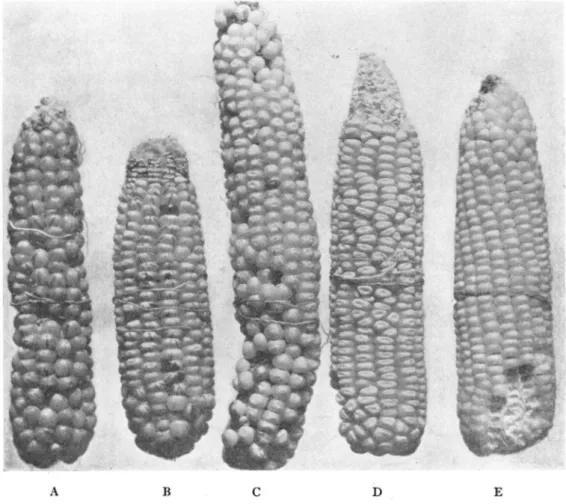
I n figure 4 are shown ears representative of the light-variegation patterns. Ears A and B represent a light variegation with a very coarse pattern. This pattern is distinctive in that the markings are in the form
of broad lines or bands, with the remainder of the surface quite free from color markings. Ear C has an intermediate type of light variegation. A
number of kernels have large segments or the entire surface colored while many kernels have smaller color markings. The variegated type repre- sented by ear C is different from all other variegations in that the color markings are pink instead of red. The ear E represents an extremely light type of variegation, sometimes with only a single splash of color on an entire ear.
A GENETIC ANAT.,YSIS OF VARIEGATION 385
INHERITANCE OF THE DIFFERENT VARIEGATION PATTERNS
Progenies were grown from each of the ears illustrated in figures 4
and 5 in order t o determine the inheritance of the various patterns. The
results of these tests are given in table 5 .
A B C D E
FIGURE 4.-A series of ears having a light pattern of variegation ranging from ears with many bands and lines of red (ear A) to ears that have often only a single splash of red color (ear E).
Inheritance of the light-variegation patterns
The parent plant of ear B, figure4, had the gene for variegation associated
with a gene for red cob and colorless pericarp and was back-crossed with a
plant homozygous for white cob and colorless pericarp. The progeny
consisted of 25 ears with red cob and colorless pericarp and 22 ears that
386 WILLIAM H. EYSTER
were variegated. Three of the variegated ears were coarser in pattern
than the parent ear, 16 ears had a pattern quite similar to the parent
ear, 2 ears had a distinctly finer pattern and one ear had only a few splashes
of color on the entire ear.
The ear
C,
figure 4, was produced on a plant grown from one of thevariegated kernels of the ear illustrated in figure 3.
It
had a gene forvariegated pericarp associated with a gene for red cob and colorless peri-
carp and was back-crossed with 'a plant homozygous for white cob and
colorless pericarp. The progeny consisted of 70 ears with red cob and
colorless pericarp and 66 variegated ears. Three of the variegated ears
A B C
n
1:A GENETIC ANALYSIS OF VARIEGATION 387
had a coarse pattern, like ear
B,
figure 4, 62 ears had the pattern of theparent ear, and one ear had a light pattern like that of ear D, figure 4.
Ear
D,
figure 4, was open-pollinated and produced a progeny with redcob and colorless pericarp, red cob and red pericarp, and variegated pericarp. All of the variegated ears were of the pattern of the parent ear.
Inheritance of the heavy-variegation patterns
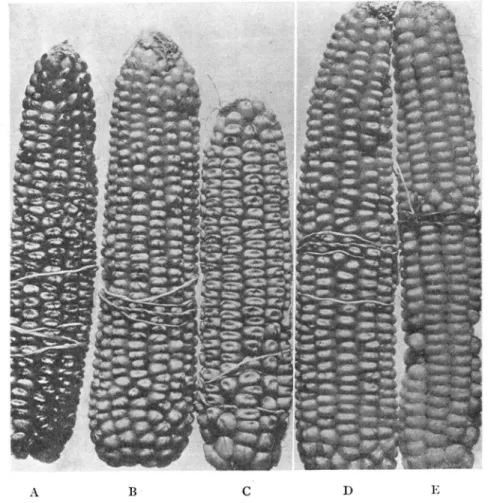
Ears
A
andB
in
figure 5 were open-pollinated.A
large percentage ofthe variegated ears of their progenies had the variegation patterns of the
parent ears, but ears with medium and fine patterns were also found.
The plant that produced ear
C,
figure 5, was heterozygous for red cob andcolorless pericarp and variegated cob and variegated pericarp and was
back-crossed with a plant homozygous for white cob and colorless pericarp.
The progeny consisted
of
55 ears with red cob and colorless pericarp,52 ears with variegated cob and
variegated pericarp, and one ear with
red cob and red pericarp. Thirty-five
of the variegated ears had the pattern
of the parent ear, 15 ears had a coarser
pattern, 11 being like ear
B,
figure 5, and4 like ear
A,
figure 5, and 2 ears had the very fine pattern of earE,
figure 5 .The parent plant of ear
D,
figure 5,was also heterozygous for variegated cob and pericarp and for red cob and color- less pericarp and was back-crossed with a plant homozygous for white cob and colorless pericarp. The resulting prog-
eny consisted of 36 ears. with red cob
and colorless pericarp and 37 ears with
variegated cob and variegated pericarp.
Seventeen
of
the variegated ears had thefine pattern of the parent ear, 15 ears
had a medium pattern much like
C,
figure 5, and 5 ears had a pattern as
coarse as that of ear
B,
figure 5.The heavy variegations form a con-
tinuous series ranging from very coarse to very fine patterns and cannot be
variegation patterns have a genetic ferences are due to changes in the gene.
grouped
into
distinct Thatthese
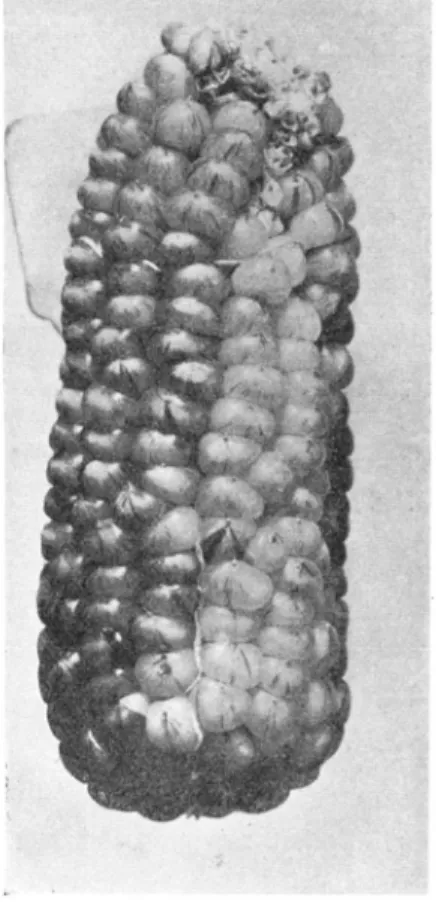
of variegation, showing that pattern FIGURE 6.-An ear with two patterns &if-388 \TILLTAM H. EYSTEK
basis is shown by the occurrence of more than one pattern on the same ear, as may be seen from the illustration in figure 6. Whenever two variegation patterns occur on the same ear they are sharply delimited and evidently represent a change in the variegation gene.
The progenies from both the light and heavy variegations include a
number of distinct patterns in the form of a frequency curve, with the pattern of the parent ear as the modal class. I n this respect the variega- tions are like the orange pericarps from which they originated.
I n the progeny of every variegated ear tested, ears with red cob and colorless pericarp and ears with variegated cob and variegated pericarp occurred in approximately equal numbers, thus indicating that a single pericarp gene was concerned in the production of each variegation. The variation in the pattern of variegation in each progeny is thought to be due to changes in the variegation gene.
RELATION BETWEEN COLOR INTENSITY O F ORAKGE PERICARP A S D TYPE
O F VARIEGATIOK
I n order to determine the relation between color intensity of orange pericarp and type of variegation several bushels of orange ears were grouped in five color-intensity classes ranging from very light orange t o red. All kernels that had enough of the surface variegated to be classified were taken from each group of ears and classed as light variegations or heavy variegations, with the results given in table 6. The very light orange ears produced only light variegations, while the red ears produced nothing but heavy variegations. The number of heavy variegations increases with
the intensity of orange pericarp. These results show that there is a definite correlation between the intensity of orange color and the types of variegation that are produced.
Color changes in the uariegated patterns
The variegated patterns undergo somatic color changes to dark crown, red orange, colorless, and to other patterns of variegation.
Frequency of changes in light variegation
The ears of the progenies grown from the ears B, C and D, in figure 4,
were studied for color changes with the results recorded in table 7. A total
of 3181 kernels were observed in the strain having a fine pattern. There
A GENETIC ANALYSIS OF VARIEGATION 389 frequency of 9.43 such changes per thousand kernels observed. No color change was observed that covered more than a single kernel.
The strain with a medium pattern of light variegation, the progeny of
ear C, figure 7, is different from other variegations in that the color is
deep pink instead of red. The number of kernels observed was 9286.
Of these, 198 kernels had one-eighth or more of the surface pink self- colored. This would be a frequency of change to pink color of 21.28 per thousand kernels observed. The frequency of change to self-color was about ten times as great in the medium as in the fine pattern, the latter having seven kernels with one-eighth or more of their surface changed to red, giving a frequency of change of 0.75 kernels per thousand studied. There were 74 changes to dark crown covering one-fourth of a kernel or larger areas, which is a frequency of 8 changes per thousand kernels ob- served in the medium pattern, as compared with 9.43 for the fine pattern.
Changes to self-color and dark crown occur much more frequently in the coarse pattern than in the medium and fine patterns. Among the 2966 kernels from coarsely variegated ears, were found 258 changes t o red affecting one-eighth or more of a kernel, and 117 changes to dark crown. This would be one change to red for every 11.5 kernels, or 87 changes for every thousand kernels studied, and one change to dark crown for every 25.4 kernels, or 40 per thousand. Changes to self-color occur 40 times as frequently in the coarse pattern as in the fine and 4 times as often in the medium pattern. The changes to dark crown occur about 5 times as often in the coarse pattern as in the medium and fine patterns.
Frequency of changes in heavy variegation
The ears with heavy variegation patterns were separated into groups having coarse, medium and fine patterns, respectively. The ears of each of these groups were studied for color changes to self-color with the results given in table 8. Only areas covering one-fourth or more of a single kernel were recorded.
The ears with a coarse variegation pattern yielded a total of 86,550 kernels. There were 48 changes to red that extended over more than a single kernel; 225 changes were as large as a single kernel, or 2.6 self-red kernels per thousand kernels studied. Color changes affecting smaller areas are more and more frequent as is shown in table 8. There were 1978 color changes affecting one-fourth of a kernel, which is a frequency of 23 changes per thousand kernels. Considering all changes to self-color cover- ing one-fourth of a kernel or larger areas, there was a total of 3840 in the
390 WILLIAM H. EYSTER
86,550 kernels observed. This is a frequency of 44 changes per thousand kernels from the coarsely variegated ears.
There was a total of 18,427 kernels taken from the ears with a medium- coarse variegation pattern. Only two changes to self-red covering more than a single kernel were found. There were 7 color changes covering a single kernel which is a frequency of less than 0.4 kernel per thousand kernels observed. Forty-six kernels had one-half of the surface self-colored and 69 kernels had approximately one-fourth of the surface self-colored, with frequencies equal to 2.5 and 3.7 changes per thousand kernels, respectively.
Among the 18,427 medium variegated kernels there was a total of 131 changes to self-color covering one-fourth of a kernel or larger areas. This would be an average frequency of about 7 changes to self-color per thousand kernels, as compared with 44 such changes in the coarsely varie- gated patterns.
There was a total of 7560 kernels from the finely variegated ears. No
color changes extending over more than a single kernel were found. There were 2 self-red kernels, 6 kernels with half the surface red, and 11 kernels with approximately one-fourth of the surface red. Among the 7560 kernels were found a total of 20 changes to red covering one-fourth of a kernel or larger areas. This is equal to an average frequency of 2.6 changes per thousand kernels.
From these results it is evident that changes to self-color increase with the coarseness of the heavily variegated pattern.
Frequency of changes to dark crown in the variegated types
A GENETIC ANALYSIS OF VARIEG,4TION 391
The total of 414 dark-crown changes in the 7560 finely variegated kernels
is a frequency of 55 per thousand kernels.
A
summary of the changes todark crown in the variegated patterns follows:
Types of Number of dark-crown
variegation per 1000 kernels studied
Heavy coarse, 51.0
Heavy medium, 58.0
Heavy fine, 55.0
Light coarse, 40.0
Light medium, 8.0
Light h e , 9 . 5
I n the heavy variegations dark crowns occurred with about the same frequency in all the types. I n the light variegations dark crowns occurred about as frequently in the fine type as in the medium type, but in the coarse type the frequency was five times as high.
Frequency of changes f r o m heavy
to
light variegationsAll the heavy types of variegation studied change to colorless or light- variegated types. Since colorless types originate from the heavy variega- tions only rarely, it may be assumed that the apparently colorless areas are in reality light variegations. The frequency of change from heavy variegation to light variegation as observed in three lots of ears is given in
table 10. In the coarse pattern there was an average of about 8 changes to
light variegation per thousand kernels, while in the medium pattern there were approximately two light variegations per thousand kernels. Only changes affecting one-fourth of a kernel or larger areas were recorded.
Reverse changes from variegation to orange pericarp
The variegated types revert occasionally to orange pericarp. While the
patches that cover one-fourth of a kernel or larger areas can be dis-
tinguished from red easily, the smaller areas are more difficult to classify
accurately. Only a few such reverse changes have been observed. In
family 1501 were found 2 kernels with one-half of the surface changedto
orange, and one kernel with one-fourth of the surface orange-red in a total of 40,975 kernels. Among the medium-variegated kernels of family 5492 one kernel was found with about one-sixteenth of its surface changed to
orange in the total of 11,732 kernels observed. Among the 866 finely
viriegated kernels of family 5492 were found 1 7 kernels with about one- sixteenth of the surface changed to orange.
Changes from pink variegation to red variegation
I n typical variegations in maize pericarp the contrasting colors are
white (colorless) and red. I n family 5497, as already mentioned, the
392 WILLIAM H. EYSTER
colored areas of the variegated kernels are light pink instead of red. This pink type of variegation gives rise to the typical variegation with red- pigmented areas. Of the 9286 pink-variegated kernels studied 7 had red variegations which evidently represent independent changes from the pink type. This would be a frequency of nearly 0.8 changes per thousand kernels.
COLOR CHANGES IN THE CHERRY-RED PERICARP THAT ORIGINATED FROM ORANGE PERICARP
The deep-red pericarps that originate from orange pericarp are fairly constant, but reverse changes do occur as indicated below.
Reverse changes f r o m cherry-red to orange
A large number of ears with cherry-red pericarp that originated from strains having orange pericarp, having a total of 32,568 kernels, were studied for color changes. The kernels were shelled off the ears and examined individually for color changes. The most frequent color change was the reverse change to orange. One kernel was one-half orange, 2 kernels were one-fourth orange, 48 kernels had a band of orange color, and 247 kernels had a fine line of orange color. Excluding the kernels that had only a fine line of orange pericarp, the frequency of change from red to orange was about 1.6 per thousand kernels. Also 7 1 kernels had a part of the crown changed to orange and 8 kernels were fully orange-crowned.
Reverse changes j r o m cherry-red to variegations
The changes from cherry-red to colorless or variegation were less fre- quent than the changes to orange. I n the 32,568 kernels studied the largest color change to variegation covered approximately one-fourth of a kernel, and only one change as large as this was found. There were 8 kernels with a narrow band of colorless pericarp and 16 kernels with a fine line of colorless pericarp. Excluding the kernels with only a fine line of colorless pericarp, the frequency of change from red to variegation was about one change in three thousand kernels.
There were also a few changes to light crown. One kernel was entirely light-crowned, and 20 kernels were partly light-crowned.
Stability of coiorless pericarp originating f r o m orange
that the gene for colorless pericarp which originates from the orange-peri- carp gene has, the stability of the ordinary white-cob colorless-pericarp gene.
Sunamury oJ color changes ill. the orange-pericarp series
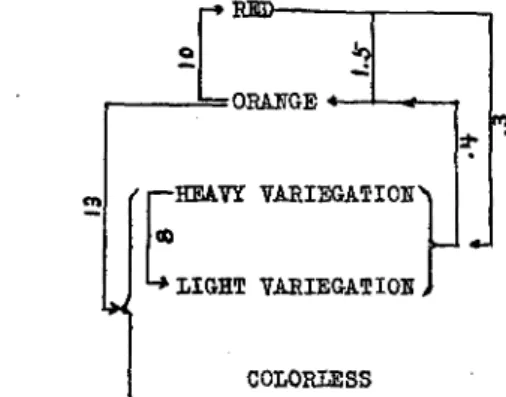
A summary of the various changes, including the direction and fre- quency of changes, is given in figure 7. The must frequent changes are from orange to variegation (13 per thousand kernels) and from orange to red (ten per thousand kernels). The heavy variegations also appear to be quite unstable, as they change to lighter variegations with a fairly high frequency (eight per thousand kernels). Changes from red to orange,
from red to variegation, and from variegation to orange occur with a low frequency, ranging from 0.3 and 1.6 changes per thousand kernels ob- served.
COLORLESS
FIGURE 7.-A diagram to show the relative frequencies of pericarp-color and pattern changes expressed in numbers per thousand kernels.
INTERPRETATION AND DISCUSSION
Any interpretation of the pericarp-color and pattern changes described
on the foregoing pages must accciunt for the following facts: (1) Orange pericarp is inconstant ; it produces progenies that vary in color intensity from a slight tinge of color to deep cherry-red, in the form of a frequency curve. (2) The orange color separates into its component colors, red and white (colorless), to form a variegation. Variegations seem to occur more frequently in the orange pericarp of medium intensity than in the extreme- ly light or extremely dark classes. (3) The variegations are inconstant, varying in pattern from fine to coarse in the form of a frequency distribu- tion. Some patterns are light, with few well-dispersed markings, while other patterns are heavy, made up of many closely-set color markings. (4) There is a correlation between intensity of orange color and the type
394 WILLIAM H. EYSTER
tions increases with the color intensity. ( 5 ) All color and pattern changes are reversible, but with different frequencies.
The nature of the gene
The gene is doubtless highly complex in its organization so that changes in its chemical composition or rearrangements. of its structural parts occur more or less frequently in all genes. Whatever the nature of
the genes may be, the work on Drosophila has shown that they occupy definite loci in the chromosomes. The most distinctive feature of the gene, as nointed out by MULLER (1922), is its property of self-propagation. I n p5ga;ation for each mitosis each gene must reproduce itself by attract- ing to itself from the protoplasm materials of a similar kind which are then separated into the daughter genes. Gene constancy demands that the daughter genes be identical in chemical composition and in structural arrangement. That genes do change, and that they are capable of chang- ing so as to produce a number of different effects is shown by the common occurrence of multiple allelomorphs. I n most cases the changes are quantitative so as to produce a linear series of effects.
The changes or variations in the gene for orange pericarp form 'an orthogenetic series of colors ranging from whitish to deep cherry-red. Such a quantitative variation can be most easily explained by assuming that the gene for orange pericarp is a compound structure, made up of pigment- producing gene elements and non-pigment-producing gene elements.
According to this view the intensity of color depends upon the relative numbers of the contrasting gene elements incorporated in the structure of the gene. An excess of non-pigment-producing gene elements would produce a light orange color, while an excess of the pigment-producing gene elements would produce a deep orange or red color.
A GENETIC ANALYSIS OF VARIEGATION 395 plants also appeared. The lilac-flowered plants, which correspond to the medium orange colors in maize, produced offspring with the whole range of color from whitish to violet. Only 5 violet-flowered plants were tested and they produced violet-flowered offspring.
Evidently the various colors in the pericarp of maize and in the petals of Hesperis are the expressions of genes that are made up of definite numbers of pigment-producing and non-pigment-producing gene elements. Each gene must reproduce itself between every two mitoses, and many mitoses occur between the fertilized egg and the formation of the tissues in which the color is expressed. Because of the random assortment of gene elements the existingrelation between the contrasting gene elements would be maintained in a relatively large number of plants. I n a somewhat smaller number of plants there would be expected a slight excess of the pigment-producing or non-pigment-producing elements in the tissue in which the color is expressed, due to slight inequalities in the separation of the elements a t the mitoses, or to a slight difference in the rate of repro- duction of the individual gene elements. I n the same manner a larger excess of one or the other kind of gene element would be expected in a smaller number of plants, and so on. The progeny of an individual with a gene behaving in development as indicated above would consist of a series of individuals ranging from very light colors, due to a gene with an excess of gene elements for no color, to deep colors, due to a gene with an excess of color-producing gene elements.
A similar quantitative expression of color would result in the presence of multiple modifying factors similar to the modifiers of eosin eye color in Drosophila, reported by BRIDGES (1919). Suitable studies to determine whether or not modifying factors influence color intensity
in
orange peri- carp have not been made, but changes from medium orange to full red, as illustrated in figure 1, would hardly be expected if a large number of modifying factors are concerned,ments represent thc cell progenies of the daughter genes with and without pigment-producing gene elements, respectively. I n orange pericarp the medium colors separate into red and white with a higher frequency than the lighter and clarker colors. Apparently, the same thing is true of Hes- :,eris, as DE VRAES (1 910) described the lilac-colored flowers as being often striped or spotted. The fact that color segregation in the somatic tissues of both maize and Hesperis occurs most frequently in the colors of average in- tensity indicates a relationship between the relative numbers of the two kinds of gene clcn~cnts in the structure o f the gene and its stability. Like gene elements are mutually attractive while the unlike ones are mutually repulsive. A gene with only one kincl of element in its structure, as the one for colorless pericarp, should be compact, due to the mutual attraction
o f the like elements, and therefore highly stable. Similarly a gene with un- like elements in its structure, as the gene for orange or variegated pericarp, would tend to be dispersed and its structure would be the resultant of the unlike genes in a state of equilibrium with varying stability.
EMERSON (1922) made the important observation that changes to self-
red occur somewhat more frequently in heterozygous than in homozygous variegated ears, and concluded that a gene for variegation is more mutable when associated with a gene for colorless pericarp than when i t is present in the duplex condition. It will do no harm, it is hoped, to offer an inter- pretation of this observation based on the gene structure discussed above. The higher frequency of change to self-red in pericarp tissue which has a gene for variegation associated with a gene for colorless may be due simply to an accumulation of pigment-producing gene elements. Any accumulation of a particular kind of element would be retained if there is no interchange of parts between the highly stable colorless-pericarp gene and the variegated gene with which it is associated. I n homozygous variegated pericarp the associated genes are made up of similar structural units.
If
these genes which are unstable because they are made. up of con- trasting gene elements, interchange parts between mitoses any accumula- tion of one kind of gene element in one of the genes might be negatived by an accumulation of the contrasting gene element in the homologous gene, so that the actual number of changes t o red would be less than in pericarp tissue where the unstable variegation gene is associated with a highly stable gene like the one for colorless pericarp between which there is no interchanging of parts.nature of one of the structural elements of the gene. This change fol- lowed by a random assortment of the gene elements would provide the mechanism for the quantitative expression of color and for the occurrence of variegations in the tissues of the pericarp of maize and of the petals of Hesperis.
The nature of variegation
The equal and adjacent segments of red and colorless tissue on otherwise orange-colored kernels represent early stages in the production of a varie- gation. In such k.ernels the separation of the orange into red and white began too late in development of the pericarp to affect more than a small segment of the tissue. When this separation begins earlier in the develop- ment of the pericarp tissue the variegation extends over larger segments, a
whole kernel, or a number of kernels.
The fundamental difference between orange pericarp and variegated pericarp is that in the former the pigment is diffused throughout the tissue, while in the latter the pigment is limited to segments and patches of various sizes. I n the gene for orange pericarp the complete segregation of unlike gene elements usually occurs not a t all, or only very late in develop- ment, so that only small segments of red and colorless tissues are produced. I n the gene for variegation the segregation of unlike gene elements begins early enough so that they are completely segregated by the end of pericarp- tissue development.
There is a decided correlation between the intensity o f orange color and the type of variegation that originates from orange pericarp. Prac- tically all of the variegations that spring from the light orange colors are very light in pattern. The percent of heavy variegations increases with the color intensity of the orange from which they originate. These varie- gations are not constant in inheritance, but produce progenies that vary in pattern from light to heavy and from h e to coarse. The results are quantitative, quite like the variation in intensity of the orange color from which these variegations sprang. Evidently, the light variegations are produced by genes with a relatively small number o f pigment-produc- ing elements, while the heavy variegations are produced when the genes have an excess of pigment-producing gene elements.
It seems evident that a color variegation is produced when a gene in- cludes both pigment-producing and non-pigment-producing gene elements
which become segregated in the somatic tissue, in the course of develop- ment, by the mechanism of mitosis.
398 WILLIAM H. EYSTER
SUMMARY
The important features of the present paper may be summarized as follows :
1. Orange pericarp in maize varies in color from whitish to deep cherry- red.
2. The progeny of an ear of medium-orange pericarp includes ears ranging in color from whitish t o red in the form of a frequency curve. The curve may be skewed towards the light or dark end of the range by plant- ing from ears that are light- or dark-orange, respectively.
3 . The orange pericarp gives .rise t o variegations of a number of distinct types.
4. Light-orange ears produce variegations that are prevailingly light in pattern, while dark-orange ears tend to give rise to heavy variegations. Evidently, there is a correlation between color intensity of orange pericarp and variegation pattern. According to the interpretation the color intensity of the orange pericarp, and the number and size of the color- markings of the variegations increase with the number of pigment-pro- ducing gene elements in the pericarp gene.
5 . All color and pattern changes are reversible, but with different frequencies.
6. The gene for orange pericarp is thought to be made up of pigment- producing and non-pigment-producing gene elements. Variations in the
-,1-.. +- ,J:CC-+.--+
,
:,,
..+
,,,
-..
,f th- ,,,+,,.-c:~~uiaiigc cuiui air; u u c LU u i i i r ; ; I c i i L pivpuiLiwi3 VI uic t - u i i u a a u i i f j guic
elements in the pericarp gene.
7. The occurrence of adjacent segments of red and white (colorless) of equal size, on an otherwise orange-colored kernel, indicates that the gene for orange pericarp divided in such a way that its pigment-producing elements were separated from its non-pigment-producing elements by the mechanism of mitosis.
8. Variegations are produced when the contrasting gene elements become completely segregated in the somatic tissues in the course of
development. Since variegations in general, in animals as well as in plants, are fundamentally alike in their inconstancy and in the nature of their color changes, it may be concluded that all typical variegations are produced in a manner similar to that described above for maize pericarp.
LITERATURE CITED
A GENETIC ANALYSIS OF VARIEGATION 399 CORRENS, C., 1910 Der Ubergang aus dem homozygotischen in einen heterozygotischen Zustand
im selben Individuum bei buntblattrigen und gestreiftbliihenden Mirabilis-Sippen. Ber. deutsch. bot. Gesell. 28: 418-434.
Inheritnce in maize. Connecticut Exp. Sta. Bull. 167. Genetic correlation and spurious allelomorphism in maize. Nebraska 1913 The inheritance of a recurring somatic variation in variegated ears of maize. Amer. 1917 Genetical studies of variegated pericarp in maize. Genetics 2: 1-34.
1922 The origin of variations. Amer. Nat. 56: 64-79. EAST, E. M., and HAYES, H. K., 1911
EMERSON, R. A., 1911 Pp. 3-142.
Agric. Exp. Sta. Ann. Rpt. 24: 59-90. Nat. 48: 87-115.
GREGORY, R. P., 1911 Experiments with Primula sinensis. Jour. Genetics 1: 74-132. Pls.
30-32.
HARTLEY, C. P., 1902 Improvement of corn by seed selection. United States Dept. Agric. Yearbook, 1902: 539-552.
HAYES, H. K., 1917 Inheritance of a mosaic pericarp pattern color of maize. Genetics 2: 261- 281.
MULLER, H. J., 1922 Variations due to change in the individual gene. Amer. Nat. 56: 32-50. PUNNETT, R. C., 1922 On a case of patching in the 5ower color of the sweet pea (Lathyus VRLES, H. DE, 1905 Species and varieties: their origin by mutation. 2nd ed., xviii+847 pp.
1910 The mutation theory. Vol. 2. viiiS683 pp. Chicago: Open Court Pub. Co. odoratus). Jour. Genetics 12: 256-281.
Chicago: Open Court Pub. Co.
400 ____ PEDIGREB 5485 5532 Total 5,533 5534 Total l504 1506 1.512 1521 5.535 5536 Total 1519 l520 1 524 1.525 5537 .S539 5486 5487 Total 1522 3522 5527 Total 1510 3848 5529 Total 5542 S543 Total 5544
-__
_ _ _ . -____"
-~___
"_ _ _
. ___ - - .~PIIRICARP COLOR OF THE PROGESY CARS
-olor-
1
Orange ears with intensities indicated below:" I
-l-
H I"
I-
l
-,.
- 1 .
-1-
l 1
_" 1
-r
l
"
2 20 1 0
l ~-
>
L
8 1 2 ~ 2 t l l - . 1 1 2 4 __ 1 1 15 19 2 " I 36 66 63 - i
-1
l
129- ,
40 1
TABLE 2
Freqzmuies of color changes in maize pericarpfron~ o r m g e to red.
__ PEDI- GREE
-
1504 1525-
Total I_IN KERNELS AS INDICATED IN C O L W N H E A D S
I
CHANGES FROM ORANGE TO RED EXPRESSED
NTENSlTZ
ORANGE OF
PI,:RlC \RI'
NUMBER KERNELS OF OHSI:R\~IID 2135 9206 13399 14086 2738 1645 3012 3313 5493 1120 1020 57167
__ " " 'umber
lousand
per Part Full
I_,"
-
9.8 58 3 12.0 250 26
6.0 139 23 7.2 283 40
9.1 46 13 9.1 16 3 24.0 42 15 36.0 47 13
5 . 0 30 6
2.5.0 6 1 l5 1
"
l :
"
"
-
"-Num- 'otal
thousand ber per
-_I 62 23 323 12 163 33 280 42
59 22 20 12
60 20 60 18 37 7
8 7
16 15 088 l')
"
-- "i
_ _ _ _
9 5 64 7 14 22 62 16 39 l5 6 336 17 84 16 16 5 18 7
"
"-
48 113
" " 4 22 15 12 3 4 16 10 4 2
-
-
92" " Total
.
" " 5 - B Cn
I.: I.' Cn
1; F G H 21 110 78 102 26 l5 72 118 27 28 00 597TABLE 3
\ .\RIEGhTEU OR COLORLESS IN KERNELS CH W G X S TO LIGHTER ORANGY, LIGDT
.\S ILXPRKSSKU I N COLUMN HEADS BELOIV
LIGHT CROWN L u ~ I B 1 ~ : R 01'
OP KERNELS OHSERI lil)
" -2135 9206 13399 14086 2758 1645 3012 3313 5493 1120 1020 57167
"-
" " Num- 'otal
thousand
ber per
-
". - 16CL
117 3.; 489
12 162 20 187
7
26 16 58 19 79 24 37 7 15 l.? 48 50
"
1234 22
___ ~.
lthouvand
~
-
11
!
15 1 7I
167 20 64 , 3I
107 55 97 ~ i ! 431 58 31,
1.: ~ 89 28"
_"
1 5
2 2
5 9
1 2
1 1 1
3 4 1 -2 2 1 1 " "
".
-
17 26
19 11 19 7 41 14 49 9 40 12 64 15 14 3 30 7 10 9 12 3
0 48