KAMPANAKIS, PANAGIOTIS T. Identity-Based Cryptography: Feasibility & Applica-tions in Next Generation Sensor Networks. (Under the direction of Associate Professor Peng Ning).
Elliptic Curve Cryptography (ECC) has been a very interesting research field for many applications especially in sensor networks. The main reason for this is the restrictions on resources posed by sensor motes. ECC alleviates these restrictions by using small prime fields. At the same time, the evolution of hardware technology has built new, sophisticated motes with more capabilities which open new ways for sensor network applications.
by
Panagiotis T. Kampanakis
A thesis submitted to the Graduate Faculty of North Carolina State University
in partial fulfillment of the requirements for the Degree of
Master of Science
Computer Engineering
Raleigh, NC
2007
Approved By:
Mihail L. Sichitiu
Michael Devetsikiotis Peng Ning
Dedication
S' autoÔ pouprospajoÔnna
knounènab mamakrÔtera. . .
Biography
Acknowledgements
I would like to thank Dr. Peng Ning for supporting me financially along with providing the necessary resources and giving me the opportunity to work in such a successful team. Also, I would like to thank Dr. Michael Devetsikiotis for his valuable advice and contribution in my graduate studies in North Carolina State University.
In addition, I have to thank our team in Cyber Defense Laboratory and especially An Liu whose ECC implementation and contribution was very important for this work. What’s more, Dr. Geraldo Pelosi from Politecnico di Milano and Dr. Michael Scott from Dublin City University have been very helpful, provided me with valuable resources and answered technical questions.
Contents
List of Figures vii
List of Tables viii
1 Introduction 1
2 Problem - Motivation 3
2.1 Discrete Logarithm problem . . . 3
2.2 Elliptic Curve Cryptography . . . 4
2.2.1 Discrete Logarithm on Elliptic Curves . . . 4
2.3 Sensor networks . . . 5
3 Related Work 8 3.1 Diffie - Hellman . . . 8
3.2 Bilinear Pairing . . . 9
3.2.1 Encryption schemes . . . 9
3.2.2 Signature schemes . . . 10
3.2.3 Key sharing-agreement schemes . . . 11
3.2.4 Other schemes . . . 12
3.3 ECC on sensor networks . . . 12
4 Theory - Preliminaries 13 4.1 Elliptic Curves . . . 13
4.2 Function Field of an Ellitpic Curve . . . 15
4.3 Divisor Theory . . . 16
4.4 Bilinear Pairing . . . 17
4.4.1 Weil pairing . . . 17
4.4.2 Tate pairing . . . 18
4.5 Tate Pairing computation . . . 19
4.5.1 Miller’s algorithm . . . 19
4.5.2 Optimizations . . . 20
5 Key establishment in WSNs 25
5.1 Next generation networks . . . 25 5.2 Hybrid networks . . . 27
6 Implementation Parameters 30
7 Results and Evaluation 31
7.1 ECDSA on Imote2 . . . 32 7.2 Tate Pairing on Imote2 . . . 35 7.3 Work conserving scheme . . . 37
8 Conclusion 41
8.1 Future Work . . . 42
Bibliography 44
Appendices 48
A Appendix Algorithms 49
List of Figures
2.1 Figure MicaZ and Wireless Sensor Network . . . 6
2.2 Figure Imote2 . . . 7
4.1 Figure Point addition . . . 14
4.2 Figure Point doubling . . . 15
5.1 Figure Next generation network . . . 26
5.2 Figure Hybrid network . . . 28
7.1 Figure ECDSA.init() - sign . . . 34
7.2 Figure ECDSA energy consumption . . . 34
7.3 Figure Tate Pairing results . . . 37
7.4 Figure Operations comparison . . . 39
List of Tables
7.1 Table 1GHz Pentium III MIRACL timing results (ms) . . . 31
7.2 Table ECDSA MicaZ - TelosB . . . 32
7.3 Table ECDSA Imote2 - energy consumption . . . 33
7.4 Table Imote2 Tate Pairing code size . . . 35
7.5 Table Imote2 Tate Pairing timing results (secs) . . . 36
7.6 Table Tate Pairing Imote2 energy consumption (mJ) . . . 36
7.7 Table Number and kind of operations for Tate Pairing . . . 38
7.8 Table Total number of operations for Tate Pairing . . . 38
7.9 Table Operations comparison . . . 39
7.10 Table Timing results, TP vs Exp (secs) . . . 40
7.11 Table Table MicaZ exponentiation code size . . . 40
B.1 Table SSc k2 192 . . . 53
Chapter 1
Introduction
Elliptic Curve Cryptography (ECC) has gained great attention from the cryptog-raphy research community in recent years. The main reason is the small key sizes it uses that can lead to efficient cryptographic calculations. In our case, Cyber Defense Lab of NC State University and especially An Liu have worked in this field on sensor networks by producing the TinyECC package.
In the work that follows we are trying to extend his implementation and try to eval-uate the feasibility of using some new computationally expensive cryptographic techniques on next generation sensor networks. The new implementation of TinyECC can now be used on Imote2, the new high-end mote by Intel. What is more, Identity-Based Cryptography functionality is also added in. More specifically, TinyECC now supports Tate Pairing which can be used for Identity-Based encryption or signatures, key establishment and more, which will be addressed below. On the other hand, we try to evaluate and study the feasibility of using such techniques on sensor motes. Thus, we study the performance; code size, timing and energy consumption for the cryptographic techniques implemented and we are proving that they can efficiently be used on new technology motes. What is more we are proving that the above techniques are very hard to be efficiently used on low-end, traditional motes because of their computational restrictions.
delegation to the more powerful motes.
Chapter 2 describes the motivation and states the research problem, Chapter 3 goes through some important research work in the field of Bilinear pairing and describes some significant security schemes. Then, Chapter 4 presents the background theory behind bilinear pairing and Chapter 5 describes our scheme for key establishment on sensor net-works. After that, Chapter 6 shows the curve parameters we use for our evaluations and we proceed with Chapter 7 which evaluates our implementation work on real motes running TinyOS. Finally Chapter 8 concludes this thesis, it summarizes the accomplishments and mentions future research work that could be derived from it.
Chapter 2
Problem - Motivation
Before proceeding with the details of our work, it is worth presenting our motiva-tions and the problem statement. After going through the definition and basics of Discrete Logarithm problem in Section 2.1 we proceed with the Elliptic Curves in Section 2.2 and the Discrete Logarithm on Elliptic Curves in section 2.2.1. Finally, Section 2.3 explains our intension of studying Bilinear Discrete Logarithm problem on next generation sensor networks.
2.1
Discrete Logarithm problem
Many cryptosystems in the past relied on the security provided by the hardness of the Discrete Logarithm (DL) problem. First, we have to define when a problem is considered to be hard. In an intuitive manner, a problem is considered to be hard when there is no algorithm that solves it in polynomial, in size of the input, time. Furthermore, hard problems can in turn be divided in subexponential and exponential time problems according to the time it takes an algorithm to solve them at best. We say that exponential time problems are harder than subexponential ones.
Thus, we can proceed with defining the DL problems as follows:
We regard these problems on the finite multiplicative group (G,*) of orderm. Without loss of generality we can assume m of G to be prime, meaning G is cyclic and has base, sayg. Leth∈G, such thath=gx mod q for somex∈Z∗
q. Giveng and h, the DL problem is to
find x. Notationwise it isDLg(h) =x.
Leta, b∈Z∗
q. Giveng,ga,gb, the CDH problem is to findh∈Gsuch thatgab=h mod q.
Notationwise CDHg(ga, gb) =h.
Except from the problems presented above there are many relevant to DL problems which have been used in security protocols. Some of them include Decisional Diffie-Hellman (DDH), Weak Deffie-Hellman (WDH), Reversion of CDH (RCDH) k-strong Diffie-Hellman (k-SDH) and more. As far as the security of DL problems is concerned, there have been several attacks on the DL. They can be divided ingeneric and Index Calculus algorithms. Generic ones are also called square root methods and take exponential time to solve the DL problem. Index Calculus algorithms and its extensions (Number Field Sieve) take advantage of the properties of the multiplicative group and take subexponential time. These are the best tools at present to solve the DL problem. Thus, choosing the group parameters appropriately make the DL problem to be generally believed subexponential.
2.2
Elliptic Curve Cryptography
Elliptic curve cryptography [21] has a history of almost a hundred years. It has its origins in mathematics and number theory. Though, by considering the discrete logarithm problem and mapping it to discrete logarithms on groups of points of an elliptic curve we can realize the alternative use of elliptic curves in elliptic curve cryptography.
In the mid-nineties, researchers like Neal Koblitz and Victor Miller proposed using elliptic curves for public-key cryptosystems. Since then, elliptic curve cryptography has been widely studied and there are a significant number of systems and protocols where it is being used. Many of these systems are of commercial acceptance and this is only the beginning as the research community is constantly accepting and extending the capabilities and uses of elliptic curves.
2.2.1 Discrete Logarithm on Elliptic Curves
Although the DL problem is defined on a multiplicative group G of a finite field
Z∗q, it can actually be defined on any group. And fortunately there exist groups in which
solving the discrete logarithm problem is harder than in Z∗q. These, for example can be
groups of points on an elliptic curve.
this particular group of points. There have been a number of attempts to extend the Index Calculus method to elliptic curves but without success. So, it seems that there isn’t a subexponential time algorithm to solve the discrete logarithm problem. As a result, elliptic curves are very appealing and can be used to achieve the same level of security with shorter keys, which is one of their main advantages.
We next give the definition of symmetric pairing. Note that it is not the formal def-inition of pairing which will be presented in Section 4.4. LetG1 be an additive cyclic group of prime orderm. Also, groupG2 is a cyclic multiplicative group of orderm. Then the pair-ing is defined as follows: A map : e:G1×G1 →G2, called a symmetric pairing (i.e. pairing of points P, Q isehP, Qi). As we will also see later, one of the properties of pairing is bilin-earity which means that ifa, b∈Z∗m thenehaP, bQi=ehaP, Qib=ehP, bQia=ehP, Qiab.
Let (G1,+) be an additive cyclic group and (G2,∗) a multiplicative one, both of prime order m, and e : G1 ×G1 → G2 be a symmetric pairing. Then h=ehP, Pi is the generator ofG2 and the Bilinear Diffie-Hellman (BDH) problem is defined as follows: Let a, b, c∈Z∗
m. Given P, aP, bP, cP the BDH is to compute ehP, Piabc. Notationwise
BDHP(aP, bP, cP) =ehP, Piabc
As for the hardness of BDH, so far there is no known method of solving BDH without first solving CDH. Thus, even though it isn’t proved, the hardness of BDH is equivalent to hardness of CDH. Finally, many relevant problems have been studied and used in some protocols which include Decisional Bilinear Diffie-Hellman (DBDH), Decisional Hash Bilinear Diffie-Hellman (DHBDH) and others. These problems are beyond the scope of this work.
2.3
Sensor networks
It is well-known that sensor networks have been very popular in the research community for the passed years. A number of different reasons and its multiple uses have triggered great research activity to this promising field. Some of their applications involve military, forest monitoring, wildlife monitoring, surveillance, assembly line monitoring and many more. Now that this is gradually becoming more mature, the problems become even more interesting.
tions, computational weakness, transmission inaccuracies are some examples of the restric-tions in sensor networks. On the other hand, given the open environment where such networks are deployed, in the clear transmission and the challenging applications (i.e. mil-itary, monitoring), it is becoming obvious that there are also great security issues against the viability of such networks. These problems have been studied for the passed years and a number of different solutions have been proposed for many of them.
The Cyber Defense Lab of NC State Univ. has focused on cryptography and its efficient implementation on sensor motes. In more detail, given the security advantages of elliptic curves and the short keys being used, ECC seemed as a very interesting topic to study on sensor networks. In this way, short keys would save a lot of storage space and the arithmetic operations on smaller numbers would make public key cryptography on devices like motes more efficient than in traditional cryptography. An Liu has been working on ECC for almost 2 years and his work has given some very important results [27].
Figure 2.1: MicaZ and Wireless Sensor Network
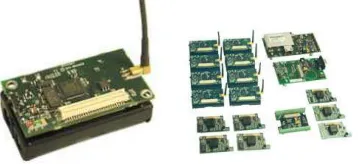
Thus, specifically for this work, Bilinear Pairing’s popularity has intrigued our interest for studying the feasibility of using it on sensor networks. If this was possible, then a lot of different protocols could be used (i.e. identity-based cryptography) to solve many problems (i.e. key exchange). Though, pairing is very expensive computationwise, even for traditional computers, as it is also proved in Shamus Software project. Thus, it would be a very challenging task to implement pairing on traditional motes. For example, the traditional MicaZ (see Figure 2.1) motes have a 6MHz 8-bit processor with 4KB of RAM and TelosB ones have a 16-bit processor with 10KB of RAM. Such devices would make efficient pairing very challenging.
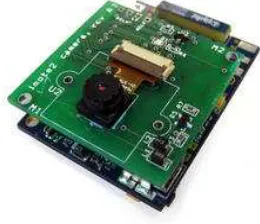
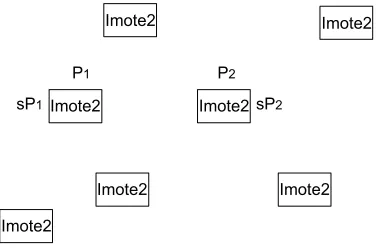
motes. For example, Imote2(see Figure 2.2) from Intel has a 32-bit XScale processor which can support 13-416MHz frequencies. It has 32MB flash memory, 256KB SRAM and 32MB of SDRAM. In addition, Sun has created Sun Spot which is a 190MHz processor with 512KB of RAM and a JVM built in. As we can easily understand, such devices seem more capable of performing expensive pairing operations and this is the task we concentrated on first. After working on the efficient implementation of pairing on Imote2, the results are presented in Chapter 7.
Figure 2.2: Imote2
Chapter 3
Related Work
Lately, as already mentioned, the research community has been widely investigat-ing Elliptic Curve Cryptography (ECC) and especially Bilinear Pairinvestigat-ing. They have been focusing mostly on potential uses of these mechanisms because of their advantages against more traditional cryptographic techniques. Many schemes (some of them very successful) have been developed that can provide encryption, digital signatures, threshold decryption or signatures, key exchange, identity-based encryption and many more. Below, we will present some of the basic and most popular uses of the discrete logarithm problem and bilinear pairing. These can be used as proof of concept of the different tools bilinear pairing can provide for the security field. Also, there is much work done on the computation and optimizations of the bilinear pairing procedure but in this chapter we will focus mostly on its uses.
3.1
Diffie - Hellman
For many years, the discrete logarithm problem has been providing useful tools for key exchange, signatures and encryption. Diffie-Hellman key agreement [34] is describing a scheme that is widely used for key exchange between two parties. It has also been used in many cases and extensions of some security standards. The idea behind it is based on the DL problem. Each of the two parties A, B picks a secret numbera,b∈Z∗q. By having
a public key g, they can exchange theirga mod q,gb mod qwithout revealing their secrets
and thus establish a shared keygab mod q unknown to the public.
signa-ture [17]. According to ElGamal, a party having a long-term public/private key pair can use a temporary key to sign his messages which will enable others to verify them by just using the temporary public key. Again, the underlying property that is exploited is the DL relation between the public/private, long-term/short-term keys.
In addition, a variety of publications have been based on DL problem and some of them try to come up with complete solutions to certain problems. An example would be [3] which attempts to provide signatures by using symmetric encryption, hash functions and the DL problem. What is more, one can find numerous publications (among which the famous RSA standard) on this area that contribute to the realization of how important the DL problem has been for cryptography for the passed years.
3.2
Bilinear Pairing
As mentioned above, Bilinear Pairing has been of great attention within the cryp-tography and security research community lately. The advantages of ECC along with the unique characteristics of pairing itself make it very appealing to achieve traditional cryptog-raphy goals with less overhead. Only in the last 5-7 years, more than 250 papers have been published in the area and some of them can be found in The Pairing-Based Crypto Lounge webpage maintained by P. Barreto. In these papers, many schemes have been proposed that claim to achieve better security with more useful attributes. Some of them are pre-sented below and show the significant role of bilinear pairing in cryptography. Section 3.2.1 presents some pairing based encryption schemes whereas section 3.2.2 presents signature ones and section 3.2.3 some key-sharing techniques. Finally, section 3.2.4 describes some other proposed tools that are based on pairing.
3.2.1 Encryption schemes
is more computationally expensive than verification but both require an expensive pairing computation.
Gentry and Silverberg in 2002 [20] suggested a method that can achieve hierar-chical identity based encryption (HIDE) and dual hierarhierar-chical identity based encryption (Dual-HIDE). In other words, it enables a single PKG to distribute keys to a large number of network nodes. This is a heavy job, but with HIDE a root can delegate private key generation to lower level PKGs. Authentication and private key generation can be done locally. So, for example if A wants to speak to B, he only has to obtain his parent PKG and identity. On the other hand, in Dual-HIDE even if A and B are in different hierarchy levels, if they have a common ancestor they can send encrypted information between each other. HIDE and Dual-HIDE have the advantage of damage control. Though, they also require multiple pairing computations by the encrypter/decrypter, which is expensive.
Similar schemes have been investigated in [11] by Boneh and Boyen. There, they describe methods for Identity based encryption (IDE) and Hierarchical ID-Based encryption (HIBE). One of their scheme advantages is that it provides identity based encryption without the use of a Random Oracle and is resilient against selective-ID chosen ciphertext attack.
3.2.2 Signature schemes
Boneh, Lynn and Shacham in 2001 [15] proposed the Blind Short Signature Scheme. According to it, a private key distributed to different parties along with func-tions that map identities to points and hash funcfunc-tions that also map messages into points are used to perform a signature generation and verification. This technique provides an elegant way for digital signatures and requires a pairing computation for both the signer and verifier.
In [14] the authors propose how multiple signatures of different messages from different signers can be aggregated in one single signature from which it can be inferred that indeed a signer has signed a specific message. But again the cost of verification is very high for this scheme. Another very useful signature technique is presented in [41]. In this paper, a so called ZSS signature is generated by using only a secret key and a hash function on a message. In 2002, Hess [22] presents an alternative of identity based signatures with the advantages of allowing some pre-computation to alleviate the computational effort and the efficiency in terms of communication requirements. Finally, [12] describes how short signatures can be generated without the use of a random oracle and allow for some pre-computation to alleviate the computational burden.
3.2.3 Key sharing-agreement schemes
Bilinear pairing has also been useful for performing key exchange and establish-ment. This is what we attempt to achieve for sensor networks in our work in Chapter 5. In the previous years Sakai, Ohgishi and Kasahara in 2000 [35] came up with a simple protocol that achieves key exchange between two parties. Both parties must have a common secret embedded in their public key which corresponds to their identity. Thus, by using functions that map identities to points and without exchanging any messages the two parties can share a secret key for their communication. The protocol requires both parties to perform a pairing computation which is expensive especially for low power nodes. This problem for hybrid sensor networks with both low and high power motes is addressed in Chapter 5.
3.2.4 Other schemes
Except from the basic uses that have been mentioned above, bilinear pairing has been used in many other schemes and techniques. Some of them are mentioned here. In [10] Boldyreva describes how a private key shared among multiple servers using Shamir’s secret sharing scheme can be used by each server to sign a message M (partial signature). Then from the partial signature a verifier can verify if a server honestly participated in the signature and with (t+ 1)-honest servers he can reconstruct the signature (where t is a threshold value). Such schemes involve many computations as the verifier has to verify shares from multiple servers and reconstruct the signature. Another similar scheme that does decryption was proposed by Libert and Quisquater in [26]. There, given an encrypted message, they extend [13] in such a way that a fixed PKG plays the role of a trusted dealer that distributes shares to users which they, in turn, can decrypt and send to a recombiner that in the end will recover the decrypted message. Finally, Kim and Kim in [25] present a way for a prover to prove its identity to a verifier. This is a multi-round protocol and requires more computations from the verifier.
3.3
ECC on sensor networks
Chapter 4
Theory - Preliminaries
ECC and bilinear pairing, as we already mentioned, are widely studied in various ways and there have been many publications in the area during the passed years. [18, 28, 16, 32] summarize this work and present the basic considerations and research activity. In this chapter we will present the background for the implementation on sensor networks and the research work that will follow. Sections 4.1, 4.2, 4.3 and 4.4 describe the theory preliminaries, Section 4.5 goes through the implementation details and optimizations and Section 4.6 depicts some of the security considerations lying into pairing.
4.1
Elliptic Curves
We start by going through some background knowledge on Elliptic Curve Cryp-tography [2]. First of all, an elliptic curve by the (affine) Weistrass equation is
E :y2+a1xy+a3y=x3+a2x2+a4x+a6 (4.1)
The elliptic curve is the set of points (x,y) that satisfy Equation 4.1 along with point O
which doesn’t exist in reality and is called point of infinity. E is said to be defined over K, denoted E/K, where K is a field and a1, a2, a3, a4, a6 ∈K. We denote E(K) the set of K-rational points (i.e. points with both coordinates in K and the point of infinity). Observe that by definition, we can writeE =E(K) whereK is the algebraic closure of K.
In our case, we will be working with elliptic curves over a finite field, thusK =Fq
and K =∪i≥1Fqi. Also, the curves we will use have to have certain properties in order for
use are supersingular of the form
E :y2 =x3+x (4.2)
For the points of an elliptic curve, there exists an operation called tangent-and-chord method. It is written additively and has point of infinityO as the zero element. Let pointsU(x1, y1),V(x2, y2)∈E\{O}. The point−P is given by (x1,−y1). IfP 6=−Q, then for the pointP+Qwith coordinates (xU+V, yU+V) it is
xU+V = (yx22−−yx11)
2−x1−x2
yU+V = (xy22−−yx11)(x1−xU+V)−y1
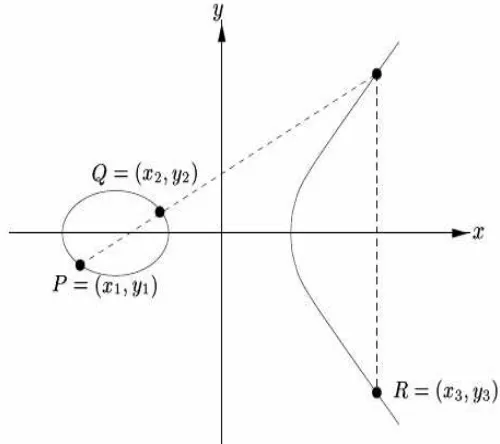
Figure 4.1 (reprinted from [23]) presents the point addition operation graphically.
Figure 4.1: Point addition
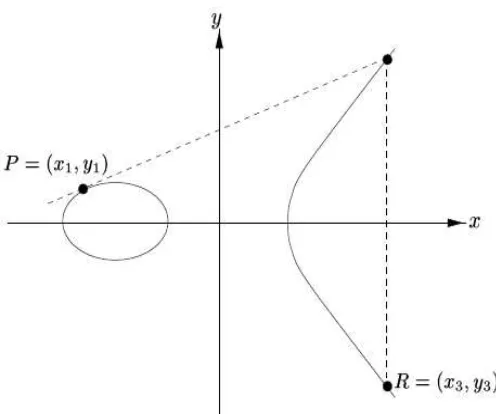
Since addition operation exists on elliptic curves, we can also define scalar doubling and multiplication. Given a pointU(x1, y1), the double of it (x2U, y2U) is defined to be
x2U = (3x
2 1+a
2y1 )
2−2x 1
y2U = 3x
2 1+a
2y1 (x1−x2U)−y1
Figure 4.2: Point doubling
Thus, form∈Zand P ∈E, the multiplication is given by:
[m] P=P+P+...+P (m times)
[0] P=O, [−m] P= [m] (-P)
We say that the order of a point P is m, when m is the minimum number that satisfies [m]P =O(in this thesismP will also be referred as [m]P). Further, we write that
E(K) [n] ={P ∈E(K) : [n]P =O}
is the subgroup of n-torsion points, where an n-torsion point is point whose order divides n.
Finally, order #E(Fq) of an elliptic curve E inFq is the number of points inE(Fq).
For the supersingular curves we will be using for our work, the curve order is #E(Fq) =q+1.
4.2
Function Field of an Ellitpic Curve
If we have a curve E of the form in Equation 4.1 then we can define function F such that
• The coordinate ringFq[E] is the integral domainFq=Fq[x, y]/(Fq). Additionally, we
can define the coordinate ring Fq = Fq[x, y]/(Fq) and its elements are called regular
functions.
• A field of fractions of Fq[E] is called a function field Fq(E) of E over Fq. And the
elements of Fq(E) are called rational functions.
It is worth noticing that each rational function can be represented asu(x) +yw(x) where u(x), w(x) ∈ Fq[x]. Now, if we have a regular function v(x, y) = u(x) +yw(x) we
define its degree asdeg(v) =max{2degx(u),3 + 2degx(w)}.
If there is a rational function f and a point of the elliptic curve P(x0, y0) thenf can be called regular or defined if there is a representation of it as g/h where g, h belong to the coordinate ring Fq[E] such that h(x0, y0) ≡ h(P) 6= 0. Then, we can say that if f is regular and f(P) = 0, it has a zero at P. If it isn’t regular then it has a pole at P (f(P) =∞). Also, we can define
f(O) =
0, ifdeg(g)< deg(h)
(highest degree of g)/(highest degree of h), ifdeg(g) =deg(h)
∞, ifdeg(g)> deg(h)
For each point of the elliptic curve there exists a rational function u ∈ Fq(E):
u(P) = 0, such that ∀f ∈Fq(E), it can bef =udswheres∈Fq(E), d∈Z,s(P) = 0 or ∞.
This u is named uniformizing parameter for P. Next the order off at P is defined to be d, ordP(f) =d. Point P is a zero off if and only ifordP(f)>0 and the multiplicity of that
zero is ordP(f). On the other hand, P is a pole of f if and only if ordP(f) < 0 and the
multiplicity of that pole is−ordP(f). ordP(f) = 0 if and only if f is defined at P.
Finally, let f ∈Fq(E). Thenf has finite number of zeros and poles on points of
E. Furthermore,
X
P∈E
ordP(f) = 0 (4.4)
4.3
Divisor Theory
The group of divisorsDiv(E) is the free abelian group generated by a formal sum of points in E.
Div(E) =
( X
P∈E
mPhPi:mP = 0 ∀ but finitely manyP ∈E
We can define
• The degree of a divisorD to bedeg(D) =P
P∈EmP.
• The support of a divisor Dto beSupp(D) ={P ∈E|mP 6= 0}.
• The subgroup ofDiv(E) of divisors of degree zero is Div0(E).
• If r is a rational function thendiv(r) =P
P∈EordP(r)hPi. div(r) is a divisor because
a rational function has finite number of poles and zeros. And a divisor D is called principal ifD=div(r) for some r∈F∗q.
• The subgroup ofDiv(E) of principal divisors is P rin(E).
• Equivalent are two divisors D1 and D2 if D1 −D2 ∈ P rin(E) and equivalence is denoted as D1 D2.
It can be shown that for every D ∈ Din0(E), there is a unique point Q ∈ E: D hQi − O.
Now letDbe a divisor andf be a rational function: Supp(D)∩Supp(div(f)) = 0. Then, we can define a value off at D to be
f(D) = Y
P∈Supp(D)
f(P)mP (4.5)
.
4.4
Bilinear Pairing
There are two techniques which have been proposed for computing bilinear pairing and are based on the Bilinear Diffie-Hellman problem. These are Weil and Tate Pairing. For our work, we will focus on the second technique but for the completeness of the theory presentation we will go through the formal definition of both.
4.4.1 Weil pairing
LetE be an elliptic curve defined overFq. Letmbe a positive integer coprime to
Let P, Q ∈ E[m]. Let D1, D2 ∈ Div0(E): D1 hPi − hOi, D2 hQi − hOi and Supp(D1)∩Supp(D1)6=⊘. ThenmD1, mD2are principal divisors. So, iffD1, fD2 ∈Fq(E):
div(fD1) =mD1,div(fD2) =mD2 the Weil pairing function is
em :E[m]×E[m]→µm defined byemhP, Qi=
fD1(D2)
fD2(D1)
(4.6)
The Weil pairing has to satisfy certain properties:
1. Well-defined: emhP, Qi has to be independent of the choice ofD1, D2,fD1, fD2.
2. Identity: ∀P ∈E[m]emhP, Qi= 1.
3. Non-Degeneracy: For a certain P ∈E[m], emhP, Qi = 1, ∀Q ∈ E[m] if and only if
P =O.
4. Bilinearity: ∀P, Q, R∈E[m]emhP +Q, Ri=emhP, Ri·emhQ, RiandemhP, Q+Ri=
emhP, Qi ·emhP, Ri.
5. Alternation: ∀P, Q∈E[m]emhP, Qi=emhQ, Pi−1
6. IfE[m]⊂E(Fqn), then emhP, Qi ∈Fqn,∀P, Q∈E[m].
4.4.2 Tate pairing
Tate Pairing has similarities with Weil Pairing. Though, it requires half the ratio-nal function computations which makes it more attractive for implementation on sensors.
Let E be an elliptic curve defined over Fq. Let m be a positive integer coprime
to q and k be a positive integer such that m|(qk−1). From now on k will be called the
embedding degree of the curve with respect to m. As we will see in Section 4.6, kis a very
important factor for the security of the Bilinear Diffie-Hellman problem.
LetP ∈E[m] andQ∈E. LetD1, D2 ∈Div0(E): D1 hPi − hOi, D2 hQi − hOi
and Supp(D1)∩Supp(D1) 6= ⊘. Then mD1 is a principal divisor. So, if fD1 ∈ Fq(E):
div(fD1) =mD1, the Tate Pairing function is
tm :E(Fqk)[m]×E(Fqk)/mE(Fqk)→F∗qk/(F∗qk)m defined bytmhP, Qi=fD1(D2) (4.7)
Tate pairing has to satisfy certain properties:
2. Non-Degeneracy: For P ∈E[m],tmhP, Qi= 1∀Q∈E if and only if P =O.
3. Bilinearity: ∀P, Q, R∈E[m],tmhP +Q, Ri=tmhP, Ri·tmhQ, RiandtmhP, Q+Ri=
tmhP, Qi ·tmhP, Ri.
It is also worth mentioning that tmhP, Qi is not a unique value because it is an
equivalence class in F∗
qk/(F∗qk)m. For a unique outcome we need to eliminate the m−th powers. This is done by raising to the power of (qk−1)/m. Consequently, the pairing value is anm−throot of unity.
4.5
Tate Pairing computation
We chose Tate Pairing as the technique to insert Identity-Based Cryptography in sensor networks. The reason was that we wanted to do it as computationally cheap as possible. Tate Pairing is the more suitable solution in contrast to Weil Pairing. In this section we will present how it is computed and the optimizations we used to improve the timing results of the algorithm.
4.5.1 Miller’s algorithm
In 1986, Miller [29] proposed an algorithm for short functions on curves. About two decades later, this algorithm became the prevalent algorithm to compute the Weil and Tate Pairing (rational functions). Additionally, Baretto et al. [7] in 2002 suggested and formalized the computation and some of the optimizations. Miller’s algorithm is shown in Algorithm A.1.
As we can see, the algorithm works iteratively. Each iteration involves a point doubling and/or not a point addition. Also, in each iteration we have evaluations of the rational functions at certain points and their division. The number of iterations depends on the size of the ordermof pointP. To make it more concise, theg functions used in the algorithm are defined as follows:
If we have two pointsU(x1, y1), V(x2, y2) then the line defined by these points is
y−y1 x−x1
= y2−y1 x2−x1
Then, the function gU,V(Q) at pointQ is the evaluation of this point coordinates
on this line
gU,V(Q) =
1 , Q∈ {O, P}
yQ−y1+λ1(x1−xQ) , otherwise
(4.8)
On the other hand, if we have one point U(x1, y1) then the line between points U(x1, y1),−[2]U(x1, y1) where−[2]U(x1, y1) =U′(x2
U,−y2U), is
x2U = (3x
2 1+a
2y1 )
2−2x 1
y2U = 3x
2 1+a
2y1 (x1−x2U)−y1
⇒λ2 =−
y1+y2U
x2U−x1 = 3x
2 1+a 2y1
So, in the same way functiongU,U(Q) at pointQ is
gU,U(Q) =yQ−y1+λ2(x1−xQ). (4.9)
Finally, let point U(x1, y1). Then the vertical line that crosses U is x−x1 = 0. AndgU(Q) is
gU(Q) =
1 , U ==O
xQ−x1 , otherwise
(4.10)
Please note that above we presented the formal definition of Miller’s algorithm but in section 4.5.2 we will see the actual format of the algorithm used. There, a number of different techniques are used in order to make the computation efficiently.
4.5.2 Optimizations
Below, we present the actual implementation techniques we used for our own implementation. They were chosen in order to make the computation quicker and more efficient which is imperative for sensor motes.
In [8] and [7] M. Scott, P. Barreto et al. propose a method of optimizing Tate pairing. In more detail, they propose a twist of the original curve E(Fq): y2=x3+ax+b
only in E(Fqd) which improves the performance of algorithm. In our case d= 1 and thus point operations remain in E(Fq). Alternatively, the above technique is described in the
literature [18] as a distortion map or an efficient endomorphism. It is proven that if there is a distortion map φ(Q) for the point Q of curve E(Fq) then the denominators for the
computation oftmhP, Qiin Miller’s algorithm can be discarded without affecting the result
value.
Though, there is not always an endomorphism for all different elliptic curves. Actually, endomorphisms exist for supersingular curves. More importantly, for the curve E(Fq): y2 =x3+ax+bwhich we are using for our work with a= 1, b= 0, q mod 4 = 3
the distortion map of a pointQ(Qx, Qy)∈E(Fq) is defined to be
φ(Q)≡φ(Qx, Qy) = (−Qx, iQy)
wherei∈Fq2, i2 =−1.
Actually, such methodology used in accordance with the Lucas functions men-tioned later decrease the size of operations that do not involve pairing, like key generation and point transmission in half, whereas points inE(Fq2) are only used for the pairing
com-putation and are then mapped again in points inE(Fq). More details about distortion maps
and how they can be used can be found in the survey by Joux [5]. After using distortion maps, the modified algorithm for Tate pairing becomes Algorithm A.2.
Another important factor in the choice of m. In the binary expansion of m : (mt−1mt−2...m0)2, if the number of bitsmi == 1 is small then the second step (if-statement)
of Miller’s algorithm can be avoided in many iterations. So, choosing a prime m for which the Hamming weight is as low as possible would make our algorithm more efficient. Such primes are Solinas primes [39] of the form m= 2b±2a±1. For our implementation, the
m of the 512-bit curves is such that we have only one point addition evaluation. What is more, int the last iteration of Miller’s algorithm if i= 0 then the evaluation gV,P(φ(Q) is
avoided becauseV +P =O.
Now, we can proceed with exponentiation that is performed in the end of the Algorithm A.2 and is used to make sure we have a unique pairing values (section 4.4.2). If f is numberu+i·v then we have to performfqkm−1. In our case k= 2, thus
qk−1
m = (q−1) q+ 1
But also
(u+i·v)q−1 = (u+iv)q u+i·v =
u−iv u+i·v =
u2−v2 u2+v2 −i
2uv u2+v2 So,
fqk−1
m = (u 2−v2 u2+v2 −i
2uv u2+v2)
c
In this way, we are saving a lot of additions and multiplications that would be needed for the complete exponentiation off.
In modified Miller’s algorithm, the point operations can also be used to perform the slope calculations used in the evaluation of thegfunctions. That is because these values are also used in for the point operations. This trick saves calculation time and decreases the code used.
It is also worth noting that for the final exponentiation the Lucas function is used in order to get intoFq2 extension field as proposed in [39]. The Lucas function algorithm
used is presented in Algorithm A.3. More information on how the exponention using Lucas functions works and the use of twists on curves can be found in [38, 8, 36].
To summarize, it can be proven that Algorithm A.2 can be changed in the final exponentiation step to be
fqk−1
m = 2(−1)·Lucas[2∗(u2−v2)/(u2+v2),(q+ 1)/m]
and also that in the evaluation of the g-function, it is
g= [V y−λj(Qx+V x)] +i·(−Qy)
wheref =u+i·v and all the operations are modular q.
The overall computational advantage is considerable as we will see later in Chap-ter 7. Not to mention that there were many cases were we used pre-computation to avoid inversions inFq and shifting to perform simple doublings, triplings and halvings inFq. Also,
However, the literature proposes some more optimizations which weren’t applicable in our case for a number of different reasons. In [19] it is argued that divisions are more expensive than multiplications. So, it is suggested to compute functionf as the quotient of functionsf1 and f2 using only multiplications. In other words,f =f1/f2 and only a single division is required for the final computation of f. Though, in our case, the denominator elimination optimization makes such an attempt unnecessary. Additionally, [18] argues that if P ∈E(Fq) and Q∈E(Fpk) then the computation of Tate pairing ehP, Qi is much faster than ehQ, Pi, but in our case the distortion map makes it redundant. Another suggestion made in [19] is to do a pre-calculation of [n]P for all possible values of n inside a ’window’ of a certain number of bits. Though, such scheme would cause much memory burden which we wanted to avoid given the restrictions of sensor nodes. Finally, some other further memory-wise challenging optimizations are described in [37].
4.6
Security Considerations
Recall that Elliptic Curves were proposed in the first place because they could provide the same security levels with DL-based systems using shorter keys. However, it turned out that there exist certain reductions to less secure groups on certain curves (i.e. supersingular). Thus, to avoid such cases, elliptic curves have to be chosen with great care. The ideal case would be to choose curves at random and perform some specific security checks. Though, this technique is not always capable to provide curves suitable for pairing. In our case, the security of the Bilinear Diffie-Hellman problem depends on the embedding degree of the curve. That is because the Weil and Tate Pairing are bilinear maps that map a pair of points of an elliptic curve over a finite fieldFq to a multiplicative group
For our work, we chose supersingular curves because they can provide sufficient security with the current tools of our current TinyECC implementation. If we chose curves with higher embedding degrees then we should be able to provide operations in the exten-sion field F
qk2 which isn’t supported in TinyECC. As far as the security of such curves is
concerned, to ensure the hardness of the Bilinear Diffie-Hellman problem we have to make the CDH hard in both the E(Fq) and E(Fqk). Thus, the desired value of k is a trade-off between efficiency and security. Curves that satisfy these criteria are with k≤6. On the other hand, [30] argues that an embedding degree of 6 doesn’t add any further security in contrast to embedding degree equal to 2. It also argues that supersingular curves with em-bedding degree 2 can provide sufficient security for current cryptosystems when the prime field number q is 512-bits long. So, even if in some way we break the advantage of ECC which provides same security with smaller keys, the advantages provided by Bilinear Pairing are still important (Identity-Based Cryptography) and we still have a reduction on the key sizes.
Chapter 5
Key establishment in WSNs
Now, that we have gone through the details of the implementation of Bilinear Pairing, it is important to see its uses in sensor networks. As someone might imagine there could be many applications some of which have been discussed in Chapter 3. Though, most of these applications require multiple calculations of Tate Pairing which might make them expensive if they are performed on a per message basis. For example, digital signatures using pairing on a per message basis might prove to be very expensive for both the signer and the verifier. This overhead might also cause an extra DoS vulnerability on the scheme. Not to mention the signature size, which is 64-bytes (for a 512-bit curve) and decreases the maximum possible payload size to 38-bytes (ZigBee standard).
In this chapter, we will present how Identity-Based Cryptography and Bilinear Pairing can be successfully applied in next generation sensor networks. More specifically, we will present a very useful application of Tate Pairing for sensor networks whose relatively seldom use can alleviate the high expense of Pairing. In Section 5.1 we will show how keys can be established in a network consisting of modern nodes only (i.e. Imote2). In Section 5.2 we will show how this scheme would work in a hybrid network consisting of traditional (MicaZ) and modern (Imote2) nodes.
5.1
Next generation networks
If we have a certain authority that chooses a secret number s∈ Z∗
q then it can
pre-distribute a secret sPi to every node before the network deployment. Pi is the point
that corresponds to the identity i of the mote. Thus, there also has to be a well-defined function that maps identityito a unique pointPi of the elliptic curve shared by the sensor
network. Consequently, each powerful node has the ability to establish a shared session key with any of its neighbors using Tate Pairing without requiring any communication between the parties.
In a more formal manner, if nodeiwants to establish a key with nodej then he will compute
tmhsPi, Pji
Note that onlyiknowssPiandPjcan be derived easily byiusing the map-to-point function
on the idj of nodej. On the other hand, j will compute
tmhPi, sPji
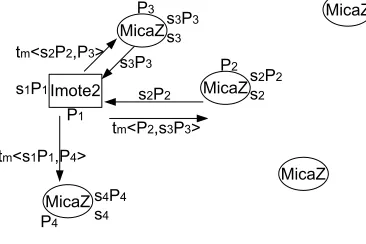
Because of the bilinear property of pairing, the two keys computed by each of the motes will be equal and thus they can establish pair-wise session keys without exchanging any messages. Figure 5.1 demonstrates the formulation of this scheme.
Figure 5.1: Next generation network
unsusceptible to DoS attacks. Finally, providing Identity-Based Encryption between two nodes would work in a very similar way, which is beyond the scope of this work to present.
5.2
Hybrid networks
We believe that because of the high cost of Imote2s and high-end motes in general, the future sensor networks will not purely consist of them. Rather, they will consist of many low-end, cheap motes (MicaZ, TelosB) and a few more expensive ones (Imote2). In this way, the cost will be kept low. The most demanding functionality will be distributed on the powerful motes whereas the traditional ones will perform inexpensive operations. For example, the data aggregation in a network will be performed on the Imotes which will be chosen as parents in the upper levels of the aggregation tree and the low-end ones will perform sampling and forward the samples to their parents in the tree.
Such a situation would complicate things in a sensor network using Tate Pairing to perform key establishment. That is because a low-end sensor having to establish a key with another low-end sensor or with an Imote2 would be a very challenging operation. MicaZs or TelosBs cannot efficiently compute Tate Pairing, so key establishment has to be done in a different manner.
In this case, we can assume that each node will delegate an important part of the computational work to a nearby Imote2 without revealing his secret. Then he will perform the final part of the key establishment on its own. In more detail, lets assume that every low-end node has locally stored a secret si ∈ Z∗q and its corresponding point siPi. Once
againPi is the point that is derived from the identity ofi(using map-to pount function) of
each node. High-end nodes have stored their own siPi only. When a low-end node iwants
to exchange keys with another low-end nodej, it will ask an Imote2 to compute
tmhPi, sjPji
by first having nodej to provide hissjPj. Then the Imote2 will forward this value to node
i. Besides, the Imote2 will be provided withsiPi fromi and it will also compute
tmhsiPi, Pji
and forward it to nodej. Then node iwill compute
and nodej
(tmhsiPi, Pji)sj
Because of the bilinearity
(tmhPi, sjPji)si == (tmhsiPi, Pji)sj
and thus the two parties have established a shared key.
Please note that although computing Tate Pairing on low-end motes cannot be achieved efficiently, the exponentiation used for this scheme can be computed (using Lucas funtions) as we will show in Section 7.3.
In a different scenario where an Imote2iwants to establish a key with a MicaZj or inversely, the Imote2 would provide
tmhsiPi, Pji
to node j and after being provided withsjPj it would use
tmhsiPi, sjPji
as the session key. Nodej on the other hand would expenentiate
(tmhsiPi, Pji)sj
and the two parties will have an established shared key. Figure 5.2 shows how such a schemes would be formulated.
Figure 5.2: Hybrid network
results in Chapter 7 such computations can be performed on these motes without having significant impact on their power. Though, if the key establishments are performed often such computations would burden the motes performing them. It is also worth mentioning that an alternative that would alleviate some communication overhead would be to store siPi on the Imote2 beforehand. This is achievable because of the high memory capacity of
such sensors but would pose a restriction to the network in case sensors changed positions. In such a case, the Imote2 would then have to be updated about the new siPi’s of its
neighbors.
For the security perspective of the schemes described above, we have to say that there are certain vulnerabilities that can be exploited. One would be compromising a MicaZ mote to stealsi. This would give an intruder the opportunity to compute the session
Chapter 6
Implementation Parameters
For our implementation we chose to use supersingular curves with embedding degree k = 2 over 512-bits prime field. These curves can provide security equivalent to 1024-bit DL [30]. The reason we chose them is that they have been widely studied for pairing purposes, they provide an efficient distortion map, they have smallk which makes pairing more efficient and also can be supported with the existing tools in TinyECC.
The format of our curves is
y2 =x3+x
More specifically we experimented with two supersingular curves. One is SSc k2 192 which is over a 192-bit prime field and the other is SSc k2 512 over 512-bit prime field. For both curves we made sure to have low Hamming-weight of the group order m and also generated points for the verification of the properties of Tate Pairing.
Note that the 192-bit curve doesn’t provide sufficient security levels and thus cannot be used in real cryptosystems. It was just used for verification and evaluation purposes. For our implementation, we used the generated points on the curves to verify that
tmhP, sQi==tmhsP, Qi==tmhP, Qis
.
Chapter 7
Results and Evaluation
In this chapter we will present the evaluation results of our work and describe our conclusions about the feasibility of using Identity-Based Cryptography on next generation sensor networks.
First, it is essential to go through some background benchmarks on ECC and Bilin-ear Pairing produced by other projects. Such information can be found in MIRACL benchmarks and MIRACL EC point multiplication benchmark and is summarized in the table below.
Table 7.1: 1GHz Pentium III MIRACL timing results (ms)
ECDSA Tate Pairing signature verification
160-bit curve 1.52 2.07
-192-bit curve 2.19 3.06
-512-bit curve - - 20
expen-sive application of Identity-Based Encryption (IDE). Thus, one can easily distinguish how expensive pairing is and the significance of implementing it as efficiently as possible.
Please note that we aimed at producing open source software that can be used on many platforms using TinyOS. Thus, our work can be used on sensor motes (MicaZ, TelosB, Imote2) running TinyOS.
7.1
ECDSA on Imote2
First, it is worth looking at the performance of the new technology sensor motes from Intel and comparing it with the traditional motes (MicaZ, TelosB). In order to do so, we extended An Liu’s work on ECDSA and ported ECDSA to Imote2. Before we proceed with the results we have to mention that for ECDSA we use the SecG curves with 128, 160, and 192-bit prime fields.
Table 7.2: ECDSA MicaZ - TelosB
Curve init sign verify secp128r1 2.522 1.923 2.418 secp128r2 2.518 2.069 2.674 secp160k1 3.553 2.059 2.441 secp160r1 3.548 1.925 2.433 secp160r2 3.543 2.066 2.615 secp192k1 4.992 3.070 3.612 secp192r1 4.992 2.991 3.776
(a) MicaZ ECDSA timing results (secs) for
W=4
Curve init sign verify secp128r1 3.861 4.059 5.056 secp128r2 3.847 4.325 5.618 secp160k1 5.208 4.433 5.209 secp160r1 5.225 4.361 5.448 secp160r2 5.197 4.457 5.609 secp192k1 7.190 6.695 7.840 secp192r1 7.204 6.651 8.331
(b) TelosB ECDSA timing results (secs) for
For the MicaZ, the timing results when using hybrid window method for modular multiplication with windoww= 4 are in Table 7.3a. For TelosB, the ECDSA timing results are in Table 7.3b. The results for the Imote2 are in Table 7.4a. The reader should be reminded that the Imote2 processor frequencies range from 13MHz to 416MHz. Thus, the processor frequencies are much higher than these of the previous motes which urges us to expect much better performance. Not to mention the 32-bit technology that certainly speeds up operations on large numbers.
As we can observe from the tables Imote2 performance is by far better than the other motes. The fact that the technology is increasing the capabilities of sensors, which were very restricted in the past, increases the uses and possible security measures on sensor networks in the future. And this is the underlying motivation of our work too.
Table 7.3: ECDSA Imote2 - energy consumption
104 MHz 416 MHz
Curve init sign verify init sign verify secp128r1 0.136 0.255 0.317 0.035 0.065 0.083 secp128r2 0.136 0.275 0.360 0.035 0.069 0.095 secp160k1 0.151 0.186 0.219 0.038 0.049 0.060 secp160r1 0.148 0.167 0.208 0.037 0.042 0.054 secp160r2 0.151 0.187 0.233 0.038 0.047 0.060 secp192k1 0.199 0.265 0.308 0.050 0.067 0.079 secp192r1 0.200 0.265 0.325 0.050 0.068 0.084
(a) Imote2 ECDSA timing results (secs) for W=4
MICAZ TELOSB IMOTE2
13 MHz 104 MHz 416 MHz
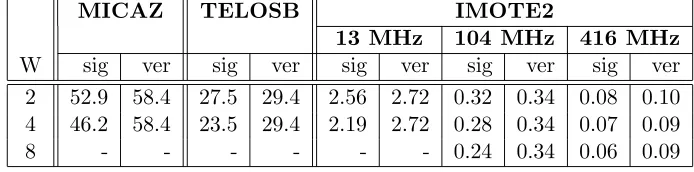
W sig ver sig ver sig ver sig ver sig ver 2 52.9 58.4 27.5 29.4 2.56 2.72 0.32 0.34 0.08 0.10 4 46.2 58.4 23.5 29.4 2.19 2.72 0.28 0.34 0.07 0.09
8 - - - 0.24 0.34 0.06 0.09
(b) ECDSA energy consumption (mJ) fow secp160r1
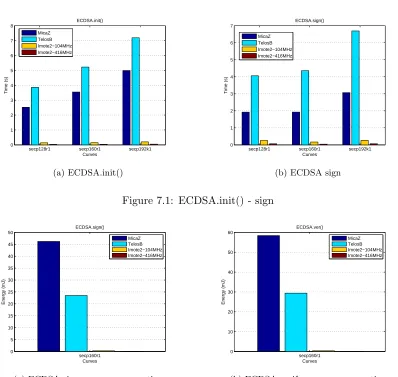
secp128r1 secp160r1 secp192k1 0 1 2 3 4 5 6 7 8 ECDSA.init() Curves Time (s) MicaZ TelosB Imote2−104MHz Imote2−416MHz (a) ECDSA.init()
secp128r1 secp160r1 secp192k1 0 1 2 3 4 5 6 7 ECDSA.sign() Curves Time (s) MicaZ TelosB Imote2−104MHz Imote2−416MHz
(b) ECDSA sign
Figure 7.1: ECDSA.init() - sign
secp160r1 0 5 10 15 20 25 30 35 40 45 50 ECDSA.sign() Curves Energy (mJ) MicaZ TelosB Imote2−104MHz Imote2−416MHz
(a) ECDSA sign energy consumption
secp160r1 0 10 20 30 40 50 60 ECDSA.ver() Curves Energy (mJ) MicaZ TelosB Imote2−104MHz Imote2−416MHz
(b) ECDSA verify energy consumption
Figure 7.2: ECDSA energy consumption
motes. As we can see, the power that Imote2 uses is much less than the power used from the other motes. Especially at higher frequencies the magnitude difference is incredible. Figures 7.1, 7.2 graphically show the above results. We can easily distinguish the magnitude difference and the performance improvement of Imote2 for ECDSA.
doesn’t just hold for Imote2 but possibly for Sun Spots, which are produced by Sun and have similar capabilities. Though, Sun Spots use Java which might make their operation slower. We have no evaluation for Sun Spots and we cannot securely be able to tell if they would perform that good for our experiments.
7.2
Tate Pairing on Imote2
Now, we can proceed with evaluating the feasibility of using Tate Pairing for Identity-Based Cryptography purposes on next generation sensor motes. As mentioned above, bilinear pairing is a very expensive operation and very challenging for the capabilities of sensor motes. For this reason, it is worth noting that MicaZ and TelosB nodes are unable to compute pairing efficiently. While experimenting on these motes we found out that they hung, probably because their task queue was overloaded.
The next step would be to evaluate Tate Pairing computation on next gener-ation sensor motes, meaning Imote2s. We implemented the optimizgener-ations described in section 4.5.2 and then we proceeded with measuring the code size, time and energy con-sumption. As we have already said, we used two supersingular curves for our evaluation, one over 192-bit prime field and another over 512-bit prime field. Again, the 192-bit curve cannot be considered secure enough but was used for evaluation and verification purposes. At this point, we also have to mention the Barret Reduction which was implemented by An Liu in order to speed up the Mod operations and further improved the results of pairing. Table 7.4 shows the code size for Tate Pairing.
Table 7.4: Imote2 Tate Pairing code size
Curve ROM RAM ss192k2 13,512 434 ss512k2 13,844 1,034
As we can observe the RAM size isn’t very high for the capabilities of the Imote2 (32MB) for both the 192-bit and 512-bit curves. The same holds for the ROM requirements. Thus, the code size for pairing can be considered low for the Imote2.
Table 7.5: Imote2 Tate Pairing timing results (secs)
104 MHz 416 MHz
Curve Miller Final exp total Miller Final exp total ss192k2 0.459 0.032 0.491 0.115 0.008 0.123 ss512k2 4.405 0.154 4.559 1.575 0.055 1.629
We can easily see that Miller’s algorithm is the most expensive part of pairing. Though, once again the timing results are acceptable for the 512-bit curve that provides sufficient security level. Both in 104MHz and 416MHz the time it takes to compute Tate Pairing is relatively low and can be used in real sensor networks. Especially if the operations used aren’t performed so often (i.e. Identity Based Key exchange). One disadvantage would be the possibility of overloading an Imote2 with many computations in order to achieve DoS attacks. In the future, we believe that the use of projective coordinates will overcome this obstacle and will make Tate Pairing more DoS-resilient on Imote2s (10 times less). And also, the reader should bear in mind that these timing results are for the worst case scenario. In case the neighbors of the motes are static, then we are able to store and reuse the lines used for the g-functions evaluation the time will improve further.
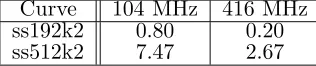
Finally, Table 7.6 shows the energy consumption of Tate Pairing on Imote2. The mode, current draw and voltage remain the same as described in the previous section.
Table 7.6: Tate Pairing Imote2 energy consumption (mJ)
Curve 104 MHz 416 MHz ss192k2 0.80 0.20 ss512k2 7.47 2.67
The energy consumed by Imote2 is much less than the energy consumed from a MicaZ or TelosB in order to perform ECDSA verification. Thus, the energy consumption is acceptably low for Tate Pairing on Imote2. Figure 7.3 shows the above results.
ss192_k2 ss512_k2 0 0.5 1 1.5 2 2.5 3 3.5 4 4.5 5 Tate Pairing Curves Time (s) Imote2−104MHz Imote2−416MHz
(a) Tate Pairing time
ss192_k2 ss512_k2 0 1 2 3 4 5 6 7 8 Tate Pairing Curves Energy (mJ) Imote2−104MHz Imote2−416MHz
(b) Tate Pairing energy consumption
Figure 7.3: Tate Pairing results
TelosBs. Such hybrid networks would have to integrate some intelligence to be able to take advantage of the extra power of Imote2s to overcome the restrictions of the traditional nodes (Section 5.2).
7.3
Work conserving scheme
In Section 5.2 we described a scheme that aims at establishing keys in a hybrid network with low and high-end nodes. In order for this scheme to be effient the high-end nodes have to compute the Tate Pairing of two points whereas the low-end nodes have to perform an exponentiation. This exponentiation is performed using the Lucas function that we presented in section 4.5.2.
Before going into the evaluation details of the exponentiation on a low-end MicaZ node it is worth evaluating the feasibility of computing Tate Pairing on a MicaZ. When trying to compute it we found out that the mote hung. This was probably owed to the overflow of the TinyOS task queue as it took a long time to complete the posted tasks. In order to calculate the number of operations required to provide a time estimation for pairing on MicaZ we wrote a Java tool that computes Tate Pairing using the distortion map-Lucas function or without using the Lucas function. Table 7.7 shows the results for the necessary computations required.
Table 7.7: Number and kind of operations for Tate Pairing
add: 125, sub: 2, mult: 125, div: 2 mod 192 bits add: 61, mult: 121 F1922bits
point additions: 1, point doubleings: 60 in in F192bits
(a) SSc k2 192, regular
add: 62, sub: 63, mult: 63, div: 1 mod 192 bits add: 0, mult: 121 inF1922bits
point additions: 1, point doubleings: 60 inF192bits
(b) SSc k2 192, Lucas sequences
add: 323, sub: 2, mult: 323, div: 2 mod 512 bits add: 160, mult: 319 in inF5122bits
point additions: 1, point doubleings: 159 inF512bits
(c) SSc k2 512, regular
add: 161, sub: 162, mult: 162, div: 1 mod 512 bits add: 0, mult: 319 in F5122bits
point additions: 1, point doubleings: 159 inF512bits
(d) SSc k2 512, Lucas sequences
construct Table 7.8. This table includes the total number of operations used for the imple-mentation of Tate Pairing using our 512-bit curve.
Table 7.8: Total number of operations for Tate Pairing
Miller’s algor, mod Point Expon, mod
Curve add sub mult div add doub sub mult ss512k2 480 481 1438 1 1 159 702 703
So, now we can compare the operations for the calculation of pairing and expo-nentiation on a MicaZ in order to see how much the scheme in Section 5.2 improves the performance. Table 7.9 and Figure 7.4 shows these results. x in the table is the number of bits of the exponent.
Table 7.9: Operations comparison
Modular Tate Pairing Exponentiation
add 528
-sub 1666 2x
mult 2620 2x+1
div 162 1
TP 32−bit exp 80−bit exp 160−bit exp 0
500 1000 1500 2000 2500 3000
Number of modular operations
Operations
Number
add sub mult div
Figure 7.4: Operations comparison
of operations. More importantly, the cost depends on the bit size of the exponent (the maximum bit size is the bit size of the order m). Then, by measuring the average time of addition, subtraction, multiplication and division on a 512-bit prime field on a MicaZ we can compare the Tate Pairing time estimation and the exponentiation time on a MicaZ or Imote2 (Table 7.101, Figure 7.5). It is easy to notice that the exponentiation time varies according to the exponent bit size and is much lower (1/10-1/100-fold) than in the Tate Pairing. In fact pairing time makes such a pairing scenarion on a MicaZ unrealistic and impossible. Thus, the scheme proposed in Section 5.2 makes Tate Pairing in hybrid networks more realistic and achievable by delegating part of the computationally expensive work to the powerful motes and a more practical computation to the low-end mote.
Eventually, it is worth noticing Table 7.11 which shows the code size for the expo-nentiation on a MicaZ. Note that the ROM code size is approximately 2KB for one simple exponentiation whereas the EEPROM memory of the MicaZ is only 4KB.
1
Table 7.10: Timing results, TP vs Exp (secs)
MicaZ Imote2 - 104MHz
Secret number Expon T. Pair. (approx) Expon T. Pair.
32-bit 0.94 226 0.13 4.56
64-bit 1.90 226 0.26 4.56
80-bit 2.38 226 0.33 4.56
160-bit 4.78 226 0.53 4.56
32−bit exp 80−bit exp 160−bit exp 0 50 100 150 200 250
Exponentiation vs Tate Pairing
method
Time (s)
exp (approx) TP
(a) MicaZ
32−bit exp 80−bit exp 160−bit exp 0 0.5 1 1.5 2 2.5 3 3.5 4 4.5 5
Exponentiation vs Tate Pairing
method
Time (s)
exp TP
(b) Imote2
Figure 7.5: Tate Pairing vs Exponentiation
Table 7.11: MicaZ exponentiation code size
Curve ROM (Bytes) RAM (Bytes)
Chapter 8
Conclusion
In conclusion of our work, we can make some interesting remarks. First of all, we have proven that as Moore’s law continues to hold and we get more elaborate embedded devices with better capabilities we can use more cryptographic techniques that can solve important security considerations in sensor networks. We extended the already famous TinyECC package by porting it to Imote2, adding significant functionality and leading the way to the Identity-Based Cryptography field.
One of our main contributions is porting ECDSA and efficiently implementing Tate Pairing and its optimizations on Imote2. With this work, except ECDSA which is performed very efficiently, we can also relatively efficiently compute Tate Pairing. What is more, the evaluation results establish that pairing is feasible on next generation motes from a code size, time and energy point of view. Thus, we can now use pairing in any security scheme on sensor networks. Not to mention, that it has become so efficient that it is almost resilient against DoS attacks. For example, if someone tried to wear out the battery of an Imote2 by getting it to compute the Tate Pairing value many times, he probably wouldn’t be able to achieve much as Tate Pairing is computed without severe effort for the mote (especially after An Liu’s contribution).
Our evaluation shows that Imote2 is a very promising platform as it performs very well; it is robust and has low power consumption. This will probably be the case with other embedded devices in the future to come which permits us to envision more powerful and secure sensor networks.
that can solve the problem of key establishment on a sensor network. This scheme can be successfully applied on networks consisting of just Imote2’s. But it can also be used in hybrid networks consisting of low and high-end motes. Even though the latter has some disadvantages and needs further improvements in order to be considered a viable solution, we believe that our contribution is important because it opens the way for the study of schemes that exploit the bilinearity of Tate Pairing. Especially as current trends show that we are heading toward cost efficient hybrid networks, schemes facing similar challenges like the one we are proposing will be widely studied in the future.
Finally, we hope that our work will inspire others for continuing research on the field of cryptography and security on sensor networks. All this work is part of the attempt of many researchers to provide and mature the technology for secure sensor networks that can serve us in many different ways. I am sure that the group in which this thesis was produced will continue wholeheartedly in this direction.
8.1
Future Work
TinyECC was started about 2.5 years ago and it seems that this work will continue being extended in the future too. An Liu started by implementing ECC and ECDSA on MicaZ and TelosB sensor motes. For the past year he kept improving the performance and optimizing these techniques. The research community and industry showed great interest on TinyECC. Now, it has been ported to Imote2 and been extended even more. In the time to come, there are more things that can be added to it.
First of all, for the performance improvement of Tate Pairing there are a couple more methods that, we believe, can significantly bring down the timing results. One of them is to perform the point operations and line calculations in projective coordinates; this would eliminate the divisions of the slope calculations and would improve the performance. Another optimization is to pre-compute and store the line coefficients when the point P is constant which would save some calculations in optimized Miller’s algorithm. After these optimizations we believe that the DoS resilience of pairing will be achieved.
the Identity-Based values provided by other parties [4]. But their mapping to the above case would need careful attention. This way, the scheme will become resilient against DoS attacks on the MicaZ motes. What would also be very interesting is to try to see how we could remove the tamper-resilient assumption on the MicaZ’s. If the above are achieved then we would have successful ways to establish keys between motes in any kind of hybrid network which is of great importance.
Overall, we consider the field of Identity-Based Cryptography is a very interest-ing for sensor networks because it provides cryptographic ways of overcominterest-ing traditional problems of them. Some applications that we want to focus on and could solve important problems are identity-based signatures and threshold cryptography. The reason is that many times sensor motes form groups (clusters) that might need to be authenticated all together for load balancing reasons. In the same context, aggregate signatures could also be used. Other schemes that could be applied on sensor networks are blind signatures es-pecially for hybrid nets where Imote2’s can blindly sign data the MicaZ cannot sing due to power restrictions. And of course, multiparty key agreement protocols [9] and signature schemes can serve for different reasons on sensors too. Though, our future research will al-ways have to cope with computation expenses and power consumption on motes, especially since most of the above schemes require more than one Tate Pairing computation. What is more, a great challenge would again be the hybrid network case where the low-end motes are the bottleneck of the network. In such cases, the research community would always have to address problems like load balancing in a secure way and without revealing private information between the low and the high end sensors (zero knowledge).
Bibliography
[1] Working draft American National Standard x9.62-1998 public key cryptography for the Financial Services Industry: The Elliptic Curve Digital Signature Algorithm (ECDSA), September 1998.
[2] IEEE Standard Specifications for Public-Key Cryptography, January 2000.
[3] Michel Abdalla, Mihir Bellare, and Phillip Rogaway. DHAES: An Encryption Scheme Based on the Diffie-Hellman problem. Technical Report 99–07, 1999.
[4] S. Al-Riyami and K. Paterson. Authenticated three-party Agreement protocol from pairing, 2002.
[5] Joux Antoine, Fieker Claus, and Kohel David R. The weil and tate pairings as building blocks for public key cryptosystems (survey). InInternational symposium on
algorith-mic number theory No5, volume 2369 of Lecture Notes in Computer Science, pages
20–32. Springer, 2002.
[6] R. Balasubramanian and N. Koblitz. The improbability that an elliptic curve has subexponential discrete log problem under the Menezes-Okamoto-Vanstone algorithm, 1998.
[7] P. S. L. M. Barreto, H. Y. Kim, B. Lynn, and M. Scott. Efficient algorithms for pairing-based cryptosystems. InAdvances in Cryptology, Crypto’2002, Lecture Notes in Computer Science 2442, pages 354–368. Springer-Verlag, 2002.