INVESTIGATION
CloudMap: A Cloud-Based Pipeline for Analysis
of Mutant Genome Sequences
Gregory Minevich,*,1Danny S. Park,* Daniel Blankenberg,†Richard J. Poole,*,1,2and Oliver Hobert*,1 *Department of Biochemistry and Molecular Biophysics, Howard Hughes Medical Institute, Columbia University Medical Center, New York, New York 10032, and†Center for Comparative Genomics and Bioinformatics, Penn State University, University Park, Pennsylvania 16802
ABSTRACTWhole genome sequencing (WGS) allows researchers to pinpoint genetic differences between individuals and significantly shortcuts the costly and time-consuming part of forward genetic analysis in model organism systems. Currently, the most effort-intensive part of WGS is the bioinformatic analysis of the relatively short reads generated by second generation sequencing platforms. We describe here a novel, easily accessible and cloud-based pipeline, called CloudMap, which greatly simplifies the analysis of mutant genome sequences. Available on the Galaxy web platform, CloudMap requires no software installation when run on the cloud, but it can also be run locally or via Amazon’s Elastic Compute Cloud (EC2) service. CloudMap uses a series of predefined workflows to pinpoint sequence variations in animal genomes, such as those of premutagenized and mutagenizedCaenorhabditis elegansstrains. In combination with a variant-based mapping procedure, CloudMap allows users to sharply define genetic map intervals graphically and to retrieve very short lists of candidate variants with a few simple clicks. Automated workflows and extensive video user guides are available to detail the individual analysis steps performed (http://usegalaxy.org/cloudmap). We demonstrate the utility of CloudMap for WGS analysis ofC. elegansandArabidopsisgenomes and describe how other organisms (e.g.,ZebrafishandDrosophila) can easily be accommodated by this software platform. To accommodate rapid analysis of many mutants from large-scale genetic screens, Cloud-Map contains anin silicocomplementation testing tool that allows users to rapidly identify instances where multiple alleles of the same gene are present in the mutant collection. Lastly, we describe the application of a novel mapping/WGS method (“Variant Discovery Mapping”) that does not rely on a defined polymorphic mapping strain, and we integrate the application of this method into CloudMap. CloudMap tools and documentation are continually updated at http://usegalaxy.org/cloudmap.
W
HOLE genome sequencing (WGS) represents thefast-est and most cost-effective way to map phenotype-causing mutations in model organisms such as
Caenorhabdi-tis elegans(Hobert 2010). However, analysis of the resulting
data is complex and requires specialized bioinformatics knowledge not readily available in most labs. Furthermore,
theflood of WGS data has raised new concerns about both computing power needs and data storage capacities. Re-searchers may be unwilling to commit resources to com-puters or software in the fear that they may be quickly replaced or will not be interoperable with existing or future systems. As WGS costs continue to plummet and the tech-nology becomes pervasive, all laboratories that use genetic analysis will be faced with these problems.
The basic premise of genetic mapping is simple: out of the millions of base positions in a mutagenized, sequenced genome, we aim tofind the region of genome that is linked to the phenotype-causing mutation and identify the causal variant. Our lab has previously developed single-step SNP mapping strategies coupled with whole genome sequencing (Doitsidou et al. 2010) as well as software analysis tools (MAQGene) for mutant genome sequence analysis (Bigelow
et al.2009). Although MAQGene has been broadly used by
labs in theC. eleganscommunity (Flowerset al.2010; Sarin
Copyright © 2012 by the Genetics Society of America doi: 10.1534/genetics.112.144204
Manuscript received July 21, 2012; accepted for publication September 25, 2012 Supporting information is available online at http://www.genetics.org/content/ suppl/2012/10/08/genetics.112.144204.DC1.
1Corresponding authors: Department of Biochemistry and Molecular Biophysics, Howard Hughes Medical Institute, Columbia University Medical Center, New York, New York 10032. E-mail: [email protected]; Department of Cell and Developmental Biology, University College London, London WC1E 6BT, United Kingdom. E-mail: [email protected]; and Department of Biochemistry and Molecular Biophysics, Howard Hughes Medical Institute, Columbia University Medical Center, New York, New York 10032. E-mail: [email protected]
et al.2010; Zhanget al.2011; Kimet al.2012; Labedet al.
2012), we no longer support it because the pipeline relies on an outdated aligner (MAQ) and requires technical expertise to install, which inevitably limits its general adoption.
In an effort to take advantage of cloud computing and many freely available open source tools, we have designed a new mutant genome sequence analysis pipeline to run on the Galaxy platform (Afgan et al.2011). Our pipeline uses custom Python scripts to provide greatly improved mutant mapping tools and relies on the Next Generation Sequencing (NGS) Toolbox software suite in Galaxy, along with other software adapted for Galaxy. The pipeline is browser based, requires no software installation (when run on the cloud), and is modular and thus able to accommodate new tools when available. In addition to mapping mutations inC. ele-gans using mapping strains like the polymorphic Hawaiian strain CB4856, CloudMap can be used to support similar mapping strategies for any model organism that can be crossed to a polymorphic mapping strain. We also show how CloudMap can be used to apply a novel, variant-based map-ping method (“Variant Discovery Mapping”) for WGS-based mutant identification. We demonstrate native CloudMap sup-port forArabidopsisand show how other organisms can easily be accommodated with no changes to the software. We an-ticipate that as more biologists use these cloud-based tools to process their own WGS data, more intellectual cross-pollination will occur between biologists and bioinformaticians, resulting in many new tools for the Galaxy platform.
Materials and Methods
The reader is referred to the online user guides and videos (http://usegalaxy.org/cloudmap) and the proof-of-principle examples described below. These materials will be continu-ously updated.
Strains
For the proof-of-principle application of CloudMap, the strains
OH4254 ot266; vtIs1[dat-1::gfp; rol-6(d)], OH4240ot260;
vtIs1[dat-1::gfp;rol-6(d)], andOH4247ot263;vtIs1[dat-1::
gfp; rol-6(d)] were used. FASTQ files from the mutant
strains fp6 and fp9 were kindly provided by S. Jarriault and were used for the EMS Variant Density Mapping tool demonstration.
For the Variant Discovery Mapping proof of principle, we used the strainOH4254ot266;vtIs1[dat-1::gfp;rol-6(d)].
Tool settings
We used default settings for all of the tools except where otherwise noted. Users are strongly encouraged to read documentation for each tool to suit their needs. Custom tool settings are described below, in the user guide, and are also defined in the CloudMap published workflows available at:
http://usegalaxy.org/cloudmap.
The mapping quality and base quality thresholds for Hawaiian Variant Mapping, unmapped mutant analysis,
submission of variant lists to WormBase (www.wormbase. org), and other community databases follow.
Lenient variant lists: (Parameters applied to the sample being subtracted from, i.e., the mutant strain being ana-lyzed.) To accommodate low-quality/low-coverage WGS data and to ensure the causal variant is not accidentally removed during variant subtraction, the mapping quality and base quality thresholds for the mutant being analyzed are more lenient than for samples used for variant
subtrac-tion. WGS alignment data were filtered for reads with
PHRED-based mapping score.10 and individual base qual-ity scores at a given variant position were filtered for PHRED-based quality .17. No read depthfilter was used.
Stringent variant lists: (Parameters applied to samples used in variant subtraction in both mapping methods, to identify heterozygous and homozygous positions in Variant Discovery Mapping, for Hawaiian variant filtration, and for submission to various databases such as WormBase.) Reads
required a PHRED-based mapping score .30 (1/1000
chances of mismapping to another location of the genome)
(Liet al.2008) and individual base quality scores at a given
variant position werefiltered for PHRED-based quality.30 (1/1000 chances of being called incorrectly) (Ewing and Green 1998). For a position to be considered, read depth had to be$3. For Variant Discovery Mapping heterozygous
and homozygous position data were further filtered for
a PHRED-based QUAL score of$200 assigned to each var-iant by the Genome Analysis Toolkit (GATK) Unified Geno-typer. We empirically determined this value as working best across several samples and several organisms. The Cloud-Map Variant Discovery workflow produces output filesfi l-tered at Q100, Q200, and Q300 and the CloudMap Variant Discovery tool can easily be rerun with any of the three different quality outputfiles.
In silico complementation testing tool:Liberal subtraction
strategy: Variant call format (VCF) files (Danecek et al.
2011) containing both homozygous and heterozygous var-iants from all samples should be used as input to the Com-bine Variants tool with the option “Combine variants and output site only if variant is present in at least N inputfiles” set to“2.”This VCFfile of liberally defined common variants is then subtracted from the VCF for each individual sample using the GATK Select Variants tool with this common var-iant VCF output file as an input to the parameter“Output variants that were not called in this comparison track.”
Conservative subtraction strategy: The GATK Combine
all samples can be used as input for the GATK Combine Variants tool. This VCF file of conservatively defined com-mon variants is then subtracted from the VCF for each in-dividual sample using the GATK Select Variants tool with the earlier outputfile from the Combine Variants step used as an input to the parameter“Output variants that were not called in this comparison track.”
Results and Discussion
Overview
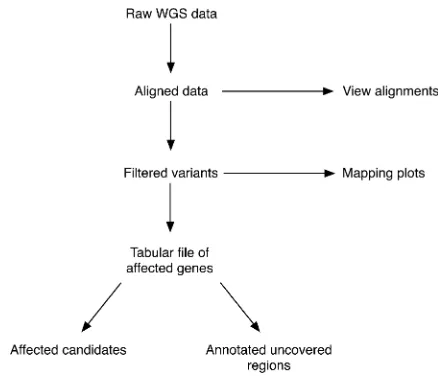
While WGS is the preferred method to map and clone mutations from forward genetic screens, there is currently no free, easy-to-use, non–model-organism–specific bioinfor-matics tool to analyze this type of WGS data. We have there-fore developed CloudMap, a Galaxy-based pipeline that allows end users to go from raw sequencing data (from any next-generation sequencing platform) to a specific map position and to a small list of potential candidate var-iants in a few simple steps. The overall conceptual strategy is schematically depicted in Figure 1.
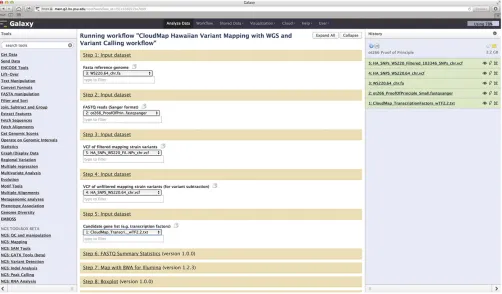
The CloudMap pipeline is entirely browser- and cloud-based, meaning no software installation is required (as discussed below, CloudMap can also be run locally or via Amazon’s Elastic Compute Cloud service). Data are uploaded to secure individual user accounts and analyzed on servers running Galaxy software (hosted at Penn State University among other locations; list of available Galaxy servers in Table 1) and all of the steps required for common mutant analysis functions can be sequentially executed online with a few simple clicks as part of Galaxy workflows (Fig-ure 2). These workflows provide default function param-eters, ensuring that users follow best practices and allow for automated execution of sequential operations. We provide these workflows as helpful guides, but experi-enced users may execute functions in any meaningful order they please and may also create and share their own workflows to take advantage of the automation fea-ture. Documentation of common use case scenarios is provided both in the form of pdf user guides and as screen capture videos athttp://usegalaxy.org/cloudmap. These serve essentially as a simplified, graphic version of this article that application-oriented end users, who are not interested in the bioinformatic details of the strategy, can use to get started (also see Proof-of-principle
applica-tion of CloudMapbelow).
Strategies and workflows
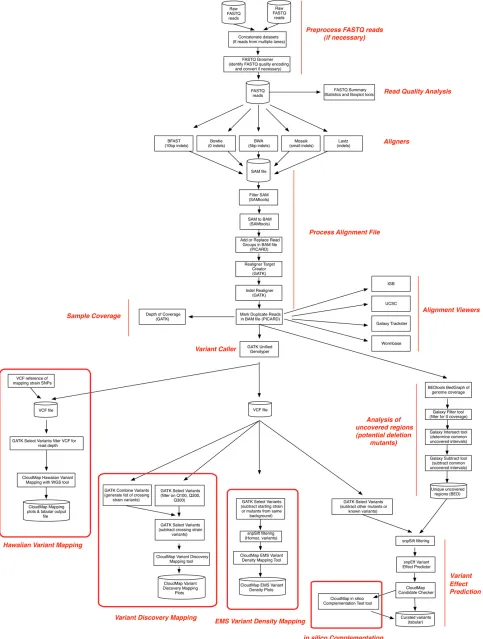
When running the CloudMap pipeline using the workflows we provide, several different bioinformatic processing steps are performed automatically using a standardized set of tools. Figure 3 illustrates all of these steps and additionally indicates branch decision points where more experienced users can choose among different software applications to perform desired operations (detailed step-by-step
instruc-tions are available in provided workflows, user guides, and videos). For instance, users may choose from several align-ers including the Burrows-Wheeler Aligner (BWA) (Li and
Durbin 2010), Bowtie (Langmead et al. 2009), or other
aligners. Users may also choose from several alignment
viewers such as the UCSC Genome Browser (Kent et al.
2002), the Integrated Genome Browser (IGB) (Nicol et al.
2009), WormBase (Harris et al. 2004), or other alignment viewers depending on their preferences. Additionally, we have written several tools, which are incorporated into the automated workflows, designed to extract mapping posi-tions for model organisms where a mapping cross has been performed, to performin silicocomplementation test analy-sis on mapped or unmapped strains, and to further annotate candidate variants. The modular nature of CloudMap allows the latest bioinformatics tools to be seamlessly incorporated into the data analysis pipeline as they become available. Likewise, the latest data stores, including releases of
ge-nome referencefiles for most common model organisms,
are updated regularly within Galaxy. Alternatively, they can be uploaded by users and immediately used.
All workflows begin with users generating an account and uploading sequencing data to the Galaxy website (http://usegalaxy.org) or loading such data in their local Galaxy installation (see below). Galaxy is also tightly inte-grated with many popular databases such as WormBase, modENCODE, and Biomart, and transferring data from these websites into Galaxy is a straightforward process. Gal-axy accepts FASTQ format data files from all of the major next-generation sequencing platforms (e.g., Illumina, ABI, 454) andfiles may be compressed for quicker upload times. Current user quotas on the Galaxy main site (250 Gb) allow for analysis of data from an entire Illumina flow cell to
be performed in 1 day with relatively minimal user
involvement. Users requiring more data storage or more powerful computing needs are encouraged to configure their own local install of Galaxy or to configure an instance of Galaxy using Amazon Elastic Compute Cloud (EC2), which offers computing services on a payment-per-usage basis (for details about these configurations see Table 1).
Below we describe in more detail the individual steps and specific operations that can be performed as part of the CloudMap pipeline. Importantly, all of these steps are
automated when using the workflows we provide. Our
general assumption in the description below is that users will employ CloudMap to identify mutations in a mutagen-ized model system strain, such asC. elegans.
Alignment, variant calling, and annotation
Following upload of WGS sequencing data into Galaxy, several preprocessing steps may be run on FASTQ files if necessary. First, if the same sample was run on different sequencing lanes, users may concatenate FASTQfiles using the Concatenate Datasets tool in Galaxy (Figure 3). Next, if FASTQ quality scores are not in the recommended Sanger format, users may convert the quality encoding in their FASTQ files using the Galaxy FASTQ Groomer tool (Blankenberget al.
2010). Once the quality score encoding of the FASTQfile is resolved, the Galaxy FASTQ Summary Statistics and Boxplot tools can be used to perform quality control checks on the raw data (Blankenberget al.2010).
Figure 2 Screenshot of Galaxy workflow using the ot266 example discussed inProof-of-principle application of CloudMap. Users may run this workflow as well as others athttp://usegalaxy.org/cloudmap. The output of theot266 workflow is also available as a shared history at the URL mentioned above. Here we see a Galaxy history with the FASTQ raw datafile forot266along with various referencefiles used as input into the CloudMap Hawaiian Variant Mapping With WGS Data and Variant Calling workflow. The reader is referred to user guides and videos for step-by-step instructions. Table 1 Summary of useful Galaxy links
Function Link
Galaxy Wiki http://wiki.g2.bx.psu.edu/
Learn Galaxy http://wiki.g2.bx.psu.edu/Learn
List of hosted Galaxy servers http://wiki.g2.bx.psu.edu/Public%20Galaxy%20Servers
Instructions to configure Galaxy locally http://wiki.g2.bx.psu.edu/Admin/Get%20Galaxy Other options for running Galaxy http://wiki.g2.bx.psu.edu/Big%20Picture/Choices Instructions on running Galaxy using Amazon Elastic Compute
Cloud (EC2)
http://wiki.g2.bx.psu.edu/CloudMan
List of common Galaxy tool errors http://wiki.g2.bx.psu.edu/Support#Error_from_tools
Toolshed http://toolshed.g2.bx.psu.edu
Users can then choose from the latest open source aligners to align their samples to their reference genome (Figure 3). Readers are referred to a useful survey of se-quencing alignment algorithms to learn more about their respective strengths (Li and Homer 2010). Our automated workflow uses BWA (see Proof-of-principle application of
CloudMap). Following alignment, we use several tools to
process the alignment file to improve insertion/deletion (indel) calling and remove duplicate reads (reads with iden-tical start and end points) (seeProof-of-principle application of
CloudMap).
Several alignment viewers are available for viewing alignments, together with any type of additional track-based data such as gene structure and conservation (via the UCSC Genome Browser), protein domains, available alleles, and modENCODE transcriptome data (via Worm-Base forC. elegansdatasets). More experienced users may also upload custom tracks of their own into any supported alignment viewer. In the cases where alignment viewers are integrated into Galaxy (UCSC Genome Browser, IGB, WormBase, Galaxy Trackster, etc.) the alignment file
[bi-nary alignment/map (BAM) file] resides on the Galaxy
server and is dynamically streamed to the location hosting the alignment viewer.
While alignment viewers are useful for assessing read coverage and sequencing quality, a list of variants is necessary to determine how sequence variants affect genomic func-tion. Variant callers from GATK (DePristo et al.2011) and SAMtools (Liet al.2009) calculate comprehensive lists of all the genomic variants (SNPs and indels of varying sizes depend-ing on the aligner used) with respect to a reference genome in a given sample and output these in the VCF (Danecek
et al.2011). Users have the choice to use either variant caller.
Readers are referred to a review of SNP calling from
next-generation sequencing data that also discusses respective features of GATK and SAMtools (Nielsen et al. 2011). Our automated workflow uses GATK (seeProof-of-principle
appli-cation of CloudMap). Then, the variant effect caller snpEff
(Cingolani et al. 2012) predicts and annotates the effects of these variants on genes (amino acid changes, splice site variants, upstream/downstream potential regions, etc.) and provides PHRED-based quality scores (Ewing and Green 1998) and coverage statistics for each variant. A sample output is shown in Figure 4. Users can sort these tabularfiles for specific types of variants, such as those that fall within a mapping interval (see below) and are likely to have high impact (for example, premature stops, frameshift mutations, etc.). The user can then easily navigate in an alignment viewer, to the region that contains the mutation of interest for detailed inspection of the reads that were used to call the variant.
Variant subtraction andfiltration
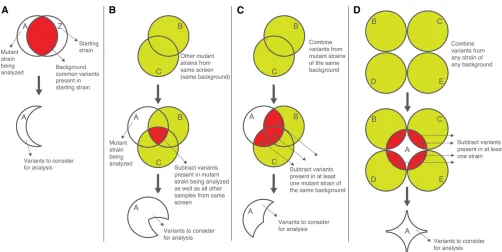
The process of variant subtraction is motivated by the desire to remove all but the phenotype-causing variant(s) in a given sample. Therefore, prior to performing analysis on the variants in a given sample, variants that are present in the premutagenesis starting strain (“background variants”), and thus not responsible for the mutant phenotype, should be subtracted. As previously shown in various WGS studies (e.g., Flowerset al.2010), such variant subtraction greatly reduces the number of variants to consider. This can be achieved in several ways, as illustrated in Figure 5. If the premutagenesis, starting strain has been sequenced (our preferred approach, given the low cost of WGS), users may use the GATK Select Variants tool to subtract common var-iants in this starting strain from the varvar-iants in their mutant sample (Figure 5A).
Alternatively, if the premutagenesis strain has not been sequenced, common variants present in the premutagenesis strain can be deduced from sequence analysis of two or more mutants that have been derived from forward genetic screens on the same starting strain. The GATK Combine Variants and Select Variants tools can be used to query mutant WGS datasets for variants present in the mutant strain of interest as well as in all other samples from the same screen (Figure 5B, i.e., the logical intersection of all sets of variants, A \B\C).
Researchers may employ a less conservative variant subtraction strategy by subtracting all variants that are present in the mutant strain of interest and at least one additional strain from the same screen (Figure 5C). As this approach involves subtracting more than only background mutations in the starting strain, it carries with it the in-creased risk that potentially important phenotype-causing or modifier variants may be eliminated from consideration (e.g., if the identical phenotype-inducing variant is present in one of the subtraction strains, something that is unlikely within a small set of mutant strains but which should be taken into account as the number of datasets grows).
The most liberal variant subtraction strategy involves subtracting from the mutant strain of interest all variants present in additional strains of any background (from any screen), even if present in only one of these additional strains (Figure 5D). The same caveats for this strategy apply as for the strategy described above in Figure 5C; namely, the potential exists for phenotype-causing mutations to be un-intentionally subtracted from the mutant strain of interest.
In an effort to subtract as many variants as possible, users may subtract not only homozygous variants from other strains, but also heterozygous variants. Such a strategy as-sumes that phenotype-inducing homozygous mutant variants in the strain under analysis are unlikely to be heterozygous in strains that will be used for subtraction. It is especially important to apply this strategy when subtracting variant lists generated from outcrossed samples using either the Ha-waiian Variant Mapping or the Variant Discovery Mapping
approaches (seeHawaiian Variant Mapping with WGS Data
toolandVariant Discovery Mapping tool implements a novel
mapping method), since background variants will be
pres-ent in a heterozygous state in these pooled samples as a consequence of the mapping cross.
Because it is easy to perform variant subtraction and downstream analysis as well as to document settings for each analysis performed (via Galaxy histories), we recom-mend starting with the most liberal variant subtraction strategy to quickly see whether prime candidate variants are present in the data. In parallel, users can run more conserva-tive subtraction strategies and analyze those results, as they deem appropriate.
Our lab maintains a list of background variants found in various different screens and routinely compares them to new WGS datasets. We submit premature stops, frame-shift and splice variants to WormBase, and strains carrying these variants to the Caenorhabditis Genetics Center (CGC). We have set our thresholds for variant quality analysis rather
high to err on the side of caution (see Materials and
Methods).
CloudMap Candidate List Checker and useful gene lists
Depending on the type of mutant sequenced or the genetic screen performed, users may be especially interested in variants that affect certain classes of genes. For instance, forward genetic screens for C. elegans mutants in which cellular fates are not appropriately executed often yield mutations in transcription factors (e.g., Doitsidou et al.
2008). To quickly check whether classes of genes (such as transcription factors) have been affected in a mutant, Cloud-Map provides the Candidate List Checker tool for snpEff output. This tool accepts a two column, tab-delimited list of gene names and their respective annotation information together with the tabular output from snpEff.
We have generated five such lists that can be used with the Candidate List Checker; the lists are available athttp:// usegalaxy.org/cloudmap. These lists consist of: (1) all pre-dicted transcription factors (Reece-Hoyes et al. 2011); (2) a list of predicted chromatin factors (Tursunet al.2011); (3) a list of all C. elegansgenes with human orthologs (Shaye and Greenwald 2011); (4) a list of genes associated with neuronal function (Hobert 2012); and (5) a list of genes commonly involved in transgene silencing; such mutants are often retrieved from screens in which transgenes are
used (Kim et al. 2005; Wang et al. 2005; Vastenhouw
et al. 2006). Notably, some transgene silencer mutations
may affect one transgene but not another (even within the same cell), thus falsely encouraging researchers to pursue what they may think is a variant that affects cell fate.
We encourage users to share similar lists by uploading them to shared Galaxy libraries (http://wiki.g2.bx.psu.edu/
Admin/Data%20Libraries/Libraries).
In silico complementation testing
If performed on a large scale, forward genetic screens usually yield multiple alleles of individual loci, which define specific complementation groups. The traditional way to identify such complementation groups is via complemen-tation tests performed by genetic crosses. If screens have revealed dozens of mutants, comprehensive
complementa-tion testing can be time consuming and labor intensive. Moreover, complementation tests are impossible to perform with dominant alleles and are sometimes subject to mis-leading results (such as allelic complementation or non-allelic noncomplementation). With the decreasing costs of WGS, it is now possible to simply sequence many mutants that result from a screen and determine in silico which mutants carry variants in the same locus (user-defined up-stream/downstream boundaries of a gene can also be con-sidered as part of a locus by modifying snpEff output—our pipline sets the upstream/downstream gene boundary to 0 bp as default). To allow such analysis, we developed the CloudMap In Silico Complementation Test tool to compare tabular snpEff outputs [which have beenfiltered for quality and had common variants subtracted for shared gene hits (alleles)—seeMaterials and Methods] for shared gene hits (alleles). This tool creates two output files: (1) a summary file of the number of shared gene hits among the sequenced mutants sorted from most to fewest (an abbreviated exam-ple is shown asSupporting Information,Figure S1A) and (2) a corresponding file of the snpEff annotated alleles from each sample also sorted from most to fewest (Figure S1B). Below we describe the general steps involved in using the tool (see user guide for detailed examples and the CloudMap in Silico Complementation Test workflow: http://usegalaxy.
org/cloudmap).
As afirst pass at analysis, to remove background variants present in the premutagenized strain, we recommend a liberal subtraction strategy be applied where the most possible variants are subtracted from each strain prior toin
silicocomplementation analysis (seeMaterials and Methods
for liberal subtraction strategy tool settings). The GATK Combine Variants tool shouldfirst be used to create a single VCF file that contains only variants present in at least two samples from the same genetic background (Figure 5C). This VCFfile of liberally defined common variants will next be subtracted from the VCF for each individual sample using the GATK Select Variants tool. snpEff will then annotate each of these subtracted VCFfiles and it is these annotated, tabular snpEff outputfiles that will be used as input to the In Silico Complementation Test tool. When this liberal subtrac-tion strategy is used, the tool will only return results where allelic genetic loci contain nonidentical hits in more than one sample.
subtraction approach, many nonphenotype-causing back-ground variants will remain in the output files and will appear as“false positive”identical variants present in mul-tiple samples. Most of these will simply be background variants present in the starting strain premutagenesis. To deal with this problem in the context of the conservative subtraction strategy, users may lower the Combine Variants parameter to subtract variants shared by,100% of strains, but more than two strains (seeMaterials and Methods).
Candidate allelic mutants identified by suchin silico com-plementation tests can then be confirmed by classic genetic complementation and therefore can be reduced to a few simple crosses of candidate alleles (rather than an entire mutant collection).
Identifying deletions in WGS datasets
Various mutagens, including EMS, induce small (a few base pairs) to large (many kilobases) deletions at appreciable frequency (Janssenet al.2010). Current aligners have diffi -culty in identifying deletions using short read length se-quencing approaches such as those favored by Illumina. While BWA is capable of identifying indels in short reads, the size of such indels is limited to 5 bp according to default
settings. We have included in the automated workflow
a realignment-around-indels step (using GATK), which improves the reliability of indel calling. However, it is still often difficult to distinguish regions of the genome that have no sequencing coverage from genomic regions that are genuinely deleted in the sample (Sarinet al.2010).
CloudMap contains a workflow that helps identify dele-tions based on lack of coverage. Using the BedGraph tool that is part of the BEDtools package (Quinlan and Hall 2010), users can obtain a file of genome coverage at every position in the genome. Thisfile can befiltered for positions with zero coverage using the Galaxy Filter tool, and the data in the resulting Browser Extensible Data (BED)file can then be subtracted (using the Galaxy Intersect and Galaxy Sub-tract tools) from other uncovered regions in samples from the same screen in much the same way that normal variant subtraction is performed. We provide a predefined workflow that automates these steps and a user guide that explains the process in detail. The uncovered regions that are unique to a strain can then be used as input into snpEff and a resulting tabular annotatedfile can be sorted for those unique uncov-ered regions that fall in the mapping region and affect pro-tein coding genes.
While the list of annotated uncovered regions is a useful guide, in terms of data confidence, it does not compare to having high read depth for a variant and high quality scores for the bases at the variant position. In other words, un-covered regions are the absence of evidence, not evidence that a genomic region is truly missing. To ascertain with greater confidence which uncovered regions are real, researchers should view these regions in an alignment viewer. Wefind that true deletions tend to have a“cliff-like”pattern of high coverage followed by a steep drop in coverage down to zero
(Figure S2). Furthermore, the regions of high coverage
flanking the putative deletion often have SNPs or insertions present in many of the reads—reflecting the fact that regions of the genome that were previously physically separated are now adjacent (short NGS reads do not span large deletions as BWA by default only recognizes indels of up to 5 bp). We confirmed that the putative deletion inFigure S2was real by amplifying this genomic region by PCR and Sanger se-quencing of the amplicon.
CloudMap Hawaiian Variant Mapping With WGS Data tool
As mutagenized strains contain thousands of variants (SNPs, indels, etc.), a list of variants and their effects alone is usually not adequate for identifying the phenotype-causing mutation. We have previously described a one-step strategy for whole genome sequencing and mapping (Doitsidouet al.
2010) modeled on a similar strategy in plants (Schneeberger
et al. 2009) that allows for fine mapping of
phenotype-causing mutations in a time- and cost-efficient manner. Our strategy requires crossing a mutant parental strain from a ge-netic screen (derived from theN2Bristol strain) to the
poly-morphic mapping strain, Hawaiian CB4856, and picking
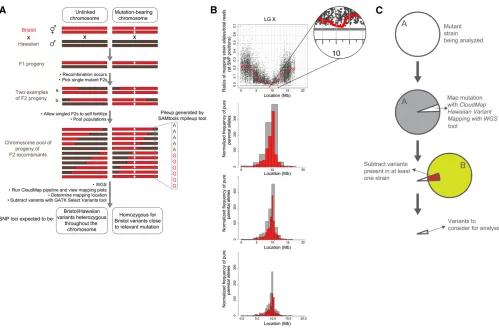
a number of F2mutant progeny (Figure 6A). The progeny of these F2’s (F3’s and F4’s) are then pooled and sequenced. Genomic regions that are linked to the causal mutation (and thus selected for) will recombine less frequently during mei-osis and thus sequencing will reveal a stretch of pure paren-tal sequence in the region of the mutation. In contrast, nonlinked genomic regions will recombine in a roughly
50/50 ratio of mapping vs. parental sequences (Figure
6A). We can discriminate between stretches of parental vs.
mapping strain sequence in pooled F2progeny by examining the presence/absence of mapping strain SNPs relative to the parental Bristol strain, that are distributed at1 every 1000 bp (Hillier et al. 2008). The ratio of Hawaiian reads/total reads at each of the 112,000 Hawaiian SNP positions is then plotted according to physical position in the genome. Genomic regions devoid of Hawaiian SNPs represent loci that are linked to the causal mutation (Doitsidou et al.
2010).
CloudMap’s Hawaiian Variant Mapping With WGS Data
tool offers an improved plotting method for representing variant mapping data derived from crosses such as described above. [Note: while the Hawaiian Variant Mapping tool accepts variants (SNPs and indels) as input, we use only Hawaiian SNPs for mapping here because this list of SNPs was already provided in WormBase. Researchers who wish to use the mapping tools with known indel positions as well as with SNPs—for instance if they have sequenced their crossing strain—may do so with no modifications to the tool.] Prior to running the plotting tool, we feed an align-ment (BAM) file and a VCF referencefile of provided
Ha-waiian SNP positions compiled from WormBase (http://
usegalaxy.org/cloudmap) as input into the GATK Unified
reference (Bristol) and alternate (Hawaiian) allele calls at each of the100,000 Hawaiian SNP positions in the pooled sample. The reader is referred to the user guide and online video for direction on this procedure. The Hawaiian Variant Mapping with WGS Data plotting tool accepts as input this single VCF file (the list of base calls at all Hawaiian SNP positions in the pooled sample). As output, the tool plots the ratio of Hawaiian strain reads/total read depth at each SNP position of the mapping strain. Chromosomes that con-tain regions of linkage to the causal mutation(s) display regions enriched for SNP positions that have a Hawaiian reads/total reads ratio equal to 0. The scatter plots of these ratios plotted against chromosome position for such linked regions will have a cluster of data points lying exactly on the
x-axis.
The Hawaiian Variant Mapping With WGS Data tool then plots a local regression (LOESS) regression line through all
the points on a given chromosome thus giving far greater accuracy to the mapping region (Figure 6B). LOESS regres-sion is a locally weighted polynomial regresregres-sion that gives weight to points near the position being estimated as well as to points further away on the chromosome (Clevelandet al.
1992). We use the LOESS smooth function in R (available as dloess at http://www.netlib.org/a/) and provide an adjust-able span parameter that allows users to modify the weight given to points other than the point being estimated. Based on our testing, we have settled on 0.1 as a LOESS span default for
C. elegans. Larger span values result in smoothing of the
re-gression line to reflect trends at a more macro level while smaller values result in regression lines that more closely re-flect local datafluctuations. While adjusting the LOESS span is a useful method for achieving a tighter mapping region, the largest gains in mapping accuracy come when greater num-bers of F2progeny are pooled and sequenced.
For each scatter plot, the CloudMap Hawaiian Variant Mapping With WGS Data tool also plots a corresponding frequency plot that displays regions of linked chromosomes where pure parental allele variant positions are concen-trated (Figure 6B). For a given linked chromosome scatter plot, the same genomic region that shows a dip in the LOESS line should show a matching peak in the pure parental allele frequency plot. Parental allele variant position frequencies are calculated on a binned basis with bins of 1 Mb and 0.5 Mb by default. Users wishing to decrease their bin sizes to achievefiner mapping (in the case where many F2progeny were sequenced) or increase their bin sizes to accommodate data from fewer pooled F2progeny can easily do so (details in user guides and videos). Wefind that the causal variant typically resides in the largest 1-Mb frequency bin (unpub-lished data; 5/5 cases where single gene mutants have been mapped using CloudMap and rescued by expressing wild-type (WT) copies of the gene,$50 recombinants used).
In cases where two or more mutations reside on a single chromosome, or a mutation and a transgene on the same chromosome are selected during picking of F2’s, users should expect to see a LOESS line that approximates a zero ratio for a long physical distance and a corresponding broad peak for the frequency plots (G. Minevich, R. J. Poole, and O. Hobert, unpublished data). Such plots indicate that two or more linked genetic elements have been selected for, with little to no recombination in between.
Both the scatter plots and frequency plots of pure par-ental alleles can be customized via the CloudMap Hawaiian Variant Mapping With WGS tool to output publication-ready mappingfigures.Y-axis limits, and the colors of the dots and LOESS line, can be adjusted. Users also have the option to standardize thex-axis of all plots to the size of the largest chromosome so that plots for each chromosome can be eas-ily compared. Accurate mapping of this nature allows users to furtherfilter previously subtracted variant lists for a spe-cific region, dramatically reducing the number of possible causal variants (Figure 6C; see Figure 8 further below for an example).
Hawaiian SNP normalization
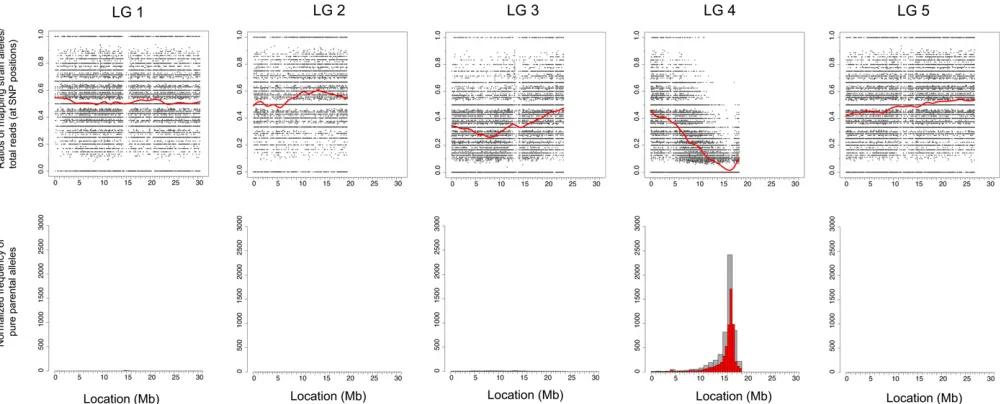
Analysis of the CloudMap SNP Mapping with WGS Data tool output from several mutant strains reveals previously de-scribed patterns of genetic incompatibility between the Bristol and Hawaiian strains (Seidel et al. 2008). For in-stance Figure 7 shows that at the2-Mb physical locations on chromosomes I and II, there are sharp dips in the LOESS regression line with corresponding peaks in the frequency plots of pure parental alleles. These regions, enriched for parental alleles, are consistent in all mapping plots exam-ined thus far (.10 strains, G. Minevich, R. J. Poole, and O. Hobert, unpublished data) and in terms of locating the correct mapping region, contribute to noise in both the scatter plots and frequency plots of pure parental alleles. To nor-malize for these incompatibilities and also to correct for di-vergence of either our Bristol or Hawaiian strains from their
respective published reference strains, we subtracted SNPs where the ratio of Hawaiian alleles/total read depth was
,0.05 or .0.95 in at least two mutant strains (Table S1). For the purposes of Hawaiian SNP normalization alone, SNPs that have Hawaiian alleles/total read depth ratios of
,0.05 are considered Bristol at that position (allowing for sequencing error or picking of WT animals) and SNPs with Hawaiian alleles/total read depth ratios of .0.95 are con-sidered Hawaiian at that position (allowing for sequencing and picking error as described above). It is important to note that these ratios of ,0.05 or .0.95 reflect the presence/ absence of Hawaiian mapping strain alleles in the progeny of individually picked F2’s (mostly F3 and F4 generations) that are pooled and sequenced. The purpose offiltering out those SNP positions that consistently show ratios of ,0.05 or.0.95 across several samples is simply to normalize the plots, not to assess potential incompatibility regions.
We were able to remove from consideration 8715 Hawaiian SNP positions that consistently had a ratio of Hawaiian alleles/ total read depth,0.05 or.0.95 in at least two mutant strains.
We provide this filtered list of 103,346 Hawaiian SNPs
together with the unfiltered list of 112,061 Hawaiian SNPs
from the WS220 release of WormBase (http://usegalaxy.
org/cloudmap). It is important to note that researchers who sequence their own Hawaiian strain may use their personal derived list of Hawaiian variants instead of the one provided here.
If the CloudMap Hawaiian Variant Mapping With WGS Data tool is run using the filtered list of Hawaiian SNPs, unlinked chromosomes no longer display the same levels of linkage as measured by the frequency plots of pure parental allele positions, while linked chromosomes continue to appear linked (Figure 7A). The effect of subtracting these 8715 Hawaiian SNPs from the plots is to dramatically clean up the linkage signal while dampening linkage resulting from incompatibility regions. In principle, any mapping strain whose SNP positions and variants are known can be used with this tool. We encourage researchers to share their curated lists of mapping variants so other members of the genetics community may use them.
The Hawaiian Variant Mapping With WGS Data tool further normalizes the frequency plots by adjusting for the density of Hawaiian SNPs on each chromosome according to
the equation in Figure 7B. We find that this equation
sharpens the signal of pure parental allele frequencies on the linked chromosomes (Figure 7A). Users have the option of running the Hawaiian Variant Mapping With WGS Data tool without the normalization option by leaving the
“normalize” checkbox unchecked and using the list of
112,061 unfiltered Hawaiian SNPs (the tool is set to nor-malize by default).
Hawaiian Variant Mapping with WGS Data support for other organisms
to a mapping strain for which variant information is avail-able. C. elegansandArabidopsisare natively supported. For all other organisms, users must provide a simple tab-delimited configuration file containing chromosome num-bers and respective lengths (example configuration files
for most major organisms provided at http://usegalaxy.
org/cloudmap). Additional files required for other
organ-isms are the same as described for C. elegans: a VCF file consisting of pooled F2 mutant progeny sequencing data, and a VCF file of the mapping strain variants. To demon-strate support for organisms other thanC. elegans, we show that CloudMap can be used to map mutant WGS data from
Arabidopsis.
Our one-step strategy for whole genome sequencing and mapping (Doitsidouet al.2010) was originally modeled on a similar strategy in plants (Schneebergeret al.2009) so we decided to test whether the CloudMap Hawaiian Variant Mapping With WGS Data tool would work on the publically available data from that publication. Wefind that the LOESS regression line and frequency plots very closely resemble the plots from Schneeberger et al. (2009) (Figure 9). Further-more, our method has the additional advantage of being available on the cloud and not requiring installation or con-figuration of any software.
Proof-of-principle application of CloudMap
We used the CloudMap Hawaiian Variant Mapping with WGS Data tool together with tools within Galaxy to map and identify thevab-3(ot266)allele that we have previously an-alyzed with another WGS sequence analysis tool developed in our lab, MAQGene (Bigelowet al.2009). This direct com-parison with MAQGene using the same reads analyzed in Doitsidou et al. (2010) allows us to illustrate some of the advantages inherent in the new pipeline. For this proof of principle, we focused exclusively on the analysis of SNPs and indels in the mapping region but readers are reminded that tools exist in the pipeline for analysis of putative uncovered regions (seeIdentifying deletions in WGS datasets).
vab-3(ot266)is a recessive mutation that we identified in
a screen for loss of dopamine neuron specification as evalu-ated by loss ofdat-1::gfpexpression (contained on transgene
vtIs1) (Doitsidou et al. 2008, 2010). ot266; vtIs1 animals
were crossed with the HawaiianCB4856strain and 50 sin-gled F2progeny were picked according to the defective do-pamine neuron specification phenotype. Only F2 progeny
that were heterozygous for the vtIs1 reporter were
se-quenced to avoid linkage to the vtIs1 transgene. Progeny of the 50 singled F2’s (F3’s and F4’s) were pooled and se-quenced using 100-bp reads on an Illumina GA2 sequencer, as previously described (Doitsidouet al.2010).
Data were processed according to the CloudMap Hawai-ian VarHawai-iant Mapping with WGS Data workflow. We describe here each of the individual steps this automated workflow performs, with links to the relevant sections of the user guide and videos. Raw datafiles and automated workflows used for this analysis are available at (http://usegalaxy.org/
cloudmap). The analysis of ot266 was performed using
a workflow that consists of two main branches: one that leads to a list of annotated variants and another that results in mapping plots. The initial data analysis steps are shared between the two branches: raw FASTQ reads are loaded
into Galaxy from the CloudMap ot266 library and the
FASTQ Summary Statistics and Boxplot tools immediately begin to calculate quality metrics on the raw FASTQ reads prior to alignment. While this is happening, those same FASTQ reads are aligned using BWA. The BWA aligner is preferred over MAQ, the aligner used by MAQGene, because it is faster, more accurate, and can also detect indels of up to 5 bp using default settings. Aligned sequence alignment map
(SAM) files then had unmapped reads removed and were
converted to their binary equivalent BAMfiles using SAM-tools. We then added read groups to the BAM file (sample annotations required for downstream processing) using PIC-ARD (http://picard.sourceforge.net), realigned the BAMfile around indels using GATK, and removed duplicate reads using PICARD (this step keeps the best quality read out of a set of identical reads, thus reducing a potential source of noise). This BAM alignmentfile is used as input into several downstream functions, but it can also be viewed directly using one of the available alignment viewers (Figure 3). Sample coverage is automatically calculated on this BAM file using the GATK Depth of Coverage tool as part of the
provided workflow. At this point, the two alternative
branches in the analysis diverge but these steps are run in parallel using the provided workflow. Users receive an E-mail when the separate branchesfinish analysis.
The analysis branch that ultimately results in a tabular list of annotated variants uses one of two analysis paths to arrive at an intermediate step list of variants in the form of a VCFfile (Daneceket al.2011). Our preferred variant caller (used in the automated workflow) is the GATK Unified Gen-otyper, which is used to quickly and directly generate a VCF from a BAM file. Alternatively a combination of SAMtools
“mpileup”and BCFtools“view”(Li et al.2009) (which we provide a Galaxy wrapper for) can also be used to generate a VCF. Provided user guides detail how either GATK’s Uni-fied Genotyper or SAMtools mpileup followed by BCFtools view can be used to generate VCFfiles from BAMfiles.
As described earlier, the ability to easily subtract variants between samples is one of the advantages of CloudMap over the MAQGene pipeline. VCF files contain all variant in-formation provided by the variant caller and VCFfiles can be merged or subtracted from one another using the GATK Combine Variants and GATK Select Variants tools as part of the CloudMap Subtract Variants workflow (details in the provided user guides and videos; see Supporting Informa-tion). In Figure 8, we schematically summarize the variant filtration and subtraction steps we followed to subtract non-causal mutations from theot266variant list.
analysis occur in parallel using automated workflows). Using the BAM file we generated earlier, we selectively
ran the GATK Unified Genotyper tool on Hawaiian SNP
positions only (using a supplied reference VCF file of
103,346filtered Hawaiian SNP positions, http://usegalaxy. org/cloudmap). The resulting VCFfile of reference (Bristol) and alternate (Hawaiian) alleles at all Hawaiian SNP posi-tions was then used as input into our CloudMap Hawaiian Variant Mapping with WGS Data tool. From the resulting plots (Figures 6B and 7A) we narrowed down the mapping interval for our causal mutation to a 1-Mb interval on link-age group (LG) X.
We next used theot266postsubtraction VCF with 1085 remaining variants that we generated earlier (Figure 8) as input into snpEff to predict the effect of the homozygous variants in theot266VCFfile and to annotate these variants (Cingolaniet al.2012). To check what transcription factors might be affected in the sample, we then ran the CloudMap Candidate List Checker with our provided list of transcrip-tion factors (http://usegalaxy.org/cloudmap). When wefi l-tered for the 10- to 11-Mb mapping region on LG X in the tabular outputfile in Excel, we observed 10 variants in total (Table S2). Of these 10 variants, 2 were protein coding and 1 was a premature stop in the vab-3 transcription factor previously identified as the causal variant (Doitsidouet al.
2010). This variant can then easily be viewed in the UCSC Genome Browser to examine the individual reads covering the mutation and also to view nematode conservation (or any other track-based data) at that position (Figure 10).
EMS Variant Density Mapping tool
Due to the vast number and frequency of Hawaiian SNPs relative toC. elegansand the speed with which one can pick individual F2mutants and sequence their progeny, we rec-ommend the Hawaiian SNP mapping approach for most mapping applications. However, there remain certain sce-narios where alternate mapping approaches are useful. For instance, introducing tens of thousands of Hawaiian variants into a mutant strain may not be desirable for individuals concerned with the possibility that some of these Hawaiian variants may act as modifiers of a given phenotype. Behav-ioral mutants may be especially vulnerable in this regard. Furthermore, in the case of suppressor screens or other screens that have been performed in a mutant background, it is complicated to recover both the suppressor variant and the starting mutation when picking the F2progeny required for the Hawaiian SNP mapping technique. In these scenar-ios, it is useful to follow the approach detailed in Zurynet al.
(2010) that involves plotting frequencies of variant density in a mutantC. elegansstrain that has been backcrossed to its (premutagenesis) starting strain (Zuryn et al. 2010). We therefore developed the CloudMap EMS Variant Density Mapping tool to plot data acquired from the Zuryn et al.
(2010) backcrossing approach.
Common (i.e., nonphenotype causing) variants present in multiple WGS strains with the same background shouldfirst
be subtracted from the variants in the sequenced mutant using the GATK Select Variants tool. The EMS Variant Den-sity Mapping tool accepts this list of filtered variants in the form of a VCFfile and offers the option of further filtering
for the most common EMS-induced mutations i.e., G/C/
A/T).
We analyzed the fp6 mutant from Zuryn et al. (2010)
using the EMS Variant Density Mapping tool and the results are shown in Figure S3. While Zuryn et al. (2010) sub-tracted common variants in the fp9 and fp12 strains from
fp6, we only used the fp9 strain for common variant
sub-traction. Nonetheless, we were able to clearly show linkage to the causal mutation on approximately the same region of LG III as in Zuryn et al.(2010).
As we used the more sensitive BWA aligner (which can pick up indels#5 using default settings) for our CloudMap approach, we were able to retrieve many more variants than Zuryn et al. (2010). In theory, these additional variants should be useful for achieving greater mapping accuracy. Subtracting common (nonphenotype causing) variants from more whole genome sequenced strains (using the GATK Se-lect Variants tool) should result in less noise and a tighter mapping region. Additional backcrosses will, of course, also result in a smaller mapping region.
Variant Discovery Mapping tool implements a novel mapping method
As mentioned above, mapping based on the segregation of linked EMS-induced mutations as described by Zuryn et al.
(2010) has the important advantage of not relying on a poly-morphic mapping strain like the Hawaiian strain. A recent study in plants has extended this conceptual approach, using not only EMS-induced variants to map a phenotype-causing mutation, but also using bulk segregant analysis to increase
mapping accuracy (Abe et al. 2012). We have developed
a similar method, which we call Variant Discovery Mapping. Our method makes use of background variants in addition to EMS-induced variants (including indels as well as SNPs), and it also uses the bulk segregant approach. We have in-tegrated the method into CloudMap and undertook a proof-of-principle analysis, as described below.
Following an outcross to a nonparental strain and selection of a pool of F2mutant recombinants, these homo-zygous variants will segregate according to their degree of linkage to the phenotype-inducing locus. Just as with pre-viously described polymorphic mapping (Figure 6A), the de-gree of linkage will be directly reflected in the allele frequency among the pool of recombinants and this can be represented as scatter plots of the ratio of variant reads/ total reads present in the pool of sequenced recombinants (Figure 11A). We then plot a LOESS regression line through all the points on a given chromosome to give greater accu-racy to the mapping region (Figure 11B) (as discussed in the CloudMap SNP Mapping With WGS Data tool section). While the concept of the scatter plots is similar to that of the polymorphic mapping approach, the LOESS lines on scatter plots for linked chromosomes now approach 1 in-stead of 0, indicating retention of the original homozygous variants in the linked region.
We also draw corresponding frequency plots that display regions of linked chromosomes where pure parental allele variant positions are concentrated (positions where the ratio of variant reads/total reads are equal to 1) (Figure 11B). These pure parental allele frequency plots are by default normalized in a manner similar to that for polymorphic mapping, although this normalization option can be turned off (seeFigure S4for the normalization equation). In addi-tion, we provide an option for users to draw frequency plots of positions where the ratio of variant reads/total reads are
$0.9. This option is useful in cases where there are few variants remaining after subtraction, as it effectively increases the number of variants and may therefore provide a stronger mapping signal. Using this 0.9 option should also handle cases where one or a few of the pooled mutants was
incorrectly picked (i.e., it was not a mutant) or where sequencing errors have resulted in less than the perfect 1 ratio for pure parental alleles at a given position. We find that using this option in some cases increases the strength of the linkage signal in the frequency plots. However, the scatter plots with LOESS regression remain the more robust and accurate of the two plots and we recommend adhering to them in any cases where the scatter plots and frequency plots disagree.
During the outcrossing to a nonparental strain (“crossing strain”), variants that are present in the crossing strain (rel-ative to the reference genome) will be introduced into the F2 mutant recombinants (Figure 11, A and B, lime green dia-monds). This set of crossing strain variants will cause false linkage or false nonlinkage to the causative mutation and must be identified and removed to assess only those mutant strain variants that were homozygous (relative to the refer-ence genome), before outcrossing. If we consider the two most extreme examples, any variant that is homozygous in the crossing strain and also by chance homozygous in the mutant strain will remain homozygous after outcrossing (see unlinked chromosome in Figure 11A). In this case, the allele frequency, as assessed by the variant read/total read ratio, in the pool of outcrossed F2mutant recombinants will be close or equal to 1. This will generate regions of false linkage on ratio plots of unlinked chromosomes (Figure 11B, top left scatter plot). In the second case where crossing strain variants pose a problem, variants that are homozy-gous in the crossing strain, and positionally close to, but not present in the linked region of the mutant, will be picked up by meiotic recombination at a low frequency. This fre-quency depends on the physical distance of the crossing-strain variant from the phenotype-inducing mutation
(Figure 11A). These variants will therefore have low allele frequencies in the pool of recombinants, despite being close to the phenotype-inducing mutation and will appear as false nonlinkage in the scatter plots (Figure 11B, top middle scat-ter plot). These crossing strain variants must therefore be identified and subtracted from the list of variants in the pool of outcrossed F2 mutant recombinants. Preferably, subtrac-tion of crossing strain variants can be performed by sequenc-ing the crosssequenc-ing strain to identify all the variants it contains.
Alternatively, crossing-strain variants can be identified by combining the lists of variants identified in several other strains that were all outcrossed to the same crossing strain, which is the approach we chose here (Figure 11C).
It is also possible, in a similar manner, to exclude back-ground variants (pale blue diamonds) from the analysis if desired (Figure 11, B and C), although a larger number of noncrossing strain variants are likely to make the method more accurate. It is important to note that in the case of
a suppressor screen, where the crossing strain is the parental premutagenesis strain, background variants will remain ho-mozygous throughout and will be removed when subtract-ing crosssubtract-ing-strain variants. Thus in this particular case, only mutagen-induced variants can be used in the analysis.
The degree of mapping accuracy is likely to be strongly affected by the number of recombinants pooled, as well as both the total number and quality of variants analyzed. Our analysis and others have suggested that, in the case of C.
elegans, both the accumulation of naturally occurring
muta-tions and the addition of mutagen-induced mutamuta-tions con-tribute to a high mutational load of close to 1000 SNPs across the genome of mutagenized strains (Flibotte et al.
2010; Sarin et al. 2010; Zuryn et al.2010). This is likely to be enough to delineate a mapping region small enough to contain only a few candidate mutant variants.
Proof-of principle example for Variant Discovery Mapping
To determine the best parameters and to validate this
strategy, we applied it to analyze the recessive vab-3
(ot266)allele that we have previously mapped and cloned
using the polymorphic mapping strategy both with older WGS analysis tools (Doitsidou et al.2010) and here with
our new CloudMap pipeline. Utilizing the same dataset allows a direct comparison between polymorphic mapping and Variant Discovery Mapping. When the vab-3(ot266)
data are processed using the Hawaiian polymorphic map-ping strategy with the CloudMap Hawaiian Variant Mapmap-ping
With WGS Data workflow, the mapping plots indicate
a linked region on LG X between 10 and 11 Mb (Figure 6B). We find that the Variant Discovery Mapping strategy defines a very similar mapping region, despite using a total of only 575 background and EMS-induced SNPs and indels (Figure 11B, middle right plot). We describe below in more detail the individual steps required to perform Variant Dis-covery Mapping, all of which are automated when running
the CloudMap Variant Discovery Mapping workflow that
we have incorporated into our CloudMap pipeline (http://
usegalaxy.org/cloudmap).
Thefirst step is to determine which variants will be used for the analysis. One output of the CloudMap Variant Discovery Mapping workflow is a list of all high-quality heterozygous and homozygous variants present in the out-crossed pool of F2 mutant recombinants as called by the GATK Unified Genotyper (DePristoet al.2011). This geno-typer uses a Bayesian genotype likelihood model to estimate genotypes and allele frequencies, detecting both SNPs and
indels (when used in combination with the BWA aligner). For Variant Discovery Mapping, we further apply a quality filter to this set of heterozygous and homozygous variants so that a single PHRED-scaled quality score reflects the proba-bility of the variant allele (see Materials and Methods) (Danecek et al.2011). Because we sequence pooled popu-lations of F2mutant progeny, the definition of heterozygous and homozygous as defined by the GATK Unified Genotyper is not the same as it would be for a single strain. The ratio of variant reads/total reads at a given position approximately reflects the variant allele frequency in the pooled population and we therefore use the GATK defined quality score as a simple proxy for variants that are at least“heterozygous” in the pooled population of genomes to a large degree of confidence (seeMaterials and Methods). The goal is to plot variant read/total read ratios for all variants that are het-erozygous or “homozygous” in the pooled population of recombinants. As GATK is an aggressive variant caller, many false positive heterozygous variant calls are those with low allele frequencies. Filtering for high-quality variants removes most of these false positive variants from the scatter plots. Rather than decreasing the prior likelihood value when run-ning the genotyper, arbitrarily setting a read ratio cutoff point (e.g., defining heterozygous variants as having a ratio of reference reads/variant reads .0.3), or invoking a com-plicated series of post-calling filters, all of which are valid methods to identify high-quality variants, we chose tofilter using the single PHRED-scaled quality score assigned by
GATK. The CloudMap Variant Discovery Mapping workflow
produces outputfilesfiltered at Q100, Q200, and Q300 (see
Materials and Methods). We empirically determined that
filtering for a QScore$200 worked the best across several samples and several organisms. This score represents a 1 in 10^20 chance of error in variant calling and we use this set of filtered variants for all downstream steps.
The second step is to subtract crossing strain variants (as described in the previous section). In the case ofvab-3(ot266), it was crossed to the highly polymorphic Hawaiian strain, which will introduce a large number of crossing strain var-iants. To remove these variants, rather than specifically se-quence our Hawaiian strain, we combined the heterozygous and homozygous variants detected in six other strains that were also crossed to Hawaiian as illustrated in Figure 11C in addition to the unfiltered list of known Hawaiian variants. We took the liberal approach and subtracted variants present in at least one of these strains. The effects of this subtraction can be seen in Figure 11B (middle row of plots).
In thefinal step, we used a custom Python script to plot the ratio of variant reads/total reads for each variant position and a LOESS regression line (as discussed in the CloudMap Hawaiian Variant Mapping With WGS Data tool section) is used to reveal the trend. With relatively few data points, we empirically determined that a span of 0.4 works the best for all tested samples and species, although this parameter can be adjusted as desired when running the Variant Discovery Mapping tool (see Materials and
Meth-ods). The tool additionally plots the normalized frequency of pure parental allele positions (variant reads/total reads is equal to 1) across each chromosome. As can be seen in Figure 11B (middle plots for linked chromosome X), both Variant Discovery Mapping plots define a mapping region on LG X between 10 and 11 Mb. Despite containing200-fold fewer variants, this is an identical mapping region to that defined by Hawaiian Variant Mapping and examination of homozygous variants in this region (using the less stringent list of homo-zygous variants output as part of the CloudMap Variant Dis-covery Mapping workflow) reveals only two protein coding variants, one of which is the premature stop in thevab-3locus. It is also possible to distinguish background variants from EMS-induced variants by subtracting those variants present in other WGS strains from the same parental strain (in this
caseot260andot263) (Figure 11B, bottom row of plots) or
to remove indels from the analysis. In the case of vab-3
(ot266), removing background variants reduced the
accu-racy of the mapping (Figure 11B, bottom row of plots for linked chromosome X) but removing indels had relatively little effect (data not shown). We conclude that it is impor-tant to retain as many noncrossing strain variants as possible to achieve the best mapping accuracy.
Validation of the CloudMap Variant Discovery Mapping method in other organisms
In principle, Variant Discovery Mapping should work in any organism provided the numbers of homozygous background and mutagen-induced variants present in the starting strain are high enough. To test this, we analyzed the slow growth
Arabidopsismutant described in Schneebergeret al.(2009).
This recessive mutant was isolated in the Columbia back-ground, crossed to the polymorphic Landsberg strain, and
500 F2 mutant recombinants were pooled and whole
ge-nome sequenced. We ran this publicly available WGS data-set through the CloudMap Variant Discovery Mapping workflow and compared these plots to standard Hawaiian Variant Mapping plots (generated using the CloudMap Ha-waiian Variant Mapping With WGS Data workflow described above). We identified crossing-strain variants using the list of variants generated by analysis of a second mutant dataset that had also been crossed to the Landsberg polymorphic strain and subtracted them (Galvaoet al.2012). Wefind that Variant Discovery Mapping localizes the linked region to the far right end of chromosome IV between 16 and 18 Mb and is almost as accurate as polymorphic mapping (Figure S5). This indicates that our Variant Discovery Mapping pipeline is ap-plicable to other species. The CloudMap Variant Discovery Mapping tool natively supportsArabidopsisand is easily con-figured for other species (see CloudMap user guides and vid-eos athttp://usegalaxy.org/cloudmap).
Conclusion
on the Galaxy platform, CloudMap requires no software installation when run on the cloud (as opposed to locally or via Amazon’s EC2 service) and is modular and thus able to accommodate the latest software tools as they become avail-able. CloudMap uses a series of predefined workflows that allow users to arrive at a mapping region and a list of var-iants with a few simple clicks. We encourage users to check for updates of the CloudMap pipeline at http://usegalaxy.
org/cloudmap.
Regarding the preferred mapping strategy, our current best practice recommendation is to use Hawaiian Variant Mapping if there are no obvious issues with the polymorphic Hawaiian strain. In this approach, no additional WGS information from other strains is required. If a laboratory has extensive WGS information on other strains (the“ cross-ing strain”in the Variant Discovery Mapping method) or if the Hawaiian strain causes problems, we recommend using the Variant Discovery Mapping approach.
Acknowledgments
We thank members of the Hobert lab, many colleagues in
theCaenorhabditis eleganscommunity for reading and
com-menting on the manuscript, and Alexander Boyanov for his expert handling of our WGS operations. This work was funded in part by the National Institutes of Health (NIH) (R01NS039996-05 and R01NS050266-03) and the Howard Hughes Medical Institute. G.M. was supported by a F31 pre-doctoral fellowship (1F31NS074841-01). We thank the Gal-axy Team for their continuing help on this project. GalGal-axy is supported by US National Institutes of Health grants HG005133, HG004909 and HG006620 and US National Sci-ence Foundation grant DBI 0850103. Additional funding is provided, in part, by the Huck Institutes for the Life Sciences at Penn State, the Institute for Cyberscience at Penn State and a grant with the Pennsylvania Department of Health using Tobacco Settlement Funds. The Department specifi -cally disclaims responsibility for any analyses, interpreta-tions or conclusions.
Literature Cited
Abe, A., S. Kosugi, K. Yoshida, S. Natsume, H. Takagi et al., 2012 Genome sequencing reveals agronomically important loci in rice using MutMap. Nat. Biotechnol. 30: 174–178. Afgan, E., D. Baker, N. Coraor, H. Goto, I. M. Paul et al.,
2011 Harnessing cloud computing with Galaxy Cloud. Nat. Biotechnol. 29: 972–974.
Bigelow, H., M. Doitsidou, S. Sarin, and O. Hobert, 2009 MAQGene: software to facilitate C. elegans mutant ge-nome sequence analysis. Nat. Methods 6: 549.
Blankenberg, D., A. Gordon, G. Von Kuster, N. Coraor, J. Taylor et al., 2010 Manipulation of FASTQ data with Galaxy. Bioin-formatics 26: 1783–1785.
Cingolani, P., and A. Platts, L. Wang le, M. Coon, T. Nguyenet al., 2012 A program for annotating and predicting the effects of single nucleotide polymorphisms, SnpEff: SNPs in the genome
of Drosophila melanogaster strain w1118; iso-2; iso-3. Fly (Aus-tin) 6: 80–92.
Cleveland, W. S., E. Grosse, and W. M. Shyu, 1992 Local regres-sion models,Statistical Models in S, edited by J. M. Chambers, and T. J. Hastie. CRC Press, Boca Raton, FL.
Danecek, P., A. Auton, G. Abecasis, C. A. Albers, E. Banks et al., 2011 The variant call format and VCFtools. Bioinformatics 27: 2156–2158.
DePristo, M. A., E. Banks, R. Poplin, K. V. Garimella, J. R. Maguire et al., 2011 A framework for variation discovery and genotyp-ing usgenotyp-ing next-generation DNA sequencgenotyp-ing data. Nat. Genet. 43: 491–498.
Doitsidou, M., N. Flames, A. C. Lee, A. Boyanov, and O. Hobert, 2008 Automated screening for mutants affecting dopaminer-gic-neuron specification in C. elegans. Nat. Methods 5: 869– 872.
Doitsidou, M., R. J. Poole, S. Sarin, H. Bigelow, and O. Hobert, 2010 C. elegans mutant identification with a one-step whole-genome-sequencing and SNP mapping strategy. PLoS ONE 5: e15435.
Ewing, B., and P. Green, 1998 Bacalling of automated se-quencer traces using phred. II. Error probabilities. Genome Res. 8: 186–194.
Flibotte, S., M. L. Edgley, I. Chaudhry, J. Taylor, S. E. Neil et al., 2010 Whole-genome profiling of mutagenesis in Caenorhabdi-tis elegans. Genetics 185: 431–441.
Flowers, E. B., R. J. Poole, B. Tursun, E. Bashllari, I. Pe’eret al., 2010 The Groucho ortholog UNC-37interacts with the short Groucho-like protein LSY-22 to control developmental decisions in C. elegans. Development 137: 1799–1805.
Galvao, V. C., K. J. Nordstrom, C. Lanz, P. Sulz, J. Mathieuet al., 2012 Synteny-based mapping-by-sequencing enabled by tar-geted enrichment. Plant J. 71: 517–526.
Harris, T. W., N. Chen, F. Cunningham, M. Tello-Ruiz, I. Antosh-echkinet al., 2004 WormBase: a multi-species resource for nem-atode biology and genomics. Nucleic Acids Res. 32(Database issue): D411–D417.
Hillier, L. W., G. T. Marth, A. R. Quinlan, D. Dooling, G. Fewell et al., 2008 Whole-genome sequencing and variant discovery in C. elegans. Nat. Methods 5: 183–188.
Hobert, O., 2010 The impact of whole genome sequencing on model system genetics: get ready for the ride. Genetics 184: 317–319.
Hobert, O., 2012 The neuronal genome of Caenorhabditis ele-gans. WormBook (in press).
Janssen, T., M. Lindemans, E. Meelkop, L. Temmerman, and L. Schoofs, 2010 Coevolution of neuropeptidergic signaling sys-tems: from worm to man. Ann. N. Y. Acad. Sci. 1200: 1–14. Kent, W. J., C. W. Sugnet, T. S. Furey, K. M. Roskin, T. H. Pringle
et al., 2002 The human genome browser at UCSC. Genome Res. 12: 996–1006.
Kim, J. K., H. W. Gabel, R. S. Kamath, M. Tewari, A. Pasquinelli et al., 2005 Functional genomic analysis of RNA interference in C. elegans. Science 308: 1164–1167.
Kim, S., J. A. Govindan, Z. J. Tu, and D. Greenstein, 2012 The SACY-1 DEAD-box helicase links the somatic control of oocyte meiotic maturation to the sperm-to-oocyte switch and gamete maintenance inCaenorhabditis elegans. Genetics (in press). Labed, S. A., S. Omi, M. Gut, J. J. Ewbank, and N. Pujol, 2012 The
pseudokinase NIPI-4 is a novel regulator of antimicrobial pep-tide gene expression. PLoS ONE 7: e33887.
Langmead, B., C. Trapnell, M. Pop, and S. L. Salzberg, 2009 Ultrafast and memory-efficient alignment of short DNA sequences to the human genome. Genome Biol. 10: R25. Li, H., and R. Durbin, 2010 Fast and accurate long-read alignment