An Enhanced Cooperative Harmony
Search Algorithm for Solving Optimization
Problems
C.Mariyammal
1, M.Jose priya
2PG Scholar, Department of CSE, P.S.R Rengasamy College of Engineering for women, Tamilnadu, India1 Assistant Professor, Department of CSE, P.S.R Rengasamy College of Engineering for women, Tamilnadu, India2
ABSTRACT:
Harmony search algorithm (HS) is a new meta-heuristic algorithm which is inspired by a
process involving musical organization. HS is a stochastic optimization technique that is similar to genetic
algorithm (GA) and particle swarm optimization (PSO). Optimization is the act of achieving the best
possible result under given circumstances to solve many complex optimization problems, including function
optimization. An enhanced cooperative harmony search algorithm will be developed in this project in which
harmonies are split into desired vectors and also GA is used when the harmonies are stagnated for particular
number of iterations. Enhanced HS will be applied to function optimization problems. The results of the
analysis show that enhanced HS is capable of finding better solutions when compared to HS and cooperative
HS, especially in high-dimensional problems.
KEYWORDS:
Harmony search, Genetic Algorithm, Function Optimization.
I. INTRODUCTION
A. optimization
Optimization is a very ancient problem. Optimization is the act of achieving the best possible result under given circumstances to solve many complex optimization problems, such as including function optimization. My work focus on function optimization. The function optimization of all such decisions is either to minimize effort or to maximize benefit. The goal of this work best minimization valve. There is no single method available for solving all optimization problems efficiently. Hence, a number of methods have been developed for solving different types of problems.
B.Methods of optimization
The methods are harmony search, cooperative harmony search algorithm. An enhanced cooperative harmony search algorithm will be developed on harmonies are split into desired vectors. It can be finding on best solution. The major issue of occur in this work harmonies are stagnated for particular number of iterations. This problem solving on use algorithm on genetic algorithm. The genetic algorithm (GA) is a search technique based on the mechanics of natural genetics and survival of the fittest. GA is a smart and different tool for solving complex multimodal optimization problems.
II. ORGANIZATION OF THE PAPER
Pandian Saraswathi Yadav Engineering College, Arasanoor, Sivagangai, Tamilnadu, India
III. RELATED WORK
Improved Multi objective Harmony Search Algorithm with Application to Placement and Sizing of Distributed Generation: A Review [1] thathas introduced the novel intelligent optimization algorithm for multi objective harmony search (MOHS). To solve the comprehensive multi objective optimization problem.Multi objective optimization is concerned with mathematical optimization problems involving more than one objective to be optimized simultaneously. There are two approaches in solving the multi objective optimization problem. Finding optimal solution by using a weighted sum approach: Finding optimal solution by using a weighted sum approach aims to solve the multi objective problem through using the weighting factors to transform the multiple objectives into one objective. Finding optimal solution based on Pareto-optimal front: Finding optimal solution based on Pareto-optimal front approach aims to optimize all objective functions simultaneously based on non dominated solutions.
A Novel Self-Adaptive Harmony Search Algorithm [2] presented that anovel, self-adaptive search mechanism for optimization problems with continuous variables. This new variant can automatically configure the evolutionary parameters in accordance with problem characteristics, such as the scale and the boundaries, and dynamically select evolutionary strategies in accordance with its search performance. The new variant simplifies the parameter setting and efficiently solves all types of optimization problems with nonstop variables. The results analysis that variant is considerably robust and outperforms the original harmony search (HS), improved harmony search (IHS), and other selfharmony search (HS), improved harmony search (IHS), and other self- adaptive variants for large-scale optimization problems and constrained problems.
An Effective Hybrid Firefly Algorithm with Harmony Search for Global Numerical Optimization[3]expressed thatthe hybrid metaheuristic approach by hybridizing harmony search (HS) and firefly algorithm (FA), namely, HS/FA, to solve function optimization. In HS/FA, the exploration of HS and the exploitation of FA are fully exerted, so HS/FA has a faster convergence speed than HS and FA. top fireflies scheme is introduced to reduce running time, and HS is utilized to mutate between fireflies when updating fireflies. These metaheuristic approaches are solving complicated problems, like permutation flow shop scheduling reliability, high-dimensional function optimization and other engineering problems. Have newly introduced on genetic algorithms (GA). In HS/FA, top fireflies scheme is introduced to reduce running time.
An Improved Harmony Search Based on Teaching-Learning Strategy for Unconstrained Optimization Problems the algorithm expressed as improved global harmony search algorithm, named harmony search based on teaching-learning (HSTL), for high dimension complex optimization problems. The HSTL algorithm for four strategies. Harmony memory consideration, teaching-learning strategy, Local pitches adjusting. Random mutation is employed to maintain the proper balance between convergence and population diversity, and dynamic strategy is adopted to change the parameters. The HSTL algorithm is investigated and compared with three other state-of-the-art HS optimization algorithms. HSTL algorithm is more effective and stable in obtaining high quality solutions and has less FEs, less runtime, and higher success rates under the same conditions.
Hybrid harmony search and artificial bee colony algorithm for global optimization problems have introduced the artificial bee colony algorithm is a new swarm intelligence technique inspired by intelligent foraging behavior of honey bees. The ABC and its variants are used to improve harmony memory (HM). To compare and analyze the performance of hybrid algorithms, a number of experiments are carried out on a set of well known benchmark global optimization problems. The effects of the parameters about the hybrid algorithms are discussed by a uniform design experiment. The newly introduced on self-adaptive harmony search algorithm. Hybrid Harmony Search with Artificial Colony Bee algorithm (HHSABC) for solving global numerical optimization problems. The Artificial Bee Colony (ABC) algorithm is a new swarm intelligence technique inspired by the intelligent foraging behavior of honey bees. In the ABC algorithm, the colony of artificial bees contains three groups of bees: employed bees, onlookers and scouts
of metaheuristic algorithms. First outline the fundamental steps of Harmony Search, and it works. Then review briefly other popular meta heuristics such as particle swarm optimization so as to find their similarities and differences from HS.Finally, discuss the ways to improve and develop new variants of HS.A heuristic algorithm is a good solution to an optimization problem by „trial-and-error‟ in a reasonable amount of computing time. Here „heuristic‟ means to „find‟ or „search‟ by trials and errors. Five types of popular Metaheuristics algorithms used. Simulated Annealing, Evolutionary Algorithms, Particle Swarm Optimization, Ant Colony Optimization, Firefly Algorithm. Characteristics of HS and Comparison. There are used two components. Diversification and Intensification.
IV. PRELIMINARIES
A. Find optimization
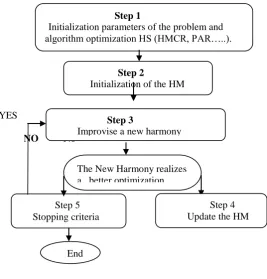
The find optimization first it can be find on minimum optimal value. It can be using on two algorithms. First on harmony search and second on cooperative harmony search algorithm. The System architecture has shown in fig.1
YES
NO No
Fig 1 System Architecture
First Initialization parameters of the problem and algorithm optimization HS (HMCR, PAR…..).Second initialization of HM value. Next improvise a new harmony and New Harmony realizes on better optimization. This step means on no stop the criteria and yes means on update the HM.
1. HARMONY SEARCH ALGORITHM
Harmony search (HS) is a meta-heuristic algorithm that mimics the improvisation process of musicians. The important steps involved in HS algorithm are:
A. The problem and algorithm parameters are initialized
Initialize the problem algorithm parameters. The problem parameters like 𝑛, 𝐿𝑥𝑖, 𝑈𝑥𝑖 should be initialized. In addition, four algorithm parameters should be initialized, including harmony memory size (HMS), harmony memory considering rate (HMCR), pitch adjusting rate (PAR), and the maximum number of improvisation (𝑇max), or stopping
Step 3
Improvise a new harmony
Step 1
Initialization parameters of the problem and algorithm optimization HS (HMCR, PAR…..).
Step 2
Initialization of the HM
The New Harmony realizes a better optimization
Step 5
Stopping criteria
Step 4
Update the HM
Pandian Saraswathi Yadav Engineering College, Arasanoor, Sivagangai, Tamilnadu, India
criterion. The 𝐿𝑥𝑖 and 𝑈𝑥𝑖 are the lower and upper bound of the ith decision variables and n is the number of decision variables.
B.Harmony memory is initialized
The SHS is similar to GAs. GAs is population based optimization algorithms, but the “population” in SHS is referred to as harmony memory (HM), which is composed of solution vectors.
C.A New Harmony is improvised
The New Harmony is improvised is following to these three rules: (1) Harmony memory consideration
(2) Pitch adjustment (3) Randomization.
D.The harmony memory is updated
If the New Harmony vector values are better than the worst harmony vector in the HM in terms of the object function value, the worst harmony in the HM is superseded by the New Harmony vector.
E. Check stopping criterion
If the harmony vector values are satisfied, the iteration is terminated. If the harmony vector values are not satisfied, the Steps 3 and 4 are repeated again and again in best harmony values.
2. COOPERATIVE HARMONY SEARCH ALGORITHM
The CHS algorithm may be more easily attentive in a local optimum. As the CHS algorithm is does not an answer to each problem, we must ask ourselves the question of when exactly it is that the CHS algorithm can perform better and which kinds of problems can be solved satisfactorily by the CHS algorithm. The algorithm CHS uses multiple harmony memories, so that every harmony memory can optimize different components of the solution vector.
A. Algorithm of CHS
Initialize the parameters
Divide the 𝑛 decision variables into 𝑚 groups Foreach HM do
Initialize HM randomly End for
Whiletermination condition is false do Calculate PAR and BW by using Equation (1)
For each HM do
Generate a new harmony Evaluate the New Harmony End for
End while
Formula for PAR and BW:
𝑃𝐴𝑅 𝑡 = 𝑃𝐴𝑅
𝑚𝑖𝑛+
𝑃𝐴𝑅𝑚𝑎𝑥−𝑃𝐴𝑅𝑚𝑖𝑛𝑇𝑚𝑎𝑥
× 𝑡
…(1)4.4.1
𝑏𝑤 𝑡 = 𝑏𝑤
𝑚𝑎𝑥× exp
ln bw
min⋰ bw
maxV.ALGORITHM IMPLEMENTATION
In this section, the proposed work on the measure on optimal (best) values on using an enhanced cooperative harmony search algorithm, but harmonies are stagnated for particular number of iterations. So time on increased from find best values. This types of problem avoid it can be using on algorithm genetic algorithm.
A.IMPLEMENTATION OF GENETIC ALGORITHM
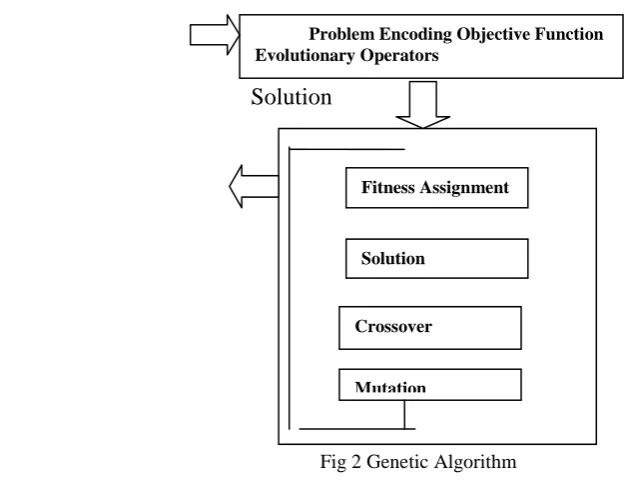
To successfully apply a GA to solve a problem one needs to determine the following: 1) How to represent possible solutions, or the iteration encoding.
2) What to use as the fitness function which accurately represents the value of the solution. 3) Which genetic operators to employ and
4) The parameter values (population size, probability of applying operators, etc.), which are suitable. The GA algorithm a following the steps.
Initialization, Fitness Function, Selection, Crossover Mutation, Evaluation, termination.
Initialization
Initially many individual solutions are randomly generated to form initial values
.
Fitness function
A fitness function must be devised for each problem to be solved. For many problems, particularly function optimization, and the fitness function should simply measure the value of the function. Fitness function is a designed function that measures the goodness of a solution. It should be designed in the way that will have a higher fitness function value than worse solutions. The fitness function plays a main role in the selection process.
Example on fitness function: A Simple Fitness Function
Here we want to minimize a simple function of two variables min f(x) = 100 * (x (1) ^2 - x (2)) ^2 + (1 - x (1)) ^2;
X
Coding the Fitness Function
We create a MATLAB file named simple_fitness.m with the following code in it:
Function y = simple_fitness(x)
y = 100 * (x (1) ^2 - x (2)) ^2 + (1 - x (1)) ^2;
Pandian Saraswathi Yadav Engineering College, Arasanoor, Sivagangai, Tamilnadu, India
Problem
Solution
Fig 2 Genetic Algorithm
Selection
Selection is a genetic operator that chooses a chromosome from the current generation‟s population for inclusion in the next generation‟s population. Good individuals will probably be selected several times in a generation. Poor ones may not be at all. Before making it into the next generation‟s population, selected chromosomes may undergo crossover and mutation (depending upon the probability of crossover and mutation) in which case the offspring chromosome(s)
are
actually the ones that make it into the next generation‟s populationB. The system models
The system models are followed by, 1) Benchmark Functions Implementation
2) Implementation of Basic Harmony Search Algorithm 3) Implementation of Cooperative HS
4) Implementation of Enhanced HS with GA 5) Experimental Analysis with benchmark functions.
1) Benchmark Functions Implementation
Ten benchmark functions have been chosen to test the performance of the Cooperative harmony search Algorithm, and standard harmony search algorithm and GHS algorithms are tested for the sake of comparison
2) Implementation of Basic Harmony Search Algorithm
Improvised according to these three rules: (1) harmony memory consideration; (2) pitch adjustment; (3) randomization. The probabilities of harmony consideration and pitch adjustment are dependent on HMCR and PAR.
3) Implementation of Cooperative HS
The CHS algorithm may be more easily trapped in a local optimum. As the CHS algorithm is not an answer to every problem, we must ask ourselves the question of when exactly it is that the CHS algorithm can perform better and
Problem Encoding Objective Function Evolutionary Operators
Fitness Assignment
Solution
Crossover
which kinds of problems can be solved satisfactorily by the CHS algorithm. The algorithm CHS uses multiple harmony memories, so that each harmony memory can optimize different components of the solution vector.
4) Implementation of Enhanced HS with GA
An enhanced cooperative harmony search algorithm will be developed in which harmonies are split into desired vectors and also GA is used when the harmonies are stagnated for particular number of iterations.
5) Experimental Analysis with benchmark functions Benchmark function it can be many types.
Griewank benchmark function
Rast function
Rosen function
Ackley function
Quadric function
A.Griewank function
𝑓 𝑥 =
𝑥𝑖2
4000
−
cos
(
𝑥𝑖 𝑖 𝑑
𝑖=1 𝑑
𝑖=1
) + 1
N=100; ∈ [-600,600]: Dimensions x(x1……..x30) B.Rosenbrock’s function
𝑓 𝑥 =
𝑛=1𝑖=1(cos
(𝑥
𝑖2− 𝑥
𝑖+1)
2+ ( 1 − 𝑥
𝑖)
2 Where 𝑛 = 100, ∈ [−2.048,2.048]30. Rosenbrock‟s function is a naturally non separable function, the global optimum being𝑋∗ = (1, 1, . . . , 1) which is located in a narrow valley; it is very hard for algorithms to find the correct direction and reach to the global minimum.
C.Quadric function
𝑓(𝑥) =
𝑛
𝑖=1
(
𝑖
𝑗 =1
𝑥
𝑗
)
2
N=100: and dimension x=30 D.Ackley function
𝑓 𝑥 = −20exp
(−0.2
1𝑛
𝑥
𝑖2
) + 20 − exp
(
1𝑛 𝑛
𝑖=1 𝑛𝑖=1
cos
(2𝜋𝑥
𝑖)) + 𝑒
N=100; dimension x=30.
E.Rastrigin function
𝑓 𝑥 =
𝑛𝑖=1(𝑥
𝑖2− 10 cos 2𝜋𝑥
𝑖+ 10)
Pandian Saraswathi Yadav Engineering College, Arasanoor, Sivagangai, Tamilnadu, India
VI.SIMULATION RESULTS AND ANALYSIS
In this section, the mat lab 2013(a) software as used. The bench mark function on input. Pitch values (intervals) on -600 to 600.number of iteration on N=100.dimension of x=30, x values on (x1, x2 ….x30).the five bench mark function
as used as followed
A.Griewank benchmark function
B.Rast function
C.Rosen function
D.Ackley function
E.Quadric function
1) Cooperative harmony search:
CHS algorithm is able to find a better solution. Value an (-600,600).number of iteration it can be 100.griewank function a zeros. Dimension it can be 30.spliting value on (3 3 3 3 3 3 3 3 3 3 3)
Griewank_1_HS_results&Griewank_1_HS_GA_results
Run of two different random number (seed number) .first random numbers it can be produce on harmony search result. Second random number it can be produce on genetic algorithm. That below graph on Griewank harmony search and genetic algorithm comparison.no.of iteration on 100.series 1 on genetic algorithm result. Series 2 on harmony search result.
Fig 3Griewank_1_HS_results&Griewank_1_HS_GA_results
Griewank_2_HS_results and Griewank_2_HS_GA_results
Run of two different random number (seed number) .first random numbers it can be produce on harmony search result. Second random number it can be produce on genetic algorithm. That below graph on harmony search and genetic algorithm comparison.no.of iteration on 100.series 1 on genetic algorithm result. Series 2 on harmony search result.
0 200 400 600 800
1 18 35 52 69 86
f(x)
No.of iteration
Ряд1
Fig 4 Griewank_2_HS_results and Griewank_2_HS_GA_results
The best value on griewank 1 from 323.15 and griewank 2 from189.78.it can be using on more number of bench mark function.
VI I. CONCLUSION AND FUTURE WORK
In this work, the CHS was then applied to function optimization problems. The results of the experiment show that CHS is capable of finding better solutions when compared to HS and a number of other algorithms, especially in high-dimensional problems. An enhanced cooperative harmony search algorithm will be developed in which harmonies are split into desired vectors and also GA is used when the harmonies are stagnated for particular number of iterations.
Future work aims at Due to premature convergence, solution stagnates in the GA. So we will go for Cuckoo search with cooperative harmony search to improve the solution and enhance the performance it can be calculated.
REFERENCES
1.Waxing Sheng,1 Ke-yan Liu,1 Yunhua Li,2 Yuan Liu,2 and XiaoliMeng1,”Improved Multi objective Harmony Search Algorithm with Application to Placement and Sizing of Distributed Generation, Hindawi Publishing Corporation Mathematical Problems in Engineering Volume 2014
2. Lihong Guo, 1 Gai-Ge Wang, 2 Heqi Wang,1 and Dinan Wang1,”An Effective Hybrid Firefly Algorithm with Harmony Search for Global Numerical Optimization”Research Article,2013
3. D. Manjarres a, I.Landa-Torres a, S.Gil-Lopez a, J.DelSer a, M.N.Bilbao b, S. Salcedo-Sanz c, Z.W.Geem d,” A survey on applications of the harmony search algorithm “Engineering Applications of Artificial Intelligence26 (2013).
4. Kaiping Luo,”A Novel Self-Adaptive Harmony Search Algorithm” Hindawi Publishing Corporation Journal of Applied Mathematics Volume 2013.
5. L. Wang, R. Yang, Y. Xu, Q. Niu, P. M. Pardalos, and M. Fei, “An improved adaptive binary harmony search algorithm, “Information Sciences, 2013.
6.Shouheng Tuo,1 Longquan Yong,1 and Tao Zhou2, ” An Improved Harmony Search Based on Teaching-Learning Strategy for Unconstrained Optimization Problems” Hindawi Publishing Corporation volume 2012.
7. Bin Wu∗, Cunhua Qian, Weihong Ni, Shuhai Fan,”Hybrid harmony search and artificial bee colony algorithm for global optimization problems” Computers and Mathematics with Applications (2012).
8.Chukiat Worasucheep,” A Harmony Search with Adaptive Pitch Adjustment for Continuous Optimization” International Journal of Hybrid Information Technology October, 2011.
9.X.-S. Yang, “Harmony search as a metaheuristic algorithm,” in Music-Inspired Harmony Search Algorithm, vol. 191 of Studies in Computational Intelligence, Springer, 2009.
0 100 200 300 400 500 600 700
1 18 35 52 69 86
f(x)
No.of iteration
Ряд1