MATERNAL INHERITANCE I N BARLEY
D. W. ROBERTSON
Colorado Slate College, Fort Collins, Colorado
Received September 2, 1936
INTRODUCTION
WO types of inheritance, Mendelian and non-Mendelian, have been
T
described by various workers. The majority of cases of non-Mende- lian inheritance described in higher plants have dealt with variegation of one type or another. In the monocotyledons, several workers have de- scribed the occurrence of non-Mendelian inheritance in striped plants of Zea, Avena, Hordeum, Oryza and Sorghum. The present paper deals with the occurrence of maternal inheritance in a chlorina (solid color) plant obtained from Coast barley (Hordeum vulgare).LITERATURE REVIEW
CHITTENDEN (1927), DEMEREC (1927), and SHARP (1934) have reviewed the work of CORRENS, BAUR and SHULL on maternal inheritance of varie- gation in Mirabilis, Antirrhinum and Melandrium and discuss the various theories offered to explain the phenomena. DEMEREC (1927) describes a case of maternal inheritance in maize. In his experiment, variegation(strip- ing) was inherited only through the female gametes and the male gametes had no influence either in its transmission or its expression. All attempts made to transmit the variegation asexually were unsuccessful. He assumes that the variegation is determined by a dominant mutable gene which has a highly increased frequency of mutation when it comes in contact with other than the parent cytoplasm. Striping of the leaves, similar to the cases above, has been discussed by ANDERSON (1923) in maize, ROBB (1934) in oats, IMAI (1928) in barley and rice, KARPER and CONNER (1931) in sorghum. RHOADES (1933) found a type of male sterility which was inherited maternally. Male sterile plants were crossed to normal linkage testers having several genes located a t various distances apart on the chromosomes. The F1 plants were crossed on plants bearing all of the fac- tors under test in the recessive condition. The backcross data were ana- lyzed for the characters and their relationship to male sterility. The results indicate that the genetic complex plays no part in the expression of the male sterile character. I n his summary, he states that there was no indica- tion of male sterility being caused by a virus disease.
MATERNAL INHERITANCE I N BARLEY 105
MATERIAL AND METHODS
Coast V was selected in a plot of normal Coast barley in 1926. The plant is chlorophyll deficient, the seedling color being “absinthe green.” (Plate 31, RIDGEWAY 1912.)
The color of normal Coast seedlings is “cress green.” (Plate 31, RIDGE-
WAY.) The color in Coast V remains constant until after heading when it darkens before ripening. The plants are slightly smaller than the normal Coast plants.
Several chlorophyll deficient “chlorina” plants have been previously described by ROBERTSON (1932 and 1933) and NILSSON-EHLE (1922). Their behavior when crossed with normal green plants has shown them to be normal Mendelian recessives. For this reason, no particular atten- tion was paid to Coast V until it was found that reciprocal crosses did not behave according to simple Mendelian expectancy.
In order to determine if the Coast V plants were homozygous chlorinas, reciprocal crosses were made in which the same plants were used as male parents and as female parents, respectively.
RESULTS
TABLE I
Results of reciprocal crosses in which both plants were used as male and female parents.
FEYALI1 U L 1 COLOR OF NO. SEEDS
PARENT PARWNT PI PLANT SET
CEO88 NO.
11-31-141 11-3 I- 144
11-3 1-143 11-3 1-146
Coast V 28-3398
Coast V
28-3398
Coast V
28-3398
Coast V
Colsess V
28-3398 Coast V
28-3398 Coast V
28-3398 Coast V
Colsess V
Coast V
Chlorina Green
Chlorina Green
Chlorina Green
Chlorina Green
6 seeds 4 seeds
7 seeds 5 seeds
I O seeds
18 seeds
3 seeds 3 seeds
Description of F1 plants
The FI plants of crosses No. 141, 144, 142, 145, 143 and 146 were rough- awned six-rowed, covered, and had long-haired rachillas.
The female parent (Coast V) in crosses No. 141, 142, and 143 has a short-haired rachilla, so that if the offspring were hybrids they should have had long-haired rachillas. The female parent (28-3398) in crosses
No.
144,106 D. W. ROBERTSON
rough awns. The data show clearly that the F1 plants were hybrids and were not the result of self-pollination.
The F1 plants of cross 147 were hooded, indicating that they were hy- brids. Cross 1 5 0 could not be determined in Fl since all of the dominant characters are found in the Colsess parent. However, Colsess V is de- scribed by ROBERTSON and DEMING (1930) as a dull green-yellow. Since the F1 was normal green, evidently the factor for green was carried over from the Coast V parent.
Pedigreed cultures
Pedigreed cultures of Coast V were grown for eight generations and no normal green plants have been found. The pedigreed cultures were made
I 4
2
5
3
FIGURES-I, 2 and 3 are from normal green plants.
FIGURES-4, 5 and 6 are from chlorina plants.
by selecting individual plants from Coast V rows each year. Reselections of this type have been made for eight generations.
Backcross
I n order to determine if the chlorina color could be affected by con- tinued doses of normal green genes, backcrosses to normal green plants were started in 1933. The following family histories of the backcrosses are given.
MATERNAL INHERITANCE IN BARLEY 107
cross was again crossed to H . def. nudidejciens in 1935. The progeny of the 1935 cross were chlorina in color in 1936.
A similar condition was found when H . dis. n i g r i n u d u m was used as the male parent in place of H . def. nudidejciens. The progeny from the ni-
grirtudum crosses were high fertility intermediate, awned, black glumed and covered with short-haired rachillas, showing clearly that the plants were hybrids. The H . dis. n i g r i n u d u m parent is two-rowed, awned, and black glumed, with a naked caryopsis and short-haired rachilla.
When Minnesota 72-8, a six-rowed, white glumed, awned plant with a covered caryopsis and long-haired rachilla was used as the male parent, the F1 plants were six-rowed, white glumed, covered with long-haired rachillas; again indicating a hybrid. The third backcross to green has not developed far enough to describe plant characters, but, as has been stated already, it is still chlorina in color.
Inoculation studies
In order to determine if a virus disease might be the cause of the chlorina condition in the Coast V female parent, inoculations were made by apply- ing sap obtained by grinding plants of Coast V to lacerations on normal green plants in the greenhouse. All of the normal green plants remained normal, and seedlings from the seed of these plants were normal green in the field in the spring of 1936. The results indicate that evidently the chlorina condition is not due to a virus disease which is easily transmitted to other barley plants.
Chromosome counts"
Root tips from both Coast V and normal Coast plants were fixed in formaline-acetic alcohol and carried through in the customary manner. The sections were 'stained with !Heidenhain's iron-alum haematoxylin or safranin-light green. Several slides of each type were examined and cam- era-lucida drawings of typical cells from both Coast V (chlorina) plants and normal green Coast I11 plants were made. The cells showed fourteen chromosomes in each case indicating no abnormalities in chromosome numbers. (Figs. 1-6.)
T H E REACTION OF FACTOR PAIRS IN THE VARIOUS LINKAGE GROUPS TO CHLORINA A N D NORMAL G R E E N PLANT COLOR
Coast V was crossed with various barleys to test the possibility of link- age of the chlorina character with other characters which have been lo- cated in different linkage groups. The following characters were used:
I 08 D. W. ROBERTSON QROUP I I1 I11 I V V VI VI1 CEARAFPER PAIR
6-row vs. non-6-row
Chlorina vs. normal plant color (Minn. 84-7) Black vs. white glume color
Covered vs. naked caryopsis Hoods vs. awns
Intermedium vs. non-intermedium Rough vs. smooth awn
Long vs. short-haired rachillas Green vs. white seedlings (Colsess I) Green vs. chlorina seedlings (Colsess V) Green vs. virescent seedlings (Coast 111)
FACTOR PAIR8
VV Ff Bb N n Kk I i Rr ss Acac
F c f c YCYC
Group I . The factor pair
Vv
for 6-row vs. non-6-row is linked withFf
(green vs. chlorina seedlings) in Minnesota 84-7. The progeny of both F1 chlorina and F1 green plants from Coast V crosses were tested for the segre- gation of
Vv
andFf.
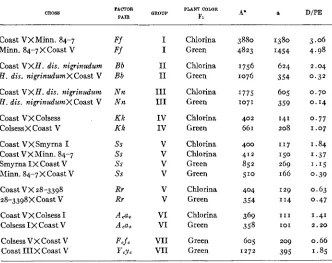
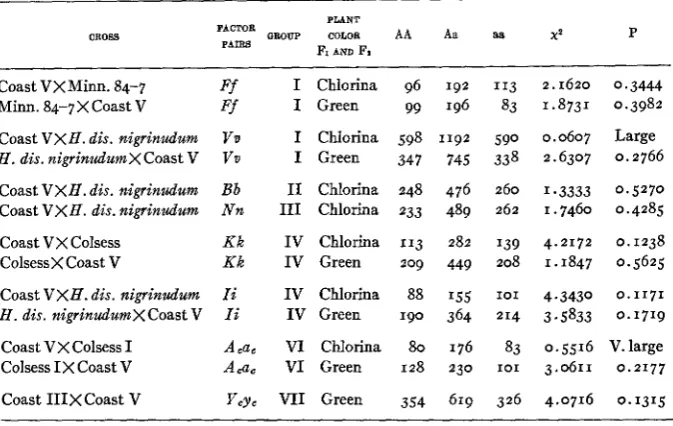
The results are given in table 2 . The numbers of plantssegregating in the dominant and in the recessive classes are given in the columns headed A and a. Table 3 gives the number of plants in the dif-
TABLE 2
Segregation of factor pairs in crosses i n which Coast V was used as both male and female parent.
A' a Df PE
PLANT C O W R
F* QROUP
FACTOR PAIR CROaS
Coast VXMinn. 84-7 Minn. 84-7 X Coast V
Coast VXH. dis. nigrinudum
H . dis. nigrinudumXCoast V
Coast VX H . dis. nigrinudum
H . dis. nigrinudumXCoast V
Coast VX Colsess ColsessX Coast V
Coast VXSmyrna I
Coast VXMinn. 84-7 Smyrna I X Coast V hlinn. 84-7XCoast V
Coast VX 28-3398 28-3398XCoast V
Coast VX Colsess I Colsess I X Coast V
Colsess VX Coast V Coast I I I X Coast V
Ff I
Ff I
Bb I1
Bb I1
N n I11
N n I11
Kk IV
K k IV
ss V
SS V
s s V
SS V
Rr V
Rr V
A VI
A eac VI
F C f C VI1
YcYc VI1
Chlorina Green Chlorina Green Chlorina Green Chlorina Green Chlorina Chlorina Green Green Chlorina Green Chlorina Green Green Green 3880 4823 '756 1076 1775 1071
40 2 66 I
400 41 2
510 404 354 852 369 358 605
1 2 7 2
1380 1454
624
3 54 605 359 141 208 117 150 166 129
1 I4
269 I11 101 209 395 3.06 4.98 2.04 0.32
0 . 7 0 0.14
0 . 7 7 I .07
I .84 1.37 1.15 0.39
0.63 0.47
I .41 2 . 2 0
0.66 1.85
MATERNAL INHERITANCE IN BARLEY I09 ferent genotypes as determined by FB segregations of the different Fz
plants. Column AA gives the double dominants, Aa the heterozygous dominants, and aa the double recessives.
The Fz segregation of the factor pair
Ff
for green or chlorina seed- lings gives a poor fit to a 3 to I ratio in the green families. However, thegenetic constitution as determined from F3 seedling counts in both cases is good. The number of chlorina plants is low in the green families.
The segregation of
Vv
for 6-row or non-6-row indicates a normalI : 2 : I ratio, found when incomplete dominance allows one to distinguish
the (AA) and (Aa) classes.
TABLE 3
Number of Fr plants ofdijflent genotypes as determined by Fa segregetions.
CROBS
PLANT
QROUP COLOU AA Aa aa X* P
FACTOR
PAIRS Ft
AND PI
Coast VXMinn. 84-7 Ff I Chlorina 96 192 113 2.1620 0.3444 Minn. 84-7XCoast V Ff I Green 99 196 83 1.8731 0.3982 Coast VX H. dis. nigrinudum Ve I Chlorina 598 1192 590 0.0607 Large H. dis. nigrinudumXCoast V Vnr I Green 347 745 338 2.6307 0.2766 CoastVXH.dis. nigrindum Bb I1 Chlorina 248 476 260 1.3333 0.5270 Coast VXH. dis. nigrinudum N n I11 Chlorina 233 489 262 I . 7460 0.4285 Coast VX Colsess Kk IV Chlorina 113 282 139 4.2172 0.1238
ColsessXCoast V Kk IV Green 209 449 208 1.1847 0.5625 CoastVXH.dis. nigrinudum Zi IV Chlorina 88 155 IOI 4.3430 0.1171 H.dis. nigrinudumXCoastV Ii IV Green 190 364 214 3.5833 0 . 1 7 1 9
Coast V X Colsess I Acac VI Chlorina 80 176 83 0.5516 V.large Colsess I X Coast V Acac VI Green 128 230 I O I 3.0611 0.2177 Coast IIIXCoast V YCyc VI1 Green 354 619 326 4.0716 0.1315
A further test was made in the families involving crosses between Coast
V and Minnesota 84-7. Coast V is chlorina and 6-rowed and evidently carries FF for green which is suppressed by the maternal chlorina condi- tion. Minnesota 84-7 is 2-rowed and carries
ff
for chlorina.The segregations of
Ff
andVv
are given in table 4 for the chlorina fami- lies obtained when Coast V is used as the female parent.I I O D. W. ROBERTSON
Group I I . The factor pair (Bb) for black versus white glume color is located in Group 11. This is linked with A t a t (green versus white seed- lings) in Trebi I. Several crosses were made in which Coast V was crossed with varieties having black glumes. The segregations of the Fz families having all the plants chlorina in color and in Fz families having all of the plants normal green in color are given in tables 2 and 3.
The segregation of black versus white glume color fits the calculated 3 : I ratio very well in both the pure chlorina families and the normal green families.
The Fz genotypes as determined from the Fa segregations, table 3, again indicate a normal I : 2 : I ratio in the chlorina families.
TABLE 4
Linkage relationship of Vu and Ff in families from FI chlmina plants.
P
COAST V CBLORINA P I N N . 84-7 CELORINA NON-2-ROW 2-ROW NON-2-ROW 2-ROW
Observed 1504 388 358 255
Calculated 9 : 3 : 3 : I 1409.06 469.69 469.69 156.56 109.06 V.small Calculated36.3rOJocrossingover 1506.51 372.24 372.24 254.01 1 . 2 2 0 1 0.7509
Group I I I . The factor pair Nn (covered versus naked caryopsis) has been placed in Group 111. Crosses involving Nn were made with Coast V
which has a covered caryopsis. The Fz segregations for normal green families and chlorina families are given in table 2. The
Fz
and F3 behavior of thechlorina families indicates that the segregation is similar to that found in green plants of the reciprocal cross.
Group I V . In Group I V are
Kk
(hoods versus awns) andIi
(non-inter- medium versus intermedium). Both factors unfortunately were not lo- cated in a single parent used in the studies. The results of crossing Coast (awned) with Colsess (hooded) are given in table 2. The data show thatthe segregation is similar in both chlorina and green families indicating that there is no influence of the Coast chlorina on
Kk.
The genetic constitution of the Fz plants in chlorina or green families segregating for
Ii
was determined by the segregation of the F3 families, table 3 . The number of plants of the different genetic constitution again indicates independent inheritance. The factor pairsKk
andIi
have previ- ously been shown to be linked with about 1 5 . 1 2 k 0 . 6 5 percent crossingover
(ROBERTSON
1933).Group V . The factor pairs Ss and Rr from short versus long haired rachilla and rough versus smooth awns are in Group V. The behavior of
MATERNAL INHERITANCE I N BARLEY I 1 1
green families, indicating that Ss reacts independently of the chlorina con- dition found in Coast V. The behavior of the main factor pair Rr for rough versus smooth awn is given in table 2 . The segregation of Rr also indi-
cated no interaction with the chlorina condition.
Group V I . This group contains Acac (green versus white seedlings) in Colsess I. The segregation of Acac is given for both chlorina and green families. The data presented in tables 2 and 3 again show a similar segre-
gation for Acac in both green and chlorina families.
Group V I I . Group VI1 contains Fefc (green versus chlorina seedlings) in Colsess V and Ycyc (green versus virescent seedlings) in Coast 111. The segregation of Fcfc is given in table 2 . The reciprocal cross was chlorina in
TABLE 5
Linkage relationship of V v and Ff in Fz fanciliesfrom Fl normal green plants.
P QREEN MI". 84-7 CFIWRMA
NON-2-ROW 2-ROW NON-2-ROW 2-ROW '*
Observed 1178 291 273 156
Calculated 9:3:3:1 1067.6 355.9 355.9 118.6 54.36 V.sma11 Calculated 38.57% crossing over 1128.08 294.42 295.42 179.08 6.9513 0.0738
F1, but too small a number survived to make counts in
Fz.
The F2 segrega- tion in the green families shows no abnormal behavior of Fcfc in a cross where Coast V was used as the male parent.In the studies involving Ycyc, Coast V was again used as the male par- ent. Since the characters, with the exception of plant color, are the same, it is necessary to check the possibility of self-fertilization taking place. If self-fertilization had taken place, one out of four F1 plants shoold be virescent, and one pure green. The other two would segregate for green and virescent in Fz. If they were crossed with Coast V, which carries the Ycyc, half of the plants should be pure green and half should segregate for green and virescent in F2. Out of eight families, none were virescent in F,
and four segregated for green and virescent in F2.
When Coast I11 was crossed with Coast V (chlorina) a normal 3 : I segre- gation was obtained in the green families. The Fs data also indicated a single factor pair responsible for green versus virescent in Coast 111.
DISCUSSION
I 1 2 D. W. ROBERTSON
The possibility of a virus disease was considered and inoculation tests with juice extracted from chlorina seedlings were made on normal plants. No change was noted on the plants or on their progeny, indicating that the chlorina condition was not easily transmitted to normal plants. Many chlorophyll deficiencies of varying shades of green are more or less com- mon in barley. Three of these, a t least, are inherited as simple Mendelian recessives.
Unfortunately, only a few factor pairs have been located in the various linkage groups in barley, and the reaction of a t least one factor pair in each linkage group to the Coast V chlorina condition was studied. The tests made indicate that the factor pairs studied reacted independently of the chlorina condition. A greater number of factor pairs would add to the value of the data, but the results obtained clearly show that Coast V
chlorina is not a simple Mendelian character and that some other explana- tion is necessary to explain its behavior.
The results indicate that it is maternal and evidently of a similar type to that described by DEMEREC (1927) and by RHOADES (1933) in maize.
SUMMARY
Coast V is a pale green chlorophyll deficient plant. The chlorina color is Ridgeway’s “absinthe green.”
When Coast V is used as a female parent in crosses with other barleys the F1, Fz and
F1
are all chlorophyll deficient like the Coast V parent, in- dicating maternal inheritance of the chlorina plant color.In crosses in which Coast V is used as the male parent, the F1 is normal green in color. In later generations the Coast V chlorina color does not appear or segregate out when Coast V is used as the male parent. This indicates that the pollen does not carry a factor for Coast V chlorina.
Factor pairs located in all of the seven linkage groups gave simple Mendelian segregations in both chlorina (Coast V) and normal green families (reciprocal crosses).
Three generations of backcrossing to normal green did not change the Coast V parental color.
Inoculation tests with extracts from Coast V chlorina seedlings had no apparent effect on the color of normal plants.
Pedigree breeding has shown the Coast V chlorina to be constant for eight generations.
LITERATURE CITED
ANDERSON, E. G., 1923 Matemal inheritance of chlorophyll in maize. Bot. Gaz. 76: 411-418.
CHITTENDEN, R. J., 1927 Vegetative segregation. Bibliogr. Genetica 3: 355-442.
DEMEREC, M., 1927 A second case of maternal inheritance of chlorophyll in maize. Bot. Gaz
MATERNAL INHERITANCE I N BARLEY 113 IYAI, Y., 1928 A consideration of variegation. Genetics 13: 544-562.
KARPER, R. E., and CONNER, A. B., 1931 Inheritance of chlorophyll characters in Sorghum. NILSSON-EHLE, H., 1922 Uber freie Kombination und Koppelung verschiedener Chlorophyller- REOADES, M. M., 1933 The cytoplasmic inheritance of male sterility in Zea mays. J. Genet. RIDGEWAY, R., 1912 Color standards and color nomenclature. Washington. Published by the ROBERTSON, D. W. and DEMING, G. W., 1930 Genetic studies in barley. J. Hered. 21 : 283-288. ROBERTSON, D. W., DEMING, G. W., and KOONCE, D., 1932 Inheritance in barley. J. Agric. Res. ROBERTSON, D. W., 1933 Inheritance in barley. Genetics 18: 148-158.
ROBB, W., 1934 Inheritance in oats, with special reference to striped leaves. Proc. World’s SHARP, L. W., 1934 Introduction to cytology. 3rd Ed. 447 pp. N. Y. McGraw-Hill Book Co.
Genetics 16: 291-308.
beinheiten bei Gerste. Hereditas 3: 191-199.
27: 71-93.
author.
44: 445-466.