DeBruhl, Christopher Dwayne. NOx Formation in Unsteady Counterflow Diffusion
Flames. (Under the direction of Dr. William L. Roberts)
The formation of NO and NO2 are sensitive indicators of both temperature and
residence time in a combustion environment. In this work, the NOx emission index is
measured in an unsteady counterflow diffusion flame with methane, propane or ethylene,
as a function of average strain rate and amplitude and frequency an imposed sinusoidal
oscillation. These flames varied from non-sooting to high soot loading, and from low
average strain rate to near extinction. Due to the relatively long time scales associated with
NOx formation, the effect of unsteadiness on emission index is weaker than on either
temperature or soot volume fraction. Time averaged global measurements were taken
using a NO/NOx analyzer. Methane – air results are compared with unsteady calculations
By
Christopher Dwayne DeBruhl
A thesis submitted to the Graduate Faculty of North Carolina State University
in partial fulfillment of the requirements for the Degree of
Master of Science
AEROSPACE ENGINEERING
Raleigh
2003
APPROVED BY:
________________________________ ________________________________ Dr. Fred R. DeJarnette Dr. Stefan Franzen
Advisory Committee Member Advisory Committee Member
________________________________ Dr. William L. Roberts
Biography
Christopher Dwayne DeBruhl was born in Asheville, NC on January 29, 1978, and,
after a brief period of moving around Western North Carolina, grew up in Mars Hill, NC.
He lived with his parents Larry and Marsha DeBruhl and his sister Rachel DeBruhl. He
attended Madison High School, where he enjoyed playing football, wrestling, running
track, and playing lead trumpet in the wind ensemble and jazz bands. He graduated in May
1996, and enrolled at North Carolina State University. While at NCSU Dwayne earned his
BS degree in aerospace engineering, and graduated in the spring of 2000. Dwayne then
began working toward his master’s degree, in the area of combustion research. Dwayne
will begin his professional career as an aerospace engineer at Cherry Point Marine Corps
Acknowledgements
I would first like to thank my parents, Larry and Marsha, and sister, Rachel, for
their unwavering love and support throughout my life. Without their support none of this
would have been possible. They have always been there for me and I hope that I will be
able to do the same. I would also like to thank my Love and best friend, Jeanette. I could
not have made it through the last few years without her. Thank you for being you, and
being in my life. Thank you to all the friends I have made at NCSU and, especially, in the
MAE department. You’ve made my college experience unforgettable.
Thank you to Dr. William Roberts for the experience of working on this interesting
project, and for always being there to answer questions and show support. Thank you to
Dr. Tarek Echekki for the much needed support with the all of the computational work
involved in this research. I would also like to acknowledge the support of Dr. David Mann
from the Army Research Office. Partial support has for this research has been provided
Table of Contents
LIST OF FIGURES... vi
LIST OF TABLES... viii
1 INTRODUCTION... 1
1.1 NOx Formation ... 3
1.1.1 Thermal NO Mechanism... 3
1.1.2 Prompt NOx Mechanism... 5
1.1.3 Fuel Bound NOx... 8
1.1.4 NO2 Reaction Mechanism... 8
1.2 Flamelet Theory... 9
1.3 Counterflow Diffusion Flames...13
2 DESCRIPTION OF EXPERIMENTAL APPARATUS...16
2.1 Counterflow Diffusion Flame Burner...16
2.2 NOx Analyzer...19
3 NUMERICAL METHOD...21
4 STEADY COUNTERFLOW DIFFUSION FLAMES...24
5 UNSTEADY COUNTERFLOW DIFFUSION FLAME...31
5.1 Experimental Measurements for Methane CFDF’s...31
5.2 Experimental Measurements for Propane CFDF’s...34
5.3 Unsteady Computational Results for Methane CFDF’s...37
6 CONCLUSIONS...44
6.1 Steady Propane Counterflow Diffusion Flames...44
6.2 Steady Methane Counterflow Diffusion Flames...45
6.3 Unsteady Propane Counterflow Diffusion Flames...46
6.4 Unsteady Methane Counterflow Diffusion Flames...46
6.5 Future Work...48
8 APPENDICES...55
8.1 Flow Meter Settings...55
8.1.1 Global Strain Rate Conditions for Methane Counterflow Diffusion
Flames...55
8.1.2 Global Strain Rate Conditions for Propane Counterflow Diffusion
Flames...55
List of Figures
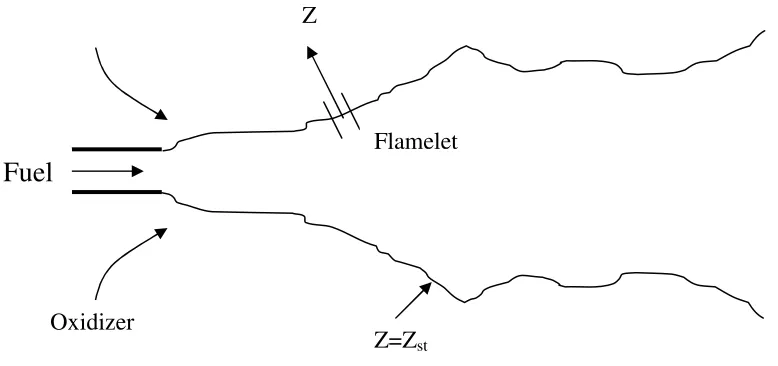
Figure 1.1 Representation of a turbulent diffusion flame illustration a diffusion flamelet.10
Figure 1.2 The S-shaped curve showing the quenching scalar dissipation rate... 13
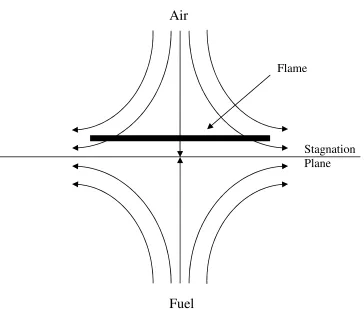
Figure 1.3 Sketch of a stagnation point flow field in a counterflow diffusion flame... 15
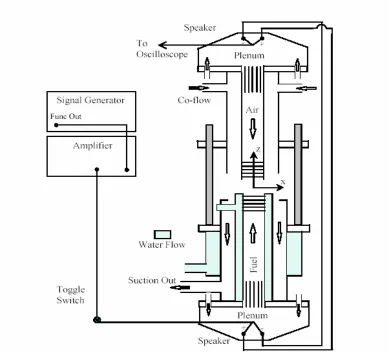
Figure 2.1 Schematic of counterflow diffusion flame burner... 16
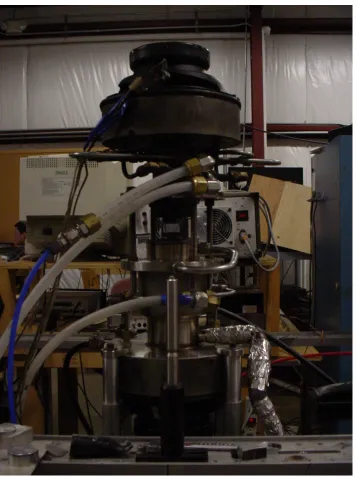
Figure 2.2 Counterflow diffusion flame burner used in experiments... 18
Figure 2.3 California Analytical Instruments Model 400 HCLD NO/NOx analyzer used in experiments...19
Figure 3.1 Comparison of speaker induced velocity oscillations and that of the opus code... 23
Figure 4.1 Uncorrected measured NO and NOx concentration versus steady strain rate. CH4 and C3H8 are plotted on the left axis while C2H4 is plotted on the right axis due to the very high soot loading associated with ethylene... 24
Figure 4.2 Counterflow diffusion flame burner with the test section shielded from room air with a window built in for flame observation... 26
Figure 4.3 Measured steady NO and NOx concentration in ppm versus steady strain rate for C3H8 and CH4... 27
Figure 4.4 NO and NOx concentration versus strain rate for the modified burner. Both numerical and experimental results for CH4 are plotted... 28
Figure 4.5 Measured NO and NOx emission index for varying steady strain rates for C3H8 and CH4... 29
Figure 4.6 NO emission index for varying steady strain rates for CH4. Experimental data is plotted the right axis and numerical results are plotted on the left axis.... 30
Figure 5.1.1 NO concentration for methane – air flame as a function of frequency and global steady strain rate for medium velocity oscillations (a) and near flow reversal oscillations (b)... 32
Figure 5.1.3 NOEmission Index for methane – air flame as a function of frequency and global steady strain rate for medium velocity oscillations (a) and near flow
reversal oscillations (b)... 34
Figure 5.1.4 NOx Emission Index for methane – air flame as a function of frequency and
global steady strain rate for medium velocity oscillations (a) and near flow reversal oscillations (b)... 34
Figure 5.2.1 NO concentrations for propane – air flame as a function of frequency and global steady strain rate for medium velocity oscillations (a) and near flow reversal oscillations (b)... 35
Figure 5.2.2 NOx concentrations for propane – air flame as a function of frequency and
global steady strain rate for medium velocity oscillations (a) and near flow reversal oscillations (b)... 36
Figure 5.2.3 NO emission index for propane – air flame as a function of frequency and global steady strain rate for medium velocity oscillations (a) and near flow
reversal oscillations (b)... 37
Figure 5.2.4 NOx emission index for propane – air flame as a function of frequency and
global steady strain rate for medium velocity oscillations (a) and near flow reversal oscillations (b)... 37
Figure 5.3.1 Phase relationship between the peak flame temperature and unsteady strain rate...39
Figure 5.3.2 Phase relationship between NO mole fraction and peak flame temperature.. 40
Figure 5.3.3 Numerical NO concentration for methane – air flame as a function of forcing frequency, amplitude and strain rate... 41
Figure 5.3.4 Computational NOx concentration as a function of frequency and amplitude for GSR 30 s-1... 41
List of Tables
1 Introduction
NOx, composed of NO, NO2, and N2O, is a pollutant formed by the combustion of
fuel in air. In the lower atmosphere nitrogen dioxide (NO2) is converted to nitric acid
(HNO3) which is a major contributor to acid rain. NOx in the lower atmosphere is
primarily produced by sources on the surface, such as automobiles and power generation
facilities. Due to the nature of terrestrial combustion many methods can be incorporated to
control NOx emissions, primarily through control of the combustion process or after-gas
treatment. Using pre-mixed flames allows for the control of the equivalence ratio, which
has a direct effect on NOx production through a reduction in the peak flame temperature.
Ozone (O3) absorbs harmful ultra violet rays, keeping the flux of UV radiation
which reaches the surface of the Earth, at a tolerable level. In the upper atmosphere nitric
oxide (NO) is very aggressive in the destruction of ozone. This is a catalytic process
because NO is regenerated, and a few molecules of NO can be responsible for the
destruction of hundreds of O3 molecules. It is difficult for NOx produced on the surface to
reach the upper atmosphere. The primary cause of NOx in the stratosphere is high altitude
aircraft such as commercial airliners. NOx produced by these aircraft is particularly
undesirable because it is inserted directly in the ozone layer.
Due to the nature of aeropropulsion, premixing the fuel and air is generally not
feasible. Therefore, these engines use turbulent diffusion flames, which operate with a
fixed equivalence ratio of unity. This means the combustion process operates at
stoichmetric conditions and cannot be adjusted, which makes controlling NOx emissions
very difficult. Because these jet engines use turbulent diffusion flames in the combustion
The study of turbulent diffusion flames is very complicated because of its
complicated multi-component flowfield, inherently unsteady nature, and the coupled
interaction between the flowfield and chemical processes. For this reason combustion
research has focused on simplifying the problem to one with simple chemistry (single step
or reduced mechanisms) or full chemistry with a simple flow field. Neither of these
approaches accurately models the chemistry in a real turbulent diffusion flame. Flamelet
theory simplifies this analysis by treating the turbulent diffusion flame as an ensemble of
strained, laminar, one-dimensional flamelets which can be described by one variable, the
mixture fraction. The flamelet model can be extended to include the non-equilibrium
effects of finite rate chemistry by introducing a new variable, the scalar dissipation rate,
which is a function of the hydrodynamics of the flowfield. Flamelet theory will be
discussed further in section 1.2.
Previous studies have shown that laminar counterflow diffusion flames under
steady rates of strain exhibit many fundamental characteristics of flamelets (Spalding,
1961; Tsuji, 1982; Seshadri & Peters, 1988; Dixon & Lewis, 1984). Conversely, only few
studies have looked at the response of counterflow diffusion flames to unsteady strain rates
(Im et al., 1995; Sung et al., 1995; Egolfopoulos & Campbell, 1996; Im et al., 1998).
Flamelet theory assumes the flamelets respond quasi-steadily to the instantaneous imposed
strain field. Recent experimental and numerical results show this is not a good assumption
for high frequency unsteadiness (Egolfopoulos, 2000; Welle et al., 2002).
This research involved experiments designed to study a flamelet’s response to
unsteady strain rates by taking time averaged measurements of the NOx produced in a
analyzer. The flames studied vary from non-sooting to high soot loading, and from low
average strain rate to near extinction. NO and NOx measurements for both steady and
unsteady flames are compared with calculations using a modified OPPDIF code, OPUS,
included in the Chemkin package.
1.1 NO
xFormation
Many researchers have studied NOx formation under many different conditions
(Hayhurst & Vince, 1983; Miller & Bowman, 1989; Bowman, 1992). Many experimental
studies have been done in premixed flames (Fenimore, 1971; Glarborg et al., 1986; Dupont
& Williams, 1998; Charlston-Goch, 2001; Konnov et al., 2003) and in coflow and jet
diffusion flames (Turns & Myhr, 1991; Turns, 1995; Smyth, 1996; Yamashita et al. 1997;
Sanders et al., 1997; Caldeira-Pires et al., 2000; Frank et al., 2000; Beltarme et al., 2001;
Dally et al., 2003). There have also been many studies in steady laminar counterflow
diffusion flames which have yielded both experimental and computational data (Hahn &
Wendt, 1981; Drake & Blint, 1989; Bonturi et al., 1996; Ravikrishna & Laurendeau, 1999;
Lee et al., 2001; Fuse et al., 2002). Few researchers have focused on NOx formation in
unsteady flowfields. In general four production pathways are for NOx are distinguishable.
These include the thermal mechanism, prompt mechanism, NO production from fuel
nitrogen, and the nitrogen dioxide mechanism.
1.1.1 Thermal NO mechanism
The thermal NO mechanism (or Zel’dovich mechanism) is comprised of the
N O NO N k + + → ← 1 2
2 (1.1)
N O k NO O
k + + → ← 3 4
2 (1.2)
N OH k NO H
k +
+ → ←
5
6 (1.3)
M O M O k k + + → ← 2 7 8
2 (1.4)
If the steady state assumption is applied to N atoms, and the concentration of NO is
assumed to be small compared to the other concentrations, and if destructive reactions are
neglected compared to the formation reactions, it can be shown that,
] ][ [ 2 ] [ 2 1 O N
k dt
NO
d =
(1.5)
Applying the partial equilibrium assumption to reaction 1.4 the O atom concentration can
be written as,
12 12 12
2] ( ) ( ) [
]
[O = O eqkp T RuT − (1.6)
Combining these two assumptions yields,
dt kkp T RuT O eq N eq
NO d ] [ ] [ ) ( ) ( 2 ] [ 2 2 1 2 2 1 2 1 1 −
= (1.7)
This equation shows the strong temperature dependence, because the ki’s are exponential in
temperature, and somewhat weaker dependence on the O2 concentration of the burned gas
[O2]eq, on the NO formation rate.
Reactions 1.1-1.4 involve the O and OH radicals, which also play an important role
in the oxidation of the fuel. Therefore, it is generally necessary to couple the thermal NO
reactions with that of the fuel oxidation process. However, since the overall formation of
Zel’dovich (Zel’dovich, 1946), that the thermal NO formation reactions can be decoupled
from the fuel oxidation mechanism. Zel’dovich also said that the NO formation rates
could be calculated assuming equilibrium values of temperature and concentrations of O2,
N2, O, and OH. This is, therefore, known as the Zel’dovich mechanism (cf. Miller &
Bowman, 1989).
1.1.2 Prompt NOx mechanism
Prompt NOx is NO that is formed at a rate faster than that calculated from the
simple equilibrium thermal NOx description (Zel’dovich mechanism). The formation of
prompt NOx is not fully understood. In general three sources of prompt NOx can be
distinguished; super equilibrium, Fenimore, and nitrous oxide mechanism.
Prompt NOx can be a result of super equilibrium concentrations of O and OH in the
reaction zone. This phenomenon can accelerate the rate of the Zel’dovich mechanism.
This is because the Zel’dovich mechanism assumed that the reactions O →O ←
2
2
1 and
O OH O
H+ → +
←
2 are in partial equilibrium. Super equilibrium is most important in
diffusion flames, stirred reactors at lean conditions, and low pressure premixed flames. It
can account for as much as 80% of the NO formation in these flames (Drake & Blint,
1991).
The Fenimore prompt mechanism deals with the formation of NO in hydrocarbon
flames by a reaction sequence that is initiated by hydrocarbon radicals, which attack
nitrogen molecules. This leads to the formation of atomic nitrogen, cyanides and amines,
suggested to be responsible for the prompt NO in hydrocarbon flames such as CH, CH2,
C2, C2H, and C (Miller & Bowman, 1989), however, the major contributors have been
found to be CH, CH2, and CN radicals. The mechanism is controlled by the following
reactions,
N HCN N
CH + → +
← 2 H NO OH
N+ → +
← (1.8)
O NO O
N + → +
← 2 NH HCN N
CH + → +
← 2 2 2 H N H
NH + → +
← (1.9)
H NO OH
N+ → +
←
O NO O
N + → +
← 2 O OCN O
CN+ → +
←
2 (1.10)
NO CO O
ONN+ → +
←
H HCN H
CN + → +
← 2 OH HCN O H
CN+ → +
← 2 2 H N H
NH + → +
← (1.11)
O NO O
N + → +
← 2 H NO OH
N+ → +
←
Reactions 1.8 was first suggested by Fenimore (Fenimore, 1971), hence the name
Fenimore prompt mechanism. This is the most dominate step in then Fenimore
mechanism. The Fenimore mechanism dominates in fuel rich premixed flames and is also
The third prompt mechanism is the nitrous oxide mechanism. This mechanism
concerns the reactions between N2O and O. The nitrous oxide pathway is given below by
reactions 1.12-1.19. The mechanism is initiated by the reverse reaction of 1.12, at which
time the N2O formed is oxidized to NO primarily by reaction 1.13. However, NO can also
be formed by reactions 1.14-1.16. The remaining N2O is then reduced by reactions 1.12
and 1.17-1.19 (Bonturi et al., 1996).
M O N M O
N + → + +
← 2
2 (1.12)
NO NO O
O
N + → +
←
2 (1.13)
NH NO H
O
N + → +
←
2 (1.14)
NCO NO
CO O
N + → +
←
2 (1.15)
M NO N M O
N + → + +
←
2 (1.16)
2 2
2O O N O
N + → +
← (1.17)
OH N
H O
N + → +
← 2
2 (1.18)
2 2
2O OH N HO
N + → +
← (1.19)
The N2O-O mechanism becomes more important in very lean flames, and low
temperatures, and is enhanced by super-equilibrium O atom concentrations. It is also very
important at high pressures because the high pressure facilitates a higher probability of a
1.1.3 Fuel Bound NOx
Another important contributor to NOx production is nitrogen that is bound
chemically to the fuel. This can be the primary source of NOx emissions from the
combustion of fossil fuels. Fuels such as ammonia (NH3) or pyridine (C5H5N) break apart
during the oxidation process and leave N-atoms free to react with O-atoms. The extent to
which the N converts to NO is a strong function of the temperature and the fuel-to-air ratio.
It is also a strong function of the fuel nitrogen content. However, it is nearly independent
of the composition of the parent fuel molecule.
Song et al. (1981), through kinetic modeling, and Chen et al. (1982), through
laboratory experiments, showed that at φ > 1 the conversion of fuel nitrogen to NO is less
prevalent than for φ ≤ 1. Some of the NO formed under this mechanism may react with
smaller hydrocarbon radicals. This facilitates the conversion of NO, formed during the
combustion process, to cyano compounds (HCN or CN). Under fuel-rich conditions these
compounds may react to form N2. This mechanism has many common features with the
Fenimore mechanism, i.e., HCN formation (Bowman 1992).
1.1.4 NO2 Reaction Mechanism
A significant source of NOx can be attributed to nitrogen dioxide, NO2. NO2 is
mainly formed by the reactions of NO with HO2, OH, O, and O2 by the following
reactions,
OH NO HO
NO+ → +
← 2
2 (1.20)
H NO OH
NO+ → +
O NO O
NO+ → +
← 2
2 (1.22)
M NO M
O
NO+ + → +
← 2 (1.23)
Because of its short lifetime in high temperature zones most NO2 formation occurs in the
low temperature regions of the flame. Here significant amounts of HO2 can be found to
react with NO formed in high temperature regions that are transported to the low
temperature regions by diffusion. Since NO2 is sensitive to the HO2 present in low
temperature regions of the flame, as shown in equation 1.20, it is also sensitive to reactions
responsible for the formation and destruction of HO2. The most important reaction for the
formation of HO2 in low temperature zones is,
M HO M
O
H + + → +
← 2
2 (1.24)
The H-atoms needed for this reaction also come from the high temperature zone by
diffusion (Miller & Bowman, 1989).
For counterflow diffusion flames the mechanisms that are most important are the
thermal mechanism, Fennimore prompt mechanism, and the Super equilibrium
mechanism.
1.2 Flamelet Theory
Turbulent diffusion flames have a very complex flame surface caused by turbulent
eddies which cause the flame to distort and wrinkle at the large scale and augment the
diffusional transport at the small scales. In order to better understand turbulent diffusion
flames flamelet theory was developed to describe the response of these complex flame
Flamelet theory treats the complex flame structure of the turbulent diffusion flame as an
ensemble of strained, laminar, one dimensional flamelets as shown in Figure 1.1.
Figure 1.1 Representation of a turbulent diffusion flame illustrating a diffusion flamelet
Burke and Schumann (1928) were the first to characterize a diffusion flame using a
conserved scalar. They suggested that the Damköhler number (Da), the ratio of fluid
dynamic time to chemical kinetic time, was infinite. The Da = ∞ assumption implies that
the flame is a one-dimensional stoichiometric surface. They also assumed single step
chemistry and a Lewis number (Le), the ratio of heat and mass diffusivities, equal to unity.
Flamelet theory says that all temperature and species profiles for the 1-D flamelet
can be completely described by a single conserved scalar for Da = ∞, Le = 1, and single
step chemistry. The conserved scalar used is the mixture fraction, Z, which is a function of
the fuel mass fraction and is bounded between zero, for pure air, and unity, for pure fuel.
0 , 0 ,
0 , O F
O
Z
β β
β β
− −
=
Fuel
Oxidizer
Z=Zst
Z
where
) (
)
( F F F
F O O O O M Y M Y ν ν ν ν β ′ − ′′ − ′ − ′′ = (1.25)
YO is the mass fraction of the oxidizer, YF is the mass fraction of the fuel, M is the
molecular weight, ν′and ν′′are the stoichiometric coefficients for the reactants and
products, respectively. Using this analysis, Burke and Schumann were able to predict
flame shape and height reasonable well, for the first time. One advantage of this method is
that temperature and species profiles are linear in mixture fraction space.
In diffusion flames the mixture fraction is continuously changing throughout the
flowfield, and can be expressed as a function of the equivalence ratio. Assuming fast
chemistry, the flame is infinitely thin and exists at the stoichiometric mixture fraction
contour. The stoichiometric mixture fraction is given by,
1 2 , 1 , 1 − ⋅ ′ ⋅ ⋅ ′ ⋅ + = F F O O O F
st Y M
M Y Z ν ν (1.26)
In order to predict phenomena such as flame quenching, liftoff and blowoff, and
pollutant formation the non-equilibrium effects of finite rate chemistry must be included.
With finite rate chemistry the flame is no longer one-dimensional, but is now of finite
thickness, which is modeled as a diffusive-reactive zone. In order to account for
non-equilibrium effects an additional variable, χ, the instantaneous scalar dissipation rate, must
be introduced.
2
2D∆Z ≡
χ (1.27)
The scalar dissipation rate can be interpreted as the inverse of a characteristic
diffusion time and due to the transformation that leads to this parameter, it
incorporates the effects of convection and diffusion normal to the surface of the
stoichiometric mixture (Peters, 1984 & 1986). The scalar dissipation rate varies
inversely with Damköhler number, so as the fluid transport time gets shorter (increasing
strain rate), the dissipation rate increases. The scalar dissipation rate is a measure
of the heat conduction from both sides of the diffusive-reactive zone.
The governing equation in the region of the reactive – diffusive zone can be written
as, ) ˆ ( 2 2 2 2 ) ˆ ( ˆ δ ξ γξ
ξ = y − e− y+
d y
d (1.28)
where yˆ is the scaled mass fraction, ξ is the stretched mixture fraction variable, δ is the
reduced Damköhler number, and γ is a non-dimensional temperature. The scaled mass
fraction, stretched mixture fraction, reduced Damköhler number, and non-dimensional
temperature are given by,
γξ
− −
=( 2)
ˆ st u a st T R E T T
y , where Ea is the activation energy (1.29)
) (Z −Zst
≡β
ξ (1.30)
3 2 ) / ( , 0
2ρ β
δ st st T R E F O Z Z D e A
Y a u st
∆
= − , where AF is the rate constant for the consumption of fuel (1.31)
− − − − − ≡ c st o F st st
st T T
T T Z ZZ
ZZ 1 (1 ) ,0 ,0
For a given γ the governing equation can be numerically integrated to yield the maximum
temperature as a function of the reduced Damköhler number, δ. This is shown in the
S-curve in Figure 1.2. Thus if χ is increased past a critical value, χq, then the amount of heat
conducted away from the reaction zone exceeds the amount of heat generated by the
chemical reaction and the flame quenches. If equation 1.26 is evaluated at a value of Z at
the stoichiometric surface, Zst, the result is the stoichiometric scalar dissipation rate, χst.
Figure 1.2 The S-shaped curve showing the quenching scalar dissipation rate.
The two-parameter formulation assumes the flamelet responds in a quasi-steady
manner to unsteady hydrodynamics. However, recent experimental and numerical results
show that the application of unsteady strain rates to a laminar flamelet will result in a
transient response (Im et al., 1995; Welle et al., 2002).
1.3 Counterflow Diffusion Flames
Unstable solution Increasing strain rate
Da ∞
A burner comprised two opposed jets containing fuel and oxidizer impinging on a
stagnation surface is know as a counterflow diffusion flame (CFDF). A CFDF has many
essential features of a laminar diffusion flamelet and has the advantage of being very
repeatable. CFDF’ s have been used extensively to study, both experimentally and
computationally, hydrogen and light hydrocarbons flowing against air, with and without
dilution. The burner used in this study is similar to the design of Seshadri (Puri &
Seshadri, 1986), but modified to generate an unsteady flow field (Riggen-DeCroix, 1998).
Figure 1.3 is a sketch showing a counterflow diffusion flame stabilized near the
stagnation plane of two steady, laminar opposed jets of fuel and oxidizer. For
momentum-matched opposed jets the axial velocity gradient (strain rate) is given by,
] [ , 1 2 1 5 . 0 − + = s V V L V a o f o f o ρ ρ (1.33)
where a is the strain rate and Vo, Vf, ρf, ρo and L are the oxidizer outlet velocity, fuel outlet
velocity, fuel density, oxidizer density and burner separation distance, respectively
(Seshadri and Williams, 1978). In this study the global strain rate (GSR) is defined as
(Riggen-DeCroix, 1998),
L V
a=2 o (1.34)
Peters (2000) derived the scalar dissipation rate along the stoichiometric mixture
fraction contour for stagnation point flow, which is a function of the strain rate, a,
[
2 ( [2 ] )]
exp 2 )
( 1 2
st
st erf Z
a
Z = − ⋅ − ⋅
π
χ (1.35)
The scalar dissipation rate is a fundamental parameter as it describes the molecular mixing
important because it relates the scalar dissipation rate to an easily measured quantity, the
strain rate a.
Figure 1.3 Sketch of a stagnation point flow field in a counterflow diffusion flame
For flamelets subjected to unsteady strain rates, the scalar dissipation rate is time
dependent. Recent experimentation (DeCroix et al., 1998; Welle et al., 2000) and
computational results (Im, et al. 1995; Pitsch et al., 1998; Im, et al., 1999) has show that
these unsteady flamelets do not respond quasi-steadily as earlier expected. In fact as the
mean χ approaches the critical value, the instantaneous scalar dissipation rate may actually
exceed χq for short periods of time. The two parameter flamelet model, however, cannot
account this transient effect.
Stagnation Plane
Air
Fuel
2 Description of Experimental Apparatus
2.1 Counterflow Diffusion Flame Burner
Figure 2.1 is a schematic of the counterflow diffusion flame burner used in this
experiment. The burner is similar to that described by Seshadri (Puri & Seshadri, 1986),
but has been modified to generate an unsteady flow.
The counterflow burner was operated at atmospheric pressure. The reactants flow
through 2.54 cm diameter tubes centered in the top (oxidizer side) and bottom (fuel side)
sides of the burner. The separation distance of the fuel and oxidizer tubes was held
constant at 1.27cm.
The oxidizer tube was surrounded by a 0.6 cm thick annulus for a nitrogen coflow.
This prevented preheating of the oxidizer and entrainment of ambient air into the reaction
zone. The velocity of the nitrogen coflow was set to match that of the air. The fuel tube
was surrounded by an inner water jacket to prevent preheating of the fuel. A heat
exchanger was used to cool the exhaust gases down to room temperature and prevent
preheating of the fuel. Combustion products were pumped from the test section through an
annulus by a shop-vac connected to the burner. For these experiments the suction of the
vacuum was set to 1.5 inches of water.
A 25 mesh screen was laid across the entrance of the exhaust tube to stabilize the
flame. Since the flame attached itself to the screen so there was soot deposits on the
screen. For highly sooting fuels or long running times measured NOx values began to drift
due to large deposits of soot on the screen. For this reason the screen was cleaned often.
Five one inch, 100 mesh steel screens, separated by 3mm spacers were placed in
the reactant delivery tubes. The screens flattened the exit velocity profile to be similar to a
top hat profile. Each screen was oriented at a 45° to the one above and below it. It was
found that to achieve the best results the screen at the exit of the tube needs to be a 150
mesh screen.
The unsteady flow field was imposed by using two 20cm Kicker C8a subwoofer
was set up by applying a sine wave of know frequency and amplitude to the speakers. The
sine wave was generated by a SRS Model DS335 signal generator. A McIntosh amplifier
was connected between the signal generator and the speakers to provide a 2:1 amplification
for large amplitudes. The speaker signal was monitored with an oscilloscope. A
photograph of the CFDF burner is shown in Figure 2.2.
2.2 NO
xAnalyzer
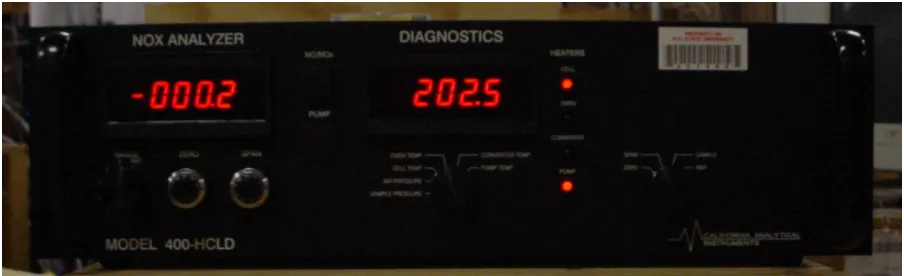
Measurements of both NO and NOx were taken using a California Analytical
Instruments Model 400 HCLD NO/NOx analyzer (shown in Figure 2.3) as a function of
fuel type, strain rate, and amplitude/frequency of imposed oscillation. The Model 400
HCLD uses chemiluminescence to analyze the NO or NOx concentration within a gaseous
sample. It has two selectable modes NO and NOx. In the NO mode the analyzer measures
the concentration of NO in the sample and in the NOx mode it measures the concentration
of NO + NO2. A t-joint was installed down stream of the heat exchanger so the analyzer
could draw sample gases from the CFDF exhaust line.
Figure 2.3 – California Analytical Instruments Model 400 HCLD NO/NOx analyzer used in experiments.
The California Analytical Instruments Model 400 HCLD Analyzer utilizes the
principle of chemiluminescence for analyzing the NO or NOx concentration within a
gaseous sample. In the NO mode, the method is based upon the chemiluminescent reaction
Approximately 10% of the NO2 produced from this reaction is in an electronically excited
state. The transition from this excited state back down to a ground state produces a photon,
and the intensity is proportional to the number density of NO2 in the reaction chamber. The
light is measured by means of a photodiode tube and associated amplification electronics.
In the NOx mode, NO plus NO2 is determined as above, however, the sample is first routed
through the internal NO2 to NO converter which converts the NO2 in the sample to NO.
The resultant reaction is then directly proportional to the total concentration of NOx. The
3 Numerical Method
The numerical results for the steady flow field were obtained using OPPDIF (Lutz
et al., 1996). OPPDIF is a FORTRAN program that computes the diffusion flame between
two opposing nozzles. The two-dimensional axisymmetric flow field is reduced to a
one-dimensional problem using a similarity transform. Assuming that the radial component of
velocity is linear in radius, the dependent variables become functions of the axial direction
only. OPPDIF solves for the temperature, species mass fractions, axial and radial velocity
components, and radial pressure gradient, which is an eigenvalue in the problem. The
Twopnt software solves the two-point boundary value problem for the steady-state form of
the discredited equations (Lutz et al., 1996). The Chemkin packages are used to calculate
the chemical reaction rates and thermodynamic/transport properties. The chemical
mechanism used was GRI-mech 3.0 (listed in appendix 8.5) with its corresponding
thermodynamic and transport properties. Flame profiles for the species mass fraction were
spatially integrated to obtain equilibrium values for which could be compared to data
obtained from the gas analyzer. The emission index is also output by the code.
The numerical results for unsteady flow fields were computed using OPUS (Im et
al., 2000). OPUS is a FORTRAN program for computing unsteady combustion problems
in an opposed flow configuration using one-dimensional similarity coordinate. The code is
an extension of its steady counterpart, OPPDIF, to handle unsteady strain rates by
modifying the formulation to accommodate, gas dynamic compressibility effects. This
allows high-accuracy time integration with adaptive time stepping. Time integration of the
differential-algebraic system (DAE) of equations is performed by the DASPK software
for solving the DAE’ s. DASPK incorporates a variable-order, variable-step
backward-differentiation formula to solve the DAE’ s. This allows for a robust time integration of
complex unsteady problems. Like the steady code OPPDIF, OPUS also uses the Chemkin
packages to compute the associated chemical reaction rates and thermodynamic/transport
properties (Im et. al, 2000).
In order to accurately match the experimental velocity oscillation pattern the
function that described the unsteady velocity profile had to be rewritten. Originally the
code described the velocity as,
[
1 {1 cos(2 )}]
)
(t U AMP ft
u = steady× + − π
However, when the function was changed to
[
1 sin(2 )]
)
(t U AMP ft
u = steady × + π ,
the code became unstable and crashed on the first time step. After much trial and error, it
was decided that, in order to get around this problem the amplitude needed to gradually
increase to its desired value. To do this, a form of the hyperbolic tangent was incorporated
into the forcing function. After a measure of time the hyperbolic tangent would go to
unity, leaving just the sin function. Therefore, the function used was:
+ − ×
= sin(2 )
1 1 ) ( 2 1 2 2 3 3 ft e e AMP U t
u steady tt π
This allowed the function to reach its desired value much faster than a normal hyperbolic
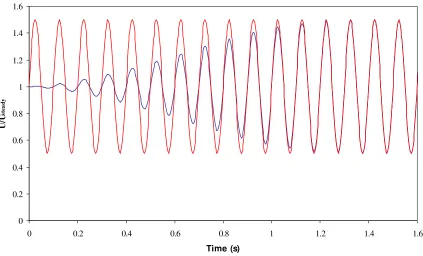
tangent function. This function is compared to a regular sine wave in Fig. 3.1. The
0 0.2 0.4 0.6 0.8 1 1.2 1.4 1.6
0 0.2 0.4 0.6 0.8 1 1.2 1.4 1.6
Time (s)
U
/U
st
ea
dy
Figure 3.1 - Comparison of speaker induced velocity oscillations and that of the opus code.
OPUS outputs species mass fractions, maximum temperature, and emission indices
as a function of time. It was also modified to output the overall species concentrations.
From this the time average values can be calculated and compared to experimental values.
4 Steady Counterflow Diffusion Flames
Readings of NO and NOx (NO + NO2) were taken for strain rates of 30, 60, 90,
120, and 150 s-1 for methane, propane, and initially ethylene. Initial measurements for
steady state methane and propane flames show that the NOx concentration increased with
strain rate as seen in Figure 4.1. This appears to run counter to what was expected so
certain steps were taken in order to validate the experimental data.
Figure 4.1 Uncorrected measured NO and NOx concentration versus steady strain rate. CH4 and C3H8 are plotted on the left axis while C2H4 is plotted on the right axis due to the very high soot loading
The first step was to express the NOx concentration in terms of the emission
index, EI. The emission index is the ratio of the mass rate of NO/NOx produced per mass
flux of fuel supplied. The emission index is give by:
4 / 2 d u m m m EI F F NO F NO
NO ρ π
=
= , [g/kg] (4.1)
where ρF is the fuel density, uF is the fuel velocity and d is the diameter of the exit tube. In
order to calculatemNOit was important to express it in terms of the mole fraction of NO,
which is easily obtained from experimentation:
products NO NO NO
NO V X V
m = ρ = (4.2)
From the conservation of mass it is clear that, Vproducts(slpm) is equal to the sum of
the volume flow rates of the fuel, oxidizer, and nitrogen coflow, corrected for standard
temperature and pressure, if the number of moles are equal.
In order to accurately calculate the volume flow rates of the products it was
important to be sure that no room air was being entrained into the flame or exhaust tube
due to the low pressure annulus around the fuel tube. To do this, the burner test section
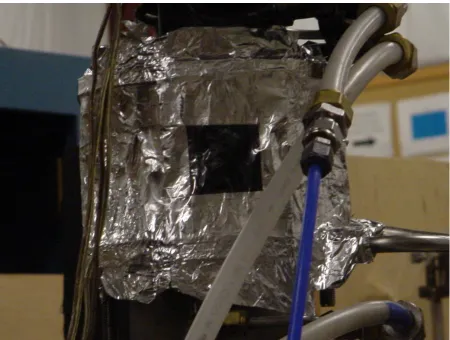
was enclosed with aluminum tape, as shown in Figure 4.2. This ensured that Vproductswas in
fact equal to VF+VO+VN2coflow.
1. Upon repeating the experiments with the enclosure, the data was seen to drastically
change from the previous results. Five runs, at each strain rate, were completed and the
error bars show that the data is very repeatable. Figure 4.3 shows the new experimental
data for C3H8 and CH4. At high steady strain rates the NO concentration, for propane,
decreases with increasing steady strain rate except between 30 and 60 s-1. Here the
concentration increases with steady strain rate, which show that more NO2 is produced at
high strain rates.
Figure 4.2 – Counterflow diffusion flame burner with the test section shielded from room air with a window built in for flame observation.
For methane, instead of increasing with strain rate, the NO concentration now
decreases with increasing strain rate as expected. The NOx concentration also decreases
with steady strain rate except between 30 and 60 Hz. This is the result that would be
expected since the flame temperature also decreases with increasing strain rate.
Experiments for C2H4 were not repeated because its high flame temperature began to melt
Figure 4.3 – Measured steady NO and NOx concentration in ppm versus steady strain rate for C3H8 and CH4.
Figure 4.4 shows the comparison between OPPDIF results and experimental data
for a methane-air flame. The experimental results matched the numerical results very well
for NO at high strain rates. However at low strain rates, particularly 30 s-1, experiment and
computation diverge. At a strain rate of 30 s-1 computational results predict twice as much
NO formation over what was experimentally measured. Even though methane is a low
sooting fuel, soot is still present at the lower strain rates, causing some of the heat to be
radiated away from the reaction zone. As the strain rate increases, the residence
time of incipient soot particles in the high temperature zone is reduced and the
a significant contribution to the total NOx production, while the numerical results show
virtually no NO2.
Figure 4.4 – NO and NOx concentration versus strain rate for the modified burner. Both numerical and experimental results for CH4 are plotted.
The emission index was also calculated and plotted for varying strain rates. Figure
4.5 shows how the emission index of NO (EINO) varies with steady strain rate for both the
experimental data for C3H8 and CH4. Here the NO emission index drops slightly with
increasing steady strain rate, while the NOx emission index remains relatively constant
Figure 4.5 - Measured NO and NOx emission index for varying steady strain rates for C3H8 and CH4.
Figure 4.6 shows how both EINO and EINOx vary with steady strain rate for
experimental and computational results for CH4. Both EINO and EINOx for the
computational data are considerably higher than their experimental counterparts. The
slope of the EINO curve from the experimental data is much steeper than that of the
predicted values. The absolute slope of the numerical curve is 7.2 x 10⁻³, and the
experimental is 1.83 x 10⁻⁴. This is a substantial difference. The numerical emission index
values are in good agreement with the numerical results presented by Nishioka et al.
above, while the computational emission index uses the molar production rates, similar to
that outlined by Turns (1995).
It is interesting to note contribution of NO2 to the total EINOx. As with the
concentration data the experimental EINOx has a large contribution of NO2, while the
computed values hardly has any contribution of NO2 to the total NOx.
5 Unsteady Counterflow Diffusion Flame
Measurements for the unsteady counterflow diffusion flames were also taken at
global strain rates of 30, 60, 90, 120, and 150 s-1. At each strain rate the frequency of the
loudspeakers oscillation was varied and readings were taken at 25, 50, 100, and 200 Hz for
constant amplitude. This was done for medium amplitude oscillation and an amplitude
near the flow reversal amplitude. The speaker amplitude settings are shown in Table 5.1.
Because of feedback caused by the added enclosure, previously measured applied
flow reversal voltages were no longer valid. The signal generator had to be at a much
higher voltage setting to produce the same velocity oscillation, and because of the
enclosure it was impossible to measure their exact values. This made it necessary to
visually inspect the flame to estimate the amplitude. Measurements were taken as the
flame seemed to be near the flow reversal amplitude and at roughly half the flow reversal
amplitude. This methodology was kept consistent for each strain rate.
strain rate (s-1) V/Vrev ~ 0.5 V/Vrev ~ 1.0 strain rate (s-1) V/Vrev ~ 0.5 V/Vrev ~ 1.0
30 1 1.5 30 1 1.5
60 1 2.5 60 1 1.5
90 2 3 90 2 3
120 2.15 3.15 120 2 3
150 2.15 3.15 150 2.15 4
Applied Speaker Voltage Applied Speaker Voltage
a) b)
Table 5.1 – Applied Speaker Voltage for a) methane – air flame and b) propane – air flame.
5.1 Experimental Measurements for Methane CFDF
Figure 5.1.1 shows the NO concentration for CH4 as a function of frequency and
global steady strain rate for medium velocity oscillations (a) and near flow reversal
concentration between 25 and 100 Hz. This drop becomes much sharper as the amplitude
reaches the flow reversal amplitude. For example, at GSR 90 s-1 the NO concentration
drops from about 1 ppm at the medium amplitude and about 3 ppm at the near flow
reversal amplitude. After the drop between 25 and 100 Hz the medium amplitude
oscillation increases roughly 1 ppm between 100 and 200 Hz. However, for the strong
velocity oscillation the NO concentration remains relatively constant between 100 and 200
Hz.
a) b)
Figure 5.1.1 - NO concentration for methane – air flame as a function of frequency and global steady strain rate for medium velocity oscillations (a) and near flow reversal oscillations (b)
Figure 5.1.2a and b show the NOx concentration for CH4-air flame as a function of
frequency and global steady strain rate. The trends for both the medium and near flow
reversal amplitudes show a drop in NOx concentration between 25 and 100 Hz. For the
medium amplitude the drop is small between 25 and 50 Hz, but between 50 Hz and 100 Hz
the drop is much steeper. This drop becomes much sharper as the amplitude reaches the
flow reversal amplitude
s-1
s-1
s-1
s-1
s-1 ss-1
-1
s-1
s-1
After the drop between 25 and 100 Hz the medium amplitude oscillation increases
the NOx concentration roughly 1 ppm between 100 and 200 Hz. However, for the strong
velocity oscillation the NOx concentration drops about 1 ppm between 100 and 200 Hz.
The flame extinguished before reaching the near flow reversal amplitude for GSR 30 s-1
and GSR 60 s-1, which explains the increase on Figure 5.1.2b.
a) b)
Figure 5.1.2 – NOx concentration for methane – air flame as a function of frequency and global steady strain rate for medium velocity oscillations (a) and near flow reversal oscillations (b)
Figures 5.1.3 and 5.1.4 show how the NO and NOx emission index, respectively,
vary as a function of frequency, strain rate and forcing amplitude. These trends correspond
very well with the concentration data. The main notable difference is how GSR 30 s-1 is
very separated from the other strain rates. This is due to the increased nitrogen co-flow
need to stabilize the flame at the low strain rate.
s-1
s-1
s-1
s-1
s-1
s-1
s-1
s-1
s-1
a) b)
Figure 5.1.3 – NOEmission Index for methane – air flame as a function of frequency and global steady strain rate for medium velocity oscillations (a) and near flow reversal oscillations (b)
a) b)
Figure 5.1.4 – NOx Emission Index for methane – air flame as a function of frequency and global steady strain rate for medium velocity oscillations (a) and near flow reversal oscillations (b)
5.2 Experimental Measurements for Propane CFDF’s
Figure 5.2.1 shows the NO concentration for C3H8-air flame as a function of
frequency and global steady strain rate for medium velocity oscillations (a) and near flow
reversal oscillations (b). Both the medium and flow reversal amplitudes show a drop in
NO concentration between 25 and 100 Hz at strain rates of 90, 120, and 150 Hz. As with
s-1
s-1
s-1
s-1
s-1 s-1
s-1
s-1
s-1
s-1
s-1
s-1
s-1
s-1
s-1
s-1
s-1
s-1
s-1
methane, this drop becomes much sharper as the amplitude approaches the flow reversal
amplitude. However, at strain rates of 30 and 60 Hz the NO concentration is less sensitive
to the oscillations for the medium forcing amplitude. Also, the 100 and 200 Hz
measurements for 30 and 60 Hz in Figure 5.2.1b are unreliable because the flame
extinguished before the correct amplitude could be reached.
After the drop between 25 and 100 Hz the medium amplitude oscillation increases
the concentration roughly 2 ppm between 100 and 200 Hz for the higher strain rates.
However, for the strong velocity oscillation the NO concentration only increases slightly
between 100 and 200 Hz. This is more pronounced as the strain rate increases.
a) b)
Figure 5.2.1 – NO concentrations for propane – air flame as a function of frequency and global steady strain rate for medium velocity oscillations (a) and near flow reversal oscillations (b).
Figure 5.2.2a and b show the NOx concentration for C3H8 - air flames as a function
of frequency and global steady strain rate. As with the NO concentration for propane-air
flames, the NOx concentration for both the medium and flow reversal amplitudes show a
drop in concentration between 25 and 100 Hz for global strain rates of 90 s-1 and greater.
This drop becomes more pronounced as the amplitude reaches the flow reversal amplitude.
s-1
s-1
s-1
s-1
s-1
s-1
s-1
s-1
s-1
After the drop between 25 and 100 Hz the medium amplitude oscillation increases
the NOx concentration roughly 1 ppm between 100 and 200 Hz for global strain rates of 90
and greater. However, for the strong velocity oscillation the NOx concentration drops
about 1 ppm between 100 and 200 Hz. As with the NO measurements the flame
extinguished before reaching the flow reversal amplitude for GSR 30 and GSR 60.
a) b)
Figure 5.2.2 – NOx concentrations for propane – air flame as a function of frequency and global steady strain rate for medium velocity oscillations (a) and near flow reversal oscillations (b).
Figures 5.2.3 and 5.2.4 show how the NO and NOx emission index, respectively,
vary as a function of frequency, strain rate and forcing amplitude. As with the methane
emission index these trends correspond very well with the concentration data. Once again,
the main notable difference is how GSR 30 s-1 is very separated from the other strain rates.
This is due to the increased nitrogen co-flow need to stabilize the flame at the low strain
rate.
s-1
s-1
s-1
s-1
s-1
s-1
s-1
s-1
s-1
a) b)
Figure 5.2.3 – NO emission index for propane – air flame as a function of frequency and global steady strain rate for medium velocity oscillations (a) and near flow reversal oscillations (b).
a) b)
Figure 5.2.4 – NOx emission index for propane – air flame as a function of frequency and global steady strain rate for medium velocity oscillations (a) and near flow reversal oscillations (b).
5.3 Unsteady Computational Results for Methane CFDF’s
Numerical calculations were done for methane – air flames subjected to unsteady
strain rates using the opus code outlined in section 3. Computations were done for strain
rates of 30, 60 and 90 s-1. At each strain rate runs of 25, 50, 100 and 200 Hz were
s-1
s-1
s-1
s-1
s-1
s-1
s-1
s-1
s-1
s-1
s-1
s-1
s-1
s-1
s-1
s-1
s-1
s-1
s-1
calculated at forcing amplitudes of one half the flow reversal amplitude, and 95% of the
flow reversal amplitude. The results were then compared to the experimental methane
data. Propane was not calculated due to the lack of a reasonably sized propane
mechanism.
Figure 5.3.1 shows how the phase of the peak flame temperature changes relative to
the calculated strain rate for increasing frequency. At 25 and 50 Hz the flame responds
quasi-steadily, because the temperature and strain rate are approximately 180 degrees out
of phase. This makes sense because, for steady laminar diffusion flames, as the strain rate
increases the temperature drops accordingly. However, as the frequency grows, the
temperature begins to move into phase with the strain rate. This is goes along with the
experimental findings of Welle (2002). Also, the NO mole fraction is directly in phase
with the temperature, as shown in Figure 5.3.2. This is to be expected because of the
nonlinear relationship between NOx formation and temperature due to the Zel’ dovich
mechanism.
b)
c)
Figure 5.3.2 – Phase relationship between NO mole fraction and peak flame temperature at frequency of 200 Hz.
Figure 5.3.3 shows the variation of NO concentration as a function of global strain
rate and frequency. The computational results show that at half of the flow reversal
amplitude the NO concentration rises slightly above the calculated steady value, and drops
slightly as the frequency increases. Between 50 and 100 Hz the concentration drops
slightly below the steady value, and remains relatively constant with further increases in
temperature. However, at 95 % of the flow reversal amplitude this effect is more
pronounced. The concentration jumps roughly 1 ppm above the steady value. As with the
medium amplitude, the high amplitude oscillation shows that the concentration drops
below the steady value between 50 and 100 Hz. It then drops even lower than the medium
amplitude, to roughly 1/3 ppm below the steady value. It is interesting to note how the
large and medium amplitudes cross the steady value at the same frequency for each global
steady computations the contribution of NO2 to the total NOx emission is very small, and
follows the same pattern as the NO concentration.
Figure 5.3.3 – Numerical NO concentration for methane – air flame as a function of forcing frequency, amplitude and strain rate.
Figure 5.3.4 – Computational NOx concentration as a function of frequency and amplitude for GSR 30 s-1.
Steady Value
In order to better understand the experimental results it is important to directly
compare the data to calculations. Figure 5.3.5a and b shows the experimental and
computational NO concentrations for methane – air flames, plotted on the same graph for
U/Urev = 0.5 and U/Urev = 0.95 respectively. At half of the flow reversal amplitude, aside
from the already addressed difference at low strain rates, the experimental and
computational trends match up reasonably well. Both measured and calculated NO
concentration decreases as the frequency in increased up to about 100 Hz, and then
increase up to 200 Hz. However, this is much more pronounced in the experimental data,
whereas with the computational data it is much more subtle. A big difference between the
two data sets is while the experimental data shows that the imposed oscillation causes the
NO concentration to drop below the steady state value and then approach it again as the
frequency is increased, a super-equilibrium condition seems to exist with the
computational data. The imposed oscillation causes the NO concentration to rise above the
steady value, and then approach it as the frequency is increased.
At 95% of the flow reversal amplitude the experimental data still drops below the
steady value, however, the drop is much more significant. Also, after a frequency of 100
Hz the concentration no longer rises to the steady value, but rather decreases slightly. The
exact same trends can be seen in the computational data, except that the initial frequencies
a)
b)
Figure 5.3.5 - Experimental and computational NO concentrations for methane – air flames.
Steady Computational NO Value Steady Experimental NO Value
6 Conclusions
NOx emissions are a very important consideration in combustor design. Not only
are they very destructive to the natural environment, they are also hazardous to human
health and wellbeing. While NOx formation is fairly well understood in laminar diffusion
and premixed flames for simple hydrocarbons, it is not well understood for turbulent
diffusion flames or for more complex hydrocarbons. This is important because of the large
number of practical combustion devices that incorporate turbulent diffusion flames. This
research has focused on expanding the knowledge of NOx formation in steady and
unsteady counterflow diffusion flames. This research is also one of the first to
computationally and experimentally study NOx formation in unsteady counterflow
diffusion flames. The conclusions that can be drawn from this research are as follows.
6.1 Steady Propane Counterflow Diffusion Flames
2. At high steady strain rates the NO concentration, for propane, decreases with
increasing steady strain rate except at strain rates less than 60 s-1. At strain rates less
than 60 s-1 the opposite is true due to high soot loading, and thus, high radiative hear
transfer.
3. The NOx concentration increases with steady strain rate, which show that more NO2 is
produced at high strain rates. This is probably due to the fact that the high temperature
zone of the flame is narrower at high strain rates.
4. The NO emission index drops very slightly with increasing steady strain rate, while the
NOx emission index drops slightly between 30 and 60 s-1 then begins to rise with
6.2 Steady Methane Counterflow Diffusion Flames
1. The NO concentration decreases with increasing steady strain rate, as expected.
2. The NOx concentration shows a increase between 30 and 60 s-1 and then drops with
further increases in steady strain rate.
3. The NO emission index drops slightly with increasing steady strain rate, while the NOx
emission index remains relatively constant with increasing steady strain rate. The
experimental results matched the numerical results very well for NO at high strain
rates. However at low strain rates, particularly 30 s-1, experiment and computation
diverge. At a strain rate of 30 s-1 computational results predict twice as much NO
formation over what was experimentally measured. Even though methane is a low
sooting fuel, soot is still present at the lower strain rates, causing some of the heat to be
radiated away from the reaction zone. As the strain rate increases, the residence
time of incipient soot particles in the high temperature zone is reduced and
the total amount of soot decreases dramatically. According to computations
and experiments conducted by Beltrame et al. (2001), higher concentration
of soot in the flame leads to enhancement of radiant heat exchange, which
acts to reduce temperature. This could account for the reduction in the NO
concentration.
4. The OPPDIF code cannot model soot and PAH formation so the overall temperature is
predicted to be higher, corresponding to a higher NO concentration. This becomes less
predominant as the strain rate increases, because much less soot is created, hence why
5. Both EINO and EINOx for the computational data are considerably higher than their
experimental counterparts. The slope of the EINO curve from the experimental data is
much steeper than that of the predicted values. The substantial difference observed is
most probably due to the very different methods used to calculate each.
6.3 Unsteady Propane Counterflow Diffusion Flames
1. Both the medium and flow reversal amplitudes show a drop in NO concentration
between 25 and 100 Hz at strain rates of 90, 120, and 150 s-1. This drop becomes much
sharper as the amplitude reaches the flow reversal amplitude. However, at strain rates
of 30 and 60 s-1 the NO concentration is less sensitive to the oscillations for the
medium forcing amplitude.
2. Between 100 and 200 Hz the medium amplitude oscillation increases roughly 2 ppm
for the higher strain rates. However, for the strong velocity oscillation the NO
concentration only increases slightly between 100 and 200 Hz. This becomes more
pronounced as the strain rate increases.
3. The NOx concentrations follow the same trends as the NO concentration for propane –
air unsteady counterflow diffusion flames
4. The emission index also follows the same trends as the NO concentration.
6.4 Unsteady Methane Counterflow Diffusion Flames
1. Both the medium and flow reversal amplitudes show a drop in NO concentration
between 25 and 100 Hz. This drop becomes much sharper as the amplitude reaches the
oscillation increases slightly between 100 and 200 Hz. However, for the strong velocity
oscillation the NO concentration remains relatively constant between 100 and 200 Hz.
2. The trends for both the medium and flow reversal amplitudes show a drop in NOx
concentration between 25 and 100 Hz. For the medium amplitude the drop is small
between 25 and 50 Hz, but between 50 Hz and 100 Hz the drop is much steeper. This
drop becomes much sharper as the amplitude reaches the flow reversal amplitude.
After the drop between 25 and 100 Hz the medium amplitude oscillation increases the
NOx concentration slightly between 100 and 200 Hz. However, for the strong velocity
oscillation the NOx concentration drops slightly between 100 and 200 Hz.
3. The emission index trends correspond very well to the concentration data trends
4. The computations show that the temperature is initially 180 degrees out of phase with
the strain rate, but as the frequency increases the temperature begins to move into
phase with the strain rate. This matches well to previous experimental data.
5. The computed NO mole fraction is directly in phase with the temperature.
6. The experimental and computational trends match up reasonably well. Both
measurements and calculations decrease as the frequency in increased up to about 100
Hz, and then increase up to 200 Hz. However, this is much more explicit in the
experimental data, whereas with the computational data it is much more subtle. A big
difference between the two data sets is while the experimental data shows that the
imposed oscillation causes the NO concentration to drop below the steady state value
and then approach it again as the frequency is increased, a super-equilibrium condition
seems to exist with the computational data. The imposed oscillation causes the NO